C3.1 Integration of body systems questions for IB Biology
40 questions on Integration of body systems, written by Augment in the style of IB exam papers. Six of them are below in full, to answer on paper.
- IB Biology
- Part of C Interaction and interdependence
- SL and HL
Questions by paper and level
SL and HL questions are for students at either level. HL only questions cover what only HL students study.
| Paper | SL and HL | HL only | All |
|---|---|---|---|
| Paper 1A | 13 | 7 | 20 |
| Paper 1B | 3 | 2 | 5 |
| Paper 2 | 11 | 4 | 15 |
| Every paper | 27 | 13 | 40 |
Counted on
Questions to try
Written by Augment in the style of IB exams, not past papers. Answer them on paper, then check each one against its markscheme with a free account.
A peregrine falcon (Falco peregrinus) can dive at more than 300 km h-1 and seize a flying bird in mid-air. Why is this hunting ability described as an emergent property?
Students investigated the effect of exercise on heart rate and ventilation rate. Eight students sat at rest for 5 minutes and then stepped on and off a 30 cm step in time with a metronome for 3 minutes. Heart rate was measured with a pulse monitor and ventilation rate was found by counting breaths for 30 s. Measurements were taken at rest, at the end of the exercise and at intervals during recovery. The table shows the mean results.
Time / min | Stage | Mean heart rate / beats min-1 | SD | Mean ventilation rate / breaths min-1 | SD |
|---|---|---|---|---|---|
0 | rest | 72 | 6 | 14 | 2 |
3 | end of exercise | 138 | 11 | 31 | 4 |
4 | recovery | 112 | 9 | 24 | 3 |
5 | recovery | 96 | 8 | 19 | 3 |
7 | recovery | 81 | 7 | 16 | 2 |
9 | recovery | 74 | 6 | 14 | 2 |
- (a)
State one variable, other than the height of the step, that was controlled in this investigation.
1 mark
- (b)
Calculate the percentage increase in mean ventilation rate between rest and the end of the exercise.
1 mark
- (c)
Compare and contrast the changes in heart rate and ventilation rate during recovery.
2 marks
- (d)
Explain how the increase in ventilation rate during exercise is brought about.
3 marks
- (e)
Suggest one limitation of measuring ventilation rate by counting breaths.
1 mark
Cells in multicellular organisms must communicate with each other.
- (a)
Outline how a neuron generates and maintains its resting potential.
4 marks
- (b)
Explain how a signal is transmitted across a synapse between two neurons that use acetylcholine as a neurotransmitter.
7 marks
- (c)
Distinguish between nervous and hormonal signalling in animals.
4 marks
Which row distinguishes correctly between signalling by the nervous system and by the endocrine system?
Row | Nervous system | Endocrine system |
|---|---|---|
A | Signals reach all cells of the body | Signals reach only the target cells |
B | Chemical signals carried in the blood | Electrical impulses carried by neurons |
C | Effects are usually long-lasting | Effects are usually short-lived |
D | Signals carried along neurons to specific cells | Signals carried in the blood to all parts of the body |
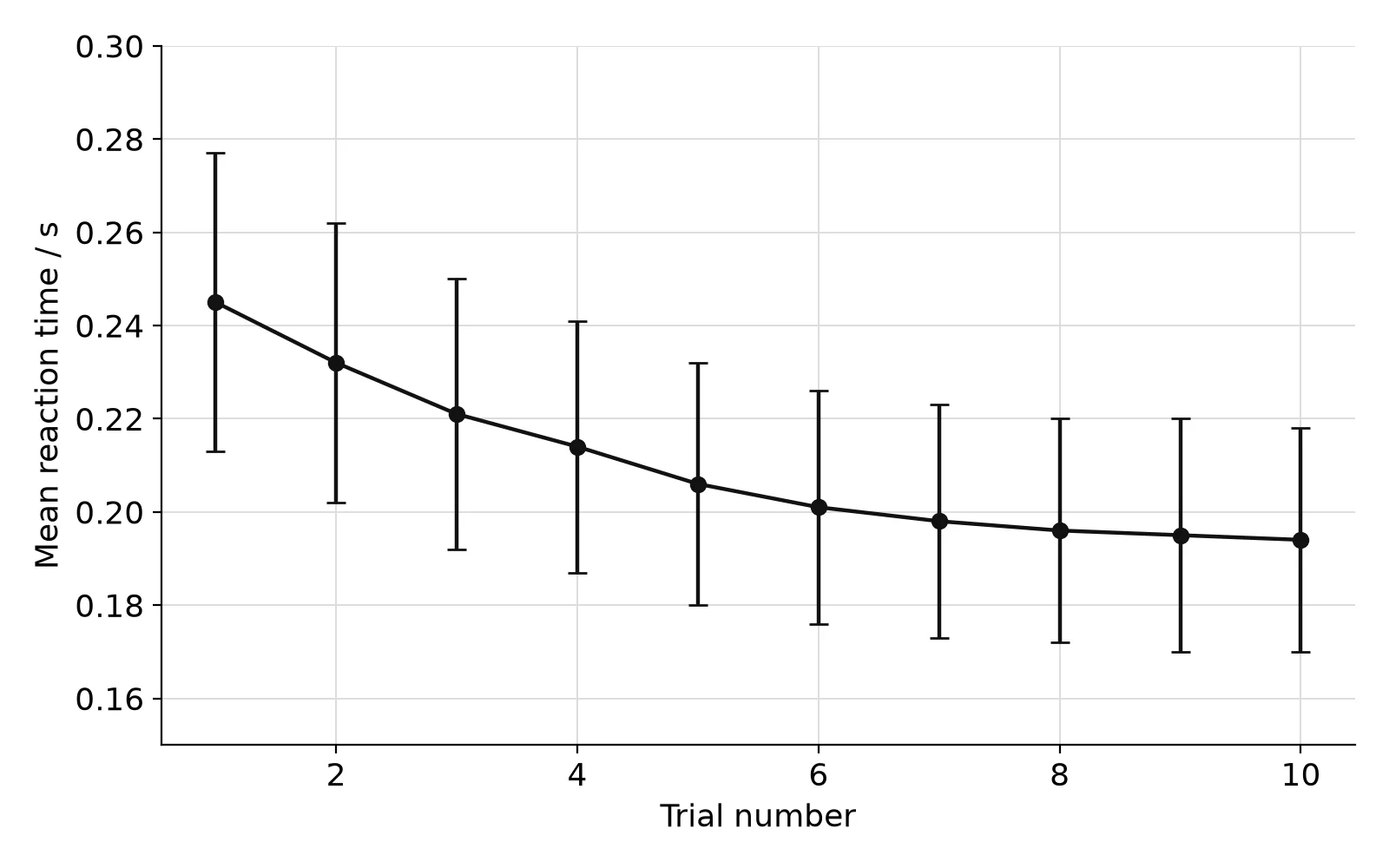
Twenty students each measured their reaction time ten times in a row using a ruler-drop test. A partner held a 50 cm ruler vertically between the student's open thumb and finger and dropped it without warning. The student caught the ruler as soon as they saw it move, and the distance it fell was converted to a reaction time. The graph shows the mean reaction time for each trial. Error bars show ± one standard deviation.
- (a)
State the dependent variable in this investigation.
1 mark
- (b)
Calculate the percentage decrease in mean reaction time between trial 1 and trial 10.
1 mark
- (c)
Describe the trend in the results.
2 marks
- (d)
Suggest a reason for the decrease in reaction time over the trials.
1 mark
- (e)
Using the error bars, discuss whether reaction time continued to improve between trial 6 and trial 10.
2 marks
- (f)
Outline the pathway of nerve impulses from detection of the moving ruler to the contraction of the muscles that close the fingers.
3 marks
The nervous system processes information through the interaction of many neurons.
- (a)
Outline why consciousness is regarded as an emergent property of the brain.
4 marks
- (b)
Explain how excitatory and inhibitory neurotransmitters together determine whether a postsynaptic neuron transmits an impulse.
7 marks
- (c)
Describe the pain reflex arc that withdraws the hand from a sharp object.
4 marks
Practice all 40 in Augment
Free with an account. Every question has its markscheme, and Augment keeps the ones you got wrong so you can come back to them.
More questions in Interaction and interdependence
- C1.1Enzymes and metabolism
- C1.2Cell respiration
- C1.3Photosynthesis
- C2.1Chemical signallingHL only
- C2.2Neural signalling
- C3.1Integration of body systemsThis page
- C3.2Defence against disease
- C4.1Populations and communities
- C4.2Transfers of energy and matter
Check your answers in Augment
A free account opens all 40 questions on Integration of body systems with their markschemes, and keeps a record of what you have marked.