C1.1 Enzymes and metabolism questions for IB Biology
43 questions on Enzymes and metabolism, written by Augment in the style of IB exam papers. Six of them are below in full, to answer on paper.
- IB Biology
- Part of C Interaction and interdependence
- SL and HL
Questions by paper and level
SL and HL questions are for students at either level. HL only questions cover what only HL students study.
| Paper | SL and HL | HL only | All |
|---|---|---|---|
| Paper 1A | 12 | 8 | 20 |
| Paper 1B | 4 | 2 | 6 |
| Paper 2 | 7 | 10 | 17 |
| Every paper | 23 | 20 | 43 |
Counted on
Questions to try
Written by Augment in the style of IB exams, not past papers. Answer them on paper, then check each one against its markscheme with a free account.
What is the main benefit to a cell of having enzymes that act as catalysts?
Students investigated the effect of temperature on the activity of catalase, an enzyme that breaks down hydrogen peroxide into water and oxygen. Tubes containing 2 cm3 of potato (Solanum tuberosum) extract and tubes containing 5 cm3 of hydrogen peroxide solution were placed in water baths for 5 minutes. The contents were then mixed and the oxygen released in 60 s was collected in a gas syringe. Each temperature was tested three times.
Temperature / °C | Trial 1 / cm3 | Trial 2 / cm3 | Trial 3 / cm3 | Mean volume of oxygen / cm3 |
|---|---|---|---|---|
10 | 4.2 | 4.6 | 4.0 | 4.3 |
20 | 7.8 | 8.4 | 8.1 | 8.1 |
30 | 13.5 | 12.9 | 13.8 | 13.4 |
40 | 16.2 | 17.0 | 16.5 | |
50 | 11.0 | 9.6 | 12.1 | 10.9 |
60 | 2.4 | 3.1 | 2.0 | 2.5 |
- (a)
Identify the independent variable and state one variable that was controlled in this investigation.
2 marks
- (b)(i)
Calculate the mean volume of oxygen released at 40 °C.
1 mark
- (b)(ii)
Calculate the mean rate of oxygen production at 40 °C in cm3 s-1.
1 mark
- (c)
Describe the effect of temperature on the volume of oxygen released.
2 marks
- (d)
Explain the difference in results between 40 °C and 60 °C.
2 marks
- (e)
Suggest how the method could be changed to find the optimum temperature of catalase more precisely.
1 mark
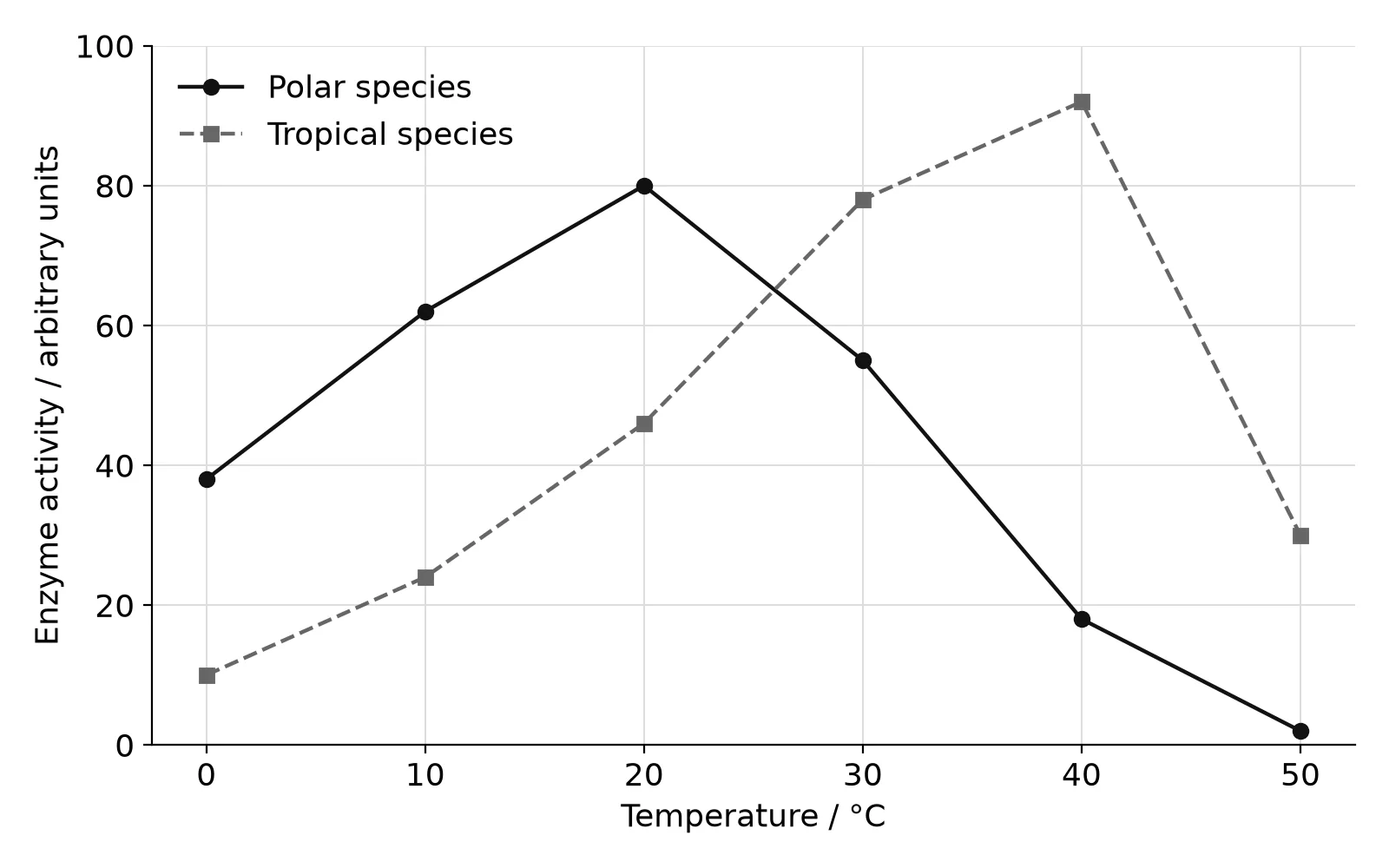
The same enzyme was extracted from the muscles of two related fish species: one lives in polar seas at about 0 °C and the other in tropical seas at about 27 °C. The activity of each enzyme was measured at temperatures from 0 °C to 50 °C, with substrate concentration and pH kept constant.
- (a)
State the temperature at which the enzyme from the polar species had its highest activity.
1 mark
- (b)
Compare and contrast the effect of temperature on the enzymes from the two species.
3 marks
- (c)
Explain why the activity of both enzymes increases between 0 °C and 20 °C.
2 marks
- (d)
Suggest why the enzyme from the polar species loses activity at a lower temperature than the enzyme from the tropical species.
2 marks
- (e)
Suggest an advantage to the polar species of having this form of the enzyme.
2 marks
Which of these reactions are anabolic?
I. Formation of glycogen from glucose in liver cells
II. Digestion of starch to maltose by amylase in the mouth
III. Synthesis of a polypeptide at a ribosome
The effect of pH on the activity of human salivary amylase was investigated at 30 °C. Each tube contained 5 cm3 of 1 % starch solution, 2 cm3 of a buffer solution and 1 cm3 of amylase solution. Every 10 s a drop of the mixture was added to iodine solution on a spotting tile. The time taken until the iodine no longer turned blue-black was recorded. Each pH was tested five times.
pH | Mean time for starch to disappear / s | Standard deviation / s |
|---|---|---|
4 | 312 | 41 |
5 | 148 | 22 |
6 | 64 | 9 |
7 | 58 | 12 |
8 | 95 | 14 |
9 | 210 | 33 |
- (a)
State the purpose of the buffer solutions.
1 mark
- (b)
The rate of reaction can be calculated as 1 ÷ mean time. Calculate the rate at pH 7, giving the units.
2 marks
- (c)
Using the standard deviations, discuss whether the data show that the optimum pH of salivary amylase is pH 7 rather than pH 6.
2 marks
- (d)
Explain why the starch took longest to disappear at pH 4.
2 marks
- (e)
Suggest one limitation of the method and an improvement that would address it.
2 marks
Hydrogen peroxide breaks down to water and oxygen, releasing energy. The reaction is very slow unless it is catalysed by an enzyme such as catalase.
- (a)
Draw a labelled graph to show the energy changes during this reaction with and without an enzyme.
3 marks
- (b)
Outline why energy is needed to start this reaction, even though energy is released overall.
2 marks
- (c)
Explain the benefit to cells of enzymes that reduce activation energy.
2 marks
Practice all 43 in Augment
Free with an account. Every question has its markscheme, and Augment keeps the ones you got wrong so you can come back to them.
More questions in Interaction and interdependence
- C1.1Enzymes and metabolismThis page
- C1.2Cell respiration
- C1.3Photosynthesis
- C2.1Chemical signallingHL only
- C2.2Neural signalling
- C3.1Integration of body systems
- C3.2Defence against disease
- C4.1Populations and communities
- C4.2Transfers of energy and matter
Check your answers in Augment
A free account opens all 43 questions on Enzymes and metabolism with their markschemes, and keeps a record of what you have marked.