C2.1 Chemical signalling questions for IB Biology
39 questions on Chemical signalling, written by Augment in the style of IB exam papers. Six of them are below in full, to answer on paper.
- IB Biology
- Part of C Interaction and interdependence
- HL only
Questions by paper and level
| Paper | Questions |
|---|---|
| Paper 1A | 21 |
| Paper 1B | 6 |
| Paper 2 | 12 |
| Every paper | 39 |
Counted on
Questions to try
Written by Augment in the style of IB exams, not past papers. Answer them on paper, then check each one against its markscheme with a free account.
Which feature of a receptor allows it to respond to only one type of signalling chemical?
The marine bacterium Vibrio fischeri produces light (bioluminescence). In experiment 1, three flasks of liquid medium were inoculated with V. fischeri and kept at 25 °C. Every 2 hours a sample was taken from each flask to measure the cell density and the light emitted (luminescence). The table shows the means of the three flasks.
Time / h | Mean cell density / 107 cells cm-3 | Mean luminescence / arbitrary units |
|---|---|---|
0 | 0.1 | 2 |
2 | 0.4 | 3 |
4 | 1.6 | 5 |
6 | 5.2 | 40 |
8 | 12.0 | 650 |
10 | 18.5 | 2400 |
12 | 20.1 | 2600 |
In experiment 2, a culture at low density (1.6 × 10⁷ cells cm-3) was divided between two flasks. Synthetic autoinducer dissolved in a solvent was added to one flask, and the same volume of solvent alone was added to the other. Luminescence was measured 30 minutes later. The bar chart shows the means of four repeats (error bars show ± 1 standard deviation).
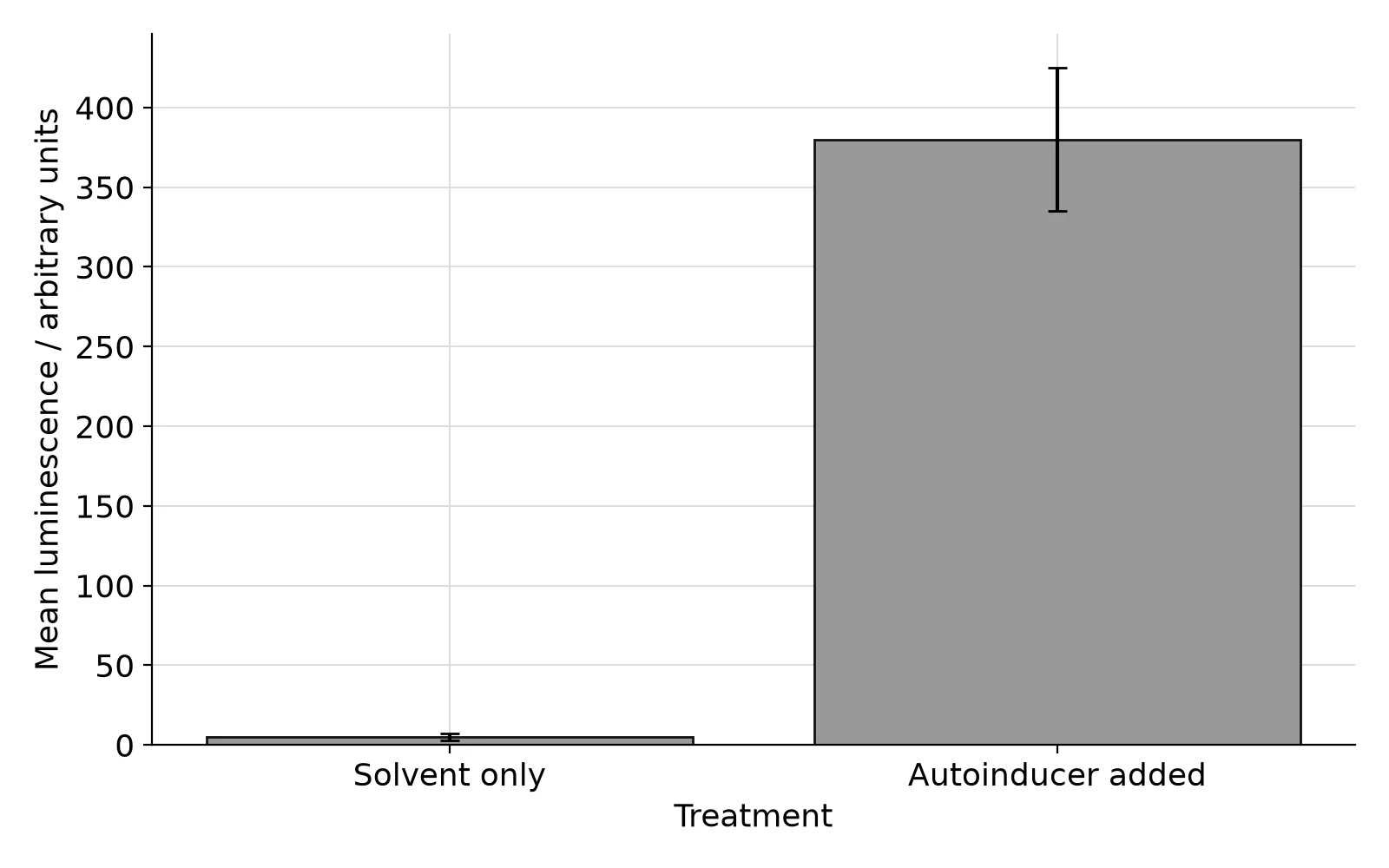
- (a)
Identify the independent variable in experiment 2.
1 mark
- (b)
Calculate the luminescence per 107 cells cm-3 at 4 h and at 10 h in experiment 1.
2 marks
- (c)
Describe the relationship between cell density and luminescence in experiment 1.
2 marks
- (d)
Explain why solvent alone was added to the second flask in experiment 2.
2 marks
- (e)
Explain the results of experiments 1 and 2 in terms of quorum sensing.
3 marks
Cells detect signalling chemicals using receptor proteins.
- (a)
State the term used for a signalling chemical that binds to a receptor.
1 mark
- (b)
Distinguish between transmembrane receptors and intracellular receptors.
3 marks
- (c)
Explain why only certain cells in the body respond to a particular hormone.
2 marks
The marine bacterium Vibrio fischeri emits light only when its population density is high. What explains this?
Muscle cells grown in culture were incubated for 20 minutes with insulin at five concentrations, either without or with a drug that inhibits the tyrosine kinase activity of the insulin receptor. The rate of uptake of glucose by the cells was then measured. Each treatment was carried out on five dishes of cells. The error bars show ± 1 standard deviation.
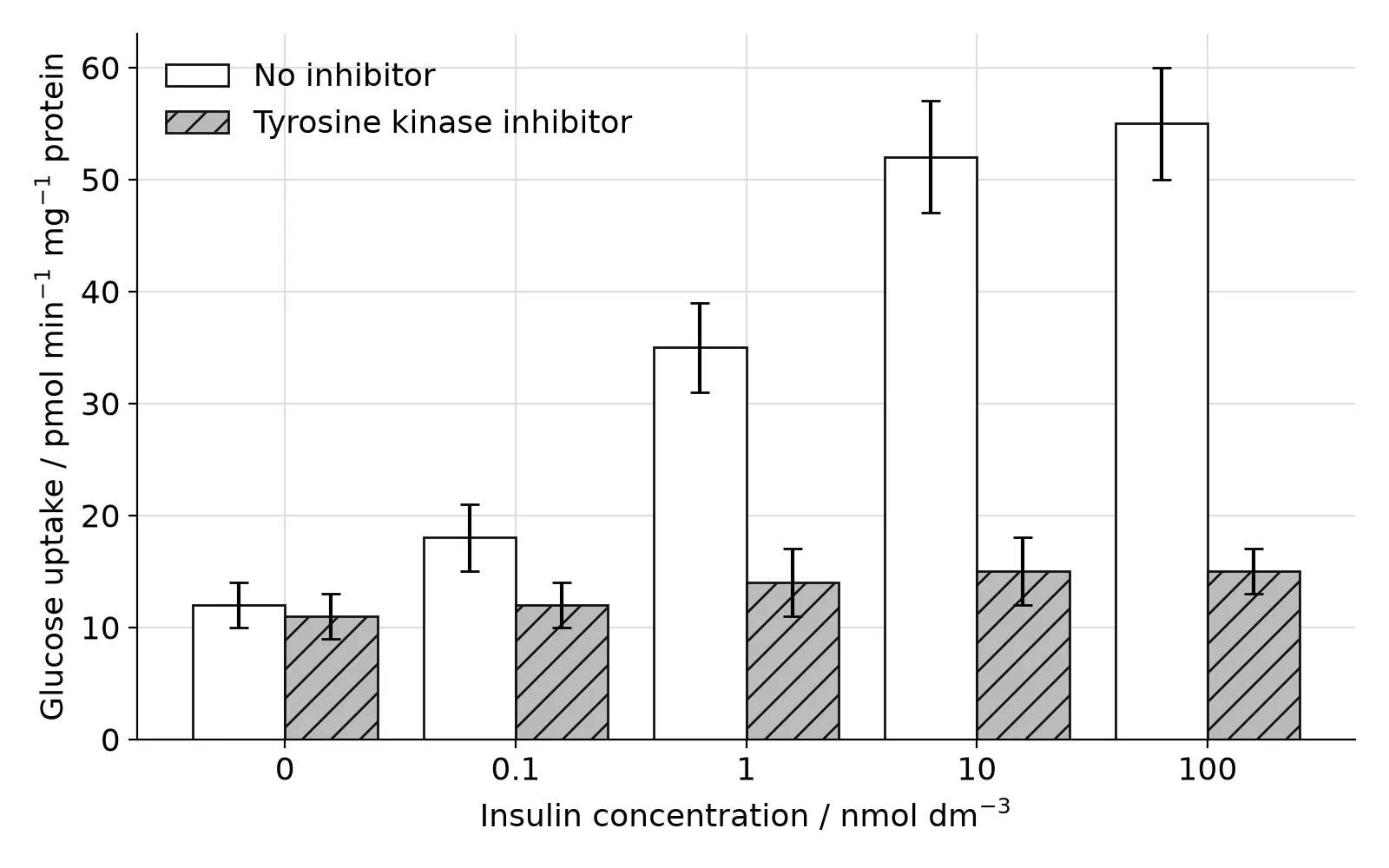
- (a)
State the dependent variable in this investigation.
1 mark
- (b)
Calculate the percentage increase in glucose uptake between 0 and 10 nmol dm-3 insulin without the inhibitor.
1 mark
- (c)
Discuss whether there is a significant difference in glucose uptake between 10 and 100 nmol dm-3 insulin without the inhibitor.
2 marks
- (d)
Suggest a reason for the uptake of glucose in the absence of insulin.
1 mark
- (e)
Explain the effect of the inhibitor on glucose uptake.
3 marks
- (f)
State one variable, other than those already given, that should have been kept constant.
1 mark
Animals use a wide range of chemical substances as signalling chemicals.
- (a)
Identify the chemical group to which each of these signalling chemicals belongs.
Signalling chemical
Chemical group
Epinephrine
Insulin
Oestradiol
Glycine (a neurotransmitter)
2 marks
- (b)
Contrast the ways in which hormones and neurotransmitters reach their target cells.
2 marks
- (c)
Suggest reasons for animals using many different chemical substances as signalling chemicals.
2 marks
- (d)
Outline the role of cytokines as signalling chemicals.
2 marks
Practice all 39 in Augment
Free with an account. Every question has its markscheme, and Augment keeps the ones you got wrong so you can come back to them.
More questions in Interaction and interdependence
- C1.1Enzymes and metabolism
- C1.2Cell respiration
- C1.3Photosynthesis
- C2.1Chemical signallingThis page
- C2.2Neural signalling
- C3.1Integration of body systems
- C3.2Defence against disease
- C4.1Populations and communities
- C4.2Transfers of energy and matter
Check your answers in Augment
A free account opens all 39 questions on Chemical signalling with their markschemes, and keeps a record of what you have marked.