E.5 Fusion and stars questions for IB Physics
74 questions on Fusion and stars, written by Augment in the style of IB exam papers. Six of them are below in full, to answer on paper.
- IB Physics
- Part of E Nuclear and quantum physics
- SL and HL
Questions by paper and level
SL and HL questions are for students at either level. HL only questions cover what only HL students study.
| Paper | SL and HL | HL only | All |
|---|---|---|---|
| Paper 1A | 34 | 0 | 34 |
| Paper 1B | 4 | 0 | 4 |
| Paper 2 | 28 | 8 | 36 |
| Every paper | 66 | 8 | 74 |
Counted on
Questions to try
Written by Augment in the style of IB exams, not past papers. Answer them on paper, then check each one against its markscheme with a free account.
A red giant star has a luminosity of and a surface temperature half that of the Sun. is the luminosity of the Sun and is the radius of the Sun.
What is the radius of the red giant?
A group of students model the measurement of stellar parallax in the laboratory. A small sighting device can be placed at either of two positions, A and B, on a straight rail. The distance AB is the baseline . A vertical pin stands at a perpendicular distance from the midpoint of AB. A mark on a building about 200 m away, seen through an open window, plays the part of the distant background stars.
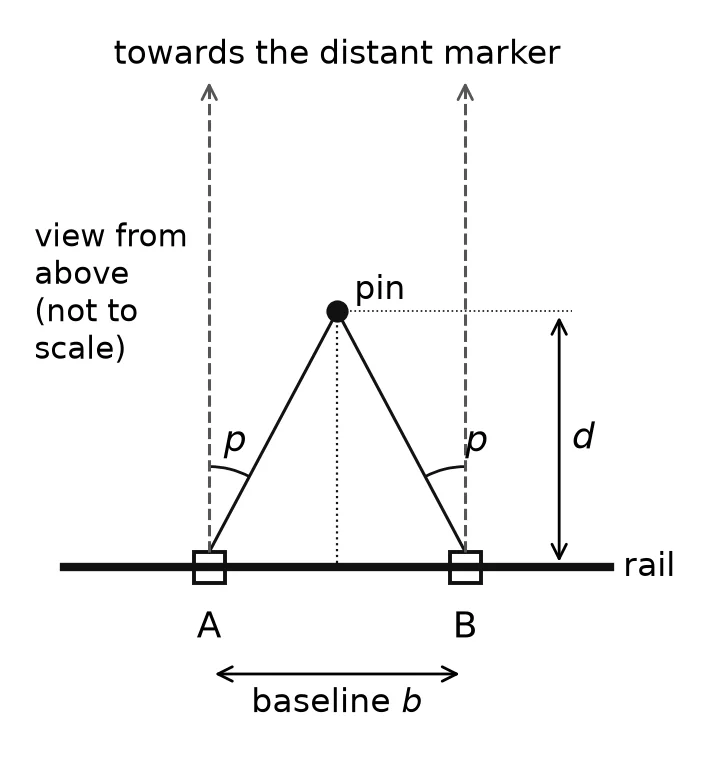
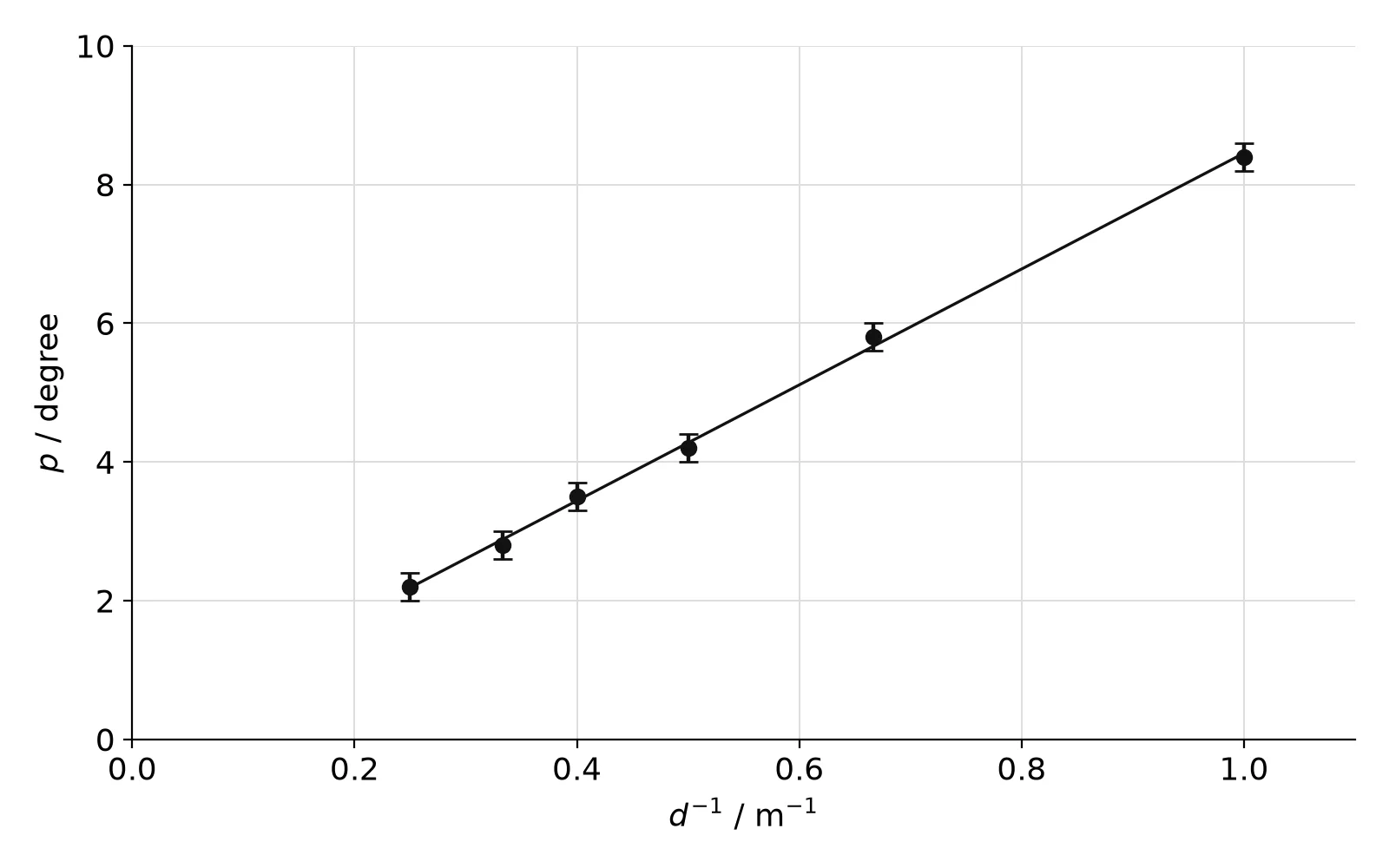
From each of A and B the students measure the angle between the direction of the pin and the direction of the distant marker. They repeat this for six values of . The angles are measured with an uncertainty of . The graph shows the variation of with , with the line of best fit. The uncertainty in is negligible.
- (a)
Outline why the marker must be very far away compared with the pin.
1 mark
- (b)
Calculate the largest percentage uncertainty in for these data.
2 marks
- (c)
Explain why the students plot against .
2 marks
- (d)
Determine .
3 marks
- (e)
Outline how the graph supports the hypothesis that is proportional to .
1 mark
- (f)
In astronomy the parallax angle of a star is measured using the orbit of the Earth as the baseline. A space telescope measures parallax angles with an uncertainty of arc-second. Determine, in pc, the greatest distance of a star whose parallax angle can be measured with a percentage uncertainty of no more than 10 %.
2 marks
A small uncrewed probe is to travel from Earth to a star 4.4 ly away in the reference frame of Earth. The probe is accelerated by a powerful laser beam to a cruising speed of and then travels at this constant speed. Ignore the motion of the star relative to Earth.
- (a)
The probe accelerates from rest to with a constant acceleration of . Calculate the time taken and the distance travelled during this acceleration. Use Newtonian mechanics.
2 marks
- (b)
Outline why it is reasonable to use Newtonian mechanics in (a).
1 mark
- (c)
The acceleration distance and time are negligible for the rest of the question. Calculate, in years, the time taken for the journey to the star in the reference frame of Earth.
1 mark
- (d)
Calculate the time for the journey measured by a clock on the probe.
2 marks
- (e)
Calculate the distance between Earth and the star in the reference frame of the probe.
1 mark
- (f)
On arrival, the probe sends a radio signal to Earth. Determine, in the reference frame of Earth, the time between the probe passing Earth at its cruising speed and the signal arriving at Earth.
2 marks
- (g)
Sketch a spacetime diagram in the reference frame of Earth, with and axes, showing the world lines of Earth, the probe and the radio signal. Label the coordinates of the arrival at the star and the reception of the signal.
3 marks
- (h)(i)
The probe's instruments are powered by a radioactive source of plutonium-238, which has a half-life of 88 years. Outline why the time measured on the probe, rather than the time measured on Earth, determines how much of the plutonium decays during the journey.
1 mark
- (h)(ii)
The power output of the source is 300 W at the start of the cruise. Calculate the power output when the probe reaches the star. Assume the power is proportional to the activity of the source.
2 marks
- (i)
The luminosity of the star is 1.5 times the luminosity of the Sun, which is W. Mission scientists want to study a planet that receives the same intensity of starlight, , as Earth receives from the Sun. Determine, in AU, the distance of this planet from the star.
3 marks
- (j)
The surface temperature of the star is 6100 K. Determine the radius of the star.
2 marks
Star X has twice the luminosity of star Y and is four times as far from the Earth.
What is ?
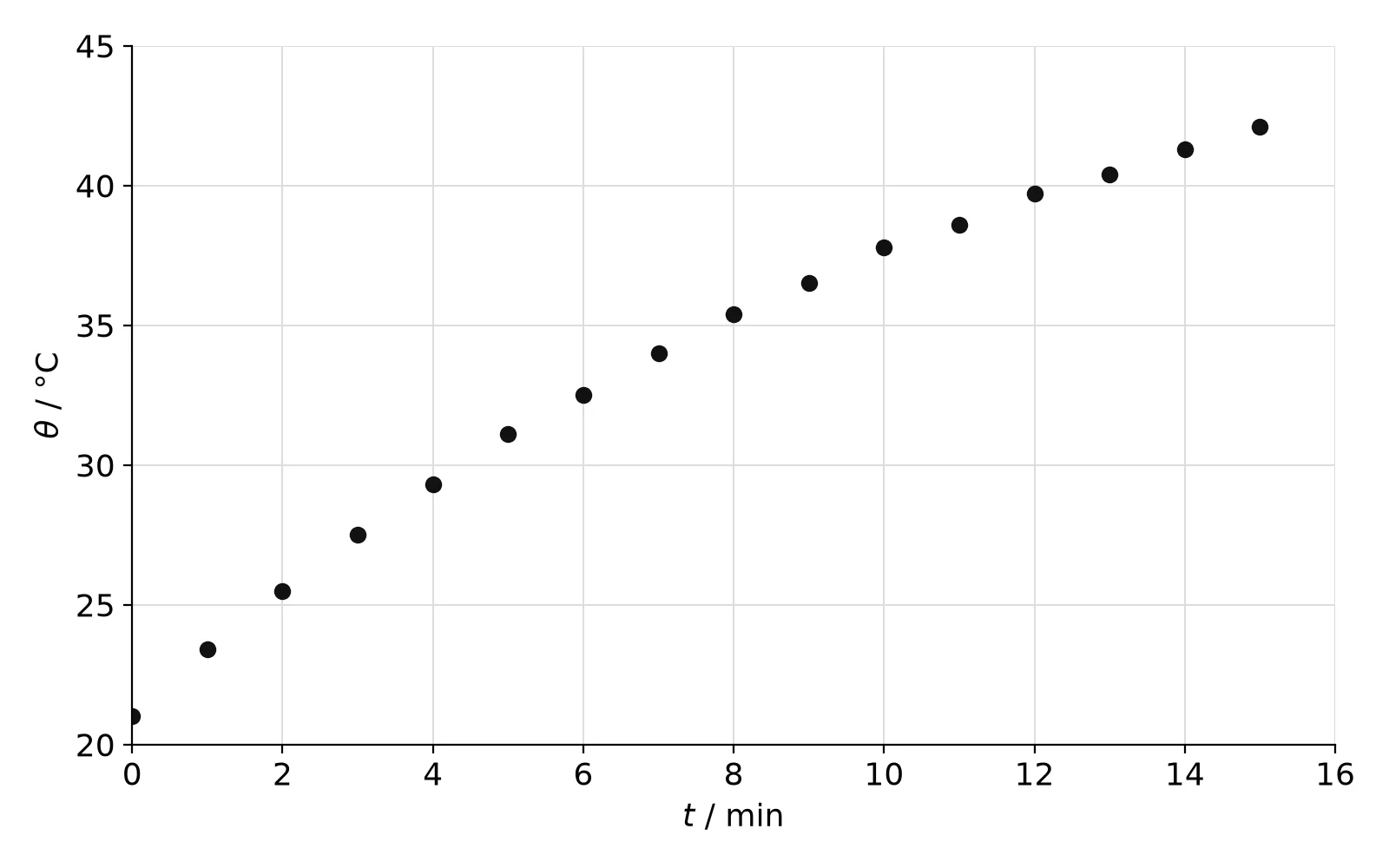
A group of students estimate the luminosity of the Sun. A flat aluminium disc of diameter 8.00 cm and mass 0.120 kg is painted matt black on its front face and mounted on an insulating stand. At midday on a clear day the front face is turned so that it faces the Sun directly. A digital thermometer, reading to 0.1 °C, is inserted into the disc and its temperature is recorded every minute.
Specific heat capacity of aluminium =
The graph shows the variation of with time .
- (a)
Explain why the students should use the gradient of the graph at rather than the mean rate of rise of temperature over the 15 minutes.
2 marks
- (b)
Determine, using the graph, the intensity of the sunlight absorbed by the front face of the disc.
3 marks
- (c)
The uncertainty in the initial gradient is estimated to be 8 %. The mass is measured to kg and the diameter to cm. Calculate the percentage uncertainty in the intensity.
2 marks
- (d)
The students assume that the intensity of sunlight above the atmosphere is equal to their value in (b). Calculate their value for the luminosity of the Sun.
2 marks
- (e)
The accepted value of the luminosity of the Sun is . Discuss the students' result, with reference to your answer to (c).
3 marks
At the end of its life, a massive star collapses. Its core, of mass , shrinks from a radius of to form a neutron star of radius . Before the collapse the core rotates once every hours. Assume that the core and the neutron star are both uniform spheres, for which , and that the core loses no mass and no angular momentum during the collapse.
- (a)
State the name of the event in which the core of a red supergiant collapses and the outer layers of the star are ejected.
1 mark
- (b)
Explain why the neutron star rotates much faster than the core did before the collapse.
2 marks
- (c)
Show that the period of rotation of the neutron star is about .
2 marks
- (d)(i)
Determine .
2 marks
- (d)(ii)
Identify the source of the increase in rotational kinetic energy.
1 mark
- (e)
Calculate the gravitational field strength at the surface of the neutron star.
2 marks
- (f)
If the neutron star rotated too quickly, material at its equator would be thrown off. Determine the shortest possible period of rotation for the neutron star, and comment on your answer to (c).
3 marks
- (g)
Observations of the neutron star show that its angular speed decreases by in one year (). Calculate the average torque acting on the neutron star.
2 marks
- (h)
Determine the average rate at which the neutron star loses rotational kinetic energy.
2 marks
- (i)
The surface temperature of the neutron star is . Calculate the luminosity of the neutron star due to its thermal radiation. Assume it radiates as a black body.
2 marks
- (j)
Identify, with a calculation, the region of the electromagnetic spectrum in which the thermal radiation from the neutron star is most intense.
1 mark
Practice all 74 in Augment
Free with an account. Every question has its markscheme, and Augment keeps the ones you got wrong so you can come back to them.
More questions in Nuclear and quantum physics
- E.1Structure of the atom
- E.2Quantum physicsHL only
- E.3Radioactive decay
- E.4Fission
- E.5Fusion and starsThis page
Check your answers in Augment
A free account opens all 74 questions on Fusion and stars with their markschemes, and keeps a record of what you have marked.