E.4 Fission questions for IB Physics
54 questions on Fission, written by Augment in the style of IB exam papers. Six of them are below in full, to answer on paper.
- IB Physics
- Part of E Nuclear and quantum physics
- SL and HL
Questions by paper and level
SL and HL questions are for students at either level. HL only questions cover what only HL students study.
| Paper | SL and HL | HL only | All |
|---|---|---|---|
| Paper 1A | 25 | 0 | 25 |
| Paper 1B | 3 | 0 | 3 |
| Paper 2 | 20 | 6 | 26 |
| Every paper | 48 | 6 | 54 |
Counted on
Questions to try
Written by Augment in the style of IB exams, not past papers. Answer them on paper, then check each one against its markscheme with a free account.
About two billion years ago, groundwater seeped into rich deposits of uranium ore at Oklo in Gabon, and natural fission chain reactions ran in the ore for long periods. The reactions stopped whenever the water boiled away.
What was the role of the water in sustaining the chain reaction?
Spent fuel from a nuclear reactor is stored under several metres of water. A group of students model this using a sealed cobalt-60 source, which emits gamma radiation, placed under a plastic tank. A GM tube is clamped above the tank. The students vary the depth of water in the tank and record the count in 100 s for each depth.
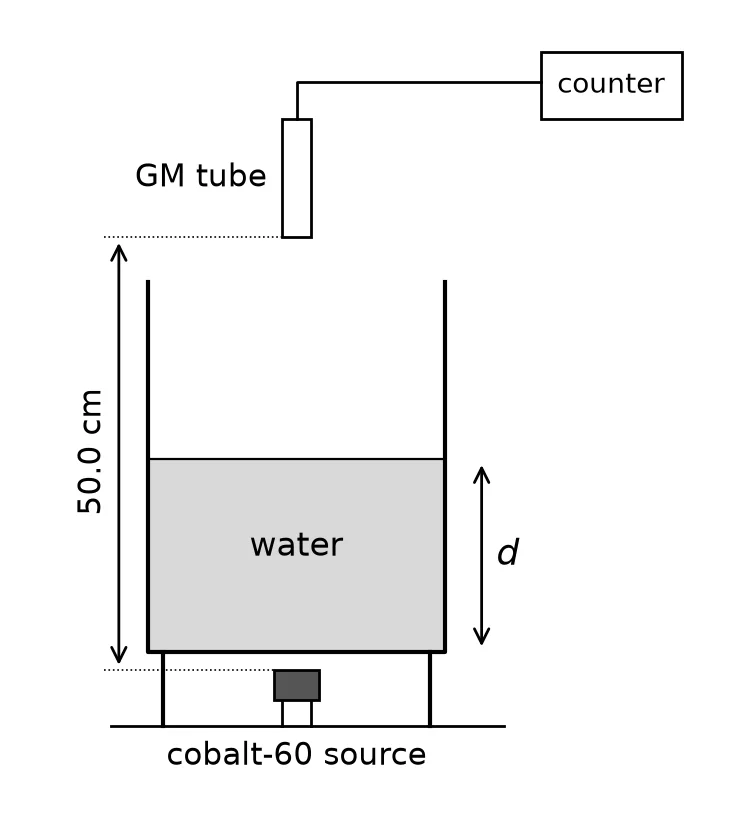
With the source removed, the students record a background count of 412 in 1000 s.
- (a)
The students repeat the count three times at each depth. Outline why repeating the counts is necessary in this experiment.
1 mark
- (b)
Identify one variable, other than the source, that the students must keep constant, and explain why.
2 marks
- (c)(i)
The three counts in 100 s for cm are 405, 437 and 421.
Calculate the mean count rate for this depth and its absolute uncertainty.
2 marks
- (c)(ii)
Hence determine the corrected count rate for cm.
1 mark
- (d)
The graph shows the variation of the corrected count rate with , together with the curve of best fit.
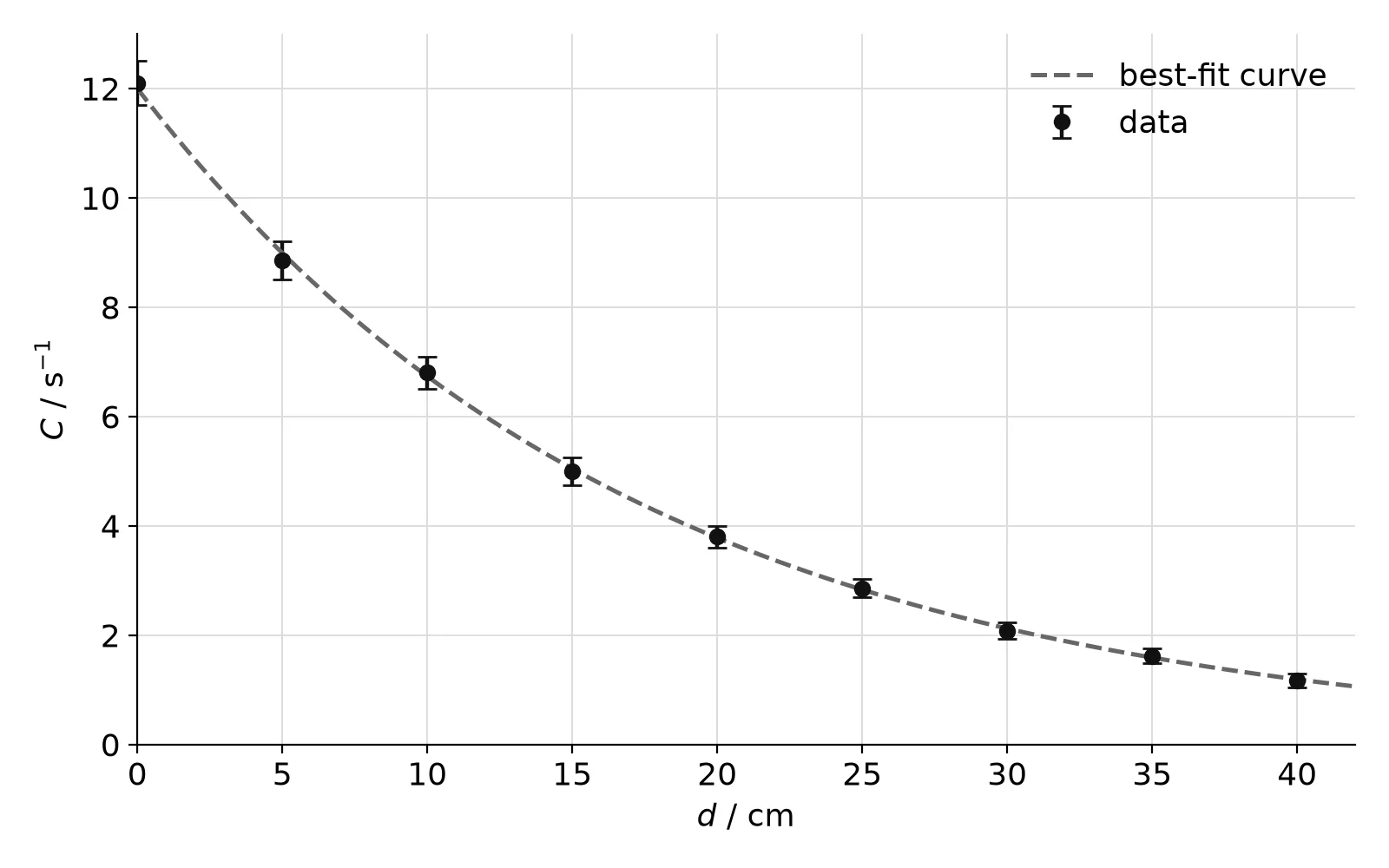
Show, using the graph, that halves for each equal increase in the depth of water.
2 marks
- (e)
In a storage pond, the water above the spent fuel must reduce the intensity of the gamma radiation reaching the surface by a factor of at least 2000. Estimate the minimum depth of water needed. Assume the radiation is absorbed by the water in the same way as in this experiment.
2 marks
- (f)
Outline one other reason why spent fuel is stored under water.
1 mark
A gas-fired power station has an electrical power output of 800 MW and an overall efficiency of 0.55. The fuel may be treated as pure methane.
The following data are available:
energy released per kilogram of methane burned: J kg-1
mass of carbon dioxide produced per kilogram of methane burned: 2.75 kg
molar mass of methane: 16 g mol-1
- (a)
Calculate the rate at which energy is supplied by the fuel.
1 mark
- (b)
Show that the mass of methane burned each second is about 26 kg.
2 marks
- (c)
Calculate the mass of carbon dioxide released by the power station in one year.
2 marks
- (d)
Sketch a Sankey diagram for the power station. Label each arrow with its power.
2 marks
- (e)
60 % of the wasted energy is transferred to river water used for cooling. The temperature of the cooling water rises by 8.0 K. The specific heat capacity of water is 4200 J kg-1 K-1.
Calculate the mass of cooling water that flows through the power station each second.
2 marks
- (f)
The power station keeps a reserve of methane in a storage tank of volume at a pressure of Pa and a temperature of 15 °C. Assume that methane behaves as an ideal gas.
Determine the time for which this reserve can keep the power station running at full output.
3 marks
- (g)
Explain how the carbon dioxide released by the power station can lead to an increase in the mean surface temperature of the Earth.
3 marks
- (h)
A nuclear power station with the same electrical output has an overall efficiency of 0.33. Each fission of a uranium-235 nucleus releases J. Determine the mass of uranium-235 that undergoes fission each day.
3 marks
- (i)
Discuss, with reference to the climate, one advantage and one disadvantage of generating electricity with the nuclear power station rather than the gas-fired power station.
2 marks
Late at night the demand for electricity falls, and the operators of a nuclear power station reduce the power output of the reactor.
What do they do to the control rods, and why does this reduce the power?
Control rods are | Reason | |
|---|---|---|
A. | withdrawn further | they slow down fewer neutrons |
B. | withdrawn further | they absorb fewer neutrons |
C. | inserted further | they absorb more neutrons |
D. | inserted further | they slow down more neutrons |
A group of students model the way the coolant removes energy from a reactor core. Water flows at a steady rate through a glass tube that contains an electric heating coil. Two digital thermometers, each reading to 0.1 °C, measure the temperature of the water entering the tube and the temperature of the water leaving it.
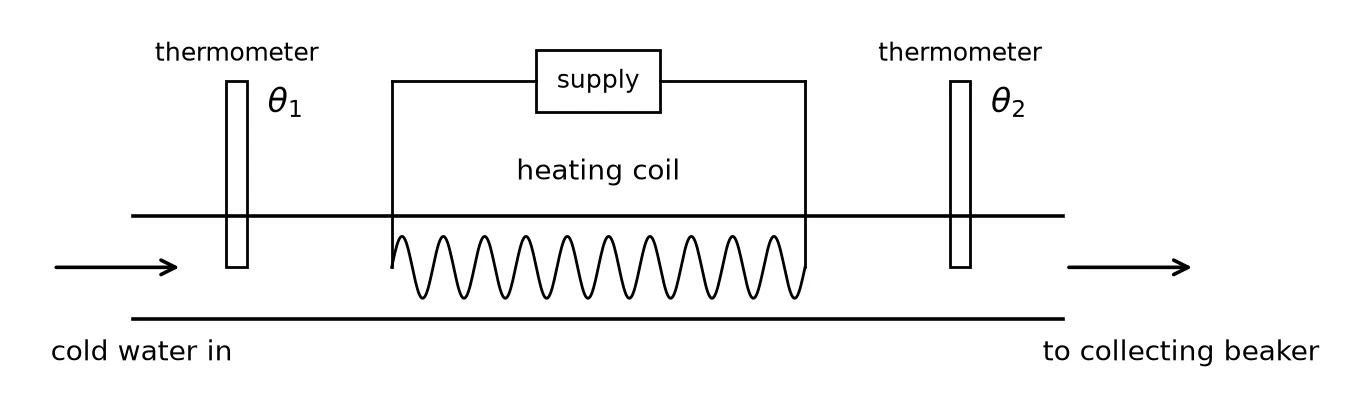
The pd across the heating coil is 12.0 V and the current in it is 4.00 A. For each flow rate, the students wait until the temperatures are steady. They collect the water leaving the tube for s and measure its mass on a balance reading to 1 g. The mass flow rate is . The temperature rise is .
/ g ± 1 g | / s kg | / K |
|---|---|---|
60 | 2000 | 22.1 |
80 | 1500 | 16.5 |
105 | 1143 | 12.9 |
135 | 889 | 9.9 |
170 | 706 | 8.1 |
215 | 558 | 6.2 |
270 | 444 | 5.1 |
330 | 364 | 4.1 |
- (a)
State the absolute uncertainty in .
1 mark
- (b)
Calculate the percentage uncertainty in for the smallest flow rate.
2 marks
- (c)
The students assume that all the electrical power supplied to the coil is transferred to the water, so that , where is the specific heat capacity of water.
The graph shows the variation of with , with error bars and the line of best fit.
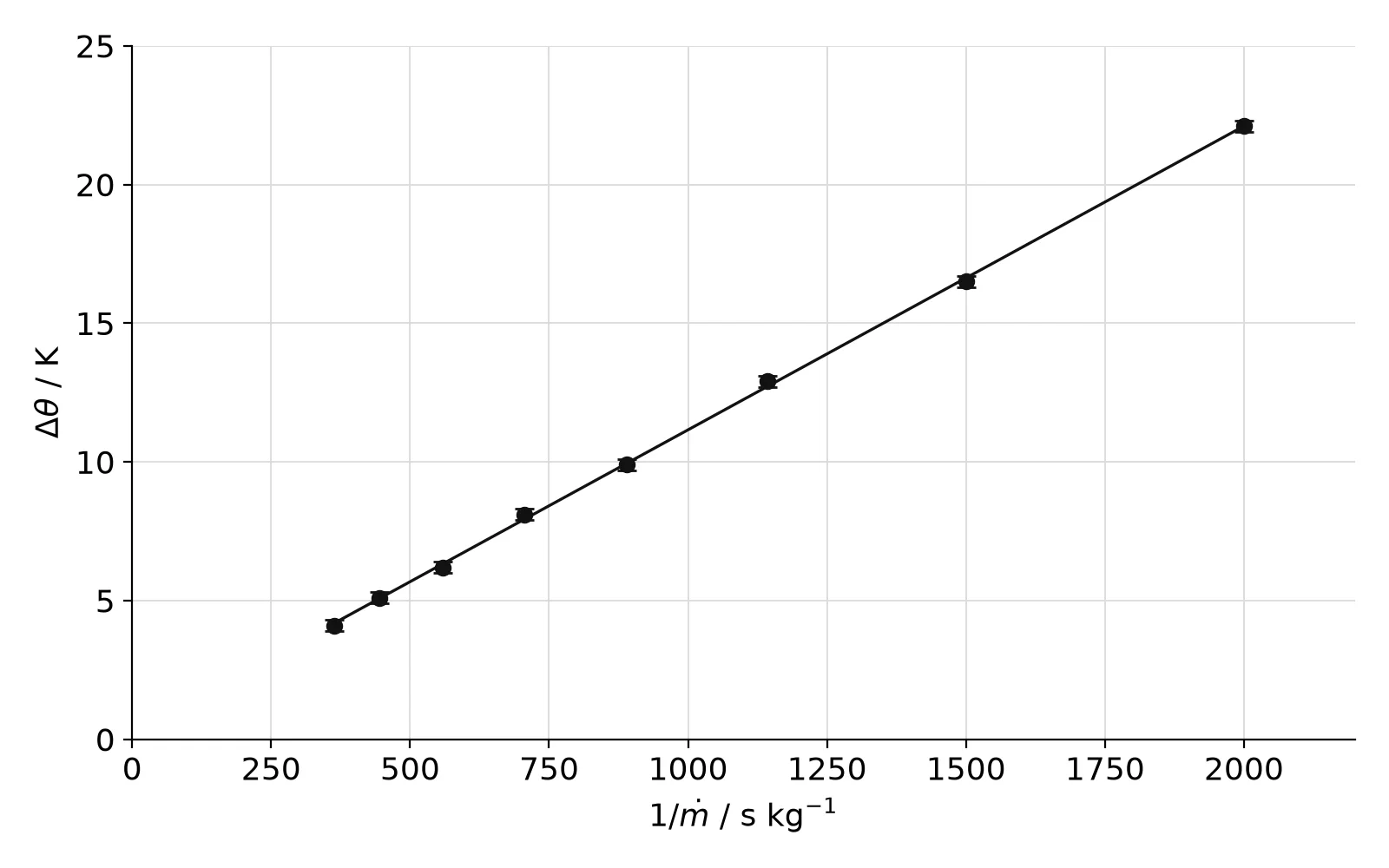
Determine, using the graph, the power transferred to the water.
3 marks
- (d)
Comment on your answer to (c) by comparing it with the electrical power supplied to the coil.
2 marks
- (e)
Suggest one change to the apparatus that would make the value from the graph closer to the electrical power.
1 mark
- (f)
In a pressurized water reactor, the primary coolant flows through the core at and its temperature rises by 30 K. The specific heat capacity of the coolant at its operating temperature and pressure is . Estimate the thermal power of the reactor.
2 marks
- (g)
The primary coolant passes through a heat exchanger, where it transfers energy to water in a separate circuit that drives the turbines. Outline why the primary coolant is not sent directly to the turbines.
1 mark
A pressurized-water nuclear power station has a thermal power output from its reactor core of 3.0 GW and an electrical power output of 1.0 GW. Each fission of a uranium-235 nucleus releases 200 MeV.
- (a)
Calculate the number of fissions that occur each second in the core.
2 marks
- (b)
Calculate the mass of uranium-235 used in one day. The mass of a uranium-235 atom is 235 u.
2 marks
- (c)
State the role of the moderator in the reactor.
1 mark
- (d)
Water in the primary circuit removes the energy from the core. It enters the core at 290 °C and leaves at 325 °C. At the high pressure in the circuit, the specific heat capacity of the water is . Calculate the mass of water flowing through the core each second.
2 marks
- (e)
In the steam generator, the energy passes through the walls of thin metal tubes with a total area of and a wall thickness of 1.2 mm. The thermal conductivity of the metal is . Estimate the mean temperature difference across the tube walls.
2 marks
- (f)
The energy not converted to electrical energy is removed by a cooling tower. 75 % of this energy is removed by the evaporation of water. The specific latent heat of vaporization of water at the temperature of the tower is . Calculate the mass of water evaporated each second.
3 marks
- (g)
Outline how a cooling tower draws cool air in at its base without the use of fans.
2 marks
- (h)(i)
The electrical power is transmitted at a potential difference of 400 kV. Calculate the current in the transmission cables.
1 mark
- (h)(ii)
The total resistance of the cables is 2.0 Ω. Calculate the fraction of the transmitted power that is dissipated in the cables.
2 marks
- (i)
Spent fuel rods removed from the reactor are stored under water for several years. Explain why.
3 marks
Practice all 54 in Augment
Free with an account. Every question has its markscheme, and Augment keeps the ones you got wrong so you can come back to them.
More questions in Nuclear and quantum physics
- E.1Structure of the atom
- E.2Quantum physicsHL only
- E.3Radioactive decay
- E.4FissionThis page
- E.5Fusion and stars
Check your answers in Augment
A free account opens all 54 questions on Fission with their markschemes, and keeps a record of what you have marked.