E.2 Quantum physics questions for IB Physics
65 questions on Quantum physics, written by Augment in the style of IB exam papers. Six of them are below in full, to answer on paper.
- IB Physics
- Part of E Nuclear and quantum physics
- HL only
Questions by paper and level
| Paper | Questions |
|---|---|
| Paper 1A | 31 |
| Paper 2 | 34 |
| Every paper | 65 |
Counted on
Questions to try
Written by Augment in the style of IB exams, not past papers. Answer them on paper, then check each one against its markscheme with a free account.
Monochromatic light is shone on a metal surface and photoelectrons are emitted. The intensity of the light is doubled while its frequency is kept constant. What happens to the maximum kinetic energy of the photoelectrons and to the photoelectric current?
A light-beam alarm uses a photocell. Light of wavelength 450 nm falls on the metal cathode of the photocell, which has a work function of 2.1 eV. The power of the light reaching the cathode is 2.0 mW. On average, 8.0 % of the incident photons each release one electron that reaches the anode.
- (a)
Show that the energy of one photon is about 2.8 eV.
2 marks
- (b)
Calculate the number of photons incident on the cathode each second.
2 marks
- (c)
Calculate the current in the photocell.
2 marks
- (d)
The photocell is connected in series with a 47 kΩ resistor and a battery. Calculate the potential difference across the resistor.
1 mark
- (e)
Determine the stopping potential for the electrons emitted from the cathode.
2 marks
- (f)
The intensity of the light is halved, but its wavelength is unchanged. State and explain the effect on the potential difference across the resistor and on the stopping potential.
3 marks
A clean zinc plate is attached to a negatively charged electroscope. When the plate is illuminated by a weak ultraviolet lamp, the electroscope discharges at once. When it is illuminated by a very bright red lamp instead, the electroscope does not discharge, however long the lamp is left on. What explains the result with the red lamp?
Louis de Broglie suggested that the electron in a hydrogen atom behaves as a wave and that an allowed orbit of radius is one whose circumference is a whole number of de Broglie wavelengths , so that .
- (a)
Show that this condition leads to Bohr's condition for an electron of mass moving with speed .
2 marks
- (b)
The radius of the orbit is m. Calculate the de Broglie wavelength of the electron in this orbit.
1 mark
- (c)
Hence determine the speed of the electron in the orbit.
2 marks
- (d)
Outline one reason why the Bohr model is not a complete description of atoms.
1 mark
Ultraviolet radiation with a photon energy of 6.2 eV is incident on a clean tungsten surface. The work function of tungsten is 4.5 eV. What is the stopping voltage for the photoelectrons?
A beam of high-energy neutrons is directed at a thin sample containing oxygen-16 nuclei. The de Broglie wavelength of the neutrons is m. A detector measures the intensity of the neutrons scattered at different angles to the direction of the beam.
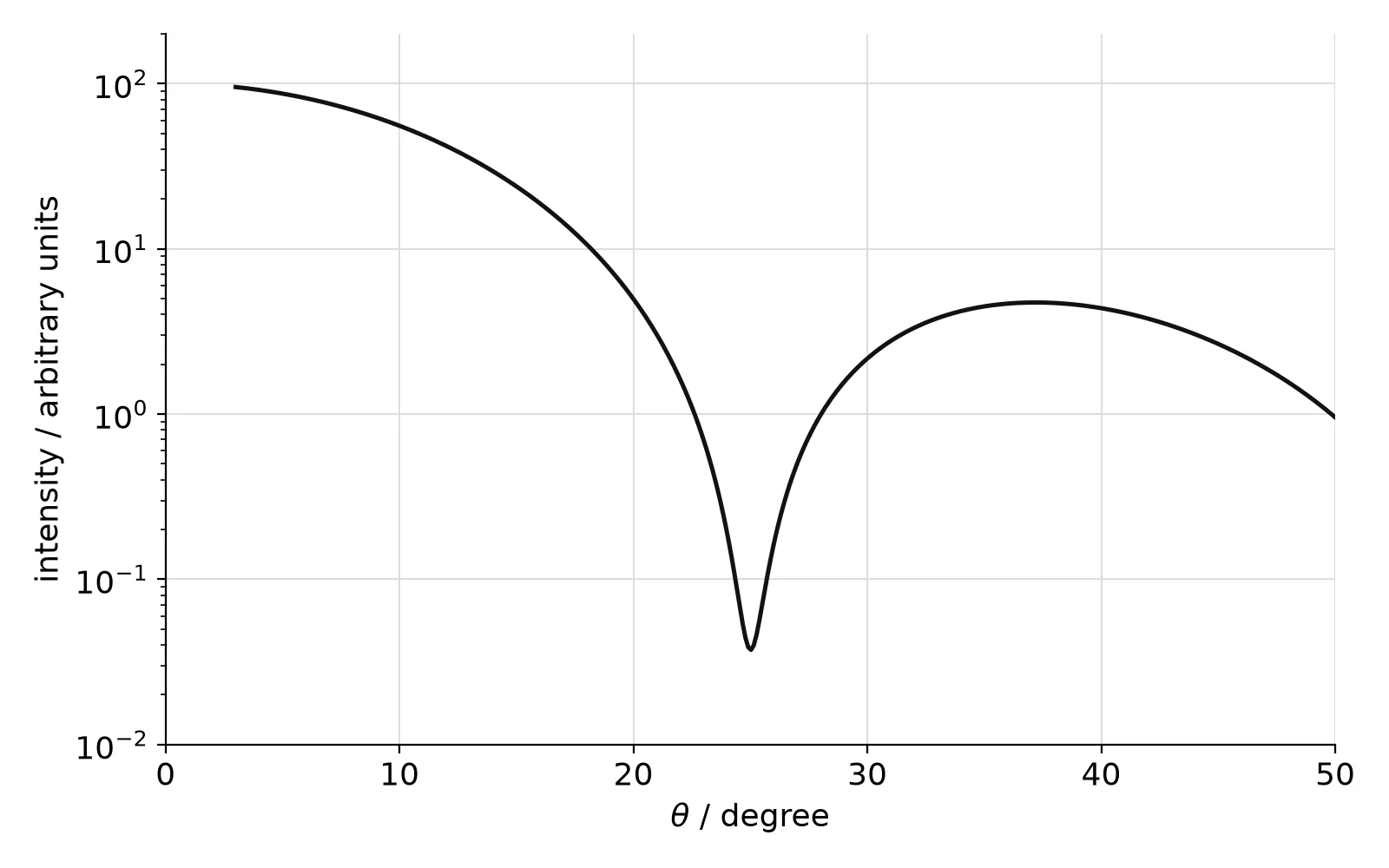
The graph shows the variation of the intensity of the scattered neutrons with .
- (a)
Calculate the momentum of a neutron in the beam.
1 mark
- (b)
The first minimum of intensity occurs at an angle given by , where is the diameter of the nucleus. Estimate, using the graph, the radius of an oxygen-16 nucleus.
2 marks
- (c)
Hence determine a value for in .
2 marks
- (d)
The oxygen sample is replaced by a thin lead-208 foil and the same neutron beam is used. Predict the angle of the first minimum.
2 marks
- (e)
Outline why this experiment shows that neutrons have wave properties.
2 marks
- (f)
Suggest why neutrons with a de Broglie wavelength of about m could not be used to measure the size of a nucleus.
1 mark
- (g)
Suggest one advantage of using neutrons rather than protons of the same de Broglie wavelength.
1 mark
Practice all 65 in Augment
Free with an account. Every question has its markscheme, and Augment keeps the ones you got wrong so you can come back to them.
More questions in Nuclear and quantum physics
- E.1Structure of the atom
- E.2Quantum physicsThis page
- E.3Radioactive decay
- E.4Fission
- E.5Fusion and stars
Check your answers in Augment
A free account opens all 65 questions on Quantum physics with their markschemes, and keeps a record of what you have marked.