E.1 Structure of the atom questions for IB Physics
80 questions on Structure of the atom, written by Augment in the style of IB exam papers. Six of them are below in full, to answer on paper.
- IB Physics
- Part of E Nuclear and quantum physics
- SL and HL
Questions by paper and level
SL and HL questions are for students at either level. HL only questions cover what only HL students study.
| Paper | SL and HL | HL only | All |
|---|---|---|---|
| Paper 1A | 18 | 13 | 31 |
| Paper 1B | 3 | 1 | 4 |
| Paper 2 | 25 | 20 | 45 |
| Every paper | 46 | 34 | 80 |
Counted on
Questions to try
Written by Augment in the style of IB exams, not past papers. Answer them on paper, then check each one against its markscheme with a free account.
In the Geiger–Marsden–Rutherford experiment, a beam of alpha particles was directed at a thin gold foil. Most of the alpha particles passed through the foil with little or no deflection. This observation shows that
A group of students investigate the visible light emitted by a hydrogen discharge tube. They use a calibrated spectrometer to measure the wavelength of each of the four visible lines in the spectrum.
- (a)
The students measure the wavelength of the red line three times.
Reading
1
2
3
/ nm
656
659
656
Calculate the mean wavelength of the red line and its absolute uncertainty.
2 marks
- (b)
The uncertainty in each wavelength is nm. The students calculate the energy of the photons in each line. A model of the hydrogen atom predicts that
where is a constant and is an integer that takes the values 3, 4, 5 and 6 for the four lines. The table shows the results.
/ nm ± 2 nm
/ eV
3
657
1.89
0.139
4
485
0.188
5
435
2.85
0.210
6
409
3.03
0.222
Calculate , in eV, for the line of wavelength 485 nm, and its absolute uncertainty.
2 marks
- (c)
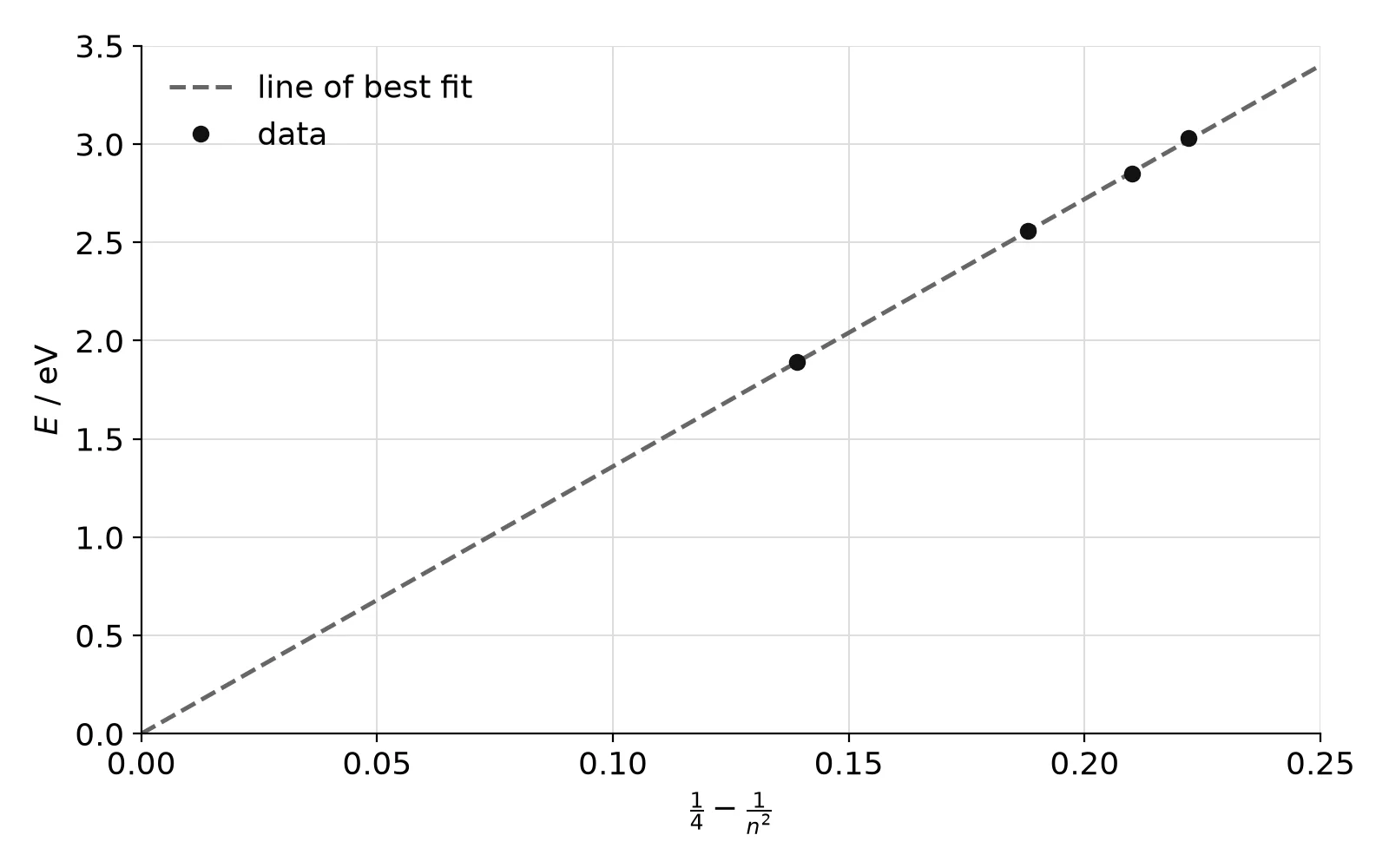
The graph shows the variation of with , with the line of best fit. The uncertainties in are too small to be shown.
Outline whether the data support the model.
2 marks
- (d)
Determine , in eV, using the graph.
2 marks
- (e)
Explain, with reference to energy levels, why the light from the tube consists of a small number of separate wavelengths.
2 marks
- (f)
The model predicts a fifth line for . Calculate the wavelength of this line and suggest why the students could not see it.
2 marks
Human activity adds several greenhouse gases to the atmosphere.
- (a)
Identify the main greenhouse gas released by each of the following activities:
the digestion of food by cattle
the use of nitrogen-based fertilisers on farmland.
2 marks
- (b)
State one natural source of carbon dioxide in the atmosphere.
1 mark
- (c)
Explain, with reference to photon energies and molecular energy levels, why carbon dioxide absorbs much of the radiation emitted by the Earth's surface but very little of the visible radiation from the Sun.
3 marks
In the Geiger–Marsden–Rutherford experiment, a very small fraction of the alpha particles fired at a gold foil were deflected through angles greater than 90°. What did Rutherford deduce from this observation?
A student uses a hand-held spectroscope to identify the gas in an unlabelled discharge lamp. Looking through the spectroscope, the student sees each spectral line against a scale and records its scale reading . The scale is read to the nearest 0.1 division.
To calibrate the scale, the student first views a helium lamp and records for five helium lines of known wavelength .
/ nm | 447 | 492 | 502 | 588 | 668 |
|---|---|---|---|---|---|
/ div ± 0.1 div | 5.9 | 7.6 | 8.1 | 11.6 | 14.7 |
- (a)
The unlabelled lamp shows only one bright line, P. The student repeats the reading of P five times.
Reading
1
2
3
4
5
/ div
11.6
11.4
11.7
11.5
11.8
Calculate the mean value of for line P and its absolute uncertainty.
2 marks
- (b)
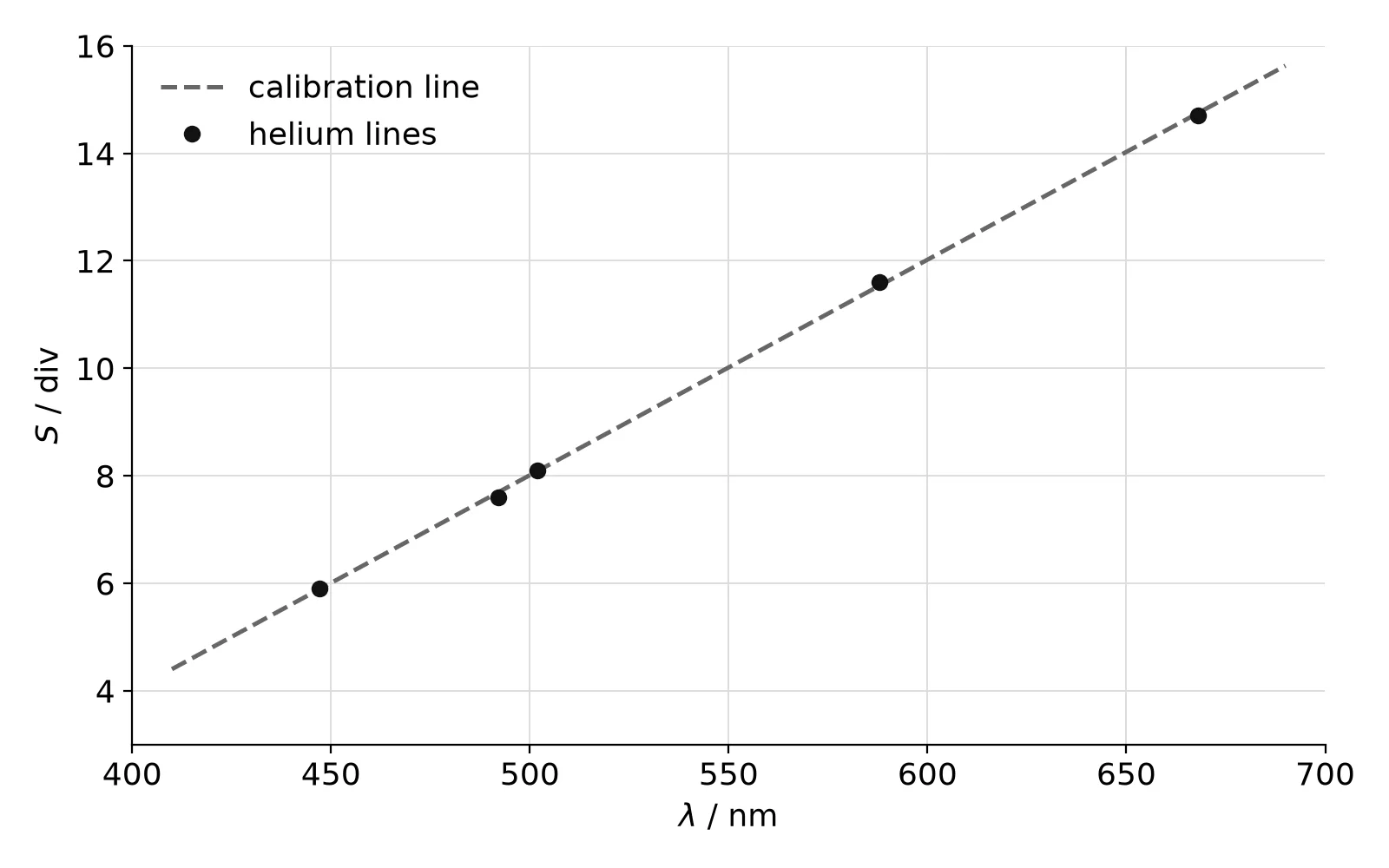
The graph shows the variation of with for the helium lines, with the line of best fit.
Determine the gradient of the line. Include an appropriate unit.
2 marks
- (c)
Determine, using the graph, the wavelength of line P and its absolute uncertainty.
2 marks
- (d)
The student consults a table of emission lines.
Element
Brightest visible lines / nm
helium
447, 492, 502, 588, 668
sodium
589
lithium
610, 671
The student concludes that the lamp contains helium. Discuss this conclusion.
2 marks
- (e)
Calculate, in eV, the energy difference between the two atomic energy levels involved in producing line P.
2 marks
- (f)
Between the calibration and the measurement of line P, the scale inside the spectroscope slipped sideways by a small amount. Outline the effect of this on the wavelength the student determined for P.
1 mark
Carbon dioxide molecules absorb infrared radiation strongly at two wavelengths, 15 μm and 4.3 μm. Each absorption corresponds to a transition between vibrational energy levels of the molecule.
- (a)
Calculate, in eV, the energy of a photon of wavelength 15 μm.
2 marks
- (b)
Show that the difference between the energy levels for the absorption at 4.3 μm is about 0.3 eV.
1 mark
- (c)
In a resonance model of this vibration, an oxygen atom of mass 16 u oscillates on a spring of stiffness attached to a fixed carbon atom. The natural frequency of this oscillator equals the frequency of radiation of wavelength 4.3 μm.
Determine .
3 marks
- (d)
Infrared radiation of a range of frequencies is incident on the molecule. Sketch a graph to show how the amplitude of the oscillation of the molecule varies with the frequency of the incident radiation. Label the natural frequency on the frequency axis.
2 marks
- (e)
Water vapour is the most abundant greenhouse gas. Suggest why the water vapour released by human activities has little direct effect on the greenhouse effect, while warming caused by carbon dioxide increases the amount of water vapour in the atmosphere.
2 marks
Practice all 80 in Augment
Free with an account. Every question has its markscheme, and Augment keeps the ones you got wrong so you can come back to them.
More questions in Nuclear and quantum physics
- E.1Structure of the atomThis page
- E.2Quantum physicsHL only
- E.3Radioactive decay
- E.4Fission
- E.5Fusion and stars
Check your answers in Augment
A free account opens all 80 questions on Structure of the atom with their markschemes, and keeps a record of what you have marked.