E.3 Radioactive decay questions for IB Physics
122 questions on Radioactive decay, written by Augment in the style of IB exam papers. Six of them are below in full, to answer on paper.
- IB Physics
- Part of E Nuclear and quantum physics
- SL and HL
Questions by paper and level
SL and HL questions are for students at either level. HL only questions cover what only HL students study.
| Paper | SL and HL | HL only | All |
|---|---|---|---|
| Paper 1A | 36 | 15 | 51 |
| Paper 1B | 5 | 2 | 7 |
| Paper 2 | 39 | 25 | 64 |
| Every paper | 80 | 42 | 122 |
Counted on
Questions to try
Written by Augment in the style of IB exams, not past papers. Answer them on paper, then check each one against its markscheme with a free account.
A stationary nucleus undergoes beta-minus decay. The electron is emitted with a momentum of 2.4 × 10⁻²² kg m s-1 and the antineutrino is emitted at right angles to the electron with a momentum of 1.0 × 10⁻²² kg m s-1. What is the magnitude of the momentum of the recoiling nucleus?
A group of students measure the half-life of protactinium-234m. A sealed plastic bottle contains two liquids that do not mix. Shaking the bottle extracts protactinium-234m into the upper liquid. A Geiger–Müller (GM) tube connected to a counter is clamped close to the upper layer.
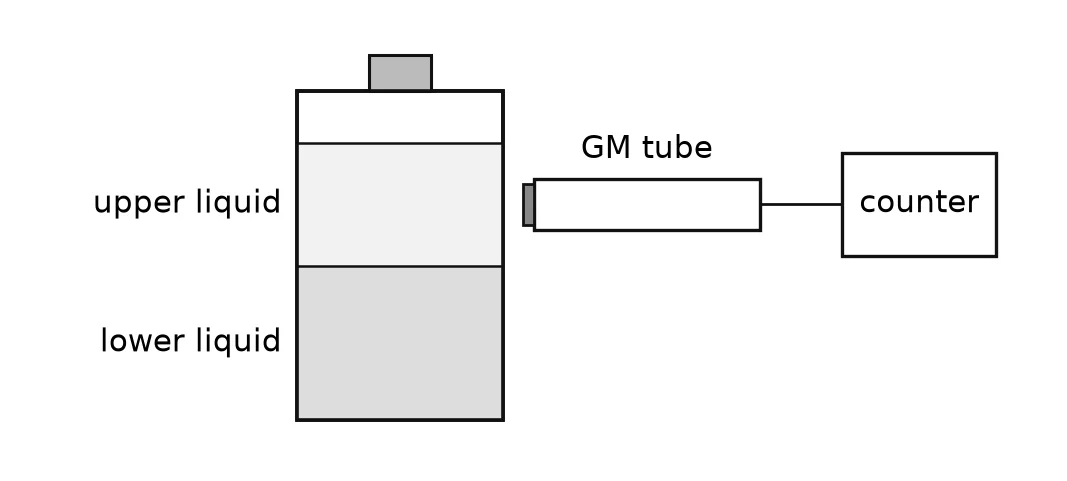
Before the experiment the students record the background count three times, each time for 100 s. The counts are 41, 47 and 44.
After shaking the bottle, they record the number of counts in 10 s intervals. The table shows the count in the 10 s interval starting at time .
/ s | 0 | 20 | 40 | 60 | 80 | 100 | 120 | 140 | 160 | 180 | 200 | 220 | 240 |
|---|---|---|---|---|---|---|---|---|---|---|---|---|---|
Count in 10 s | 126 | 101 | 86 | 69 | 60 | 48 | 42 | 33 | 30 | 24 | 22 | 17 | 16 |
- (a)(i)
Calculate the mean background count in 10 s.
1 mark
- (a)(ii)
Outline why the three background counts are not the same.
1 mark
- (b)
Calculate the count in 10 s due to the protactinium-234m alone at s.
1 mark
- (c)
The graph shows the variation of the corrected count in 10 s with . A smooth curve of best fit is drawn.
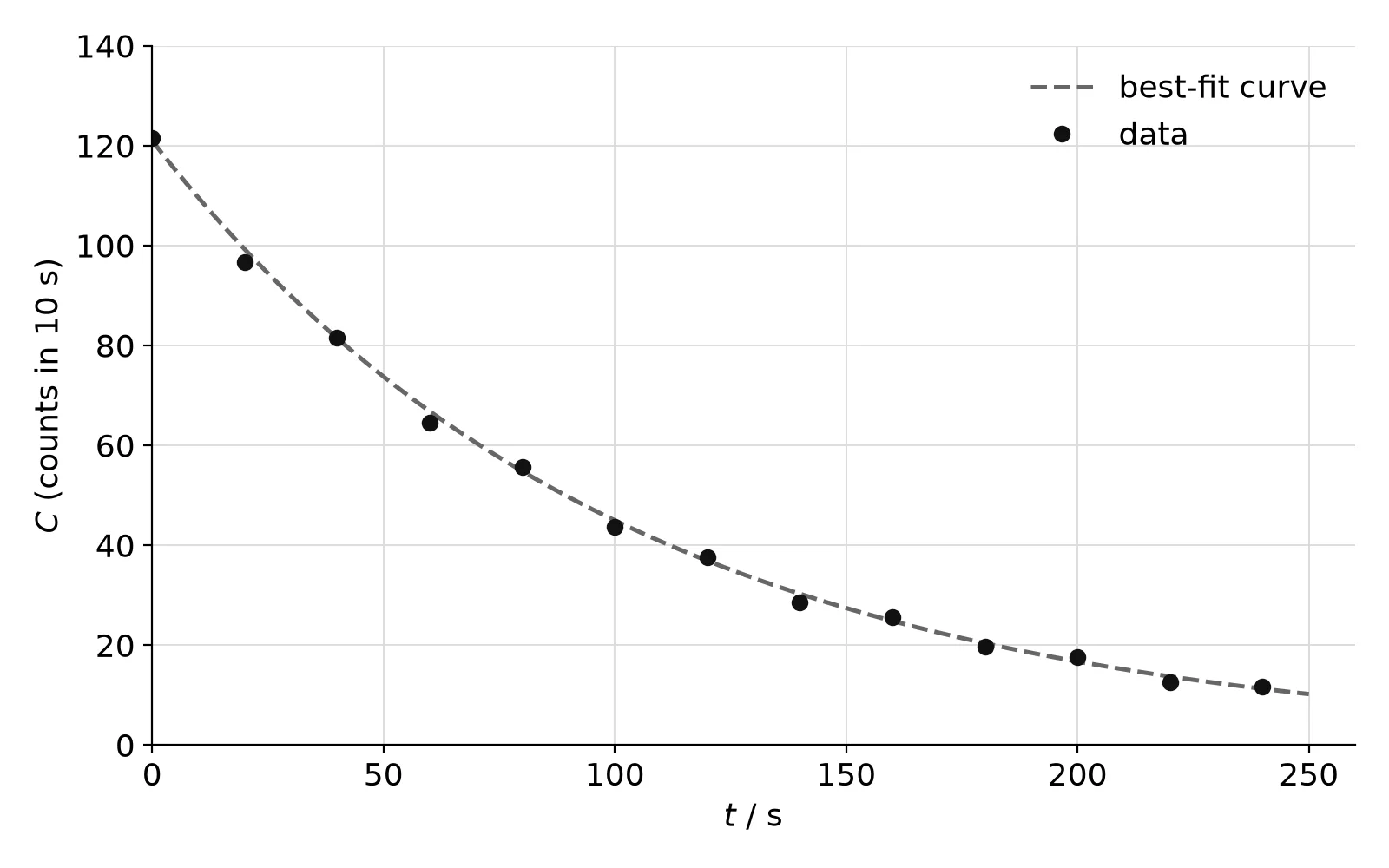
Determine, using the graph, the half-life of protactinium-234m. Use more than one halving of the count in your answer.
3 marks
- (d)
The scatter of the points about the curve, as a fraction of , is larger at later times. Explain why.
2 marks
- (e)
Suggest one change to the method, using the same apparatus, that would reduce this scatter.
1 mark
- (f)
Predict the corrected count in 10 s at s.
1 mark
Unstable particles called kaons have a half-life of 8.6 ns when measured at rest. In a laboratory, a beam of kaons travels at a speed of along a straight evacuated tube.
- (a)
Calculate the Lorentz factor for the kaons.
1 mark
- (b)
Calculate the half-life of the kaons in the reference frame of the laboratory.
1 mark
- (c)
The beam passes detector X and then detector Y, which is 18 m further along the tube in the laboratory frame. Calculate the fraction of the kaons passing X that reach Y.
2 marks
- (d)
State and explain which observer measures the proper half-life of the kaons.
2 marks
Cosmic-ray muons are produced 8.8 km above the ground, measured in the Earth frame, and move vertically downwards at . The Lorentz factor for this speed is 5.0. The half-life of muons in their rest frame is 1.5 μs. According to observers on the ground, how many half-lives pass while the muons travel to the ground?
A student investigates how the count rate from a beta source falls when sheets of aluminium are placed between the source and a GM tube. The distance between the source and the GM tube is fixed.
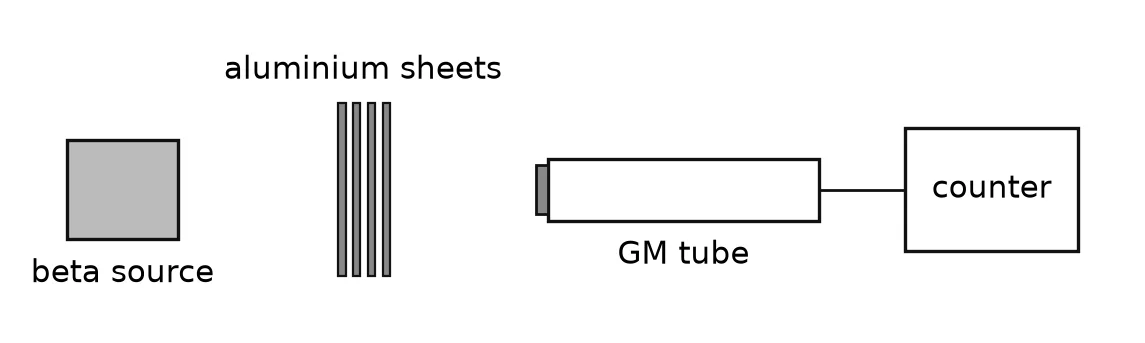
All the sheets are identical. The student measures the thickness of a stack of five sheets with a micrometer screw gauge and obtains mm.
The background count rate is 25 counts per minute. The table shows the measured count rate for different total thicknesses of aluminium.
/ mm | 0 | 0.25 | 0.50 | 0.75 | 1.00 | 1.25 | 1.50 | 2.00 | 2.50 |
|---|---|---|---|---|---|---|---|---|---|
/ counts per minute | 618 | 452 | 318 | 236 | 167 | 128 | 94 | 61 | 43 |
- (a)(i)
State the thickness of one sheet and its absolute uncertainty.
1 mark
- (a)(ii)
Outline the advantage of measuring the thickness of five sheets rather than one.
1 mark
- (b)
Calculate the count rate due to the source alone for mm.
1 mark
- (c)
The graph shows the variation of the corrected count rate with , with a curve of best fit.
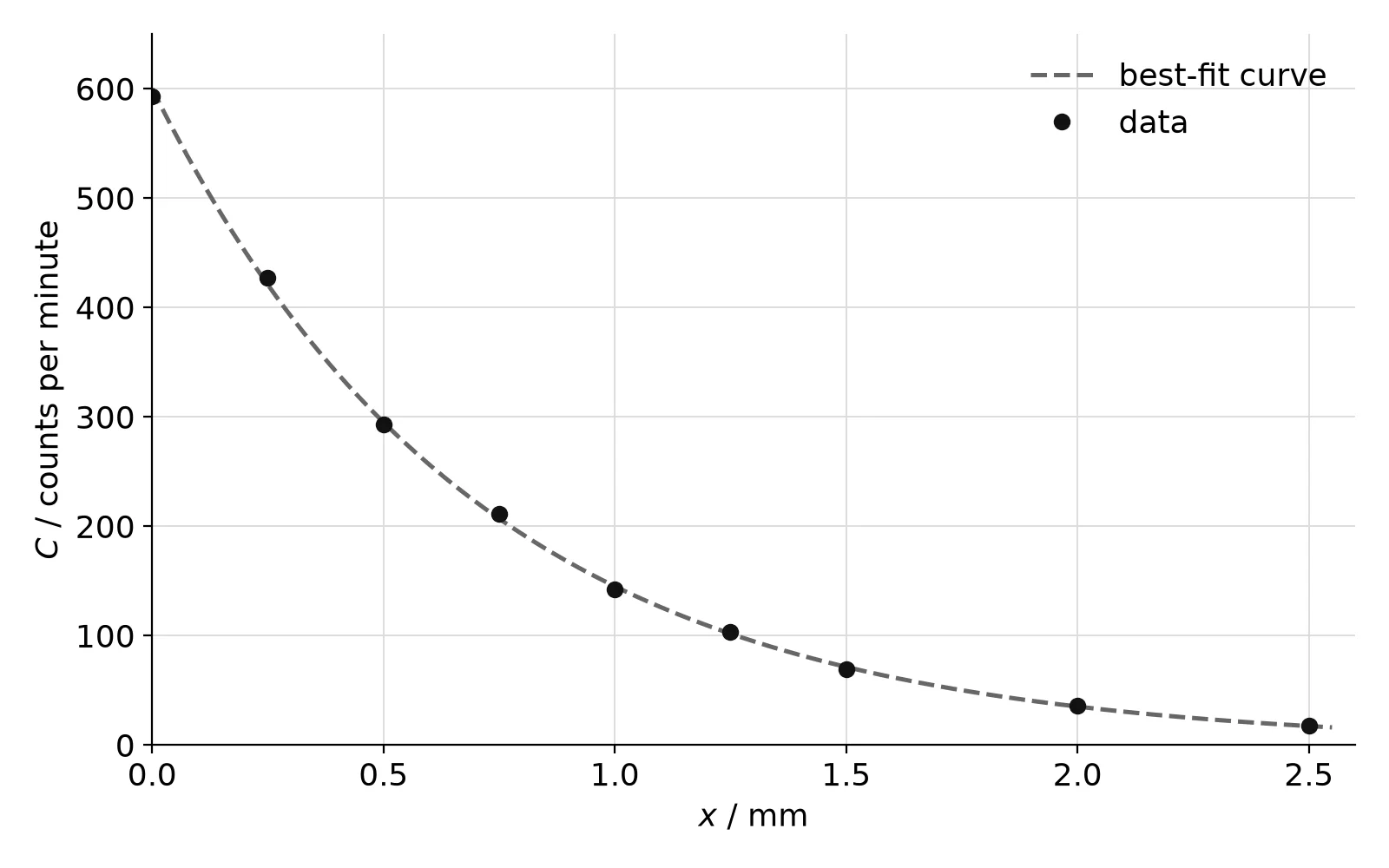
The half-value thickness is the thickness of aluminium that halves the corrected count rate. Determine, using the graph, the half-value thickness.
2 marks
- (d)
State two variables, other than the distance between the source and the GM tube, that the student should keep constant.
2 marks
- (e)
The student's hypothesis is that each additional half-value thickness of aluminium halves the corrected count rate. Discuss, using the graph, whether the data support this hypothesis.
2 marks
- (f)
A similar arrangement is used to monitor the thickness of aluminium foil in a factory. Explain why a beta source is used rather than an alpha or a gamma source.
2 marks
Muons are produced in the upper atmosphere and travel vertically downwards. Their half-life at rest is . A detector at a mountain station 2.40 km above sea level selects muons moving at relative to Earth and records 600 of them per hour. An identical detector at sea level counts muons of the same speed. Assume the muons do not slow down.
- (a)
Calculate, in the reference frame of Earth, the time a muon takes to travel from the mountain station to sea level.
1 mark
- (b)
Calculate the number of muons per hour expected at sea level if time dilation is ignored.
2 marks
- (c)
Calculate the number of muons per hour expected at sea level when time dilation is taken into account.
2 marks
- (d)
Outline how an observer moving with the muons accounts for the number detected at sea level.
2 marks
Practice all 122 in Augment
Free with an account. Every question has its markscheme, and Augment keeps the ones you got wrong so you can come back to them.
More questions in Nuclear and quantum physics
- E.1Structure of the atom
- E.2Quantum physicsHL only
- E.3Radioactive decayThis page
- E.4Fission
- E.5Fusion and stars
Check your answers in Augment
A free account opens all 122 questions on Radioactive decay with their markschemes, and keeps a record of what you have marked.