How splitting heavy nuclei releases energy, how a chain reaction is controlled in a nuclear power station, and how fission products and nuclear waste are managed.
Each is in the Physics glossary, with every other term in the subject.
A sequence of fissions in which neutrons released by one fission cause further fissions; it is self-sustaining when, on average, one neutron from each fission causes another.
A rod of a strongly neutron-absorbing material, such as boron or cadmium, moved into or out of a reactor core to control the rate of fission.
A fluid pumped through a reactor core to carry away the energy released by fission.
The smallest mass of fissile material, in a given shape and arrangement, in which a chain reaction is self-sustaining.
The energy released by the radioactive decay of fission products, which continues after a reactor's chain reaction has stopped.
A store for long-lived radioactive waste, hundreds of metres underground in stable rock, with several barriers between the waste and groundwater.
Uranium in which the fraction of uranium-235 has been raised above the natural 0.7%, to about 3–5% for most power reactors.
Describes a nuclide, such as uranium-235 or plutonium-239, that can undergo fission after absorbing a slow (thermal) neutron.
Nuclear fission is the process that powers every nuclear power station in operation today. A single fission of a uranium nucleus releases about 200 MeV, tens of millions of times more energy than a chemical reaction between two molecules. In 2024 nuclear fission supplied about 9% of the world’s electricity from about 420 reactors, with almost no carbon dioxide emitted while they run.
Understanding fission joins several ideas from across physics: mass–energy equivalence and binding energy, the momentum and energy of colliding particles, radioactive decay, and the efficiency of a thermal power station.
54 exam-style questions on this subtopic, written in the style of the IB papers. The first has its markscheme open. Counted on
A gas-fired power station has an electrical power output of 800 MW and an overall efficiency of 0.55. The fuel may be treated as pure methane.
The following data are available:
energy released per kilogram of methane burned: J kg-1
mass of carbon dioxide produced per kilogram of methane burned: 2.75 kg
molar mass of methane: 16 g mol-1
Calculate the rate at which energy is supplied by the fuel.
1 mark
«
One of 50 short multiple-choice questions on E.4. Pick an answer to see why it's right or wrong.
A reactor is running at constant power. On average, how many neutrons from each fission go on to cause another fission?
The official deck for this part of the syllabus.
In terms of binding energy per nucleon, explain why the fission of a heavy nucleus releases energy.
State the approximate binding energy per nucleon of uranium-235 and of its middle-sized fission fragments.
The entries of the physics data booklet that E.4 uses. Each opens in the explained booklet.
With a free account, Augment remembers where you stopped and what you have practiced.
A nucleus formed when a heavy nucleus splits; fission products are neutron-rich and so are usually radioactive β⁻ emitters.
A sealed metal tube filled with pellets of nuclear fuel (usually uranium dioxide), which keeps the fission products inside.
A device that transfers energy from the hot primary coolant to water in a separate loop, turning it into steam, without the two fluids mixing.
A material of light nuclei, such as water or graphite, that slows fast neutrons to thermal speeds by elastic collisions so that they are more likely to cause fission.
Fission that happens after a heavy nucleus, such as uranium-235, absorbs a neutron and becomes highly unstable.
The ratio of the numbers of neutrons and protons in a nucleus; stable nuclei have values from about 1 (light) to about 1.5 (heavy).
A device in which a controlled, self-sustaining fission chain reaction releases energy at a steady rate.
The commonest type of power reactor, in which water under high pressure acts as both moderator and coolant and transfers energy to a separate steam loop.
Unwanted radioactive material, such as spent fuel, that must be isolated from people and the environment until its activity has fallen to safe levels.
The chemical separation of spent fuel into reusable uranium and plutonium and the remaining high-level waste.
Material such as steel, water and concrete around a reactor that absorbs neutrons and gamma radiation to protect people.
Fuel removed from a reactor after use, containing unused uranium, highly radioactive fission products and plutonium.
Fission of an unstable heavy nucleus that happens on its own, randomly, without being triggered by an incoming particle.
A neutron slowed until its kinetic energy is similar to that of the surrounding particles, about 0.025 eV; it is far more likely than a fast neutron to cause fission of uranium-235.
The binding energy of a nucleus is the energy needed to separate it completely into its individual protons and neutrons. It equals , where is the mass defect: the amount by which the nucleus is lighter than its separate nucleons. Dividing by the nucleon number gives the binding energy per nucleon, a measure of how tightly each nucleon is held.
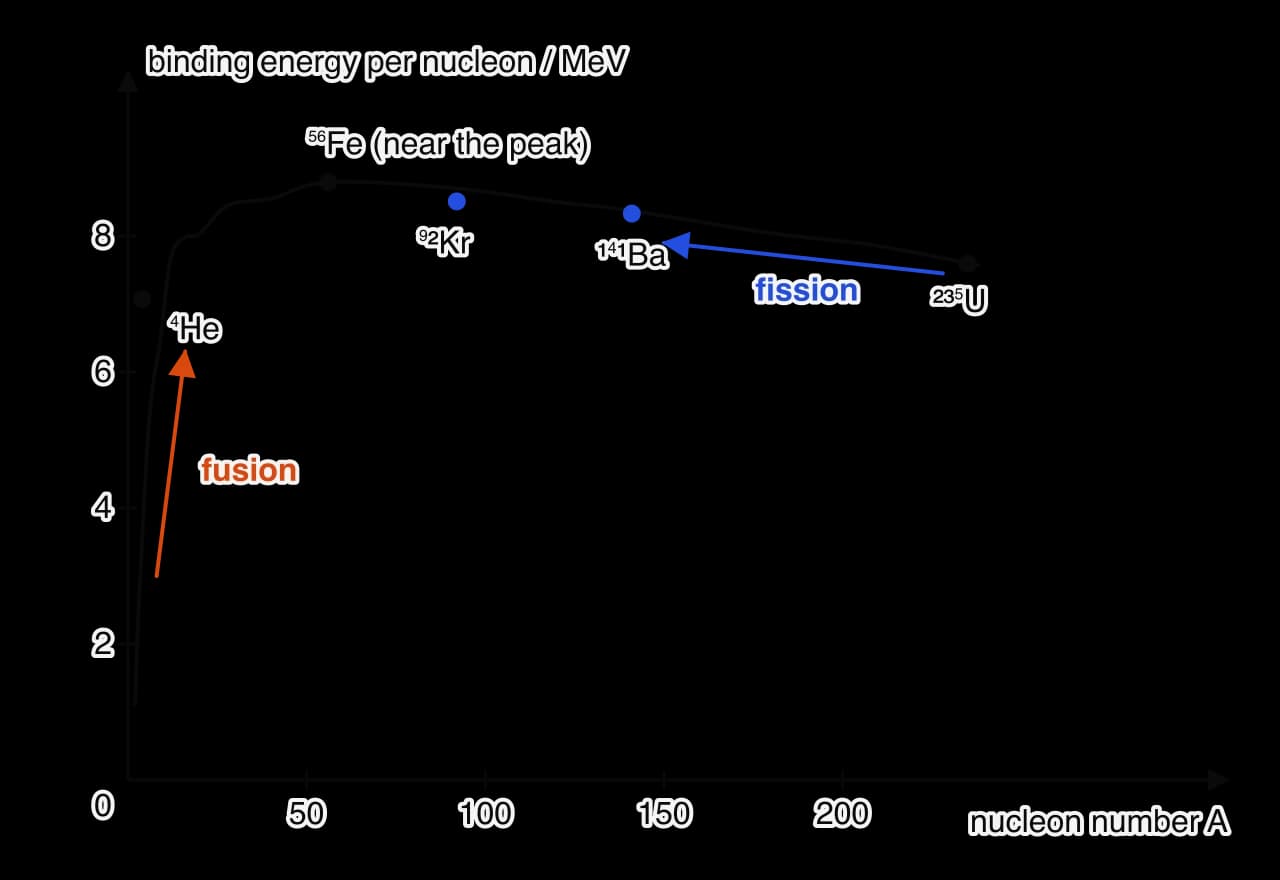
The curve of binding energy per nucleon rises to a maximum of about 8.8 MeV near iron-56 and then falls slowly to about 7.6 MeV for uranium. Any nuclear reaction whose products sit higher on the curve than its reactants releases energy, because the products have a larger total binding energy. For heavy nuclei this means splitting: the two middle-sized fragments of a uranium nucleus each have about 8.4–8.5 MeV per nucleon.
The energy released comes from a decrease in rest mass. The total mass of the products is slightly less than the total mass of the reactants, and the difference appears as kinetic energy of the products, with . Nucleons are neither created nor destroyed, so the mass lost is not "converted nucleons"; it is the change in the binding energy of the nuclei.
Fission can happen in two ways. In spontaneous fission an unstable heavy nucleus splits on its own, with no outside cause, as a random process with its own half-life, like other forms of radioactive decay. In neutron-induced fission a nucleus splits after absorbing a neutron. Only neutron-induced fission can be controlled, so it is the process used in reactors.
Spontaneous fission is very rare for most nuclides. Uranium-238 almost always decays by alpha emission; only about one decay in two million is a spontaneous fission. Some very heavy artificial nuclides split far more often. About 3% of californium-252 nuclei decay by spontaneous fission, releasing neutrons each time, so small californium-252 sources are used to provide the first neutrons when a new reactor is started.
A neutron has no charge, so it is not repelled by the nucleus and can approach and be absorbed even when it moves slowly. When uranium-235 absorbs a neutron it becomes uranium-236 in a highly excited state. The extra energy makes the nucleus oscillate and stretch. If it stretches far enough, the electrostatic repulsion between the two ends overcomes the short-range strong nuclear force holding it together, and it splits.
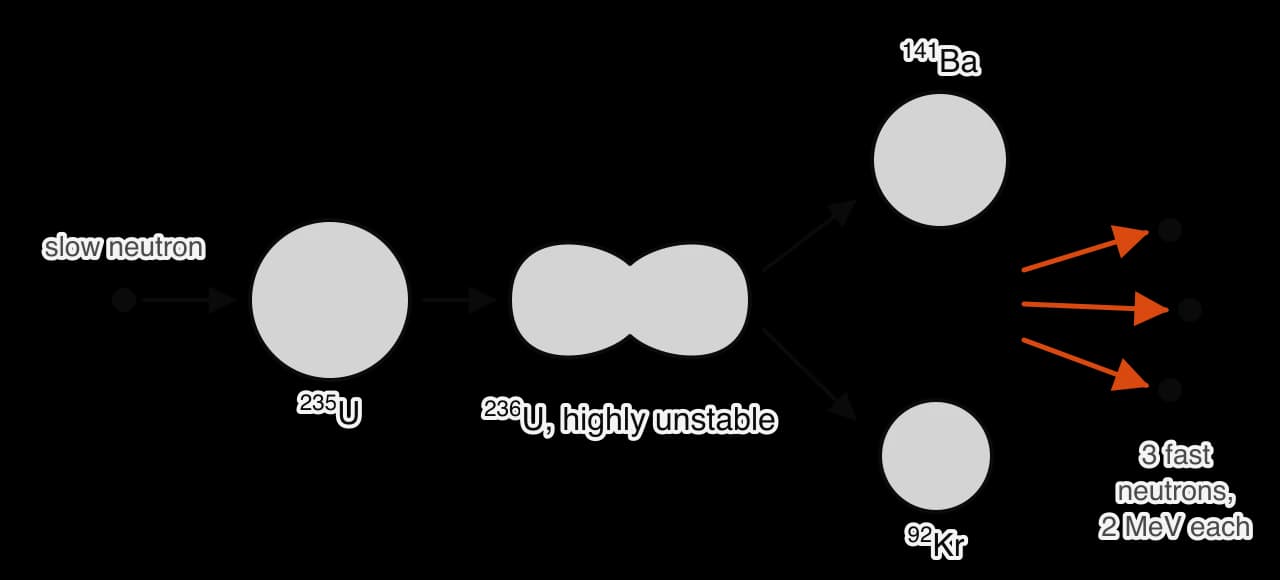
One typical fission of uranium-235 is
Like every nuclear equation, it conserves nucleon number (top numbers: ) and charge (bottom numbers: ). The same reaction can give many different pairs of fragments, such as strontium-94 and xenon-140 with two neutrons. The pair produced in any one fission is a matter of chance.
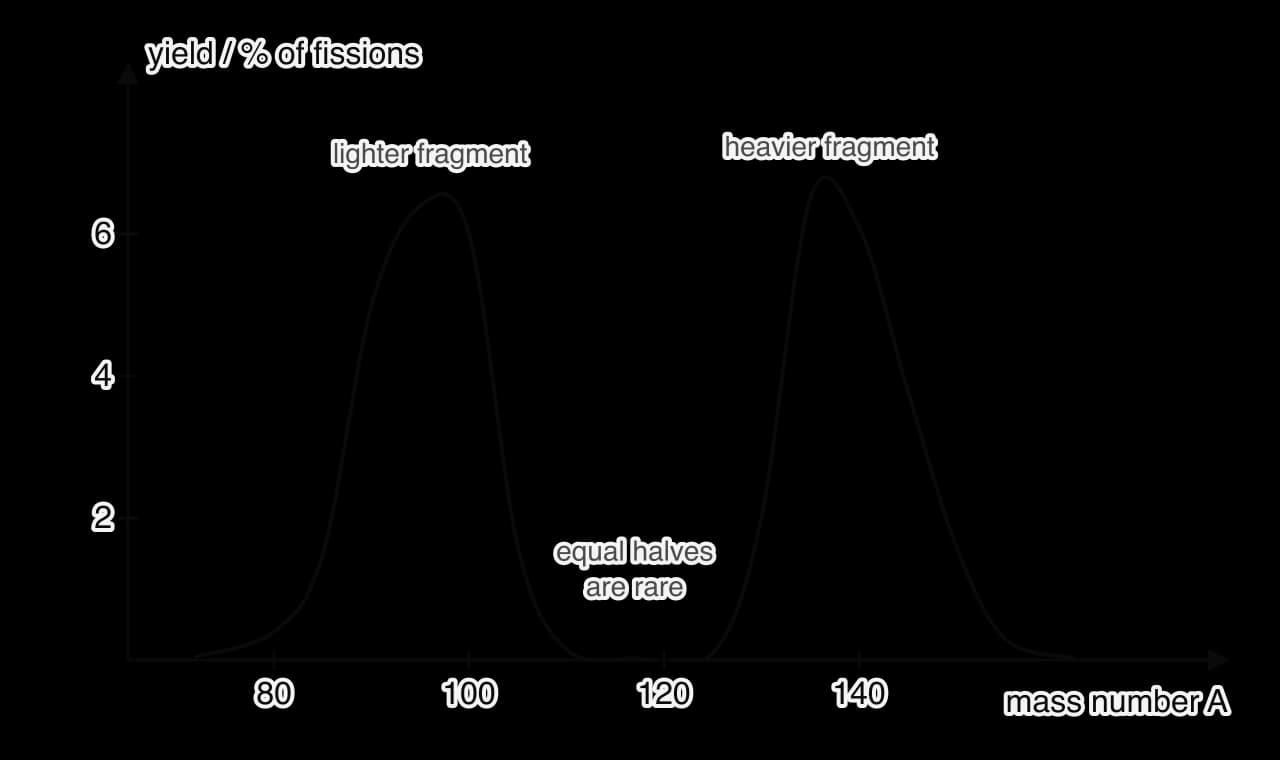
The fragments, called fission products, are almost never equal in size. The most likely outcome is a lighter fragment with mass number near 95 and a heavier one near 137. The average number of neutrons released is about 2.5 per fission, and they are fast, with kinetic energies of about 2 MeV.
Slow (thermal neutron) neutrons are far more likely to be absorbed by uranium-235 and cause fission than the fast neutrons that fission produces, by a factor of several hundred. Uranium-238, which makes up 99.3% of natural uranium, does not undergo fission with slow neutrons, and it absorbs some neutrons without splitting. These two facts explain the design of most reactors: the fuel is enriched uranium, with the fraction of uranium-235 raised from 0.7% to about 3–5%, and the neutrons are slowed down before they reach the next nucleus.
The energy released in a fission can be found in two equivalent ways: from the masses of the particles before and after, or from the binding energies of the nuclei.
The mass defect of the reaction is the total mass before minus the total mass after. With masses in unified atomic mass units, gives the energy directly in MeV. Atomic masses can be used in place of nuclear masses in a fission equation, because the numbers of electrons on the two sides are equal and their masses cancel.
The 173 MeV found from these masses is the energy released at the moment of fission, mostly as kinetic energy of the fragments. The fragments then undergo a series of radioactive decays that release more energy, so the total for one fission of uranium-235 is about 200 MeV.
Where the energy goes | Approximate energy / MeV |
|---|---|
Kinetic energy of the two fragments | 168 |
Kinetic energy of the fast neutrons | 5 |
Gamma rays emitted at the moment of fission | 7 |
Later β⁻ particles and γ rays from the decays of the fission products | 15 |
Antineutrinos from the β⁻ decays (escape the reactor) | 12 |
Total | about 207, of which about 200 is recovered as heat |
Values from J. R. Lamarsh and A. J. Baratta, Introduction to Nuclear Engineering, 3rd edition (2001). The heat recovered is a little more than the total minus the antineutrinos because neutrons absorbed without fission release further gamma rays.
The energy released also equals the increase in total binding energy. Total binding energy is the binding energy per nucleon multiplied by the nucleon number, so
Free neutrons have no binding energy, so they add nothing to either side.
To find the energy from a mass of fuel, first find the number of nuclei. A mass of a substance with molar mass contains moles, so the number of nuclei is
where . The molar mass in is the nucleon number divided by 1000: for uranium-235.
Each fission of uranium-235 releases two or three neutrons. If at least one of them goes on to cause another fission, the process continues by itself, generation after generation. Each generation takes a tiny fraction of a second, so the number of fissions can change very quickly.
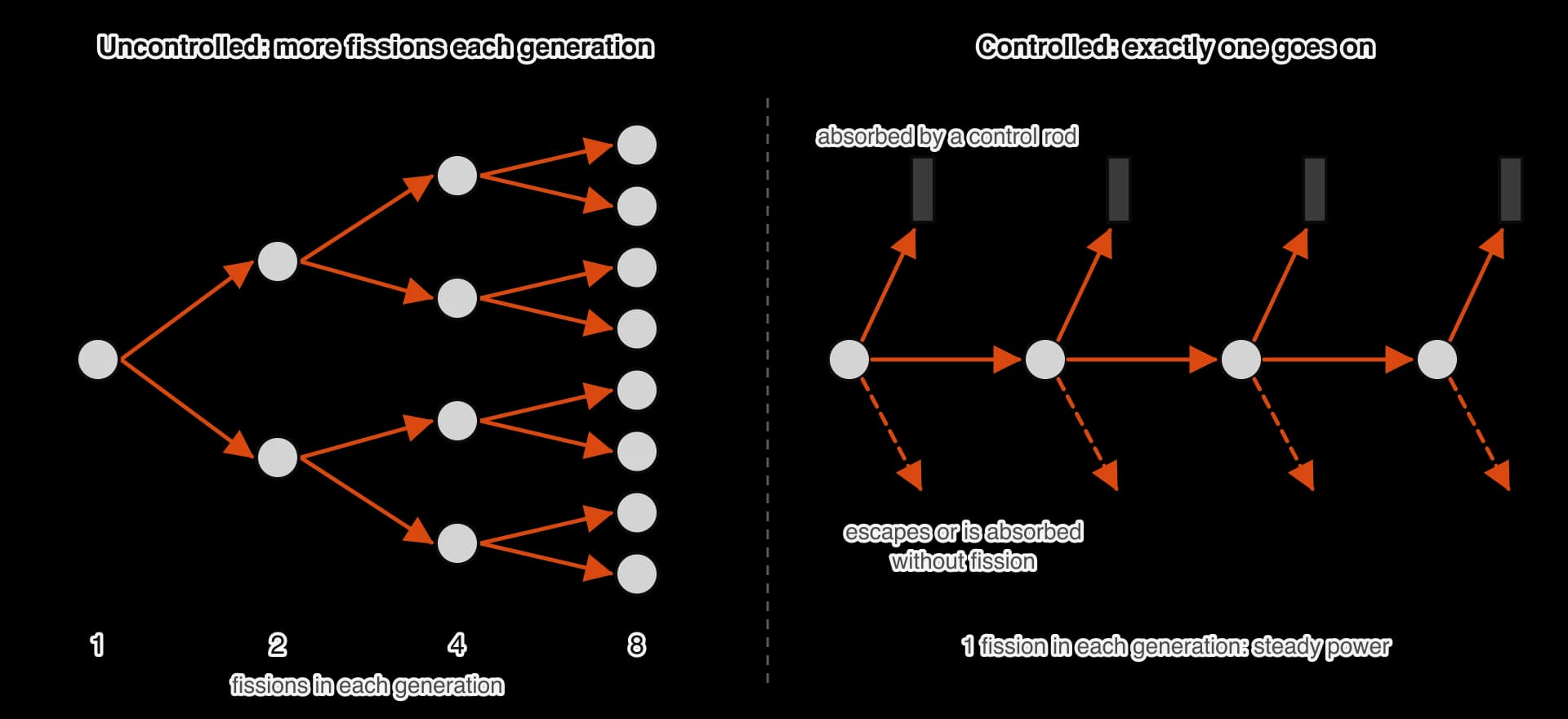
Not every neutron causes a fission. A neutron can escape through the surface of the fuel, be absorbed by uranium-238 or another material without causing fission, or be absorbed by a control rod. Three cases follow from the average number of neutrons per fission that go on to cause another fission:
fewer than one: the reaction dies away (subcritical);
exactly one: the rate of fission, and so the power, stays constant (critical). A reactor running steadily is in this state;
more than one: the number of fissions grows rapidly with each generation (supercritical). In a nuclear weapon the growth is deliberately uncontrolled.
The critical mass exists because neutrons are produced throughout the volume of the fuel but lost through its surface. For a sphere, the volume grows as and the surface area as , so a larger sphere has less surface for each unit of volume and loses a smaller fraction of its neutrons. Below a certain size too many escape for one per fission to remain; above it the reaction sustains itself.
The critical mass is not a fixed property of an element. It is smaller when the material is denser, more highly enriched, shaped closer to a sphere, or surrounded by a reflector that bounces escaping neutrons back. A bare sphere of pure uranium-235 has a critical mass of about 50 kg. Reactor fuel contains only a few per cent uranium-235 and relies on a moderator, so a reactor core holds many tonnes of uranium.
The first self-sustaining chain reaction was achieved in Chicago Pile-1 on 2 December 1942: a stack of graphite blocks with natural uranium inside, controlled by cadmium rods pulled out by hand. It ran at about half a watt. Every later reactor uses the same principle of balancing neutron production against neutron loss.
 YouTube
A nuclear reactor is a device in which a controlled chain reaction releases energy at a steady rate. A nuclear power station uses that energy to boil water, and the steam drives a turbine and generator exactly as in a coal or gas station. The commonest design is the pressurised water reactor (PWR), such as Sizewell B in the United Kingdom, which entered service in 1995 and produces about 1.2 GW of electrical power from about 3.4 GW of thermal power.
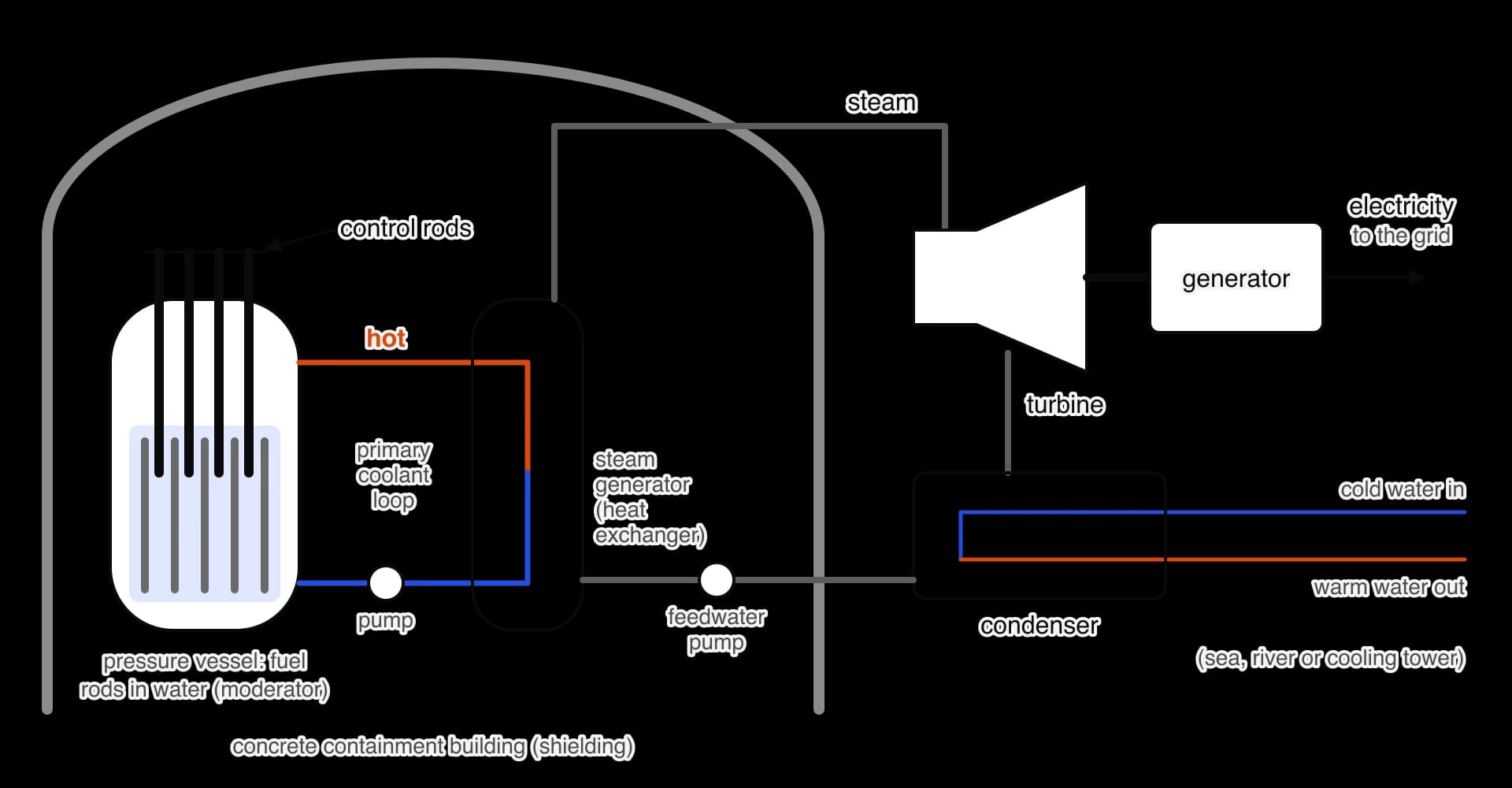
The fuel is uranium dioxide, enriched to about 3–5% uranium-235, pressed into small ceramic pellets. The pellets are stacked inside sealed metal tubes called fuel rods, which keep the fission products inside. Hundreds of rods are grouped into fuel assemblies, with water flowing between them. Each assembly stays in the reactor for several years until too little uranium-235 is left and too many neutron-absorbing fission products have built up.
Fission neutrons are fast, but uranium-235 is far more likely to absorb a slow neutron and split. The moderator sits between the fuel rods. A fast neutron leaving one rod collides many times with moderator nuclei, losing a fraction of its kinetic energy in each collision, and reaches the next rod as a thermal neutron.
The collisions are elastic collisions, so kinetic energy and momentum are both conserved. A neutron transfers the most energy when it hits a nucleus of similar mass, just as a moving snooker ball stops dead when it hits a stationary one head on, while a ball bouncing off a heavy wall keeps all its speed. Good moderators therefore contain light nuclei that rarely absorb neutrons: ordinary water (hydrogen nuclei), heavy water (deuterium) and graphite (carbon).
Pushing the control rods further into the core absorbs more neutrons, so fewer are left to cause fission and the power falls. Withdrawing them has the opposite effect. Operators adjust the rods to keep the reactor exactly critical at the power they want. In an emergency all the rods drop fully into the core within a few seconds and the chain reaction stops.
The coolant is a fluid pumped through the core to carry away the energy released in the fuel. In a PWR the coolant is the same water that acts as the moderator. It is kept at a pressure of about 15 MPa, roughly 150 times atmospheric pressure, so that it stays liquid at about 300 °C (570 K), well above its normal boiling point. This hot primary coolant flows in a closed loop to the heat exchanger, called the steam generator.
Keeping the loops separate means that the radioactive primary water never reaches the turbine. The steam in the secondary loop expands through the turbine, is cooled back to water in the condenser, and is pumped back to the steam generator.
The core emits intense neutron and gamma radiation. Shielding around it absorbs this radiation so that workers and the public are protected. The thick steel pressure vessel, the surrounding water and a concrete containment building, typically more than a metre thick, all act as shields. The containment building is also sealed and strong enough to hold in radioactive material if the primary loop leaks.
Component | Typical material | Role |
|---|---|---|
Fuel rods | Uranium dioxide pellets, 3–5% uranium-235, in metal tubes | Source of energy from fission; tubes contain the fission products |
Moderator | Water, heavy water or graphite | Slows fast neutrons by elastic collisions so that they cause fission |
Control rods | Boron, cadmium | Absorb neutrons to set or stop the rate of fission |
Coolant | Pressurised water, carbon dioxide gas | Carries energy from the core to the heat exchanger |
Heat exchanger | Steam generator with thousands of metal tubes | Transfers energy to a secondary loop to make steam |
Shielding | Steel, water, concrete | Absorbs neutrons and gamma radiation |
A nuclear power station is a thermal power station with a nuclear energy source. The energy released in fission passes through a chain of transfers before any of it becomes electrical energy.
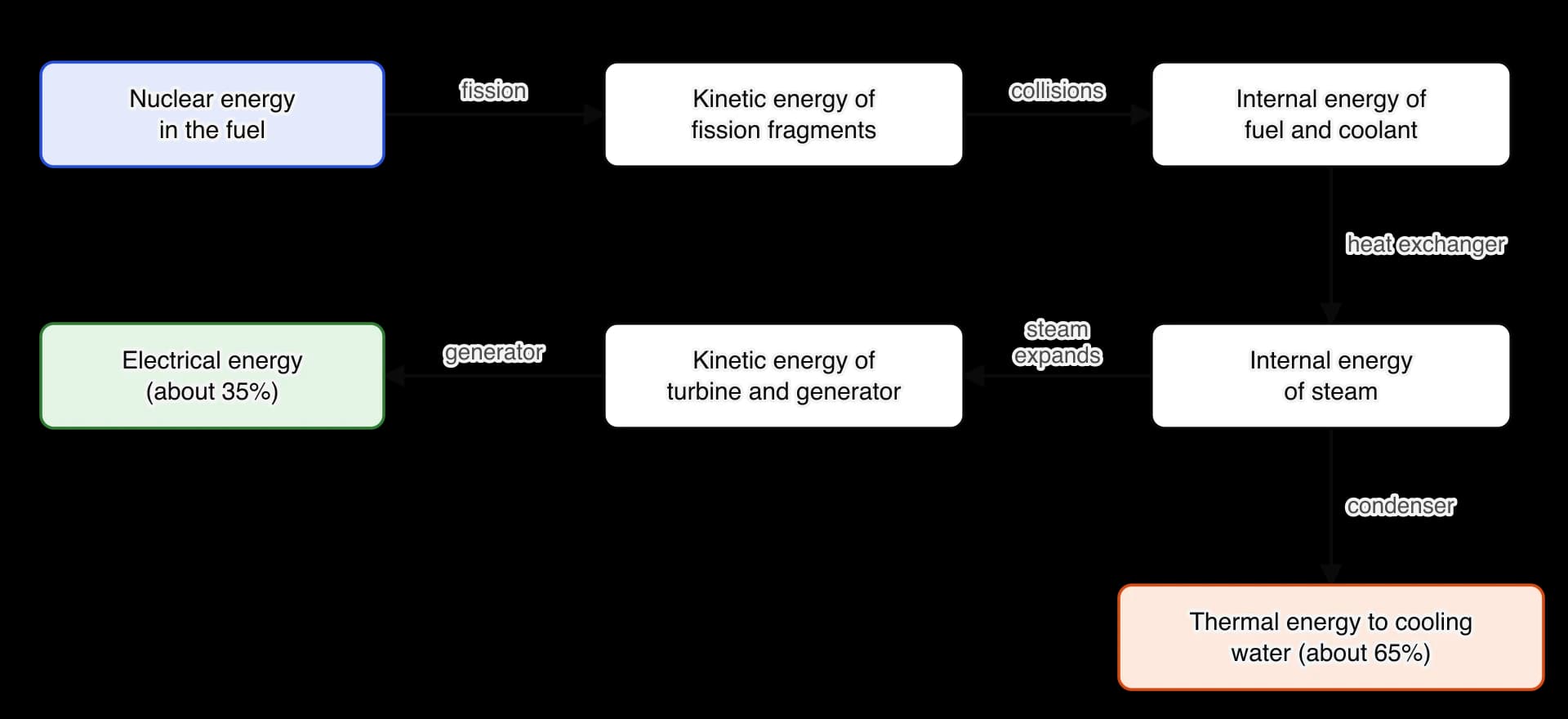
The efficiency is limited mainly by the steam cycle. Most of the energy in the steam cannot be turned into work and is transferred to the cooling water when the steam condenses. A PWR runs its steam at a lower temperature than a modern coal station, so its efficiency is a little lower, about 33–35%.
Heavy nuclei need a high ratio of neutrons to protons to be stable: uranium-235 has 143 neutrons and 92 protons, a ratio of about 1.55. Stable nuclei of mass number around 90–140 have a neutron-to-proton ratio of only about 1.25–1.45. When uranium splits, the fragments keep almost the same high ratio, so they are neutron-rich. A few neutrons are released at once, which is where the fission neutrons come from, but the fragments are still far from stable.
A nucleus with too many neutrons becomes more stable by beta-minus decay, in which a neutron changes into a proton and an electron and an antineutrino are emitted. Fission products therefore decay by a chain of β⁻ emissions, each raising the proton number by one, until a stable nucleus is reached. Barium-141, for example, decays through lanthanum-141 and cerium-141 to stable praseodymium-141.
Many of these decays leave the daughter nucleus excited, so gamma rays are emitted too. The fission products are the main source of the intense radioactivity of used fuel.
Because the fission products keep decaying, a reactor continues to release energy after the chain reaction has stopped. This decay heat is about 6–7% of the full thermal power immediately after shutdown, and it falls only slowly. For a 3 GW reactor, even 1% is 30 MW, enough to melt the fuel if cooling stops.
Spent fuel is the main nuclear waste from a power station. It is first stored under water in a pool beside the reactor for several years. The water does two jobs at once: it carries away the decay heat by convection, and it absorbs the radiation, so that a few metres of water make it safe to stand at the edge. After its activity and heat output have fallen, the fuel can be moved to dry casks of steel and concrete, cooled by natural air flow.

The hazard falls with time, but very unevenly. Short-lived fission products such as iodine-131 (half-life 8 days) dominate the activity at first. After a few decades caesium-137 and strontium-90 (half-lives about 30 years) dominate. After a few centuries the long-lived plutonium-239 (24 000 years) and some fission products such as technetium-99 (211 000 years) remain.
Nuclide in spent fuel | Origin | Half-life | Why it matters |
|---|---|---|---|
Iodine-131 | Fission product | 8 days | Very active at first; absorbed by the thyroid if released |
Caesium-137 | Fission product | 30 years | With strontium-90, the main source of heat and gamma radiation for the first few centuries |
Strontium-90 | Fission product | 29 years | Absorbed into bones like calcium |
Plutonium-239 | Neutron absorption by uranium-238 | 24 000 years | Alpha emitter, very toxic, can be used as fuel |
Technetium-99 | Fission product | 211 000 years | Long-lived and moves easily in groundwater |
Because some of the waste stays hazardous for tens of thousands of years, long-term storage must remain safe without anyone looking after it. The approach most countries plan to use is a deep geological repository: the waste is sealed in corrosion-resistant canisters and buried hundreds of metres underground in stable rock, so that several barriers separate it from groundwater. Finland's Onkalo repository, built about 400–500 m down in granite bedrock at Olkiluoto, places fuel in copper canisters surrounded by bentonite clay and is is expected to become the first of its kind in operation, with final disposal planned to begin around 2026–2027.
Long-term storage raises questions that physics alone cannot settle. Engineers must predict how rock, metal and clay behave over periods longer than human history, and future generations inherit a hazard from which they gain no electricity. Some countries reprocess spent fuel to extract plutonium and uranium for reuse, which reduces the volume of high-level waste but produces separated plutonium that must be guarded.
The two worst reactor accidents shaped how reactors are designed today. At Chernobyl in 1986, the RBMK reactor used graphite as moderator and water as coolant. When the water boiled, fewer neutrons were absorbed, so the power rose further: a positive feedback. During a test at low power the power rose uncontrollably, steam explosions destroyed the core, and there was no strong containment building to hold in the radioactive material.
At Fukushima Daiichi in 2011, the reactors shut down safely when the earthquake struck, but the tsunami that followed flooded the backup generators. Without power the pumps stopped, decay heat could not be removed, the fuel in three reactors melted, and hydrogen explosions damaged the buildings.
Modern designs build in physical safety. In a PWR the water is both moderator and coolant, so if it overheats or boils it moderates less well and the power falls by itself: a negative feedback. Control rods fall into the core under gravity if power is lost, and newer designs remove decay heat by natural circulation without pumps.
Burning fossil fuels releases carbon dioxide, the main cause of recent global warming. A fission power station releases no carbon dioxide while operating, and the emissions from mining, building and decommissioning are small when spread over the electricity it produces in 60 years or more.
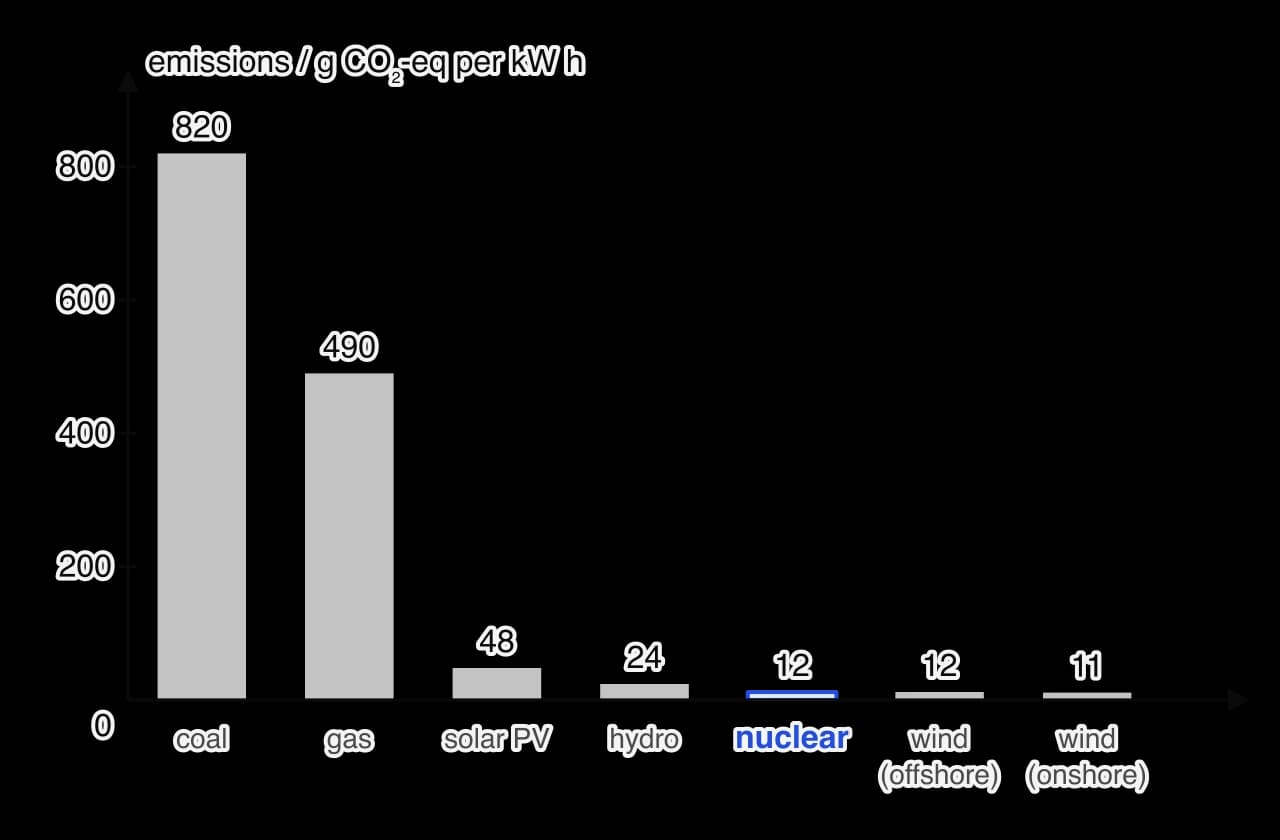
Whether to build more nuclear power stations is a question of weighing evidence and values together. The physics provides the data on emissions, energy density, waste and risk; societies then decide how much weight to give to each, and different countries have reached different conclusions. France generates most of its electricity from fission, while Germany closed its last reactors in 2023.
Advantages of fission for a low-carbon energy supply | Disadvantages |
|---|---|
Very low lifecycle greenhouse-gas emissions, similar to wind | Produces radioactive waste that must be stored safely for thousands of years |
Enormous energy density: little fuel to mine and transport | Small risk of accidents that release radioactive material over large areas |
Steady output day and night, whatever the weather | High construction cost and long building times, often over ten years |
Small land area for the energy produced | Uranium is a finite resource, and enrichment technology can be misused for weapons |
Long operating life of 60 years or more | Usually run at steady output; changing output quickly to follow demand is harder than for gas |
 YouTube
Questions on fission mix short statements about the parts of a reactor with energy calculations, so both the wording of roles and the setting out of a mass-defect calculation matter.
A group of students is given data for the thermal power produced by one spent fuel assembly at different times after it was removed from a reactor.
t / years | 1 | 2 | 5 | 10 | 20 |
|---|---|---|---|---|---|
P / kW (± 0.5 kW) | 10.2 | 6.3 | 2.9 | 1.9 | 1.4 |
I can explain, using the binding energy per nucleon curve, why fission of heavy nuclei releases energy.
I can distinguish spontaneous fission from neutron-induced fission.
I can complete and balance a fission equation.
I can calculate the energy released in a fission from masses in u or kg, or from binding energies per nucleon.
I can use N = mN_A/M to find the energy released per kilogram of fuel and the fuel used in a given time.
I can explain what a chain reaction is and when it is self-sustaining.
I can explain what is meant by critical mass and why it depends on the size and shape of the fuel.
I can state the roles of the fuel, moderator, control rods, coolant, heat exchanger and shielding.
I can explain why a moderator contains light nuclei and slows neutrons by elastic collisions.
I can describe the energy transfers in a nuclear power station and calculate its efficiency.
I can explain why fission products are neutron-rich β⁻ emitters and why they produce decay heat.
I can explain why spent fuel is stored under water and how it is stored in the long term.
I can discuss the advantages and disadvantages of fission as a response to climate change.
Show that the mass of methane burned each second is about 26 kg.
2 marks
✓
= 26.4 «kg» ✓
Answer must be shown to at least 3 s.f.
Calculate the mass of carbon dioxide released by the power station in one year.
2 marks
« =» 72 «kg s-1» ✓
« =» kg ✓
Accept kg to kg.
Sketch a Sankey diagram for the power station. Label each arrow with its power.
2 marks
single input arrow labelled 1450 MW splitting into two arrows ✓
useful electrical output 800 MW and wasted/thermal energy 650 MW, with widths in proportion «by eye» ✓
Allow ECF from (a).
60 % of the wasted energy is transferred to river water used for cooling. The temperature of the cooling water rises by 8.0 K. The specific heat capacity of water is 4200 J kg-1 K-1.
Calculate the mass of cooling water that flows through the power station each second.
2 marks
energy to cooling water per second = « =» «W» ✓
= kg «each second» ✓
Allow ECF from (a).
The power station keeps a reserve of methane in a storage tank of volume at a pressure of Pa and a temperature of 15 °C. Assume that methane behaves as an ideal gas.
Determine the time for which this reserve can keep the power station running at full output.
3 marks
Explain how the carbon dioxide released by the power station can lead to an increase in the mean surface temperature of the Earth.
3 marks
it increases the concentration of CO2 in the atmosphere ✓
so more of the infrared radiation emitted by the Earth's surface is absorbed «by excitation of molecular vibrations/resonance» ✓
the CO2 re-emits the radiation in all directions, so more returns to the surface ✓
the surface temperature rises until the power emitted again balances the power absorbed ✓
[max 3]
A nuclear power station with the same electrical output has an overall efficiency of 0.33. Each fission of a uranium-235 nucleus releases J. Determine the mass of uranium-235 that undergoes fission each day.
3 marks
power from fission = « =» «W» ✓
fissions per day = « =» ✓
mass = « =» 2.6 kg ✓
Accept 2.5 kg «from rounded values».
Allow ECF from MP1 and MP2.
Accept the mass of a U-235 nucleus as kg.
Discuss, with reference to the climate, one advantage and one disadvantage of generating electricity with the nuclear power station rather than the gas-fired power station.
2 marks
advantage: no carbon dioxide/greenhouse gas is emitted during operation «so no contribution to the enhanced greenhouse effect» ✓
disadvantage: lower efficiency means more thermal energy is released to the environment for the same output «thermal pollution of rivers» ✓
OR
disadvantage: produces long-lived radioactive waste / risk of a serious accident ✓
MP1 must refer to emissions/climate.
A pressurized-water nuclear power station has a thermal power output from its reactor core of 3.0 GW and an electrical power output of 1.0 GW. Each fission of a uranium-235 nucleus releases 200 MeV.
Calculate the number of fissions that occur each second in the core.
2 marks
Calculate the mass of uranium-235 used in one day. The mass of a uranium-235 atom is 235 u.
2 marks
State the role of the moderator in the reactor.
1 mark
Water in the primary circuit removes the energy from the core. It enters the core at 290 °C and leaves at 325 °C. At the high pressure in the circuit, the specific heat capacity of the water is . Calculate the mass of water flowing through the core each second.
2 marks
In the steam generator, the energy passes through the walls of thin metal tubes with a total area of and a wall thickness of 1.2 mm. The thermal conductivity of the metal is
The energy not converted to electrical energy is removed by a cooling tower. 75 % of this energy is removed by the evaporation of water. The specific latent heat of vaporization of water at the temperature of the tower is . Calculate the mass of water evaporated each second.
3 marks
Outline how a cooling tower draws cool air in at its base without the use of fans.
2 marks
The electrical power is transmitted at a potential difference of 400 kV. Calculate the current in the transmission cables.
1 mark
The total resistance of the cables is 2.0 Ω. Calculate the fraction of the transmitted power that is dissipated in the cables.
2 marks
Spent fuel rods removed from the reactor are stored under water for several years. Explain why.
3 marks
In a nuclear power station, energy released by fission in the reactor produces steam, which enters the turbines at . The steam leaving the turbines is condensed using sea water at . The station has an electrical power output of 1.20 GW and an overall efficiency of 0.33.
Each fission of a uranium-235 nucleus releases about 200 MeV. Calculate the number of fissions per second in the reactor.
2 marks
Calculate the Carnot efficiency for a heat engine working between the steam temperature and the sea-water temperature.
1 mark
Assume that all the energy not converted into electrical energy is transferred to the sea water. Calculate the rate at which thermal energy is transferred to the sea water.
1 mark
To protect marine life, the temperature of the sea water must rise by no more than 8.0 K as it passes through the condensers. The specific heat capacity of sea water is . Calculate the minimum mass of sea water that must flow through the condensers each second.
2 marks
Assume that the thermal energy is taken in at the steam temperature and released at the sea-water temperature. Determine the rate at which the total entropy of the steam supply and the sea water increases.
3 marks
In a coal-fired power station, steam enters the turbines at about . Explain why a coal-fired station can have a higher efficiency than this nuclear power station.
2 marks
Convert to energy. With :
The same in SI units. With kg, kg, so J. Dividing by J per eV gives 174 MeV, the same to within rounding.
The mass decreases by less than 0.08%, yet the energy released is about 173 MeV. The masses must be kept to all six decimal places: the difference is found by subtracting two nearly equal numbers, so rounding early would destroy the answer.
MeV ✓ (the answer must be seen to more than 2 s.f.)
(c) energy per fission J; fissions per day ✓
moles ✓
kg ✓ (accept 3.4–3.5 kg; allow ECF from (b), e.g. 3.2 kg with 200 MeV)
(d) fast neutrons collide (elastically) with moderator nuclei and lose kinetic energy / are slowed to thermal speeds ✓; slow neutrons are much more likely to cause fission of uranium-235, so the chain reaction is sustained ✓
(e) the fission products are radioactive and continue to release (decay) heat, which the water removes ✓; the water absorbs the radiation / acts as shielding for workers ✓
2 marks