Isotopes, binding energy and the strong force; α, β and γ decay with neutrinos; the properties of radiation; random decay, activity and half-life; and, at HL, nuclear stability, decay spectra and the decay constant.
Each is in the Physics glossary, with every other term in the subject.
The number of nuclei in a sample that decay per unit time, measured in becquerels (Bq).
The meeting of a particle and its antiparticle, which disappear and are replaced by energy; an electron and a positron at rest produce two 0.511 MeV γ photons travelling in opposite directions.
A neutral particle of almost zero mass, the antiparticle of the neutrino, emitted with the electron in β⁻ decay.
A particle with the same mass as a given particle but the opposite charge; the positron is the antiparticle of the electron and the antineutrino that of the neutrino.
Ionising radiation present everywhere from natural and artificial sources (radon, rocks, cosmic rays, food, medical uses), which must be subtracted from measured count rates.
The narrow region of a plot of neutron number against proton number where the stable nuclides lie; it follows for light nuclei and curves to
122 exam-style questions on this subtopic, written in the style of the IB papers. The first has its markscheme open. Counted on
A stationary nucleus undergoes beta-minus decay. The electron is emitted with a momentum of 2.4 × 10⁻²² kg m s-1 and the antineutrino is emitted at right angles to the electron with a momentum of 1.0 × 10⁻²² kg m s-1. What is the magnitude of the momentum of the recoiling nucleus?
The total momentum stays zero, so the nucleus's momentum is equal and opposite to the vector sum of the two perpendicular momenta:
One of 85 short multiple-choice questions on E.3. Pick an answer to see why it's right or wrong.
A source has an initial activity of and a half-life of . What is its activity after ? (Take
The official deck for this part of the syllabus.
A nucleus has 6 protons and 8 neutrons. How many nucleons does it contain?
Two nuclei have the same proton number but different nucleon numbers. Are they the same nuclide? Explain.
The entries of the physics data booklet that E.3 uses. Each opens in the explained booklet.
With a free account, Augment remembers where you stopped and what you have practiced.
The SI unit of activity: one decay per second.
A decay in which a neutron in the nucleus changes into a proton, and an electron (β⁻ particle) and an antineutrino are emitted.
A decay in which a proton in the nucleus changes into a neutron, and a positron (β⁺ particle) and a neutrino are emitted.
The energy needed to separate a nucleus completely into its individual protons and neutrons; equal to the mass defect times .
The binding energy of a nucleus divided by its nucleon number; the larger it is, the more tightly bound the nucleus.
The number of decays registered by a detector per unit time; proportional to the activity for a fixed arrangement, but smaller than it.
The nucleus left after a parent nucleus has decayed.
The constant in : the fraction of undecayed nuclei that decay per unit time, related to the half-life by .
A sequence of radioactive decays in which each daughter is itself unstable, ending at a stable nuclide.
A detector of ionising radiation: each particle or photon that ionises the gas inside produces a pulse of current, which a counter records.
The time taken for the number of undecayed nuclei of a nuclide, and so the activity of a sample, to fall to half its initial value.
Radiation with enough energy to remove electrons from atoms it passes, leaving ions; α, β and γ radiation are ionising.
The difference between the total mass of the separated nucleons of a nucleus and the mass of the nucleus itself.
The principle that mass and energy are equivalent, : any change in the energy of a system changes its mass by .
A neutral particle of almost zero mass that interacts extremely weakly with matter; emitted with the positron in β⁺ decay.
One of the discrete energies a nucleus can have; transitions between them give γ photons and α particles of definite energies.
The splitting of a heavy nucleus into two smaller nuclei of comparable mass, usually with the release of two or three neutrons and energy.
The joining of two light nuclei to form a heavier nucleus, which releases energy when the product has a higher binding energy per nucleon.
The original nucleus that undergoes radioactive decay.
How far a radiation travels into matter before it is absorbed, measured by the thickness of material needed to absorb it.
The antiparticle of the electron, with the same mass and a charge of ; emitted in β⁺ decay.
The random and spontaneous change of an unstable nucleus into a more stable one, with the emission of radiation (α, β or γ).
Finding the time since an organism died from the activity of carbon-14 per gram of carbon in its remains, which falls with a half-life of 5730 years once intake of carbon stops.
The short-range (about ) attractive force between nucleons that holds the nucleus together against the electric repulsion of the protons.
Activity and count rate fall by half in each half-life; measured count rates include background radiation.
The neutron-to-proton ratio determines whether a nucleus is stable and how it decays (HL).
The discrete energies of α particles and γ photons are evidence for nuclear energy levels, and the continuous β spectrum is evidence for the neutrino (HL).
Decay is described by the decay constant : , and (HL).
Some atomic nuclei are unstable. Sooner or later each one changes into a different, more stable nucleus by emitting radiation, a process called radioactive decay. The radiation can ionise atoms, which makes it dangerous to living cells and also useful: it sterilises surgical instruments, traces blood flow inside the body, measures the thickness of paper as it is made, and dates archaeological remains.
Explaining radioactivity needs a model of what holds a nucleus together and what energy is stored in it. The same ideas, binding energy and mass–energy equivalence, explain the energy released by fission in nuclear reactors and by fusion in stars.
A nucleus is made of protons and neutrons, together called nucleons. A particular nucleus, with a definite number of protons and neutrons, is a nuclide. It is written , where X is the chemical symbol, is the proton number (the number of protons) and is the nucleon number (the total number of protons and neutrons). The number of neutrons is .
The proton number fixes the element, because the number of protons sets the charge of the nucleus and so the number of electrons in the neutral atom, which in turn sets its chemistry. Every carbon nucleus has ; any nucleus with is nitrogen.
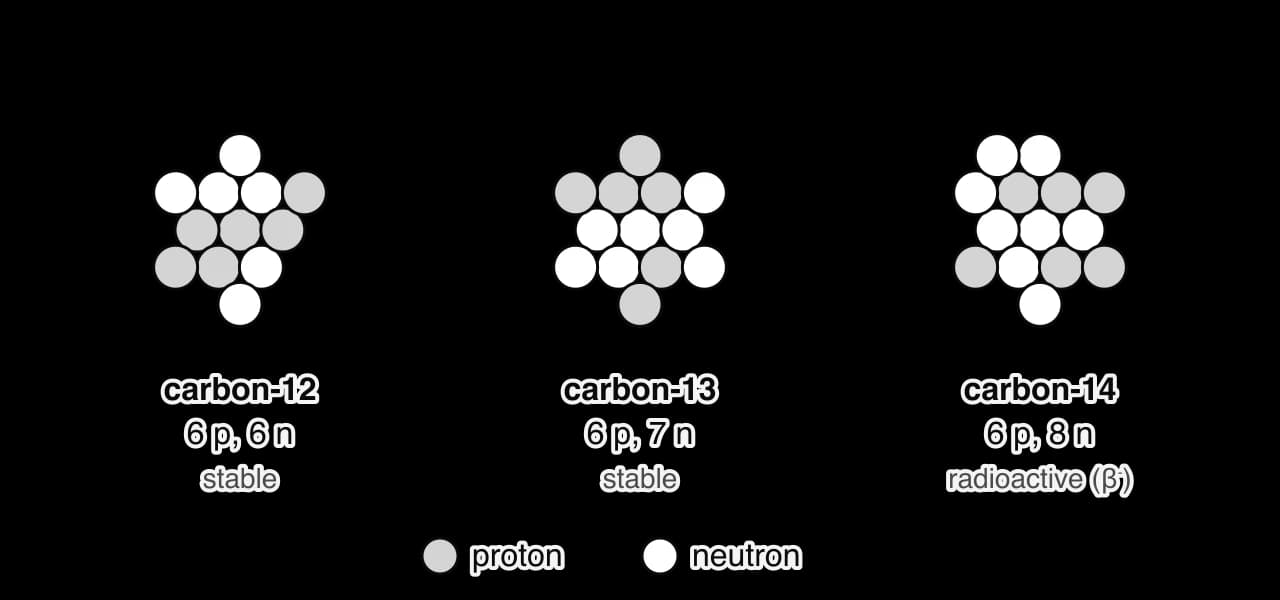
Isotopes of an element have identical chemistry, because chemistry depends only on the electrons, but they have different masses and can have very different nuclear behaviour. Carbon in nature is about 98.9% carbon-12 and 1.1% carbon-13, both stable, with a tiny trace (about one atom in ) of radioactive carbon-14. The three nuclei are compared in the diagram of the carbon isotopes.
A nuclide can also be named by element and nucleon number: carbon-14, C-14 or . The proton number is often left out because the symbol already fixes it.
Special relativity shows that mass and energy are equivalent. A body of mass has a rest energy
where is the speed of light in a vacuum. Any change in the energy of a system changes its mass by . In chemical reactions the change is far too small to measure, about one part in . In nuclear reactions the energies per particle are millions of times larger, and the mass changes are easily measured. This is mass–energy equivalence.
Nuclear masses are usually given in the unified atomic mass unit, u, defined as one-twelfth of the mass of a carbon-12 atom: . Converting this mass to energy gives
so . (The working uses more precise values of and ; the rounded values and would give 934 MeV, which is why the conversion factor is quoted directly.) A mass in is an energy in MeV divided by : a mass of is equivalent to an energy of 1 MeV. Working in u and avoids carrying powers of ten through every calculation.
Particle | Mass / kg | Mass / u | Mass / |
|---|---|---|---|
proton | 1.007276 | 938 | |
neutron | 1.008665 | 940 | |
electron | 0.000549 | 0.511 |
Data-booklet values (2025). The neutron is slightly heavier than the proton, and the electron is about 1800 times lighter than either.
The mass of a nucleus is always less than the total mass of its protons and neutrons measured separately. For helium-4, two protons and two neutrons have a total mass of 4.031882 u, but the helium-4 nucleus has a mass of only 4.001504 u. The difference is the mass defect.
The missing mass is not lost. To pull a nucleus apart into separate nucleons, work must be done against the force holding them together, so the separated nucleons have more energy than the nucleus, and therefore more mass. The energy needed is the binding energy.
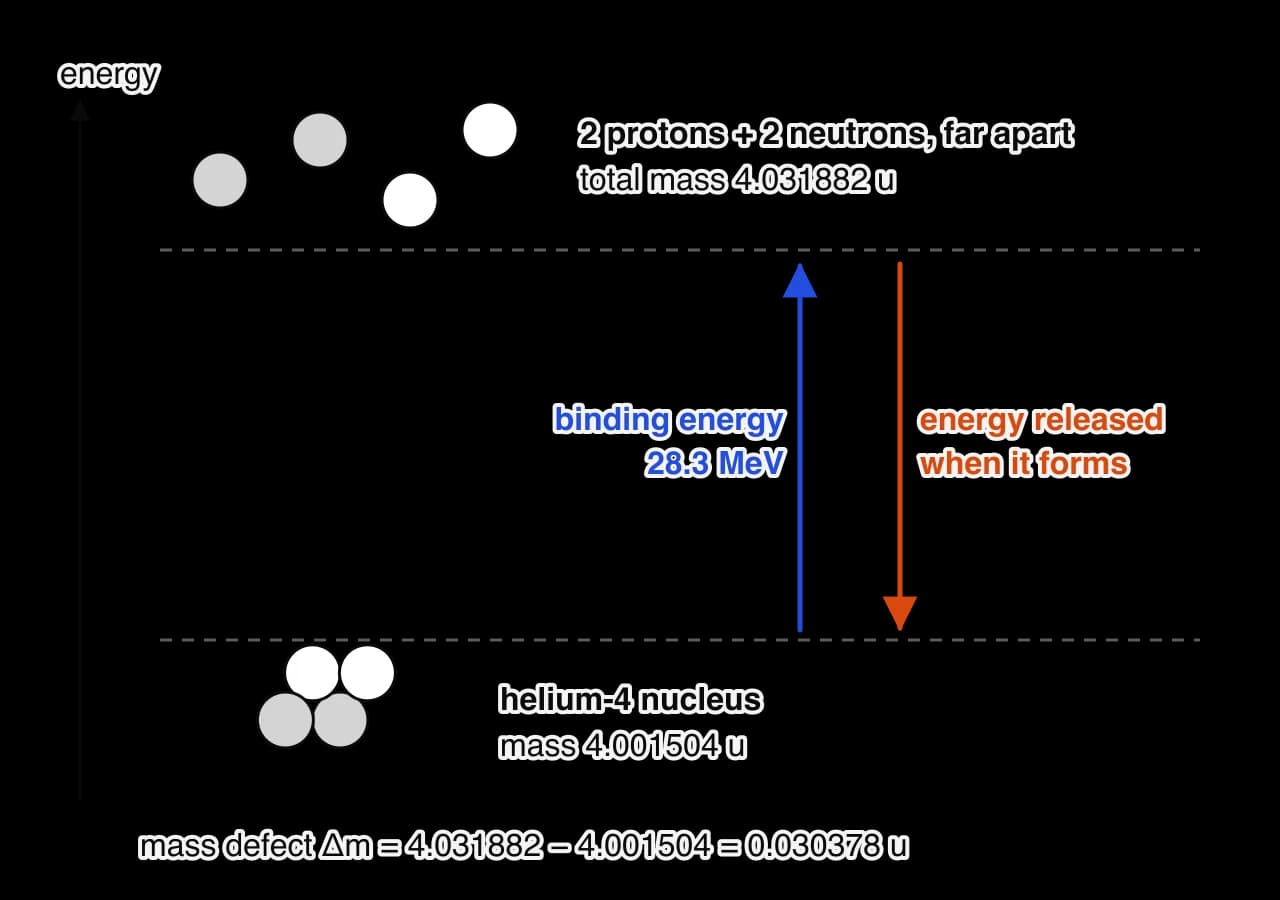
The energy diagram for helium-4 shows both directions of the process. Supplying 28.3 MeV splits the nucleus; assembling the nucleus from free nucleons releases 28.3 MeV, which is carried away as kinetic energy and radiation. With in u, the binding energy in MeV is .
Calculations can also be done in SI units. The mass defect in kg is multiplied by to give joules, and dividing by converts to MeV.
Data tables usually list atomic masses, which include the electrons. To find a nuclear mass, subtract electron masses: . For helium-4, .
In α and β⁻ decay the electron masses cancel when atomic masses are used for both sides, so the energy released can be found directly from atomic masses. In β⁺ decay they do not cancel: the daughter atom has one fewer electron and a positron is also created, so must be subtracted. Always check whether a question gives atomic or nuclear masses.
Larger nuclei have more nucleons and so larger total binding energies. The fair way to compare the stability of different nuclei is the binding energy per nucleon, the binding energy divided by the nucleon number . The larger it is, the more energy is needed on average to remove each nucleon, and the more tightly bound the nucleus.
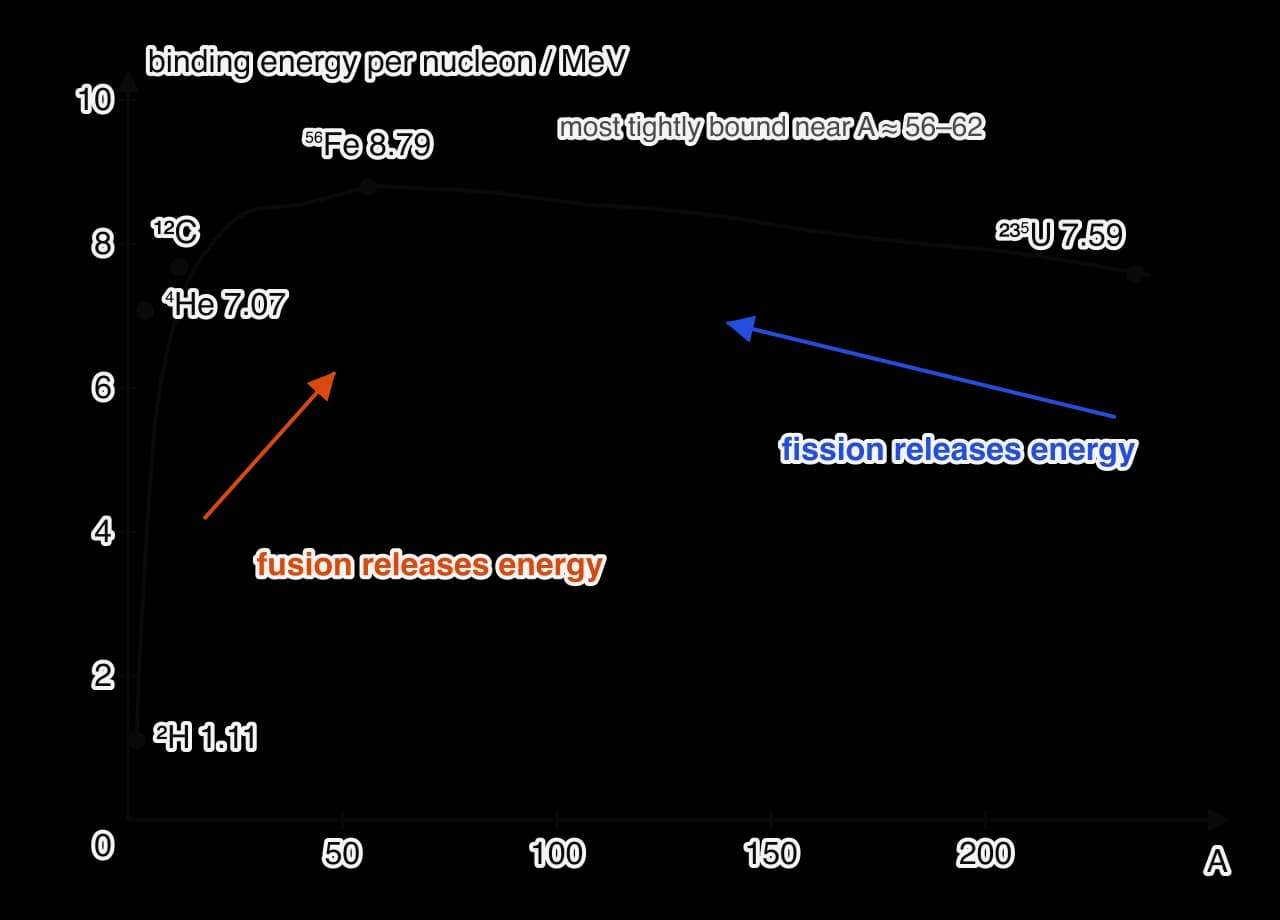
The curve of binding energy per nucleon has several features to interpret.
It rises steeply for light nuclei, from 1.11 MeV for hydrogen-2 to around 8 MeV by oxygen-16. Each added nucleon is attracted by more neighbours.
Helium-4, carbon-12 and oxygen-16 lie above the general trend. Helium-4 in particular is unusually tightly bound for its size, which is why heavy nuclei emit whole helium-4 nuclei (α particles).
The curve peaks at about 8.8 MeV near iron-56 and nickel-62. These are the most stable nuclei.
Beyond the peak it falls slowly, to about 7.6 MeV for uranium. In large nuclei the growing electric repulsion between the many protons reduces the binding per nucleon.
Any nuclear reaction whose products have a higher total binding energy than the reactants releases energy, because the products have less mass. Moving up the curve from either side releases energy. Joining two light nuclei into a heavier one, nuclear fusion, releases energy for nuclei lighter than iron; splitting a heavy nucleus into two medium-sized ones, nuclear fission, releases energy for nuclei heavier than iron.
A nucleus holds protons only a few femtometres apart (). At that separation, the electric repulsion between them is enormous, and gravitational attraction is about times too weak to balance it. Something else must hold the nucleus together.
The strong nuclear force has three key properties:
It is attractive between all nucleons, at separations of about 0.5 fm to 3 fm, and much stronger than the electric repulsion at those distances.
It has a very short range: beyond about 3 fm it is negligible. Each nucleon is attracted only by its nearest neighbours.
It acts equally between protons and neutrons, and it does not depend on charge. At separations below about 0.5 fm it becomes repulsive, which stops nucleons merging.
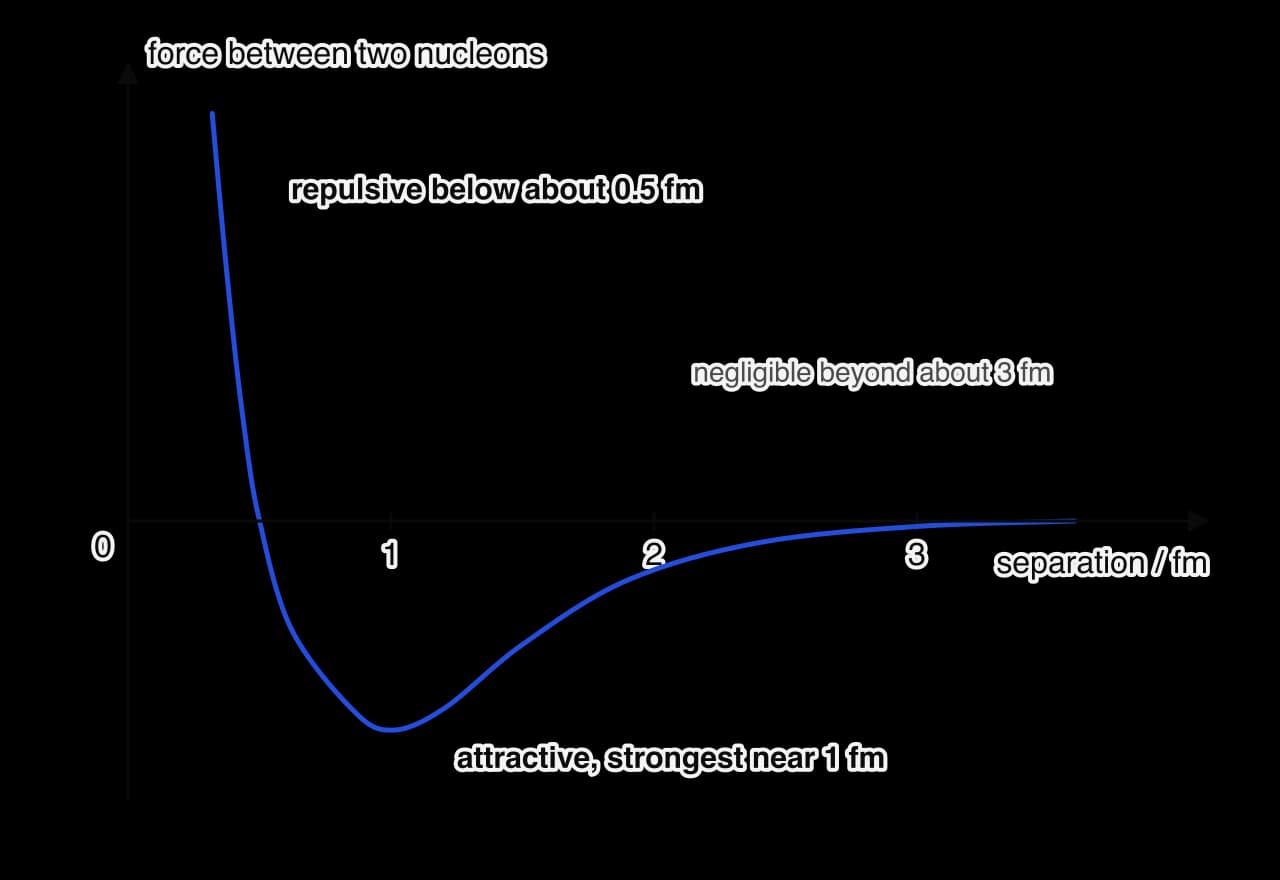
The force–separation sketch shows why nuclei have a definite size and nucleons keep a roughly fixed spacing: nucleons settle near the separation of strongest attraction, where the repulsive core and the attraction balance. The electric force, by contrast, has an infinite range, so each proton repels every other proton in the nucleus.
This competition explains the shape of the binding-energy curve. In a small nucleus, each extra nucleon adds new neighbours and strong-force attraction, so the binding energy per nucleon rises. Once a nucleus is larger than the range of the strong force, an added nucleon gains only the same few neighbours, but an added proton repels all the others. The electric repulsion grows faster than the attraction, and heavy nuclei become less tightly bound and eventually unstable.
An unstable nucleus changes into a more stable one by emitting radiation. The original nucleus is the parent nucleus; the nucleus left behind is the daughter nucleus. The four kinds of decay in this course are α decay, β⁻ decay, β⁺ decay and γ decay.
Every decay obeys conservation laws. In a balanced decay equation:
nucleon number is conserved: the top numbers add up to the same total on each side;
charge is conserved: the bottom numbers (proton number, or charge in units of ) add up to the same total on each side;
energy and momentum are conserved: the energy released is shared as kinetic energy between the products, and their momenta add to zero for a nucleus that starts at rest.
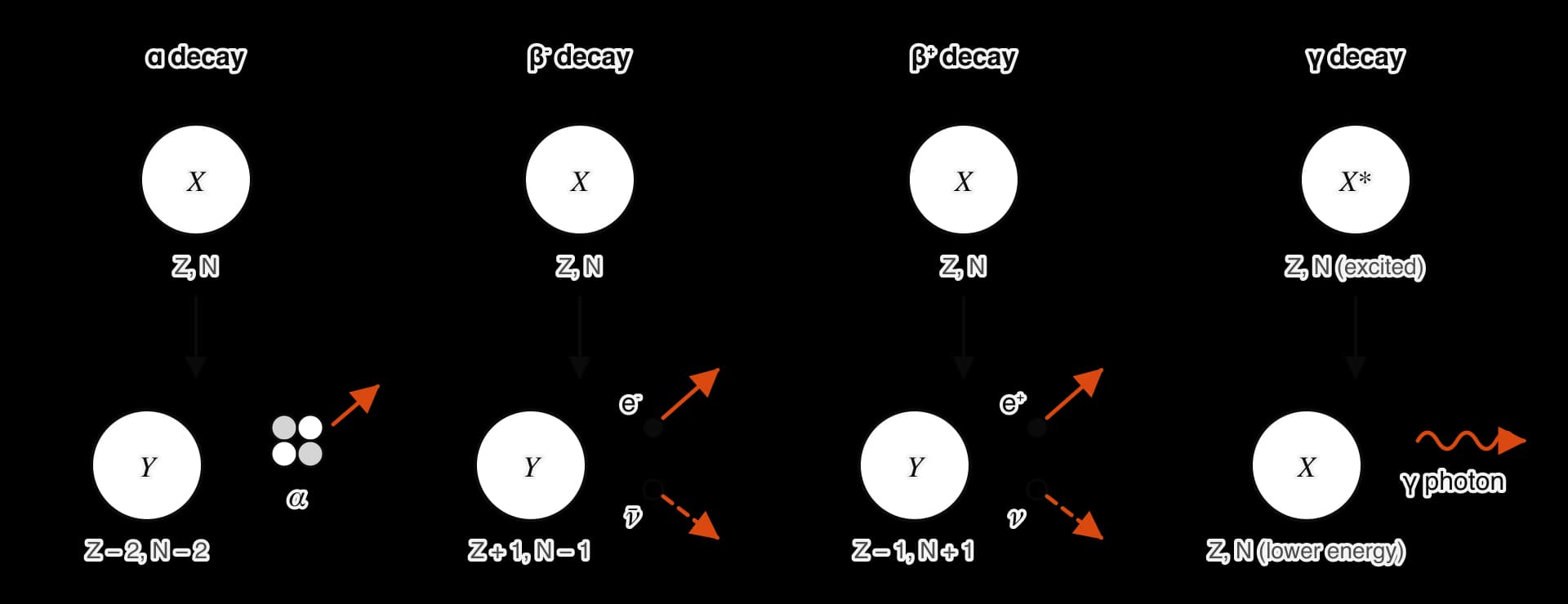
The four panels of the decay-modes diagram summarise what each decay emits and how the numbers of protons and neutrons change.
An alpha particle is a helium-4 nucleus, two protons and two neutrons bound together, written or . In alpha decay the parent loses four nucleons, two of them protons:
Alpha decay is typical of heavy nuclei (), where electric repulsion has made the nucleus less stable. Emitting a very tightly bound helium-4 nucleus releases energy and reduces the charge by . Radium-226 is an example:
The nucleon numbers balance () and so do the charges (). The daughter is a different element, radon, two places lower in the periodic table.
In beta-minus decay a neutron in the nucleus changes into a proton, and an electron and an antineutrino are emitted. The electron, called a β⁻ particle, is created in the decay; it was not in the nucleus beforehand. It is written or , with charge and nucleon number 0.
The nucleon number is unchanged, but the proton number rises by one. β⁻ decay happens in nuclei with too many neutrons for stability. Carbon-14 decays this way:
The antineutrino (charge 0, nucleon number 0, almost no mass) carries away part of the energy released. Its existence was first inferred from the energies of the emitted electrons.
In beta-plus decay a proton in the nucleus changes into a neutron, and a positron and a neutrino are emitted. The positron is the antiparticle of the electron: the same mass, but a charge of . It is written or .
β⁺ decay happens in nuclei with too many protons for stability. Fluorine-18, made in a cyclotron for medical scans, decays this way: .
After an α or β decay the daughter nucleus is often left in an excited state, with more energy than its lowest state, just as an atom can have an excited electron. It drops to a lower state by emitting a gamma ray, a high-energy photon. The nucleus keeps the same numbers of protons and neutrons; it only loses energy:
The asterisk marks the excited state. γ photons have energies of tens of keV to a few MeV, wavelengths of about or less, and travel at the speed of light. Technetium-99m (the m stands for "metastable", a long-lived excited state) emits 140 keV γ photons and nothing else of significance, which makes it the most widely used tracer in medical imaging.
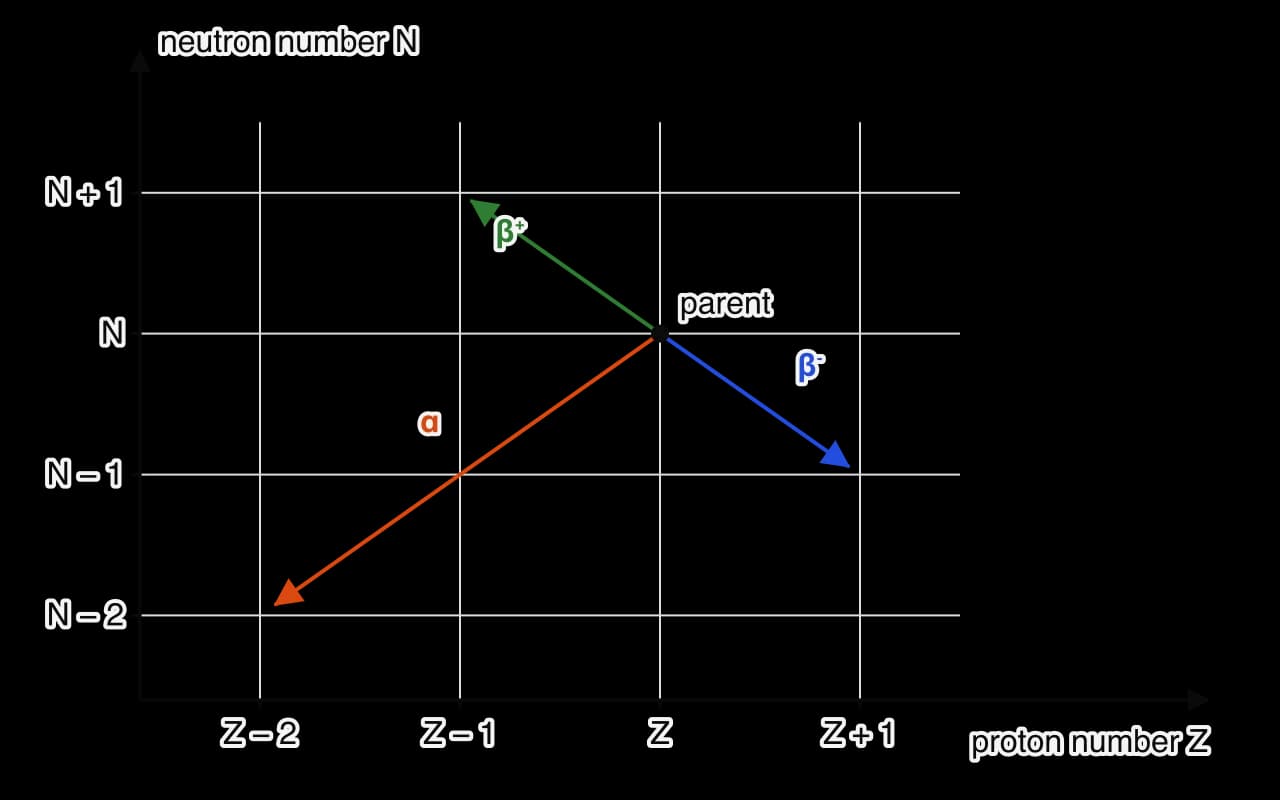
Decay | Particle emitted | Change in Z | Change in N | Change in A |
|---|---|---|---|---|
α | (helium-4 nucleus) | −2 | −2 | −4 |
β⁻ | and | +1 | −1 | 0 |
β⁺ | and | −1 | +1 | 0 |
γ | γ photon | 0 | 0 | 0 |
A daughter nucleus may itself be unstable. Uranium-238, for example, decays through a chain of fourteen α and β⁻ decays, a decay series, before it reaches stable lead-206. Radon-222, one link in that chain, is a gas, which is why it seeps out of rocks into buildings.
All three radiations are ionising radiation: as they pass through matter they knock electrons out of atoms, leaving a trail of ions. Each ionisation takes a few tens of electronvolts, so a single particle of a few MeV can produce around a hundred thousand ion pairs before it stops.
How strongly a radiation ionises depends on its charge and speed:
α particles have a charge of and move relatively slowly (about 5% of the speed of light). They interact strongly with every atom they pass, ionise very densely, and lose their energy within a few centimetres of air.
β particles have a charge of , much less mass, and move much faster (often above 90% of the speed of light). They ionise far less per millimetre, so they travel much further.
γ photons have no charge. They ionise only occasionally, when a photon interacts with an electron, so they travel furthest of all. A beam of γ photons is never completely stopped: its intensity falls gradually with thickness.
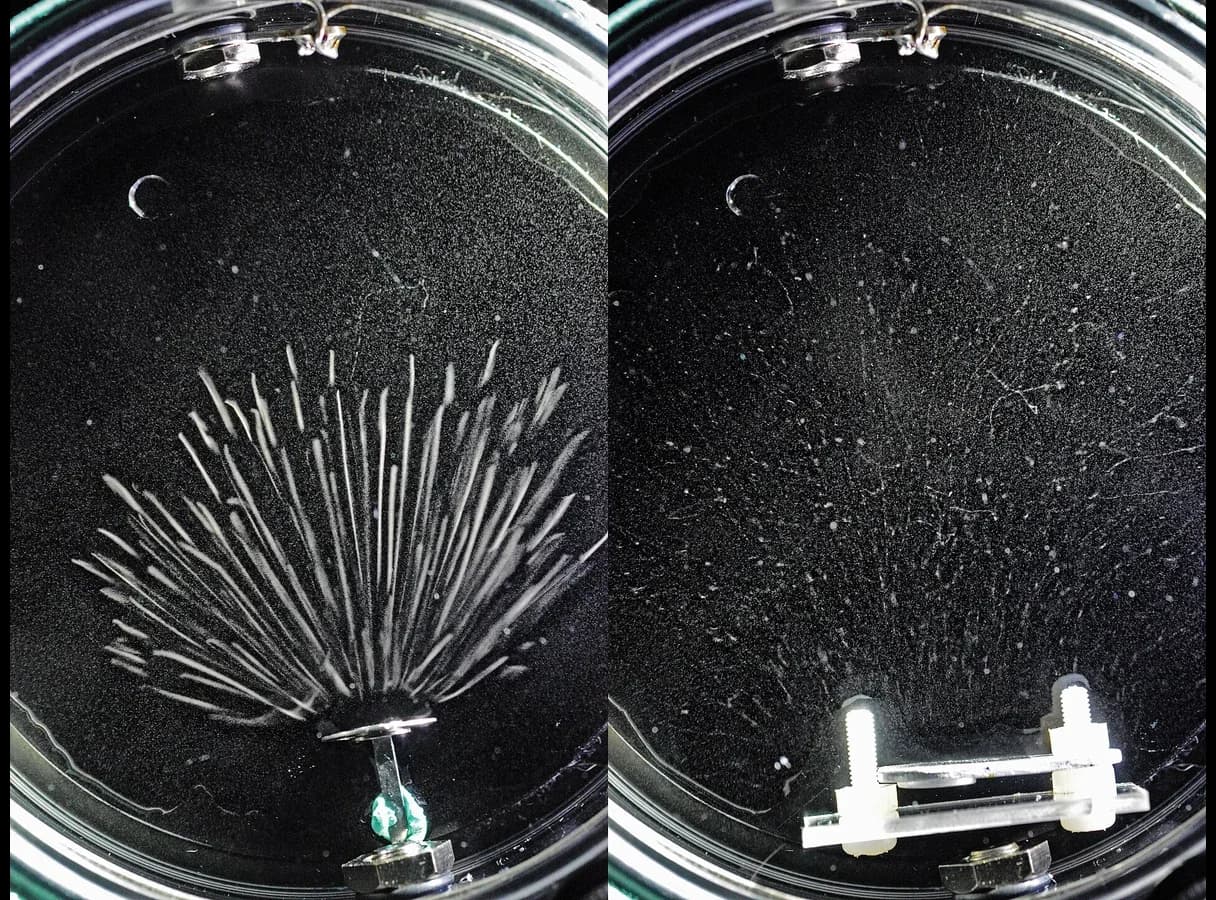
The relationship between ionisation and range follows from energy. A particle stops when its kinetic energy has been used up in ionising atoms. The more ions it makes per millimetre, the sooner its energy runs out. Strongly ionising radiation is therefore weakly penetrating, and the reverse.

The absorber diagram shows the standard result. The penetrating power of each radiation is measured by the thickness of material needed to absorb it.
Property | α | β⁻ (and β⁺) | γ |
|---|---|---|---|
Nature | helium-4 nucleus | electron (positron) | high-energy photon |
Charge | () | 0 | |
Typical speed | about | up to about | |
Ionising ability | strong | moderate | weak |
Range in air | a few cm | tens of cm to a few m | intensity falls gradually; no definite range |
Stopped by | a sheet of paper, or skin | a few mm of aluminium | reduced by several cm of lead or metres of concrete |
α particles from one nuclide are emitted with one or a few definite energies, so α particles from one source travel almost the same distance in air and stop together, with a sharp range; the americium-241 tracks in the cloud chamber are all close to the same length. β particles have a spread of energies and a much less definite range.
Positrons have a short life in matter. Once a positron has slowed down, it meets an electron and the two annihilate, producing two γ photons of 0.511 MeV each, travelling in opposite directions. Detecting these photon pairs is the basis of positron emission tomography (PET) scanning with fluorine-18.
Outside the body, α radiation is the least dangerous, because the dead outer layer of skin stops it. Inside the body (breathed in or swallowed) it is the most dangerous, because all of its energy is deposited in a small volume of living tissue. γ radiation passes through the body and is hazardous from outside, but it deposits its energy thinly. Handling sources with tongs, keeping them far away, minimising exposure time and using shielding all reduce the dose.
The choice of source for an application depends on the type of radiation, its penetration and the half-life, the time for the activity to fall by half:
Smoke detectors use about 37 kBq of americium-241, an α emitter. The α particles ionise the air between two plates, so a small current flows; smoke particles absorb the ions and the current drops, triggering the alarm. The α particles cannot escape the detector casing, and the half-life of 432 years means the source lasts for the life of the device.
Thickness gauging in paper or aluminium-foil production uses a β source on one side of the sheet and a detector on the other. A thicker sheet absorbs more β particles and the count rate falls, so the rollers are adjusted. α particles would be stopped completely and γ photons would pass through almost unchanged, so only β is sensitive to small changes in thickness.
Leak detection in buried pipes adds a short-lived γ emitter to the fluid. γ photons penetrate the soil, so a detector at the surface finds a high count rate where the fluid has leaked out. A short half-life (hours to days) means the soil does not stay radioactive for long.
Medical tracers such as technetium-99m are γ emitters, so the radiation leaves the body to reach a camera, with little ionisation along the way. The half-life of 6.0 hours is long enough to complete a scan but short enough that the activity in the patient falls quickly.
A Geiger–Müller tube (GM tube) detects ionising radiation. Radiation entering through a thin window ionises the low-pressure gas inside, and the high voltage across the tube turns each ionisation into a pulse of current, which a counter records. The number of counts per unit time is the count rate. A GM tube detects only a fraction of the radiation emitted, because the source emits in all directions and not every particle that enters is counted, so the count rate is less than the activity of the source.
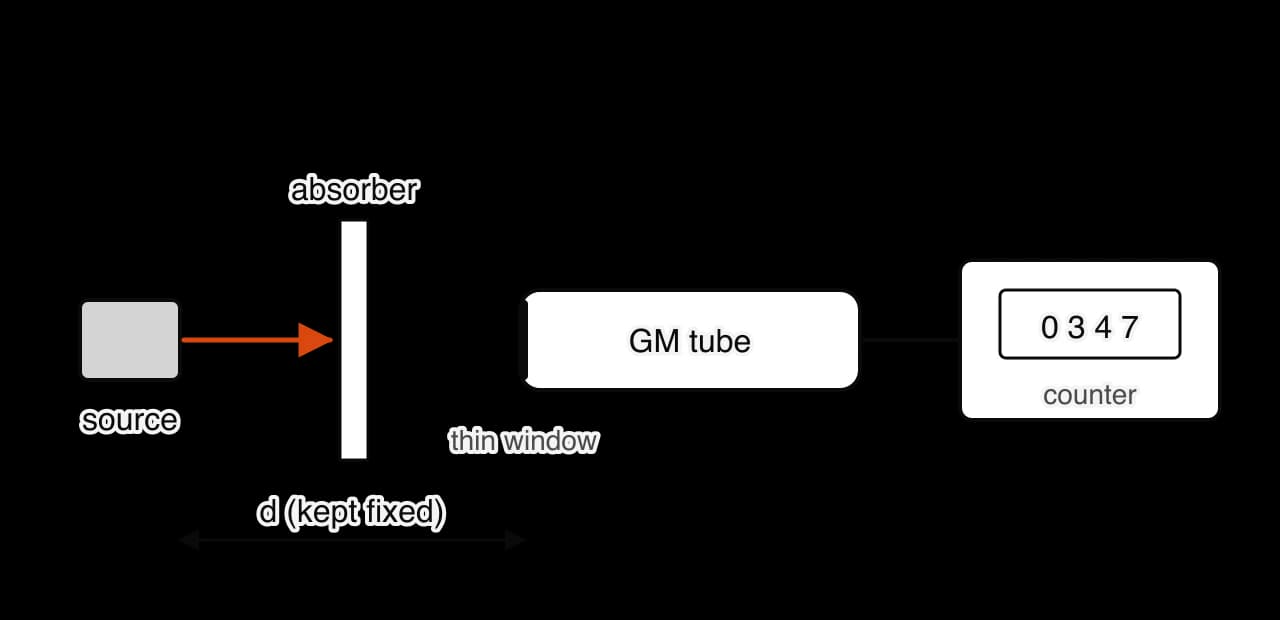
The type of radiation from an unknown source is identified with absorbers:
Measure the background count rate with no source present (over several minutes, for precision).
Measure the count rate with the source at a fixed distance from the GM tube and no absorber.
Repeat with a sheet of paper, then with about 3–5 mm of aluminium, then with a few centimetres of lead between the source and the tube, keeping the distance fixed.
Subtract the background from every reading and compare the corrected count rates.
A large fall when paper is added shows α; a further fall to background with aluminium shows β; counts remaining above background behind the aluminium, reduced by the lead, show γ. A source can emit more than one type. The distance must stay fixed because the count rate also falls with distance, and must be short (a few centimetres at most) or α particles are stopped by the air before reaching the tube.
Radioactive decay is random: it is impossible to predict when a particular nucleus will decay, or which nucleus in a sample will decay next. Every undecayed nucleus of a given nuclide has the same chance of decaying in the next second, however long it has already existed. A nucleus does not "age".
Decay is also spontaneous: it is not triggered or affected by external conditions. Heating, cooling, compressing or chemically combining a radioactive substance does not change its rate of decay, because these processes involve energies of a few electronvolts, which affect the electrons but not the nucleus, where energies are measured in MeV.
Randomness for individual nuclei leads to a predictable pattern for large numbers. If each nucleus has a fixed probability of decaying per second, the number decaying per second is proportional to the number still undecayed. A sample of nuclei decays very smoothly; a sample of a few hundred shows visible scatter.
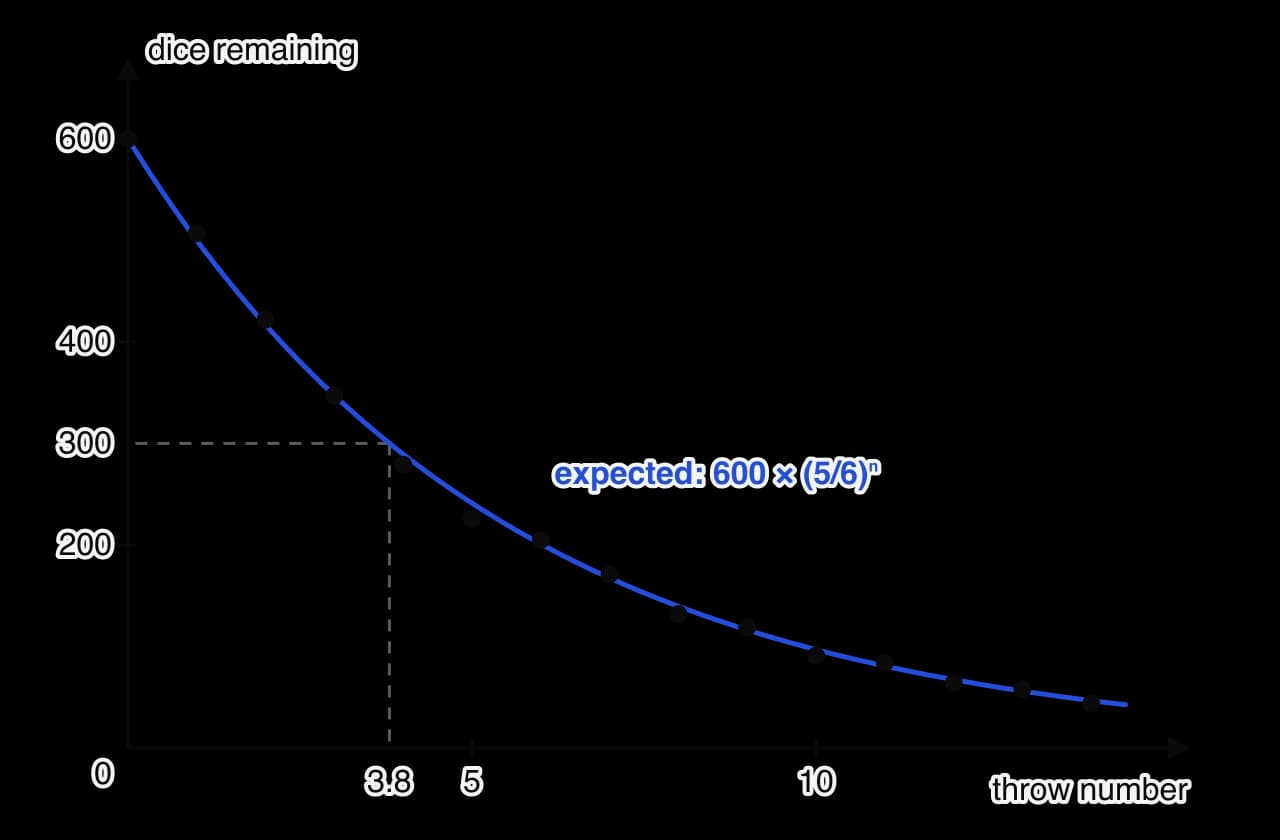
Dice make a good model. A die showing a six counts as "decayed" and is removed. Each die has a one-in-six chance of decaying at each throw, whatever has happened before, so about one-sixth of the remaining dice are removed at every throw. The simulation of 600 dice falls along an exponential curve, with random scatter about it. The number left halves every 3.8 throws, from any starting point.
The randomness shows directly in measurements. A GM tube near a steady source gives a count that fluctuates from one interval to the next. For a large mean count , the typical fluctuation is about , so counting for longer, or counting more decays, makes the measured rate more precise in relative terms: 100 counts has a relative fluctuation of about 10%, but 10 000 counts only about 1%.
Activity is measured in becquerels. A smoke-detector source has an activity of about 37 kBq; a technetium-99m dose for a scan is a few hundred MBq. Because each nucleus has a fixed probability of decaying per unit time, the activity is proportional to the number of undecayed nuclei . As falls, the activity falls in proportion.
The count rate measured by a detector is proportional to the activity, as long as the geometry (distance, absorbers, detector) stays the same. So the count rate (after background is subtracted) falls in exactly the same way as the activity and as .
The half-life is constant for a given nuclide, whatever the starting amount and however much has already decayed. After one half-life, half the nuclei remain; after two, a quarter; after three, an eighth. After whole half-lives
where and are the initial values. Half-lives range from far less than a microsecond to billions of years: polonium-214 has a half-life of 164 μs, iodine-131 has 8.0 days, carbon-14 has 5730 years and uranium-238 has years.
A decay curve of this shape is called exponential. It never reaches zero, but falls by the same factor in each equal time interval. The half-life can be read from any part of the curve: pick a value, find where it has halved, and measure the time between. Reading the half-life several times from different starting points and averaging improves the estimate.
The same reasoning works for the fraction that has decayed: after half-lives, the fraction remaining is , so the fraction decayed is . After 3 half-lives, remains and has decayed. When the daughter is stable, the ratio of daughter to parent nuclei is then .
 YouTube
Carbon-14 is produced continuously in the upper atmosphere by cosmic rays, and it enters living things through carbon dioxide and food. While an organism is alive, the ratio of carbon-14 to carbon-12 in it matches the atmosphere. When it dies, intake stops and the carbon-14 decays with a half-life of 5730 years, so the activity per gram of carbon falls. Measuring it gives the time since death, a method called radiocarbon dating.
The best-known example is Ötzi, the man whose body was found in 1991 in a melting glacier in the Ötztal Alps on the Italian–Austrian border. Radiocarbon measurements of his tissue, bone and equipment by several independent laboratories placed his death between about 3360 and 3100 BCE, roughly 5300 years ago, a little under one half-life of carbon-14. About 53% of the original carbon-14 remained.
Radiocarbon dating works for organic remains from a few hundred to about 50 000 years old. For much older samples the activity is too low to distinguish from background; for very young ones too little has decayed to measure. Older rocks are dated with longer-lived nuclides, such as uranium-238 decaying to lead-206.
A GM tube registers counts even when no source is present. This background radiation comes from natural and artificial sources all around:
radon gas seeping from rocks and soil into buildings, the largest single source;
rocks and building materials containing uranium, thorium and potassium-40;
cosmic rays from space, greater at high altitude and on aircraft;
food and drink, and the body itself, which contains potassium-40 and carbon-14;
artificial sources: medical X-rays and scans (the largest artificial source), with very small contributions from past weapons tests and nuclear power.
The worldwide average annual dose from natural sources is estimated at about 3.0 mSv (2026 United Nations estimate), roughly 60% of it from breathing in radon and its decay products. The earlier estimate of 2.4 mSv was revised upwards because of better data, not because the radiation itself increased. The level varies with location: areas built on granite, such as Cornwall in the UK, have much higher radon levels than average.
Background radiation adds to every measured count rate, so it must be measured separately (with the source removed) and subtracted:
Without the correction, a half-life read from the measured curve is too long, because the background makes the count rate fall more slowly than it should. The error is largest late in the measurement, when the source count rate is comparable to the background.
The strong force cannot be measured with a force meter, so its existence and properties are inferred from evidence:
Nuclei exist. Protons a few femtometres apart repel with forces of hundreds of newtons. A stable nucleus of many protons can only exist if a much stronger attraction acts between nucleons.
The attraction is not electric or gravitational. Neutrons have no charge, yet are bound in nuclei; gravity between nucleons is about times weaker than the electric repulsion.
It has a short range. The binding energy per nucleon is roughly constant, about 8 MeV, for all nuclei above about (it varies by only about 15% from iron to uranium). If each nucleon attracted every other nucleon, the total binding energy would grow roughly as and the binding per nucleon would grow with . A constant value means each nucleon interacts only with its nearest neighbours. This saturation also explains why nuclear density is the same for all nuclei.
It does not affect atoms. Nuclear forces play no part in chemistry or in the arrangement of atoms in solids, so they must be negligible at separations of .
High-energy scattering. α particles or electrons fired at nuclei with enough energy to reach them deviate from the predictions of electric scattering alone, showing an extra, short-range nuclear interaction.
About 250 nuclides are stable. Plotted on a chart of neutron number against proton number , they form a narrow band, the band of stability.
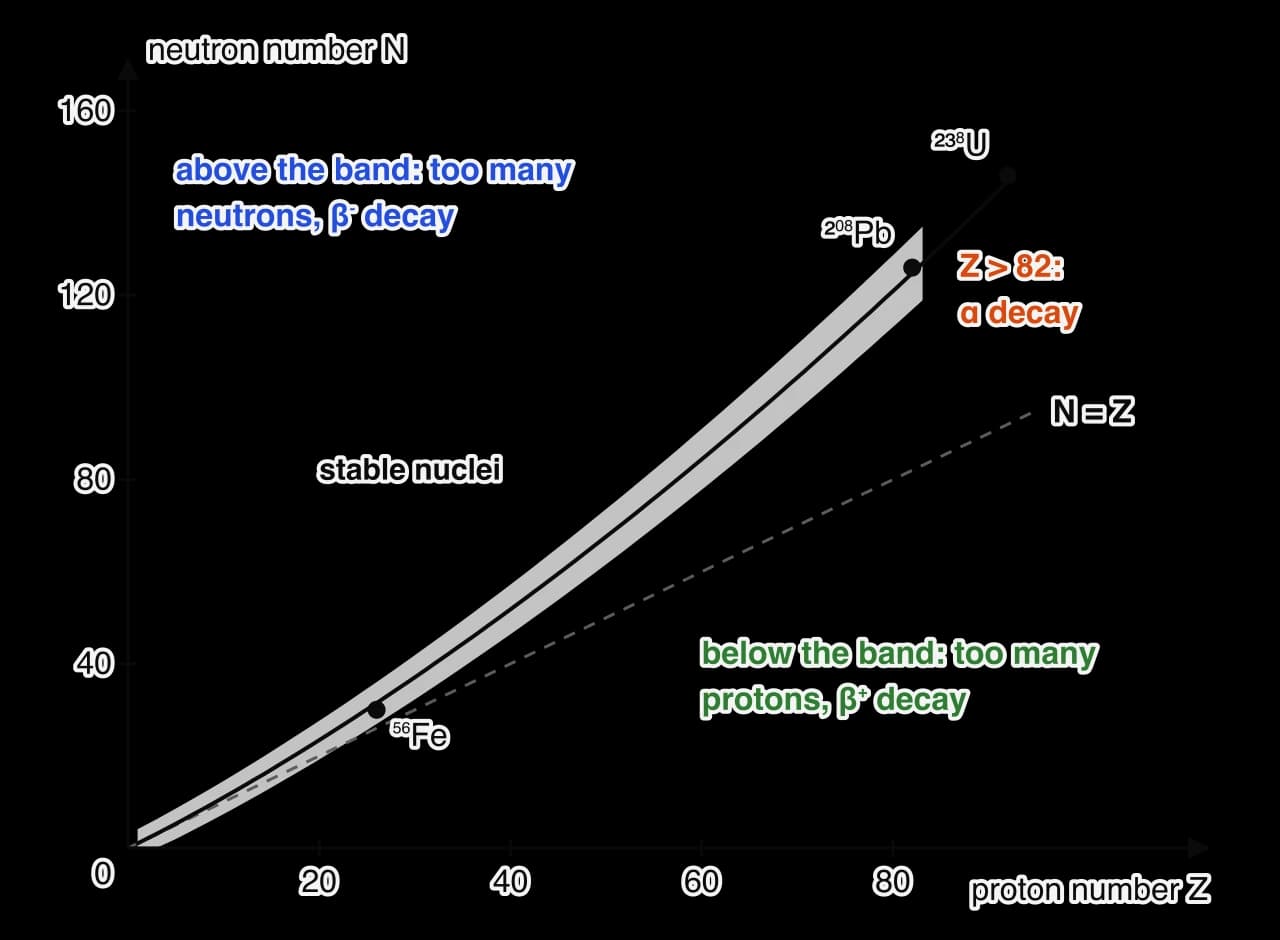
The plot shows these patterns:
For light nuclei (up to ), stable nuclei have , a neutron-to-proton ratio close to 1. Helium-4, carbon-12, oxygen-16 and calcium-40 all have .
For heavier nuclei the band curves above the line . Stable heavy nuclei need more neutrons than protons: iron-56 has , lead-208 has .
No nuclide with is stable. Every element beyond lead is radioactive.
The reason is the competition between the forces. Extra neutrons add strong-force attraction without adding electric repulsion. As grows, the repulsion between protons (which acts across the whole nucleus) grows faster than the short-range attraction, so a heavy nucleus needs a higher proportion of neutrons to stay bound. There is a limit to how far this helps: too many neutrons also make a nucleus unstable, because the neutrons then sit at higher energy than a proton in the same nucleus would.
An unstable nucleus decays in the direction that brings it closer to the band of stability:
Above the band (too many neutrons for its ): β⁻ decay turns a neutron into a proton, moving the nucleus one place down and one to the right, towards the band. Fission products, which inherit the high of uranium, are β⁻ emitters for this reason.
Below the band (too many protons): β⁺ decay turns a proton into a neutron, moving one place up and one to the left.
Very heavy (): α decay removes two protons and two neutrons, reducing the electric repulsion; because it removes equal numbers it slightly raises , which is why α decays in a series are interspersed with β⁻ decays.
When the kinetic energies of α particles from one nuclide are measured, they are not spread out: they take only a few sharp values. The same is true of the γ photons emitted afterwards. Americium-241 emits α particles with three main energies, as its α spectrum shows.

The sharp energies have a simple explanation, by analogy with atomic line spectra: the nucleus has nuclear energy levels. An α decay releases a fixed total energy, but the daughter nucleus may be left either in its ground state or in one of several excited states. Each α energy corresponds to a different final level of the daughter. The excited daughter then falls to a lower level by emitting a γ photon, whose energy equals the difference between the two levels.
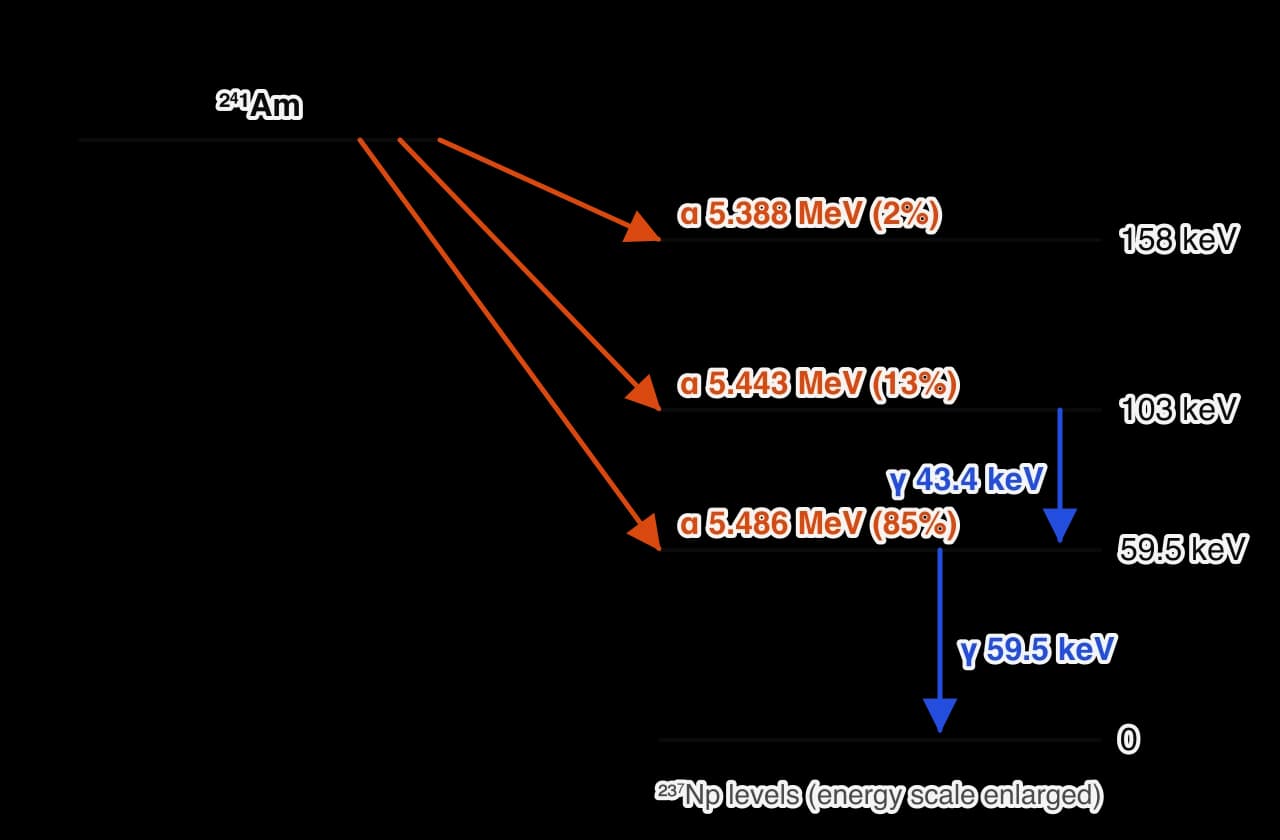
The energy-level diagram for americium-241 links the two spectra. The most common α particle, 5.486 MeV, leaves neptunium-237 in its 59.5 keV level, which then emits a 59.5 keV γ photon. The differences between α energies match the γ energies: the 5.486 MeV and 5.443 MeV α particles differ by 43 keV, and a 43.4 keV γ photon is emitted between the 103 keV and 59.5 keV levels. (The α energies differ slightly less than the levels, because the recoiling nucleus takes a small share of the energy.) Nuclear levels are spaced by keV to MeV, thousands to millions of times wider than the eV spacing of atomic levels.
β particles behave differently. Measurements of the kinetic energies of β⁻ particles from a single nuclide, first made carefully in the 1910s and 1920s, show a continuous spectrum: electrons emerge with every energy from almost zero up to a maximum, .
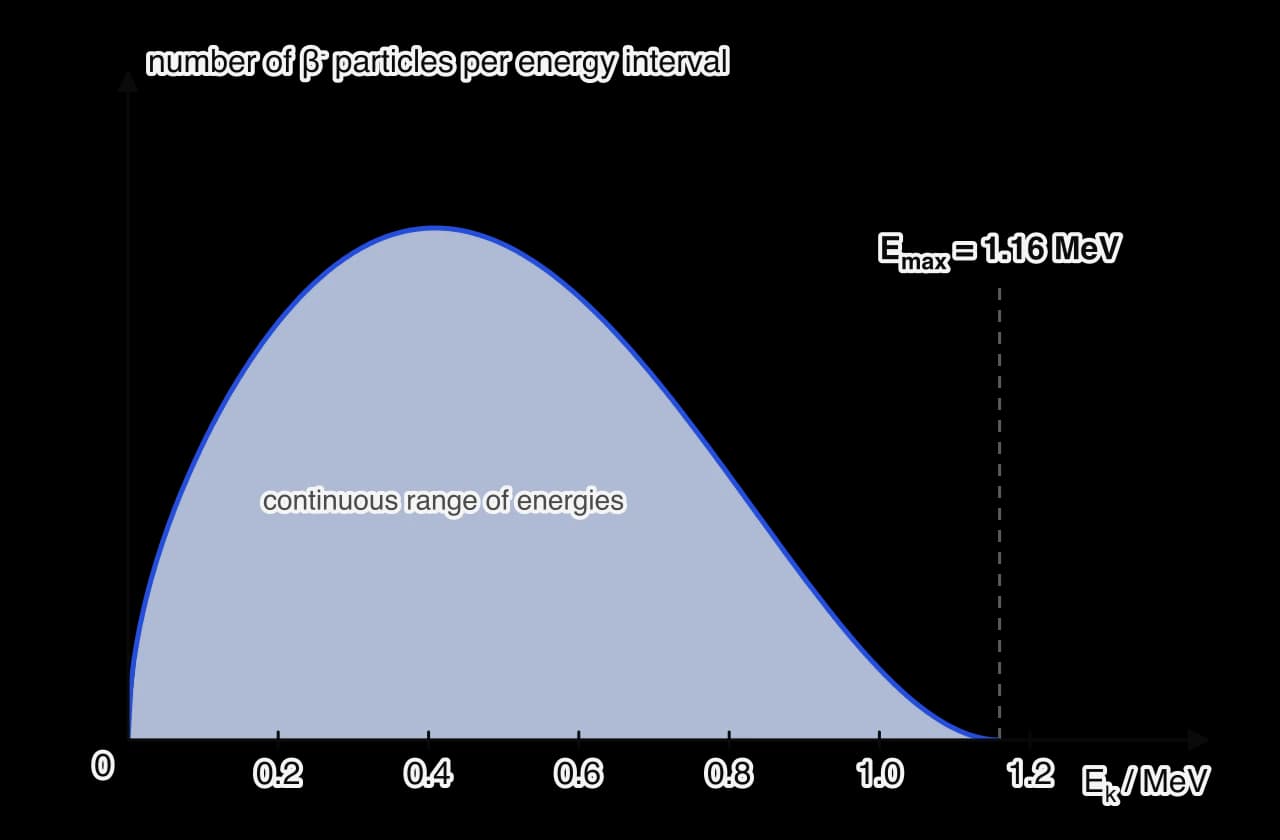
This was a serious puzzle. Each decay of a given nuclide releases the same energy, found from the masses of parent and daughter, and it equals . If only the electron and the daughter nucleus were produced, momentum conservation would force them to share the energy in one fixed ratio, so every electron would have the same energy, just as α particles do. Most electrons have much less energy than this: on its own, the spectrum seemed to show energy disappearing.
In 1930 Wolfgang Pauli proposed that a third, undetected particle is emitted in every β decay and carries away the missing energy and momentum. It had to be electrically neutral (charge is already conserved) and have very little or no mass (since some electrons do reach ). This particle, later named the neutrino, interacts so weakly with matter that it passes through the whole Earth almost unaffected. With three particles sharing the energy, any split is possible, which produces the continuous spectrum.
Feature | α spectrum | β spectrum |
|---|---|---|
Shape | a few sharp lines | continuous, from 0 to a maximum |
Number of particles emitted | two: α and daughter nucleus | three: β, (anti)neutrino and daughter |
Energy sharing | fixed by momentum conservation | any split between the three |
Evidence for | discrete nuclear energy levels | the neutrino |
Similar continuous spectra are found for β⁺ decay, where the missing energy is carried by a neutrino rather than an antineutrino.
Because the activity is proportional to the number of undecayed nuclei, , the constant of proportionality defines the decay constant :
A large decay constant means a nuclide decays quickly. Each nuclide has its own value, which, like the half-life, is not affected by external conditions.
For a short time interval , the fraction of nuclei that decay is , which is also the probability that any one nucleus decays in that interval. This interpretation of as "the probability of decay per unit time" is accurate only when is small. Over a longer interval the number of undecayed nuclei falls noticeably during the interval, so fewer decay than suggests. The exact probability of decay in time is .
The rate at which nuclei decay is proportional to the number remaining. Any quantity that falls at a rate proportional to its own size decays exponentially:
and, multiplying both sides by ,
where and are the values at , and . These equations give and at any time, whether or not it is a whole number of half-lives.
The number of nuclei decaying per unit time is , so . Separating variables, , which gives and so .
After one half-life, . Substituting into the decay equation:
A short half-life means a large decay constant. The units must match: a half-life in days gives in , and to use with activity in becquerels, must be in .
When is needed from a measured activity, use with in . A mass then follows from the molar mass: .
Taking natural logarithms of gives
which finds the time for the activity to fall from to . This is how radiocarbon ages are calculated.
A curve is hard to analyse accurately, so the exponential relation is made linear. Taking natural logarithms of :
This has the form . A graph of (or of the corrected count rate) against is a straight line with gradient and intercept . Its straightness also tests whether the decay really is exponential, and a best-fit line uses all the data at once.
Very long half-lives, such as that of uranium-238, cannot be found from a decay curve, because the activity does not change measurably during an experiment. Instead the activity and the number of nuclei in a weighed sample are both measured, and gives the decay constant directly. Very short half-lives are found by timing the delay between the formation and the decay of individual nuclei electronically.
 YouTube
Definitions and explanations about radioactivity are marked on precise physics words.
"Define binding energy" needs the idea of energy needed to separate a nucleus into its individual nucleons (or released when it is formed from them). "The energy holding the nucleus together" does not score.
"Explain why the count rate does not fall to zero" is answered by background radiation, with a named source (radon, rocks, cosmic rays).
Answers about measurement precision should mention randomness: few nuclei, or a short count, give large fluctuations.
A group of students measures the count rate from a sample of protactinium-234 using a GM tube. The background count rate was measured as counts per minute. Each count rate in the table is the mean of three 20-second counts, scaled to counts per minute.
t / s | measured count rate / min⁻¹ | corrected count rate / min⁻¹ |
|---|---|---|
0 | 942 | 920 |
30 | 706 | 684 |
60 | 530 | 508 |
90 | 399 | 377 |
120 | 302 | 280 |
150 | 230 | 208 |
I can state what isotopes are and give the numbers of protons, neutrons and electrons from nuclear notation.
I can define mass defect and binding energy, and calculate both in u, MeV and J, using atomic or nuclear masses correctly.
I can calculate binding energy per nucleon and interpret the binding-energy curve, including why fission and fusion release energy.
I can describe the properties of the strong nuclear force and explain how it competes with electric repulsion.
I can write balanced decay equations for α, β⁻, β⁺ and γ decay, including the neutrino or antineutrino.
I can calculate the energy released in a decay from masses.
I can compare the nature, ionising ability and penetration of α, β and γ radiation, and identify radiation from absorber data.
I can explain what random and spontaneous decay mean and how randomness shows in count rates.
I can define activity and half-life, find a half-life from a decay curve, and calculate activities after whole numbers of half-lives.
I can name sources of background radiation and correct count rates for it.
I can justify the choice of isotope for a medical, industrial or dating application.
HL: I can give the evidence for the strong nuclear force, including the near-constant binding energy per nucleon above A ≈ 60.
HL: I can use the N–Z plot to explain stability and predict the mode of decay of a nuclide.
HL: I can explain how α and γ spectra show nuclear energy levels, and how the continuous β spectrum is evidence for the neutrino.
HL: I can use , and
HL: I can explain when approximates the probability of decay per unit time.
HL: I can find and the half-life from the gradient of a graph of against .
The answer is B.
Cosmic-ray muons are produced 8.8 km above the ground, measured in the Earth frame, and move vertically downwards at . The Lorentz factor for this speed is 5.0. The half-life of muons in their rest frame is 1.5 μs. According to observers on the ground, how many half-lives pass while the muons travel to the ground?
Unstable particles called kaons have a half-life of 8.6 ns when measured at rest. In a laboratory, a beam of kaons travels at a speed of along a straight evacuated tube.
Calculate the Lorentz factor for the kaons.
1 mark
Calculate the half-life of the kaons in the reference frame of the laboratory.
1 mark
The beam passes detector X and then detector Y, which is 18 m further along the tube in the laboratory frame. Calculate the fraction of the kaons passing X that reach Y.
2 marks
State and explain which observer measures the proper half-life of the kaons.
2 marks
Electrons. A neutral atom has as many electrons as protons: 92 in each.
The isotopes differ only by three neutrons, yet uranium-235 is the one that sustains a chain reaction in a reactor.
Binding energy.
Per nucleon. per nucleon.
The accepted value is 7.98 MeV. The small difference comes from rounding the proton and neutron masses to four significant figures: the mass defect is the small difference of two large, nearly equal numbers, so rounding in the data has a large effect. Masses in u, given to six or seven significant figures, avoid this problem.
This is the lowest binding energy per nucleon of any nucleus with more than one nucleon, the first point on the binding-energy curve. The masses are given to five or six significant figures because the rounded booklet values, 938 and 940, would make the small mass defect very uncertain.
(b) : . Charge: . X is an electron, : this is β⁻ decay, consistent with the antineutrino.
(c) and charge already balance (, ), so X has no charge and no nucleon number. A positron is emitted, so X is a neutrino, .
Identifying the element in (a) needs a periodic table or the information in the question; chemical symbols are always given.
(b) .
(c) The intercept is , so counts per minute.
Using two widely separated points on the best-fit line, rather than two data points, gives the most reliable gradient.