Notes on E.2 Quantum physics
Light spreads, diffracts and interferes like a wave, yet when it delivers energy to a single electron it behaves like a stream of separate particles. Electrons, which carry a definite charge and mass, can produce diffraction patterns as if they were waves. Quantum physics is the description of these two-sided behaviours. It explains how a solar cell or a camera sensor turns light into an electric current, and why an electron microscope can resolve detail far finer than any light microscope.
Photons: packets of electromagnetic energy
In the photon model, electromagnetic radiation carries energy in separate packets rather than as a continuous wave. Each packet is a photon, and the energy of a photon depends only on the frequency of the radiation:
where is the Planck constant, , and is the speed of light. A beam of light of one frequency is a stream of identical photons. Making the beam brighter increases the number of photons arriving each second, not the energy of each photon. The idea grew from Max Planck's 1900 explanation of the spectrum of hot bodies, and Albert Einstein applied it to light itself in 1905.
The electronvolt
Photon energies are tiny in joules, so atomic and quantum physics uses a smaller unit. One electronvolt (eV) is the energy gained by an electron accelerated through a potential difference of 1 V:
To convert joules to electronvolts, divide by ; to convert back, multiply. The product can also be written as
Intensity and the rate of arrival of photons
The intensity of a beam is the power it delivers per unit area. If photons each of energy arrive per second, the power of the beam is . A dim beam of ultraviolet can therefore carry fewer photons than a bright beam of red light, but each of its photons carries more energy. The number of photons per second, the photon flux, is what changes when a beam is made brighter or dimmer at a fixed frequency.
The momentum of a photon
A photon has no rest mass, but it does carry momentum. Its momentum is related to its wavelength and energy by
For visible light this momentum is extremely small: a 500 nm photon has
The photoelectric effect
When electromagnetic radiation of high enough frequency falls on a metal surface, electrons are released from the surface. This is the photoelectric effect, and the released electrons are called photoelectrons. A simple demonstration uses a clean zinc plate fixed to the top of a gold-leaf electroscope. The plate and leaf are first given a negative charge, so the leaf rises.
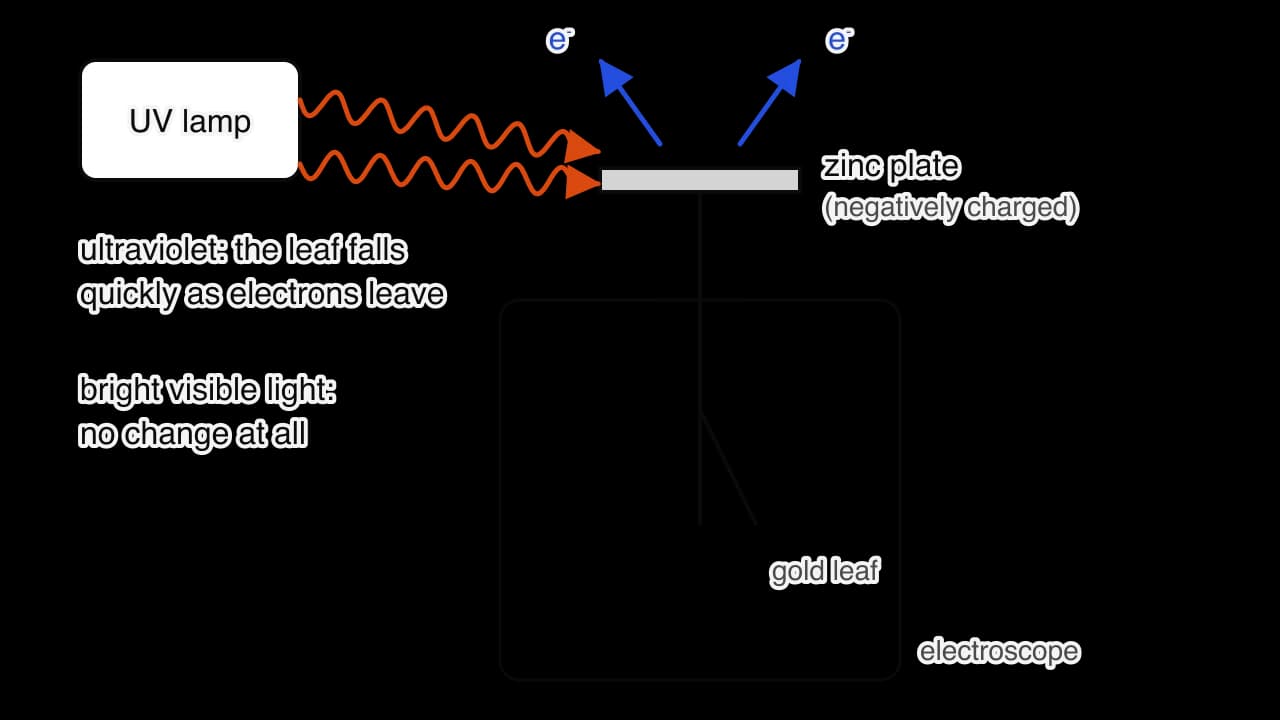
The electroscope demonstration shows three features. Ultraviolet makes the leaf fall almost at once, because electrons leave the plate. Visible light, even from a very bright lamp, has no effect at all. If the plate is charged positively instead, ultraviolet does not discharge it, because any emitted electrons are attracted straight back to the plate.
What is observed
Careful experiments with many metals and frequencies give a consistent set of results:
A threshold frequency. For each metal there is a minimum frequency below which no electrons are emitted, however intense the radiation or however long it shines.
Instant emission. Above , electrons are released immediately (within about
 YouTube
Why the wave model fails
In the classical wave model, light is a continuous electromagnetic wave whose energy is spread evenly over the wavefront. The energy delivered per second depends on the intensity, which depends on the square of the amplitude, and not on the frequency. Applied to the photoelectric effect, this model makes three clear predictions, and all three are contradicted by experiment.
Feature | Wave model predicts | Experiment shows |
|---|---|---|
Threshold | Any frequency releases electrons if the light is intense enough or shines for long enough | Below no electrons are released at any intensity |
Time delay | Dim light needs time (minutes or more) for an electron to absorb enough energy | Emission is effectively instant, even in dim light |
Effect of intensity | More intense light gives each electron more energy, so |
The photoelectric effect is a clear case of a successful theory being falsified by experiment. The wave model of light explains reflection, refraction, diffraction and interference extremely well, and it was not abandoned. Instead, it was found to be incomplete: it cannot describe how light gives up its energy to matter.
Einstein’s photon explanation
Einstein's explanation rests on the idea that the energy of light arrives in photons and that one photon interacts with one electron, giving up all of its energy at once. A photon cannot share its energy among several electrons, and an electron almost never absorbs two photons. The electron uses part of the energy to escape from the metal and keeps the rest as kinetic energy.
The electrons released with the most kinetic energy are those that needed only the work function to escape. Conservation of energy for one photon and one such electron gives Einstein's photoelectric equation:
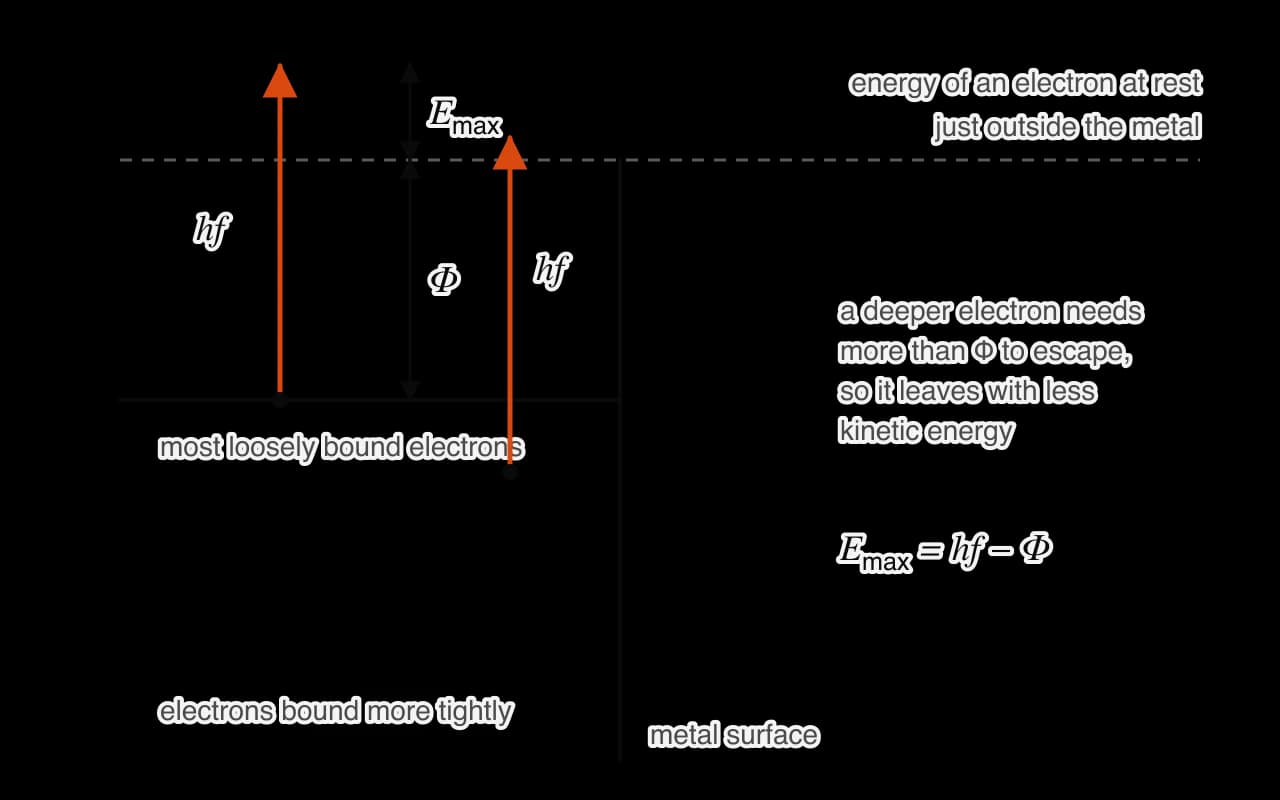
The energy diagram explains why is a maximum and not the energy of every photoelectron. Electrons further below the surface, or more tightly held, use more than in escaping, so they emerge with less kinetic energy. Some lose all of it and never leave. Photoelectrons therefore have a spread of kinetic energies from zero up to .
Threshold frequency and threshold wavelength
A photon can release an electron only if its energy is at least the work function. The threshold frequency is the frequency at which equals :
Radiation with a frequency above (or a wavelength shorter than the threshold wavelength ) releases electrons; radiation below it does not, however many photons arrive.
With the photon model, each failed prediction of the wave model is explained:
Threshold. If , no single photon has enough energy to free an electron, and electrons do not store energy from several photons, so intensity cannot help.
Instant emission. The energy of a photon is delivered to one electron in a single event, so there is no build-up time. Dim light means fewer photons, and so fewer electrons, but the first ones are released at once.
Intensity. More intense light means more photons per second, so more electrons per second and a larger current. Each photon still has energy , so
Work functions depend on the metal and on the state of its surface. The alkali metals have low work functions, so visible light releases electrons from them; most other metals need ultraviolet.
Metal | Work function Φ / eV | Threshold wavelength λ₀ / nm | Region |
|---|---|---|---|
Caesium | 1.95 | 640 | visible (red) |
Potassium | 2.29 | 540 | visible (green) |
Sodium | 2.75 | 450 | visible (blue) |
Zinc | 3.63–4.9 | 340–250 | ultraviolet |
Copper | 4.53–5.10 | 270–240 | ultraviolet |
Platinum | 5.12–5.93 | 240–210 | ultraviolet |
Data: CRC Handbook of Chemistry and Physics, 2008, “Electron work function of the elements”; threshold wavelengths calculated from these values. A range means that different crystal faces and surface preparations give different values.
Measuring photoelectron energies
The energies of photoelectrons are measured with a photocell: a photosensitive metal cathode and an anode sealed in an evacuated tube. Light falls on the cathode, and any electrons that reach the anode form a current in the external circuit, the photocurrent. The vacuum ensures the electrons do not collide with gas molecules on the way.
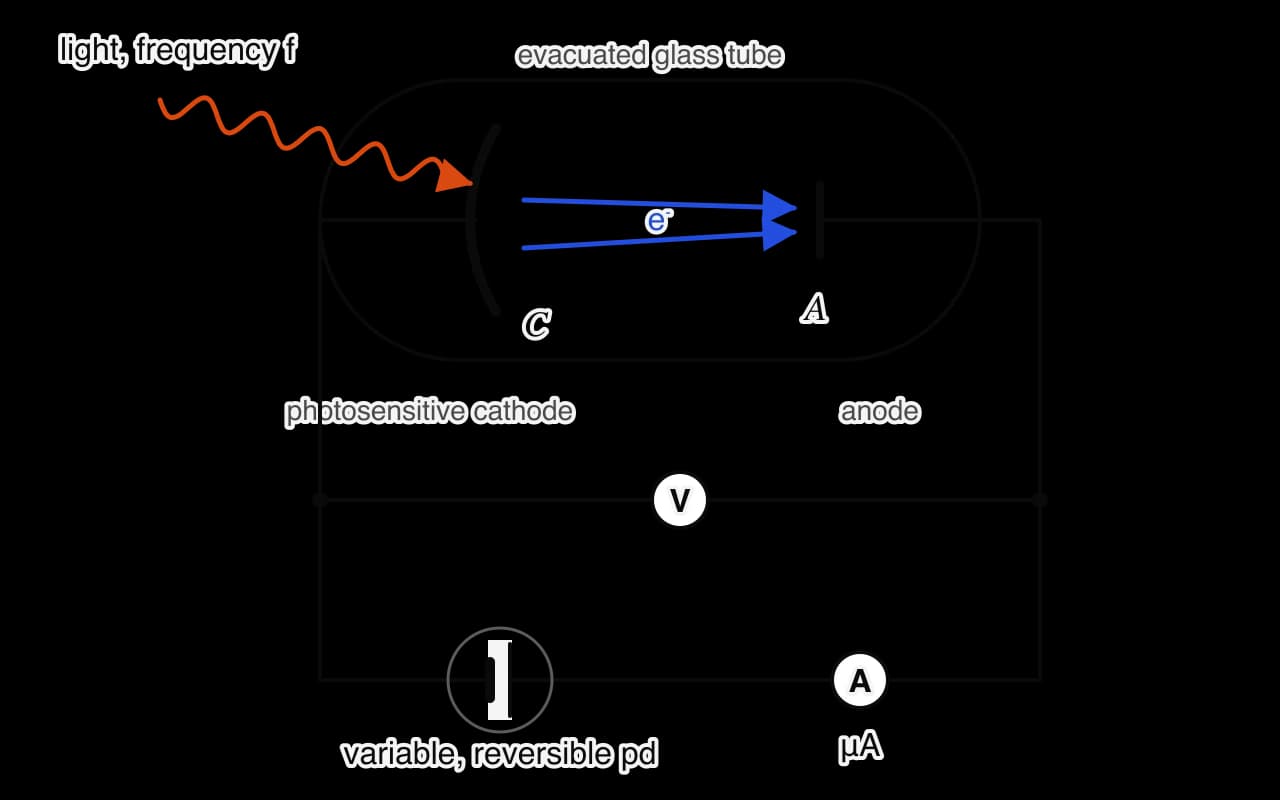
When the anode is positive relative to the cathode, it attracts the photoelectrons. When the supply is reversed, the anode is negative and repels them. Only electrons with enough kinetic energy to climb the potential difference reach the anode. As the reverse pd is increased, fewer and fewer electrons arrive, until at the stopping potential even the fastest electrons are turned back and the current falls to zero.
At the stopping potential the work done against the field on an electron of charge equals the largest kinetic energy any photoelectron has:
A stopping potential of 0.66 V means . This one-to-one link between volts and electronvolts makes the electronvolt the natural unit for photoelectron energies.
Current–potential difference graphs
Measuring the photocurrent for a range of anode pds , from negative to positive, gives a characteristic curve. Three regions can be seen on it:
Below : no current, because no electron has enough energy to reach the anode.
Between and small positive pds: the current rises as the anode repels fewer electrons, and then begins to attract them. The current is not zero at
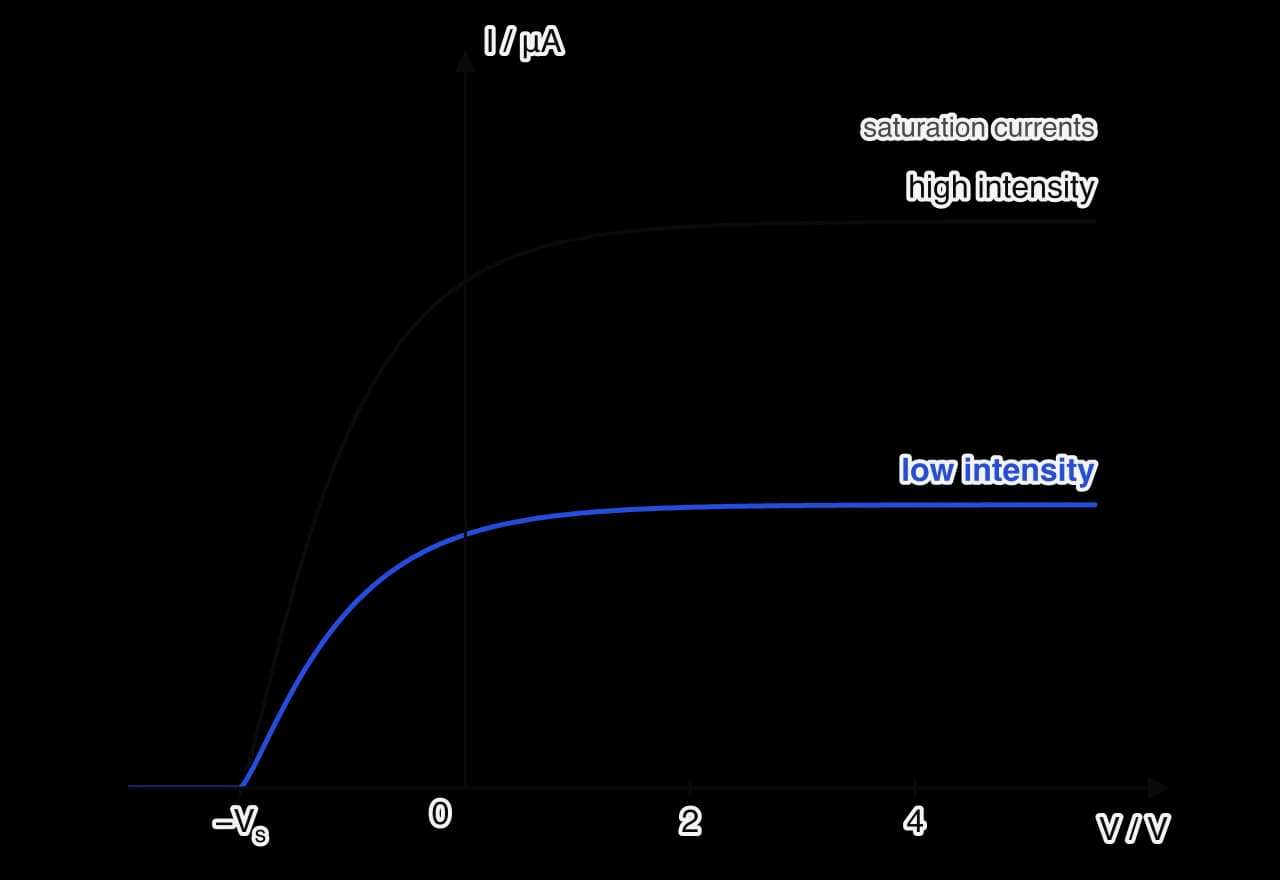
The intensity graph separates the two effects of the light. Intensity sets the number of photons per second, and so the saturation current; frequency sets the energy of each photon, and so the stopping potential.
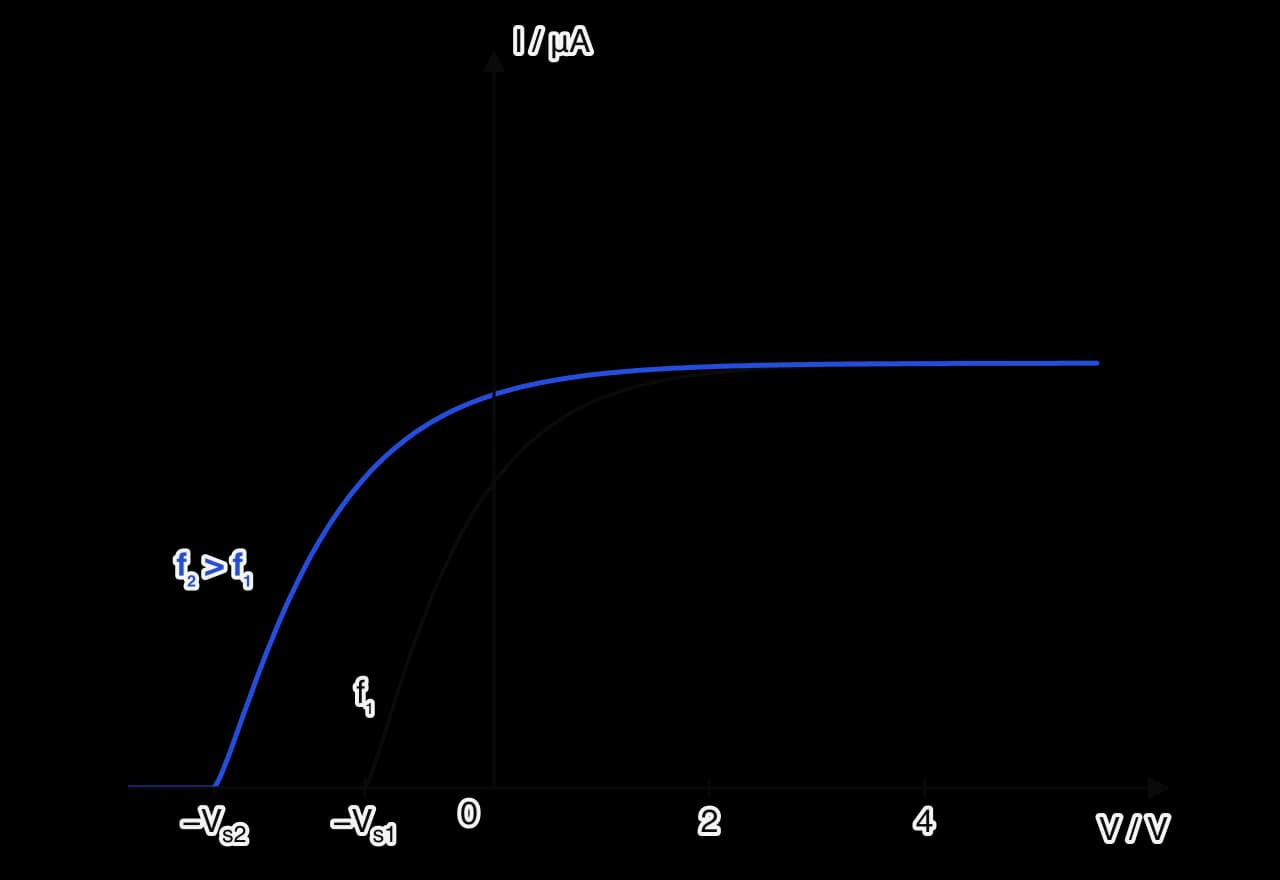
The frequency graph compares two frequencies with the same number of photons arriving each second, so the saturation currents are equal. If instead the intensity (the power per unit area) is kept the same while the frequency rises, each photon carries more energy, so fewer photons arrive per second and the saturation current is lower. In both cases the stopping potential is larger at the higher frequency.
Saturation current and photon flux
Each photoelectron carries charge , so a saturation current corresponds to electrons per second. Comparing this with the number of photons per second shows how efficient the cathode is. In real photocells only a small fraction of photons release an electron: most are reflected or absorbed without freeing one.
The stopping potential–frequency graph
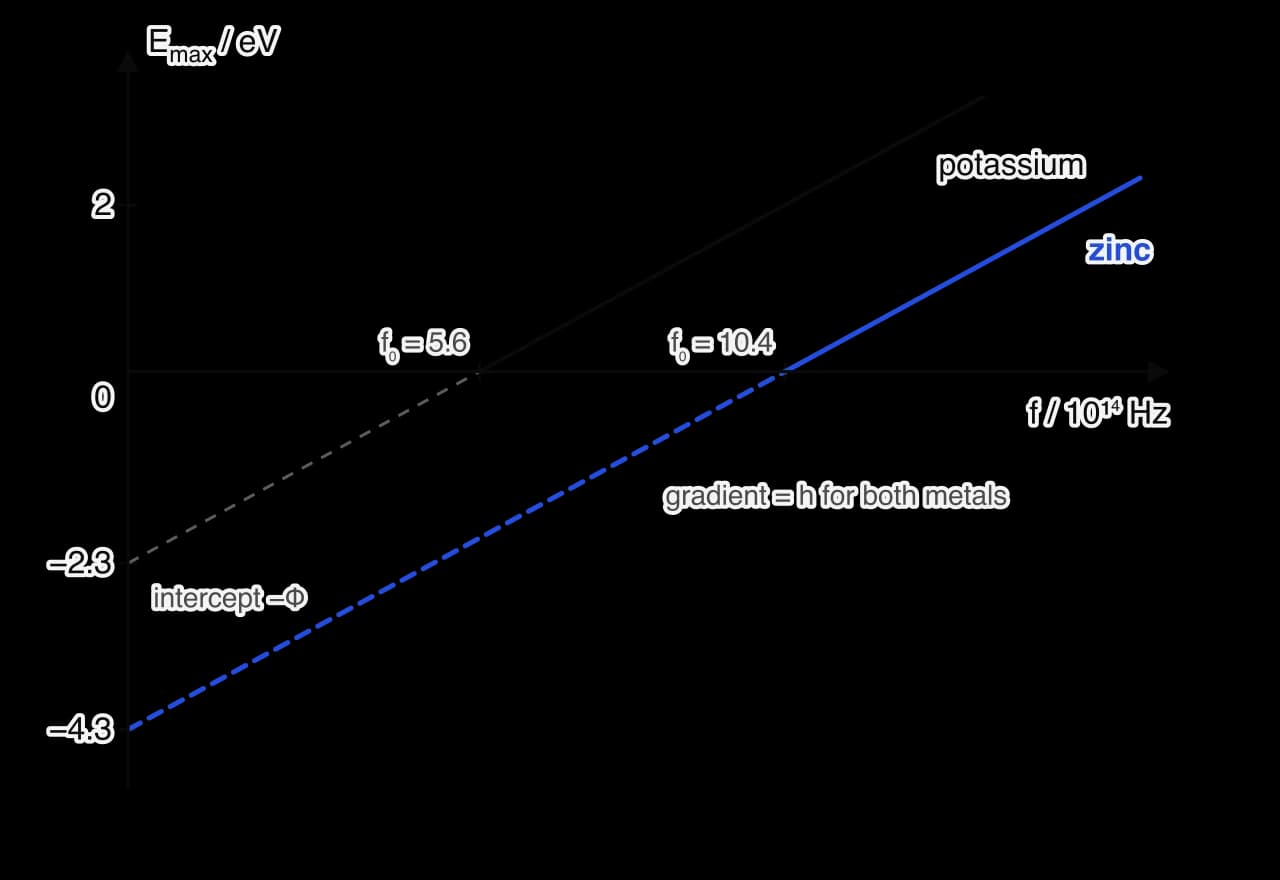
Rearranging gives an equation of a straight line:
A graph of (on the vertical axis) against is therefore a straight line with:
gradient , the same for every metal, so ;
intercept on the frequency axis at the threshold frequency , where
A graph of against has the same shape, with gradient and intercept . Different metals give parallel lines, shifted along the frequency axis by their different work functions.
Case study: Millikan tests Einstein’s equation
When Einstein proposed his equation in 1905, most physicists, including Robert Millikan at the University of Chicago, thought that light quanta must be wrong, because the wave theory of light was so well established. Millikan spent around ten years testing the prediction that is a linear function of with a gradient of .
The main experimental difficulty was the metal surface. Oxide layers change the work function and spoil the results, so Millikan used the alkali metals sodium, potassium and lithium, whose low work functions let him use visible and near-ultraviolet light, and he cleaned their surfaces inside the vacuum with a knife blade moved by electromagnets from outside the glass. His results, published in 1916, gave straight lines exactly as Einstein had predicted, and a value of of , within about 1% of the modern value.
The experiment is a strong example of how evidence is weighed in science. Millikan had expected to disprove the equation, but his data supported it, and he reported them as they were. Einstein received the 1921 Nobel Prize in Physics for his explanation of the photoelectric effect, and Millikan the 1923 prize, partly for this work.
Matter waves
If waves of light can behave as particles, perhaps particles can behave as waves. In 1924 Louis de Broglie proposed that every moving particle has a wave associated with it, with a wavelength given by the same relation as for a photon, . These waves are called matter waves.
For a particle of mass moving at a speed well below , , so
Particles accelerated through a potential difference
Electrons are usually given their speed by accelerating them through a potential difference . A particle of charge gains kinetic energy . Writing the kinetic energy in terms of momentum,
The wavelength is inversely proportional to the square root of the accelerating pd: quadrupling halves . Electrons accelerated through a few kilovolts have wavelengths of about 0.02 nm, about a tenth of the spacing of atoms in a crystal.
Because , different particles accelerated through the same pd have different wavelengths. The comparison depends on whether the particles have the same pd or the same kinetic energy.
Electron diffraction: evidence for matter waves
A wave is diffracted noticeably only by a gap or an obstacle comparable in size to its wavelength. Electron wavelengths of about m match the spacing of atoms in a crystal, so a crystal acts as a natural diffraction grating for electrons. If electrons are waves, a beam passing through or reflecting off a crystal should form a diffraction pattern; if they are only particles, it should not.
The Davisson–Germer experiment
In 1927 Clinton Davisson and Lester Germer, working at Bell Telephone Laboratories in New York, fired a beam of slow electrons at a single crystal of nickel in a vacuum and measured how many were scattered at each angle.
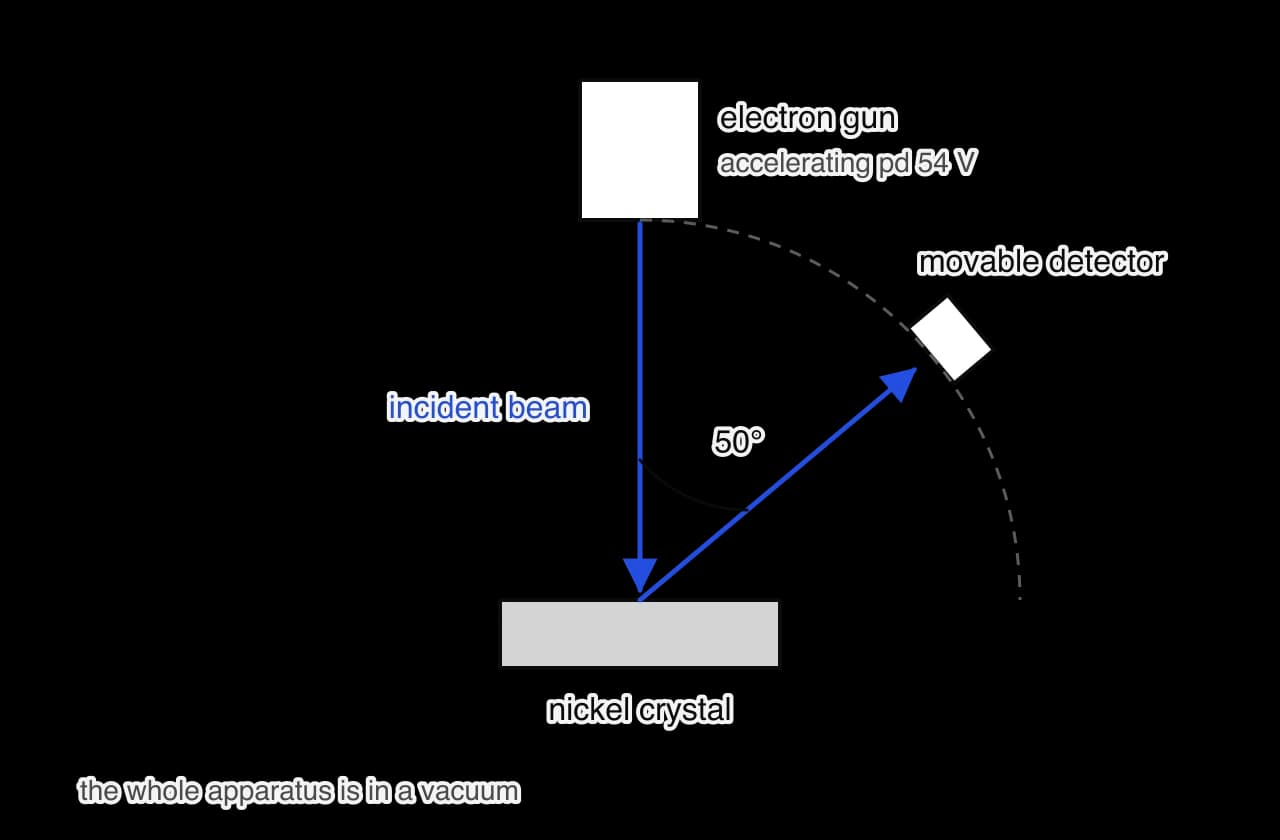
Particles bouncing off a surface would scatter smoothly over all angles. Instead, for electrons accelerated through 54 V, the number detected rose sharply to a maximum at an angle of 50° to the incident beam. A maximum at one particular angle is the signature of waves diffracted by the regular rows of atoms.
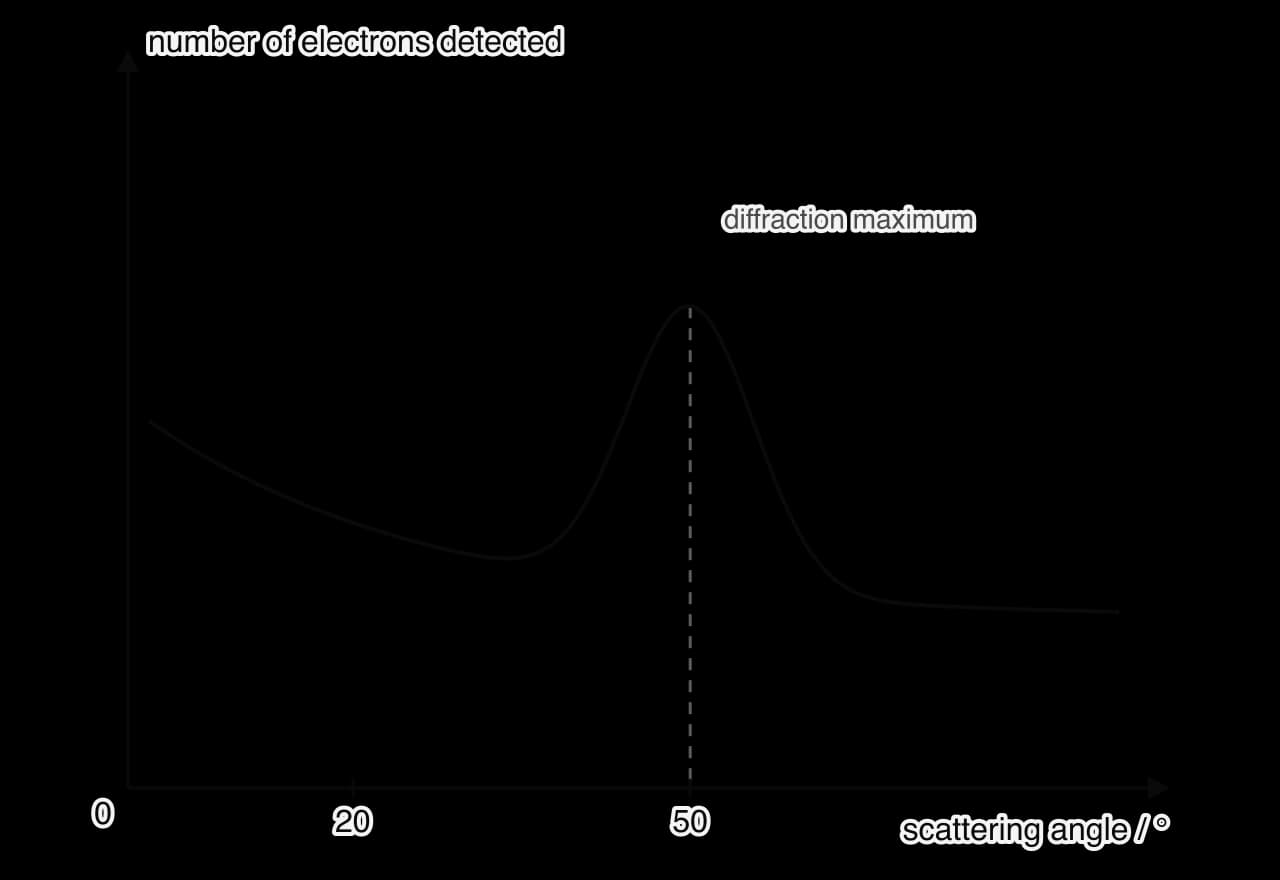
The test is quantitative. For a 54 eV electron the de Broglie wavelength is
The rows of atoms on the nickel surface are 0.215 nm apart, and for waves reflected from such rows the first maximum appears where . With this gives
The electron diffraction tube
Electron diffraction is shown in schools with an electron diffraction tube. Electrons from a heated cathode are accelerated through a few kilovolts and pass through a thin film of graphite. The film contains many tiny crystals at random orientations, so the electrons diffracted at each allowed angle form a cone. The cones meet the fluorescent screen as concentric bright rings around the undeflected central spot.
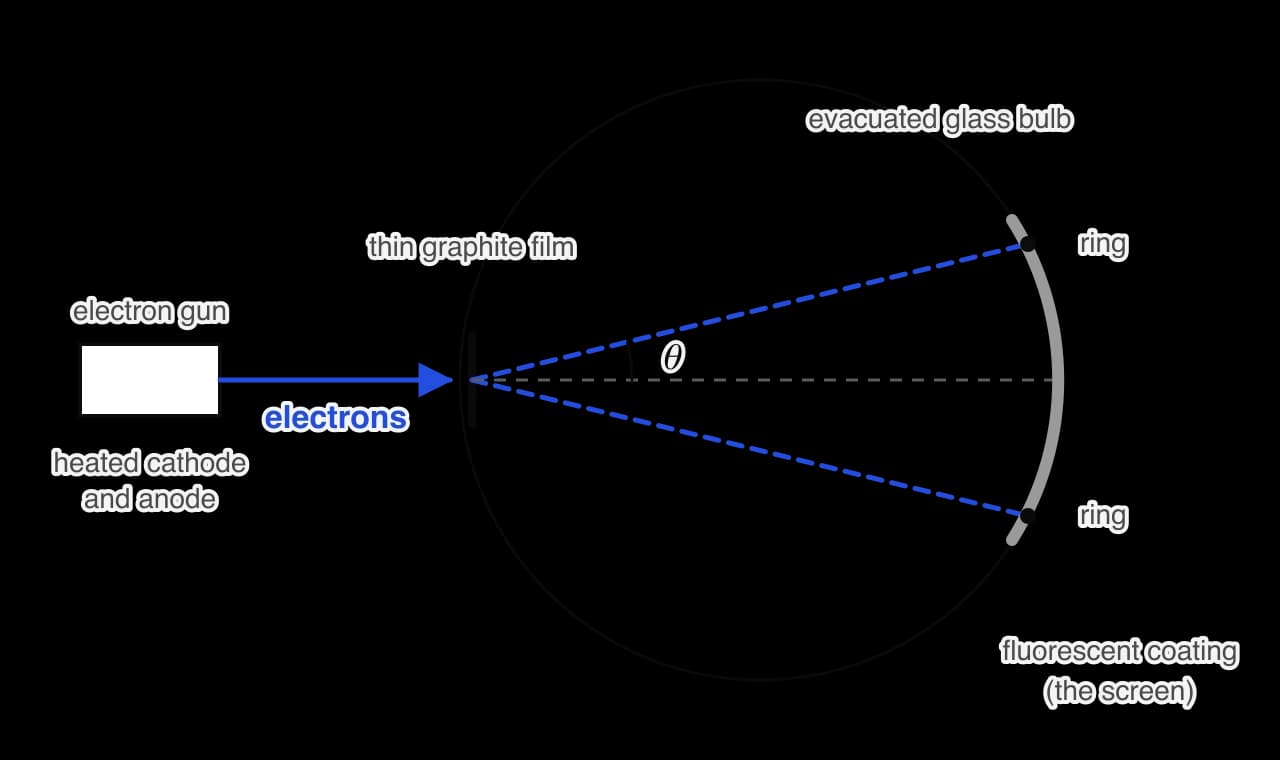
Increasing the accelerating pd increases the momentum of the electrons, which shortens their de Broglie wavelength. Every diffraction angle becomes smaller, and the rings shrink towards the centre. This dependence on is what shows the rings are a wave effect.
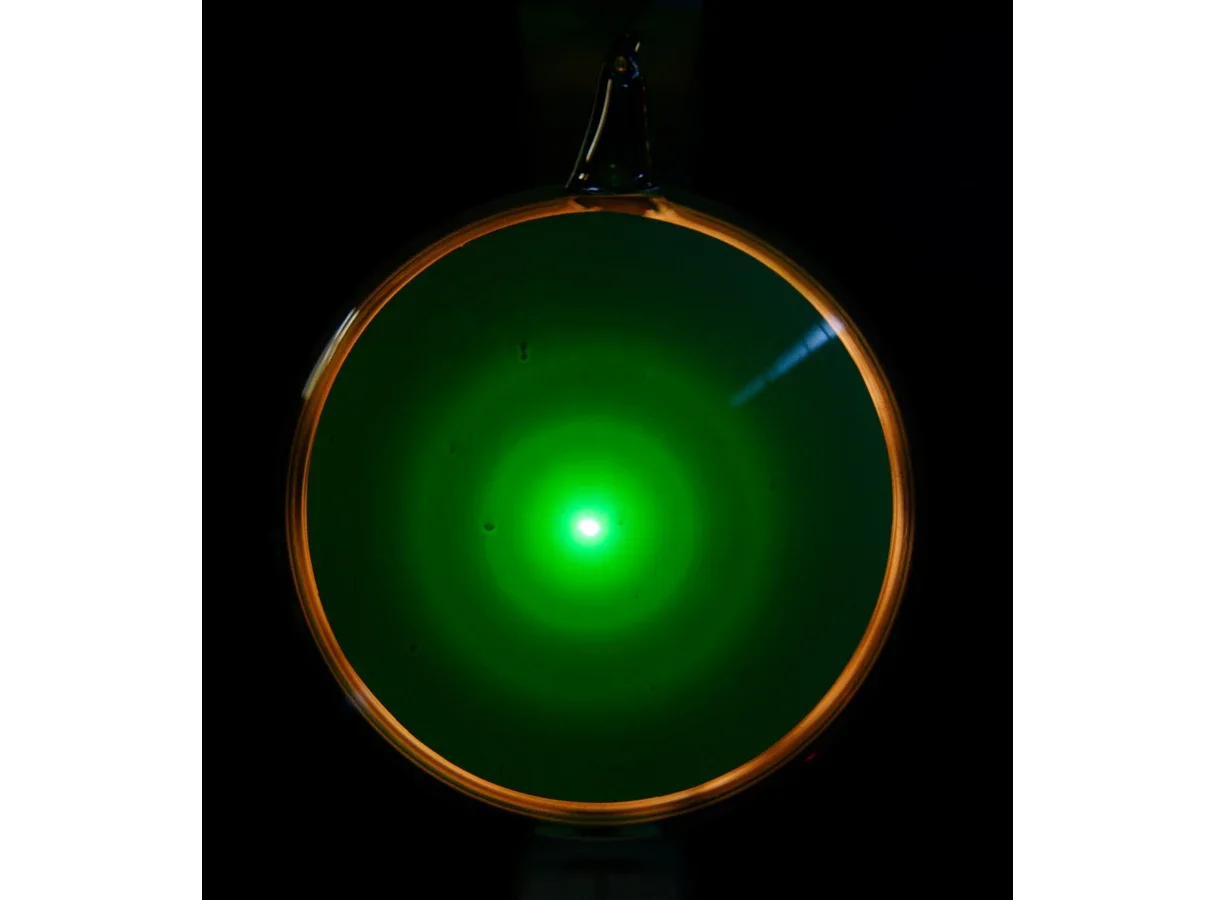
A magnet brought near the tube shifts the whole ring pattern sideways. This confirms that the pattern is formed by charged particles, not by X-rays or light from the cathode, and illustrates the two natures of the electron in a single experiment.
The position of the first minimum
The diffraction of particles follows the same rules as the diffraction of light (C.3). A beam of particles with de Broglie wavelength passing through a gap of width spreads out with a central maximum, and the first minimum of intensity is at the angle given by
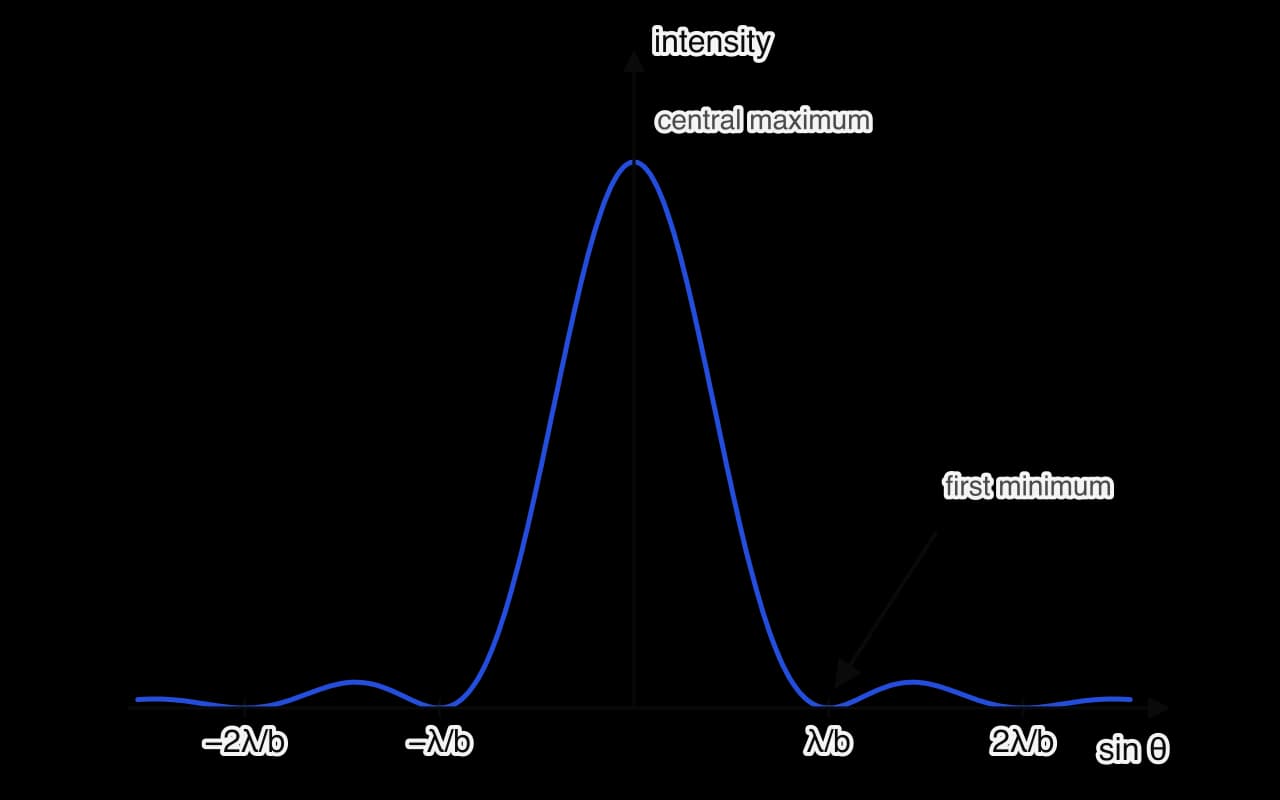
Faster particles have a shorter wavelength, so their central maximum is narrower; a narrower gap spreads the beam more. The same relation applies when particles are diffracted by a small object of width , such as an atom or even a nucleus.
Compton scattering
The photoelectric effect shows that light delivers energy in packets of . It does not show directly that photons also carry momentum, as particles do. That evidence came in 1923 from Arthur Compton at Washington University in St Louis, who directed X-rays of a single wavelength, the molybdenum K-alpha line at about 0.071 nm, at a block of graphite and measured the wavelengths of the X-rays scattered at different angles.
Compton found that the scattered X-rays contained a component with a longer wavelength than the incident X-rays. The increase in wavelength grew with the scattering angle and did not depend on the material of the scatterer. A second, unshifted component also appeared, from X-rays scattered by electrons held tightly in the atoms.
Why the wave model fails
In the classical picture, an electromagnetic wave makes an electron oscillate at the frequency of the wave, and the oscillating electron re-radiates at the same frequency. Scattered radiation should therefore have exactly the same wavelength as the incident radiation, at every angle. The wave model has no way to produce the longer wavelength.
The photon explanation
Compton treated the X-ray as a stream of photons, each of energy and momentum , and each scattering event as a collision between one photon and one electron, like a collision between two balls. In the collision both energy and momentum are conserved. The electron recoils and takes some of the photon's energy, so the scattered photon has less energy, a lower frequency and a longer wavelength.
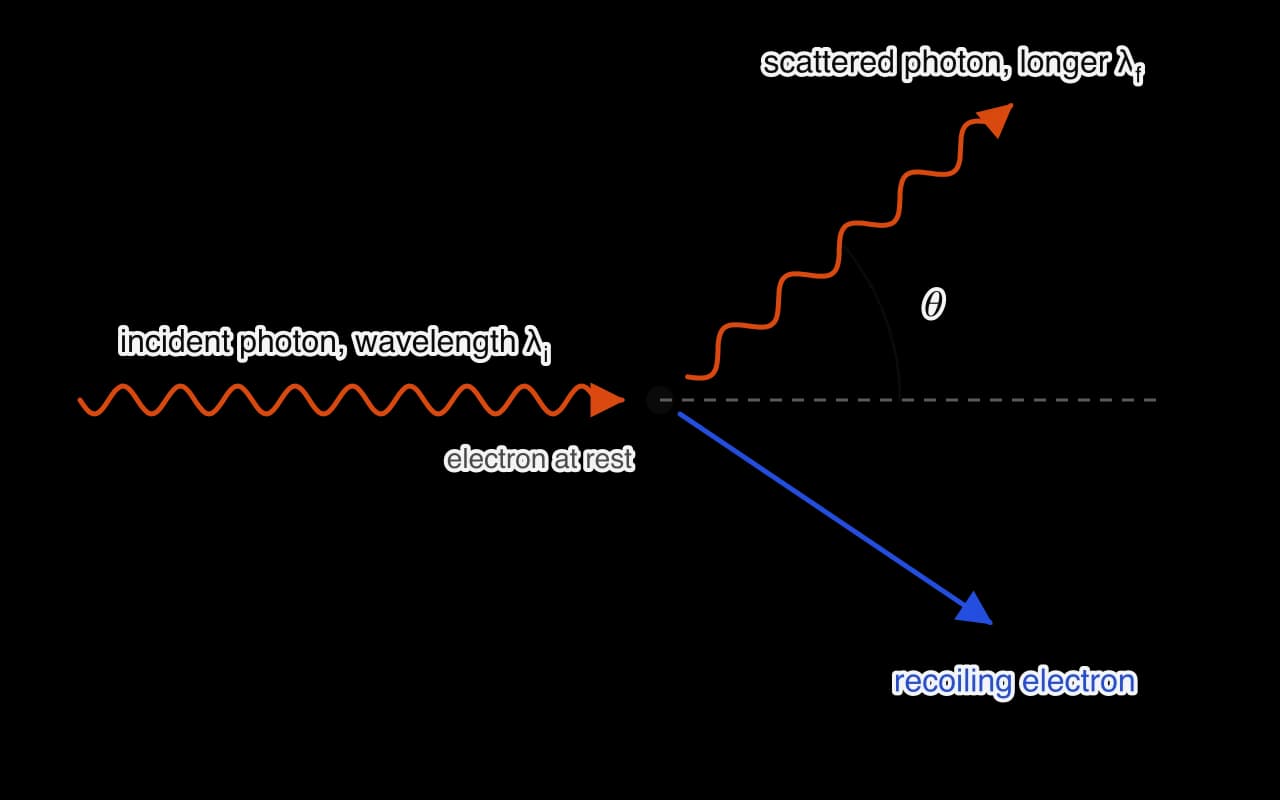
Applying conservation of energy and of momentum to the collision gives the Compton shift, the increase in wavelength of the scattered photon:
where and are the incident and scattered wavelengths,
At the photon passes undeflected and .
At ,
The shift is the same few picometres whatever the incident wavelength. For X-rays of wavelength 0.071 nm, a shift of 2.43 pm is a 3% change and easy to measure. For visible light of wavelength 500 nm it would be a change of less than one part in , which is why Compton scattering is studied with X-rays and gamma rays.
Why Compton scattering is stronger evidence for photons
The photoelectric effect can be explained by assuming only that light energy is absorbed in packets of ; it says nothing about momentum. In Compton scattering, the measured shift and its dependence on angle follow exactly from treating the photon as a particle that carries momentum and obeys conservation of momentum in a collision, like any other particle. The recoiling electrons were also detected, moving in the directions the collision model predicts. Compton scattering therefore shows that photons have both of the properties that define a particle: a definite energy and a definite momentum. Compton received the 1927 Nobel Prize in Physics for the discovery.
Wave–particle duality
The photoelectric effect, Compton scattering and electron diffraction leave both light and matter with two sets of properties. Neither the wave model nor the particle model alone describes either of them. This is wave–particle duality: radiation and matter both show wave properties in some experiments and particle properties in others.
Evidence for wave behaviour | Evidence for particle behaviour | |
|---|---|---|
Electromagnetic radiation | Diffraction and interference (C.3); polarisation | Photoelectric effect; Compton scattering; line spectra from transitions of one photon each (E.1) |
Electrons and other matter | Electron diffraction (Davisson–Germer, G. P. Thomson); diffraction of neutrons, atoms and molecules | Definite mass and charge; tracks in detectors; deflection in electric and magnetic fields (D.3) |
Which behaviour appears depends on what the experiment measures. Wave behaviour shows up in how radiation or matter travels and spreads, for example through a slit or a crystal. Particle behaviour shows up when it interacts at a single point, transferring energy and momentum in one event, for example when a photon frees one electron or an electron lights up one spot on a screen.
The clearest demonstrations send particles through an apparatus one at a time. In 1989 Akira Tonomura's group at Hitachi sent electrons through an electron biprism, the electron equivalent of a double slit, so slowly that only one electron was in the apparatus at once. Each electron arrived at the detector as a single dot. The dots looked random at first, but as thousands accumulated they built up interference fringes.
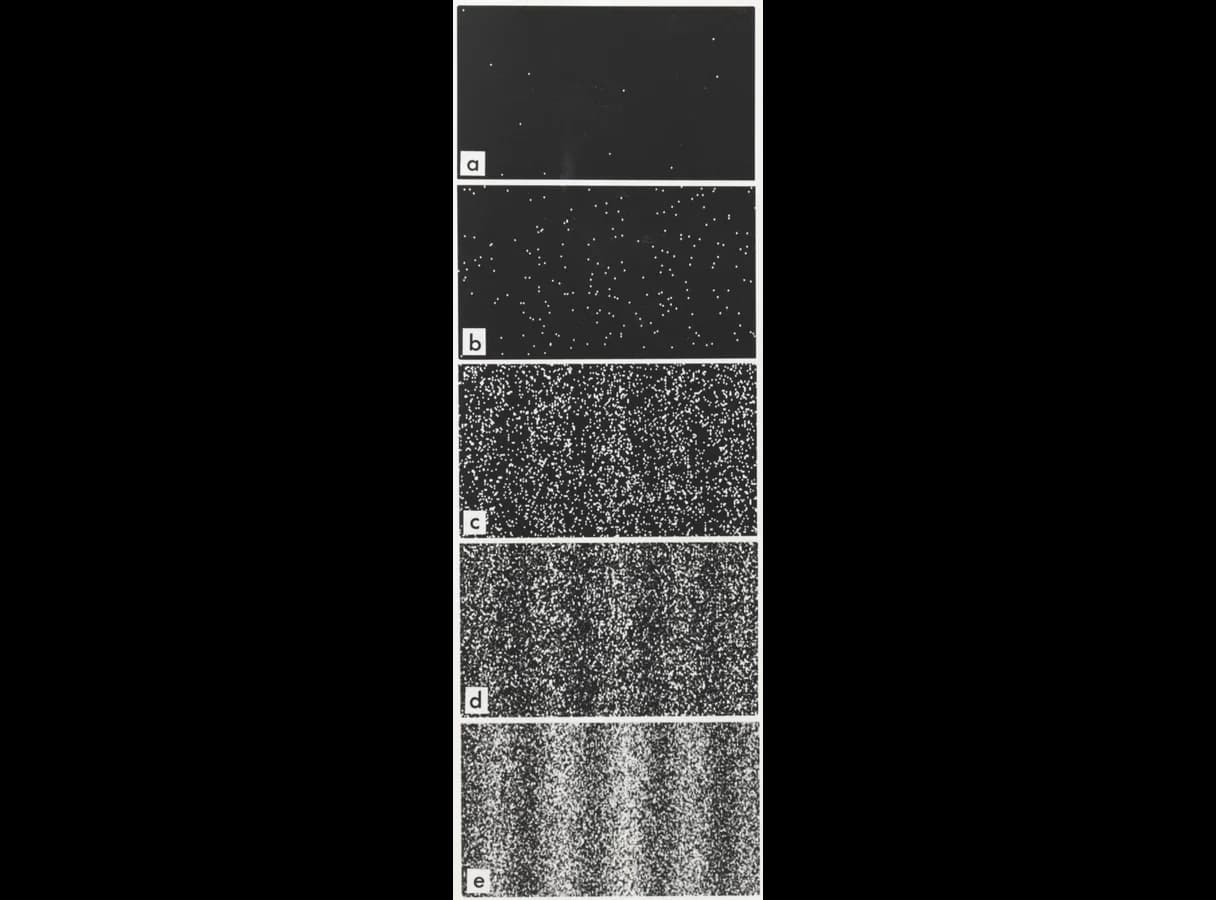
A single electron cannot interfere with another electron that is not there, so the wave property belongs to each electron on its own. The wave determines where an electron is likely to be detected; the detection itself is the arrival of one whole particle. The same experiment works with very dim light, photon by photon.
 YouTube
Duality is not confined to electrons. Neutrons from nuclear reactors are diffracted by crystals and used to study the structure of materials. In 1999 a team in Vienna diffracted molecules of buckminsterfullerene, , each containing 60 carbon atoms. The larger the particle and the faster it moves, the shorter its wavelength and the harder its wave behaviour is to see, which is why everyday objects behave only as particles.
The limits of each model
The wave and particle models are both models in the scientific sense: each is a simplified description that predicts some results correctly and fails for others. The wave model of light fails for the photoelectric effect and Compton scattering; the particle model of light cannot explain a two-slit interference pattern. Neither picture is complete on its own. A photon has no definite path between source and detector as a ball would, and an electron is always detected whole at one point rather than spread out like a ripple.
Quantum physics replaces both pictures with a single theory that predicts the probability of each result. The mathematics of that theory, quantum mechanics, is advanced, but its core idea is already visible in the electron interference experiment: the wave gives the pattern of probabilities, and each detection is a particle event.
Applying the ideas in exam questions
Paper 1A: the effect of intensity
Paper 1A: de Broglie wavelengths
Paper 1B: determining the Planck constant
A group of students shines five lines from a mercury lamp, one at a time, on the cathode of a photocell and measures the stopping potential for each. The uncertainty in each is V; the uncertainty in the frequency is negligible. The data and a graph of the results are shown.
/ Hz | 5.19 | 5.49 | 6.88 | 7.41 | 8.21 |
|---|---|---|---|---|---|
/ V ± 0.05 | 0.24 | 0.35 | 0.97 |

Paper 2: photoelectric emission from potassium
Paper 2: Compton scattering of gamma rays
Self-check
- To do:
I can calculate the energy and momentum of a photon from its frequency or wavelength, in joules and in electronvolts.
- To do:
I can relate the intensity of a beam to the number of photons arriving per second.
- To do:
I can describe the photoelectric effect and list its main observations.
- To do:
I can explain which features of the photoelectric effect the wave model cannot explain, and why.
- To do:
I can define the work function and the threshold frequency, and calculate each from the other.
- To do:
I can use Einstein’s equation E_max = hf − Φ, and explain why it gives a maximum kinetic energy.
- To do:
I can describe the photocell experiment and define the stopping potential.
- To do:
I can sketch and explain current–potential difference graphs for changes of intensity and of frequency.
- To do:
I can find the Planck constant and the work function from a graph of stopping potential against frequency.
- To do:
I can calculate the de Broglie wavelength of a particle from its speed, its kinetic energy or its accelerating potential difference.
- To do:
I can compare the wavelengths of different particles accelerated through the same pd or with the same kinetic energy.
- To do:
I can describe the Davisson–Germer experiment and the electron diffraction tube, and explain how they show the wave nature of electrons.