E.1 Structure of the atom · IB Physics | Augment Education
E.1 Structure of the atom
The nuclear model of the atom from alpha-particle scattering, nuclear notation and isotopes, line spectra, photons and energy levels, and at HL the Bohr model, nuclear radius and closest approach.
IB Physics
Part of E Nuclear and quantum physics
SL and HL
Key terms introduced here
Each is in the Physics glossary, with every other term in the subject.
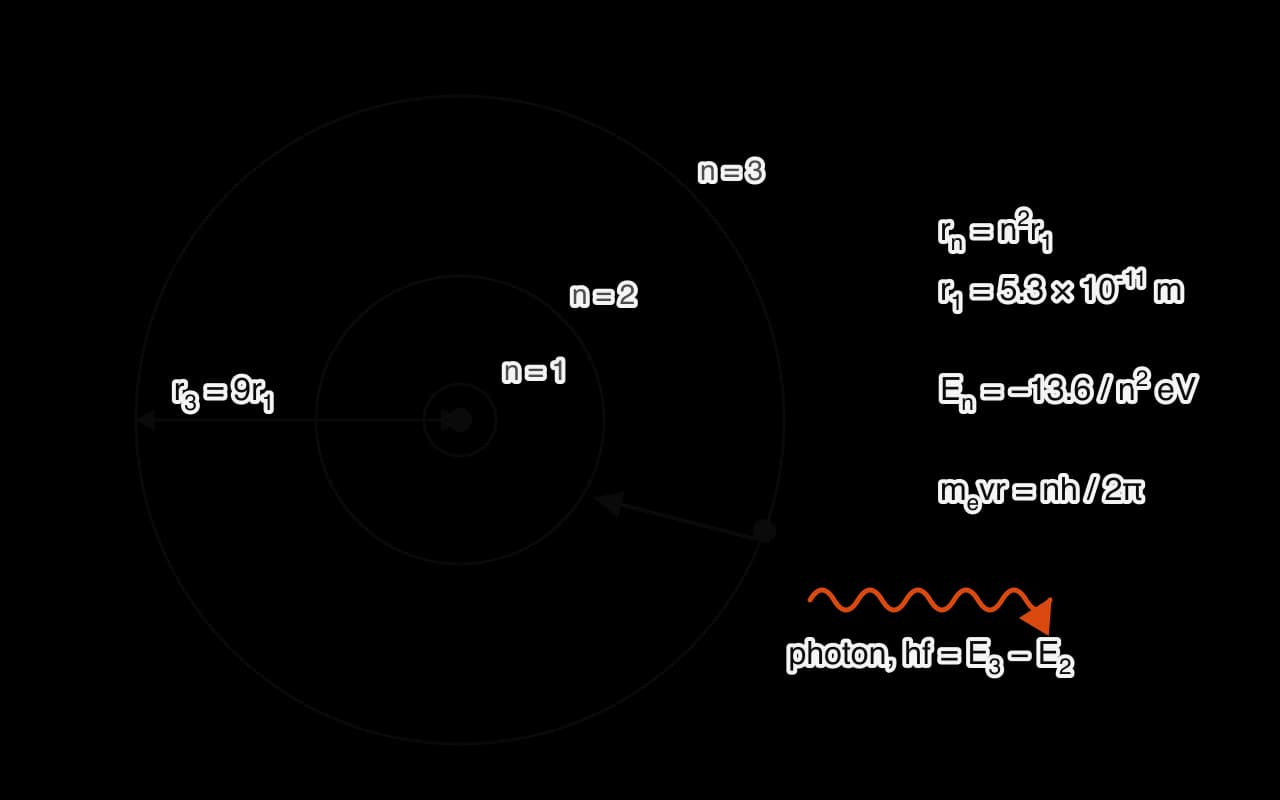
Bohr's model of the hydrogen atom: the electron moves in circular orbits whose angular momentum is quantised, mvr=nh/2π, and emits or absorbs a photon only when it jumps between orbits.
The radius of the smallest (n=1) orbit in the Bohr model of hydrogen, about 5.3×10⁻¹¹
Notes on E.1 Structure of the atom
46 min readLast reviewed
Questions on E.1
80 exam-style questions on this subtopic, written in the style of the IB papers. The first has its markscheme open. Counted on
Question 1 · PHY-004736 marks
Human activity adds several greenhouse gases to the atmosphere.
(a)
Identify the main greenhouse gas released by each of the following activities:
the digestion of food by cattle
the use of nitrogen-based fertilisers on farmland.
[2]2 marks
Markscheme (a)
cattle: methane / CH4 ✓ fertilisers: nitrous oxide / dinitrogen oxide / N2O ✓ Do not accept «nitrogen» or «NO2» for MP2.
(b)
State one natural source of carbon dioxide in the atmosphere.
[1]1 mark
Markscheme (b)
volcanic eruptions / respiration / decay of organic matter / natural forest fires / release from the oceans ✓
(c)
Explain, with reference to photon energies and molecular energy levels, why carbon dioxide absorbs much of the radiation emitted by the Earth's surface but very little of the visible radiation from the Sun.
[3]3 marks
Try a quick-fire question
One of 65 short multiple-choice questions on E.1. Pick an answer to see why it's right or wrong.
The diagram shows the apparatus for an alpha-scattering experiment, seen from above. Part A is a block with a narrow slot, with the source inside it. What is the purpose of part A?
Flashcards for E.1
The official deck for this part of the syllabus.
E.1 Structure of the atom · front
What evidence showed that electrons are part of every atom?
E.1 Structure of the atom · front
Atoms are neutral and electrons are very light. State the two deductions about atoms that follow.
E.1 Structure of the atom190 cards
From the data booklet
The entries of the physics data booklet that E.1 uses. Each opens in the explained booklet.
The minimum separation of a charged particle from a nucleus in a head-on collision, where all its initial kinetic energy has become electric potential energy: Ek=kQq/d.
A set of bright lines at particular wavelengths, produced by a hot gas at low pressure; each line comes from electrons dropping between two energy levels.
The perpendicular distance between the line along which a particle approaches and a parallel line through the centre of the nucleus; the smaller it is, the larger the deflection.
The small, dense, positively charged centre of an atom, made of protons and neutrons, which holds nearly all of the atom's mass in a region about 10−15 to 10−14 m across.
Thomson's model of the atom (1904): a sphere of evenly spread positive charge with electrons embedded in it. Alpha-particle scattering showed it to be wrong.
The deflection of alpha particles by the electric repulsion of nuclei, first measured by Geiger and Marsden by firing alpha particles at a thin metal foil; it showed that atoms have a nucleus.
The measurement of the wavelengths and intensities in a spectrum, used to identify the elements in a source of light or in a gas the light has passed through.
The range of wavelengths present in light (or other radiation) when they are spread out and separated, for example by a prism or a diffraction grating.
One-twelfth of the mass of a carbon-12 atom: 1u=1.661×10⁻²⁷kg=931.5MeV c−2.
the number of nucleons; isotopes share
Z
but differ in
A
.
Emission and absorption line spectra show that electrons in atoms can only have certain discrete energies.
A photon is emitted or absorbed when an electron moves between energy levels.
The photon energy equals the difference between the two levels, and fixes its frequency through E=hf.
Every element has its own pattern of spectral lines, so spectra show the chemical composition of a gas, including the atmosphere of a distant star.
In the Bohr model, the angular momentum of the electron is quantised, mvr=nh/2π, which leads to the hydrogen energy levels E=−13.6/n2 eV (HL).
The nuclear radius follows R=R0A1/3, so all nuclei have about the same density (HL).
Energy conservation gives the distance of closest approach of an alpha particle to a nucleus; deviations from Rutherford scattering at high energies show the size of the nucleus and the strong nuclear force (HL).
Everything around us is made of atoms, but an atom is far too small to see with light: a gold atom is about 3×10⁻¹⁰ m across. Its structure has therefore been worked out from indirect evidence, mainly from what happens when particles or light interact with it. Two kinds of evidence dominate. Firing alpha particles at atoms shows where their mass and positive charge are, and the light that atoms emit and absorb shows how their electrons are arranged.
The same ideas are used every day. Astronomers find out what stars are made of from the dark lines in their spectra, street lamps and lasers rely on electrons jumping between fixed energy levels, and the nuclear model underlies everything in nuclear physics, from radioactive dating to reactors.
Models of the atom before the nucleus
By 1900 there was strong evidence that atoms exist, but very little was known about their inside. In 1897 J. J. Thomson showed that cathode rays are streams of tiny negatively charged particles, later called electrons, that are the same whatever metal they come from. Electrons must therefore be part of every atom. Since atoms are electrically neutral, they must also contain an equal amount of positive charge, and since electrons are about 2000 times lighter than even the lightest atom, almost all of the mass of an atom must be associated with that positive charge.
Thomson's answer, the plum-pudding model (1904), pictured the atom as a sphere of positive charge, about 10−10 m across, with electrons embedded in it like fruit in a pudding. The positive charge and the mass were spread evenly through the whole volume of the atom. The model explained why atoms are neutral and roughly how big they are, and it made a clear prediction for any particle fired through it.
Because the positive charge in the plum-pudding atom is spread out, the electric field inside it is weak everywhere. A fast, heavy alpha particle passing through such an atom would be deflected by only a tiny fraction of a degree by each atom, and even many such deflections in a row would add up to no more than a degree or two. Large deflections should essentially never happen.
The Geiger–Marsden–Rutherford experiment
In 1909 Hans Geiger and Ernest Marsden, working in Ernest Rutherford's laboratory in Manchester, tested this prediction. An alpha particle is a helium nucleus, 24He: it has a charge of +2e and a mass about 7000 times that of an electron, and alpha particles from a radioactive source have kinetic energies of a few MeV. A beam of alpha particles is a good probe because the particles are fast and heavy enough not to be stopped or turned back by electrons in their way.
The apparatus
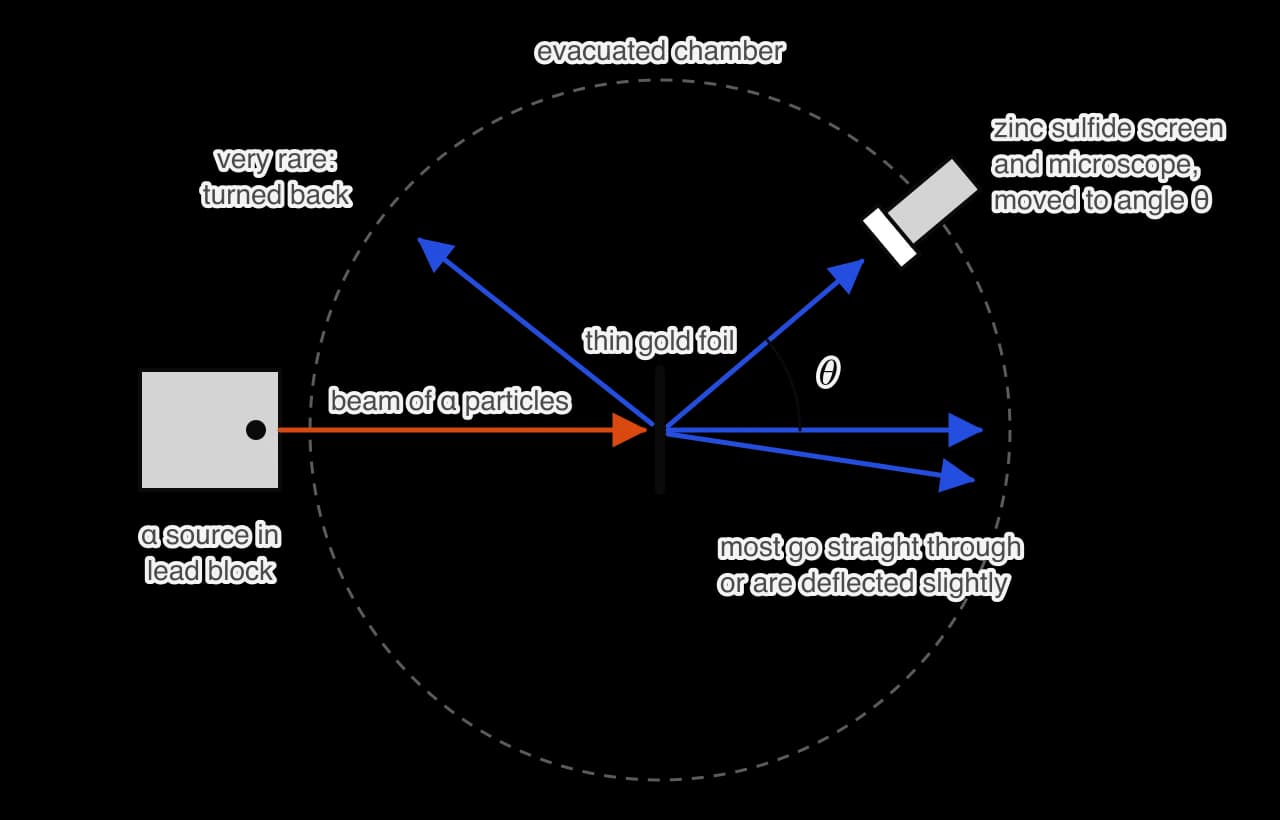
The beam (orange) strikes the foil; scattered alpha particles (blue) are counted by the flashes they make on the zinc sulfide screen, which is moved round to each scattering angle θ in turn.
The apparatus for alpha scattering has four essential parts, each with a reason:
A narrow beam of alpha particles from a radioactive source inside a lead block with a small hole. The lead absorbs the alpha particles going in every other direction, so all the particles reaching the foil travel in one known direction.
A very thin gold foil, well under a micrometre thick. Gold can be beaten into foils only a few hundred atoms thick, so most alpha particles interact strongly with at most one nucleus on the way through. Gold nuclei are also heavy and highly charged, which makes their effect large.
A zinc sulfide screen viewed through a microscope. Each alpha particle that hits the screen makes a tiny flash of light, a scintillation, which an observer counts. The screen and microscope can be turned round the foil to count the particles arriving at each scattering angle θ.
An evacuated chamber. In air, alpha particles travel only a few centimetres before losing their energy by ionising air molecules, so the air is pumped out.
Observations
The scintillations were counted, by eye in a darkened room, at many angles. Three observations stood out:
Most alpha particles passed straight through the foil, or were deflected by only a very small angle.
A small fraction were deflected through large angles.
A very small number, about 1 in 8000 in Geiger and Marsden's first measurements with a platinum foil, were turned back through more than 90°, as if they had bounced off something on the front of the foil.
The third result was completely unexpected. Rutherford later compared it to firing a large artillery shell at a piece of tissue paper and having it come back and hit the person who fired it. A sphere of spread-out positive charge could never exert a large enough force to turn an alpha particle back.
YouTube
Khan Academy: Rutherford's gold foil experiment, the set-up, the observations and the nuclear model they led to.
Interpreting the results: the nuclear model
In 1911 Rutherford showed that the observations follow if all the positive charge and nearly all the mass of an atom are concentrated in a tiny central region, the nucleus. Each observation leads to one part of this nuclear model:
Observation
Conclusion
Most alpha particles pass straight through
The atom is mostly empty space: most alpha particles never come close to a nucleus.
A few are deflected through large angles
The positive charge is concentrated in a very small volume, so very close to it the electric repulsion is strong enough to deflect an alpha particle sharply.
Very few bounce back
The nucleus contains most of the mass of the atom: an alpha particle that approaches it head-on is turned back, as a ball is by a heavy wall, rather than pushing the nucleus aside.
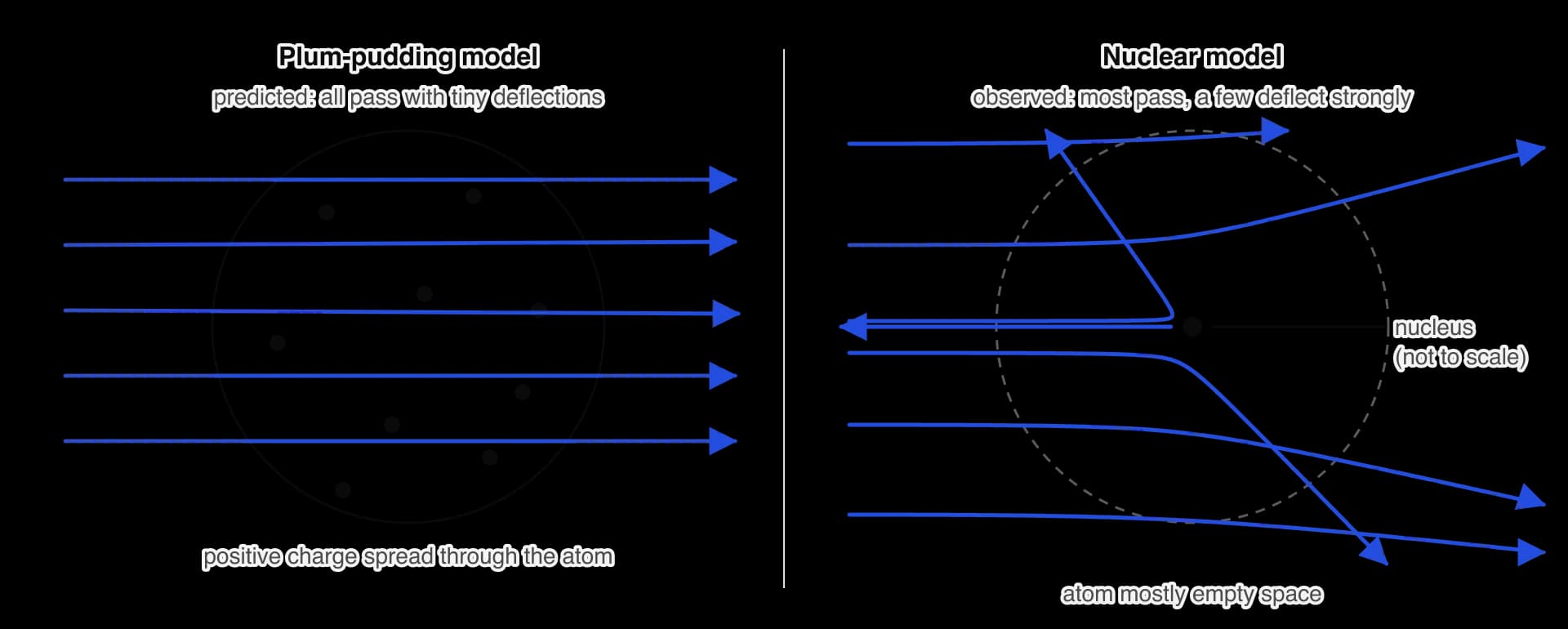
Spread-out positive charge could only nudge the alpha particles. A tiny, concentrated nucleus repels a close-passing alpha particle strongly enough to swing it through a large angle, and turns a head-on one back. The paths on the right are calculated for a Coulomb repulsion.
This deflection of alpha particles by the electric repulsion of nuclei is called Rutherford scattering. The force follows Coulomb's law: the force on an alpha particle at distance r from a nucleus of charge Ze is F=k(2e)(Ze)/r2. The force grows rapidly as r decreases, so the deflection depends very strongly on how close the alpha particle passes, a distance called the impact parameter. Particles passing far from any nucleus are hardly deflected; the few heading almost straight at a nucleus are turned through large angles. From the measured fraction scattered at each angle, Rutherford estimated that the radius of the nucleus is no more than a few times 10−14 m, thousands of times smaller than the atom.
To picture these sizes, if a nucleus were enlarged to the size of a marble, about 1 cm across, the atom would be roughly a kilometre across. The electrons occupy the space around the nucleus, and the attraction between them and the nucleus holds the atom together.
What the model left unexplained
The nuclear model raised two questions it could not answer. First, it did not explain what keeps the positive charge in the nucleus together, despite the repulsion between like charges; the answer is the strong nuclear force, studied in E.3. Second, it gave no stable arrangement for the electrons. An electron orbiting a nucleus is accelerating, and according to classical electromagnetism an accelerating charge radiates energy. The electron should spiral into the nucleus in a tiny fraction of a second, giving out a continuous spread of wavelengths as it goes. Atoms are stable and give out only certain wavelengths, so the electrons need a different description, which comes from the evidence of line spectra.
Nuclear notation and isotopes
The nucleus contains two kinds of particle, protons and neutrons, together called nucleons. The proton carries a charge of +e; the neutron, discovered by James Chadwick in 1932, is neutral. Both have a mass of about 1 u, where u is the unified atomic mass unit (1u=1.661×10⁻²⁷ kg), while the electron is nearly 2000 times lighter.
Particle
Where it is found
Charge
Mass / u
Proton
Nucleus
+e
1.007276
Neutron
Nucleus
0
1.008665
Electron
Around the nucleus
−e
0.000549
The composition of a nucleus is described by two whole numbers. The proton number Z (also called the atomic number) is the number of protons, and decides which element the atom belongs to: every carbon nucleus has six protons, every gold nucleus 79. The nucleon number A (also called the mass number) is the total number of protons and neutrons. The neutron number is therefore
N=A−Z
A particular kind of nucleus, with a given Z and A, is called a nuclide, and is written in nuclear notation:
ZAX
where X is the chemical symbol of the element. For example, 79197Au is a gold nucleus with 79 protons and 197−79=118 neutrons. A nuclide is often named by its element and nucleon number alone, such as gold-197 or carbon-14, because the element fixes Z.
In a neutral atom the number of electrons equals the number of protons, Z. An ion has gained or lost electrons, so its charge changes but its nucleus, and therefore its nuclear notation, does not. The same notation describes other particles by their charge (in units of e) and nucleon number: a proton is 11p, a neutron 01n, an electron −10e and an alpha particle 24α or 24He. This makes it easy to check that charge and nucleon number are conserved in a nuclear reaction, which is the basis of the decay equations in E.3.
Isotopes
Nuclides with the same proton number but different nucleon numbers are isotopes of the same element. They have the same number of protons, and therefore the same number of electrons in the neutral atom, but different numbers of neutrons. Hydrogen, for example, has three isotopes: ordinary hydrogen 11H (no neutrons), deuterium 12H (one neutron) and tritium 13H (two neutrons). Carbon has the stable isotopes carbon-12 and carbon-13, and the radioactive isotope carbon-14.
The chemical behaviour of an atom depends on its electrons, so isotopes of an element react in the same way and are very hard to separate chemically. Their nuclei, however, can behave very differently: carbon-12 is stable while carbon-14 is radioactive, and uranium-235 undergoes fission with slow neutrons while uranium-238 mostly does not. Isotopes also differ slightly in mass, which is how a mass spectrometer (D.3) separates them.
Emission and absorption spectra
When light is passed through a prism or a diffraction grating, its different wavelengths are spread out into a spectrum. An instrument that does this and allows the wavelengths to be measured is a spectroscope (or spectrometer, when it records the intensity at each wavelength). Spectra come in three kinds, and the difference between them is the key evidence for the arrangement of electrons in atoms.
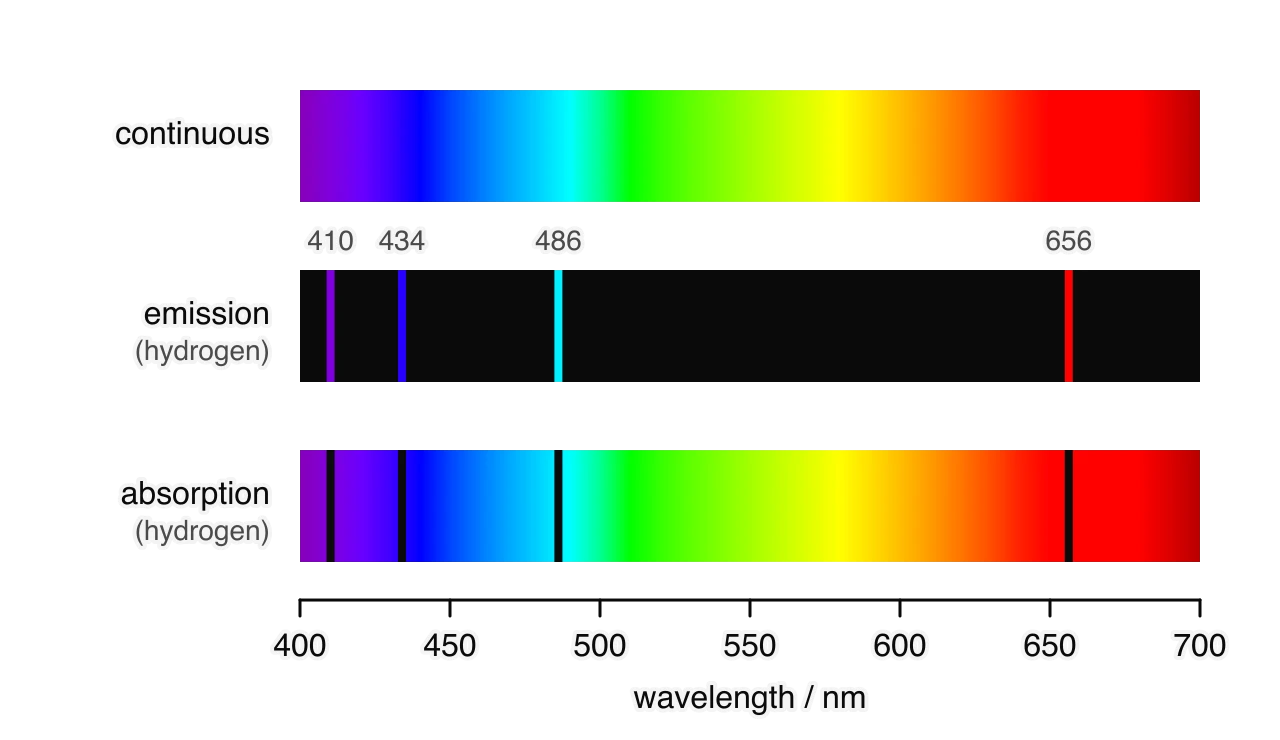
Hydrogen emits and absorbs at the same four visible wavelengths. The colours here are drawn to show where each wavelength lies in the visible spectrum.
Continuous spectra
A hot, dense object, such as the filament of a lamp, molten metal or the surface of a star, emits a continuous spectrum: all wavelengths over a wide range, with no gaps. The particles in a solid or dense gas interact strongly with one another, and the light comes from their random thermal motion rather than from individual atoms. The peak of the spectrum shifts to shorter wavelengths as the temperature rises, as described by Wien's law in B.1.
Emission line spectra
A hot gas at low pressure produces something quite different. When a high voltage is applied across a tube of hydrogen at low pressure, a discharge tube, the gas glows, and its spectrum is an emission spectrum of separate bright lines on a dark background. Hydrogen gives four lines in the visible region, at 656, 486, 434 and 410 nm, plus further lines in the ultraviolet and infrared. At low pressure the atoms are far apart and almost independent, so the light they emit is characteristic of single atoms.
The visible emission lines of hydrogen: red at 656 nm, blue-green at 486 nm and violet lines at 434 nm and 410 nm, with fainter lines crowding together at still shorter wavelengths. Image: Jan Homann, CC BY-SA 3.0, via Wikimedia Commons.
Every element has its own set of lines at its own wavelengths. Sodium vapour, used in old orange street lamps, gives a bright pair of yellow lines at 589.0 nm and 589.6 nm; neon gives many red and orange lines; mercury gives strong violet, green and yellow lines. No two elements have the same pattern.
Absorption line spectra
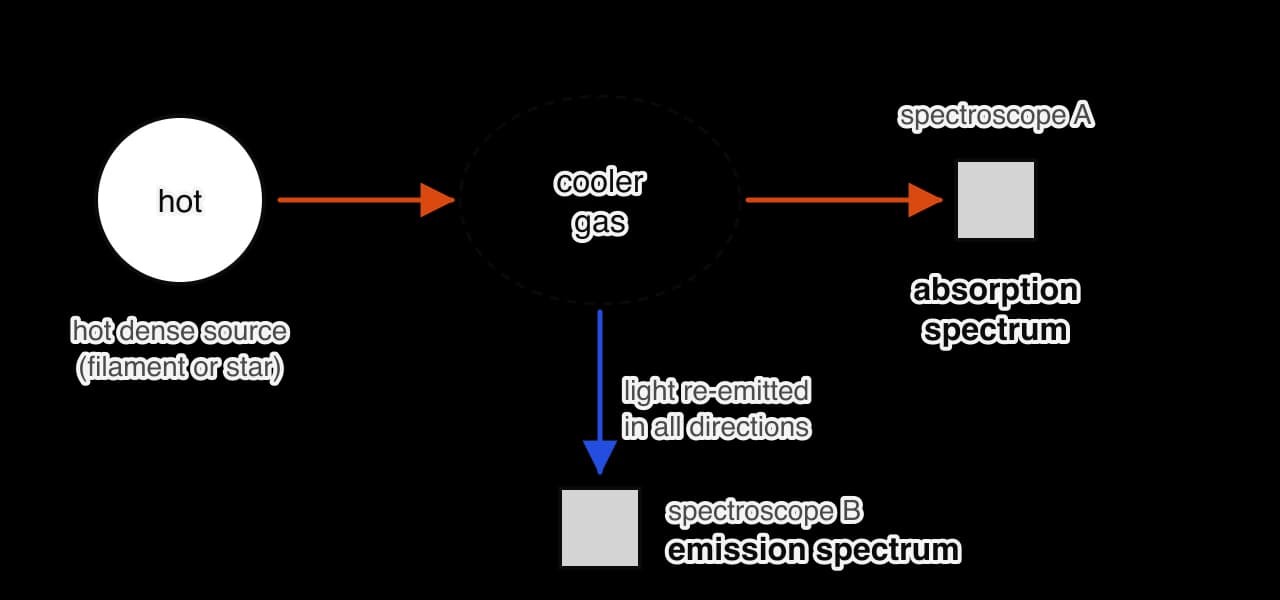
If white light from a hot source passes through a cooler gas, the spectrum that emerges is continuous except for narrow dark lines: an absorption spectrum. The dark lines of a gas are at exactly the same wavelengths as the bright lines of its emission spectrum. A cool gas therefore absorbs precisely the wavelengths that the same gas emits when hot.
Looking through the gas at the source gives dark lines; looking at the gas alone gives bright lines at the same wavelengths. Orange arrows: light from the source; blue: light re-emitted by the gas.
The dark lines are not completely black. The gas absorbs light of its own wavelengths from the beam, but the atoms then re-emit that energy, in random directions. Only a small part of the re-emitted light continues in the original direction, so at those wavelengths much less light reaches spectroscope A than at neighbouring wavelengths, and the lines look dark by contrast. Viewed from the side, against a dark background, the same gas shows a bright emission spectrum, because spectroscope B receives only the re-emitted light.
Photons and energy levels
Light as photons
Line spectra cannot be explained if light is treated only as a continuous wave whose energy can take any value. In 1900 Max Planck, and in 1905 Albert Einstein, proposed instead that light is emitted and absorbed in separate packets of energy, later called photons. The energy of one photon depends only on the frequency of the light:
E=hf=λhc
where h=6.63×10⁻³⁴J s is the Planck constant and c=3.00×10⁸m s−1 is the speed of light. A photon of blue light carries more energy than a photon of red light, because blue light has a higher frequency (shorter wavelength). The intensity of a beam depends on how many photons arrive each second, not on the energy of each one.
Photon energies are tiny in joules, so atomic physics uses the electronvolt: 1eV=1.60×10⁻¹⁹ J. Visible photons have energies between about 1.8 eV (red) and 3.1 eV (violet). The product hc=1.99×10⁻²⁵J m=1.24×10⁻⁶eV m converts directly between wavelength and photon energy.
Discrete energy levels
Line spectra show that the electrons in an atom cannot have just any energy. They can only occupy certain energy levels, each with a definite energy. When an electron moves from a higher level to a lower one, the atom loses a definite amount of energy, and this is carried away by one photon. Because the energy difference is fixed, the photon has one particular frequency, and the spectrum shows a sharp line at the corresponding wavelength.
hf=Eupper−Elower=ΔE
If the electrons could have any energy, the energy released in each change could also take any value, and the atoms would give a continuous spectrum. The appearance of separate lines is therefore evidence that the energy of an atom is quantised: it comes in discrete values.
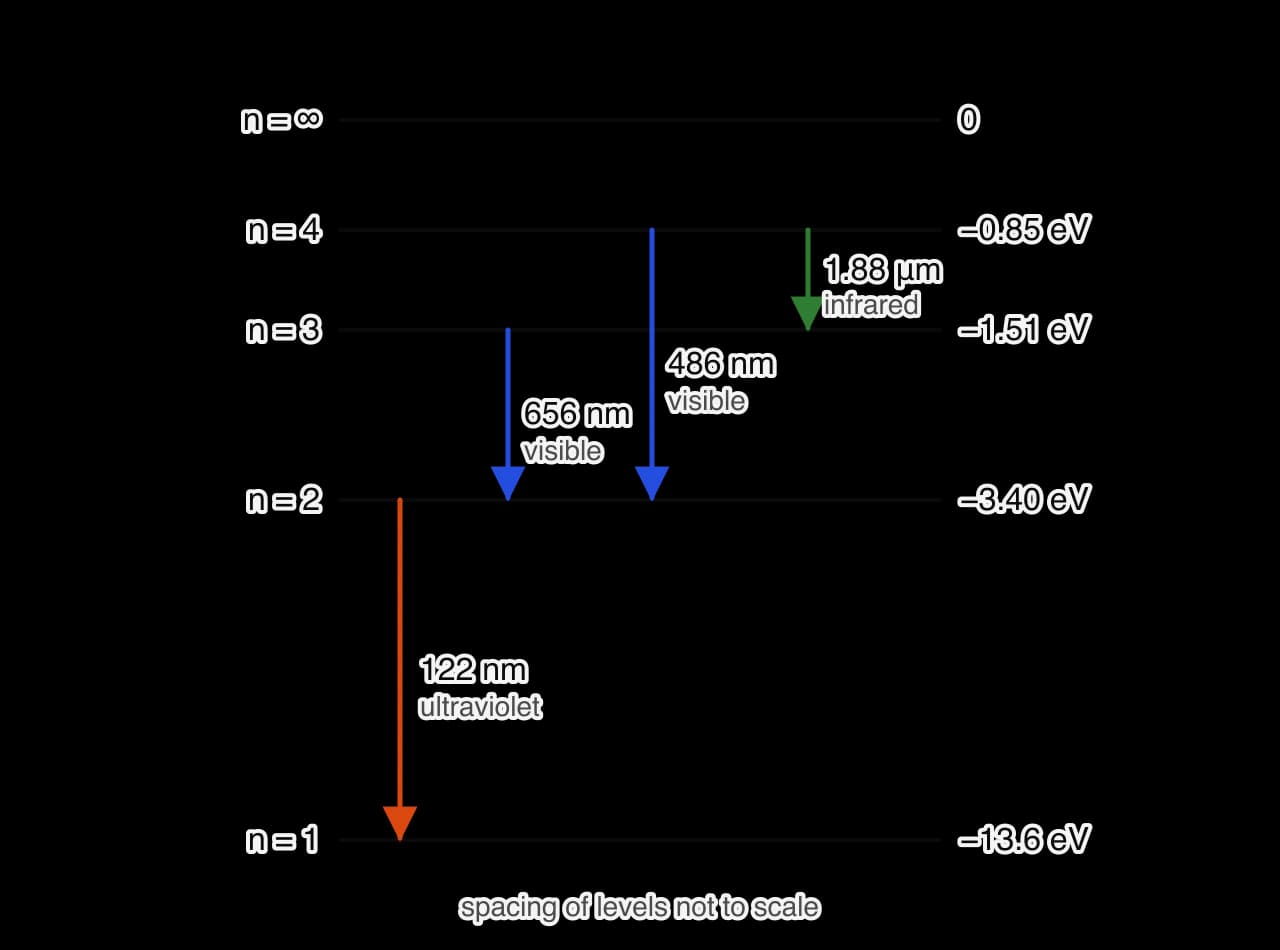
Energy-level diagrams draw each level as a horizontal line at a height proportional to its energy. The zero of energy is taken to be the energy of an electron that has just been removed from the atom and is at rest far away, the level labelled n=∞. Every bound level is below this zero, so the energies of electrons in an atom are negative. The more negative the energy, the more tightly the electron is bound. The levels are numbered with n=1 for the ground state and n=2,3,4,… for the excited states.
Transitions down to n = 1 (orange) release the most energy and give ultraviolet photons; transitions to n = 2 (blue) give the visible lines; transitions to n = 3 (green) give infrared. The gap from n = 1 to n = 2 is in fact far larger than drawn.
The hydrogen levels crowd closer together as n increases, approaching zero. Transitions that end on the same lower level form a series. All transitions down to n=1 release more than 10 eV and give ultraviolet photons; transitions down to n=2 give the four visible lines; transitions down to n=3 give infrared photons. These groups are known as the Lyman, Balmer and Paschen series after the scientists who measured them.
YouTube
Khan Academy: atomic spectra, covering emission and absorption lines and how they come from energy levels.
Emission: de-excitation
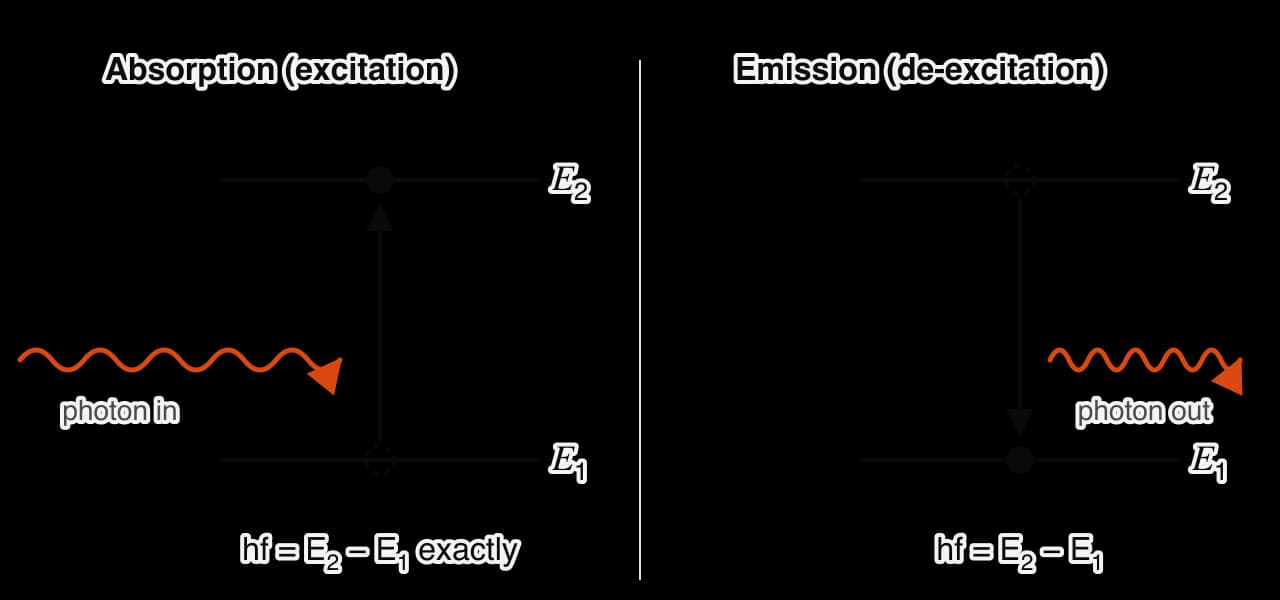
The same energy gap fixes the photon energy for absorption and for emission. A photon of any other energy cannot cause this transition.
An atom is raised to an excited state by heating, by an electric discharge (collisions with fast-moving electrons and ions), or by absorbing light. An electron in an excited state stays there only briefly, typically about 10−8 s, before dropping to a lower level and emitting a photon. It may return to the ground state in one jump or in several smaller jumps, each producing its own photon. In a gas containing many excited atoms, every possible downward transition happens in some atoms, so all the lines appear together.
The number of possible lines follows from counting pairs of levels. An electron can drop from any level to any lower one, so with N levels the number of different transitions is
number of lines=2N(N−1)
Two levels give one line, three give three and four give six.
Absorption: excitation
An atom in its ground state can absorb a photon only if the photon's energy exactly matches the gap between the ground state and one of the excited states. The whole photon is absorbed and the electron jumps up. A photon whose energy does not match any gap passes through the gas without being absorbed. This is why a cool gas removes only certain wavelengths from white light, the same wavelengths it emits when hot.
Energy can also be given to an atom by a collision with a fast-moving electron. A colliding electron can give the atom any part of its kinetic energy and keep the rest, so excitation by collision only needs the electron's kinetic energy to be at least the gap, not equal to it. This is how a discharge tube or a fluorescent lamp excites its gas.
Ionisation
If an atom absorbs enough energy, the electron leaves the atom altogether. The minimum energy needed to remove an electron from the ground state is the ionisation energy: for hydrogen, 13.6 eV, the gap from n=1 to n=∞. A photon with more than this energy can always be absorbed, because the electron leaves with the excess as kinetic energy, and a free electron's kinetic energy is not restricted to particular values.
Spectra and chemical composition
Because each element has its own set of energy levels, it has its own pattern of spectral lines, as unique as a fingerprint. Measuring the wavelengths of the lines in a spectrum therefore identifies the elements present, a technique called spectroscopy. It works on tiny samples and from any distance, since it needs only the light. Laboratories use it to measure the composition of alloys, water samples and blood; in a flame test, the colour of a flame shows a metal such as sodium, potassium or copper.
The spectrum of the Sun
The spectrum of the Sun is continuous, but it is crossed by thousands of dark absorption lines. Joseph von Fraunhofer mapped about 570 of them in 1814, and they are still called Fraunhofer lines. The hot, dense interior of the Sun emits a continuous spectrum. As this light passes out through the cooler gas of the Sun's outer atmosphere, atoms of each element absorb their own wavelengths, leaving dark lines. In 1859 Gustav Kirchhoff and Robert Bunsen showed that two prominent dark lines in sunlight are at exactly the wavelengths of the yellow sodium lines, so there must be sodium in the Sun. Lines of hydrogen, calcium, iron, magnesium and many other elements followed.
Spectroscopy has also identified an element before it was found on Earth. During a solar eclipse in August 1868, Jules Janssen observed a bright yellow line at about 587.6 nm in the light from the edge of the Sun, and Norman Lockyer studied the same line later that year. It matched no known element, and Lockyer proposed a new element, named helium after the Greek word for the Sun. Helium was not found on Earth until 1895, 27 years later, when William Ramsay detected the same line in gas released from the uranium mineral cleveite.
Spectra of stars
The same method is applied to other stars. Their absorption lines show which elements are present in their outer layers, and the strength of the lines gives information about temperature and the amount of each element. Spectra show that most stars are made mainly of hydrogen and helium, with small amounts of heavier elements. Two other properties also come from spectra: the shape of the continuous spectrum gives the surface temperature (B.1 and E.5), and a shift of all the lines to longer or shorter wavelengths shows that the star is moving away or towards the observer (the Doppler effect, C.5).
Element
Wavelengths of strong lines / nm
Hydrogen
656.3, 486.1, 434.0, 410.2
Helium
587.6, 501.6, 447.1
Sodium
589.6, 589.0
Magnesium
518.4, 517.3
Calcium
396.8, 393.4
Wavelengths of some strong visible and near-visible lines, measured in air. Data: NIST Atomic Spectra Database, accessed 2026.
The Bohr model of hydrogen (HL)
In 1913 Niels Bohr combined Rutherford's nuclear atom with the idea of quantised energy. His model of the hydrogen atom, the Bohr model, has an electron of mass me moving in a circular orbit around a single proton. It rests on three assumptions:
The electron moves in a circular orbit, held by the electric attraction of the nucleus, and in certain allowed orbits it does not radiate energy, despite accelerating.
In the allowed orbits the angular momentum of the electron is a whole-number multiple of h/2π: mevr=2πnh, with n=1,2,3,…
The atom emits or absorbs one photon when the electron jumps from one allowed orbit to another, with the photon energy equal to the energy difference.
The second assumption is the new idea. Angular momentum (mevr for a particle in a circle) is a quantity that classical physics allows to take any value. Bohr chose the rule because it produced the observed spectrum; its justification came later, in the wave description of the electron. From this one rule, the radius, speed and energy of every allowed orbit follow.
Radius of the allowed orbits
The electric force of the proton on the electron provides the centripetal force for its circular motion:
r2ke2=rmev2⇒mev2=rke2
The quantisation rule gives v=2πmernh. Substituting this into the force equation and rearranging gives the radius of orbit n:
rn=4π2kmee2n2h2=n2r1
The radius grows as n2: the second orbit is four times as large as the first and the third nine times. The smallest orbit, r1=5.3×10⁻¹¹ m, is the Bohr radius, and it matches the measured size of a hydrogen atom.
The allowed orbits are drawn to scale: the radius grows as n², so the n = 3 orbit is nine times as wide as n = 1. A jump to a lower orbit emits one photon.
Derivation of the orbit radius
Start from mev2=ke2/r and v=nh/(2πmer). Squaring the second gives v2=n2h2/(4π2me2r2). Then
The total energy of the electron is its kinetic energy plus its electric potential energy, which is negative because the electron is attracted to the proton:
E=21mev2−rke2=2rke2−rke2=−2rke2
Substituting rn=n2r1 gives En=−ke2/(2r1n2). With the data values of the constants, ke2/(2r1) comes to about 2.17×10⁻¹⁸ J, or 13.5 eV; with more precise values of the constants it is 13.6 eV, so
En=−n213.6eV
This formula reproduces the measured hydrogen levels: −13.6 eV, −3.40 eV, −1.51 eV, −0.85 eV, and so on, approaching 0 as n→∞. The model therefore explains both the wavelengths of every hydrogen line and the ionisation energy of hydrogen, 13.6 eV. The negative total energy shows that the electron is bound: 13.6 eV must be supplied to free it from the ground state.
Successes and limits of the Bohr model
The Bohr model was a major step. It explained the hydrogen spectrum quantitatively, gave the right size for the hydrogen atom, and showed why atoms are stable and emit sharp lines. It also accounts for the ultraviolet and infrared series of hydrogen, and predicted further infrared series that were found later. It works equally well for ions with a single electron, such as He⁺.
Its limits are just as clear. It does not give correct energy levels for atoms with more than one electron, it cannot explain why some lines are brighter than others, and it does not explain why some lines turn out to be several close lines when examined in detail. Above all, it offers no reason for its key assumption. Modern quantum physics replaces the circular orbits with a wave description of the electron (E.2), in which the electron in an atom has no definite path at all. The Bohr energy levels for hydrogen survive in this newer theory, so the model is still used as a simple description that gives correct answers for hydrogen and one-electron ions.
Nuclear radius and nuclear density (HL)
Scattering experiments with high-energy particles show that the nuclear radius R depends on the nucleon number A in a simple way:
R=R0A1/3
where R0=1.20×10⁻¹⁵ m is a constant, the radius that the formula gives for A=1. It can be thought of as the radius of the space that each nucleon takes up inside a nucleus. Nuclear sizes are conveniently measured in femtometres: 1fm=10−15 m. A carbon-12 nucleus has radius 1.20×121/3=2.75 fm, and a gold-197 nucleus 1.20×1971/3=6.98 fm.
R = 1.20 A^(1/3) fm
The nuclear radius rises steeply for light nuclei and only slowly for heavy ones: gold has 16 times as many nucleons as carbon but a radius only about 2.5 times as large.
Why the radius depends on the cube root
The relationship has a simple meaning. Cubing both sides gives R3=R03A, so the volume of a nucleus, 34πR3, is proportional to the number of nucleons it contains. Each nucleon takes up the same amount of space, as if the nucleus were made of tightly packed, incompressible spheres, like marbles in a bag. Adding more nucleons makes the nucleus bigger without squeezing the ones already there. This is a consequence of the strong nuclear force, which attracts nucleons strongly at short range but becomes repulsive if they are pushed closer than about 0.5 fm.
Nuclear density
The density of a nucleus, the nuclear density, is its mass divided by its volume. The mass is approximately A times the mass of one nucleon, Au with u=1.661×10⁻²⁷ kg, and the volume is 34πR3=34πR03A. So
ρ=34πR03AAu=4πR033u
The nucleon number cancels: the density is the same for every nucleus. Its value is
ρ=4π×(1.20×10−15)33×1.661×10−27=2.3×10¹⁷kg m−3
This is about 1014 times the density of water (1.0×10³kg m−3). A teaspoon of nuclear matter, about 5 cm³, would have a mass of roughly 1012 kg, more than a billion tonnes. Ordinary matter is so much less dense because the nucleus fills only about 10−13 of the volume of a gold atom; the rest is the space occupied by the electrons. The densest objects known outside the nucleus are neutron stars (E.5), which are in effect enormous nuclei made almost entirely of neutrons, with densities close to nuclear density.
Distance of closest approach (HL)
When an alpha particle heads straight towards a nucleus, the electric repulsion slows it down. Its kinetic energy is converted into electric potential energy until, at the distance of closest approach d, it momentarily stops. It then accelerates back along its original path, the head-on case of the alpha particles that bounced back in the Geiger–Marsden experiment. For a nucleus much more massive than the alpha particle, the recoil of the nucleus can be neglected, and conservation of energy gives
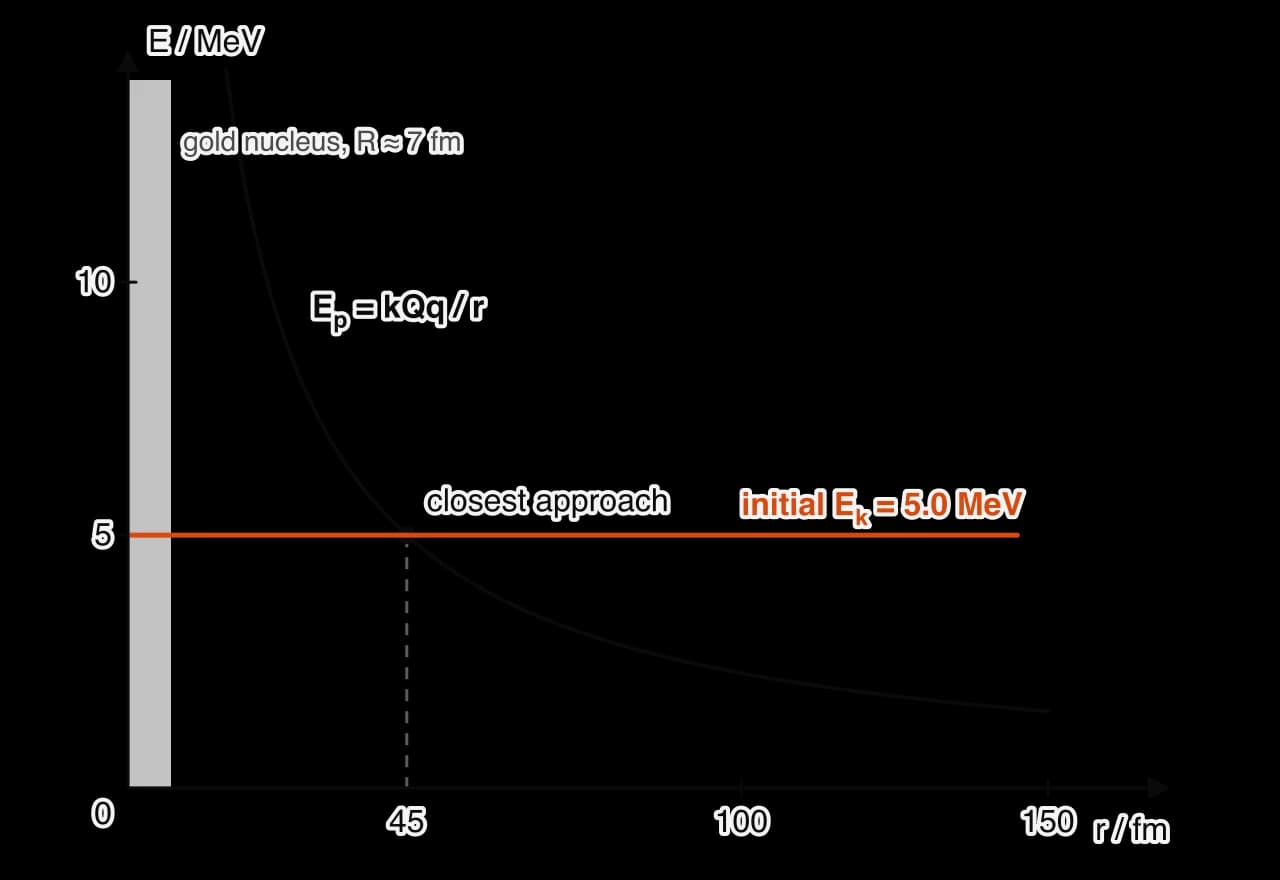
Ek=dkQq
where Ek is the initial kinetic energy of the alpha particle (when it is far from the nucleus), q=2e is its charge, Q=Ze is the charge of the nucleus and k=8.99×10⁹N m2C−2. The electric potential energy of two point charges, kQq/r, comes from D.2; at large distances it is zero, so all the energy starts as kinetic energy.
The alpha particle stops where its electric potential energy has risen to its initial kinetic energy of 5.0 MeV, about 45 fm from the centre. This is more than six times the radius of the gold nucleus (grey), so the two never touch.
Because d is inversely proportional to Ek, doubling the energy of the alpha particles halves the distance of closest approach. A nucleus with a larger charge keeps alpha particles further away, which is one reason Geiger and Marsden's heavy gold nuclei gave such clean results.
Deviations from Rutherford scattering at high energies
Rutherford's analysis assumed that only the electric force acts between the alpha particle and the nucleus. For alpha particles from natural sources and heavy nuclei this works perfectly: the number scattered at each angle matches the prediction exactly. When alpha particles are accelerated to higher energies, the distance of closest approach shrinks. Once it becomes comparable to the sum of the radii of the alpha particle and the nucleus, the two touch, and the short-range strong nuclear force begins to act. The alpha particle may then be absorbed by the nucleus or knock nucleons out of it, instead of simply bouncing off. Fewer alpha particles are scattered at large angles than Coulomb's law predicts.
A schematic (not measured data) of what scattering experiments with accelerated alpha particles on a heavy nucleus find, counting at one fixed large angle. Below the critical energy Rutherford's prediction fits exactly; above it the alpha particles reach the nucleus and the strong nuclear force changes the pattern.
The energy at which these deviations begin therefore measures the size of the nucleus: at that energy, the distance of closest approach equals the distance between the centres when the two nuclei just touch. Results of this kind, and of later experiments with high-energy electrons, are the evidence for R=R0A1/3. Deviations appear at lower energies for light nuclei, whose smaller charge lets the alpha particle get closer, which is why scattering from light elements such as aluminium departs from the prediction even with alpha particles from natural sources.
Applying the ideas in exam questions
Paper 1A: alpha-particle scattering
Paper 1A: number of spectral lines
Paper 1A (HL): nuclear radius and density
Paper 1B: identifying lines in a laboratory spectrum
Paper 2: the spectrum of a cool star
Paper 2 (HL): alpha particles and the Bohr atom
Self-check
To do:
I can describe the Geiger–Marsden–Rutherford experiment and explain why it used alpha particles, a thin gold foil and a vacuum.
To do:
I can link each observation of alpha-particle scattering to the conclusion it supports about the nucleus.
To do:
I can outline the plum-pudding model and explain why alpha scattering ruled it out.
To do:
I can use the notation ZAX to find the numbers of protons, neutrons and electrons in an atom or ion.
To do:
I can define isotopes and identify isotopes in a list of nuclides.
To do:
I can describe continuous, emission and absorption spectra and how each is produced.
To do:
I can explain why line spectra are evidence for discrete energy levels.
To do:
I can calculate photon energy, frequency and wavelength using E=hf and E=hc/λ, in joules and electronvolts.
To do:
I can find the photon energies from an energy-level diagram, count the possible lines and identify the transition of highest frequency.
To do:
I can explain which photons an atom can absorb, including ionisation.
To do:
I can explain why absorption lines appear dark and how spectra show the composition of stars.
To do:
I can state the assumptions of the Bohr model and use mvr=nh/2π and E=−13.6/n2 eV (HL).
To do:
I can derive the Bohr radius and calculate the speed of the electron in an orbit (HL).
To do:
I can calculate nuclear radii with R=R0A1/3 and show that nuclear density is constant (HL).
To do:
I can calculate the distance of closest approach of an alpha particle to a nucleus (HL).
To do:
I can explain why scattering deviates from Rutherford's prediction at high energies and what this shows about the nucleus (HL).
Markscheme (c)
a molecule absorbs a photon only if the photon energy equals a difference between its energy levels ✓ the Earth's surface emits infrared photons «long wavelength, low energy, E=λhc» ✓ infrared photon energies match the differences between vibrational energy levels of CO2 ✓ visible photons have greater energies that do not match any level difference, so they pass through ✓ [max 3]
Question 2 · PHY-0048810 marks
Carbon dioxide molecules absorb infrared radiation strongly at two wavelengths, 15 μm and 4.3 μm. Each absorption corresponds to a transition between vibrational energy levels of the molecule.
(a)
Calculate, in eV, the energy of a photon of wavelength 15 μm.
[2]2 marks
(b)
Show that the difference between the energy levels for the absorption at 4.3 μm is about 0.3 eV.
[1]1 mark
(c)
In a resonance model of this vibration, an oxygen atom of mass 16 u oscillates on a spring of stiffness k attached to a fixed carbon atom. The natural frequency of this oscillator equals the frequency of radiation of wavelength 4.3 μm.
Determine k.
[3]3 marks
(d)
Infrared radiation of a range of frequencies is incident on the molecule. Sketch a graph to show how the amplitude of the oscillation of the molecule varies with the frequency of the incident radiation. Label the natural frequency f0 on the frequency axis.
[2]2 marks
(e)
Water vapour is the most abundant greenhouse gas. Suggest why the water vapour released by human activities has little direct effect on the greenhouse effect, while warming caused by carbon dioxide increases the amount of water vapour in the atmosphere.
In the Geiger–Marsden–Rutherford experiment, a beam of alpha particles was directed at a thin gold foil. Most of the alpha particles passed through the foil with little or no deflection. This observation shows that
A
the gold nuclei are negatively charged.
B
alpha particles are not affected by electric forces.
C
the electrons in gold atoms occupy discrete energy levels.
The nucleus is unchanged, so the ion is still written with A=56 and Z=26.
and
614C
, so they are isotopes of carbon.
(b) Work out N=A−Z for each: 6, 8, 7, 8 and 7. Carbon-14 and oxygen-16 both have 8 neutrons; carbon-13 and nitrogen-14 both have 7. Either pair is correct.
eV. A value close to 2 eV is typical of visible light.
. Nuclear density is independent of
A
, so the ratio is 1.
C and D use R∝A; B assumes the mass grows while the volume does not.
eV ✓
«m» ✓
✓
d=1.8×10⁻¹⁴ «m» ✓
(b)R=1.20×10−15×1081/3=5.7×10−15 «m» ✓
the closest approach is about three times the nuclear radius / greater than the sum of the radii of the nucleus and the alpha particle ✓
so the alpha particle does not reach the nucleus and the «short-range» strong force does not act; only electric repulsion acts ✓