C.5 Doppler effect questions for IB Physics
52 questions on Doppler effect, written by Augment in the style of IB exam papers. Six of them are below in full, to answer on paper.
- IB Physics
- Part of C Wave behaviour
- SL and HL
Questions by paper and level
SL and HL questions are for students at either level. HL only questions cover what only HL students study.
| Paper | SL and HL | HL only | All |
|---|---|---|---|
| Paper 1A | 14 | 9 | 23 |
| Paper 1B | 2 | 1 | 3 |
| Paper 2 | 13 | 13 | 26 |
| Every paper | 29 | 23 | 52 |
Counted on
Questions to try
Written by Augment in the style of IB exams, not past papers. Answer them on paper, then check each one against its markscheme with a free account.
A cyclist rides at constant speed directly towards a stationary siren that emits sound of constant frequency. The air is still. Three statements about the sound detected by the cyclist are:
I. The frequency detected is higher than the frequency emitted by the siren.
II. The wavelength of the sound in the air between the siren and the cyclist is the same as when the cyclist is at rest.
III. The speed of the sound waves relative to the cyclist is greater than the speed of sound in still air.
Which statements are correct?
A group of students investigate the Doppler effect for sound. A small buzzer is fixed to a motorised cart that moves at a constant speed along a straight track directly towards a stationary microphone. A light gate measures the time for which a card of length = 10.0 cm on the cart blocks its beam, and the speed of the cart is calculated from . A frequency-analysis app connected to the microphone measures the received frequency to the nearest 1 Hz. The cart is stopped by a buffer before it reaches the microphone.
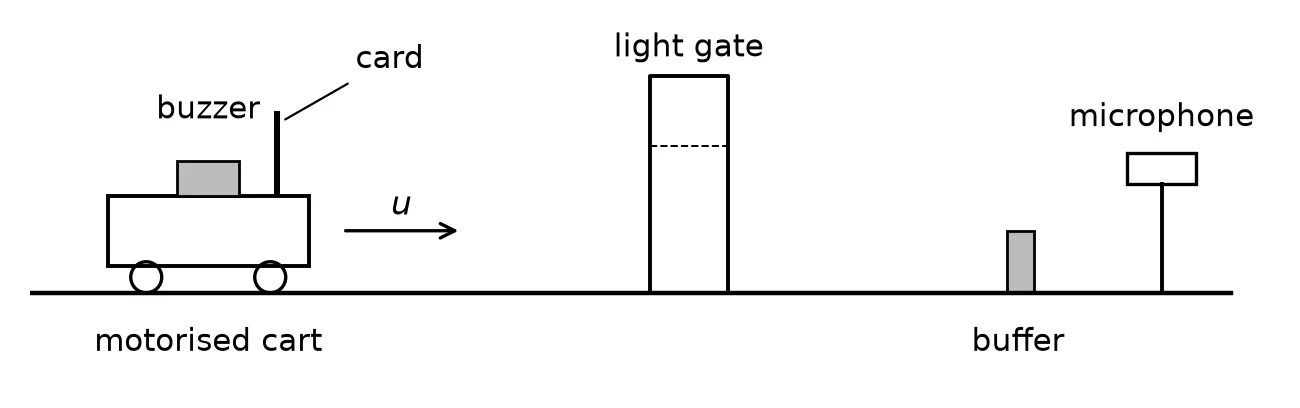
The motor setting is changed to give six different speeds. The table shows the results.
/ m s | / Hz ± 1 Hz |
|---|---|
0.52 | 4007 |
0.98 | 4011 |
1.51 | 4018 |
2.04 | 4023 |
2.47 | 4030 |
2.99 | 4035 |
- (a)
For the fastest run, the card blocked the beam for 33.4 ms. The uncertainty in is ± 0.1 ms and the uncertainty in is ± 0.1 cm.
Calculate the absolute uncertainty in for this run.
2 marks
- (b)
Suggest why the cart is driven by a motor at a constant speed rather than being released to accelerate down a slope.
1 mark
- (c)(i)
The graph shows the variation of with , with error bars for and the line of best fit.
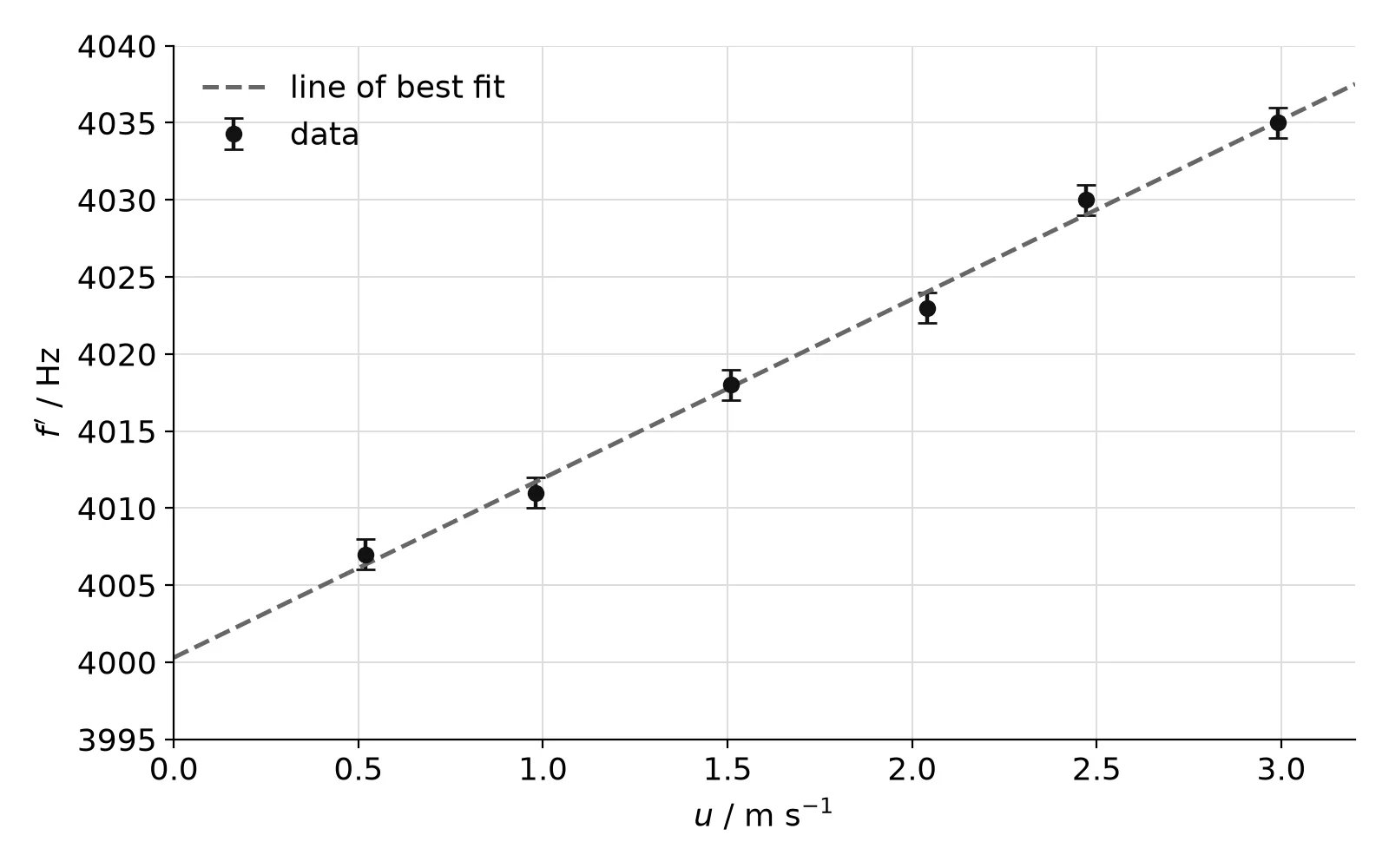
Determine the gradient of the line of best fit.
2 marks
- (c)(ii)
State the frequency emitted by the buzzer.
1 mark
- (c)(iii)
When is much smaller than the speed of sound , the gradient of this graph is approximately , where is the frequency emitted by the buzzer.
Determine .
2 marks
- (d)
The received frequency is given by .
Outline why the data lie on a straight line even though this relationship is not linear.
2 marks
- (e)
Another student suggests plotting against . Show that this graph is exactly a straight line, and state what its intercept on the vertical axis represents.
2 marks
A parking sensor on the rear bumper of a car emits pulses of ultrasound of frequency 40 kHz and detects the echoes from obstacles behind the car. The speed of sound in air depends on the absolute temperature of the air according to
where is in m s-1 and is in K.
- (a)
Show that the speed of sound in air at 20 °C is about 340 m s-1.
2 marks
- (b)
Calculate the wavelength of the ultrasound in air at 20 °C.
1 mark
- (c)
At 20 °C an echo from a wall is detected 5.8 ms after a pulse is emitted. Calculate the distance between the sensor and the wall.
2 marks
- (d)
The processor in the sensor always calculates the distance using a speed of 344 m s-1. On a winter day the air temperature is −10 °C and the car is 1.00 m from a wall. Determine the distance that the sensor indicates.
3 marks
- (e)
Comment on the safety of using this sensor on a cold day.
1 mark
- (f)
The air temperature is again 20 °C. The car reverses towards the wall at a constant speed of 1.5 m s-1. Calculate the frequency of the ultrasound received at the wall.
2 marks
The Doppler effect is the
A group of students use a microwave Doppler module to study the motion of a trolley rolling down a ramp inclined at 8.0° to the horizontal. The module is at the bottom of the ramp and sends microwaves of frequency = 10.525 GHz up the ramp. The trolley is released from rest and rolls down the ramp towards the module.
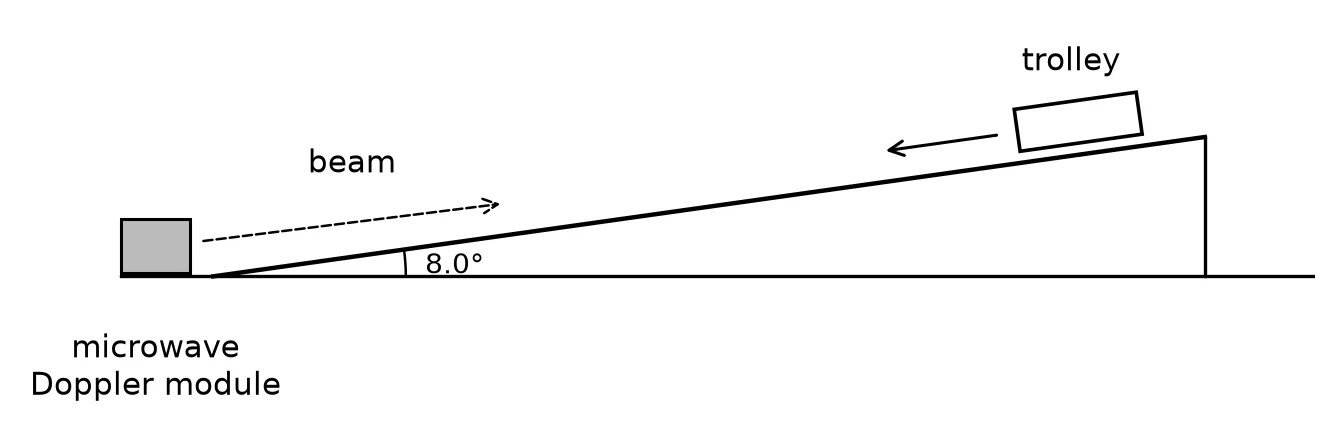
Microwaves reflected from the trolley return to the module. The module outputs the difference between the frequency it receives and the frequency it emits. When the trolley moves with speed towards the module,
The students record as the trolley passes marks at distances from its starting point. The uncertainty in each value of is ± 2 Hz.
/ m | / Hz ± 2 Hz |
|---|---|
0.20 | 49 |
0.40 | 71 |
0.60 | 85 |
0.80 | 99 |
1.00 | 110 |
1.20 | 121 |
- (a)
Outline why the change in frequency of the reflected microwaves is twice the change that would be detected if the trolley itself were emitting microwaves of frequency .
2 marks
- (b)
Calculate the speed of the trolley when = 99 Hz.
2 marks
- (c)
Calculate the percentage uncertainty in for = 0.20 m.
2 marks
- (d)
The students predict that the acceleration of the trolley is constant. Outline why, if this is true, a graph of against is a straight line through the origin.
1 mark
- (e)
The graph shows the variation of with , with the line of best fit.
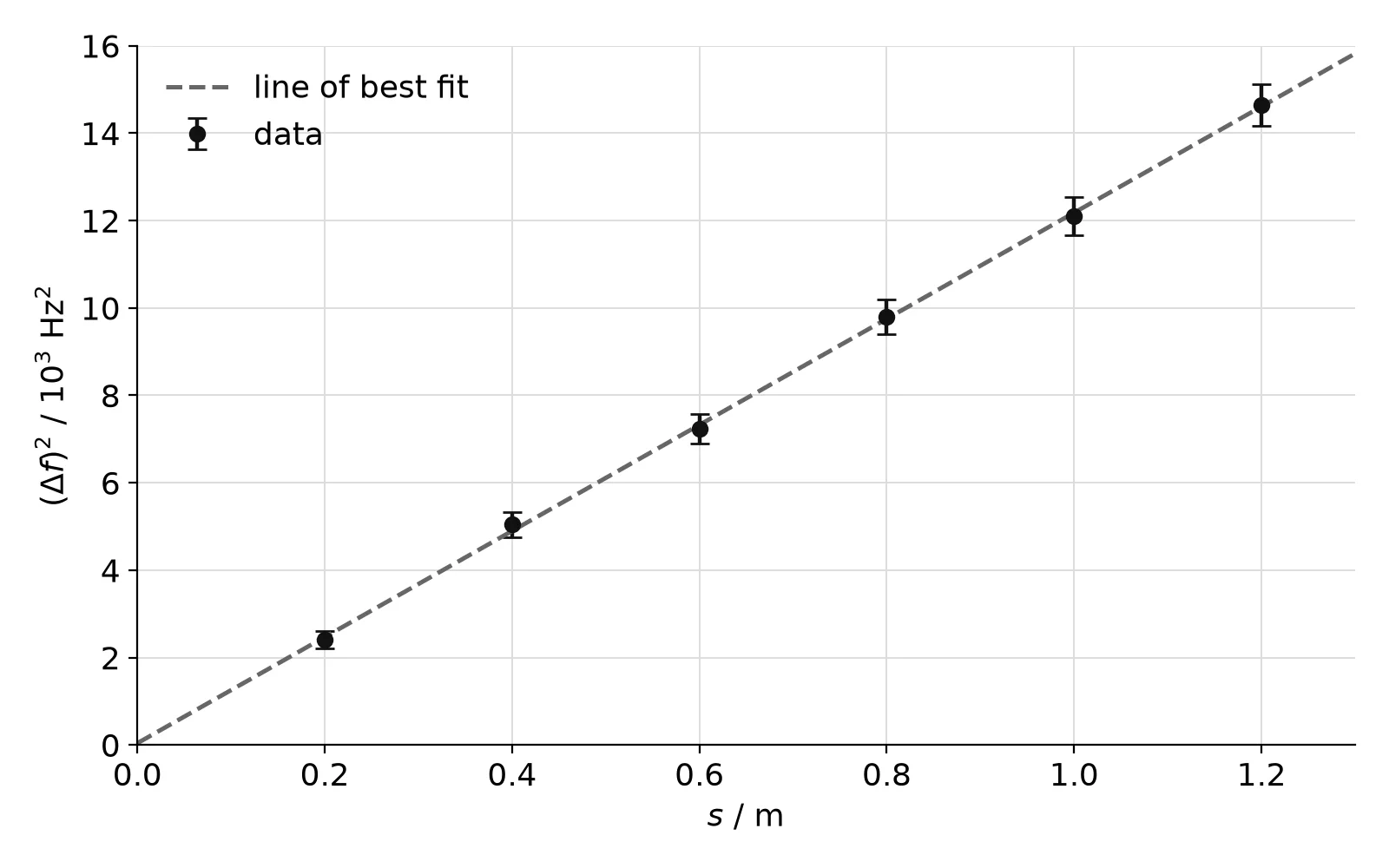
Determine, using the graph, the acceleration of the trolley.
3 marks
- (f)
Compare your answer to (e) with the acceleration of a trolley on a frictionless ramp at the same angle, and suggest a reason for any difference.
2 marks
A police officer uses a radar speed gun to measure the speeds of cars. The gun emits electromagnetic waves of frequency 24.15 GHz and detects the waves reflected from a car. When a car moves directly towards the gun with speed , the reflected waves have a frequency greater than the emitted frequency by . Because the moving car first receives and then re-emits the waves, the shift is doubled:
- (a)
Calculate the wavelength of the waves emitted by the gun and identify the region of the electromagnetic spectrum to which they belong.
2 marks
- (b)(i)
A car is 250 m from the gun. Calculate the time between the emission of a wave and the detection of its reflection.
1 mark
- (b)(ii)
The car moves at about 30 m s-1. Outline why the motion of the car during the time in (b)(i) does not affect the measurement of the distance.
1 mark
- (c)
Explain why the frequency of the reflected waves is greater than the emitted frequency when the car moves towards the gun.
2 marks
- (d)
For one car the measured frequency shift is 3.10 kHz. The speed limit on the road is 60 km h-1. Deduce whether the car is exceeding the speed limit.
3 marks
- (e)
Outline why the approximation is valid here.
1 mark
Practice all 52 in Augment
Free with an account. Every question has its markscheme, and Augment keeps the ones you got wrong so you can come back to them.
More questions in Wave behaviour
- C.1Simple harmonic motion
- C.2Wave model
- C.3Wave phenomena
- C.4Standing waves and resonance
- C.5Doppler effectThis page
Check your answers in Augment
A free account opens all 52 questions on Doppler effect with their markschemes, and keeps a record of what you have marked.