C.2 Wave model questions for IB Physics
113 questions on Wave model, written by Augment in the style of IB exam papers. Six of them are below in full, to answer on paper.
- IB Physics
- Part of C Wave behaviour
- SL and HL
Questions by paper and level
SL and HL questions are for students at either level. HL only questions cover what only HL students study.
| Paper | SL and HL | HL only | All |
|---|---|---|---|
| Paper 1A | 36 | 1 | 37 |
| Paper 1B | 8 | 0 | 8 |
| Paper 2 | 54 | 14 | 68 |
| Every paper | 98 | 15 | 113 |
Counted on
Questions to try
Written by Augment in the style of IB exams, not past papers. Answer them on paper, then check each one against its markscheme with a free account.
A student moves one end of a long horizontal rope up and down, so that a transverse wave travels along the rope. A small ribbon is tied to the rope halfway along its length.
Which describes the motion of the ribbon while the wave passes?
A group of students use the arrangement shown to measure the speed of sound in air. A loudspeaker connected to a signal generator emits sound of frequency . Microphone A is fixed close to the loudspeaker. Microphone B can be moved along a metre rule, directly away from the loudspeaker. Both microphones are connected to a dual-trace oscilloscope.
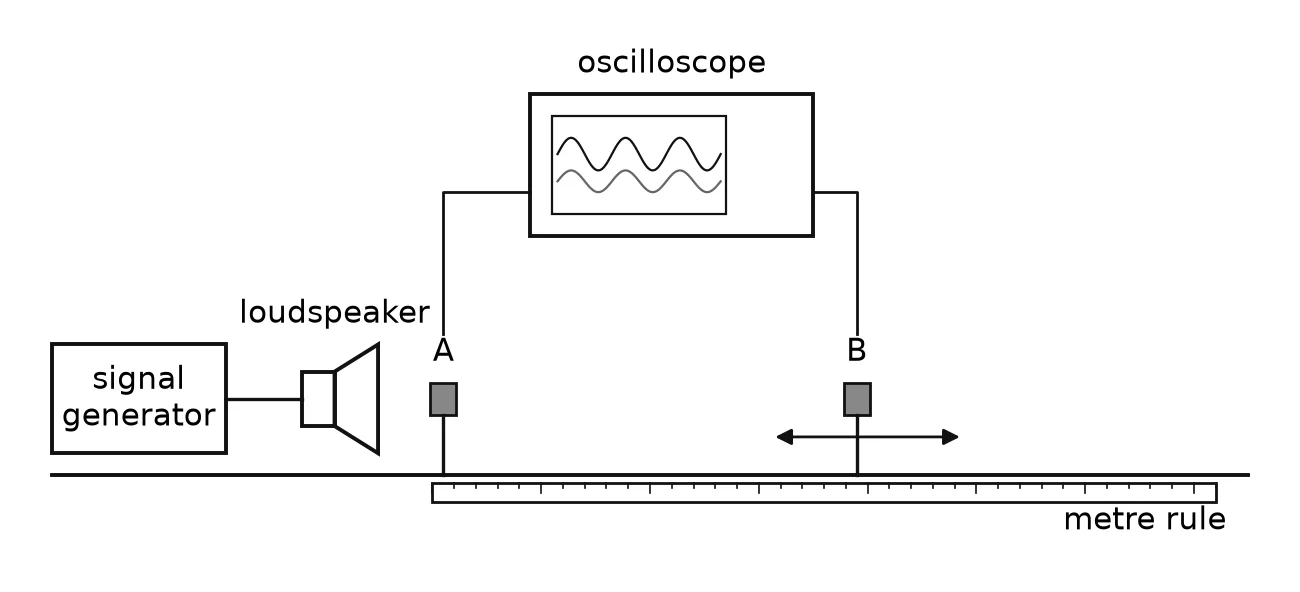
For each frequency, the students move B until its trace is in phase with the trace from A and record the position of B. They then move B further away until the two traces have come back into phase four more times, and record the distance moved by B. is equal to four wavelengths. The uncertainty in is ±1.0 cm. The air temperature is 21 °C.
/ Hz | / cm ± 1.0 cm | / cm | / s |
|---|---|---|---|
1500 | 92.1 | 23.0 | 6.67 |
2000 | 68.4 | 17.1 | 5.00 |
2500 | 55.3 | 13.8 | 4.00 |
3000 | 45.6 | 11.4 | 3.33 |
3500 | 39.5 | 9.9 | 2.86 |
4000 | 34.1 | 8.5 | 2.50 |
- (a)
State the absolute uncertainty in .
1 mark
- (b)
Explain why the students measured the distance moved by B for four wavelengths rather than for one.
2 marks
- (c)
Calculate the largest percentage uncertainty in in these data.
2 marks
- (d)
Outline why the students plot against .
1 mark
- (e)
The graph shows the variation of with , with the line of best fit.
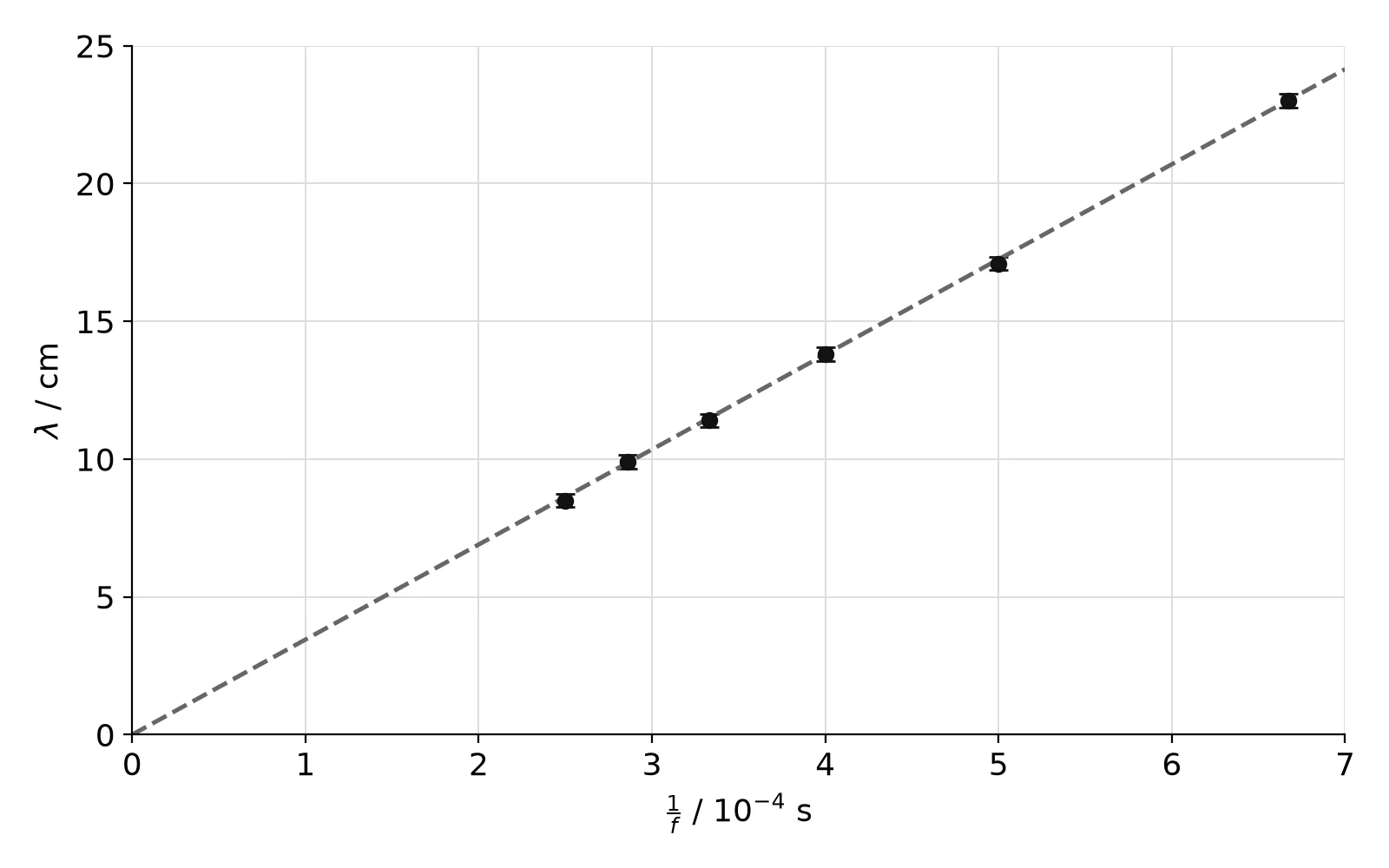
Determine, using the graph, the speed of sound in air.
3 marks
- (f)
The students draw the lines of maximum and minimum gradient that pass through all the error bars. These lines give speeds of 356 m s-1 and 336 m s-1. The accepted speed of sound in air at 21 °C is 344 m s-1.
Comment on whether the students' result is consistent with the accepted value.
2 marks
- (g)
The students propose extending the investigation to a frequency of 400 Hz. Suggest one practical difficulty they would meet.
1 mark
A rover on the surface of Mars launches a small sample capsule of mass 0.50 kg from a level plain. The capsule leaves the launcher at ground level with a speed of at above the horizontal.
The following data are given:
mass of Mars
radius of Mars
The atmosphere of Mars is very thin. Ignore air resistance unless a part says otherwise.
- (a)
Show that the gravitational field strength at the surface of Mars is about .
2 marks
- (b)(i)
Calculate the time of flight of the capsule.
2 marks
- (b)(ii)
Calculate the horizontal distance travelled by the capsule.
2 marks
- (b)(iii)
Calculate the maximum height reached by the capsule.
2 marks
- (c)
The same launcher is used on Earth, with the same launch speed and angle. Determine the ratio . Ignore air resistance on Earth.
2 marks
- (d)
Explain, without calculation, why the capsule lands with the same speed as it was launched.
2 marks
- (e)(i)
A later mission must send a sample capsule away from Mars completely. Show that the escape speed from the surface of Mars is about .
2 marks
- (e)(ii)
Calculate the minimum energy needed to move the 0.50 kg capsule from the surface of Mars to infinity.
2 marks
- (e)(iii)
Outline why the escape speed does not depend on the direction in which the capsule is launched.
1 mark
- (f)
Radio signals from the rover travel to Earth at the speed of light. On one day the distance between Mars and Earth is . Calculate the time taken for a signal from the rover to reach Earth.
1 mark
- (g)
The thin atmosphere of Mars does exert a small drag force on the capsule. Predict how the horizontal distance and the speed on landing compare with your answers to (b)(ii) and (d).
2 marks
Three waves are:
sound from a dolphin travelling through seawater
infrared radiation emitted by a heater
a pulse on a slinky spring whose end is pushed and pulled along the length of the spring
Which row correctly classifies the waves?
Sound in seawater | Infrared radiation | Pulse on the slinky | |
|---|---|---|---|
A. | longitudinal | transverse | longitudinal |
B. | longitudinal | longitudinal | transverse |
C. | transverse | transverse | longitudinal |
D. | transverse | longitudinal | transverse |
A student investigates how the speed of a pulse on the surface of water depends on the depth of the water. She uses a rectangular tray 0.800 m long. She lifts one end of the tray slightly and lowers it quickly, which sends a single pulse along the tray. The pulse reflects at the far end and returns.
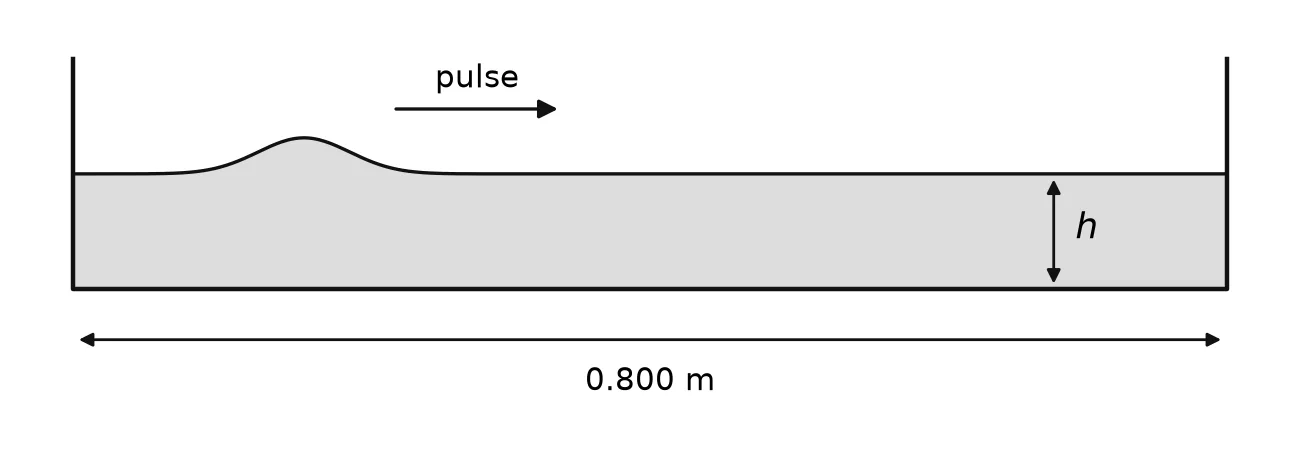
For each depth, she uses a stopwatch to measure, three times, the time for the pulse to travel to the far end and back. The depth is measured with a ruler with an uncertainty of ±0.1 cm.
/ cm ± 0.1 cm | / s | / s | / s | mean / s | / m2 s-2 |
|---|---|---|---|---|---|
1.0 | 5.21 | 5.08 | 5.17 | 5.15 | 0.097 |
2.0 | 3.73 | 3.62 | 3.68 | 3.68 | 0.189 |
3.0 | 2.91 | 3.02 | 2.96 | ||
4.0 | 2.60 | 2.53 | 2.58 | 2.57 | 0.388 |
5.0 | 2.28 | 2.34 | 2.29 | 2.30 | 0.484 |
6.0 | 2.12 | 2.05 | 2.10 | 2.09 | 0.586 |
- (a)
Calculate the percentage uncertainty in for the smallest depth.
1 mark
- (b)
Determine, for = 3.0 cm, the mean time and its absolute uncertainty.
2 marks
- (c)
Show that for = 3.0 cm is about 0.29 m2 s-2.
1 mark
- (d)
Theory suggests that for a pulse in shallow water. Explain why the student plots against .
2 marks
- (e)
The graph shows the variation of with , with error bars and the line of best fit.
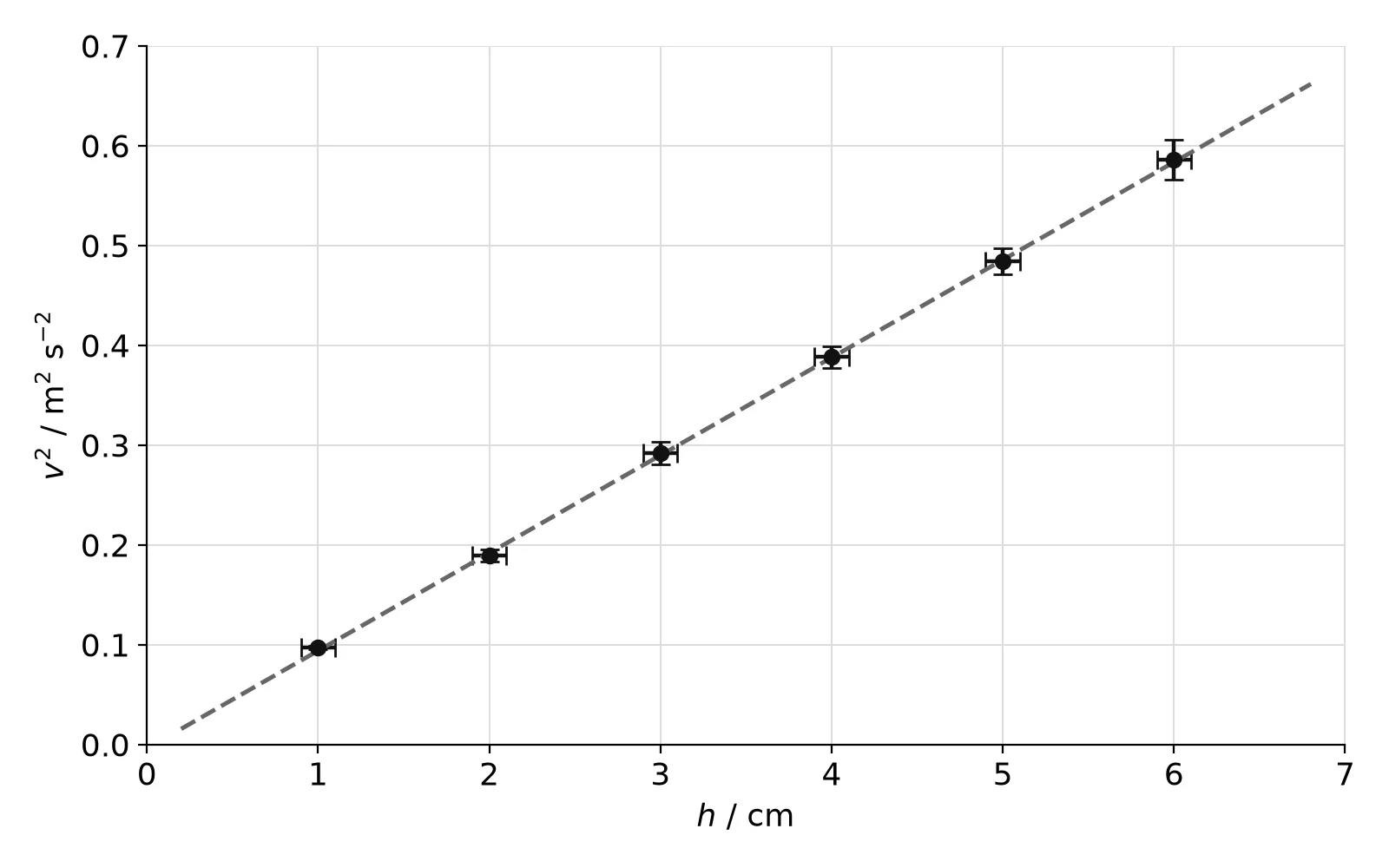
Determine using the graph.
3 marks
- (f)
Discuss whether the data support the theory.
2 marks
- (g)
Suggest why the student timed the pulse to the far end and back rather than over one length of the tray.
1 mark
An aircraft flies horizontally at a constant relative to the ground. The air is still. The speed of sound in the air is relative to the air.
- (a)
State what is meant by a reference frame.
1 mark
- (b)
Calculate, using the Galilean transformation, the speed relative to the aircraft of sound from its engines that travels straight ahead of the aircraft and of sound that travels straight behind it.
2 marks
- (c)
State the speed of the sound travelling straight ahead relative to an observer standing on the ground.
1 mark
- (d)
The aircraft switches on a landing light that shines straight ahead. State the speed of this light relative to the aircraft predicted by the Galilean transformation if the light travels at relative to the ground.
1 mark
- (e)
State the speed of the light relative to the aircraft according to special relativity.
1 mark
- (f)
Light, unlike sound, needs no medium. Outline how the postulates of special relativity changed the way the speed of light is understood compared with Galilean relativity.
2 marks
Practice all 113 in Augment
Free with an account. Every question has its markscheme, and Augment keeps the ones you got wrong so you can come back to them.
More questions in Wave behaviour
- C.1Simple harmonic motion
- C.2Wave modelThis page
- C.3Wave phenomena
- C.4Standing waves and resonance
- C.5Doppler effect
Check your answers in Augment
A free account opens all 113 questions on Wave model with their markschemes, and keeps a record of what you have marked.