C.4 Standing waves and resonance questions for IB Physics
69 questions on Standing waves and resonance, written by Augment in the style of IB exam papers. Six of them are below in full, to answer on paper.
- IB Physics
- Part of C Wave behaviour
- SL and HL
Questions by paper and level
SL and HL questions are for students at either level. HL only questions cover what only HL students study.
| Paper | SL and HL | HL only | All |
|---|---|---|---|
| Paper 1A | 30 | 0 | 30 |
| Paper 1B | 5 | 0 | 5 |
| Paper 2 | 24 | 10 | 34 |
| Every paper | 59 | 10 | 69 |
Counted on
Questions to try
Written by Augment in the style of IB exams, not past papers. Answer them on paper, then check each one against its markscheme with a free account.
A standing wave is set up on a stretched string. The standing wave is formed by the superposition of two waves that have
A group of students use a resonance tube to measure the speed of sound in air. A glass tube, open at both ends, is held vertically in a tall container of water. A tuning fork of frequency is struck and held just above the top of the tube. The tube is slowly raised, which increases the length of the air column above the water surface.
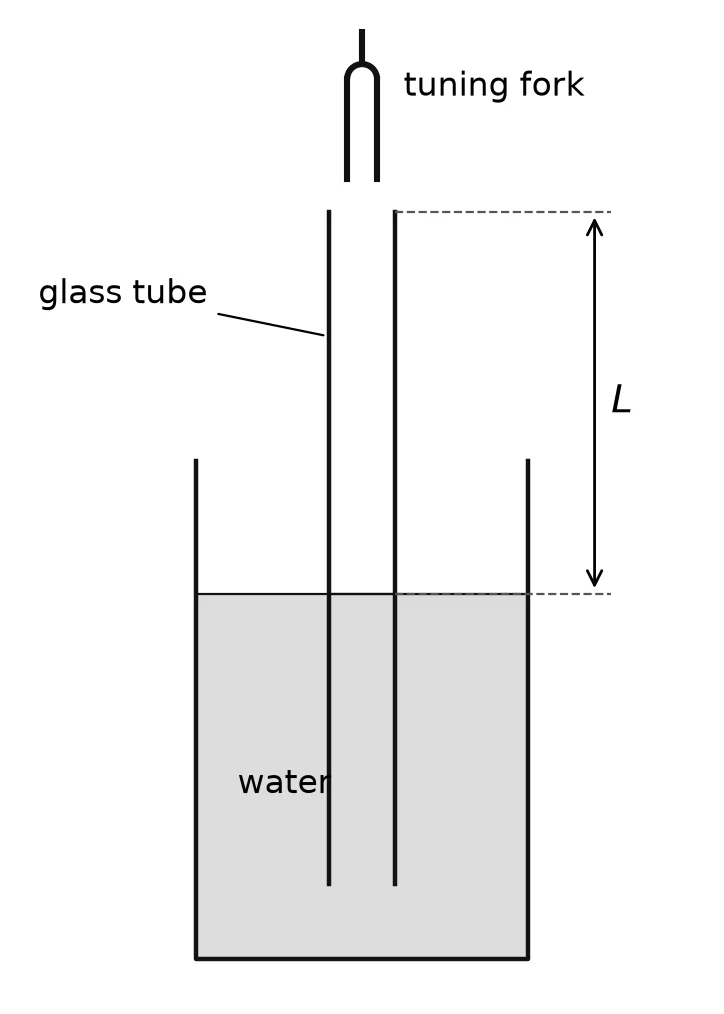
For each tuning fork, the students record the length when the sound is first heard loudest and the length when it is next heard loudest. Each length has an uncertainty of .
/ Hz | / cm ± 0.5 cm | / cm ± 0.5 cm |
|---|---|---|
256 | 32.5 | 99.5 |
288 | 29.5 | 89.0 |
320 | 25.5 | 79.5 |
384 | 21.0 | 66.0 |
480 | 17.0 | 53.0 |
512 | 16.0 | 49.5 |
The students calculate the wavelength of the sound using .
- (a)
State the absolute uncertainty in .
1 mark
- (b)
Calculate the percentage uncertainty in for .
2 marks
- (c)
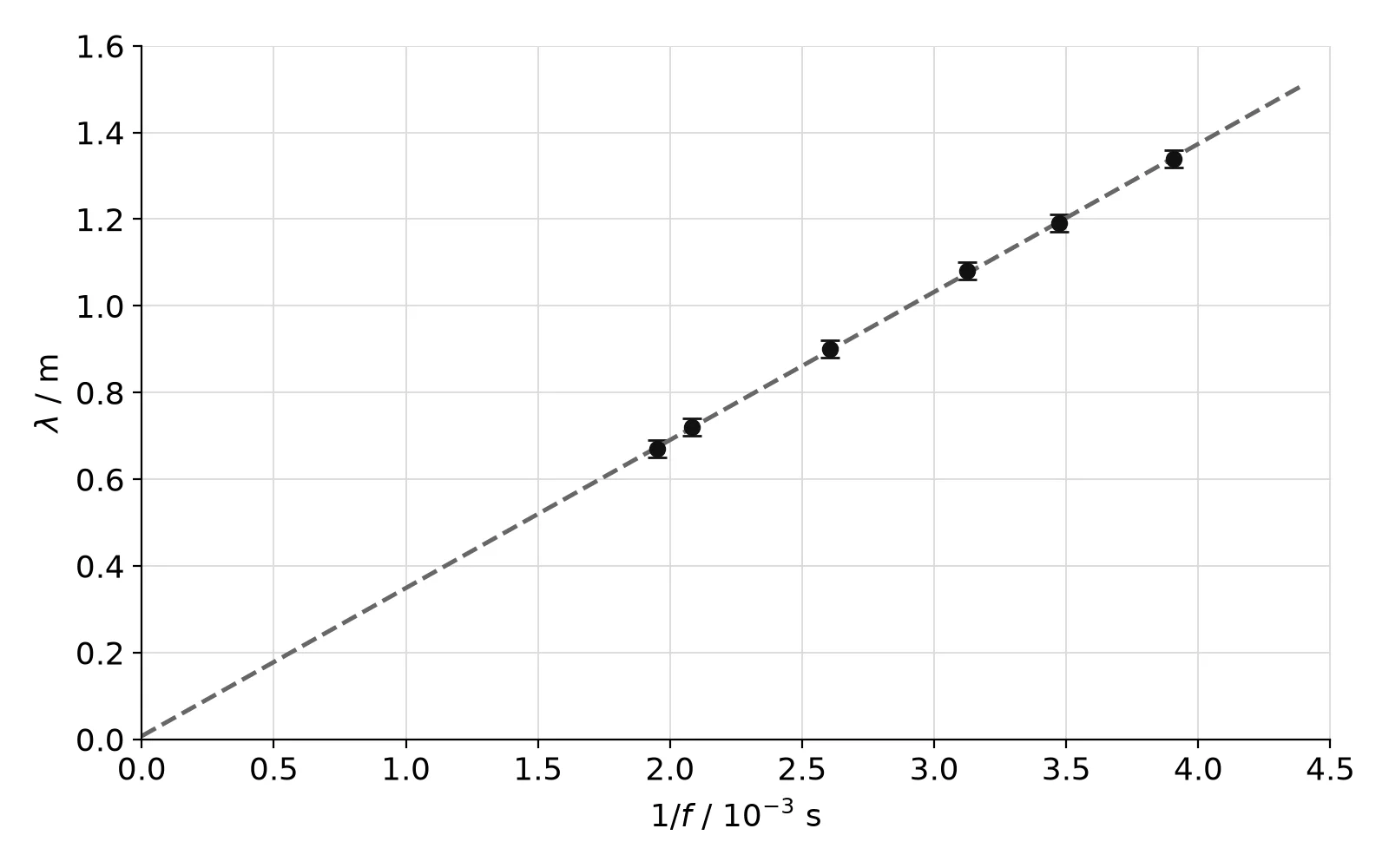
The graph shows the variation of with , with the line of best fit.
Explain why the data support the hypothesis that is proportional to .
2 marks
- (d)
Determine, using the graph, the speed of sound in air.
2 marks
- (e)
The students draw lines of maximum and minimum gradient through the error bars. The gradients of these lines are and . At the temperature of the laboratory the speed of sound in air is . Comment on whether the students' result is consistent with this value.
2 marks
- (f)
Suggest one advantage of calculating from rather than from alone.
1 mark
- (g)
The lengths are read from a rule marked in millimetres. Suggest why the uncertainty in each length is .
1 mark
In the resonance model of the greenhouse effect, a carbon dioxide molecule is treated as a system of masses connected by springs. One mode of vibration of the molecule, in which it bends, has a natural frequency of Hz.
- (a)
Calculate the wavelength of electromagnetic radiation that has this frequency.
1 mark
- (b)
The mean temperature of the Earth's surface is 288 K. Show that the surface emits radiation of greatest intensity at a wavelength of about 10 μm.
1 mark
- (c)
Explain, using the resonance model, why carbon dioxide in the atmosphere absorbs some of the radiation emitted by the Earth's surface.
3 marks
- (d)
Nitrogen and oxygen molecules make up most of the atmosphere. Suggest why they absorb very little of the radiation emitted by the surface.
1 mark
One end of a rope is tied to a wall and a student moves the other end up and down so that a standing wave forms on the rope. Three statements about the standing wave are:
I. There is no net transfer of energy along the rope by the standing wave.
II. All points on the rope oscillate with the same amplitude.
III. All points between two adjacent nodes oscillate in phase.
Which statements are correct?
A group of students investigate how the frequency of a stretched steel wire depends on its tension. The wire is fixed at one end, passes over two bridges a distance apart, and then over a pulley to a hanger. Slotted masses of total mass are placed on the hanger. The students take the tension in the wire to be .
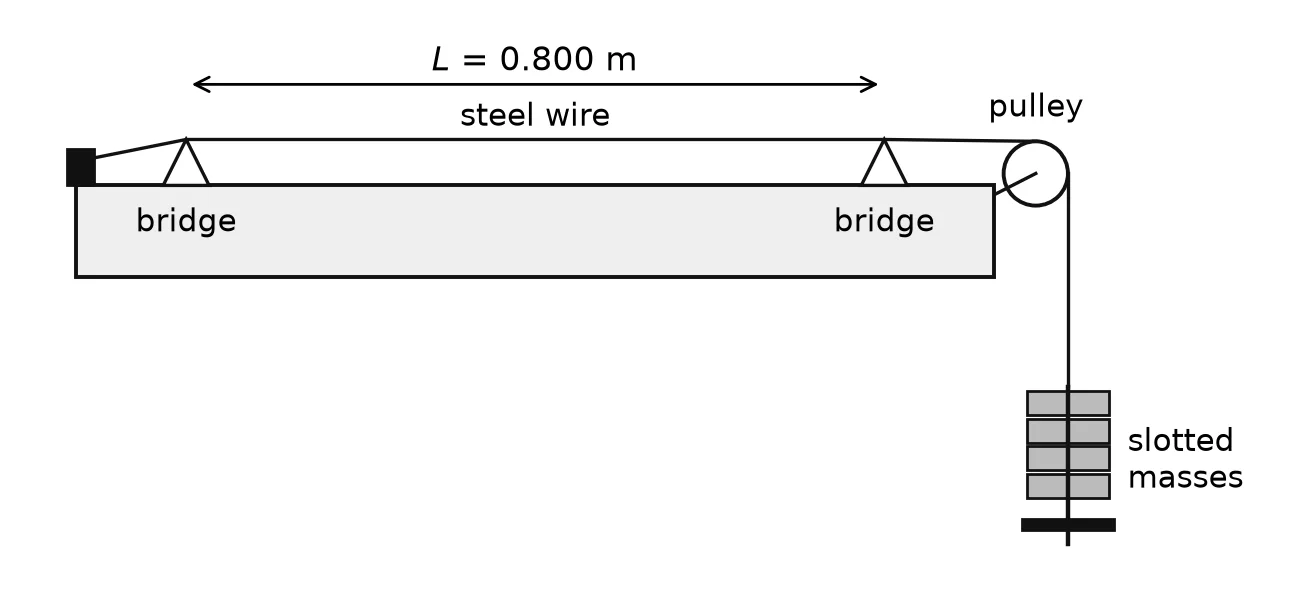
For each value of the students pluck the wire at the midpoint between the bridges and use a phone app to measure the frequency of the first harmonic. The app reads to the nearest 1 Hz and the uncertainty in is taken to be .
/ kg | / Hz ± 1 Hz |
|---|---|
0.200 | 39 |
0.400 | 52 |
0.600 | 62 |
0.800 | 71 |
1.000 | 79 |
1.200 | 86 |
The speed of transverse waves on a wire of mass per unit length and tension is given by .
- (a)
Show that .
2 marks
- (b)
Calculate the percentage uncertainty in for .
2 marks
- (c)
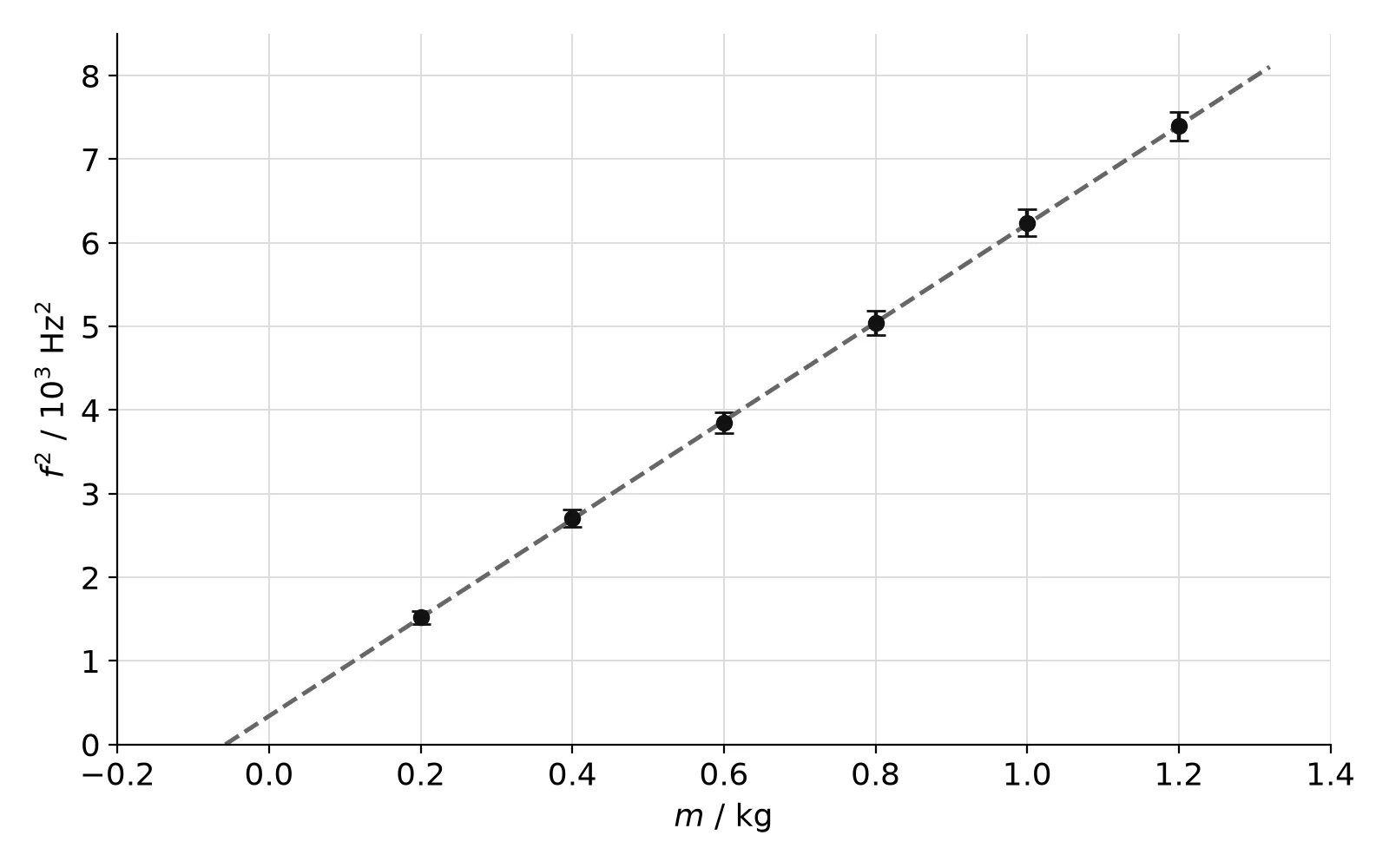
The graph shows the variation of with , with the line of best fit extended to the axis.
Determine, using the graph, the value of .
3 marks
- (d)
The students also measure directly by weighing a known length of the wire. They obtain . The percentage uncertainty in their value of from the graph is 4 %. Discuss whether the two values of agree.
2 marks
- (e)(i)
The students realise that does not include the mass of the hanger. Explain why this does not change their value of .
1 mark
- (e)(ii)
Estimate, using the graph, the mass of the hanger.
1 mark
Carbon dioxide molecules absorb infrared radiation strongly at two wavelengths, 15 μm and 4.3 μm. Each absorption corresponds to a transition between vibrational energy levels of the molecule.
- (a)
Calculate, in eV, the energy of a photon of wavelength 15 μm.
2 marks
- (b)
Show that the difference between the energy levels for the absorption at 4.3 μm is about 0.3 eV.
1 mark
- (c)
In a resonance model of this vibration, an oxygen atom of mass 16 u oscillates on a spring of stiffness attached to a fixed carbon atom. The natural frequency of this oscillator equals the frequency of radiation of wavelength 4.3 μm.
Determine .
3 marks
- (d)
Infrared radiation of a range of frequencies is incident on the molecule. Sketch a graph to show how the amplitude of the oscillation of the molecule varies with the frequency of the incident radiation. Label the natural frequency on the frequency axis.
2 marks
- (e)
Water vapour is the most abundant greenhouse gas. Suggest why the water vapour released by human activities has little direct effect on the greenhouse effect, while warming caused by carbon dioxide increases the amount of water vapour in the atmosphere.
2 marks
Practice all 69 in Augment
Free with an account. Every question has its markscheme, and Augment keeps the ones you got wrong so you can come back to them.
More questions in Wave behaviour
- C.1Simple harmonic motion
- C.2Wave model
- C.3Wave phenomena
- C.4Standing waves and resonanceThis page
- C.5Doppler effect
Check your answers in Augment
A free account opens all 69 questions on Standing waves and resonance with their markschemes, and keeps a record of what you have marked.