C.1 Simple harmonic motion questions for IB Physics
83 questions on Simple harmonic motion, written by Augment in the style of IB exam papers. Six of them are below in full, to answer on paper.
- IB Physics
- Part of C Wave behaviour
- SL and HL
Questions by paper and level
SL and HL questions are for students at either level. HL only questions cover what only HL students study.
| Paper | SL and HL | HL only | All |
|---|---|---|---|
| Paper 1A | 22 | 13 | 35 |
| Paper 1B | 6 | 0 | 6 |
| Paper 2 | 23 | 19 | 42 |
| Every paper | 51 | 32 | 83 |
Counted on
Questions to try
Written by Augment in the style of IB exams, not past papers. Answer them on paper, then check each one against its markscheme with a free account.
A buoy floating in a harbour is pushed down a short distance and released. It bobs up and down. The motion of the buoy is simple harmonic if the resultant force on it is
A group of students investigate resonance. A mass of 0.200 kg hangs from a spring attached to a vibration generator. A signal generator makes the vibration generator oscillate vertically with frequency and a small constant amplitude. The students measure the amplitude of the oscillations of the mass against a vertical metre rule. The uncertainty in is .
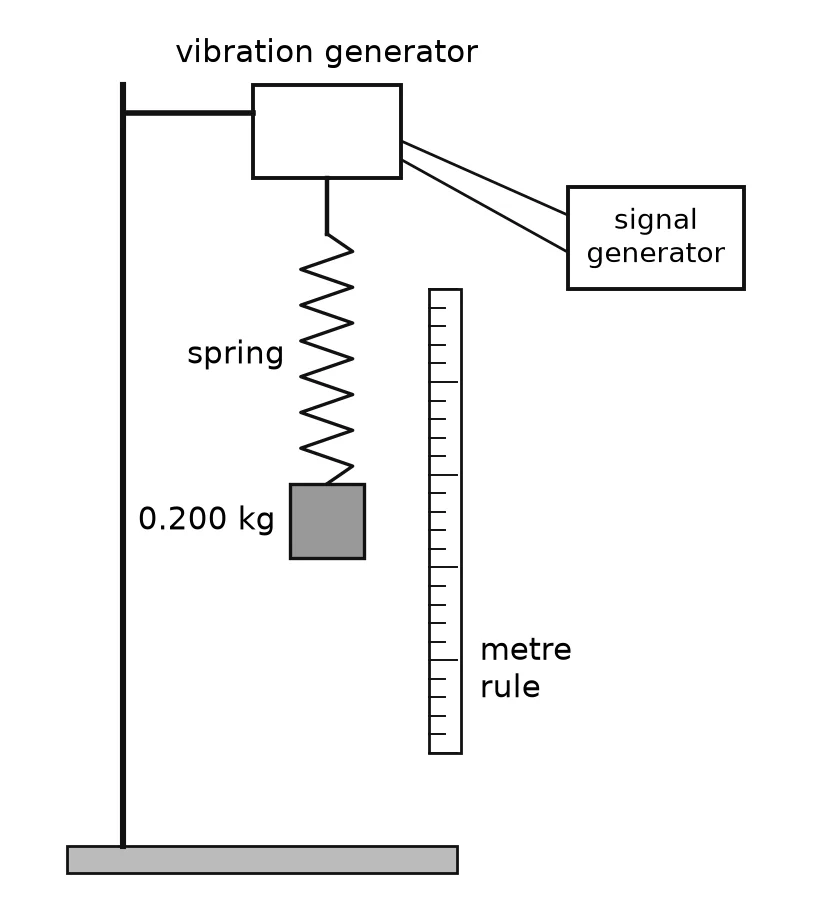
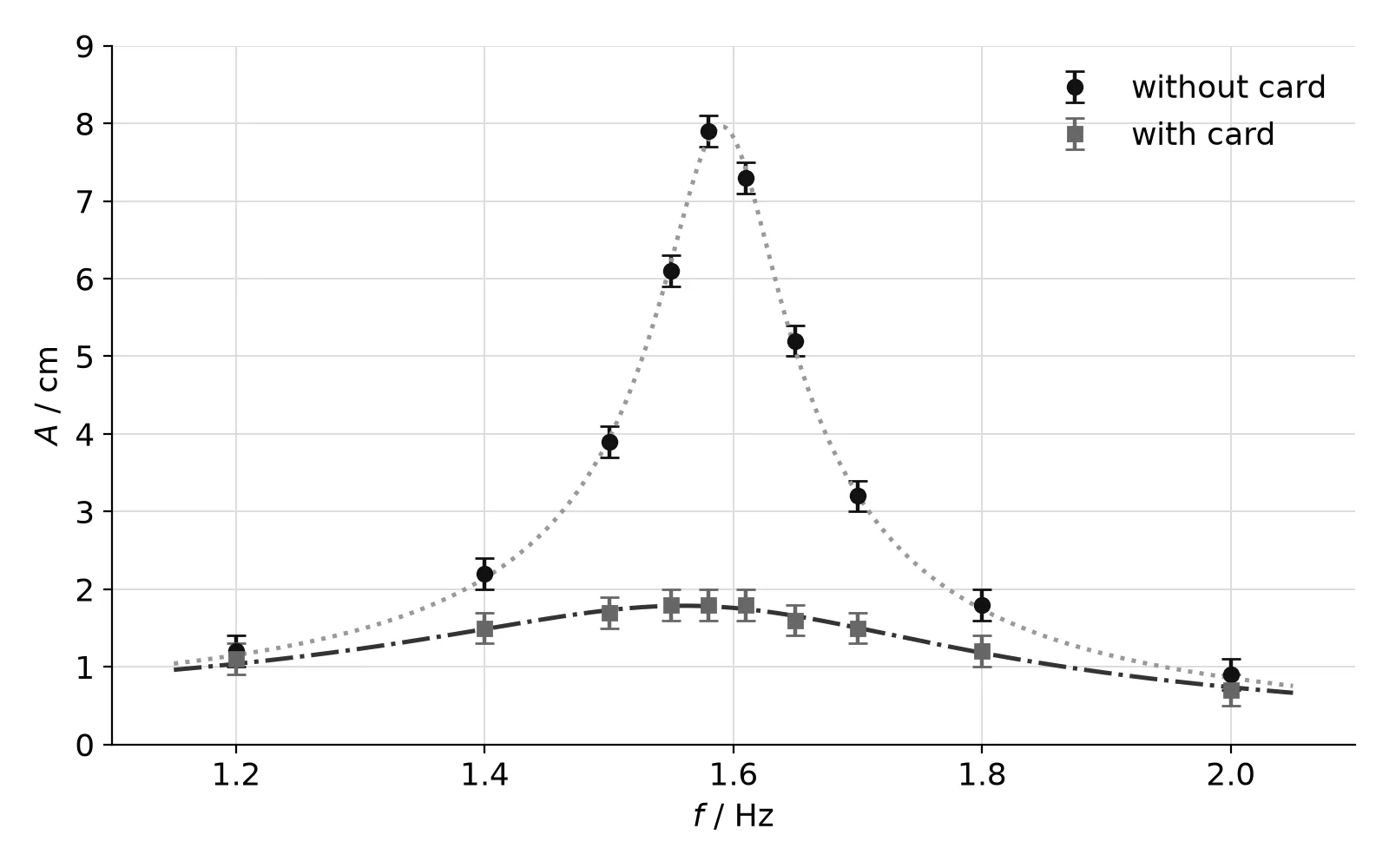
The students then fix a light horizontal card to the mass and repeat the experiment. The graph shows the variation of with for both arrangements.
- (a)
State the resonant frequency of the system without the card.
1 mark
- (b)
Assume that the natural frequency of the mass–spring system is equal to your answer to (a). Calculate the spring constant of the spring.
2 marks
- (c)
Calculate the percentage uncertainty in the maximum amplitude when the card is used.
1 mark
- (d)
Describe the effect of the card on the variation of with .
2 marks
- (e)
Outline why the card has this effect.
1 mark
- (f)
Suggest how the students could determine the resonant frequency more precisely using the same apparatus.
1 mark
- (g)
The mass is replaced by one of 0.300 kg and the card is removed. Predict the new resonant frequency.
2 marks
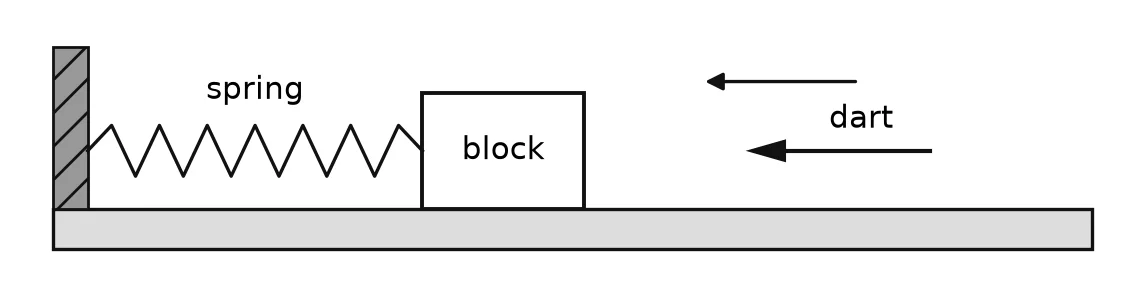
A block of mass 0.380 kg rests on a horizontal air track and is attached to a fixed support by a spring of spring constant 40 N m. The spring is at its natural length. A dart of mass 0.020 kg moving horizontally at 15 m s along the axis of the spring hits the block and sticks in it. Friction is negligible.
- (a)
Calculate the speed of the block and dart immediately after the collision.
2 marks
- (b)
Calculate the percentage of the dart's initial kinetic energy that is transferred to other forms in the collision.
2 marks
- (c)
The block and dart then oscillate with simple harmonic motion. Calculate the period of the oscillations.
2 marks
- (d)
Determine the amplitude of the oscillations.
2 marks
- (e)
Calculate the maximum force exerted on the block by the spring, and the maximum acceleration of the block.
2 marks
Three systems are set oscillating:
I. a steel ball bouncing vertically on a hard floor with no loss of energy
II. a trolley held between two stretched springs on a horizontal frictionless track, displaced along the line of the springs
III. a simple pendulum swinging through a small angle
Which systems perform simple harmonic motion?
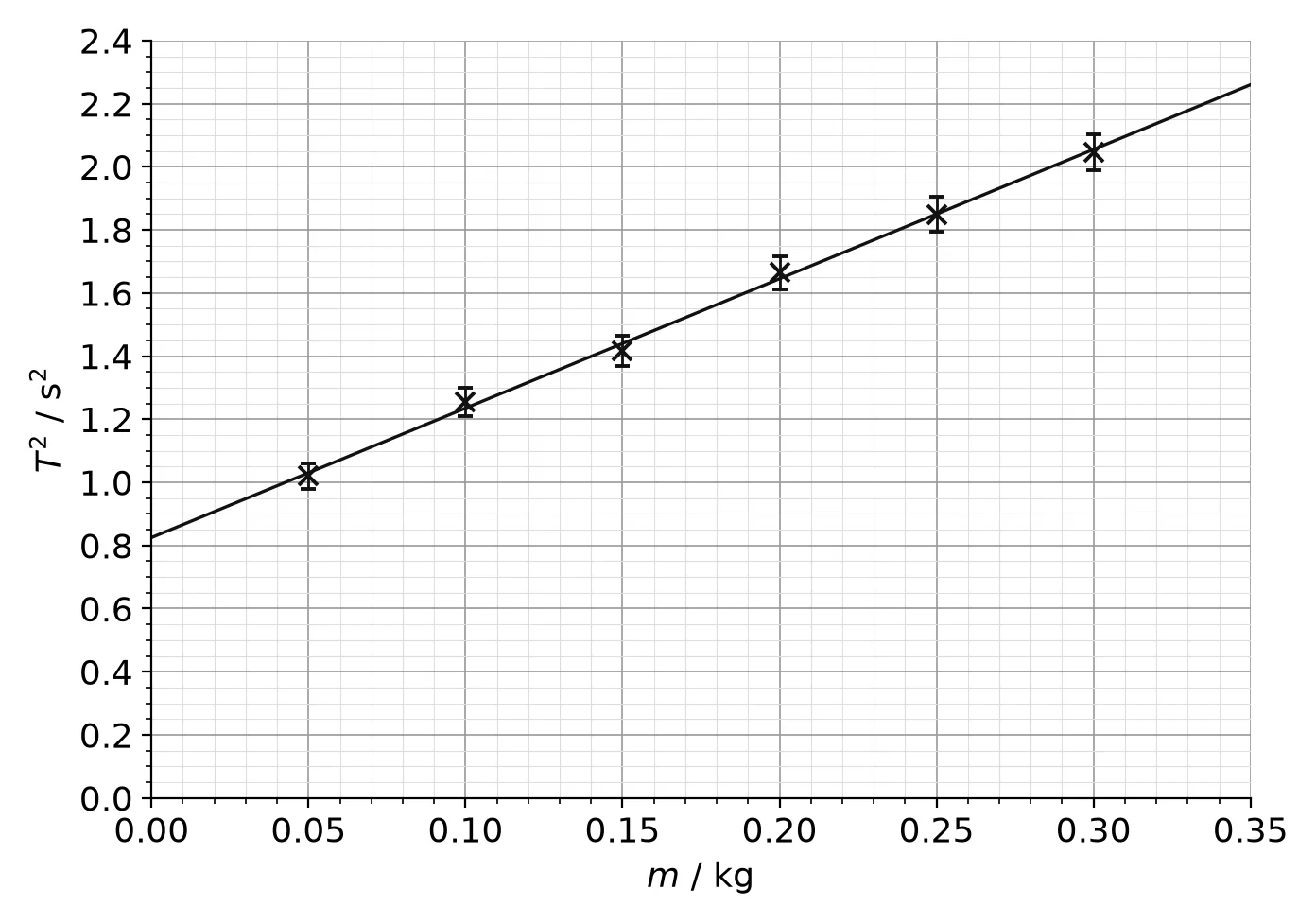
A group of students investigates how the period of oscillation of a glider on a horizontal air track depends on the mass it carries. The glider is attached between two identical stretched springs whose other ends are fixed to the ends of the track. Friction is negligible.
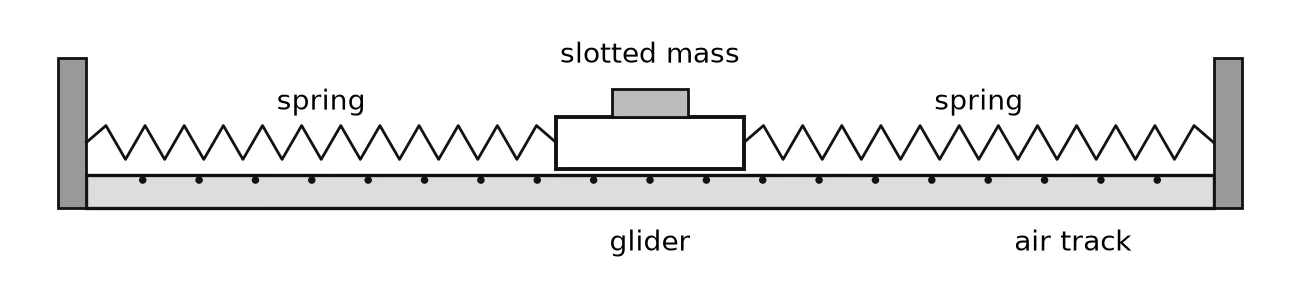
The students add slotted masses of total mass to the glider. For each value of they displace the glider along the track, release it and use a stopwatch to measure the time for ten oscillations, where is the period.
/ kg | / s ± 0.2 s |
|---|---|
0.050 | 10.1 |
0.100 | 11.2 |
0.150 | 11.9 |
0.200 | 12.9 |
0.250 | 13.6 |
0.300 | 14.3 |
The theory of the arrangement predicts that
where is the combined spring constant of the two springs and is a constant mass.
The graph shows the variation of with , with error bars for and the line of best fit.
- (a)
Outline why the students time ten oscillations rather than one.
1 mark
- (b)
Calculate the percentage uncertainty in for .
2 marks
- (c)(i)
Determine, using the graph, .
3 marks
- (c)(ii)
State the unit of the gradient of the graph.
1 mark
- (d)(i)
Determine .
2 marks
- (d)(ii)
The mass of the glider, measured on a balance, is 0.180 kg. Suggest why is greater than this value.
1 mark
- (e)
Suggest one change to the procedure that would reduce the uncertainty in , using the same apparatus.
1 mark
Carbon dioxide molecules absorb infrared radiation strongly at two wavelengths, 15 μm and 4.3 μm. Each absorption corresponds to a transition between vibrational energy levels of the molecule.
- (a)
Calculate, in eV, the energy of a photon of wavelength 15 μm.
2 marks
- (b)
Show that the difference between the energy levels for the absorption at 4.3 μm is about 0.3 eV.
1 mark
- (c)
In a resonance model of this vibration, an oxygen atom of mass 16 u oscillates on a spring of stiffness attached to a fixed carbon atom. The natural frequency of this oscillator equals the frequency of radiation of wavelength 4.3 μm.
Determine .
3 marks
- (d)
Infrared radiation of a range of frequencies is incident on the molecule. Sketch a graph to show how the amplitude of the oscillation of the molecule varies with the frequency of the incident radiation. Label the natural frequency on the frequency axis.
2 marks
- (e)
Water vapour is the most abundant greenhouse gas. Suggest why the water vapour released by human activities has little direct effect on the greenhouse effect, while warming caused by carbon dioxide increases the amount of water vapour in the atmosphere.
2 marks
Practice all 83 in Augment
Free with an account. Every question has its markscheme, and Augment keeps the ones you got wrong so you can come back to them.
More questions in Wave behaviour
- C.1Simple harmonic motionThis page
- C.2Wave model
- C.3Wave phenomena
- C.4Standing waves and resonance
- C.5Doppler effect
Check your answers in Augment
A free account opens all 83 questions on Simple harmonic motion with their markschemes, and keeps a record of what you have marked.