 YouTube
Why the frequency and wavelength of a wave change when the source or observer moves, for sound and for light: wavefront diagrams, redshift and blueshift, radar and ultrasound, and the sound equations (HL).
Each is in the Physics glossary, with every other term in the subject.
A continuous spectrum crossed by dark lines, produced when light passes through a cooler gas that absorbs photons whose energies match its energy-level differences.
A decrease in the observed wavelength (and increase in frequency) of electromagnetic waves from a source moving towards the observer.
The change in the observed frequency and wavelength of a wave when the source and the observer move relative to each other.
A medical technique that measures the speed and direction of blood flow from the frequency shift of ultrasound reflected by moving blood cells.
A planet orbiting a star other than the Sun; many are found from the periodic Doppler shift of their star's spectral lines.
The straight line joining an observer and the body observed; only motion along it produces a Doppler shift.
How high or low a sound is heard to be; a higher frequency is heard as a higher pitch.
A system that sends out microwaves or radio waves and detects their reflections; the Doppler shift of the reflected waves, , gives the speed of the target.
The component of a body's velocity along the line of sight, towards or away from the observer; it is the part of the motion that a Doppler shift measures.
An increase in the observed wavelength (and decrease in frequency) of electromagnetic waves from a source moving away from the observer.
The velocity of one body as measured by an observer moving with another body; for light, only the relative velocity of source and observer along the line joining them sets the Doppler shift.
The cone-shaped pile-up of wavefronts produced by a source moving faster than the waves it emits, heard for sound as a sonic boom.
A narrow bright or dark line in a spectrum at a wavelength emitted or absorbed by a particular element; its shift from the laboratory wavelength measures the radial velocity of the source.
52 exam-style questions on this subtopic, written in the style of the IB papers. The first has its markscheme open. Counted on
A cyclist rides at constant speed directly towards a stationary siren that emits sound of constant frequency. The air is still. Three statements about the sound detected by the cyclist are:
I. The frequency detected is higher than the frequency emitted by the siren.
II. The wavelength of the sound in the air between the siren and the cyclist is the same as when the cyclist is at rest.
III. The speed of the sound waves relative to the cyclist is greater than the speed of sound in still air.
Which statements are correct?
The siren is at rest, so the wavefronts it sends into the air are evenly spaced with the usual wavelength (II). The cyclist moves into them, so they pass him at
One of 50 short multiple-choice questions on C.5. Pick an answer to see why it's right or wrong.
For a moving source of sound,
The official deck for this part of the syllabus.
Define the Doppler effect.
In terms of wavefronts, what does the frequency an observer measures equal?
The entries of the physics data booklet that C.5 uses. Each opens in the explained booklet.
With a free account, Augment remembers where you stopped and what you have practiced.
Spectral lines from receding stars and galaxies are redshifted; those from approaching bodies are blueshifted.
Doppler shifts are used to measure speeds with radar and ultrasound.
For sound, separate equations give the observed frequency for a moving source and for a moving observer (HL).
An ambulance siren sounds higher in pitch as the ambulance approaches and lower as it moves away, even though the siren itself emits a constant note. This change in the observed frequency caused by motion is the Doppler effect. It happens for every kind of wave, and because the size of the shift depends on speed, it gives a way of measuring how fast something is moving towards or away from an observer.
Police speed guns, weather radar, ultrasound scans of blood flow and the measurement of the motion of stars and galaxies all rely on it. For light, Doppler shifts gave the first detection of a planet orbiting a Sun-like star.
The Doppler effect has a simple cause. The frequency an observer measures is the number of wavefronts that reach the observer per second. If the source or the observer moves, that number changes, even though the source still emits the same number of waves each second.
When the source and the observer approach each other, the observed frequency is higher than the emitted frequency.
When they move apart, the observed frequency is lower than the emitted frequency.
When there is no relative motion along the line joining them, there is no shift.
For sound, a higher frequency is heard as a higher pitch. For light, a higher frequency means a shorter wavelength, a shift towards the blue end of the visible spectrum; a lower frequency means a shift towards the red end.
The effect was first predicted by Christian Doppler in 1842. Three years later it was tested with sound: trumpeters playing a steady note on a moving train were heard by musicians beside the track, who recorded the change in pitch as the train approached and receded. Doppler had predicted the shift for starlight too, and astronomers confirmed this later in the nineteenth century.
YouTubeA wavefront is a line joining points on a wave that are in phase, such as the crests. Wavefronts drawn one period apart are one wavelength apart. A stationary source in still air emits circular wavefronts centred on the source, evenly spaced in every direction, so every stationary observer receives the emitted frequency .
When the source moves, each wavefront still spreads out at the wave speed from the point where it was emitted, because the speed of sound depends only on the medium, not on the motion of the source. But each new wavefront is emitted from a point further along the source's path. The wavefronts are therefore crowded together ahead of the source and spread apart behind it.
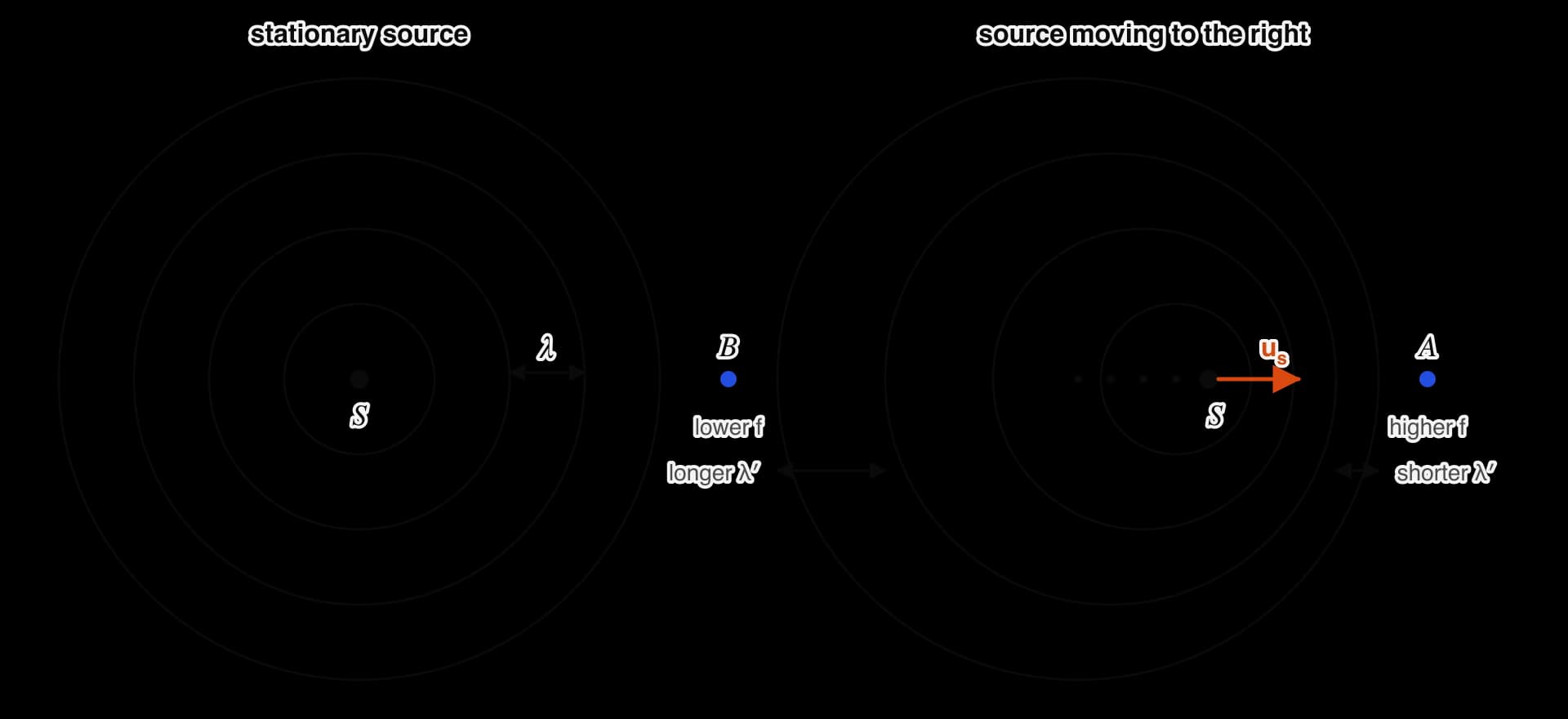
Observer A, ahead of the source. The wavelength is shorter. The waves still travel at , so more wavefronts arrive per second: the observed frequency is higher, .
Observer B, behind the source. The wavelength is longer, fewer wavefronts arrive per second, and the observed frequency is lower.
An observer to the side, at right angles to the motion at the moment the sound is emitted, receives approximately the emitted frequency, because the source is neither approaching nor receding at that moment.
A siren driving past at constant speed gives a characteristic sound: a steady high note while it is still some distance away and approaching, a rapid drop as it passes, then a steady low note as it moves away. The observed frequency depends on the component of the source's velocity along the line to the observer. Far away, almost all of the velocity is along that line; as the source passes, the component falls to zero and then reverses.
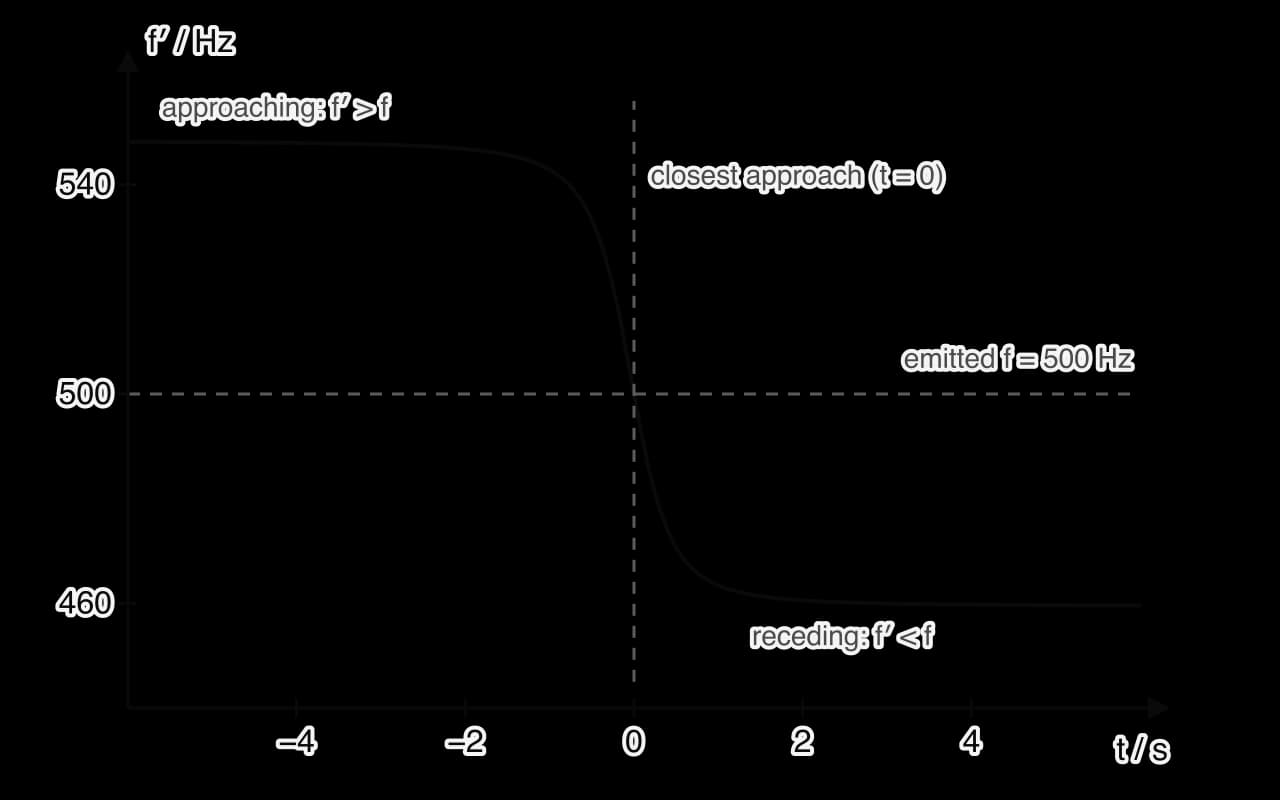
The closer the observer is to the source's path, the faster the drop. An observer standing directly in the path would hear the frequency fall instantly from the high value to the low value.
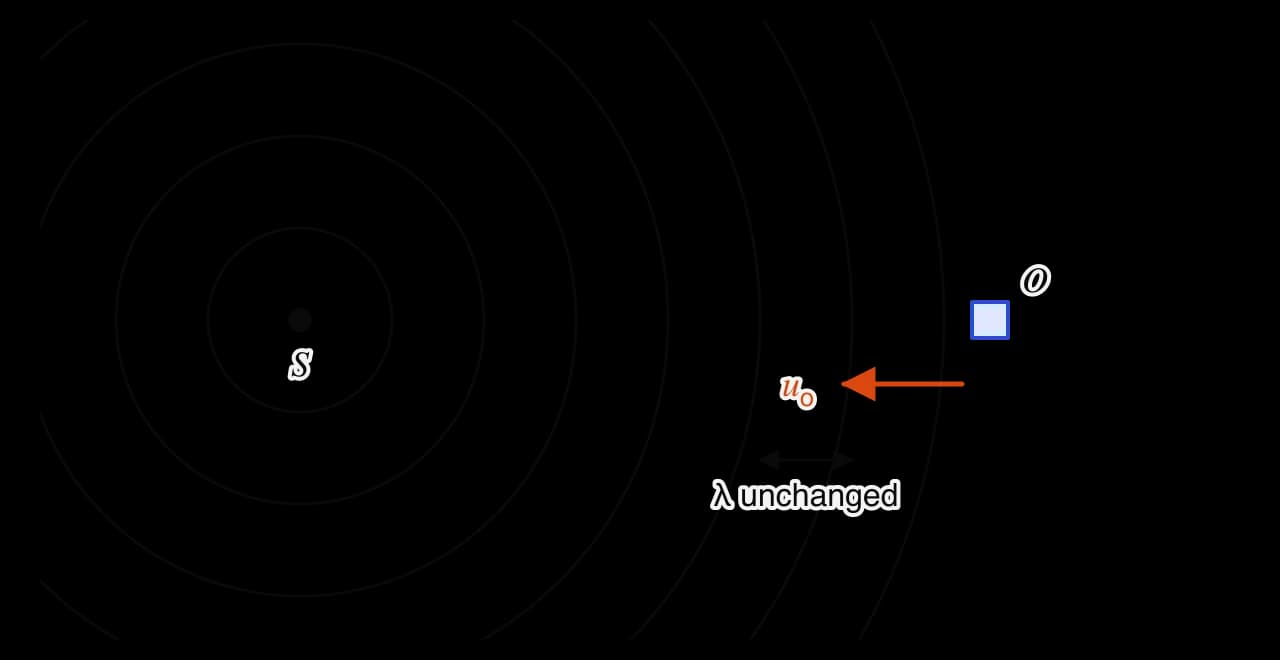
When the source is stationary and the observer moves, the wavefronts are evenly spaced circles, so the wavelength in the medium is unchanged. An observer moving towards the source meets the wavefronts more often than a stationary observer would, because the wavefronts approach at relative to the observer, where is the observer's speed. The observed frequency is higher. An observer moving away meets fewer wavefronts per second and measures a lower frequency.
Moving source | Moving observer | |
|---|---|---|
Wavelength in the medium | Changed: shorter ahead, longer behind | Unchanged |
Speed of the waves relative to the observer | (unchanged) | |
Why the frequency changes | The wavefronts are closer together (or further apart) | The observer meets the wavefronts more (or less) often |
For sound the two cases are physically different, because the medium (the air) provides a reference against which both the source and the observer move. A source moving at a certain speed towards a stationary observer gives a slightly different shift from an observer moving at the same speed towards a stationary source. For low speeds the two shifts are almost equal.
Electromagnetic waves need no medium, and the speed of light is the same for every observer. There is therefore no distinction between a moving source and a moving observer for light: only the relative velocity of the source and the observer along the line joining them matters.
When the relative speed is much smaller than the speed of light , the fractional change in frequency and the fractional change in wavelength have the same size, given by
Here and are the emitted frequency and wavelength (measured in the source's own frame, for example in a laboratory), and are the sizes of the shifts, is the relative speed of the source and the observer along the line of sight, and . The approximation is accurate to within a few per cent up to about a tenth of , and far better at the speeds of stars in the Galaxy, which are well below 1% of .
For a source moving away at speed , each wavefront is emitted a distance further away than the previous one, where is the period. The wavefronts are therefore spaced by instead of , so and , which gives .
Because , a small fractional increase in wavelength produces an equal fractional decrease in frequency. For speeds close to relativity changes the result, so the equation is only an approximation.
The words come from the visible spectrum, where red has the longest wavelength and blue and violet the shortest. They are used for any electromagnetic wave: a radio signal from a receding spacecraft is "redshifted" even though it is nowhere near red. The equation gives the size of the shift; the direction comes from whether the wavelength has increased (redshift) or decreased (blueshift).
A star's light passes through its cooler outer layers, where atoms absorb particular wavelengths. Its spectrum is therefore an absorption spectrum, a continuous spectrum crossed by dark spectral lines whose pattern identifies the elements present: hydrogen, for example, absorbs at 410 nm, 434 nm, 486 nm and 656 nm. If the star is moving along the line of sight, every line is shifted by the same fraction of its wavelength, so the pattern is still recognisable and the shift can be measured.
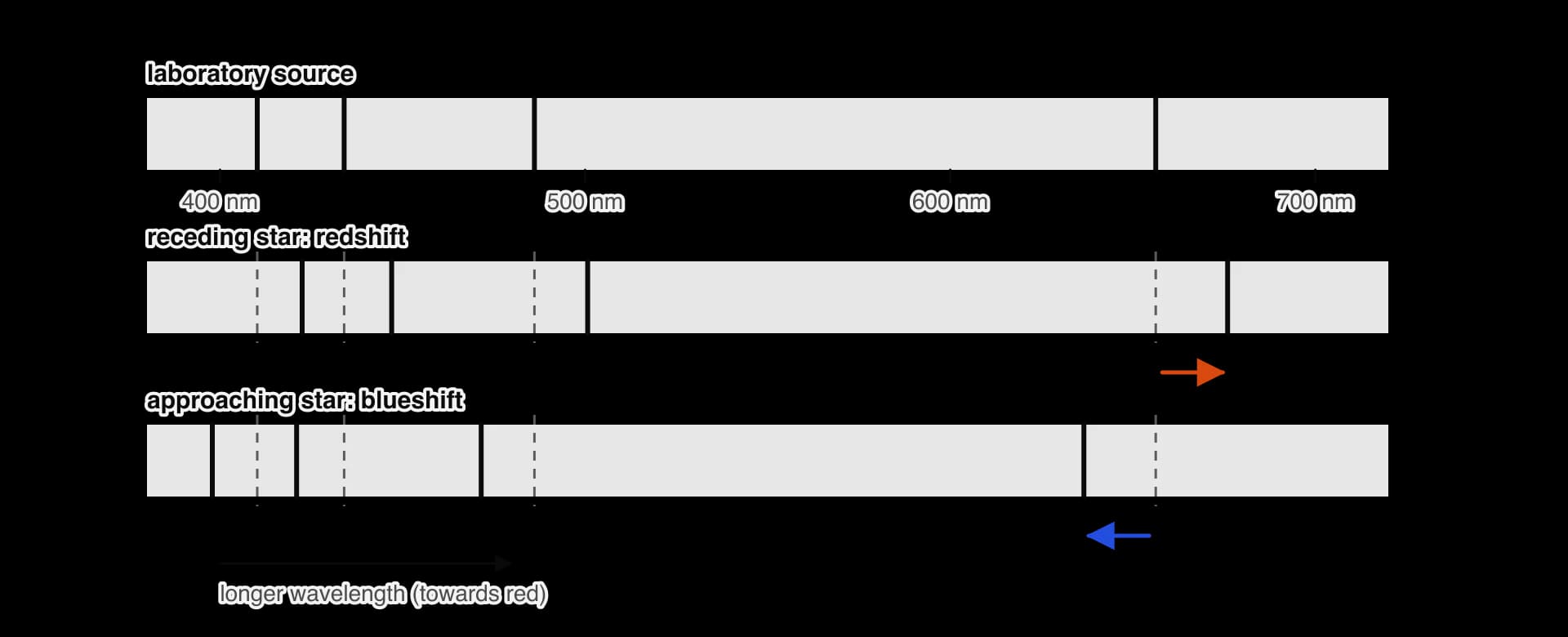
Comparing the measured wavelength of a line with its laboratory wavelength gives , and then gives the speed of the star towards or away from Earth. This speed along the line of sight is called the radial velocity. Motion across the sky, at right angles to the line of sight, produces no shift.
The Andromeda galaxy, the nearest large galaxy to the Milky Way, shows a blueshift: it is approaching the Sun at about . Much of this is the Sun's own orbital motion around the Galaxy, which carries it roughly towards Andromeda. Almost all more distant galaxies, by contrast, show redshifts, so they are moving away from the Milky Way. This pattern was one of the key observations that led to the idea of an expanding universe.
A planet and its star orbit their common centre of mass, so the star moves in a small circle and its radial velocity rises and falls with the orbital period of the planet. The star's spectral lines therefore shift periodically, alternately towards red and towards blue. In 1995 Michel Mayor and Didier Queloz detected this wobble in the star 51 Pegasi: its radial velocity varies by about either side of its average, with a period of 4.23 days. It was the first exoplanet (a planet outside the Solar System) found orbiting a Sun-like star, and the discovery earned the 2019 Nobel Prize in Physics.
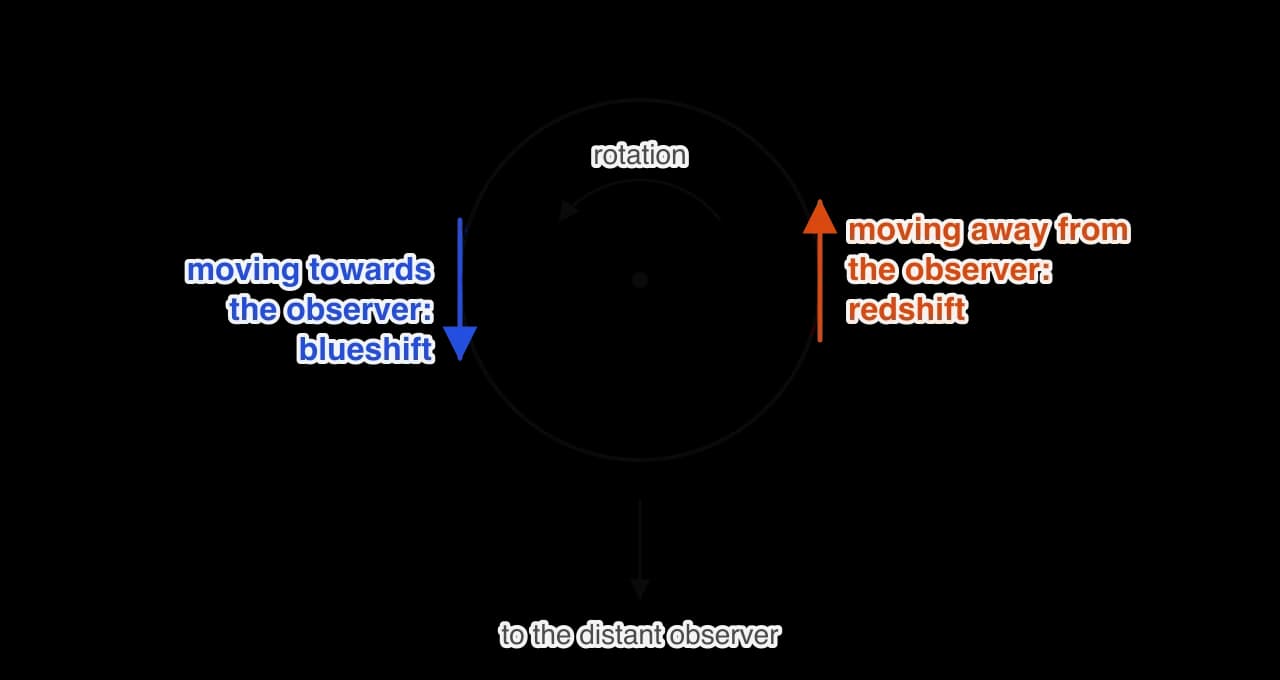
When a star, a planet or a galaxy rotates, one edge moves towards the observer while the opposite edge moves away. Light from the approaching edge is blueshifted and light from the receding edge is redshifted. Comparing the two edges gives the speed of rotation. For a star too distant to resolve, light from both edges arrives together, so each spectral line is spread over a range of wavelengths and looks broader than it would for a non-rotating star.
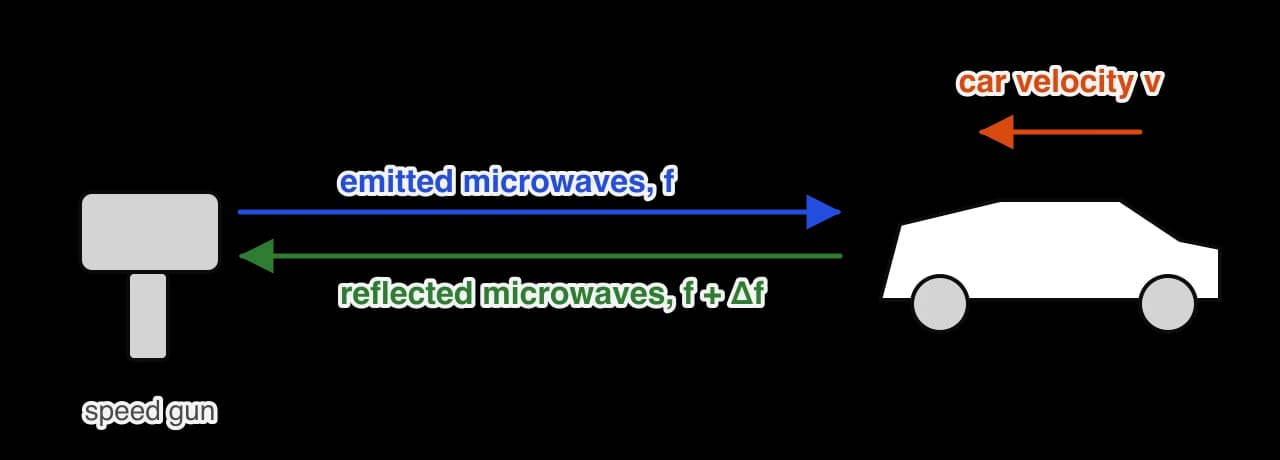
A radar speed gun sends a beam of microwaves at a moving vehicle and detects the waves reflected back. The vehicle acts first as a moving observer, receiving a shifted frequency, and then as a moving source, re-emitting that shifted frequency back towards the gun. The frequency is therefore shifted twice, and for the total shift is double the one-way shift:
The gun mixes the reflected signal with the emitted one and measures the difference frequency , which is easy to measure accurately because it is only a few kilohertz. Weather radar uses the same principle to measure the speed of raindrops, and so the wind speed inside a storm.
In a Doppler ultrasound scan, a probe placed on the skin sends ultrasound (typically a few megahertz) into the body. Red blood cells moving in an artery or vein reflect some of it back. Cells moving towards the probe return a slightly higher frequency and cells moving away a lower one. The shift gives the speed and direction of the blood flow, which shows narrowed arteries, blood clots and the blood flow in a fetus.
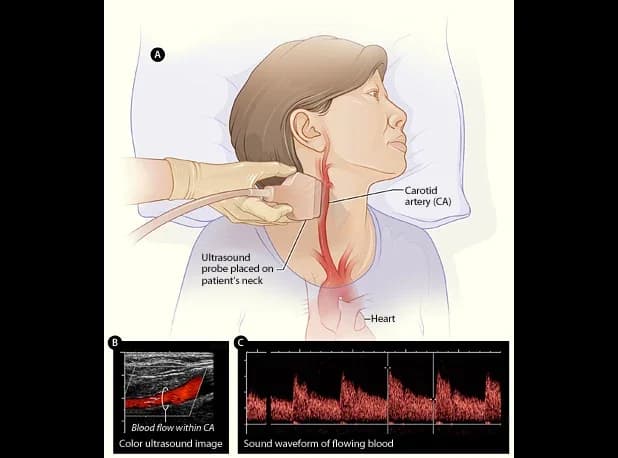
The shifts are small fractions of the emitted frequency because blood moves at less than about , much slower than ultrasound travels in tissue (about ). The shift is usually a few kilohertz, in the audible range, so scanners often play it through a loudspeaker as well as showing it as a colour map, with flow towards the probe in one colour and away in another. Because sound is a mechanical wave, the precise equations for this case are those for sound.
In the equations, is the frequency emitted by the source, the observed frequency, the speed of the wave in the medium, the speed of the source and the speed of the observer, all measured relative to the medium. Only one of the source and the observer moves at a time, and the motion is along the line joining them.
A source of frequency and period moves at speed towards a stationary observer. It emits a wavefront at A. One period later that wavefront has travelled a distance , while the source has moved to B, where it emits the next wavefront.
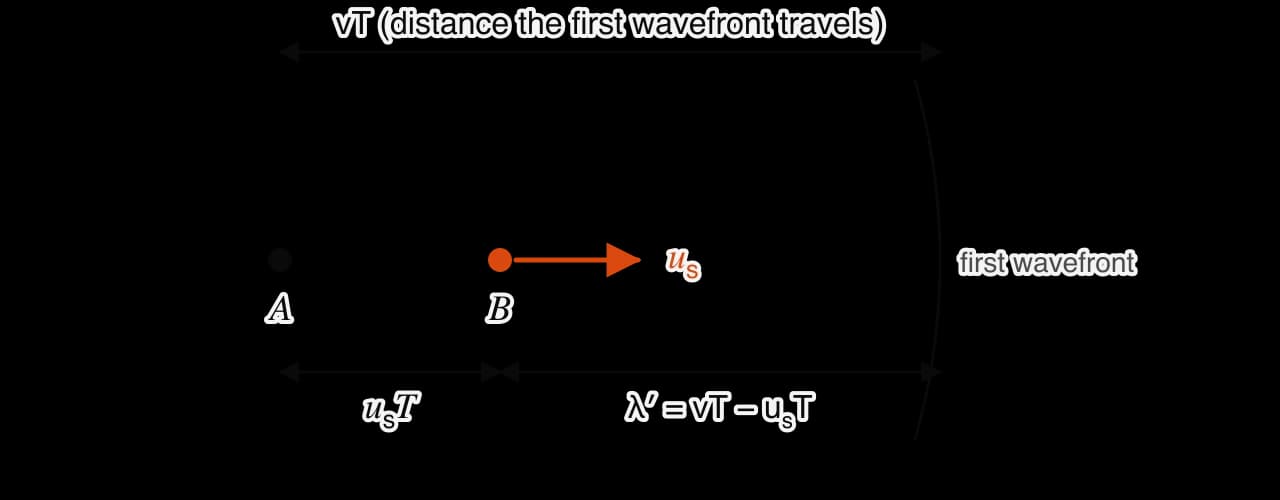
The distance between the two wavefronts, the wavelength ahead of the source, is
The waves travel towards the stationary observer at , so the observed frequency is :
The minus sign applies when the source moves towards the observer (a smaller denominator, so ) and the plus sign when it moves away (). As approaches the wavefronts ahead of the source pile up on each other; a source faster than sound produces a shock wave, the sonic boom of a supersonic aircraft.
For a stationary source the wavelength is unchanged, . An observer moving towards the source at speed meets the wavefronts at a relative speed , so the number met per second is :
The plus sign applies when the observer moves towards the source and the minus sign when it moves away.
Motion | Equation | Sign for approaching | Sign for receding |
|---|---|---|---|
Source moving, observer at rest | (denominator smaller) | ||
Observer moving, source at rest |
 YouTube
For a moving observer the equation is linear in , so equal speeds towards and away from the source give equal and opposite changes in frequency.
Problems often give two observed frequencies, one as a source approaches and one as it recedes, without the emitted frequency. Dividing one equation by the other removes and leaves an equation for the speed.
Blood cells reflecting ultrasound are first moving observers and then moving sources, so, as for radar, the shift is doubled. Because the blood speed is tiny compared with the wave speed in tissue, the two sound equations give almost the same shift, and the result simplifies to for blood moving directly towards or away from the probe.
The graph of frequency ratio against speed shows the two equations side by side. At speeds much less than the wave speed, a source and an observer moving at the same speed give nearly the same shift, , which has the same form as the equation for light. At higher speeds the two cases differ, because a moving source changes the wavelength in the medium while a moving observer does not.
Calculation questions at both levels usually ask for a speed from a measured shift, or for an observed frequency or wavelength from a given speed. State the direction of motion whenever the question asks whether the source is approaching or receding.
An astronomer measures the wavelength of a hydrogen line in the spectrum of a star that orbits a companion. The laboratory wavelength of the line is 656.280 nm. Each measurement has an uncertainty of .
t / days | 0 | 1 | 2 | 3 | 4 | 5 | 6 | 7 | 8 |
|---|---|---|---|---|---|---|---|---|---|
λ / nm | 656.313 | 656.375 | 656.400 | 656.375 | 656.313 | 656.251 | 656.226 | 656.251 | 656.313 |
I can define the Doppler effect and state when the observed frequency rises or falls.
I can draw and interpret wavefront diagrams for a moving source.
I can explain the difference between a moving source and a moving observer for sound.
I can describe how the pitch of a passing source changes, and why.
I can use for light and say when it is valid.
I can define redshift and blueshift and use spectral line shifts to find the speed and direction of a star or galaxy.
I can explain how Doppler shifts show planets around other stars and the rotation of a body.
I can explain why the shift is doubled for reflection from a moving target and use this for radar.
I can describe how Doppler ultrasound measures blood flow.
I can use the moving-source and moving-observer equations for sound, choosing the correct sign (HL).
I can find the speed of a source from the frequencies heard as it approaches and recedes (HL).
The answer is D.
The Doppler effect is the
The diagram shows the wavefronts of a sound produced by a source S that moves at constant velocity. W, X, Y and Z are stationary observers.
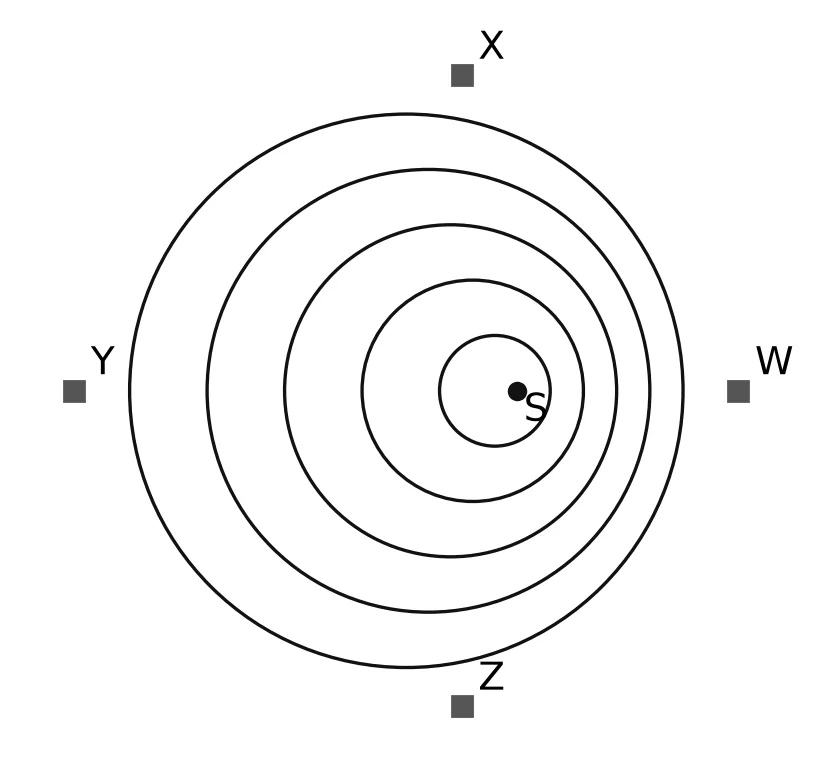
Which observer detects the highest frequency?
Minus, so that
Plus, so that
Plus, so that
Minus, so that
(numerator larger) |
B has the direction reversed. A halves the answer and D doubles it, the factor of 2 that belongs only to reflected waves.
D comes from the moving-source equation, . A and B are the corresponding answers for motion away from the source.