C.3 Wave phenomena questions for IB Physics
81 questions on Wave phenomena, written by Augment in the style of IB exam papers. Six of them are below in full, to answer on paper.
- IB Physics
- Part of C Wave behaviour
- SL and HL
Questions by paper and level
SL and HL questions are for students at either level. HL only questions cover what only HL students study.
| Paper | SL and HL | HL only | All |
|---|---|---|---|
| Paper 1A | 23 | 12 | 35 |
| Paper 1B | 3 | 2 | 5 |
| Paper 2 | 24 | 17 | 41 |
| Every paper | 50 | 31 | 81 |
Counted on
Questions to try
Written by Augment in the style of IB exams, not past papers. Answer them on paper, then check each one against its markscheme with a free account.
Plane water waves in a ripple tank meet a straight barrier at an angle and are reflected. Which statement about the reflected waves is correct?
A group of students investigate the refraction of light at the flat face of a semicircular acrylic block. A narrow ray of light from a ray box is directed through the curved face towards the centre O of the flat face. The angle of incidence inside the block and the angle of refraction in the air are measured with a protractor.
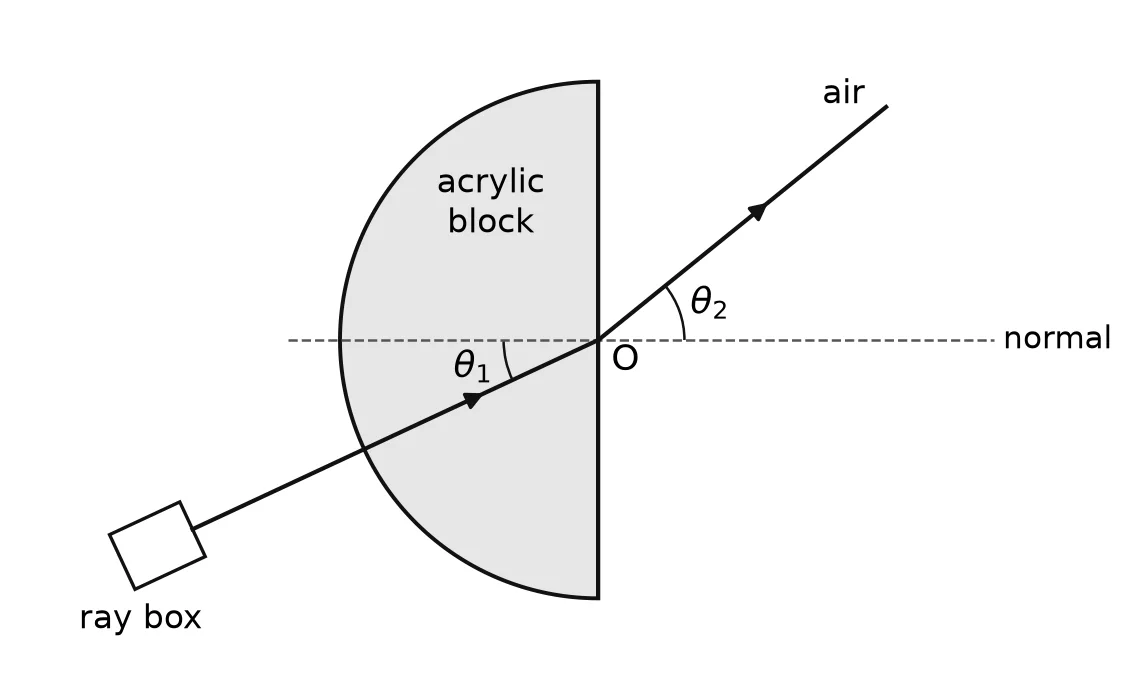
The students vary from to . Each angle is read to the nearest degree, with an uncertainty of .
/ ° ± 0.5° | / ° ± 0.5° |
|---|---|
5 | 7 |
10 | 15 |
15 | 23 |
20 | 31 |
25 | 39 |
30 | 48 |
35 | 59 |
40 | 73 |
- (a)
State why the ray is not deviated when it enters the block through the curved face.
1 mark
- (b)
Calculate the percentage uncertainty in the smallest value of .
1 mark
- (c)
The graph shows the variation of with , with error bars and the line of best fit.
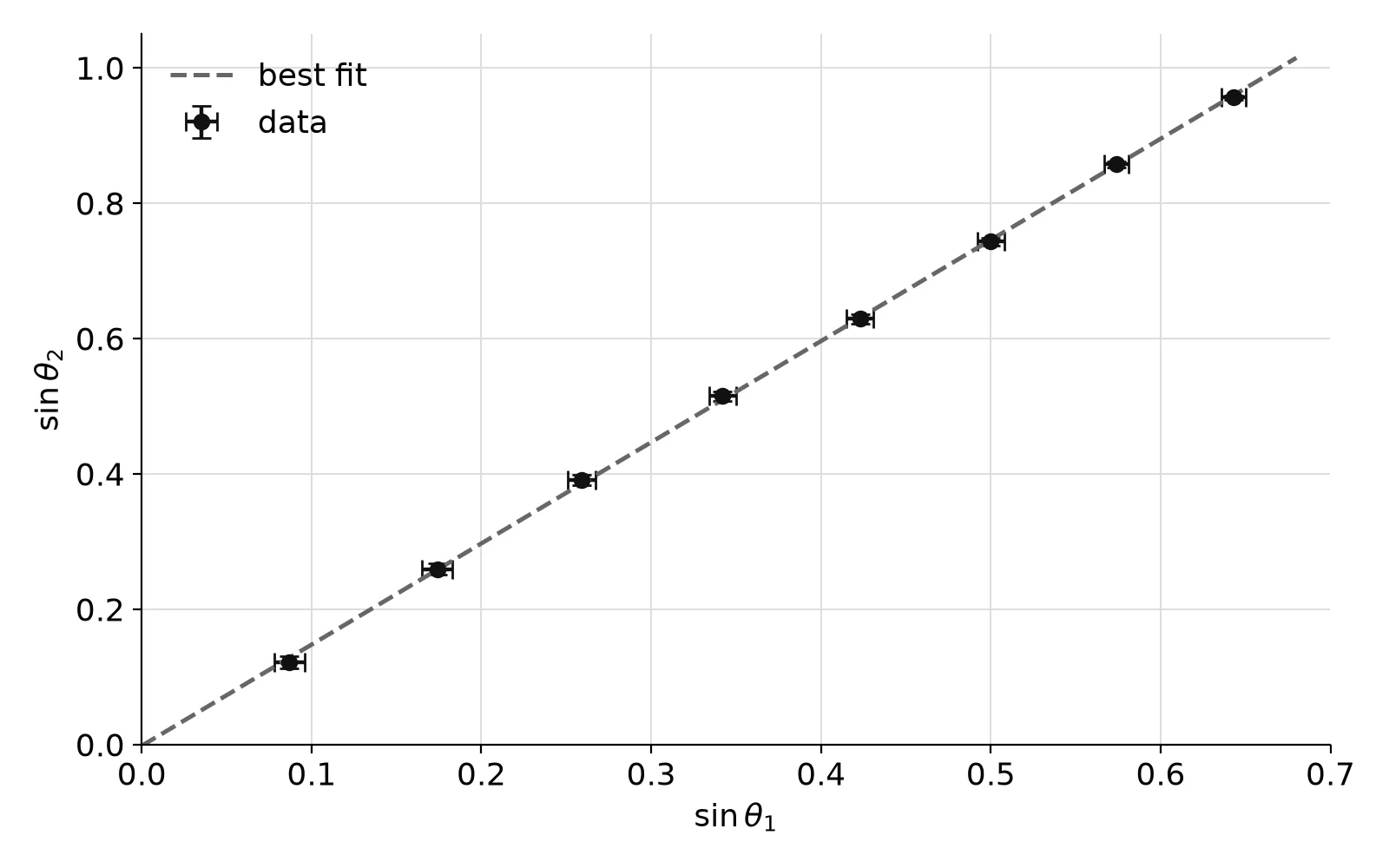
Determine, using the graph, the refractive index of acrylic.
3 marks
- (d)
The students draw the steepest and the least steep straight lines that pass through all the error bars. Their gradients are 1.56 and 1.44. Determine the refractive index of acrylic and its absolute uncertainty, to an appropriate number of significant figures.
2 marks
- (e)
Predict, using your answer to (d), the range of values within which the critical angle for acrylic in air should lie.
2 marks
- (f)
The students try a further measurement with . Explain why they cannot obtain a value of .
2 marks
A bat finds insects by emitting short pulses of ultrasound and detecting the echoes. The frequency of the ultrasound is 52 kHz. The speed of sound in air is 340 m s-1.
- (a)
Calculate the wavelength of the ultrasound.
1 mark
- (b)
The echo from a moth is detected 18 ms after the pulse is emitted. Calculate the distance between the bat and the moth.
2 marks
- (c)
Each pulse lasts 2.0 ms. Calculate the number of complete oscillations of the source in one pulse.
1 mark
- (d)
Bats that hunt very small insects use higher frequencies than bats that hunt larger prey. Suggest why.
2 marks
A diver under water hears the sound of a boat's engine. The sound travels from the air into the water, where its speed is greater. What are the changes in the frequency and the wavelength of the sound as it enters the water?
Frequency | Wavelength | |
|---|---|---|
A. | increases | unchanged |
B. | unchanged | decreases |
C. | decreases | increases |
D. | unchanged | increases |
A group of students use a red laser and a double slit to determine the wavelength of the laser light. The slit separation is . The interference pattern is observed on a screen at a distance from the double slit.
For each value of , the students use a ruler to measure the distance across ten fringe spacings, , where is the fringe spacing. The uncertainty in each measurement of is .
/ m ± 0.01 m | / mm ± 1 mm |
|---|---|
0.80 | 18 |
1.20 | 26 |
1.60 | 34 |
2.00 | 43 |
2.40 | 51 |
2.80 | 60 |
- (a)
Outline why the students measure across ten fringe spacings rather than measuring one fringe spacing.
2 marks
- (b)
State the value of and its absolute uncertainty when .
1 mark
- (c)
The graph shows the variation of with . The line of best fit has been drawn.
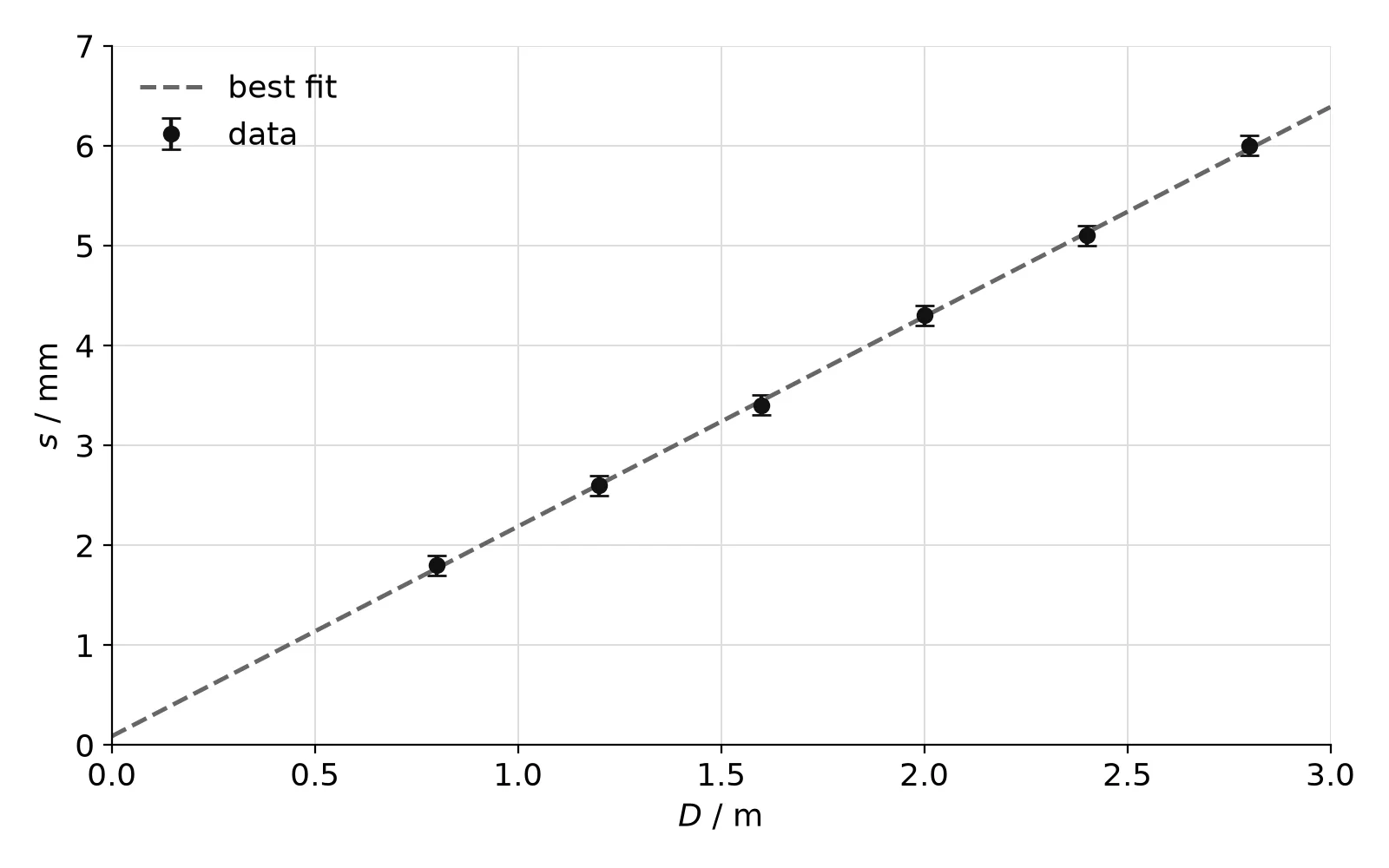
Determine the wavelength of the laser light.
3 marks
- (d)(i)
The line of best fit does not pass through the origin. The students realise they measured from the front of the holder in which the double slit is mounted. Outline how this explains the intercept on the graph.
1 mark
- (d)(ii)
State and explain the effect of this error on the value of the wavelength determined in (c).
1 mark
- (e)
The students estimate that the percentage uncertainty in the gradient is 4 %. Calculate the percentage uncertainty in their value of the wavelength.
2 marks
Long-distance internet signals are carried by pulses of laser light in glass optical fibres. The light has a wavelength of 1310 nm in a vacuum. The refractive index of the glass in the core of the fibre is 1.47.
- (a)
Identify the region of the electromagnetic spectrum to which this light belongs.
1 mark
- (b)
Calculate the frequency of the light.
2 marks
- (c)(i)
Calculate the speed of the light in the core of the fibre.
2 marks
- (c)(ii)
Determine the wavelength of the light in the core of the fibre.
2 marks
- (d)
A pulse travels 120 km along the fibre. Calculate the time taken.
1 mark
- (e)
Outline why the light remains inside the core when the fibre is bent.
2 marks
Practice all 81 in Augment
Free with an account. Every question has its markscheme, and Augment keeps the ones you got wrong so you can come back to them.
More questions in Wave behaviour
- C.1Simple harmonic motion
- C.2Wave model
- C.3Wave phenomenaThis page
- C.4Standing waves and resonance
- C.5Doppler effect
Check your answers in Augment
A free account opens all 81 questions on Wave phenomena with their markschemes, and keeps a record of what you have marked.