How standing waves form, the harmonics of strings and pipes with every boundary condition, and how resonance and damping control the response of a driven system.
IB Physics
Part of C Wave behaviour
SL and HL
Key terms introduced here
Each is in the Physics glossary, with every other term in the subject.
A pipe closed at one end and open at the other; the closed end is a displacement node, the first harmonic has L=λ/4 and only odd harmonics are present.
A guitar string, the air inside a flute and a footbridge crowded with people all vibrate in patterns that stay in one place rather than travelling. These standing waves form when waves reflected at the boundaries of a system overlap with the waves arriving there. Because only certain patterns fit between the boundaries, each system vibrates strongly only at particular frequencies, and driving it at one of them produces resonance.
Resonance is what makes musical instruments, microwave ovens and quartz watches work, and it is also what shook London's Millennium Bridge so badly that it closed two days after opening. Understanding both effects needs the same ideas: superposition, boundary conditions and the transfer of energy to an oscillating system.
Questions on C.4
69 exam-style questions on this subtopic, written in the style of the IB papers. The first has its markscheme open. Counted on
Question 1 · PHY-004746 marks
In the resonance model of the greenhouse effect, a carbon dioxide molecule is treated as a system of masses connected by springs. One mode of vibration of the molecule, in which it bends, has a natural frequency of 2.0×10¹³ Hz.
(a)
Calculate the wavelength of electromagnetic radiation that has this frequency.
[1]1 mark
Markscheme (a)
«λ=2.0×10133.00×108
Try a quick-fire question
One of 61 short multiple-choice questions on C.4. Pick an answer to see why it's right or wrong.
The graph shows displacement against time for the same system, released from the same displacement with three different amounts of damping. The damping is increased further than for curve 3. Compared with curve 3, how does the system return to equilibrium?
Flashcards for C.4
The official deck for this part of the syllabus.
C.4 Standing waves and resonance · front
What is a standing (stationary) wave?
C.4 Standing waves and resonance · front
State the three conditions two waves must meet to form a clear standing wave.
C.4 Standing waves and resonance154 cards
Carry on with C.4 in Augment
With a free account, Augment remembers where you stopped and what you have practiced.
The pattern formed when two waves of the same frequency, wavelength and amplitude travelling in opposite directions superpose; it oscillates in place and transfers no net energy.
The positive feedback in which pedestrians on a swaying footbridge fall into step with the sway, so their sideways foot forces increase it.
How a standing wave forms
A travelling wave carries energy from one place to another. When it reaches a boundary, such as the clamped end of a string or the closed end of a pipe, it is reflected. The reflected wave has the same frequency, wavelength and speed as the incoming one, and almost the same amplitude, but it travels in the opposite direction. Where the two waves overlap they obey the principle of superposition: the resultant displacement at each point is the sum of the two individual displacements.
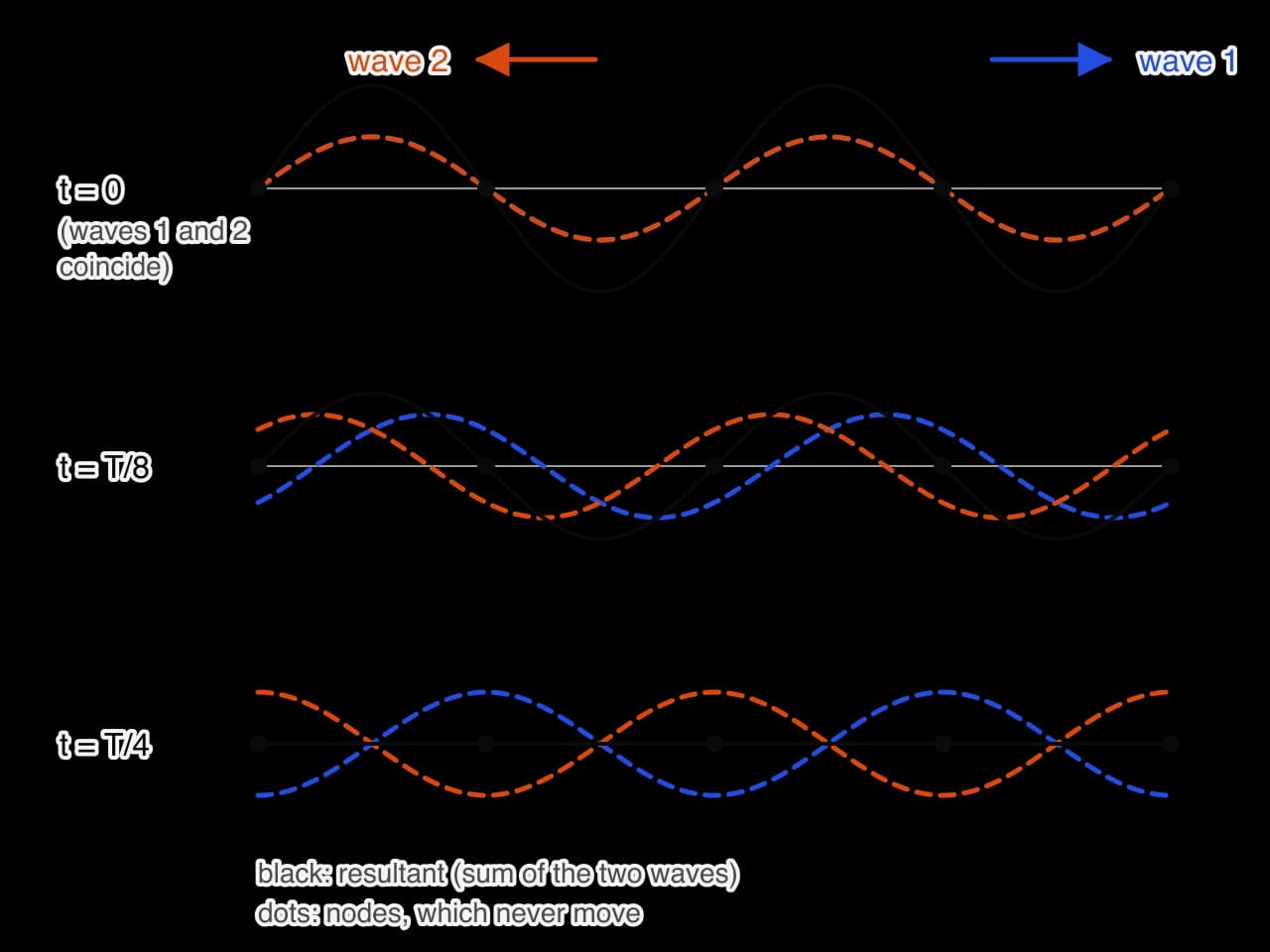
The standing wave snapshots show the process. At t=0 the two travelling waves line up exactly, so they add to give a resultant with twice the amplitude of each. A quarter of a period later each wave has moved a quarter of a wavelength, one to the right and one to the left, so that crests of one sit on troughs of the other and the resultant is flat everywhere. Half a period later they line up again with the resultant inverted. The resultant therefore grows, shrinks, inverts and grows again, without moving sideways.
Two identical waves travelling in opposite directions (blue to the right, orange to the left). Their sum (black) grows and shrinks in place, and the points marked as nodes stay at zero displacement at every instant.
At certain points the two waves always have equal and opposite displacements, whatever the time. These points never move. Halfway between them the two waves always have equal displacements, so these points oscillate with the largest amplitude, twice the amplitude of each travelling wave.
Nodes, antinodes and the phase of points along a standing wave
Nodes occur where the two travelling waves are always in antiphase, and antinodes where they are always in phase. The pattern repeats every half wavelength of the travelling waves, so:
adjacent nodes are λ/2 apart, and so are adjacent antinodes;
a node and the nearest antinode are λ/4 apart;
the section between two adjacent nodes is called a loop (or segment), and each loop is λ/2 long.
Here λ is the wavelength of the two travelling waves that make up the standing wave. It is also called the wavelength of the standing wave.
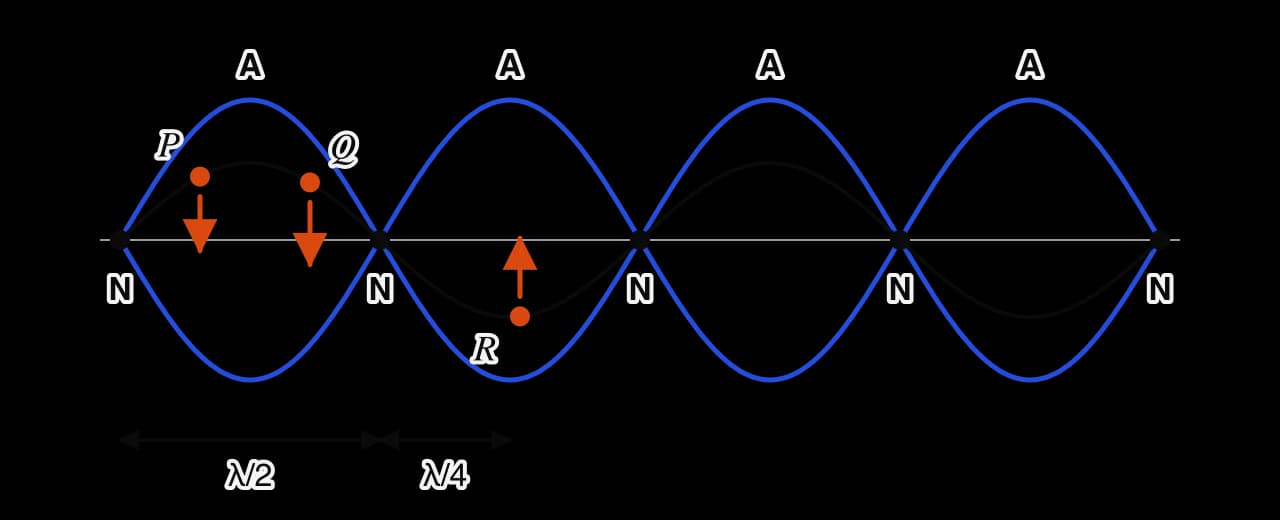
Blue: the envelope (each point's amplitude). Black: the string at one instant. Orange arrows: velocities at that instant. P and Q, in the same loop, move in phase; R, in the next loop, moves in antiphase with them.
Amplitude along a standing wave
In a travelling wave every point oscillates with the same amplitude. In a standing wave the amplitude depends on position: it is zero at a node, rises smoothly to a maximum at an antinode and falls to zero again at the next node. The blue envelope in the diagram of nodes and antinodes shows this variation. Points close to a node move only a little; points at an antinode move the most.
Phase along a standing wave
All the points between two adjacent nodes reach their maximum displacement at the same instant and pass through equilibrium at the same instant, so they oscillate in phase (phase difference 0), even though their amplitudes differ. Points in adjacent loops always move in opposite directions: when one loop is above the equilibrium line the next is below it. Points in adjacent loops are therefore in antiphase (phase difference π rad, or 180∘). Points two loops apart are in phase again.
In the diagram, P and Q lie in the same loop and both move downwards at the instant shown; R lies in the next loop and moves upwards. This is very different from a travelling wave, where the phase changes continuously along the wave, by 2π for every wavelength.
Energy in a standing wave
The two travelling waves carry equal amounts of energy in opposite directions, so there is no net transfer of energy along a standing wave. Energy is stored in the vibrating medium. In each loop it changes back and forth between kinetic energy (greatest when the string passes through the equilibrium line) and elastic potential energy (greatest when the string is at its maximum displacement). In a real system some energy is lost to the surroundings in each cycle, and the source must keep supplying energy to keep the standing wave going.
Property
Travelling wave
Standing wave
Energy
Transferred in the direction of travel
Stored; no net transfer along the medium
Amplitude
The same for every point (ignoring losses)
Varies from zero at nodes to a maximum at antinodes
Phase
Changes continuously along the wave: 2π per wavelength
The same within a loop; π between adjacent loops
Wave profile
Moves at the wave speed
Stays in place; only its size and sign change
Wavelength
Distance between adjacent points in phase
Twice the distance between adjacent nodes
Measuring the speed of light with a microwave oven
A microwave oven contains a metal box in which microwaves reflect from the walls and form standing waves. Food at antinodes heats strongly while food at nodes stays cool, which is why ovens use a turntable. With the turntable removed, a flat bar of chocolate melts first in spots at the antinodes. Adjacent melted spots are λ/2 apart, and the frequency of the oven (usually 2.45 GHz) is printed on its label, so c=fλ can be found.
Standing waves on strings
A string stretched between two points supports transverse standing waves. The waves travel along the string, reflect at the ends and superpose with the incoming waves. Only patterns that fit the conditions at the ends can last; all other patterns die out quickly because the reflected waves do not line up with the incoming ones.
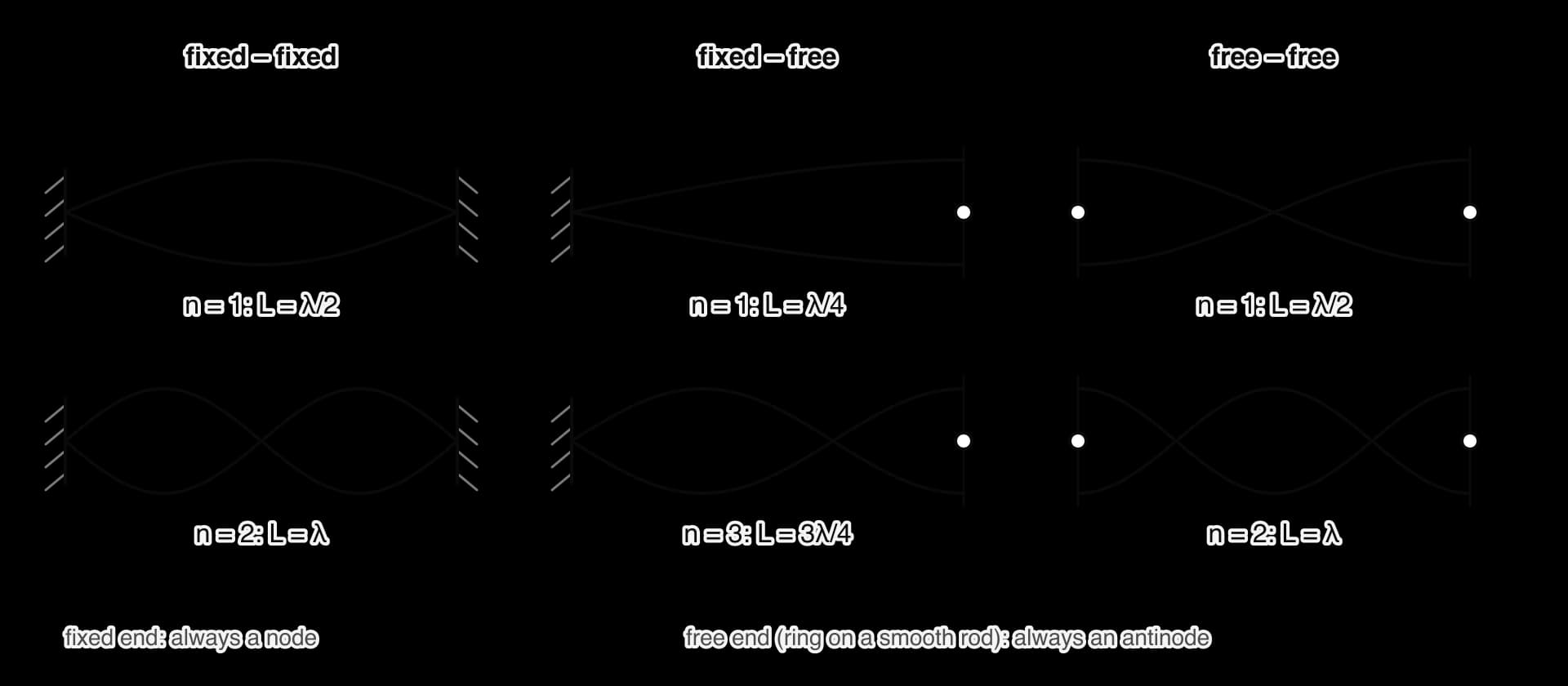
A fixed end (a clamp, a bridge or the nut of a guitar) cannot move, so it is always a node. A free end (a string tied to a light ring that slides on a smooth vertical rod) moves with the largest amplitude, so it is always an antinode. These boundary conditions set which wavelengths are possible for a given length of string, L.
A string fixed at both ends
The simplest pattern has a node at each end and one antinode in the middle: a single loop. Since a loop is half a wavelength, L=λ/2, or λ=2L. This pattern has the longest wavelength and the lowest frequency of all the possible standing waves.
The next pattern has two loops (L=λ), then three loops (L=3λ/2), and so on: any whole number n of loops fits. For n loops, L=nλ/2. These patterns are the harmonics of the string, and the one-loop pattern is the first harmonic.
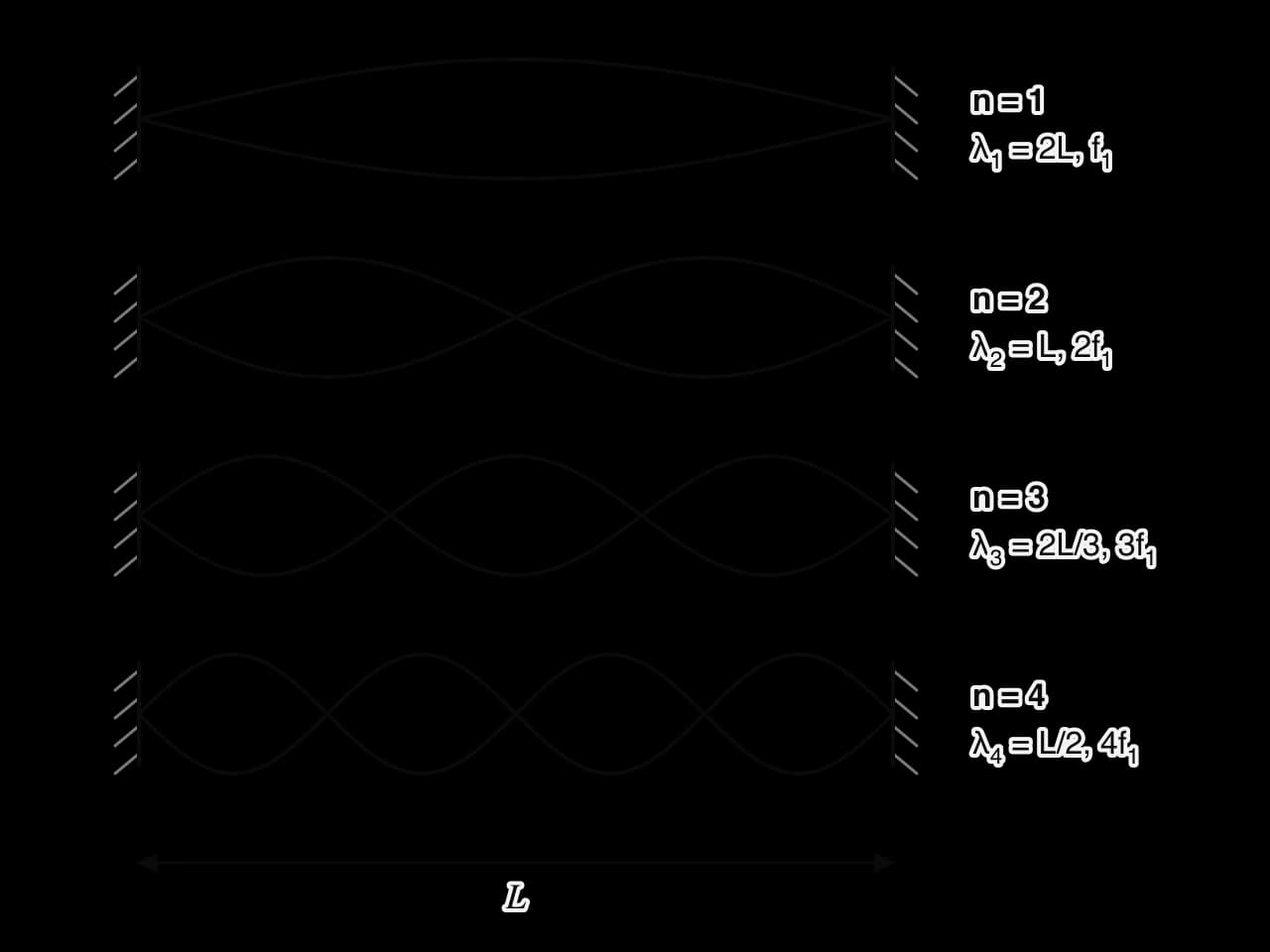
A string fixed at both ends has a node at each end. The nth harmonic has n loops, a wavelength of 2L/n and a frequency n times that of the first harmonic.
Every harmonic on a given string travels at the same wave speed v, because the speed depends only on the string (its tension and its mass per unit length), not on the frequency. Combining L=nλ/2 with v=fλ gives
λn=n2Lfn=λnv=2Lnv=nf1n=1,2,3,…
A string fixed at both ends therefore has a complete set of harmonics: every whole-number multiple of f1. The harmonic number n equals the number of loops, so it can be read straight from a diagram.
A guitarist changes the note by pressing the string against a fret, which shortens the vibrating length L and raises f1. Tightening a string raises the wave speed and therefore every harmonic frequency. A thicker, heavier string has a lower wave speed at the same tension, which is why the bass strings are thicker.
A string fixed at one end and free at the other
With a node at the fixed end and an antinode at the free end, the simplest pattern is a quarter of a wavelength: L=λ/4. The next possible pattern adds half a wavelength, L=3λ/4, then L=5λ/4, and so on. A pattern with a node at both ends cannot fit, so the even multiples are missing:
λn=n4Lfn=4Lnvn=1,3,5,…
The first harmonic of this string has wavelength 4L, twice that of the same string fixed at both ends, so its frequency is half as large. Only odd harmonics exist: f1, 3f1, 5f1 and so on.
A string free at both ends
With an antinode at each end, the simplest pattern has one node in the middle. From antinode to antinode is half a wavelength, so L=λ/2, exactly as for two fixed ends. The harmonics are again λn=2L/n and fn=nv/2L for every whole number n; only the positions of the nodes and antinodes are swapped. The same pattern describes a metal rod held at its centre and struck at one end.
The boundary conditions decide which patterns fit on a string. A fixed end must be a node and a free end an antinode, so a string fixed at one end only supports odd harmonics.
Standing waves on a string in the laboratory
In a common experiment a string runs from a vibration generator, over a pulley, to a hanging mass that keeps the tension constant. The vibration generator moves only a tiny distance, so it acts very nearly as a node. As the signal generator frequency is raised, the string shows one loop, then two, three and more, each at a sharply defined frequency, with only small, irregular movement in between. Measuring the node spacing and the frequency gives the wave speed from v=fλ, and repeating for several tensions shows how the speed depends on the tension.
Standing waves in pipes
Sound in the air inside a pipe reflects at both ends and forms longitudinal standing waves. Wind instruments, organ pipes and the human vocal tract all use them. In a longitudinal standing wave the air molecules oscillate along the pipe, so a node is a place where the air does not move and an antinode is a place where it moves back and forth with the largest amplitude.
The boundary conditions are set by the ends:
At a closed end the air is up against a solid surface and cannot move along the pipe, so a closed end is a displacement node.
At an open end the air is free to move in and out, so an open end is a displacement antinode.
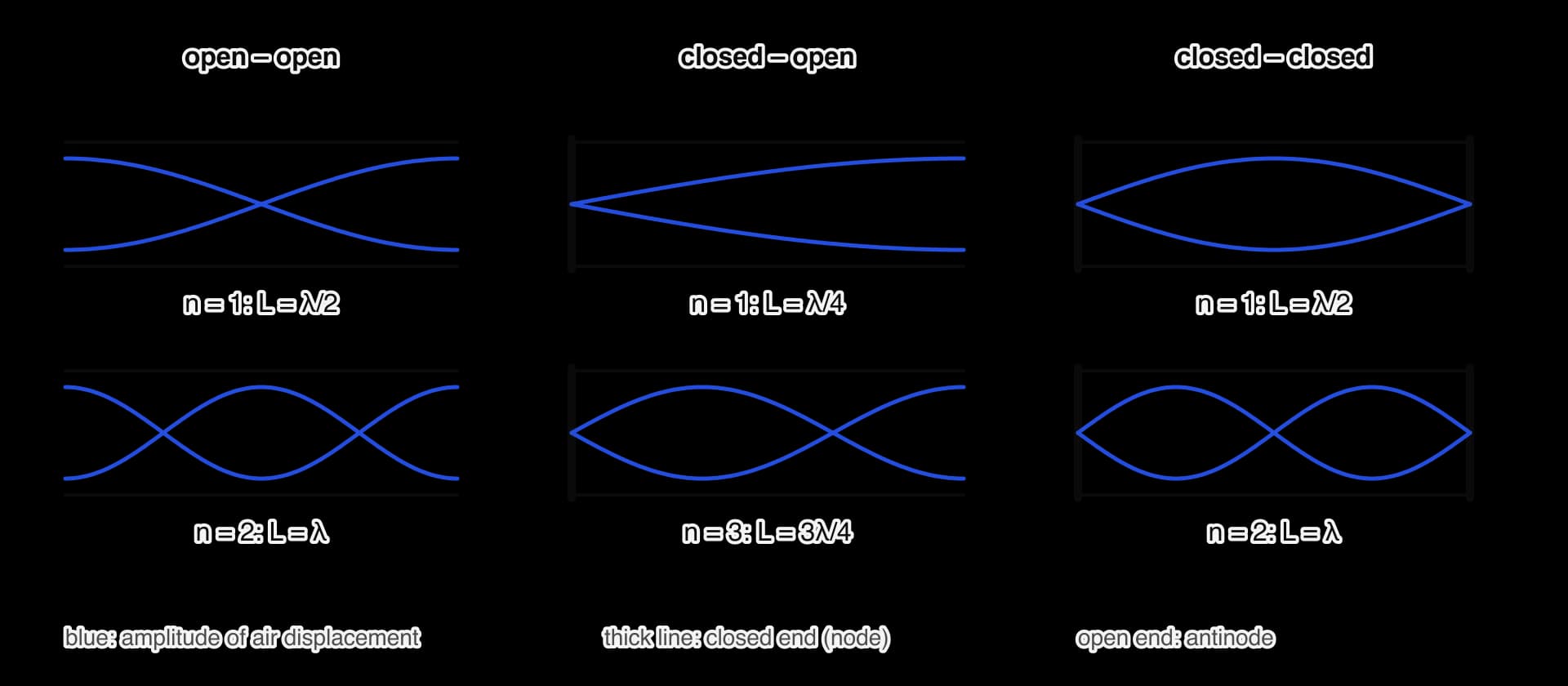
Standing waves in pipes are drawn as the amplitude of air displacement along the pipe. The curves are a graph of amplitude against position, not a picture of the air: the real motion is along the pipe, not across it.
Standing sound waves in pipes, drawn as the amplitude of air displacement. A closed end is a displacement node and an open end a displacement antinode; a pipe closed at one end has only odd harmonics.
A pipe open at both ends
An open pipe has an antinode at each end, like a string with two free ends. The first harmonic has one node in the middle and L=λ/2. Every whole number of half wavelengths fits, so
λn=n2Lfn=2Lnvn=1,2,3,…
A flute behaves as a pipe open at both ends: the player blows across a hole near one end, and the far end (or the first open finger hole) is also open to the air.
A pipe closed at one end
A closed pipe (closed at one end, open at the other) has a node at the closed end and an antinode at the open end, like a string fixed at one end. The first harmonic is a quarter of a wavelength, L=λ/4, and only odd harmonics exist:
λn=n4Lfn=4Lnvn=1,3,5,…
For the same length, a closed pipe's first harmonic has twice the wavelength and half the frequency of an open pipe's. Blowing across the top of an empty bottle excites the first harmonic of a closed pipe; adding water shortens the air column and raises the note.
A pipe closed at both ends
With a displacement node at each end, a pipe closed at both ends behaves like a string fixed at both ends: λn=2L/n and fn=nv/2L for every whole number n. Sound waves bouncing between two parallel walls of a room form standing waves of this kind, and they make some notes sound louder than others in small rooms.
Summary of the six boundary conditions
System
Ends
First harmonic
Harmonics present
fn
String fixed at both ends
node, node
L=λ/2
all
nv/2L
String free at both ends
antinode, antinode
L=λ/2
all
nv/2L
String fixed at one end, free at the other
node, antinode
L=λ/4
odd only
nv/4L
Pipe open at both ends
antinode, antinode
L=λ/2
all
nv/2L
Pipe closed at both ends
node, node
L=λ/2
all
nv/2L
Pipe closed at one end
node, antinode
L=λ/4
odd only
nv/4L
Measuring the speed of sound with a resonance tube
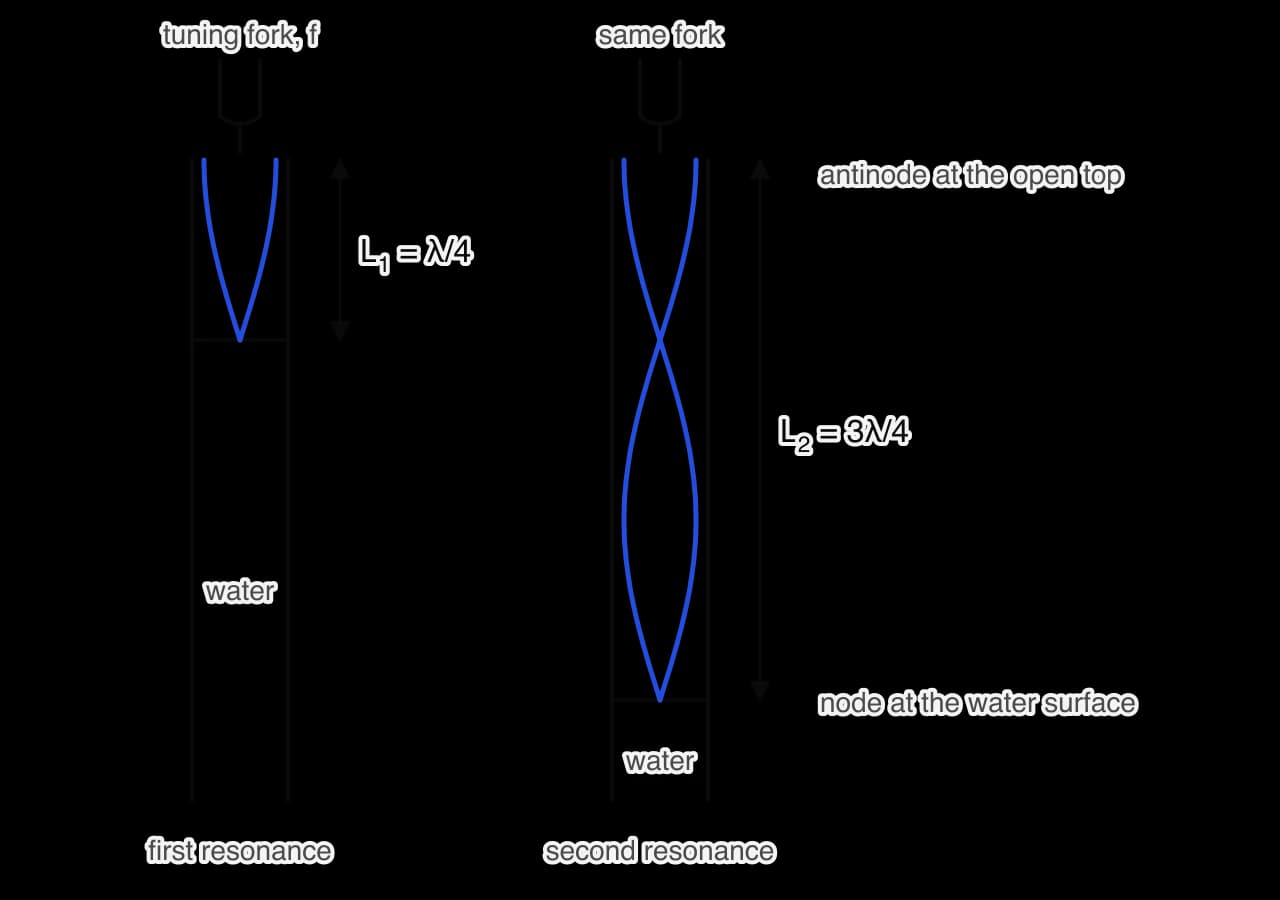
A long tube is held vertically in a tall container of water, with a vibrating tuning fork of known frequency f held over its open top. The water closes the bottom of the air column, so the column is a pipe closed at one end. The tube is raised slowly from the water: when the length of air above the water reaches λ/4, the sound becomes suddenly much louder because the air column resonates in its first harmonic. Raising the tube further gives a second loud sound at 3λ/4.
A resonance tube. The water surface closes the bottom of the air column, so loud resonances occur at lengths of λ/4, 3λ/4, 5λ/4 …; successive resonant lengths differ by λ/2.
The difference between the two resonant lengths is half a wavelength, L2−L1=λ/2, so v=fλ=2f(L2−L1). Using the difference also cancels a small systematic error caused by the antinode forming slightly beyond the open top. Repeating with forks of different frequency and plotting L1 against 1/f gives a straight line with gradient v/4.
Natural frequency and forced oscillations
A system that is displaced and released, such as a plucked string, a struck bell or a pendulum, oscillates freely at its own natural frequency. A simple pendulum or a mass on a spring has one natural frequency. An extended system such as a string, an air column or a bridge has many: one for each of its standing-wave patterns (its harmonics, or modes).
A system made to oscillate by a periodic external force undergoes a forced oscillation. The frequency of the external force is the driving frequency. When the force is first applied, the motion is irregular because the system's free oscillation mixes with the driven one. After a short time the free oscillation dies away, and the system oscillates steadily at the driving frequency, whatever its natural frequency is.
The amplitude of the steady forced oscillation depends on how close the driving frequency is to the natural frequency. Far from it, the driving force is sometimes in step with the motion and sometimes against it, so little energy is transferred over a cycle and the amplitude stays small. Pushing a child on a swing at random moments achieves little; pushing once per swing, always in the direction the swing is already moving, builds up a large amplitude.
Resonance
At resonance the driving force is in step with the velocity of the oscillating body throughout each cycle. The force then does positive work on the system at every moment, so energy is transferred to it at the maximum possible rate. The amplitude grows until the energy lost per cycle to damping equals the energy supplied per cycle. With very little damping this amplitude can be very large.
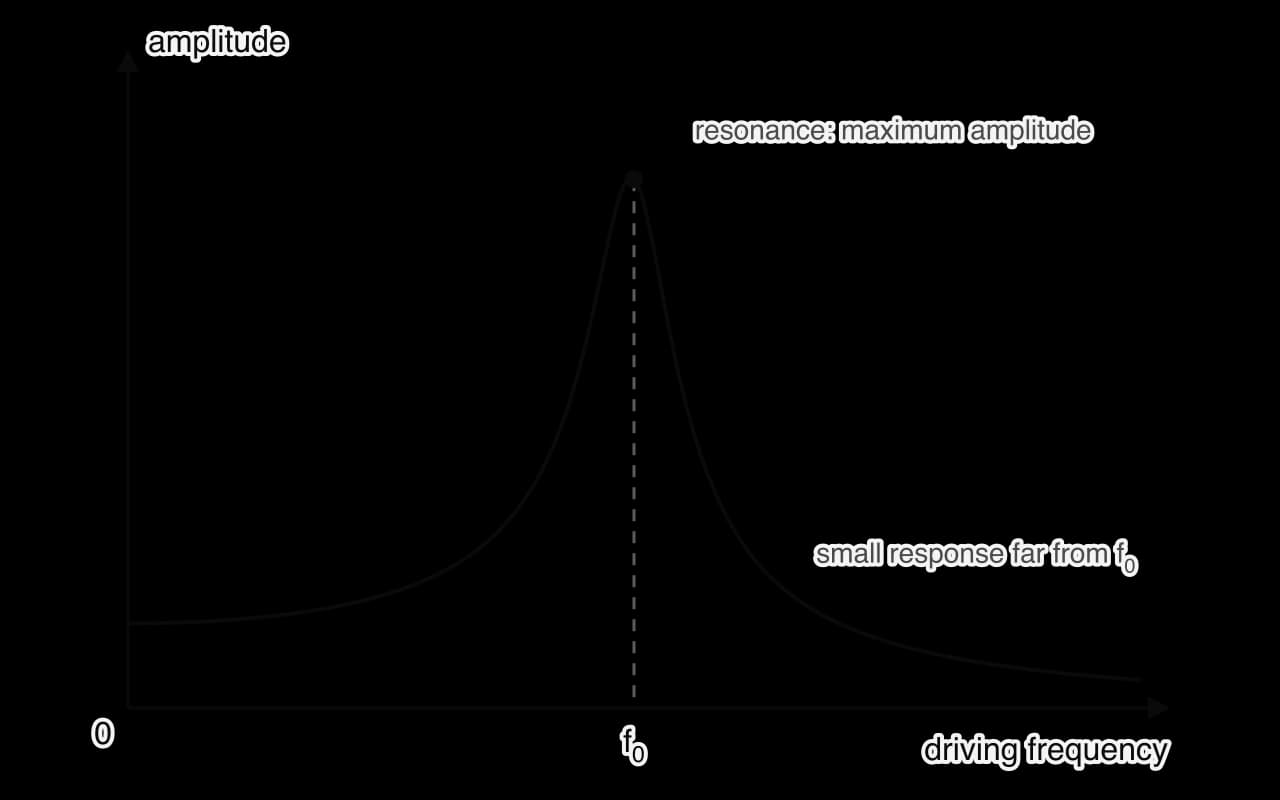
A resonance curve for a lightly damped oscillator. The amplitude is greatest when the driving frequency is close to the natural frequency.
A graph of amplitude against driving frequency, a resonance curve, shows this behaviour. At low driving frequencies the system simply follows the force with a small amplitude. Near the natural frequency f0 the amplitude rises to a sharp peak. At high driving frequencies the system cannot keep up with the rapidly changing force and the amplitude falls towards zero.
Standing waves as resonance
A system with many natural frequencies resonates at each of them. A string driven by a vibration generator shows a large standing wave only when the driving frequency matches one of its harmonics, f1, 2f1, 3f1 and so on, and only small movements in between. The air column in a resonance tube responds loudly only at the lengths where its first or third harmonic equals the fork frequency. Standing waves in strings and pipes are therefore resonances of those systems.
YouTube
Physics Girl: How I broke a wine glass with my VOICE (using science!), a demonstration of resonance in a wine glass driven by sound at its natural frequency.
Damping
A real oscillating system always loses energy, for example to fluid resistance, friction at its supports, or sound radiated into the air. Its amplitude decreases with time unless energy is supplied.
Light, critical and heavy damping
How a displaced system returns to equilibrium depends on how strong the damping is:
Light damping (underdamping): the system oscillates with an amplitude that decreases gradually. The period stays almost the same as the undamped period. A guitar string and a pendulum swinging in air are lightly damped.
Critical damping: the system returns to equilibrium in the shortest possible time without oscillating. It does not overshoot the equilibrium position.
Heavy damping (overdamping): the system does not oscillate, but it returns to equilibrium more slowly than with critical damping. A pendulum swinging in thick oil behaves this way.
light damping
critical damping
heavy damping
Displacement against time for the same system released from 1 cm with three levels of damping. Light damping oscillates with decreasing amplitude; critical damping returns fastest without overshooting; heavy damping returns slowly.
Critical damping is the design target for systems that must settle quickly after a disturbance. A car's suspension uses shock absorbers so that after the wheel hits a bump the car body returns to its normal height quickly, without bouncing up and down. With too little damping the car keeps bouncing; with too much (heavy damping) the suspension is slow to recover and a second bump arrives before the first has settled. Moving-coil meters, self-closing doors and the arms of weighing scales are also designed to be close to critical damping.
How damping changes resonance
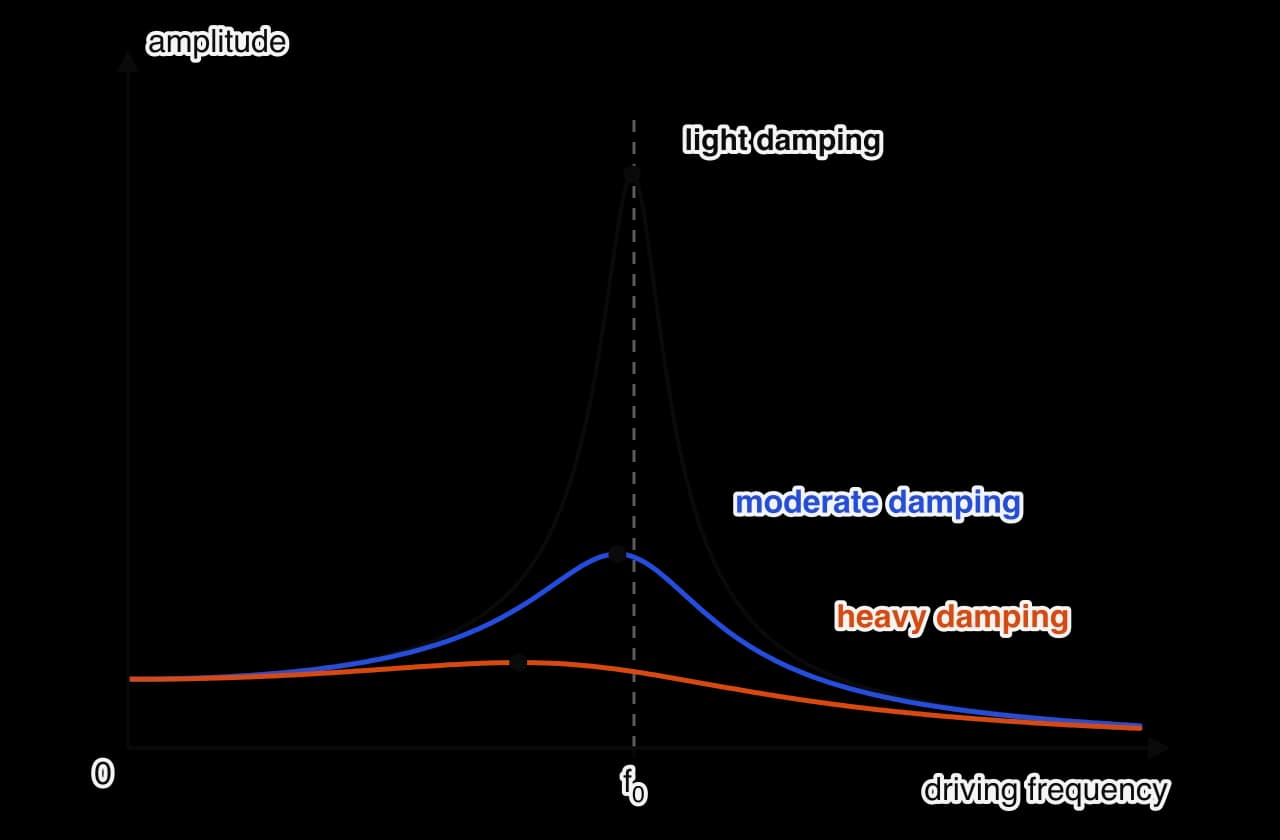
Damping removes energy from a driven system in every cycle. At resonance the amplitude grows only until the energy lost per cycle equals the energy supplied, so the more damping there is, the smaller the maximum amplitude. Comparing resonance curves for the same system with different amounts of damping shows three effects:
the peak amplitude is lower when the damping is greater;
the peak is broader: the system responds over a wider range of driving frequencies, so the resonance is less sharp;
the frequency at which the amplitude is greatest is slightly lower than the natural frequency, and it moves further below it as the damping increases.
Increasing the damping lowers and broadens the resonance peak and moves it to a slightly lower frequency (dots mark each maximum). Black: light, blue: moderate, orange: heavy damping.
At driving frequencies far from the natural frequency, damping makes little difference to the amplitude: all the curves come together at low and high frequencies. With very light damping the resonance is very sharp, so the system responds strongly only within a narrow band of frequencies around f0.
Useful and destructive resonance
Useful resonance
Musical instruments. Strings and air columns resonate at their harmonic frequencies, and the wooden body of a guitar or violin resonates with the strings, transferring their energy efficiently to the air so the sound is loud.
Microwave ovens. The metal cavity is sized so that microwaves at 2.45 GHz form standing waves inside it, building up a strong electric field that heats the water in food.
Quartz clocks. A small quartz crystal is made to vibrate at its natural frequency (32 768 Hz in most watches). Because it is very lightly damped, its resonance is very sharp, so it keeps a very steady frequency that the watch counts to measure time.
Radio and television tuning. A tuning circuit has a natural frequency that is adjusted to match one station's broadcast frequency, so it responds strongly to that station and weakly to all others.
Magnetic resonance imaging (MRI). Hydrogen nuclei in a strong magnetic field absorb energy from radio waves only at one particular frequency. Detecting this resonance maps the water and fat in the body.
Destructive resonance
Resonance is harmful whenever a structure or machine is driven, even gently, at one of its natural frequencies and its damping is too small to limit the amplitude. A washing machine can shake violently at one particular spin speed, and parts of a car may rattle at one engine speed and be quiet at others. Engineers check the natural frequencies of buildings, bridges, aircraft wings and turbine blades, and either move them away from the frequencies of likely forces or add damping.
In the 1985 Mexico City earthquake, buildings of roughly 6 to 15 storeys suffered the worst damage, because their natural frequencies were close to the frequency at which the soft lake-bed soil under the city shook. Taller and shorter buildings nearby were damaged far less.
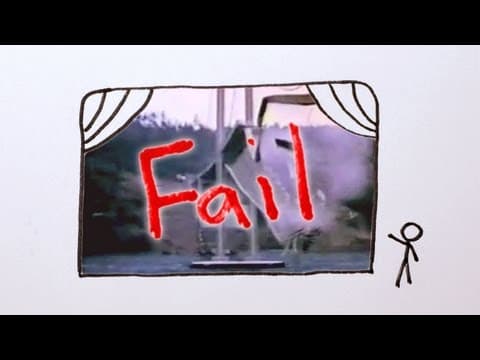
The collapse of the Tacoma Narrows Bridge in the USA in 1940 is often described as resonance. In fact the wind was steady, not periodic: the twisting motion grew because of aeroelastic flutter, in which the bridge's own motion changed the wind forces so that they fed energy into it. Flutter is a related but different effect. Explaining the collapse needed a model of how the wind forces depend on the bridge's motion, which simple resonance with a periodic force does not provide.
YouTube
minutephysics: The Tacoma Narrows Fallacy, on why the collapse of the Tacoma Narrows Bridge is not a simple case of resonance.
Case study: the wobbling Millennium Bridge
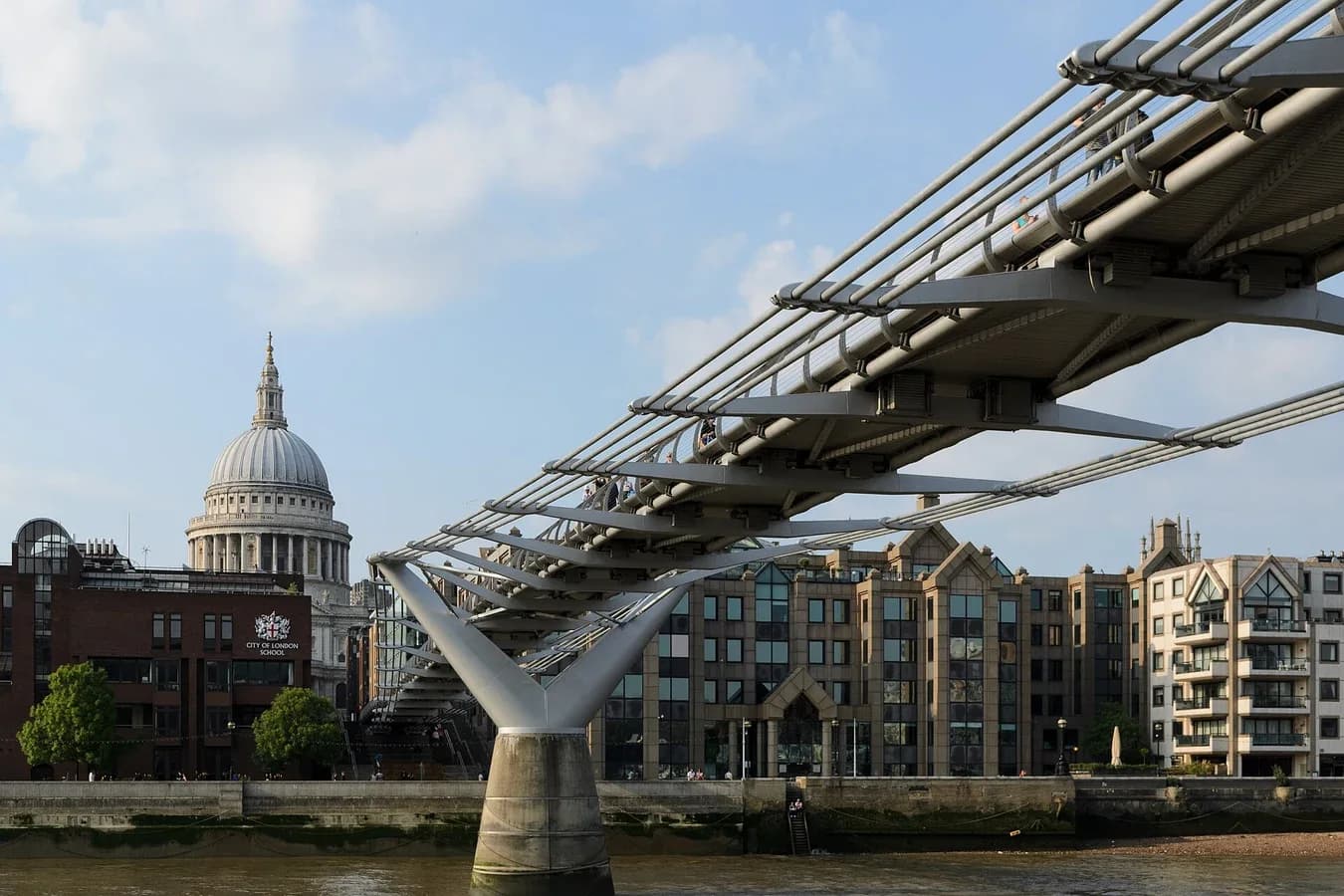
The Millennium Bridge is a steel footbridge across the River Thames in London, 325 m long with a longest span of 144 m. It is a suspension bridge with unusually shallow cables, which makes it light and slender but gives it low natural frequencies of sideways (lateral) sway.
London's Millennium Bridge. The suspension cables run almost level with the deck, which makes the bridge slender and light but gives it low natural frequencies of sideways (lateral) sway. Image: King of Hearts, CC BY-SA 4.0, via Wikimedia Commons.
The bridge opened on 10 June 2000. About 90 000 people crossed it on the first day, with up to 2000 on the deck at once. As the crowd built up, the deck began to sway from side to side, with a maximum movement of about 70 mm. Walkers struggled to keep their balance, and many stopped or held the handrails. The bridge was closed on 12 June 2000, two days after opening.
Why the bridge swayed
When a person walks, each step pushes slightly sideways, first to one side and then the other. At a typical walking pace of about 2 steps per second, this sideways force repeats about once per second, at about 1 Hz. Several lateral modes of the bridge had natural frequencies close to this, below about 1.3 Hz.
In a normal crowd the sideways forces of different people are out of step and largely cancel. On the Millennium Bridge a small random sway started the process. People on a moving deck instinctively widen their stance and time their steps with the sway to keep their balance. Their sideways forces then came into step with the sideways velocity of the deck, so they did positive work on it every cycle, just as when a swing is pushed at the right moment. The larger the sway, the more people fell into step, and the larger the force became.
The positive feedback on the Millennium Bridge. Each step round the loop makes the next stronger, so above a critical number of walkers the sway grows instead of dying away.
This positive feedback is called synchronous lateral excitation. Tests by the engineers, with controlled numbers of people walking on the bridge, showed that there was a critical number of walkers: below it, the sway stayed small because the damping removed the energy fed in; above it, the energy supplied each cycle exceeded the energy lost and the amplitude grew rapidly. The effect had been seen on a few other bridges before, but it was not well understood or included in design codes.
The solution
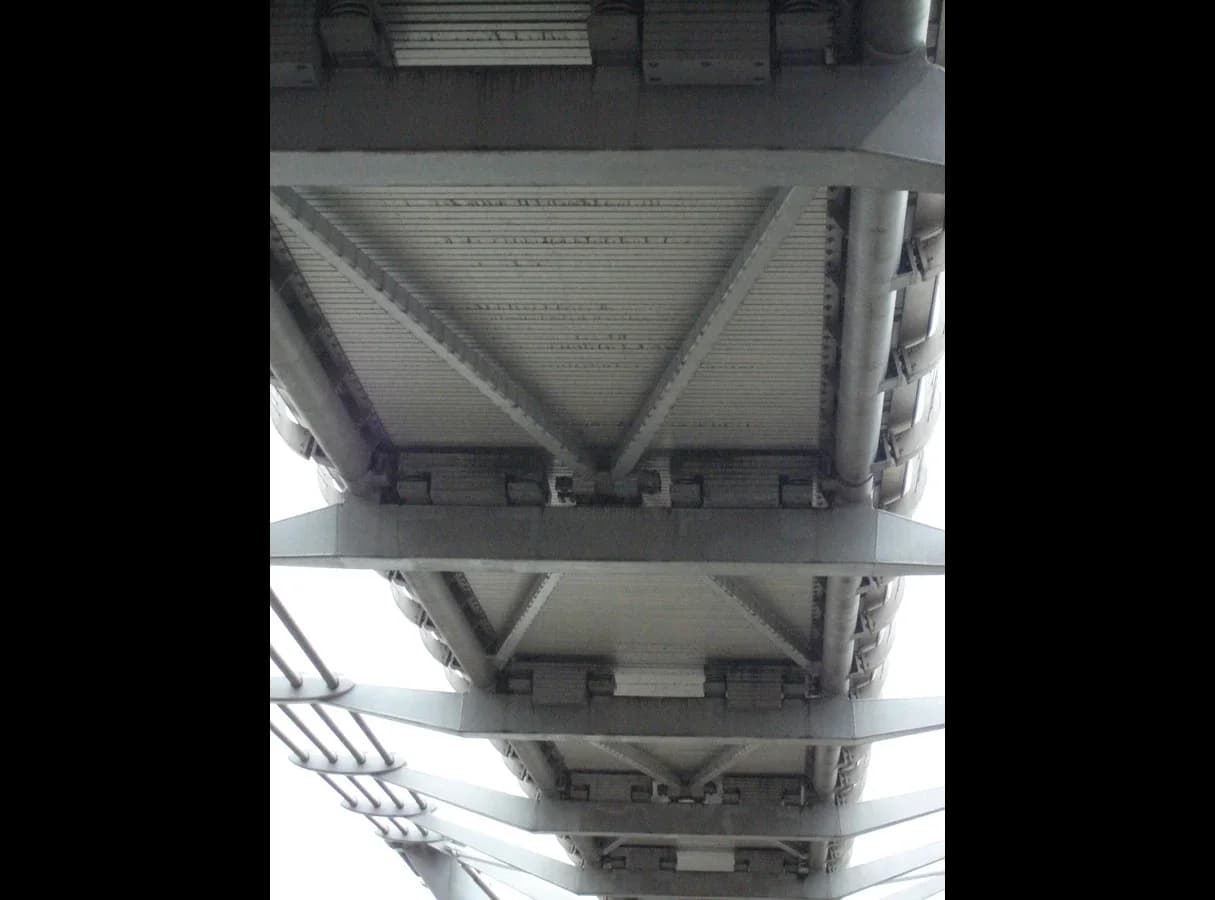
Changing the natural frequencies of the bridge would have meant making it much stiffer, which would have changed its appearance. Instead the engineers added damping, so that the energy removed per cycle would always exceed the energy that any realistic crowd could supply. They fitted 37 fluid-viscous dampers, which work like large car shock absorbers, to control the sideways motion, and more than 50 tuned mass dampers to control vertical movement. A tuned mass damper is a mass on a spring with the same natural frequency as the structure: it oscillates out of phase with the structure and absorbs energy from it.
Under the deck of the Millennium Bridge. The V-shaped (chevron) braces were added in the retrofit: the sideways sway of the deck drives fluid-viscous dampers through them, and the dampers remove energy from the motion. Image: Wikimedia Commons (public domain).
The work cost about £5 million, and the bridge reopened on 22 February 2002. Since then it has carried large crowds without noticeable sway. The case changed footbridge design worldwide. Design guidance now asks engineers to check any footbridge with lateral natural frequencies below about 1.3 Hz for crowd-induced sway.
Applying the ideas in exam questions
Questions on this content often combine a diagram of a string or pipe with v=fλ, or ask for a resonance curve to be sketched and explained.
Paper 1A: harmonics of a closed pipe
Paper 1A: phase in a standing wave
Paper 1B: speed of sound from a resonance tube
A student uses a resonance tube closed at the bottom by water. For each of five tuning forks she finds the shortest air column length L that gives a loud sound. The uncertainty in each length is ±0.005m.
f / Hz
1/f / 10⁻³ s
L / m
256
3.91
0.335
320
3.13
0.268
384
2.60
0.223
426
2.35
0.201
512
1.95
0.167
Paper 2: standing waves on a string
Paper 2: resonance and damping in a car suspension
Self-check
To do:
I can explain how a standing wave forms from two waves travelling in opposite directions.
To do:
I can define node and antinode and state their spacing in terms of the wavelength.
To do:
I can describe how the amplitude and phase vary along a standing wave.
To do:
I can compare standing and travelling waves in terms of energy, amplitude and phase.
To do:
I can apply the boundary conditions for strings with fixed and free ends and for open and closed pipes.
To do:
I can draw the first few harmonics for each of the six boundary conditions.
To do:
I can find the wavelength and frequency of the nth harmonic from the length and the wave speed.
To do:
I can identify the harmonic number from a diagram of a standing wave.
To do:
I can describe how to measure the speed of sound with a resonance tube.
To do:
I can define natural frequency, forced oscillation and resonance.
To do:
I can sketch a resonance curve and show how damping changes it.
To do:
I can describe light, critical and heavy damping and give an example of each.
To do:
I can give examples of useful and destructive resonance and explain the Millennium Bridge sway.
=»
1.5×10⁻⁵
m OR 15 μm ✓
(b)
The mean temperature of the Earth's surface is 288 K. Show that the surface emits radiation of greatest intensity at a wavelength of about 10 μm.
[1]1 mark
Markscheme (b)
λmax=2882.9×10−3 = 1.01×10⁻⁵ «m» ✓ Must see substitution or answer to at least 3 s.f.
(c)
Explain, using the resonance model, why carbon dioxide in the atmosphere absorbs some of the radiation emitted by the Earth's surface.
[3]3 marks
Markscheme (c)
the oscillating electric field of the radiation exerts a periodic «driving» force on the «charged» atoms of the molecule ✓ when the frequency of the radiation equals the natural frequency of the molecule, resonance occurs ✓ the amplitude of vibration becomes large so energy is transferred from the radiation to the molecule «absorbed» ✓ 15 μm is close to the peak of the surface emission spectrum, so a significant part of the emitted radiation has this frequency ✓ [max 3]
(d)
Nitrogen and oxygen molecules make up most of the atmosphere. Suggest why they absorb very little of the radiation emitted by the surface.
[1]1 mark
Markscheme (d)
their natural frequencies of vibration / energy level differences do not match the frequencies/photon energies of the infrared radiation emitted by the surface ✓ OR their vibration does not cause a change in charge distribution, so the electric field of the radiation cannot drive it ✓
Question 2 · PHY-0048810 marks
Carbon dioxide molecules absorb infrared radiation strongly at two wavelengths, 15 μm and 4.3 μm. Each absorption corresponds to a transition between vibrational energy levels of the molecule.
(a)
Calculate, in eV, the energy of a photon of wavelength 15 μm.
[2]2 marks
(b)
Show that the difference between the energy levels for the absorption at 4.3 μm is about 0.3 eV.
[1]1 mark
(c)
In a resonance model of this vibration, an oxygen atom of mass 16 u oscillates on a spring of stiffness k attached to a fixed carbon atom. The natural frequency of this oscillator equals the frequency of radiation of wavelength 4.3 μm.
Determine k.
[3]3 marks
(d)
Infrared radiation of a range of frequencies is incident on the molecule. Sketch a graph to show how the amplitude of the oscillation of the molecule varies with the frequency of the incident radiation. Label the natural frequency f0 on the frequency axis.
[2]2 marks
(e)
Water vapour is the most abundant greenhouse gas. Suggest why the water vapour released by human activities has little direct effect on the greenhouse effect, while warming caused by carbon dioxide increases the amount of water vapour in the atmosphere.
. The two-length method is more accurate because it does not depend on exactly where the antinode forms at the open top.
✓
(b) gradient found from two points far apart on the line, e.g. (3.91−1.95)×10−30.335−0.167 ✓
gradient =85.7 «m s⁻¹» ✓ (accept 84–88)
v=4×gradient=343 «m s⁻¹» ✓ (accept 336–352). Allow ECF from MP2.
(c)0.1670.005×100=3 % ✓
(d) the loudest point is hard to judge, so approaching it from both directions reduces random error / gives a mean nearer the true resonant length ✓ OWTTE