How travelling waves carry energy: transverse and longitudinal waves, wavelength, frequency and v = fλ, displacement graphs, sound, and the electromagnetic spectrum.
Each is in the Physics glossary, with every other term in the subject.
A region of a longitudinal wave where the particles of the medium are closer together than normal, so the pressure is higher.
A point of maximum positive displacement on a transverse wave.
The spreading of a wave as it passes through an aperture or past the edge of an obstacle; greatest when the aperture is about the same size as the wavelength.
The continuous range of electromagnetic waves ordered by wavelength: gamma rays, X-rays, ultraviolet, visible light, infrared, microwaves and radio waves.
A transverse wave of electric and magnetic fields oscillating in phase, perpendicular to each other and to the direction of travel; it travels through a vacuum at .
High-energy photons emitted when a nucleus falls from an excited state to a lower energy state; the numbers of protons and neutrons do not change.
Two oscillations of the same frequency are in phase when their phase difference is zero, so they reach their maxima at the same time.
The power carried by a wave per unit area perpendicular to its direction of travel, in ; for a given frequency it is proportional to the square of the amplitude.
A wave in which the particles of the medium oscillate parallel to the direction of energy transfer.
A wave that needs a material medium whose particles oscillate to pass on the disturbance, such as sound, water waves or waves on a string.
The material through which a mechanical wave travels, whose particles oscillate as the wave passes.
A longitudinal seismic wave; it travels faster than S waves and through solids and liquids.
A single short disturbance that travels through a medium, as opposed to a continuous wave.
A region of a longitudinal wave where the particles of the medium are further apart than normal, so the pressure is lower.
A transverse seismic wave; it travels more slowly than P waves and cannot pass through liquids.
A wave that carries energy through the Earth from an earthquake or explosion.
A longitudinal mechanical wave of compressions and rarefactions; it needs a medium and cannot travel through a vacuum.
A wave in which the oscillations are perpendicular to the direction of energy transfer.
A wave whose disturbance moves through a medium or through space, transferring energy without any net transfer of matter.
A point of maximum negative displacement on a transverse wave.
Sound with a frequency above the upper limit of human hearing, about 20 kHz.
A disturbance that transfers energy from one place to another without a net transfer of matter.
The speed at which a wave transfers energy through a medium or through space, .
The shortest distance between two points on a wave that are in phase, such as adjacent crests or adjacent compressions; symbol , in metres.
113 exam-style questions on this subtopic, written in the style of the IB papers. The first has its markscheme open. Counted on
A rover on the surface of Mars launches a small sample capsule of mass 0.50 kg from a level plain. The capsule leaves the launcher at ground level with a speed of at above the horizontal.
The following data are given:
mass of Mars
One of 55 short multiple-choice questions on C.2. Pick an answer to see why it's right or wrong.
Why can sound not travel through a vacuum?
The official deck for this part of the syllabus.
Define a travelling wave.
A travelling wave transfers […] from one place to another without any net transfer of matter.
The entries of the physics data booklet that C.2 uses. Each opens in the explained booklet.
With a free account, Augment remembers where you stopped and what you have practiced.
The speed of a wave is set by the medium; its frequency is set by the source and does not change when the wave enters a new medium.
A wave is a disturbance that carries energy from one place to another. Light from the Sun, the sound of a voice, ripples on a pond and the shaking of the ground in an earthquake are all waves. In every case energy moves outwards from the source, while the material the wave passes through only oscillates about where it already was. The wave model, built on the oscillations of C.1, describes all of these with the same few quantities and one equation.
Most of the information people receive also travels as waves: vision, hearing, radio, mobile phones, Wi-Fi and medical ultrasound scans all depend on them. The rest of theme C (wave phenomena, standing waves and the Doppler effect) builds on the description set out here.
When one end of a long rope is moved up and down, each small piece of the rope pulls on the next, which pulls on the next, and the disturbance travels along the rope. The pieces of rope themselves do not travel along; each one moves up and down about its own equilibrium position and then comes to rest. What travels is the pattern of the disturbance and the energy it carries. A single disturbance is called a pulse; a source that oscillates continuously produces a continuous wave.
A travelling wave on a rope or a slinky spring is a mechanical wave: it needs a material, the medium, whose particles are linked by forces so that one can pass the disturbance to the next. Electromagnetic waves are different, because they are oscillations of electric and magnetic fields and can travel through a vacuum. Both families obey the same wave model.
Each particle of the medium in a mechanical wave oscillates, often in simple harmonic motion, about its equilibrium position. Neighbouring particles start their oscillations a little later than the ones nearer the source, so they are at different stages of their cycle at any instant. This steady delay from one particle to the next is what makes the shape of the wave move forwards.
A wave of larger amplitude carries more energy, because the particles of the medium oscillate with larger displacements and higher maximum speeds. The rate at which a wave delivers energy to each square metre of a surface facing it is its intensity, measured in . For a wave of a given frequency, the intensity is proportional to the square of the amplitude, so doubling the amplitude of a sound wave increases its intensity by a factor of four.
Waves are classified by the direction in which the particles of the medium oscillate, compared with the direction in which the wave transfers energy.
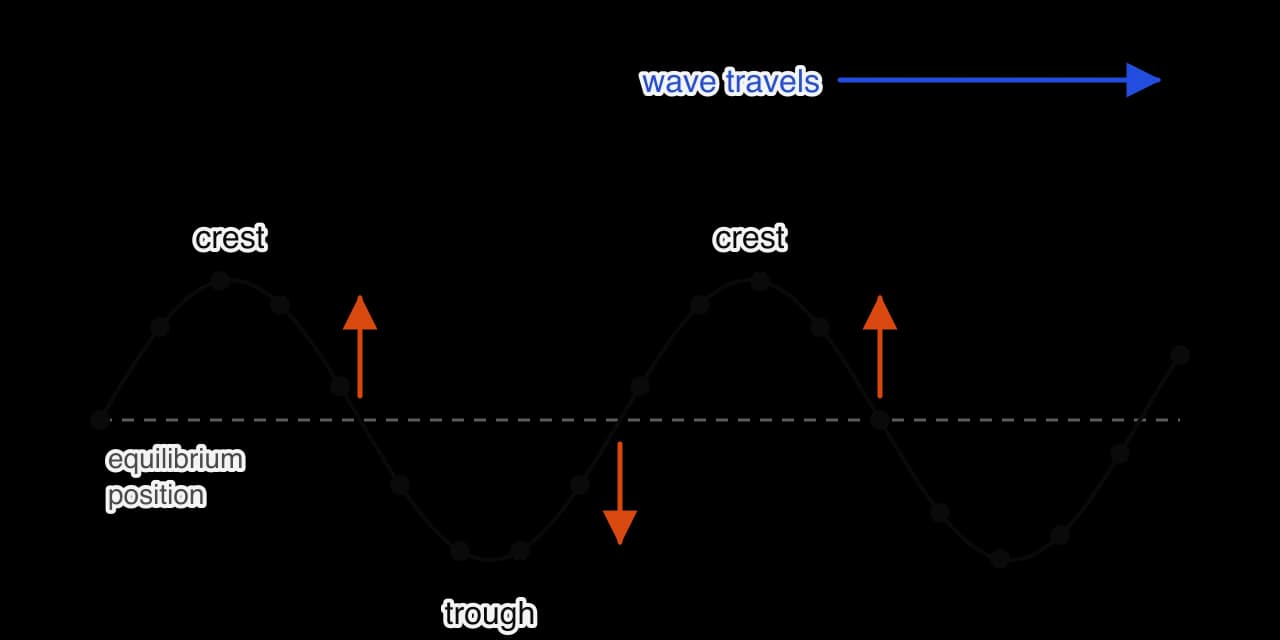
A wave on a rope or a guitar string is a transverse wave. The points of maximum positive displacement are crests and the points of maximum negative displacement are troughs. All electromagnetic waves are transverse, as are S waves in the solid rock of the Earth.
The rope diagram shows that particles at a crest or a trough are momentarily at rest, exactly like an oscillator at its extreme, while those passing through the equilibrium line move fastest. Each particle moves only up and down; none moves along the rope.
Pushing and pulling one end of a slinky spring along its length produces a longitudinal wave. The coils move back and forth along the spring, so in some places they are squeezed together and in others spread apart. A region where the particles are closer together than normal is a compression; a region where they are further apart is a rarefaction. Sound waves and P waves in the Earth are longitudinal.
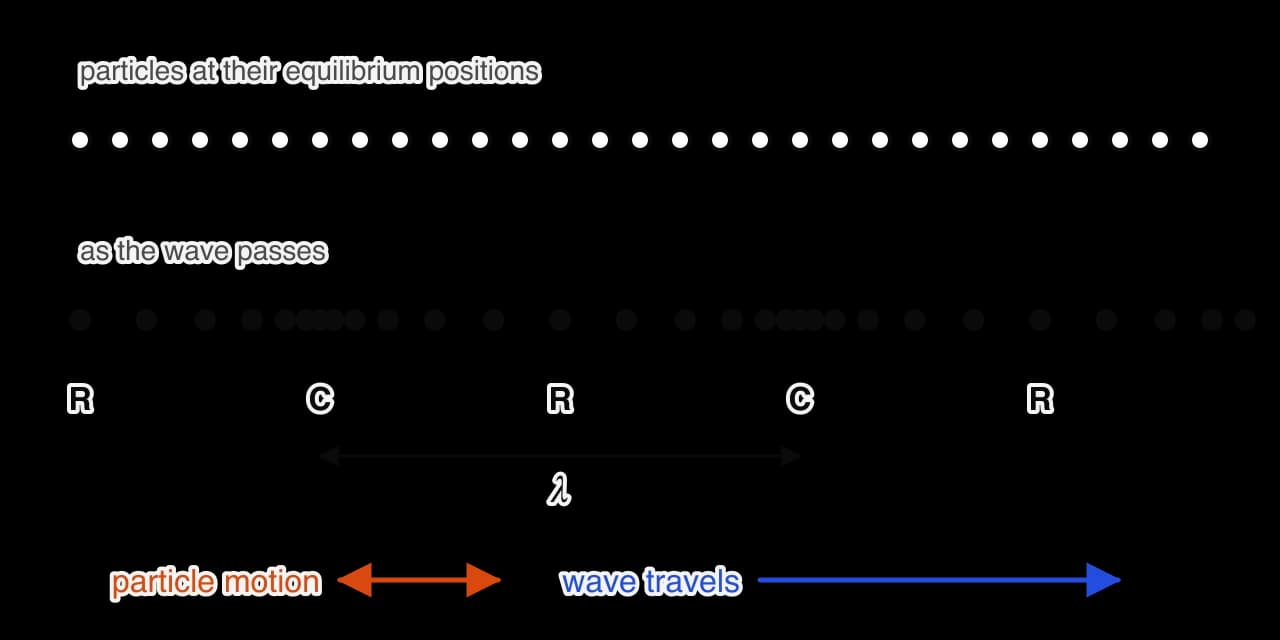
In the particle diagram, every particle oscillates about its own equilibrium position with the same amplitude. The compressions and rarefactions are where neighbouring particles happen to be displaced towards or away from each other, and these regions travel along the medium at the wave speed.
Transverse wave | Longitudinal wave | |
|---|---|---|
Particle oscillation | Perpendicular to the direction of energy transfer | Parallel to the direction of energy transfer |
Features | Crests and troughs | Compressions and rarefactions |
Examples | Waves on strings and ropes; all electromagnetic waves; S waves | Sound; P waves; a slinky pushed along its length |
Media | Mechanical transverse waves need a medium that resists being sheared, so they cannot travel through the bulk of a liquid or gas | Solids, liquids and gases |
The quantities that describe a wave combine those of an oscillation (C.1) with one that describes the wave in space.
Displacement : the distance of a particle of the medium from its equilibrium position, in a stated direction.
Amplitude : the maximum displacement of a particle from its equilibrium position.
Wavelength : the distance between two neighbouring points on the wave that are oscillating in phase, for example two adjacent crests or two adjacent compressions.
Period : the time for one particle to make one complete oscillation; equivalently, the time for the wave to move forward one wavelength.
Frequency : the number of oscillations of a particle per second, , equal to the frequency of the source.
Wave speed : the speed at which the wave (the energy, or a crest) travels through the medium.
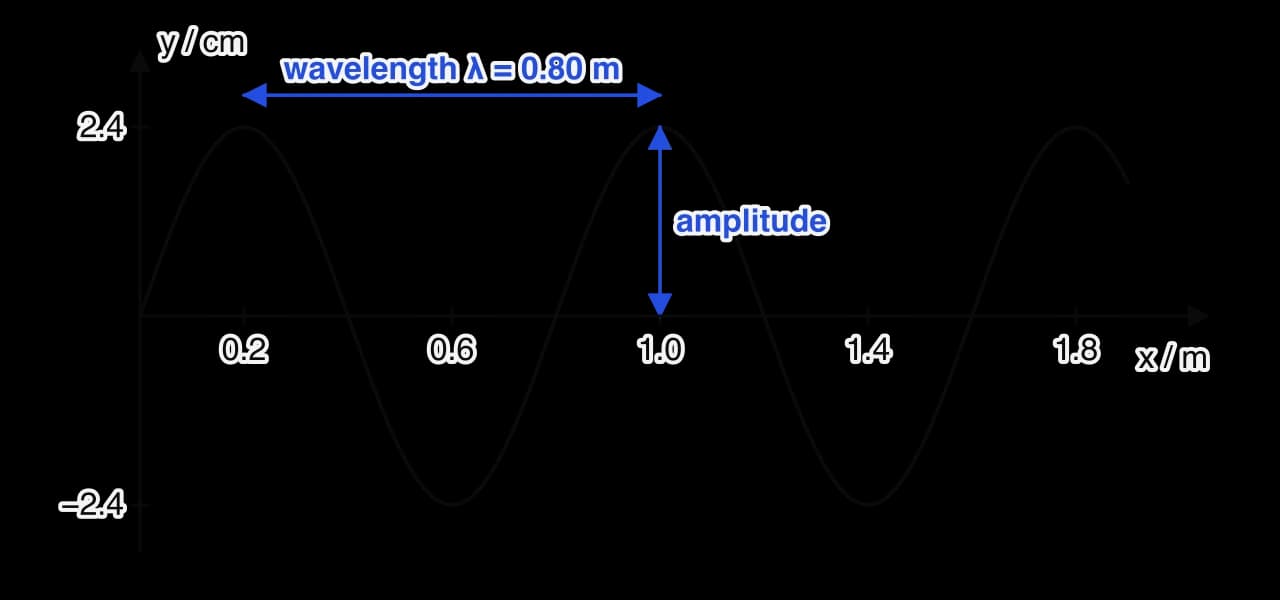
A wave can be drawn in two ways that look alike but show different things. A displacement–distance graph plots the displacement of every particle against its position along the wave at one instant, like a photograph. The wavelength is read along its horizontal axis.
A displacement–time graph plots the displacement of a single particle against time, like a video of one point. It is the same graph as the – graph of an oscillator in C.1, and the period is read along its horizontal axis.
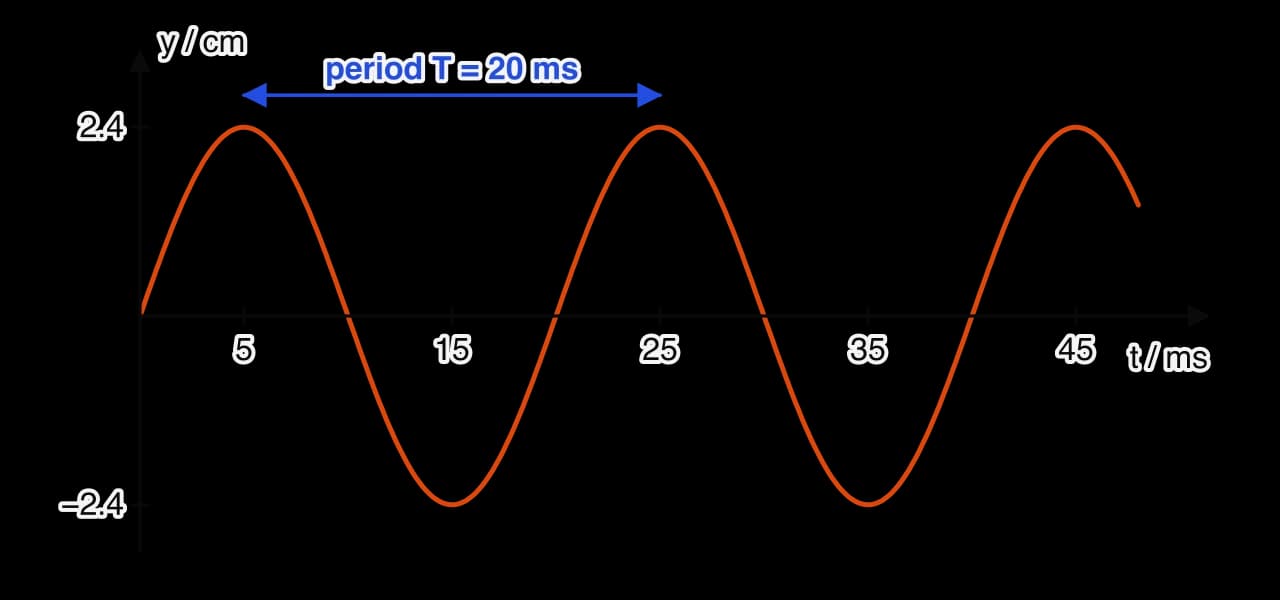
The two graphs have the same sinusoidal shape and the same amplitude, so the label on the horizontal axis is the only way to tell them apart. The wavelength cannot be found from a displacement–time graph, and the period cannot be found from a displacement–distance graph.
 YouTube
In one period , each particle completes one oscillation and the wave moves forward by exactly one wavelength . Speed is distance divided by time, so
The equation holds for every kind of wave, mechanical or electromagnetic. It also explains a pattern seen in any one medium: waves of different frequency travel at the same speed, so a higher frequency means a shorter wavelength. A note one octave higher (double the frequency) has half the wavelength in air.
The speed of sound in air at 20 °C is about . Human hearing covers frequencies from about 20 Hz to 20 kHz, so audible sound in air has wavelengths from about 17 m down to 1.7 cm.
Points on a wave are compared using phase, as for two oscillators. Points one whole wavelength apart (or any whole number of wavelengths) oscillate in phase: they move in the same direction with the same displacement at every instant. Points half a wavelength apart are in antiphase: when one is at a crest the other is at a trough. In general, two points separated by a distance along the wave differ in phase by the fraction of a cycle, which is radians.
A snapshot of a wave shows where the particles are, but not which way each one is moving. That depends on the direction in which the wave travels. A reliable method is to sketch the wave a moment later, shifted slightly in the direction of travel, and see where each particle must move to lie on the new curve.
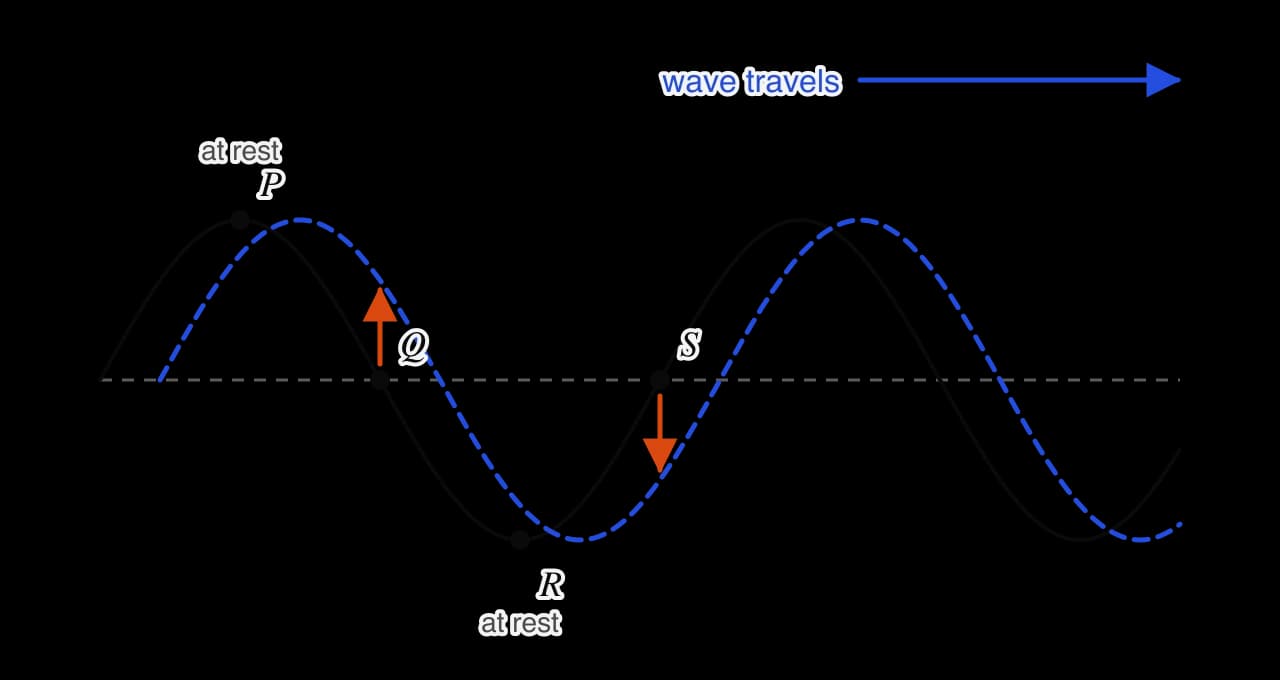
For a wave travelling to the right, the shifted-wave diagram shows that particles just ahead of a crest (on its front, right-hand side) are moving up, because the crest is about to arrive; particles just behind a crest are moving down. Particles at crests and troughs are momentarily at rest, and particles at the equilibrium position move fastest.
The speed of the particles and the speed of the wave are different quantities. The wave speed is set by the medium and is the same everywhere along the wave. The particle velocity changes continuously throughout each cycle, from zero at the extremes to a maximum at equilibrium, exactly as for simple harmonic motion. A particle on a rope can move up and down at while the wave travels along the rope at .
A longitudinal wave can also be drawn as a displacement–distance graph, although the particles move along the axis rather than across it. A positive direction is chosen (usually to the right), and the displacement of each particle along the wave is plotted upwards if it is positive and downwards if it is negative. The graph is then a sinusoid, but its crests are not compressions.
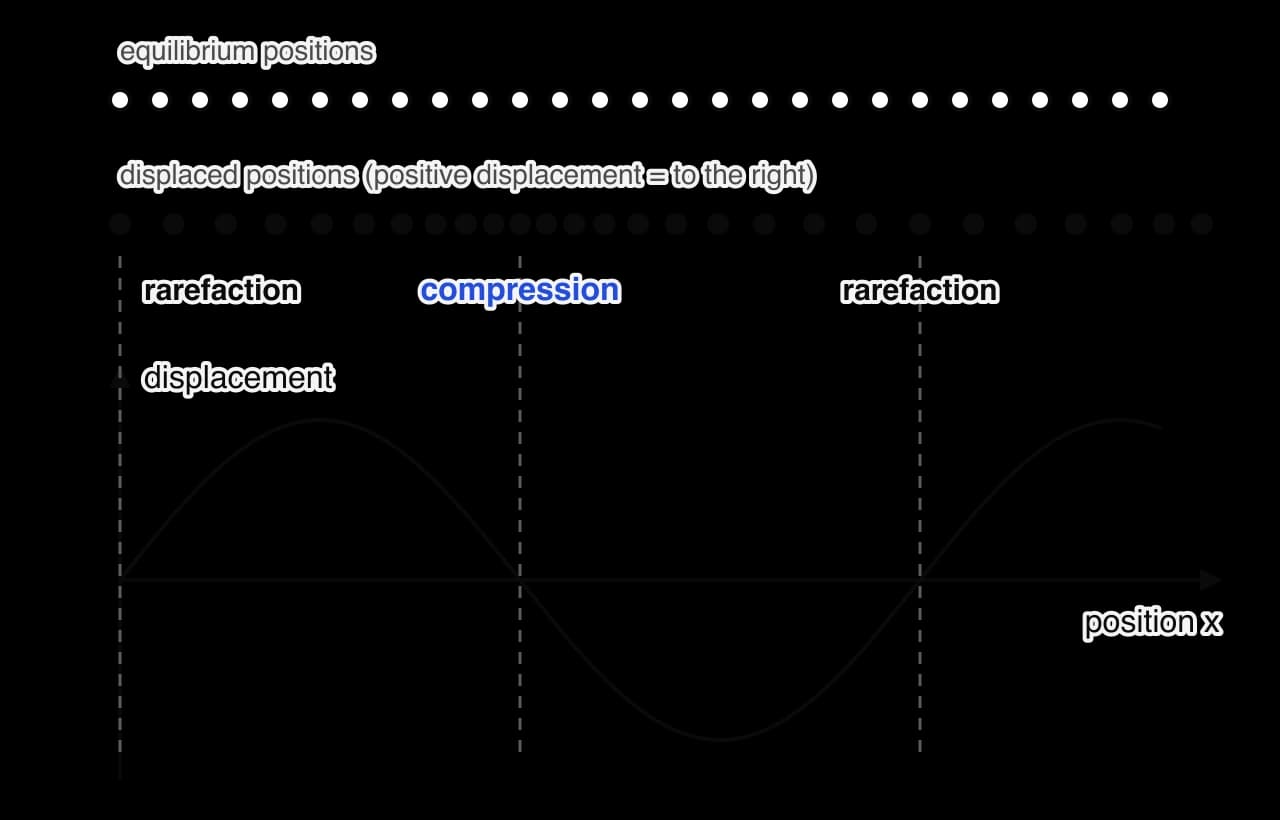
The aligned diagram shows how to find the compressions. At a compression the particles on the left are displaced to the right (positive) and those on the right are displaced to the left (negative), so they crowd together. This happens where the graph crosses the axis going from positive to negative. Where the graph crosses the axis going from negative to positive, the particles move away from each other, giving a rarefaction. At the crests and troughs of the graph the particles have their largest displacements, but their neighbours have nearly the same displacement, so the spacing is normal.
 YouTube
The speed of a wave depends on the medium: how strongly its particles are linked and how much inertia they have. Sound travels faster in water than in air, and faster still in steel; light travels more slowly in glass than in a vacuum. The frequency, by contrast, is set by the source. Every oscillation that arrives at a boundary passes on one oscillation to the far side, so the frequency cannot change when a wave crosses from one medium into another.
Since and is fixed, the wavelength changes in proportion to the speed. A wave that slows down on entering a new medium has its wavelength shortened; one that speeds up has its wavelength lengthened.
Sound is produced by a vibrating object, such as a loudspeaker cone, a guitar string or the vocal folds. As the cone moves forward it pushes the neighbouring air molecules together, creating a compression; as it moves back it leaves a region of lower pressure, a rarefaction. These pressure variations travel outwards as a longitudinal wave. The air molecules oscillate back and forth along the direction of travel; they do not flow from the loudspeaker to the listener.
Because sound needs particles to pass on the disturbance, it cannot travel through a vacuum. A ringing electric bell inside a sealed glass jar becomes quieter and quieter as the air is pumped out, although the bell can still be seen vibrating, because light crosses the near-vacuum in the jar while sound cannot.
Medium | Approximate speed of sound / |
|---|---|
Air at 20 °C | 343 |
Water | 1480 |
Steel | 5900 |
Sound is fastest in solids, where the particles are close together and strongly bonded, and slowest in gases. Sound with frequencies above the range of human hearing, above about 20 kHz, is called ultrasound; bats and dolphins use it for echolocation and hospitals use it for imaging.
An electromagnetic wave is a travelling oscillation of an electric field and a magnetic field. The two fields oscillate in phase, at right angles to each other and at right angles to the direction of travel, so electromagnetic waves are transverse. They are produced by accelerating charges, such as electrons oscillating in a radio aerial, and by energy changes inside atoms and nuclei, such as electrons moving between energy levels or nuclei emitting gamma rays.
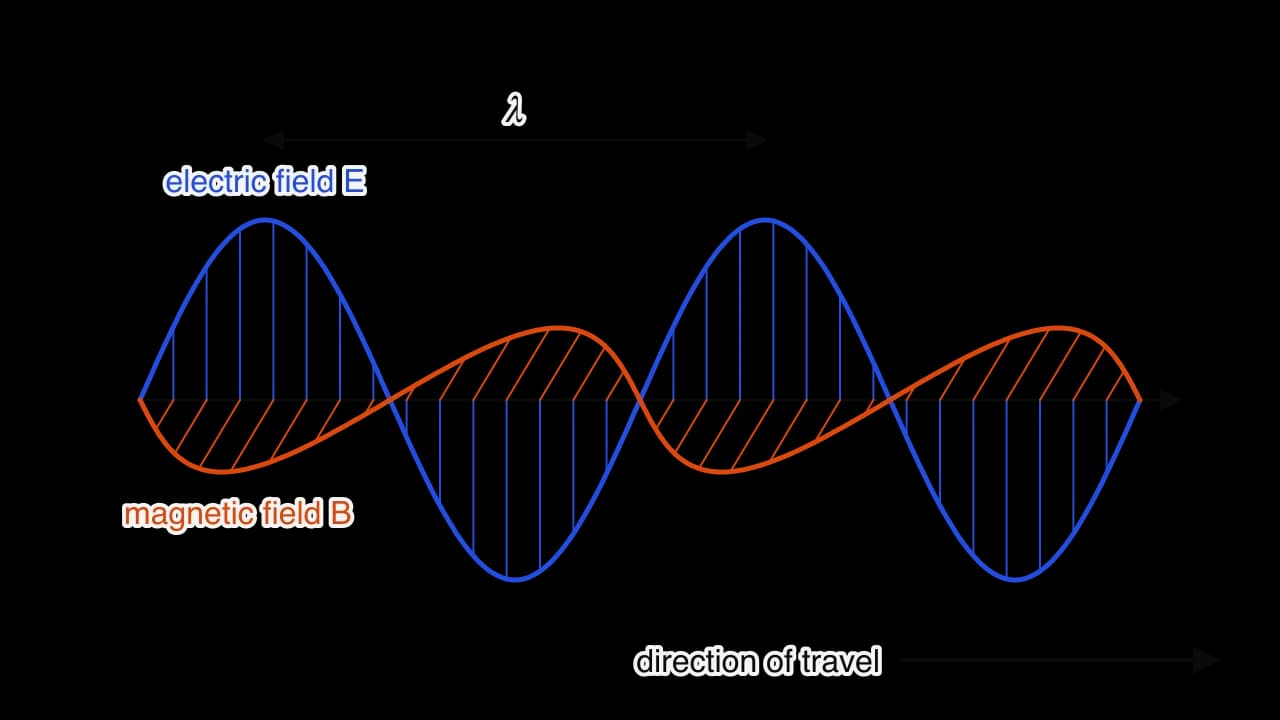
Because the fields themselves carry the disturbance, electromagnetic waves need no medium. In a vacuum all of them travel at the same speed, the speed of light , whatever their frequency. In materials they travel more slowly; in glass, for example, light travels at about .
Electromagnetic waves form a continuous electromagnetic spectrum of wavelengths, from gamma rays shorter than the size of a nucleus to radio waves many kilometres long. The spectrum is divided into named regions according to how the waves are produced, detected and used, but the physics is the same throughout, and the boundaries between regions are not sharp.
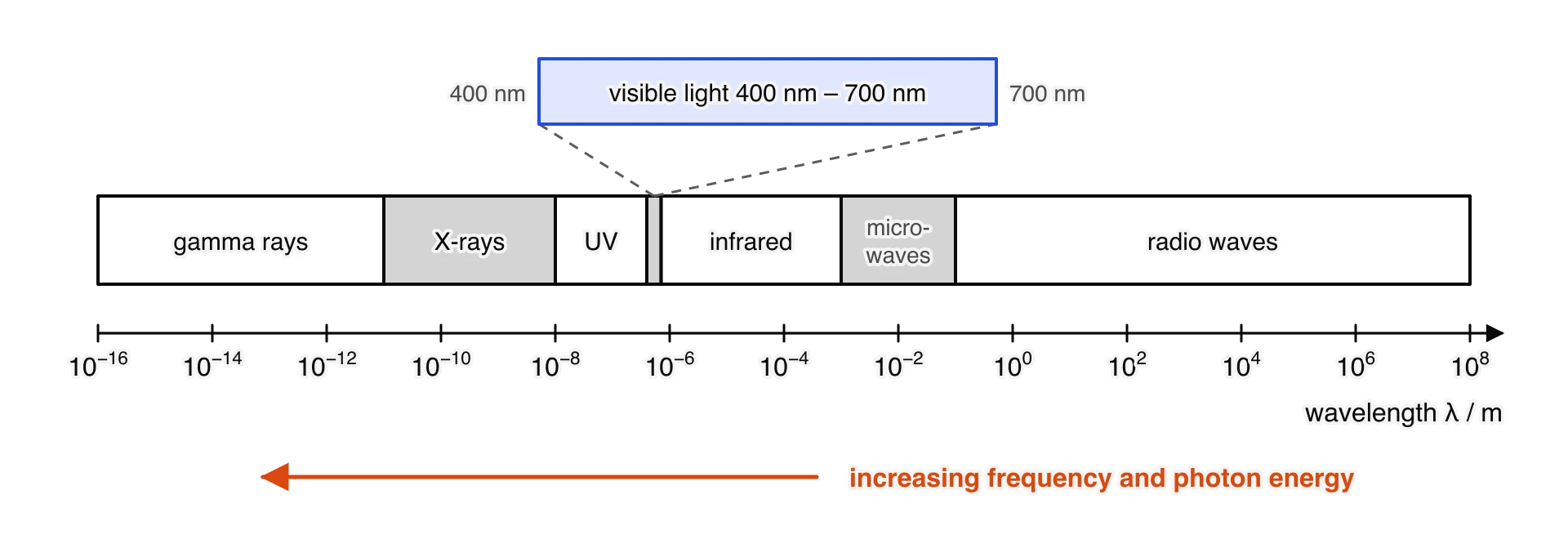
Since is the same for all of them in a vacuum, the shortest wavelengths have the highest frequencies. Gamma rays and X-rays overlap in wavelength and are distinguished by their source: gamma rays come from nuclei, X-rays from electrons.
Region | Order of magnitude of / m | Typical source or use |
|---|---|---|
Gamma rays | to | Radioactive nuclei; sterilising medical equipment; cancer treatment |
X-rays | to | X-ray tubes; medical imaging; studying crystal structures |
Ultraviolet | to | The Sun; sterilising water; causes sunburn |
Visible light | to | The Sun, lamps; vision and photography |
Infrared | to | Warm objects; remote controls; thermal imaging; optical fibres |
Microwaves | to | Mobile phones, Wi-Fi, radar, microwave ovens |
Radio waves | to about | Radio and television broadcasting |
The same method works in reverse: the order of magnitude of a wavelength places the radiation in its region, and then gives its frequency.
The wave model applies equally to mechanical and electromagnetic waves: both transfer energy, both have a wavelength, frequency and speed linked by , and both show the wave phenomena of C.3. They differ in what oscillates and in whether a medium is needed.
Mechanical waves (e.g. sound) | Electromagnetic waves (e.g. light) | |
|---|---|---|
What oscillates | Particles of the medium | Electric and magnetic fields |
Medium | Needed; cannot cross a vacuum | Not needed; travel through a vacuum |
Type | Transverse or longitudinal | Always transverse |
Speed | Depends on the medium; sound in air about | in a vacuum; slower in materials |
Effect of a denser medium | Sound is usually faster in solids and liquids than in gases | Light is slower in glass and water than in air |
An earthquake releases energy that travels through the Earth as seismic waves. Two kinds travel through the body of the Earth. P waves (primary waves) are longitudinal: the rock is alternately compressed and stretched along the direction of travel. S waves (secondary waves) are transverse: the rock is sheared from side to side. In the crust, P waves travel at roughly and S waves at roughly , so P waves always arrive first.
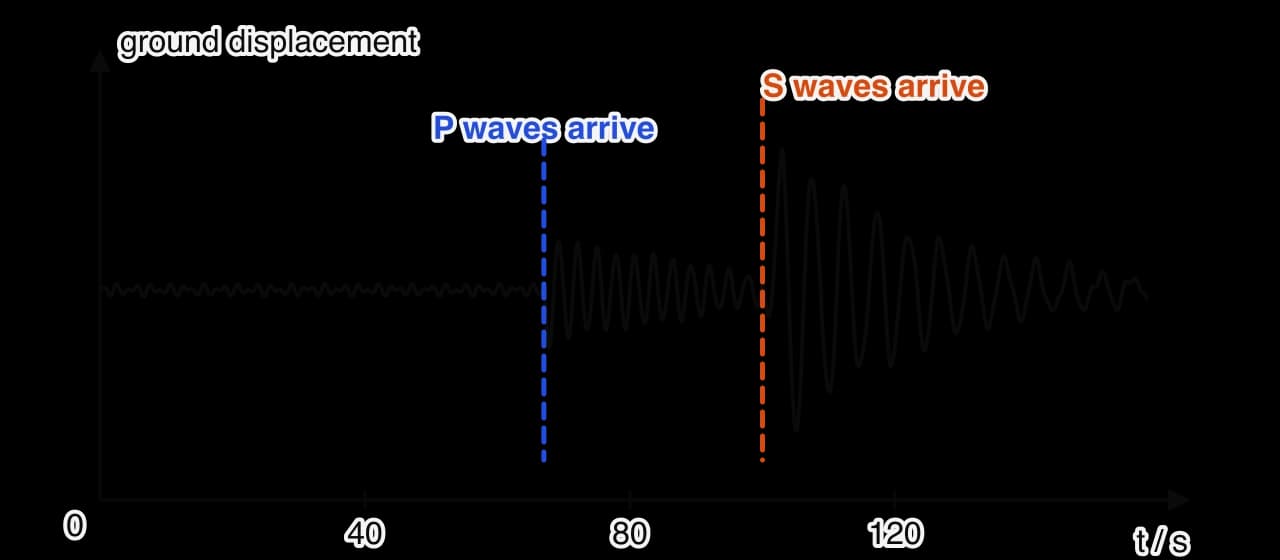
Earthquake early-warning systems use this delay. During the magnitude 9.0 Tōhoku earthquake off the north-east coast of Japan on 11 March 2011, the Japan Meteorological Agency's network detected the first P waves at the nearest coastal station and issued a public warning about 8 seconds later. Because the damaging S waves travel more slowly, places further from the epicentre received the warning several seconds or more before the strongest shaking arrived. Coastal seismometers on the Tōhoku Shinkansen line cut the power to the high-speed trains in the same way, and every passenger train stopped without derailing.
The difference between the two kinds of wave also provides evidence about the Earth's interior. S waves are transverse and cannot travel through a liquid, which does not resist shearing. Seismometers on the far side of the Earth from an earthquake detect P waves but no S waves, which shows that the outer core of the Earth is liquid.
Many wave questions start from a graph. Read the axis first, then take measurements over several wavelengths or periods where the graph allows it, to reduce the reading uncertainty.
A loudspeaker produces a sound wave of frequency 850 Hz in air. The graph shows the variation of the displacement of the air molecules with position along the wave at one instant.
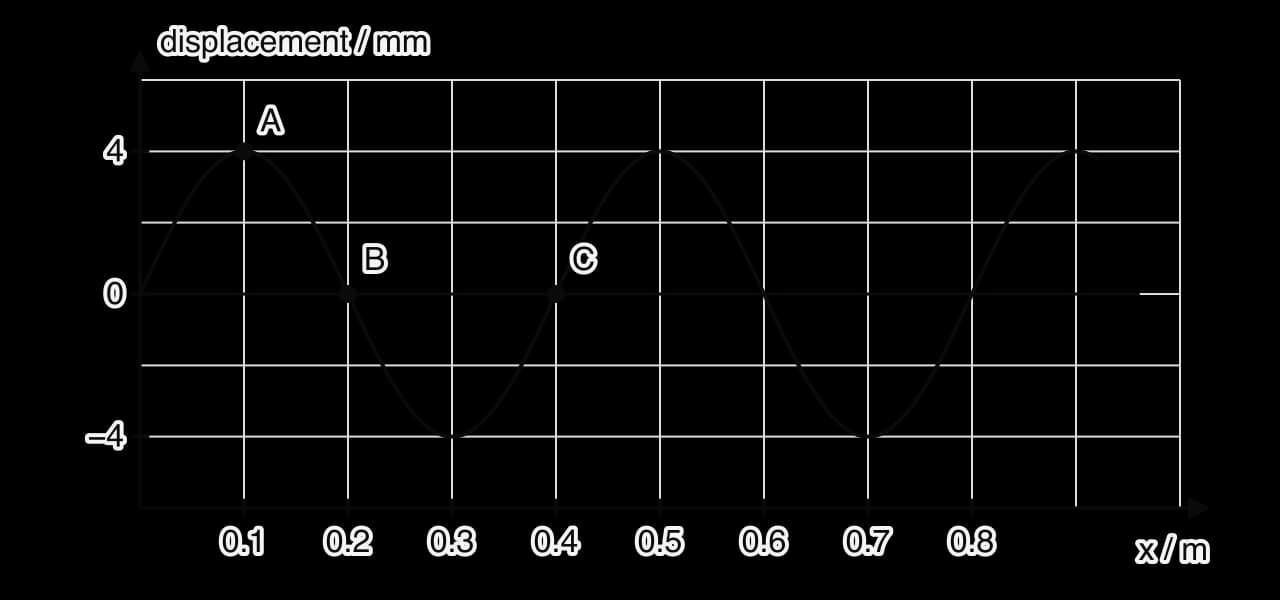
A student measures the wavelength of water waves in a ripple tank for several frequencies of the vibrating bar. The uncertainty in each wavelength is .
/ Hz | / cm (± 0.1) | / s |
|---|---|---|
10 | 3.0 | 0.100 |
12 | 2.5 | 0.083 |
15 | 2.0 | 0.067 |
20 | 1.5 | 0.050 |
25 | 1.2 | 0.040 |
I can explain how a travelling wave transfers energy without a net transfer of the medium.
I can distinguish transverse and longitudinal waves by the direction of particle oscillation relative to energy transfer, and give examples of each.
I can define displacement, amplitude, wavelength, period, frequency and wave speed for a wave.
I can read the wavelength from a displacement–distance graph and the period from a displacement–time graph.
I can derive and use v = fλ = λ/T.
I can state the phase relationship between points a given distance apart along a wave.
I can find the direction of motion of a particle in a travelling wave, and distinguish particle velocity from wave velocity.
I can locate compressions and rarefactions on a displacement–distance graph of a longitudinal wave.
I can explain why the frequency stays the same and the wavelength changes when a wave enters a new medium.
I can describe the nature of sound waves and explain why sound cannot travel through a vacuum.
I can describe the nature of electromagnetic waves and identify the region of the spectrum from a wavelength.
I can compare mechanical and electromagnetic waves, using seismic waves and light as examples.
radius of Mars
The atmosphere of Mars is very thin. Ignore air resistance unless a part says otherwise.
Show that the gravitational field strength at the surface of Mars is about .
2 marks
✓
✓
Must see the substitution OR an answer to at least 3 s.f.
Calculate the time of flight of the capsule.
2 marks
vertical component = «» ✓
«
Calculate the horizontal distance travelled by the capsule.
2 marks
horizontal component = «» ✓
«
Calculate the maximum height reached by the capsule.
2 marks
✓
140 m ✓
Accept 138–140 m.
The same launcher is used on Earth, with the same launch speed and angle. Determine the ratio . Ignore air resistance on Earth.
2 marks
time of flight and so horizontal distance are proportional to
Explain, without calculation, why the capsule lands with the same speed as it was launched.
2 marks
there is no air resistance, so mechanical energy is conserved ✓
the capsule lands at the same height, so its gravitational potential energy and hence its kinetic energy «speed» are the same as at launch ✓
Accept an argument using components: the horizontal component is unchanged and the vertical component has the same magnitude at landing.
A later mission must send a sample capsule away from Mars completely. Show that the escape speed from the surface of Mars is about .
2 marks
Calculate the minimum energy needed to move the 0.50 kg capsule from the surface of Mars to infinity.
2 marks
OR
Outline why the escape speed does not depend on the direction in which the capsule is launched.
1 mark
escape depends only on the kinetic energy being at least equal to the gain in gravitational potential energy, and energy is a scalar ✓
Ignore references to the atmosphere.
Radio signals from the rover travel to Earth at the speed of light. On one day the distance between Mars and Earth is . Calculate the time taken for a signal from the rover to reach Earth.
1 mark
«
The thin atmosphere of Mars does exert a small drag force on the capsule. Predict how the horizontal distance and the speed on landing compare with your answers to (b)(ii) and (d).
2 marks
horizontal distance is «slightly» less ✓
landing speed is «slightly» less than the launch speed, as some energy is transferred to the atmosphere ✓
An aircraft flies horizontally at a constant relative to the ground. The air is still. The speed of sound in the air is relative to the air.
State what is meant by a reference frame.
1 mark
Calculate, using the Galilean transformation, the speed relative to the aircraft of sound from its engines that travels straight ahead of the aircraft and of sound that travels straight behind it.
2 marks
State the speed of the sound travelling straight ahead relative to an observer standing on the ground.
1 mark
The aircraft switches on a landing light that shines straight ahead. State the speed of this light relative to the aircraft predicted by the Galilean transformation if the light travels at relative to the ground.
1 mark
State the speed of the light relative to the aircraft according to special relativity.
1 mark
Light, unlike sound, needs no medium. Outline how the postulates of special relativity changed the way the speed of light is understood compared with Galilean relativity.
2 marks
In the resonance model of the greenhouse effect, a carbon dioxide molecule is treated as a system of masses connected by springs. One mode of vibration of the molecule, in which it bends, has a natural frequency of Hz.
Calculate the wavelength of electromagnetic radiation that has this frequency.
1 mark
The mean temperature of the Earth's surface is 288 K. Show that the surface emits radiation of greatest intensity at a wavelength of about 10 μm.
1 mark
Explain, using the resonance model, why carbon dioxide in the atmosphere absorbs some of the radiation emitted by the Earth's surface.
3 marks
Nitrogen and oxygen molecules make up most of the atmosphere. Suggest why they absorb very little of the radiation emitted by the surface.
1 mark
(b) «m s⁻¹» ✓
(c) ✓
Accept 8.3%.
(d) measure the distance across several «e.g. 10» wavelengths and divide ✓
Do not accept "use better equipment".