Recognise simple harmonic motion from its defining equation, find periods of springs and pendulums, read the graphs of x, v, a and energy, and (HL) use the phase angle and SHM equations.
IB Physics
Part of C Wave behaviour
SL and HL
Key terms introduced here
Each is in the Physics glossary, with every other term in the subject.
2π times the frequency of an oscillation, ω=2πf=2π/T
Notes on C.1 Simple harmonic motion
37 min readLast reviewed
Questions on C.1
83 exam-style questions on this subtopic, written in the style of the IB papers. The first has its markscheme open. Counted on
Question 1 · PHY-00400HL only · 10 marks
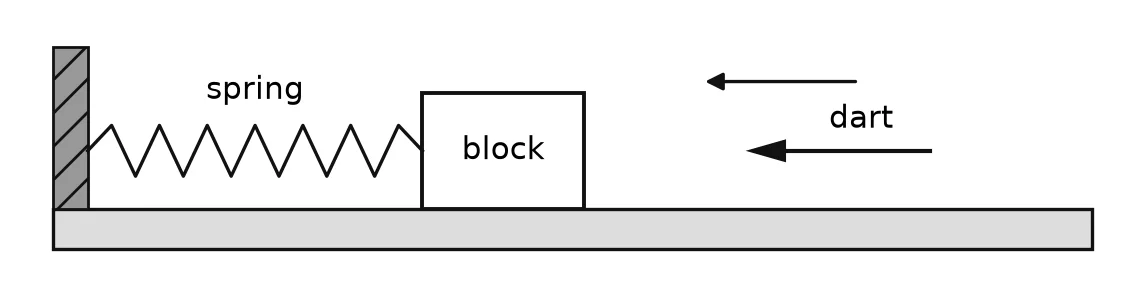
A block of mass 0.380 kg rests on a horizontal air track and is attached to a fixed support by a spring of spring constant 40 N m−1. The spring is at its natural length. A dart of mass 0.020 kg moving horizontally at 15 m s−1 along the axis of the spring hits the block and sticks in it. Friction is negligible.
Try a quick-fire question
One of 60 short multiple-choice questions on C.1. Pick an answer to see why it's right or wrong.
The graph shows how the displacement x of an oscillator varies with time t. At which point is the acceleration of the oscillator maximum and positive?
Flashcards for C.1
The official deck for this part of the syllabus.
C.1 Simple harmonic motion · front
What is an oscillation?
C.1 Simple harmonic motion · front
Give three examples of oscillations.
C.1 Simple harmonic motion163 cards
From the data booklet
The entries of the physics data booklet that C.1 uses. Each opens in the explained booklet.
Two oscillations of the same frequency are in antiphase when their phase difference is π rad (half a cycle), so one is at its positive maximum when the other is at its negative maximum.
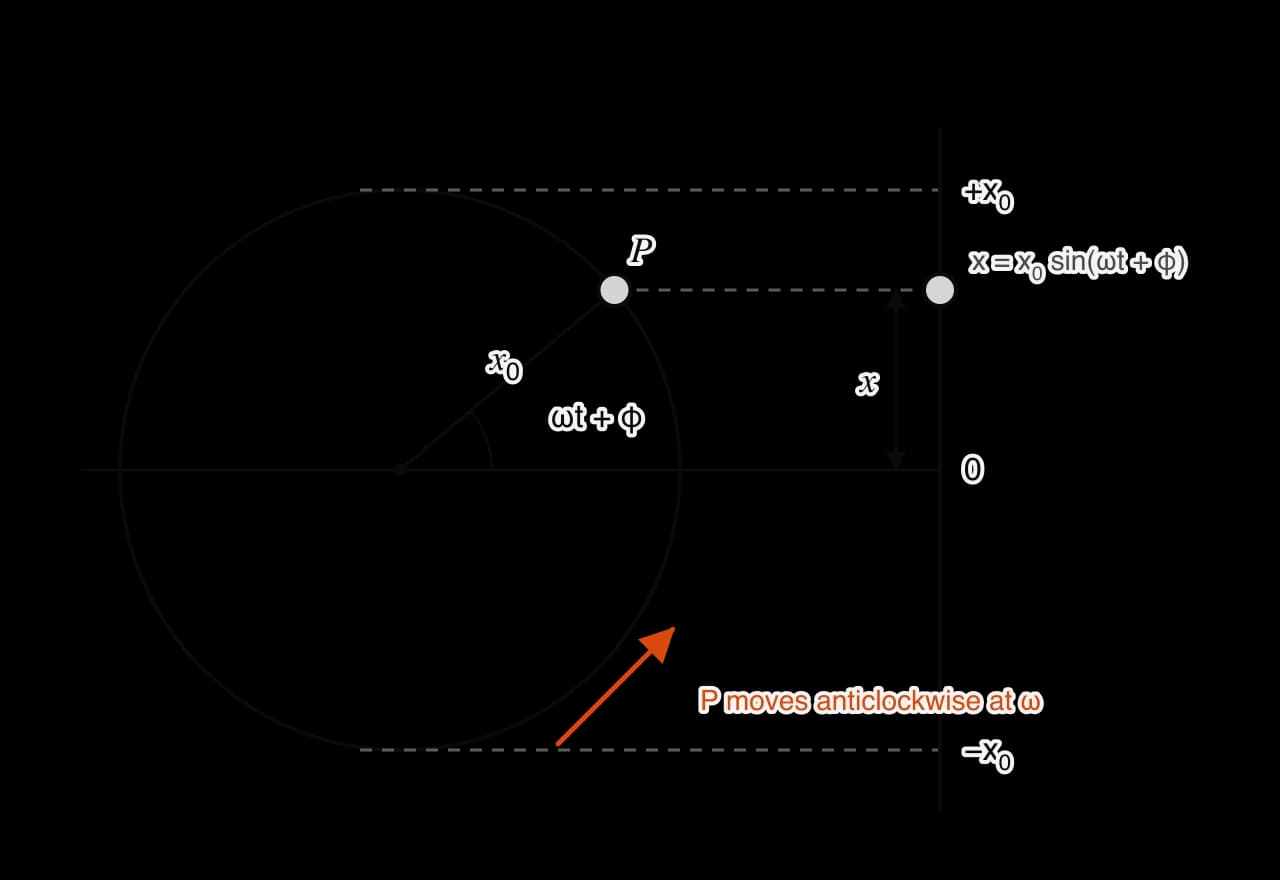
A circle of radius x0 round which a point moves at angular speed ω; the projection of the point onto a diameter moves in simple harmonic motion, and the angle of its radius is the phase ωt+ϕ.
A mass on a spring (with damping) attached to a structure and tuned to the structure's natural frequency, so that it oscillates out of phase with the structure and absorbs energy from it.
.
The period of simple harmonic motion does not depend on the amplitude.
A mass on a spring has T=2πm/k, and a simple pendulum swinging through small angles has T=2πl/g.
During each cycle energy is transferred between kinetic and potential forms while the total stays constant if there is no energy loss.
The state of an oscillation at any instant is given by its phase angle, and two oscillators can be compared by their phase difference (HL).
Displacement, velocity and energy can be calculated from x=x0sin(ωt+ϕ), v=±ωx02−x2 and ET=21mω2x02 (HL).
An oscillation is a repeated back-and-forth motion about a fixed position. Pendulums, vibrating guitar strings, the cone of a loudspeaker, atoms in a solid and the swaying of a tall building all oscillate. Many of these move in a particular way called simple harmonic motion, which can be described completely by a small set of equations and graphs. The same model later explains how waves are produced and how the particles of a medium move as a wave passes.
Pendulum clocks were the most accurate timekeepers for almost three centuries because the period of a pendulum swinging through a small angle hardly depends on how far it swings. Engineers use the same physics in reverse: the tallest buildings carry heavy pendulums tuned to swing against the building's own sway.
Describing an oscillation
Every oscillating body has an equilibrium position: the position where the resultant force on it is zero and where it would stay at rest if undisturbed. A mass on a spring rests where the spring force balances any other forces; a pendulum bob rests directly below its pivot. When the body is moved away and released, it moves back towards the equilibrium position, overshoots it and continues to the other side, again and again.
The quantities used to describe the motion are measured from the equilibrium position. The displacementx is the distance of the body from equilibrium in a stated direction, so it is positive on one side and negative on the other. The largest displacement reached is the amplitude x0. The symbol x0 for amplitude is the one used in the data booklet.
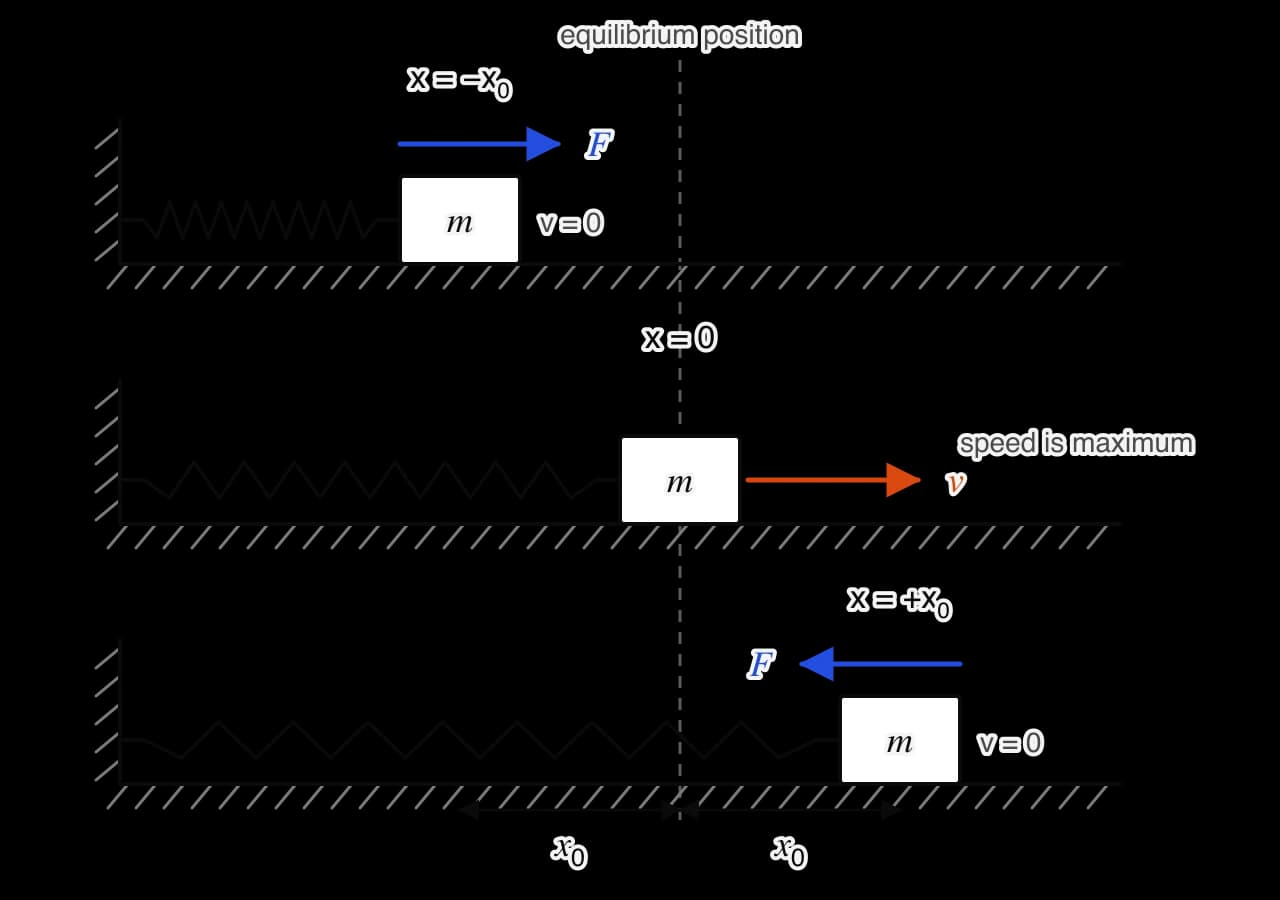
At each extreme the block is momentarily at rest and the restoring force (blue) is largest, pointing back towards equilibrium. At the equilibrium position the force is zero and the speed (orange) is greatest. The amplitude x₀ is measured from equilibrium, not from one extreme to the other.
The diagram of the block on a spring shows one complete cycle: from one extreme, through equilibrium, to the other extreme and back again. A cycle can start at any point, as long as it ends when the body is next at the same position moving in the same direction.
Period, frequency and angular frequency
If one oscillation takes a time T, the number of oscillations in one second is 1/T. The period and frequency are therefore reciprocals of each other. It is also useful to describe an oscillation by its angular frequency ω, measured in radians per second.
T=f1=ω2πω=2πf
The angular frequency comes from the link between SHM and circular motion. A point moving round a circle at constant angular speed ω turns through 2π radians in one revolution. Its shadow on a wall moves back and forth in simple harmonic motion with the same period, so one oscillation corresponds to a phase change of 2π radians. A large ω means a rapid oscillation.
The conditions for simple harmonic motion
A body oscillates only if a force pulls it back whenever it is displaced. This restoring force always points towards the equilibrium position. Motion is simple harmonic when the restoring force has a particular form: its size is proportional to the displacement.
F=−kx
Here k is a constant for the system, and the minus sign shows that the force acts in the opposite direction to the displacement. Displace the body twice as far and the restoring force doubles. By Newton's second law, a=F/m=−(k/m)x, so the acceleration is also proportional to the displacement and opposite to it. Writing the constant k/m as ω2 gives the defining equation of SHM.
a=−ω2x
Both conditions matter. A ball bouncing on the floor repeats its motion, but its acceleration is g downwards throughout the flight, whatever its height, so the motion is periodic without being simple harmonic. A body is in simple harmonic motion only when a is proportional to x.
The meaning of the minus sign
The minus sign in a=−ω2x does not mean that the body is slowing down. It means that the acceleration always points back towards equilibrium. When the body is on the positive side (x>0), its acceleration is negative; on the negative side it is positive. Whether the body is speeding up or slowing down depends on its direction of motion as well.
Moving towards equilibrium, the velocity and acceleration are in the same direction, so the body speeds up.
Moving away from equilibrium, they are in opposite directions, so the body slows down until it stops momentarily at the extreme.
The acceleration–displacement graph
Because a=−ω2x, a graph of acceleration against displacement is a straight line through the origin with a negative gradient. The gradient equals −ω2. The line stops at x=±x0, because the body never goes beyond its amplitude. Any oscillation whose a–x graph has this shape is simple harmonic.
a = −16x
The a–x graph of an oscillator with amplitude 0.050 m: a straight line through the origin with negative gradient −ω² = −16 s⁻², ending at x = ±x₀.
A force law can be tested in the same way. If the resultant force on a body is written as F=−(constant)×x, dividing by the mass gives a=−ω2x with ω2=constant/m.
Why the period does not depend on the amplitude
In SHM, a body released from a larger displacement has further to travel, but it also experiences a proportionally larger restoring force and so a larger acceleration throughout its motion. The two effects cancel exactly, and the period is the same for any amplitude. Motion with this property is called isochronous. It is the reason a pendulum clock keeps time even as its swing slowly changes, and the reason a musical note keeps its pitch as it fades.
Graphs of displacement, velocity and acceleration
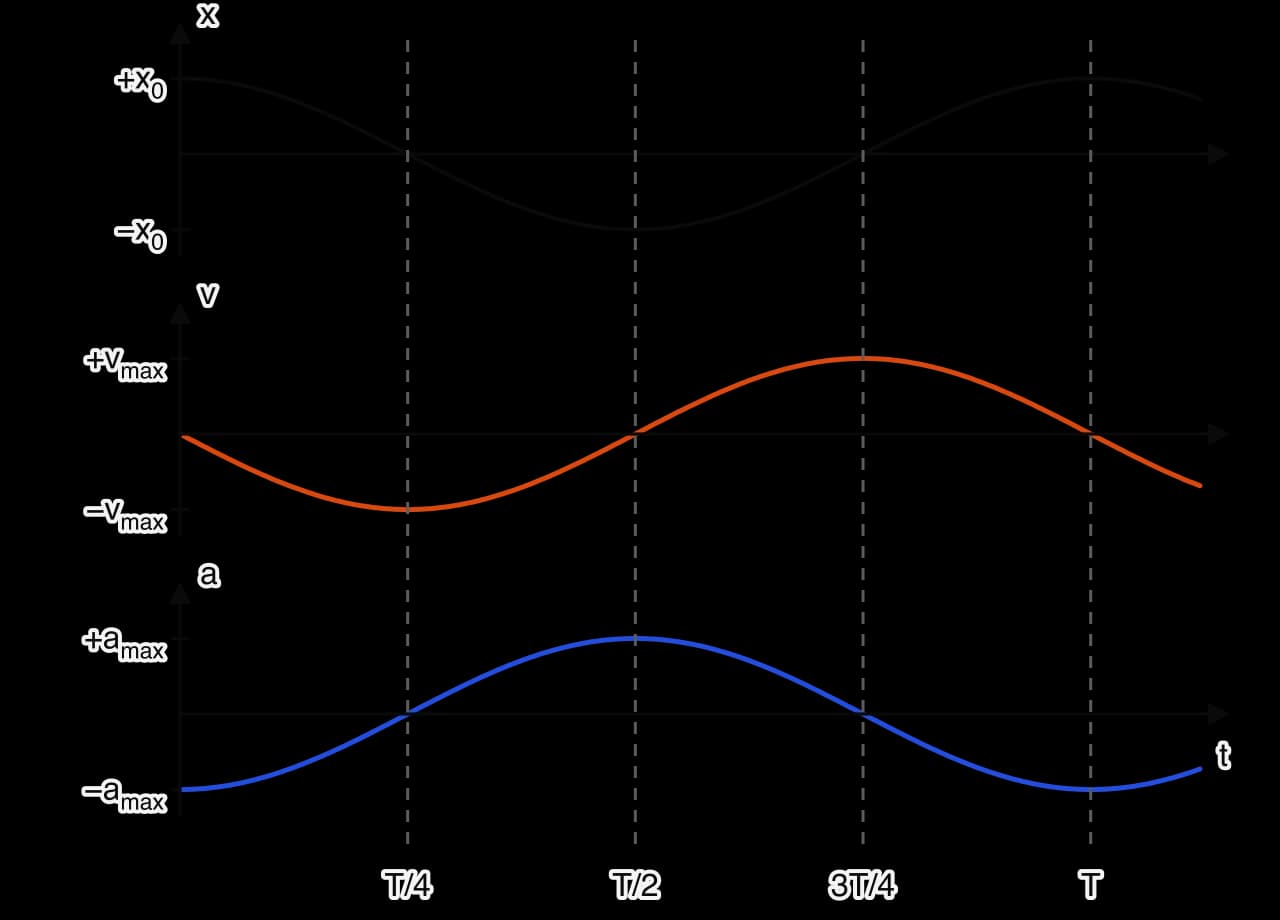
Plotting displacement against time for SHM gives a sinusoidal curve: a sine or cosine shape, depending on where the timing starts. The graphs of velocity and acceleration against time are also sinusoidal, with the same period, but shifted along the time axis. Aligning the three graphs one above the other makes the relationships clear.
An oscillator released from rest at +x₀. Velocity is the gradient of the x–t graph, so it is zero at the extremes and largest at equilibrium. The a–t graph is the x–t graph turned upside down: acceleration is always opposite to displacement.
Reading one graph from another
The three graphs are linked by gradients, exactly as in kinematics (A.1).
Velocity is the gradient of the x–t graph. At the extremes (x=±x0) the x–t graph is flat, so v=0. As the body passes through equilibrium the graph is steepest, so the speed is a maximum there.
Acceleration is the gradient of the v–t graph, and from a=−ω2x it is also −ω2
The velocity graph is a quarter of a cycle ahead of the displacement graph: each feature of the v–t curve happens T/4 earlier than the matching feature of the x–t curve. The acceleration graph is half a cycle away from the displacement graph, so the two are always opposite in sign. Oscillations in this relationship are said to be in antiphase.
Position
Displacement
Speed
Acceleration
Restoring force
Equilibrium
0
Maximum, vmax
0
0
Extreme, x=+x0
+x0
0
Maximum, directed towards equilibrium (−ω2x0)
Maximum
Extreme, x=−x0
−x0
0
Maximum, directed towards equilibrium (+ω2x0
The mass–spring system
A mass m on a light spring of spring constant k is the standard example of a mass–spring system. When the mass is displaced by x from equilibrium, the spring exerts a restoring force F=−kx (Hooke's law, from A.2). Comparing a=−(k/m)x with a=−ω2x gives ω2=k/m, and so the period.
T=2πkm
The equation agrees with experience. A larger mass has more inertia, so it accelerates less for the same force and its period is longer. A stiffer spring (larger k) pulls back harder, so its period is shorter. Gravity does not appear: a mass on a spring has the same period on the Moon as on the Earth, and the amplitude does not appear either.
Changing the mass or the spring
Because T∝m, quadrupling the mass doubles the period. Because T∝1/k, a spring four times as stiff halves it. Questions of this kind are answered fastest with ratios rather than by working out each period separately.
A mass hanging on a vertical spring
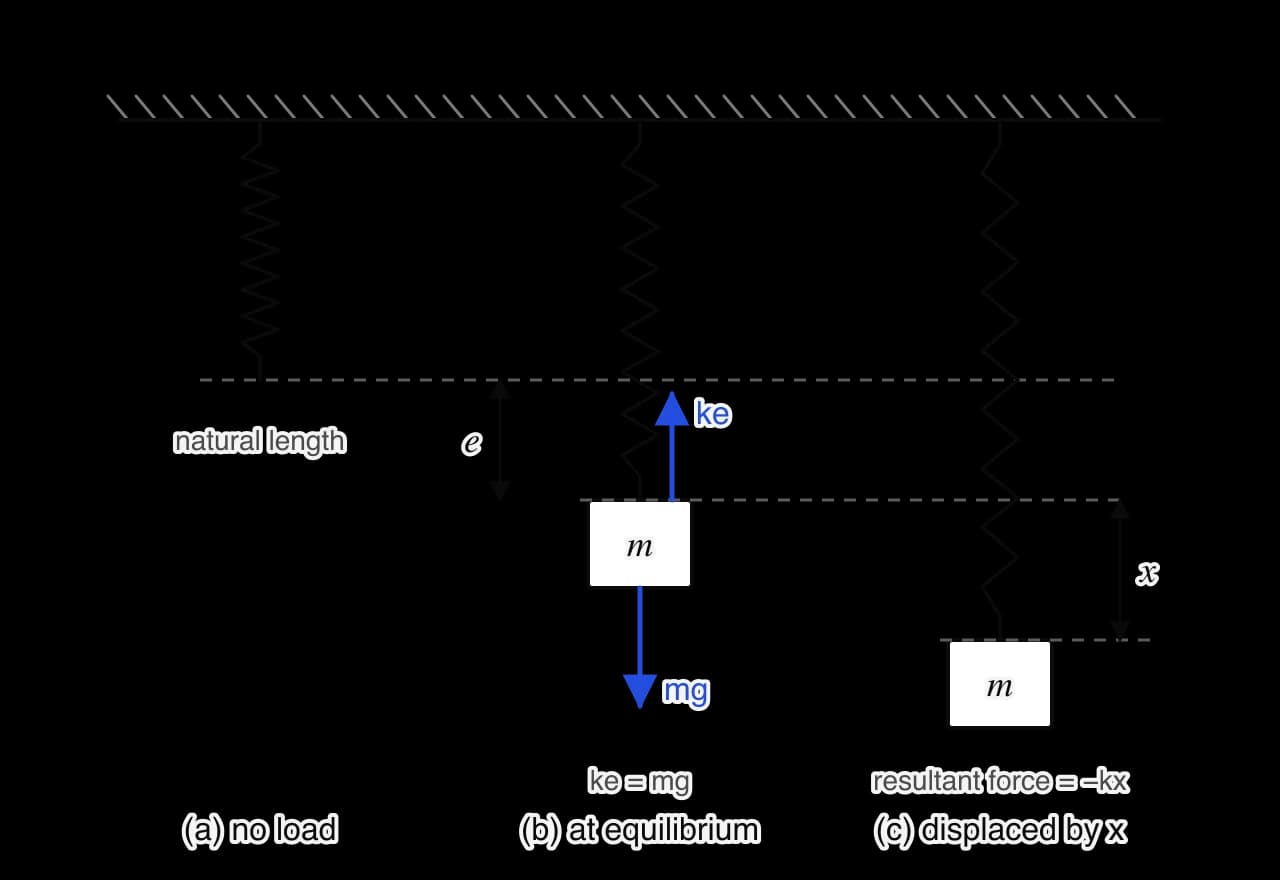
When a mass hangs from a vertical spring, its weight stretches the spring by an extension e until the spring force balances the weight: ke=mg. This is the new equilibrium position. If the mass is pulled down a further distance x, the spring force increases by kx while the weight is unchanged, so the resultant force is −kx, exactly as for a horizontal spring.
Hanging a mass shifts the equilibrium position down by e = mg/k, but the extra force for an extra displacement x is still kx. The motion about the new equilibrium is the same SHM as for a horizontal spring.
The vertical diagrams show that gravity only moves the equilibrium position. The oscillation about that position is SHM with T=2πm/k. Since m/k=e/g, the period can also be found from the static extension alone.
Measuring a spring constant from oscillations
Squaring the period equation gives T2=(4π2/k)m. A graph of T2 against m should therefore be a straight line through the origin with gradient 4π2/k. Plotting T2 rather than T turns a curve into a straight line, which is easier to test and from which a constant can be found by measuring a gradient.
T² against m is a straight line of gradient 4π²/k. The small positive intercept on the T² axis comes from the mass of the spring itself, part of which oscillates with the load.
In a real experiment the line usually has a small positive intercept on the T2 axis. The spring itself has mass, and the lower part of it moves with the load, so the oscillating mass is slightly larger than the mass on the hanger. Using the gradient rather than a single reading removes this systematic effect from the value of k.
The simple pendulum
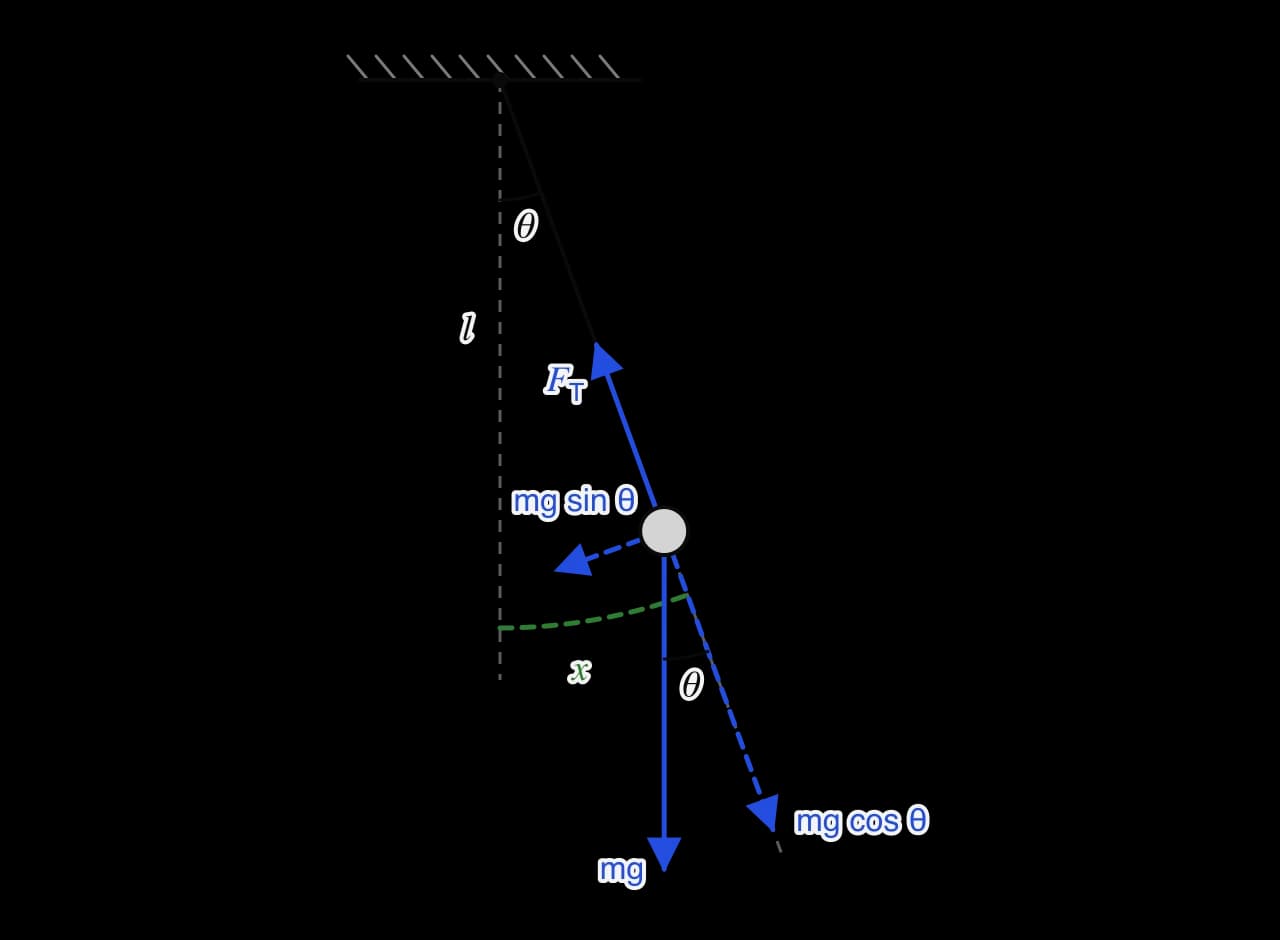
A simple pendulum is a small, dense bob on a light, inextensible string of length l, swinging in a vertical plane. The length l is measured from the pivot to the centre of mass of the bob. When the bob is displaced by an angle θ, two forces act on it: the tension FT in the string and its weight mg.
Along the string, the tension and mg cos θ provide the centripetal force. Along the arc, mg sin θ is the restoring force, always directed back towards the lowest point. Forces in blue; the arc displacement x in green.
Resolving the weight along and perpendicular to the string, as in the pendulum diagram, separates the two jobs the forces do. Along the string, FT−mgcosθ provides the centripetal force that keeps the bob on its circular path. Along the arc, the only force is the component mgsinθ, and it always points back towards the lowest point. This component is the restoring force.
Why a pendulum moves with SHM only for small angles
The restoring force is F=−mgsinθ. If the angle is small and measured in radians, sinθ≈θ, and the angle is related to the arc displacement by θ=x/l. Then
Fa≈−mgθ=−lmgx=mF≈−lgx
This has the form a=−ω2x with ω2=g/l, so for small swings the pendulum moves with SHM and its period is
T=2πgl
The small-angle approximation sinθ≈θ is the key step. For larger angles sinθ is noticeably smaller than θ, the restoring force grows more slowly than the displacement, and the period becomes slightly longer than the equation predicts. The values of sinθ and θ show how good the approximation is.
θ / degrees
θ / rad
sinθ
Difference
5.7
0.100
0.0998
0.2%
11.5
0.200
0.1987
0.7%
17.2
0.300
0.2955
1.5%
28.6
0.500
0.4794
4.1%
Up to about 10° the difference is well under 1%, so the pendulum equation is accurate for the small swings used in timekeeping and in the laboratory.
What the pendulum period depends on
The mass of the bob does not appear in T=2πl/g. A heavier bob needs a larger force to give it the same acceleration, and its weight, which supplies the restoring force, is larger in the same proportion. This is the same reason all bodies in free fall have the same acceleration. The amplitude does not appear either, as long as it is small. Only the length and the gravitational field strength matter.
T∝l: four times the length gives twice the period.
T∝1/g: a pendulum swings more slowly on the Moon, where g is about one-sixth of its value on the Earth.
The Great Clock in the Elizabeth Tower at Westminster ("Big Ben") has a pendulum that beats once every 2 seconds, so its period is 4.0 s. The pendulum has a total length of 4.4 m, but it is a heavy rod and bob rather than a simple pendulum, so the length that matters is its effective length, the length of a simple pendulum with the same period: l=gT2/4π2=9.8×4.02/4π2≈4.0m. The clock is fine-tuned by placing old penny coins on a small tray on the pendulum: each coin raises the centre of mass very slightly, shortening the effective length and making the clock gain about 0.4 s per day.
YouTube
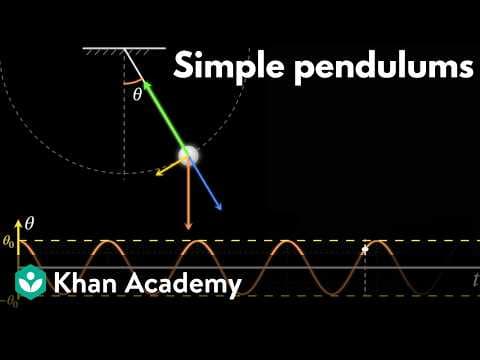
Khan Academy: SHM of simple pendulums. How the restoring force on a pendulum leads to its period equation.
Measuring g with a pendulum
Rearranging the pendulum equation gives g=4π2l/T2. Measuring T for several lengths and plotting T2 against l gives a straight line through the origin of gradient 4π2/g, from which g is found. Good practice in this experiment includes:
measuring the length to the centre of the bob, using a metre rule held close to the string;
keeping the amplitude small (under about 10°), so that the small-angle approximation holds;
timing 20 oscillations from a fiducial marker at the equilibrium position and repeating each timing;
checking that the bob swings in a plane rather than in an ellipse.
Energy changes during simple harmonic motion
As a body oscillates, energy is transferred back and forth between kinetic energy and potential energy. For a mass on a horizontal spring the potential energy is elastic potential energy stored in the spring; for a pendulum it is gravitational potential energy of the bob. If no energy is lost to the surroundings, the total energy stays constant (energy conservation, A.3), and the amplitude stays the same from one cycle to the next.
At each extreme the body is momentarily at rest: the kinetic energy is zero and the potential energy is a maximum, equal to the total energy.
At the equilibrium position the speed is greatest: the kinetic energy is a maximum, equal to the total energy, and the potential energy is a minimum (taken as zero).
In between, the energy is shared, and the two always add up to the same total.
Energy against time
The kinetic energy is greatest each time the body passes through equilibrium, which happens twice in every cycle (once in each direction). The potential energy likewise peaks twice per cycle, at each extreme. Graphs of energy against time therefore have half the period of the displacement graph, and since energy cannot be negative, they never go below zero.
potential energy
kinetic energy
total energy
An oscillator of period 2.0 s starting at equilibrium. Kinetic and potential energy each repeat every 1.0 s, half the period of the motion, and always add up to the constant total energy of 40 mJ.
Energy against displacement
Plotted against displacement, the potential energy is a parabola with its minimum at x=0, because the restoring force, and so the work needed to displace the body, grows with x. The kinetic energy is an upside-down parabola that reaches zero at x=±x0. The graphs end at the amplitude, because the body never goes further.
potential energy
kinetic energy
total energy
Energy against displacement for an oscillator of amplitude 5.0 cm. The potential and kinetic energy curves are parabolas that cross where each is half the total, and both stop at x = ±5.0 cm.
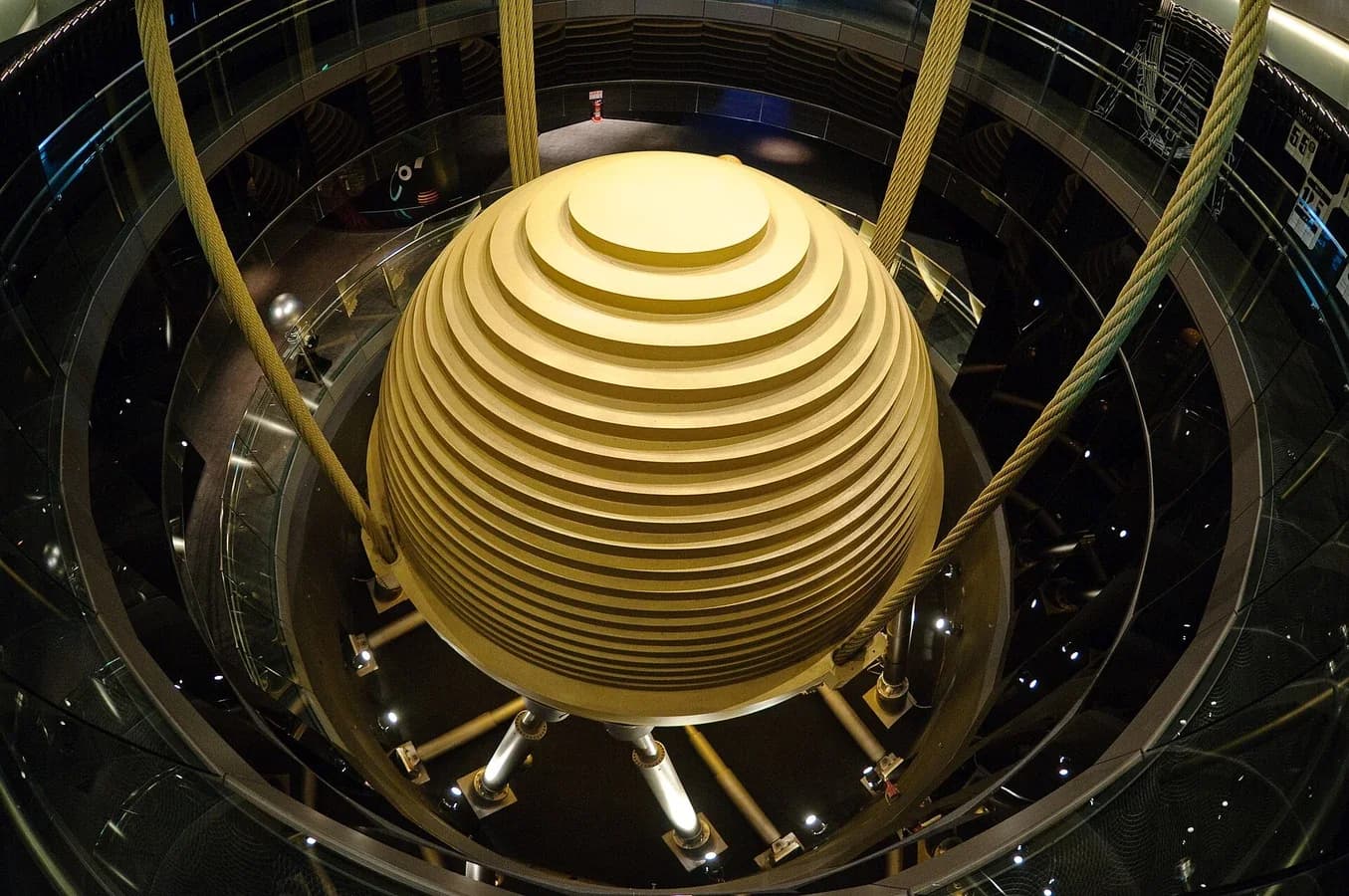
Real oscillators always lose some energy, for example through fluid resistance or friction at a pivot, so their amplitude slowly decreases. This decay, called damping, is part of standing waves and resonance (C.4). Taipei 101, a 508 m tower in a region with typhoons and earthquakes, carries a 660-tonne tuned mass damper: a steel sphere hung as a pendulum, with a period matched to the building's sway. As the building sways, the sphere swings against it, and hydraulic dampers attached to the sphere convert the energy of the motion into internal energy.
The 660-tonne tuned mass damper in Taipei 101 hangs as a pendulum between the 87th and 92nd floors. Its period is matched to the building's own sway, so it swings against the building's motion and reduces it. Image: Armand du Plessis, CC BY 3.0, via Wikimedia Commons.
Phase and phase angle (HL)
One complete cycle of SHM corresponds to 2π radians, as for one revolution of the point on a circle whose shadow moves in SHM. The phase of an oscillation is its position in the cycle expressed as an angle. At time t an oscillator with angular frequency ω is at phase ωt+ϕ, where ϕ is its phase angle at t=0, which sets where the oscillation starts.
As P goes round the circle anticlockwise at constant angular speed ω (orange arrow), its height above the centre moves up and down the vertical axis in SHM. The angle of the radius, ωt + φ, is the phase of the oscillation; one revolution is one cycle, 2π rad.
The reference circle shows where the phase comes from. A point moving round a circle of radius x0 at angular speed ω has a height x0sin(ωt+ϕ) above the centre, where ωt+ϕ is the angle its radius makes with the horizontal. As the angle increases by 2π, the height runs through one complete cycle of SHM. The phase angle ϕ is the angle of the radius at t=0.
Phase difference between two oscillators
Two oscillators with the same frequency keep a constant phase difference Δϕ. If one reaches each stage of its cycle a time Δt after the other, the fraction of a cycle by which it lags is Δt/T, so
Δϕ=T2πΔt
Phase difference
Fraction of a cycle
Description
0 (or 2π)
0 (or 1)
In phase: the oscillators reach their maxima together
π/2
41
One is at an extreme when the other is at equilibrium
π
21
Antiphase: one is at +x0 when the other is at −x0
Two oscillators are in phase when their phase difference is zero, and in antiphase when it is π. In this language, the velocity of an oscillator leads its displacement by π/2, and its acceleration is in antiphase with its displacement.
oscillator A
oscillator B
Two oscillators of period 8.0 ms. B reaches each maximum 1.0 ms after A, so B lags A by 1.0/8.0 of a cycle: a phase difference of π/4 rad.
The equations of simple harmonic motion (HL)
The sinusoidal graphs of SHM are described by two equations. With x0 the amplitude and ϕ the phase angle,
xv=x0sin(ωt+ϕ)=ωx0cos(ωt+ϕ)
The value of ϕ depends on where the timing starts.
Starting at equilibrium, moving in the positive direction:ϕ=0, so x=x0sinωt and v=ωx0cosωt.
Starting at the positive extreme:ϕ=π/2, and since sin(θ+π/2)=cosθ, x=x0cosωt
Because cos is never greater than 1, the maximum speed is vmax=ωx0, reached at equilibrium. Similarly the maximum magnitude of acceleration, at the extremes, is amax=ω2x0.
Speed at a given displacement
Often the time is not known but the displacement is. Combining the two equations with sin2θ+cos2θ=1 removes the time:
v=±ωx02−x2
The ± sign appears because the body passes each point twice per cycle, once in each direction, with the same speed. At x=0 the equation gives v=±ωx0, the maximum speed; at x=±x0 it gives v=0.
With calculus, v=dx/dt=ωx0cos(ωt+ϕ) and a=dv/dt=−ω2x0sin(ωt+ϕ)=−ω2x
The equations also show why loudspeakers and engine parts must be strong. A loudspeaker cone vibrating at 250 Hz with an amplitude of only 0.40 mm has ω=1.57×10³rad s−1, so its maximum acceleration is ω2x0≈1.0×10³m s−2, about a hundred times g.
YouTube
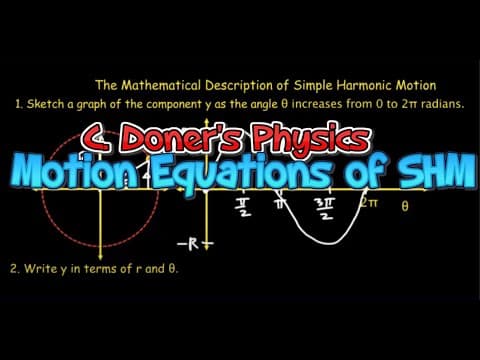
Chris Doner: IB Physics: The Motion Equations of Simple Harmonic Motion. Using the displacement and velocity equations of SHM.
Energy in simple harmonic motion (HL)
The kinetic energy at equilibrium equals the total energy, because the potential energy is zero there. Using vmax=ωx0:
ET=21mvmax2=21mω2x02
At a displacement x, the kinetic energy is 21mv2=21mω2(x02−x2), and the potential energy is the remainder of the total:
EpEk=21mω2x2=ET−Ep=21mω2(x02−x2)
For a mass on a spring mω2=k, so Ep=21kx2, the elastic potential energy from A.3. The SHM equation is more general: it applies to any simple harmonic oscillator, including a pendulum, where the "spring constant" is mω2=mg/l.
The total energy is proportional to the square of the amplitude: doubling x0 quadruples ET.
It is also proportional to ω2, so for the same mass and amplitude, doubling the frequency quadruples the energy.
Applying the ideas in exam questions
Questions on SHM combine three skills: recognising the defining condition, reading phase relationships from graphs, and choosing the right period equation. Data-based questions on springs and pendulums usually involve a linearised graph and its uncertainties.
Paper 1A: the acceleration of an oscillator
Paper 1A: changing a pendulum
Paper 1B: determining g from a pendulum
A student investigates how the period T of a simple pendulum varies with its length l. For each length she times 10 oscillations. The uncertainty in each time for 10 oscillations is ±0.2s.
l / m (± 0.005)
10T / s (± 0.2)
T2 / s²
0.200
9.0
0.81
0.400
12.6
1.59
0.600
15.6
2.43
0.800
17.9
3.20
1.000
20.1
4.04
Paper 2: a mass on a spring
Paper 2 (HL): speed and energy of an oscillator
Self-check
To do:
I can define amplitude, period, frequency and angular frequency, and convert between T, f and ω.
To do:
I can state the two conditions for simple harmonic motion and explain the minus sign in a = −ω²x.
To do:
I can identify SHM from an a–x graph or a force law and find ω from the gradient.
To do:
I can explain why the period of SHM does not depend on the amplitude.
To do:
I can sketch and relate the x–t, v–t and a–t graphs, and state where speed and acceleration are greatest.
To do:
I can derive and use T = 2π√(m/k) for a mass on a spring, including a vertical spring.
To do:
I can explain why a simple pendulum moves with SHM only for small angles and use T = 2π√(l/g).
To do:
I can find a spring constant or g from a linearised graph and handle the uncertainties.
To do:
I can describe the energy changes during an oscillation and sketch energy against time and against displacement.
To do:
I can describe oscillations using phase angle, find the phase angle from a graph or starting conditions, and calculate phase differences in radians (HL).
To do:
I can use x = x₀ sin(ωt + φ), v = ωx₀ cos(ωt + φ) and v = ±ω√(x₀² − x²) (HL).
To do:
I can calculate the total, potential and kinetic energy of a simple harmonic oscillator (HL).
(a)
Calculate the speed of the block and dart immediately after the collision.
[2]2 marks
Markscheme (a)
0.020×15=0.400v ✓ v=0.75 «m s−1» ✓ Award[2] for a bald correct answer.
(b)
Calculate the percentage of the dart's initial kinetic energy that is transferred to other forms in the collision.
[2]2 marks
Markscheme (b)
before: 2.25 «J» AND after: 21×0.400×0.752=0.113
(c)
The block and dart then oscillate with simple harmonic motion. Calculate the period of the oscillations.
[2]2 marks
Markscheme (c)
T=2π400.400
(d)
Determine the amplitude of the oscillations.
[2]2 marks
Markscheme (d)
the speed just after the collision is the maximum speed, vmax=ωx0 ✓ x0=100.75=0.075
(e)
Calculate the maximum force exerted on the block by the spring, and the maximum acceleration of the block.
[2]2 marks
Markscheme (e)
Fmax=kx0=40×0.075=3.0
Question 2 · PHY-0048810 marks
Carbon dioxide molecules absorb infrared radiation strongly at two wavelengths, 15 μm and 4.3 μm. Each absorption corresponds to a transition between vibrational energy levels of the molecule.
(a)
Calculate, in eV, the energy of a photon of wavelength 15 μm.
[2]2 marks
(b)
Show that the difference between the energy levels for the absorption at 4.3 μm is about 0.3 eV.
[1]1 mark
(c)
In a resonance model of this vibration, an oxygen atom of mass 16 u oscillates on a spring of stiffness k attached to a fixed carbon atom. The natural frequency of this oscillator equals the frequency of radiation of wavelength 4.3 μm.
Determine k.
[3]3 marks
(d)
Infrared radiation of a range of frequencies is incident on the molecule. Sketch a graph to show how the amplitude of the oscillation of the molecule varies with the frequency of the incident radiation. Label the natural frequency f0 on the frequency axis.
[2]2 marks
(e)
Water vapour is the most abundant greenhouse gas. Suggest why the water vapour released by human activities has little direct effect on the greenhouse effect, while warming caused by carbon dioxide increases the amount of water vapour in the atmosphere.
A buoy floating in a harbour is pushed down a short distance and released. It bobs up and down. The motion of the buoy is simple harmonic if the resultant force on it is
A
proportional to its displacement from the equilibrium position and directed towards that position.
B
proportional to its displacement from the equilibrium position and directed away from that position.
C
constant in magnitude and always directed towards the equilibrium position.
D
proportional to its speed and directed opposite to its velocity.
The amplitude, 0.050 m, does not enter the calculation: the period depends only on the gradient of the line.
times the displacement. It is a maximum (in magnitude) at the extremes and zero at equilibrium.
)
Maximum
.
The unit of the gradient is s2kg−1, and kg s−2 is the same as N m−1, so the answer has the correct unit for a spring constant.
, and
2.47×1.80s=4.4s
.
.
sinϕ=4.02.0=0.50⇒ϕ=6πor65π
Use the direction of motion to choose. The velocity at t=0 is v=ωx0cosϕ. The displacement is increasing, so v>0 and cosϕ>0. Of the two angles, only π/6 has a positive cosine.
ϕ=6π=0.52rad
If the displacement had been +2.0cm and decreasing, the answer would be 5π/6. On the reference circle the two cases are the two points at the same height, one on each side of the vertical diameter.
and
v=−ωx0sinωt
. This is the oscillator in the stacked
x
,
v
and
a
graphs.
, which confirms that the sine solution satisfies the defining equation.
is a quarter of
ET
:
✓
percentage uncertainty in T2=2×2.2=4.4% «accept 4%» ✓
(c)T2=g4π2l, so T2 is proportional to l ✓
a straight line through the origin is expected, whose gradient 4π2/g gives g ✓