5.7 Optimisation questions for IB Maths AI
60 questions on Optimisation, written by Augment in the style of IB exam papers. Six of them are below in full, to answer on paper.
- IB Mathematics: Applications and Interpretation
- Part of 5 Calculus
- SL and HL
Questions by paper and level
SL and HL questions are for students at either level. HL only questions cover what only HL students study.
| Paper | SL and HL | HL only | All |
|---|---|---|---|
| Paper 1 | 19 | 1 | 20 |
| Paper 2 | 23 | 15 | 38 |
| Paper 3HL only | 0 | 2 | 2 |
| Every paper | 42 | 18 | 60 |
Counted on
Questions to try
Written by Augment in the style of IB exams, not past papers. Answer them on paper, then check each one against its markscheme with a free account.
Dmitri makes an open box from a rectangular sheet of card that measures 40 cm by 25 cm. He cuts a square of side cm from each corner and folds up the sides.
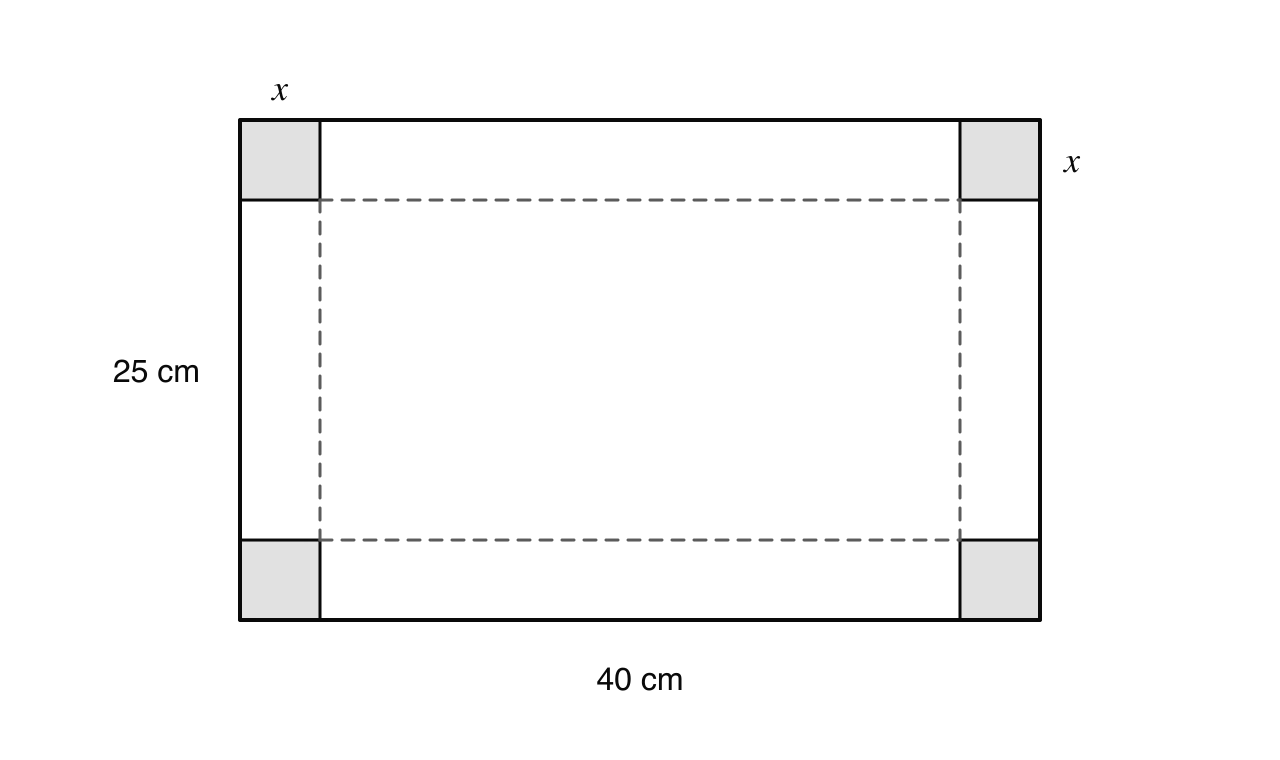
- (a)
Show that the volume of the box, cm³, is given by .
2 marks
- (b)
Write down the set of possible values of for which the model is valid.
2 marks
- (c)
Find the maximum volume of the box and the value of that gives it.
3 marks
Inés uses a rotating sprinkler to water a lawn. The sprinkler waters a region in the shape of a sector of a circle with radius m and angle radians.
Inés first sets the sprinkler so that and .
- (a)
Find the area of lawn watered.
2 marks
- (b)
Find the perimeter of the watered region.
2 marks
- (c)
Write down the value of in degrees.
1 mark
- (d)
Inés now plans a new flower bed in the shape of a sector with radius m and angle radians. The area of the flower bed must be .
Show that .
2 marks
- (e)
The whole perimeter of the flower bed will be edged with metal strip. Show that the length of strip needed, m, is given by
2 marks
- (f)
Find .
2 marks
- (g)
Hence find the value of that minimizes , and the minimum length of strip needed.
3 marks
- (h)
Find the corresponding value of .
1 mark
- (i)
The metal strip costs 14.50 euros (EUR) per metre. Find the minimum cost of the strip. Give your answer correct to two decimal places.
2 marks
This question uses calculus to design how a tram accelerates and brakes between two stops.
A tram travels in a straight line between two stops, starting and finishing at rest. Its velocity, m s−1, is recorded every 10 seconds during one journey of 80 seconds.
(s) | 0 | 10 | 20 | 30 | 40 | 50 | 60 | 70 | 80 |
|---|---|---|---|---|---|---|---|---|---|
(m s−1) | 0 | 1.5 | 4.7 | 9.1 | 12.6 | 15.1 | 14.2 | 9.9 | 0 |
- (a)
Use the trapezoidal rule with all the values in the table to estimate the distance between the two stops.
3 marks
- (b)(i)
The tram company's engineer, Mireille, models the velocity by
Find the distance between the stops according to this model.
2 marks
- (b)(ii)
Find the percentage difference between your answer to part (a) and your answer to part (b)(i), taking the value in part (b)(i) as the true value.
2 marks
- (c)
Use differentiation to find the maximum velocity of the tram according to Mireille's model.
3 marks
- (d)
Find the maximum acceleration of the tram according to the model, and the time at which it occurs.
3 marks
- (e)
For passenger comfort, the magnitude of the acceleration of a tram must never exceed 1.3 m s−2.
Show that Mireille's model satisfies this condition.
2 marks
- (f)
Find the time at which the tram has travelled half of the distance between the stops.
3 marks
- (g)(i)
On a new route, two stops are 900 m apart. Mireille uses a model of the same form,
where seconds is the journey time and is a positive constant.
Show that .
3 marks
- (g)(ii)
Show that the greatest magnitude of the acceleration during the journey is .
3 marks
- (g)(iii)
Hence find the shortest journey time on the new route that satisfies the comfort condition in part (e).
2 marks
- (g)(iv)
Find the maximum velocity of the tram on this journey.
2 marks
- (h)
State one reason why Mireille's model may not be suitable for the new route.
1 mark
A bakery in Lyon makes cakes each day. Its daily profit, euros (EUR), is modelled by
- (a)
Find .
2 marks
- (b)
Find the number of cakes the bakery should make each day to maximise its profit.
3 marks
- (c)
Find the maximum daily profit.
1 mark
Kenji makes conical paper cups. For each cup he cuts a sector with radius 20 cm and angle radians from a sheet of paper, then joins the two straight edges, with no overlap, to form an open cone with slant height 20 cm.
Kenji first uses .
- (a)
Find the length of the arc of the sector.
2 marks
- (b)
Show that the radius of the base of the cone is cm, correct to three significant figures.
2 marks
- (c)
Find the height of the cone.
2 marks
- (d)
Find the volume of the cup.
2 marks
- (e)
Find the area of the curved surface of the cup.
2 marks
- (f)
Kenji now considers other values of , where .
Show that the volume of the cup, , is given by
3 marks
- (g)
Find the value of that gives the greatest volume, and this greatest volume.
3 marks
- (h)
Explain why must be less than .
1 mark
The purpose of this question is to find the cheapest design for a grain silo, first without and then with a planning restriction.
A farming cooperative plans to build a grain silo in the shape of a cylinder of radius metres and height metres, with a hemispherical roof of radius metres, as shown in the following diagram.
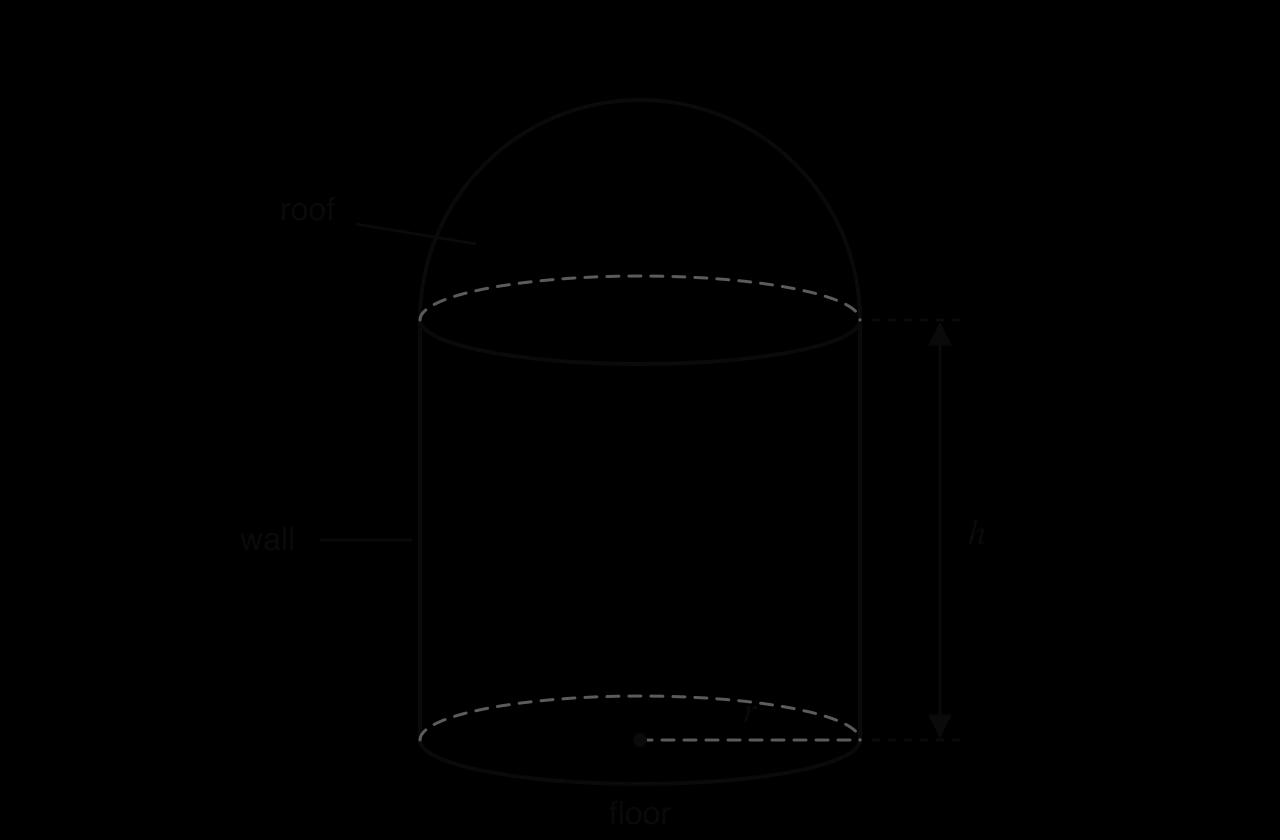
The silo must hold of grain. The building costs are 40 US dollars (USD) per m² for the circular floor, 60 USD per m² for the curved wall and 90 USD per m² for the hemispherical roof.
- (a)
Show that .
3 marks
- (b)
Show that the total cost, USD, of building the silo is given by
3 marks
- (c)
Explain why the model is only valid for .
2 marks
- (d)
Find .
2 marks
- (e)
Find the value of and the value of that minimize the cost, and find this minimum cost to the nearest dollar.
4 marks
- (f)
Use the second derivative to justify that this value of gives a minimum cost.
2 marks
- (g)(i)
A local planning regulation states that the total height of the silo, including the roof, must not exceed 9 m.
Show that the radius must satisfy .
1 mark
- (g)(ii)
Find the least value of that satisfies the regulation.
2 marks
- (g)(iii)
Explain why the cheapest silo that satisfies the regulation has the radius found in part (g)(ii), and find its cost to the nearest dollar.
3 marks
- (g)(iv)
Find the percentage increase in the minimum cost caused by the regulation.
2 marks
- (h)
Suggest one further cost that the cooperative should include in the model before deciding on the radius of the silo.
1 mark
Practice all 60 in Augment
Free with an account. Every question has its markscheme, and Augment keeps the ones you got wrong so you can come back to them.
More questions in Calculus
- 5.1Limits and the derivative
- 5.2Increasing and decreasing functions
- 5.3Differentiating polynomials
- 5.4Tangents and normals
- 5.5Introduction to integration
- 5.6Stationary points
- 5.7OptimisationThis page
- 5.8The trapezoidal rule
- 5.9Further differentiationHL only
- 5.10The second derivativeHL only
- 5.11Further integrationHL only
- 5.12Areas and volumesHL only
- 5.13KinematicsHL only
- 5.14Setting up differential equationsHL only
- 5.15Slope fieldsHL only
- 5.16Euler’s methodHL only
- 5.17Phase portraitsHL only
- 5.18Second-order differential equationsHL only
Check your answers in Augment
A free account opens all 60 questions on Optimisation with their markschemes, and keeps a record of what you have marked.