5.7 Optimisation · IB Maths AI | Augment Education
5.7 Optimisation
Solve optimisation problems in context: write a constraint, build an objective function in one variable, solve its derivative equal to zero, justify the maximum or minimum, and interpret and criticise the optimal value.
IB Mathematics: Applications and Interpretation
Part of 5 Calculus
SL and HL
Key terms introduced here
Each is in the Maths AI glossary, with every other term in the subject.
A fixed condition in an optimisation problem, such as a given amount of material, volume, perimeter or length, that links the variables and so allows all but one of them to be eliminated.
The greatest or least value of the objective function that can be achieved within the constraints, together with the value of the variable at which it occurs.
The process of finding the value of a variable that makes a quantity as large as possible (a maximum) or as small as possible (a minimum), usually subject to conditions set by the context.
Notes on 5.7 Optimisation
33 min readLast reviewed
Learning objectives
Identify the quantity to be maximised or minimised in a problem, and the constraint that links its variables.
Show that a quantity can be written as an objective function of a single variable, using the constraint to eliminate the other variables.
State the values of the variable that make sense in the context, and reject solutions outside them.
Find the value of the variable that gives an optimal value, by solving the equation derivative =0 by hand or with technology.
Justify that the value found gives a maximum or a minimum, using the sign of the derivative or a graph, and checking the end points of the domain.
Calculate the optimal value with units, and round whole-number answers in the way the context requires.
Solve optimisation problems on area, volume, surface area, cost, revenue and profit.
Interpret an optimal solution in context and comment on how well the model's optimum matches a real design.
Introduction
Questions on 5.7
60 exam-style questions on this subtopic, written in the style of the IB papers. The first has its markscheme open. Counted on
Question 1 · AI-000067 marks
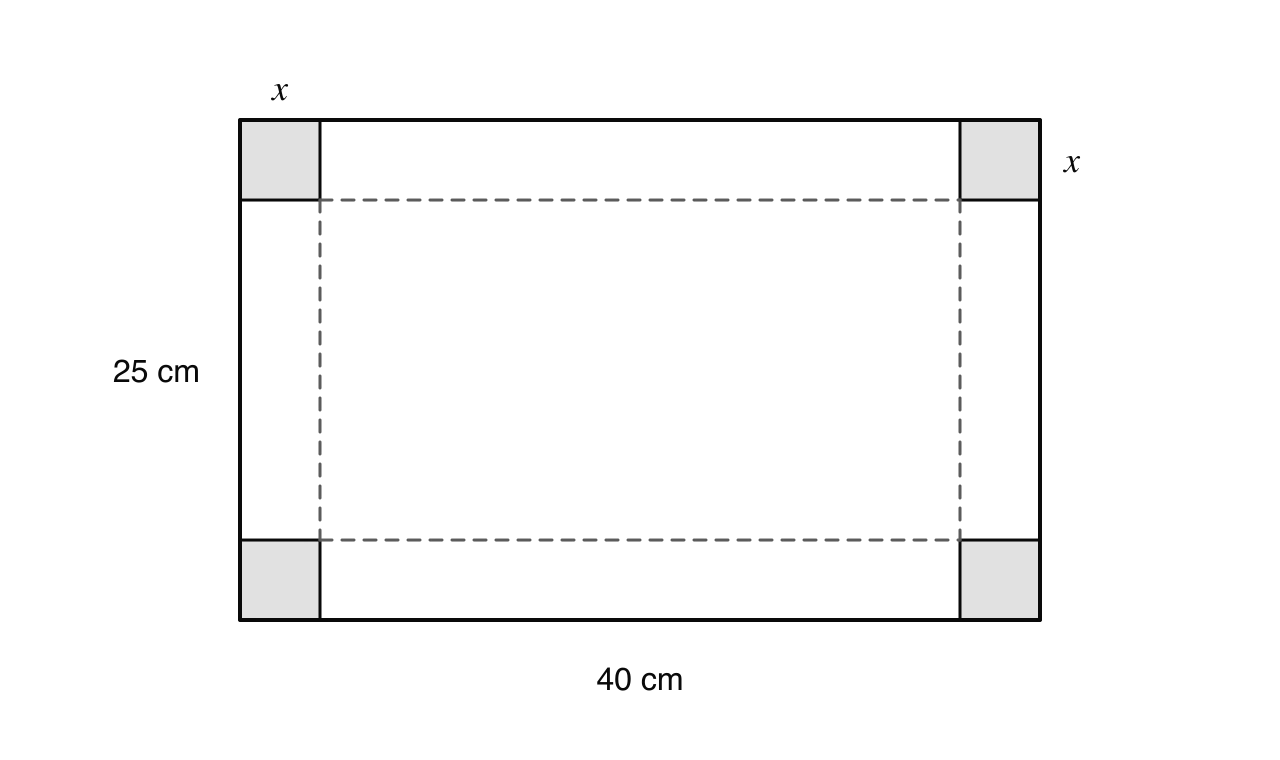
Dmitri makes an open box from a rectangular sheet of card that measures 40 cm by 25 cm. He cuts a square of side x cm from each corner and folds up the sides.
Diagram not to scale.
(a)
Show that the volume of the box, V cm³, is given by V=x(40−2x)(25−2x)
From the formula booklet
The entries of the mathematics: applications and interpretation formula booklet that 5.7 uses. Each opens in the explained booklet.
Optimisation is the search for the best possible value of a quantity: the largest volume a sheet of card can hold, the cheapest way to make a container, the price that brings in the most profit. In most real problems the quantity depends on two or more measurements that are tied together by a fixed condition, such as a set amount of material or a required capacity. Calculus turns the problem into one that can be solved exactly: write the quantity as a function of a single variable, then find its stationary points as in subtopic 5.6.
The method applies in many settings where resources are limited. Packaging engineers choose dimensions that hold a given volume with as little material as possible; a business sets its price where profit is greatest; a farmer arranges a fixed length of fencing to enclose the largest field. These problems share one structure, and the same sequence of steps applies to each.
The parts of an optimisation problem
A farmer has 120 m of fencing to make a rectangular enclosure beside a straight river. The river forms one side, so only three sides need fencing. If the two sides at right angles to the river are each x m long, the side parallel to the river is 120−2x m, and the enclosed area is A=x(120−2x) square metres. Trying a few values of x shows that the area depends strongly on the choice.
x (m)
10
20
30
40
50
120−2x (m)
100
80
60
40
20
Area A (m²)
1000
1600
1800
1600
1000
The table suggests that the best value is near x=30, but a table can only test the values chosen. Calculus finds the best value exactly, and proves that no other value does better. Every optimisation problem has the same named parts.
The quantity to be made as large or as small as possible is written as a function, and the function must depend on one variable only before it can be differentiated.
A rectangle has two dimensions, so the area at first depends on two variables, the width x and the length y. The fixed length of fencing links them: 2x+y=120. That link is what allows one variable to be replaced by an expression in the other.
The solution of an optimisation problem is reported as a value of the variable and the best value of the quantity, both with units.
Finally, the variable can only take values that make physical sense. A length cannot be negative, and in the fencing problem the side 120−2x must also be positive, so 0<x<60. This interval is the reasonable domain of the objective function, and any solution of the derivative equation outside it is rejected.
The graph of the area function shows the five trial values of the table lying on a parabola whose highest point is at x=30, where the tangent is horizontal.
A = 120x − 2x²
The trial values of the table lie on the area curve; calculus locates the top exactly at x = 30 m, where dA/dx = 0 and the area is 1800 m².
The optimisation method
The fencing problem shows the full method. The same steps apply to every optimisation problem, whether it is about a box, a can, a price or a cost.
Draw and label. Sketch the situation and name every quantity that can vary (x, h, r, …), with units.
Write the quantity to optimise as a formula, which at first may involve two variables (for example V=x2h).
Write the constraint as an equation linking the variables (for example x2+4xh=108).
Eliminate one variable: rearrange the constraint and substitute, to get the objective function in one variable.
State the domain: the values of the variable that make sense in the context.
Differentiate the objective function.
Solve derivative =0, by hand or with the GDC, and keep only the solutions inside the domain.
Justify that the value is a maximum or a minimum: the sign of the derivative either side, or a graph, and a check of the end points if the domain is closed.
Calculate the optimal value by substituting into the objective function (not the derivative), and find any other dimensions asked for.
Answer the question in context, with units, and comment on whether the result is realistic.
Building the objective function from the constraint
The most demanding step is usually step 4. The constraint is rearranged to make the variable to be eliminated the subject; when one variable appears only as a simple multiple, that is the one to make the subject. For an open box with a square base of side x, height h and a total surface area of 108 m², the constraint x2+4xh=108 contains h only once, so h=4x10⁸−x2 is substituted into V=x2h:
V=x2⋅4x108−x2=4x(108−x2)=27x−4x3
Expanding and simplifying fully before differentiating is necessary, because the power rule of subtopic 5.3 applies to a sum of terms of the form axn, not to a product or a quotient.
Optimising areas and volumes
Geometric problems use the area, volume and surface area formulas of subtopic 3.1. The volume of a cuboid is length × width × height; a cylinder of radius r and height h has volume πr2h and curved surface area 2πrh; a cone of base radius r and height h has volume 31πr2h. The surface area of a container is found by adding the areas of the faces that are actually there: an open box has no top.
Shape
Volume
Surface area
Cuboid l×w×h
lwh
closed: 2lw+2lh+2wh; open top: lw+2lh+2wh
Cylinder, radius r, height h
πr2h
closed: 2πr2+2πrh
Cone, radius r, height h, slant height l
31πr2h
Sphere, radius r
34πr3
4πr2
A box folded from a sheet
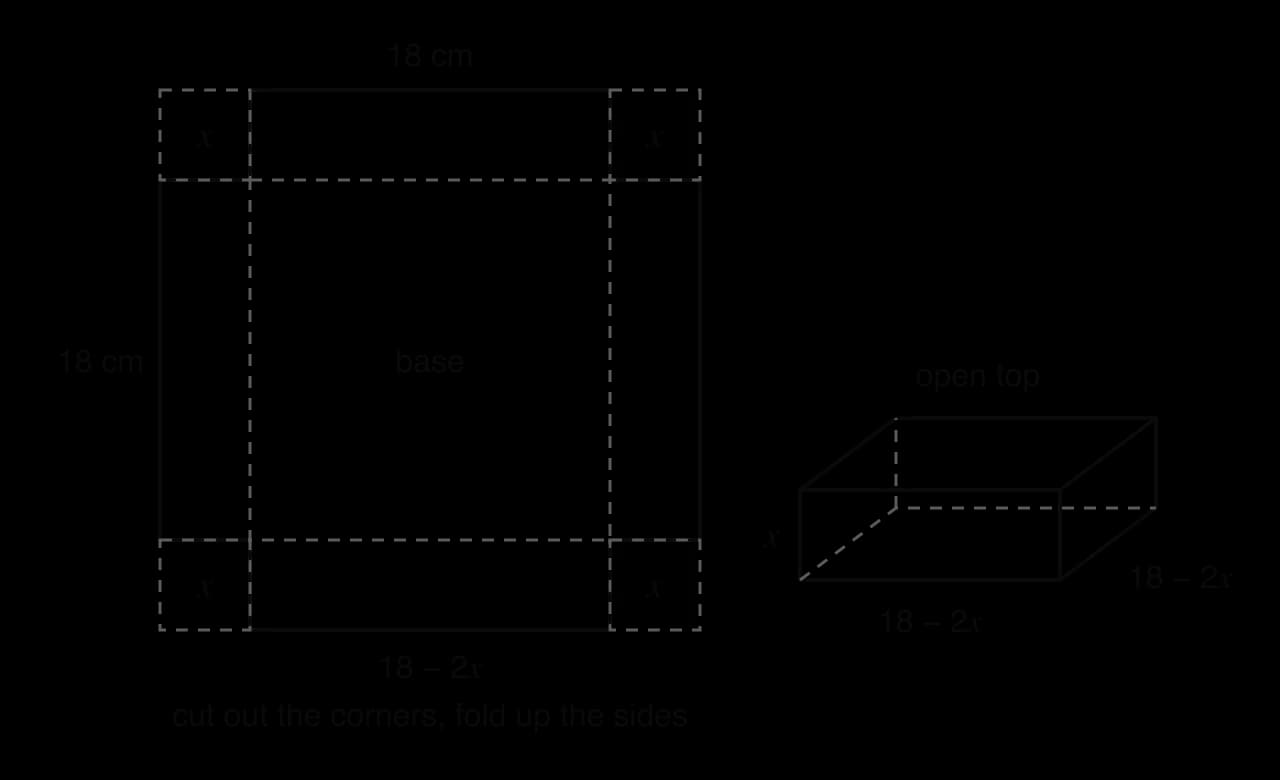
An open box can be made from a square sheet by cutting equal squares from the corners and folding up the sides. Cutting larger squares makes the box deeper but its base smaller, so there is a best size for the cut. The net and the folded box show how each dimension of the box depends on the side x of the squares removed.
Cutting a square of side x from each corner leaves a base of side 18 − 2x; folding up the flaps gives a box of height x.
YouTube
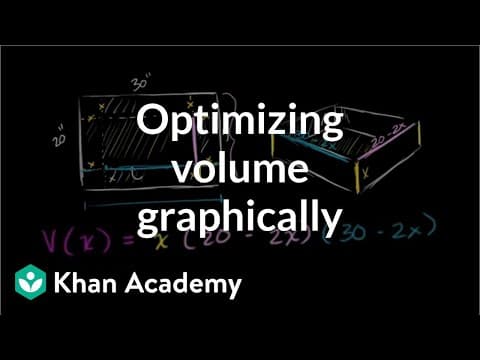
Khan Academy, “Optimization: box volume (Part 1)”: watch how the volume of a box folded from a rectangular sheet is written in terms of the corner cut, before the maximum is found.
The video sets up the box from a rectangular sheet, where the base is a rectangle rather than a square; the volume is still the product of the height x and the two base dimensions, each reduced by 2x.
When the optimum is at an end of the domain
The solution of derivative =0 gives the best value only if it lies inside the allowed values. A further practical condition can shrink the domain so that the stationary point falls outside it. The function is then increasing (or decreasing) throughout the domain, and the optimum is at an end point.
A box with a fixed volume
When the volume is fixed and the amount of material is to be minimised, the constraint produces a term with x in the denominator. The objective function then contains a negative integer power of x, which is rewritten before differentiating, exactly as for stationary points in subtopic 5.6.
The graph of S=x2+x2000 has a different shape from the area parabola of the fencing problem. As x approaches 0 the box becomes a tall, thin tube whose sides need a great deal of card, so S grows without limit; as x grows, the base itself becomes large. Between the two extremes there is a single minimum.
S = x² + 2000/x
Too narrow a base needs tall sides and too wide a base needs a large floor; the surface area is least, 300 cm², when x = 10 cm.
Justifying a maximum or minimum
A solution of derivative =0 is a stationary point, but it is not automatically the answer to the problem: it might be a minimum when a maximum is wanted, or a local maximum that is beaten at an end of the domain. Three kinds of justification are used.
Sign of the derivative either side (the first derivative test of subtopic 5.6). Choose one value of the variable on each side of the stationary point, inside the domain, and show the change of sign.
A graph of the objective function, or of its derivative, from the GDC, sketched with the stationary point labelled and the domain shown.
The shape of the function across the whole domain. If the stationary point is the only one inside the domain and the derivative is positive before it and negative after it, it is the global maximum on the domain; the same reasoning with the signs reversed gives a global minimum.
When the domain is closed, as in 0≤x≤2, the values at the end points must also be compared with the value at the stationary point.
Using the GDC
The GDC is useful at three points in the method. It can solve the equation derivative =0 when it does not factorise (the polynomial root finder, or the zero of the graph of the derivative). It can draw the objective function, so that the maximum or minimum tool confirms the answer. And it can evaluate the objective function at the optimum without rounding the input.
Optimisation in business and economics
Money problems use the cost function C(x), the revenue function R(x) and the profit function P(x)=R(x)−C(x), where x is the number of items made and sold. The objective function is often given directly. When it is not, it has to be built from information in words, for example from how the number of sales depends on the price.
Choosing a price
The same idea can be read in terms of rates. The derivative of the cost function is the marginal cost, the approximate cost of making one more item, and the derivative of the revenue function is the marginal revenue. Since P(x)=R(x)−C(x), the condition P′(x)=0 is the same as R′(x)=C′(x).
P′(x)=R′(x)−C′(x)=0⟺R′(x)=C′(x)
Minimising average cost
The average cost per item is the total cost divided by the number of items, xC(x). Fixed costs, such as rent or machinery, are shared over more items as production rises, but other costs can grow faster than production, so the average cost has a least value. Dividing by x creates a negative power, so the problem is solved like the fixed-volume box.
Whole-number answers
When the variable counts something that cannot be split, such as items, people or price rises, the solution of derivative =0 may not be a whole number. The optimal whole number is then one of the two integers either side of the solution, and the objective function is evaluated at both to see which is better. The nearest integer is not always the right choice, and a context may also force rounding in one direction, for example when a minimum number of items must be met.
Case study: the shape of a drink can
In North America the standard drink can holds 355 ml (12 US fluid ounces). It is 12.3 cm high, 6.60 cm in diameter at the widest point of its body, and narrows to 5.41 cm at the lid. The same optimisation method shows what shape of closed cylinder would hold 355 ml with the least metal, and how far the real can is from it.
Source of the can dimensions: Wikipedia, "Drink can", accessed 2026.
The least-material cylinder
Model the can as a closed cylinder of radius r cm and height h cm with volume 355 cm³ (1 ml = 1 cm³). The constraint is πr2h=355, so h=πr2355. The surface area consists of two circles and the curved surface:
Then h=π(3.837…)2355=7.674… cm, and the least surface area is A=277.5 cm² (4 s.f.). The derivative is negative for smaller r and positive for larger r, so this is the minimum. The height is exactly twice the radius: substituting 355=πr2h into r3=4π710 gives 4πr3=2πr2h, so h=2r. The least-material closed cylinder is as tall as it is wide, whatever its volume.
Comparing the model with the real can
The real can is much taller and narrower than this: its height is about 1.86 times its widest diameter, against 1 for the model. A cylinder of the real can's widest radius, 3.30 cm, holding 355 cm³ would be 10.4 cm tall and would need 283.6 cm² of metal, only 2.2% more than the minimum. The graph of the surface area against the radius explains why: near the minimum the curve is very flat, so a fairly large change of shape costs very little extra material.
A = 2πr² + 710/r
The surface area of a 355 cm³ closed cylinder is least when r = 3.84 cm; at the real can's radius of 3.30 cm it is only 2.2% more, because the curve is flat near its minimum.
The model leaves out several things that matter to a can maker. A narrow can is easier to hold in one hand, and a tall can shows a larger label. The real can is not a cylinder: it narrows at the top so that the lid is only 5.41 cm across, and the lid is stamped separately from a different aluminium alloy. If the ends cost more per square centimetre than the wall, the best shape changes. Suppose the metal for the two ends costs k times as much per cm² as the metal for the wall. Then the cost is proportional to
C=2kπr2+r710,drdC=4kπr−r2710=0⇒r3=2kπ355
and the same substitution as before gives h=2kr: the ratio of height to diameter is exactly k. The real can's ratio of about 1.86 would be the optimum if the ends cost about 1.86 times as much per cm² as the wall. The refined model does not prove that this is why cans look as they do, but it shows how adding one realistic feature to a model moves its optimum towards the real design.
Packaging is also a question of public policy, because the material saved or wasted in billions of containers adds up. Governments sometimes change the costs that shoppers and shops face in order to change what is optimal for them.
Source of the carrier bag figures: UK Department for Environment, Food and Rural Affairs, "10p bag charge turns the tide on plastic waste", 29 July 2022.
Exam focus
Optimisation is one of the most predictable question types on the SL papers. It usually appears as a structured Paper 2 question worth 12–17 marks, or as a shorter Paper 1 question of 6–8 marks. The parts follow the method in order: write down or form the constraint; show that the quantity equals a given objective function (AG); find the derivative; hence or "using your answer to (c)" find the optimal value of the variable; find the optimal value of the quantity; then a final part that applies the answer (a cost, a second shape) or asks the candidate to explain a limitation of the model.
The "show that" parts let candidates re-enter: even without the constraint, the given objective function can be differentiated. Markschemes award (M1) for setting the derivative equal to zero, (A1) for the value of the variable, (M1) for substituting it into the objective function (not the derivative) and (A1) for the optimal value; an unsupported answer from a graph earns nothing when the derivative is required. The interpretation part rewards a specific reason linked to the context, such as gaps between packed objects or the thickness of the material, not a vague "the model is not accurate".
The question shows how the parts depend on each other. A candidate who cannot do part (b) can still use the given S in parts (c) to (f), and the cost in part (g) follows through from an incorrect area.
YouTube
Revision Village, “Turning Points (Max/Min, Optimization) [IB Math AI SL/HL]”: watch how exam-style questions set the derivative equal to zero, solve with the GDC where needed, and present the optimal value.
Typical extensions to watch for include a parameter left in the objective function ("find the maximum profit in terms of k"), a second constraint that limits the domain so the optimum is at an end point, a whole-number variable (compare the integers either side), and a final "comment on the model" part. Premature rounding is a common way to lose the last mark: keep the unrounded value of x in the GDC and substitute that, not its 3 significant figure version.
Practice questions
Two positive numbers x and y satisfy x+y=20. Find the greatest possible value of x2y. [5]
A farmer has 200 m of fencing to make a rectangular pen of width x m and length y m, divided into two equal parts by an extra fence parallel to the width. Show that the area is A=100x−1.5x2, and find the maximum area. [6]
An open-topped box has a square base of side x cm and a volume of 256 cm³. Show that its surface area is S=x2+x1024, and find the dimensions that minimise S
An open tank has a square base of side x m and height h m, and is made from 75 m² of sheet metal. Show that its volume is V=475x−x3
A closed cylindrical tin holds 1000 cm³. Find the radius and height that use the least metal, and the least surface area, correct to 3 significant figures. [7]
An open box is made from a rectangular sheet 16 cm by 10 cm by cutting squares of side x cm from the corners. Find the value of x that maximises the volume, and the maximum volume. Justify your answer. [7]
A theatre sells 900−30p tickets at a price of p dollars. Each ticket costs the theatre $6 to provide. Find the price that maximises the profit, and the maximum profit. [6]
The weekly cost of producing x bicycles is C(x)=2x2+50x+1800 dollars. Find the number of bicycles that minimises the average cost per bicycle, and that average cost. [6]
The point P(x,x2) lies on the curve y=x2. Let D be the distance from P
Optimisation finds the value of a variable that makes a quantity a maximum or a minimum, within the conditions of the context.
The objective function is the quantity to optimise, written in one variable; the constraint is the fixed condition used to eliminate the other variables.
The method: draw and label, write the quantity and the constraint, eliminate to one variable, state the domain, differentiate, solve derivative =0, keep solutions in the domain, justify, calculate the optimal value, answer in context.
Terms such as x2000 are rewritten as 2000x−1 before differentiating; multiplying by a power of x clears fractions in derivative =0.
A maximum or minimum is justified by the sign of the derivative on both sides or by a labelled graph; if the domain is closed, the end points are checked too, and the optimum may be at an end point.
Profit is greatest where P′(x)=0, equivalently where marginal revenue equals marginal cost; average cost is xC(x)
Whole-number variables are tested at the integers either side of the solution, and the units of the variable (such as thousands) are applied to the final answer.
The least-material closed cylinder of any volume has h=2r; real designs differ because models leave out practical features, which is a point to comment on.
Self-check
To do:
I can identify the quantity to optimise and the constraint in a problem written in words.
To do:
I can draw and label a diagram with the variables and their units.
To do:
I can rearrange a constraint and substitute to write the objective function in one variable.
To do:
I can work forwards to a given objective function in a "show that" question.
To do:
I can choose the correct surface area or volume formula, including open boxes and cylinders without lids.
To do:
I can state the values of the variable that make sense in the context.
To do:
I can differentiate an objective function with negative powers of the variable.
To do:
I can solve derivative =0 by hand or with the GDC and reject solutions outside the domain.
To do:
I can justify a maximum or minimum with the sign of the derivative on both sides.
To do:
I can recognise when the optimum is at an end of the domain.
To do:
I can substitute into the objective function, not the derivative, to find the optimal value.
To do:
I can build a profit or revenue function from information about prices and sales.
To do:
I can find the least average cost per item.
To do:
I can choose the best whole-number answer by comparing the integers either side.
To do:
I can comment on why a model's optimal design differs from a real one.
Write down the set of possible values of x for which the model is valid.
[2]2 marks
Markscheme (b)
0<x<12.5A1A1
Note: One mark for each correct end point with correct inequality signs. Accept 0<x≤12.5.
[2 marks]
(c)
Find the maximum volume of the box and the value of x that gives it.
[3]3 marks
Markscheme (c)
sketch of V with maximum point indicated ORdxdV=0(M1)
x=5 (cm) A1
V=2250 (cm³) A1
[3 marks]
Question 2 · AI-00154HL only · 17 marks
Inés uses a rotating sprinkler to water a lawn. The sprinkler waters a region in the shape of a sector of a circle with radius r m and angle θ radians.
Inés first sets the sprinkler so that r=12 and θ=2.3.
(a)
Find the area of lawn watered.
[2]2 marks
(b)
Find the perimeter of the watered region.
[2]2 marks
(c)
Write down the value of θ in degrees.
[1]1 mark
(d)
Inés now plans a new flower bed in the shape of a sector with radius r m and angle θ radians. The area of the flower bed must be 90 m2.
Show that θ=r2180
(e)
The whole perimeter of the flower bed will be edged with metal strip. Show that the length of strip needed, P m, is given by
P=2r+r180.
[2]2 marks
(f)
Find drdP.
[2]2 marks
(g)
Hence find the value of r that minimizes P, and the minimum length of strip needed.
[3]3 marks
(h)
Find the corresponding value of θ.
[1]1 mark
(i)
The metal strip costs 14.50 euros (EUR) per metre. Find the minimum cost of the strip. Give your answer correct to two decimal places.
Kenji makes conical paper cups. For each cup he cuts a sector with radius 20 cm and angle θ radians from a sheet of paper, then joins the two straight edges, with no overlap, to form an open cone with slant height 20 cm.
Kenji first uses θ=4.2.
(a)
Find the length of the arc of the sector.
[2]2 marks
(b)
Show that the radius of the base of the cone is 13.4 cm, correct to three significant figures.
[2]2 marks
(c)
Find the height of the cone.
[2]2 marks
(d)
Find the volume of the cup.
[2]2 marks
(e)
Find the area of the curved surface of the cup.
[2]2 marks
(f)
Kenji now considers other values of θ, where 0<θ<2π.
Show that the volume of the cup, V cm3, is given by
V=3π100θ2400−π2100θ2.
(g)
Find the value of θ that gives the greatest volume, and this greatest volume.
Setting dxdV=0 gives x=3 or x=9. The value x=9 is rejected: it is outside the domain (the base would have side 0).
Justification: at x=2, dxdV=12(−1)(−7)=84>0; at x=4, dxdV=12(1)(−5)=−60<0. The derivative changes from positive to negative, so x=3 gives a maximum.
V=3×(18−6)2=3×144=432.
Cutting 3 cm squares gives the maximum volume, 432 cm³: a box 12 cm by 12 cm by 3 cm.
is a product of two negative factors and 12, so it is positive throughout: the volume increases all the way to the end of the domain.
.
.
The box has a base (x2) and four sides, each x by h, and no top:
S=x2+4xh=x2+4x⋅x2500=x2+x2000
(b) Writing S=x2+2000x−1:
dxdS=2x−2000x−2=2x−x22000
(c) Set the derivative to zero and multiply by x2 (x>0):
2x−x22000=0⇒2x3=2000⇒x3=1000⇒x=10
Then h=102500=5. The box is 10 cm by 10 cm by 5 cm.
Justification: dxdS=16−31.25=−15.25<0 at x=8 and 24−13.89=10.11>0 at x=12, so the derivative changes from negative to positive: a minimum.
(d) S=102+102000=100+200=300 cm².
The open box with least surface area is twice as wide as it is deep, and uses 300 cm² of material.
. The base costs
3×πr2
and the wall costs
1×2πrh
:
C=3πr2+2πr⋅πr220000=3πr2+r40000
(b) drdC=6πr−r240000.
GDC working. Graph y=6πx−40000/x2 for 0<x≤30 and use the zero tool: r=12.8504… (By hand, r3=6π40000 gives the same value.)
Justification: drdC=−51.6<0 at r=12 and 59.8>0 at r=14: a minimum.
h=π(12.8504…)220000=38.551…, and C=3π(12.8504…)2+12.8504…40000=4669.08… cents.
The cheapest bin has radius 12.9 cm and height 38.6 cm, and its material costs $46.69. Because the base material is dearer, the cheapest bin is tall and narrow: its height is three times its radius.
(b) dpdP=−40p+700=0, so p=17.5.
Justification: dpdP=20>0 at p=17 and −20<0 at p=18: a maximum.
P(17.5)=(17.5−5)(600−350)=12.5×250=3125.
The best price is $17.50, giving a weekly profit of $3,125.
(c) 600−20(17.5)=250 cases a week.
A higher price earns more on each case but loses customers; at $17.50 the two effects balance.
(b) A′(x)=0.5−x2800. Setting this to zero:
0.5=x2800⇒x2=1600⇒x=40(x>0)
Justification: A′(30)=0.5−0.889=−0.389<0 and A′(50)=0.5−0.32=0.18>0: a minimum.
A(40)=20+20+40800=60.
Making 40 chairs a week gives the least average cost, $60 per chair.
(b) dndR=40−30n=0, so n=34=1.33…
(c) n must be a whole number, so compare the integers either side:
n
Price
Rooms booked
Revenue
1
$125
77
$9,625
2
$130
74
$9,620
The greatest revenue is $9,625 a night, at a price of $125 (one increase). The value n=1.33 would give $9,626.67, but no price step achieves it.
(=4x2+6xh)
M1
h=2x2576=x2288A1
S=4x2+6x⋅x2288=4x2+x1728AGA1
The AG line must be seen for the final A1. Do not award marks for substituting a value of x to check the result.
(c) dxdS=8x−x21728A1A1
Award A1 for 8x, A1 for −1728x−2 in any form.
(d) 8x−x21728=0M1
x=6A1
Award M1 for equating their derivative to zero, or for a labelled sketch of their dxdS with its zero shown. Graphing S is not an acceptable method here. An unsupported x=6 earns no marks.
(e) EITHER S′(5)=−29.1<0 and S′(7)=20.7>0R1
OR a labelled sketch of S with the minimum at x=6R1
so the gradient changes from negative to positive: a minimum A1
Do not award R0A1.
(f) h=36288=8(A1)
box 6 cm by 12 cm by 8 cm A1
S=4(36)+61728=432 cm² A1
(g) 432 cm2=0.0432 m2; 5000×0.0432×2.50(M1)
=540, so $540 A1
(h) The boxes need flaps or overlaps to be glued, and card is wasted when the nets are cut from sheets R1
Accept any one valid practical reason linked to making the box. Do not accept "the model is an approximation" alone.
Total [16]
. [7]
, and
hence
find
the maximum volume. [7]
to the point
(0,3)
. (a)
Show that
D2=x4−5x2+9
. [2] (b)
Find
the least distance from the curve to
(0,3)
, and
explain
why minimising
D2
gives the same point as minimising
D
. [6]
.
A′=100−3x=0⇒x=33.3
m,
y=50
m; maximum area
1666.6≈1670
m².
.
S′=2x−x21024=0⇒x3=512⇒x=8
;
h=4
. Box 8 cm by 8 cm by 4 cm (
S=192
cm²;
S′(7)<0<S′(9)
).
,
V=x2h=475x−x3
.
V′=475−3x2=0⇒x=5
(reject
−5
),
h=2.5
;
V′(4)>0>V′(6)
, so maximum volume 62.5 m³.
,
r=5.42
cm,
h=10.8
cm (
h=2r
),
A=554
cm².
,
0<x<5
.
V′=12x2−104x+160=4(3x−20)(x−2)=0⇒x=2
(reject
320
, outside the domain).
V′(1)=68>0
,
V′(3)=−44<0
: maximum.
V=2×12×6=144
cm³.
;
P′=−60p+1080=0⇒p=18
. Price $18; profit
12×360=4320
, so $4,320.
. 30 bicycles; average cost
60+50+60=170
, so $170 per bicycle.
. (b)
dxd(D2)=4x3−10x=2x(2x2−5)=0⇒x=0
or
x=±2.5
.
D2=9
at
x=0
(local maximum) and
D2=2.75
at
x=±1.58
(minima). Least distance
2.75=1.66
(3 s.f.), at
(±1.58,2.5)
. Since
D≥0
, a smaller
D2
always means a smaller
D
, so both are least at the same
x
;
D2
is a polynomial and can be differentiated with the power rule.