5.10 The second derivative questions for IB Maths AI
31 questions on The second derivative, written by Augment in the style of IB exam papers. Six of them are below in full, to answer on paper.
- IB Mathematics: Applications and Interpretation
- Part of 5 Calculus
- HL only
Questions by paper and level
| Paper | Questions |
|---|---|
| Paper 1 | 14 |
| Paper 2 | 15 |
| Paper 3 | 2 |
| Every paper | 31 |
Counted on
Questions to try
Written by Augment in the style of IB exams, not past papers. Answer them on paper, then check each one against its markscheme with a free account.
A rumour spreads through a school of 1200 students. The number of students who have heard the rumour, , hours after it starts is modelled by
- (a)
Find the number of students who have heard the rumour after 6 hours.
2 marks
- (b)
Find the time at which the rumour is spreading most quickly, and write down the number of students who have heard the rumour at that time.
3 marks
- (c)
Explain why a logistic model is more suitable than an exponential model in this context.
1 mark
A city council introduces a rental scheme for electric scooters. The number of registered users of the scheme, , years after it starts, is modelled by
where and are positive constants. When the scheme starts there are 2500 registered users and after 3 years there are 14 000.
- (a)
Write down the number of registered users that the model predicts in the long term.
1 mark
- (b)
Show that .
2 marks
- (c)
Find the value of .
3 marks
- (d)
Find the number of registered users predicted after 6 years.
2 marks
- (e)
Show that .
3 marks
- (f)
Find the time at which the number of registered users is increasing most rapidly, and the rate of increase at that time.
3 marks
- (g)
The council claims that the scheme will have more than 90 000 registered users in the long term. Comment on this claim.
1 mark
This question uses calculus to design how a tram accelerates and brakes between two stops.
A tram travels in a straight line between two stops, starting and finishing at rest. Its velocity, m s−1, is recorded every 10 seconds during one journey of 80 seconds.
(s) | 0 | 10 | 20 | 30 | 40 | 50 | 60 | 70 | 80 |
|---|---|---|---|---|---|---|---|---|---|
(m s−1) | 0 | 1.5 | 4.7 | 9.1 | 12.6 | 15.1 | 14.2 | 9.9 | 0 |
- (a)
Use the trapezoidal rule with all the values in the table to estimate the distance between the two stops.
3 marks
- (b)(i)
The tram company's engineer, Mireille, models the velocity by
Find the distance between the stops according to this model.
2 marks
- (b)(ii)
Find the percentage difference between your answer to part (a) and your answer to part (b)(i), taking the value in part (b)(i) as the true value.
2 marks
- (c)
Use differentiation to find the maximum velocity of the tram according to Mireille's model.
3 marks
- (d)
Find the maximum acceleration of the tram according to the model, and the time at which it occurs.
3 marks
- (e)
For passenger comfort, the magnitude of the acceleration of a tram must never exceed 1.3 m s−2.
Show that Mireille's model satisfies this condition.
2 marks
- (f)
Find the time at which the tram has travelled half of the distance between the stops.
3 marks
- (g)(i)
On a new route, two stops are 900 m apart. Mireille uses a model of the same form,
where seconds is the journey time and is a positive constant.
Show that .
3 marks
- (g)(ii)
Show that the greatest magnitude of the acceleration during the journey is .
3 marks
- (g)(iii)
Hence find the shortest journey time on the new route that satisfies the comfort condition in part (e).
2 marks
- (g)(iv)
Find the maximum velocity of the tram on this journey.
2 marks
- (h)
State one reason why Mireille's model may not be suitable for the new route.
1 mark
The mass, grams, of a broiler chicken weeks after hatching is modelled by the Gompertz function
- (a)
Find the mass of a chick when it hatches.
1 mark
- (b)
Write down the mass that the chicken approaches in the long term, according to the model.
1 mark
- (c)
Find the age of the chicken when its mass reaches 2 kg.
2 marks
- (d)
Find the age of the chicken when it is gaining mass most quickly, and its mass at that time.
3 marks
A logistics company in Seoul models the cost, thousand Korean won (KRW) per kilometre, of flying a cargo drone at a constant speed of km h⁻¹ by
- (a)
Show that .
2 marks
- (b)
Find the cost per kilometre when the drone flies at 20 km h⁻¹.
1 mark
- (c)
Find .
3 marks
- (d)
Use your answer to part (c) to show that the cost per kilometre is least when .
4 marks
- (e)
Find and hence justify that gives a minimum.
3 marks
- (f)
Find the minimum cost of a 45 km delivery flight. Give your answer to the nearest thousand KRW.
2 marks
The purpose of this question is to find the cheapest design for a grain silo, first without and then with a planning restriction.
A farming cooperative plans to build a grain silo in the shape of a cylinder of radius metres and height metres, with a hemispherical roof of radius metres, as shown in the following diagram.
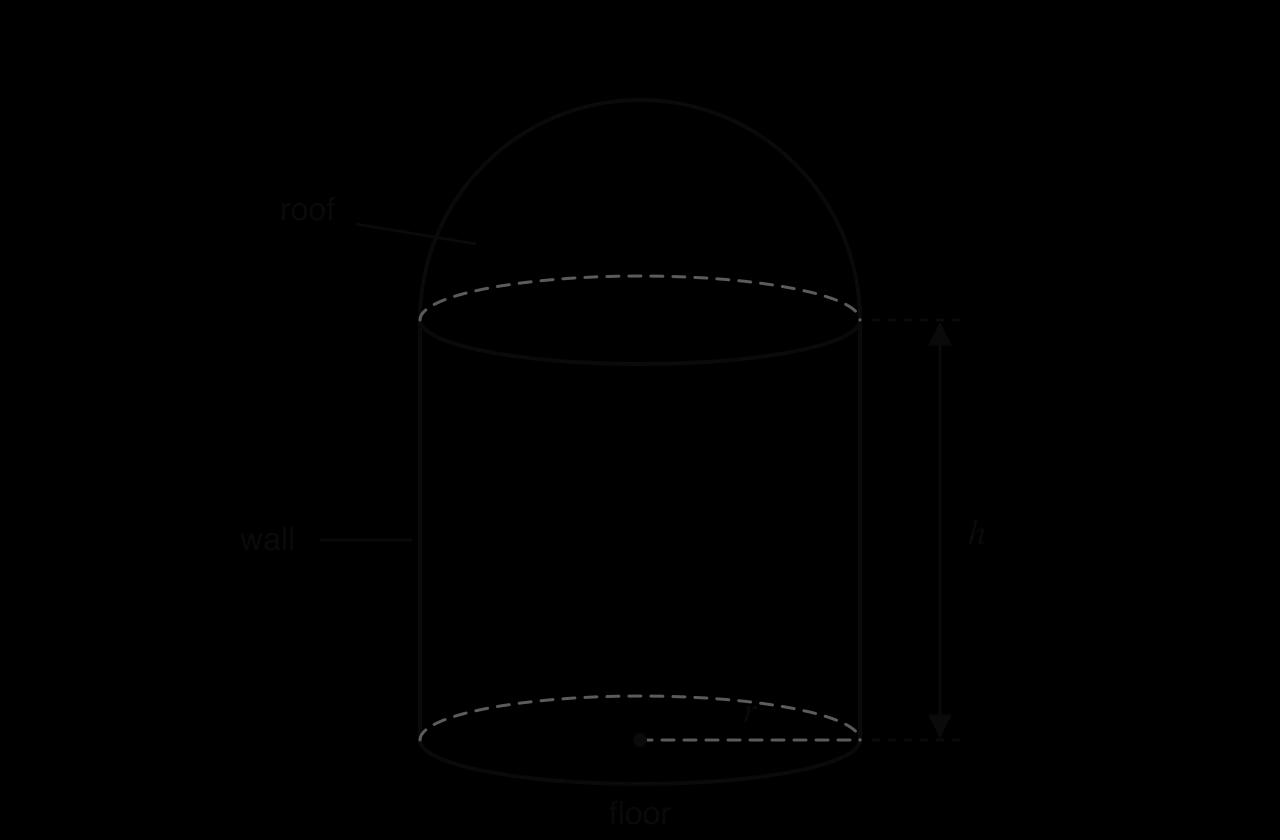
The silo must hold of grain. The building costs are 40 US dollars (USD) per m² for the circular floor, 60 USD per m² for the curved wall and 90 USD per m² for the hemispherical roof.
- (a)
Show that .
3 marks
- (b)
Show that the total cost, USD, of building the silo is given by
3 marks
- (c)
Explain why the model is only valid for .
2 marks
- (d)
Find .
2 marks
- (e)
Find the value of and the value of that minimize the cost, and find this minimum cost to the nearest dollar.
4 marks
- (f)
Use the second derivative to justify that this value of gives a minimum cost.
2 marks
- (g)(i)
A local planning regulation states that the total height of the silo, including the roof, must not exceed 9 m.
Show that the radius must satisfy .
1 mark
- (g)(ii)
Find the least value of that satisfies the regulation.
2 marks
- (g)(iii)
Explain why the cheapest silo that satisfies the regulation has the radius found in part (g)(ii), and find its cost to the nearest dollar.
3 marks
- (g)(iv)
Find the percentage increase in the minimum cost caused by the regulation.
2 marks
- (h)
Suggest one further cost that the cooperative should include in the model before deciding on the radius of the silo.
1 mark
Practice all 31 in Augment
Free with an account. Every question has its markscheme, and Augment keeps the ones you got wrong so you can come back to them.
More questions in Calculus
- 5.1Limits and the derivative
- 5.2Increasing and decreasing functions
- 5.3Differentiating polynomials
- 5.4Tangents and normals
- 5.5Introduction to integration
- 5.6Stationary points
- 5.7Optimisation
- 5.8The trapezoidal rule
- 5.9Further differentiation
- 5.10The second derivativeThis page
- 5.11Further integration
- 5.12Areas and volumes
- 5.13Kinematics
- 5.14Setting up differential equations
- 5.15Slope fields
- 5.16Euler’s method
- 5.17Phase portraits
- 5.18Second-order differential equations
Check your answers in Augment
A free account opens all 31 questions on The second derivative with their markschemes, and keeps a record of what you have marked.