5.15 Slope fields questions for IB Maths AI
18 questions on Slope fields, written by Augment in the style of IB exam papers. Six of them are below in full, to answer on paper.
- IB Mathematics: Applications and Interpretation
- Part of 5 Calculus
- HL only
Questions by paper and level
| Paper | Questions |
|---|---|
| Paper 1 | 10 |
| Paper 2 | 8 |
| Every paper | 18 |
Counted on
Questions to try
Written by Augment in the style of IB exams, not past papers. Answer them on paper, then check each one against its markscheme with a free account.
The following diagram shows the slope field for the differential equation
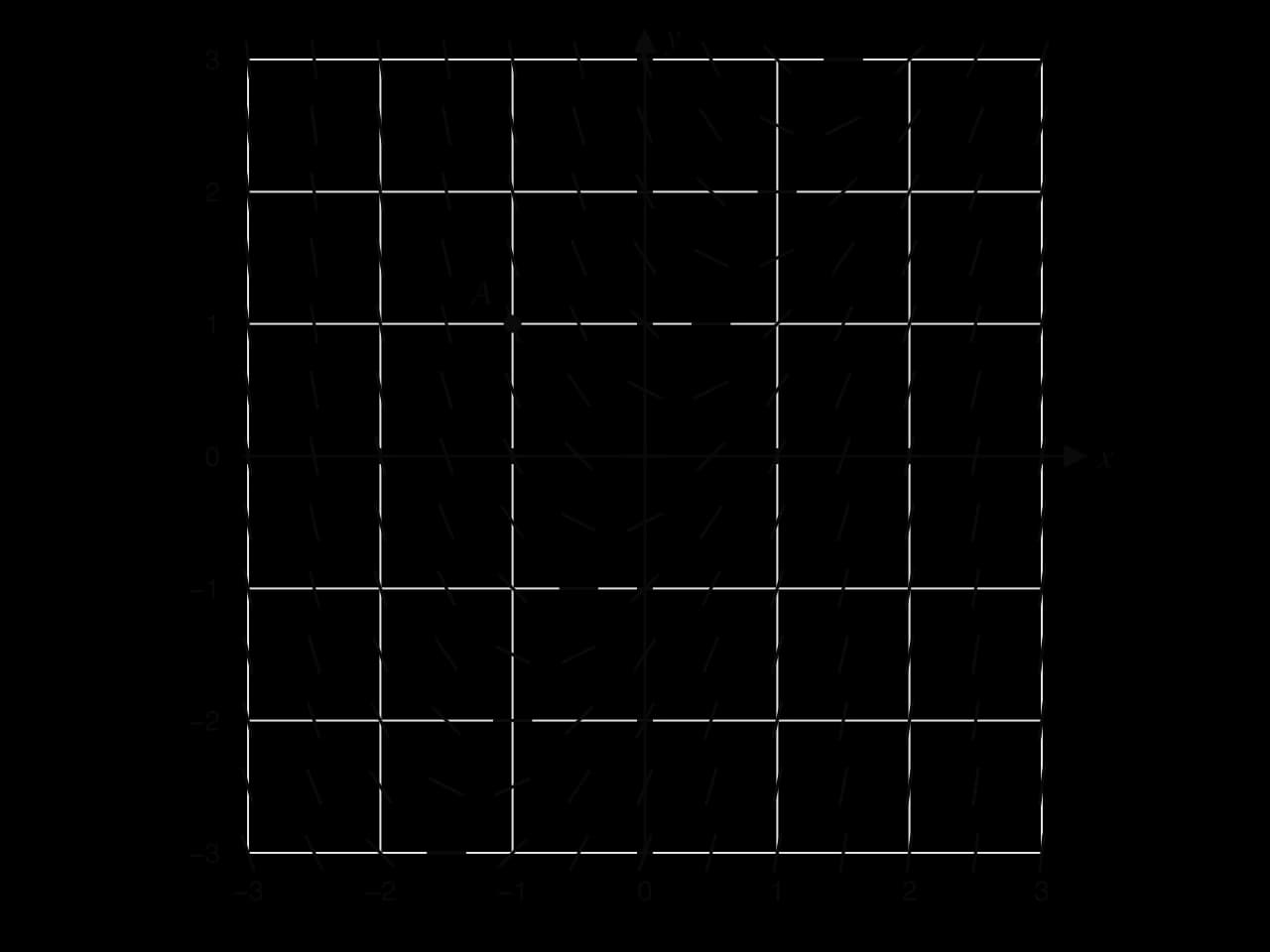
The point lies on one of the solution curves.
- (a)
Find the equation of the tangent to this solution curve at . Give your answer in the form , where .
2 marks
- (b)
On the diagram, sketch the solution curve that passes through .
2 marks
- (c)
Write down the equation of the line on which every solution curve has a gradient of zero.
1 mark
- (d)
Show that is a solution of the differential equation.
2 marks
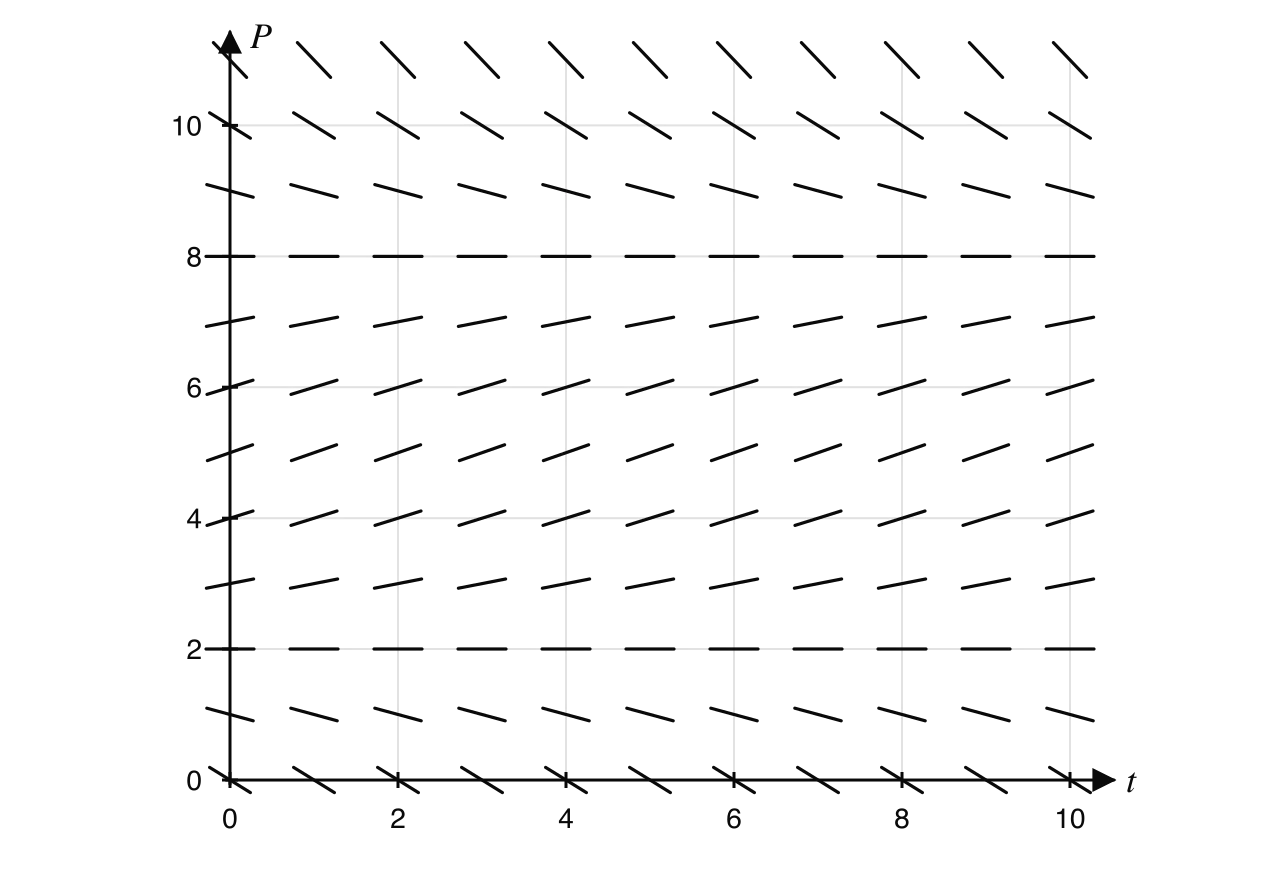
A fishery manager models the number of fish in a lake, thousand, years after the start of a fishing programme. The fish reproduce, and 800 fish are caught each year. The model is
The slope field for this differential equation is shown in the following diagram.
- (a)
Show that the equilibrium solutions are and .
3 marks
- (b)
State, with a reason, which of these equilibrium solutions is stable.
2 marks
- (c)
On the diagram, sketch the solution curves for which the initial number of fish is
(i) 1000;
(ii) 4000;
(iii) 10 000.3 marks
- (d)
The lake initially contains 4000 fish. Use Euler's method with a step length of 0.5 to estimate the number of fish after 2 years.
4 marks
- (e)
The manager wants to increase the number of fish caught each year to thousand, with the model . Find the largest value of for which the model still has an equilibrium solution with .
3 marks
- (f)
Explain why catching exactly this number of fish each year would be risky for the fishery.
1 mark
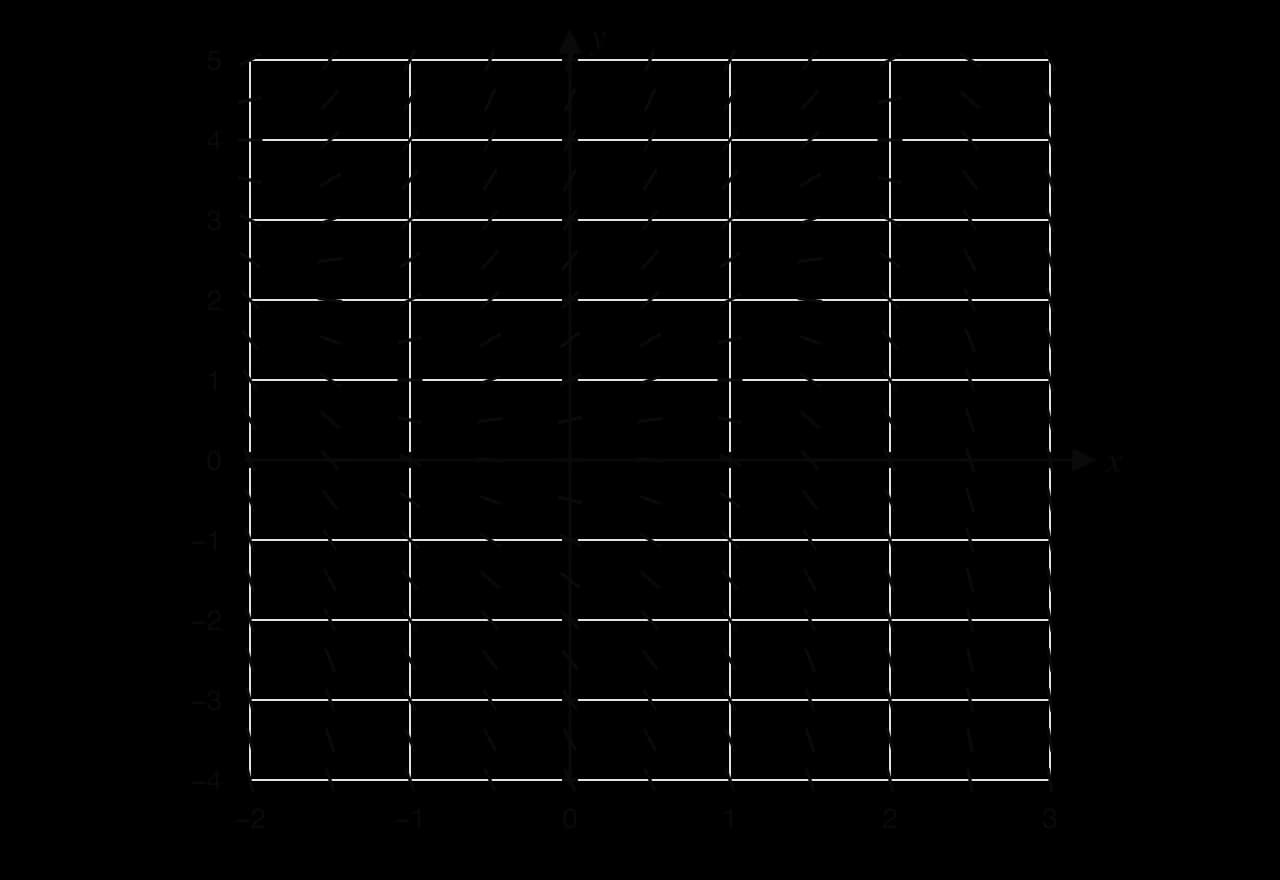
The following diagram shows the slope field for the differential equation
- (a)(i)
Write down the equation of the curve on which every local maximum and local minimum of the solution curves lies.
1 mark
- (a)(ii)
Sketch this curve on the diagram.
1 mark
- (b)
On the diagram, sketch the solution curve that passes through the point .
2 marks
- (c)
The solution curve through has a turning point at which . Determine whether this turning point is a local maximum or a local minimum. Justify your answer.
2 marks
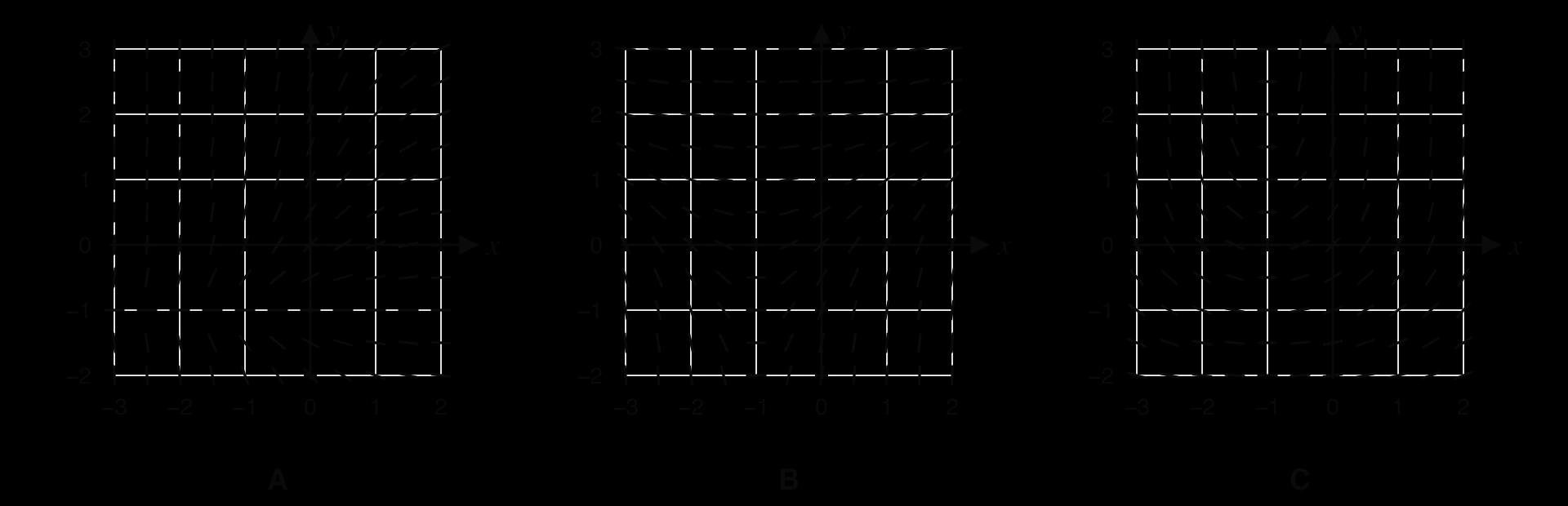
Consider the differential equation
The following diagrams show three slope fields.
- (a)
Identify which diagram, A, B or C, shows the slope field of this differential equation. Give a reason for your answer.
2 marks
- (b)
Solve the differential equation, given that when . Give your answer in the form .
6 marks
- (c)
Show that this solution is defined for all real values of .
2 marks
- (d)
Find the minimum value of on this solution curve.
2 marks
- (e)
Use Euler's method with a step length of 0.2 to estimate when , and find the percentage error in this estimate.
4 marks
The following diagrams show the slope fields of three differential equations.
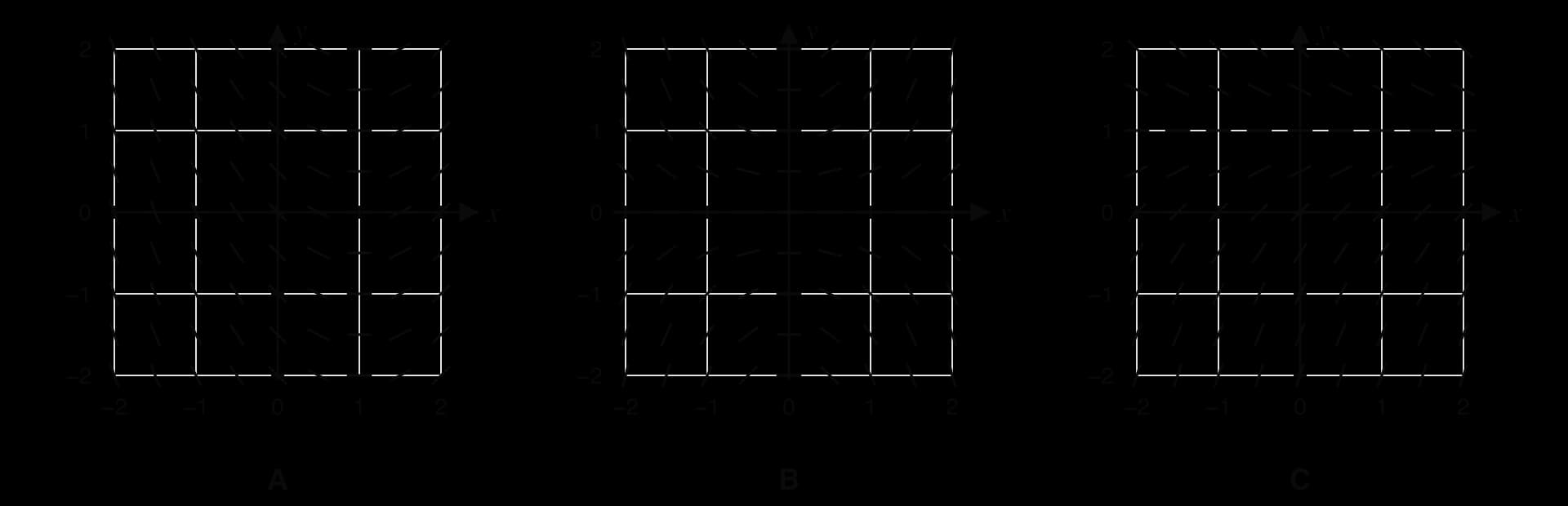
The three differential equations are
- (a)
Match each differential equation to its slope field. Give a reason for each choice.
3 marks
- (b)
For differential equation (I), write down the equilibrium solution and describe the long-term behaviour of every other solution.
2 marks
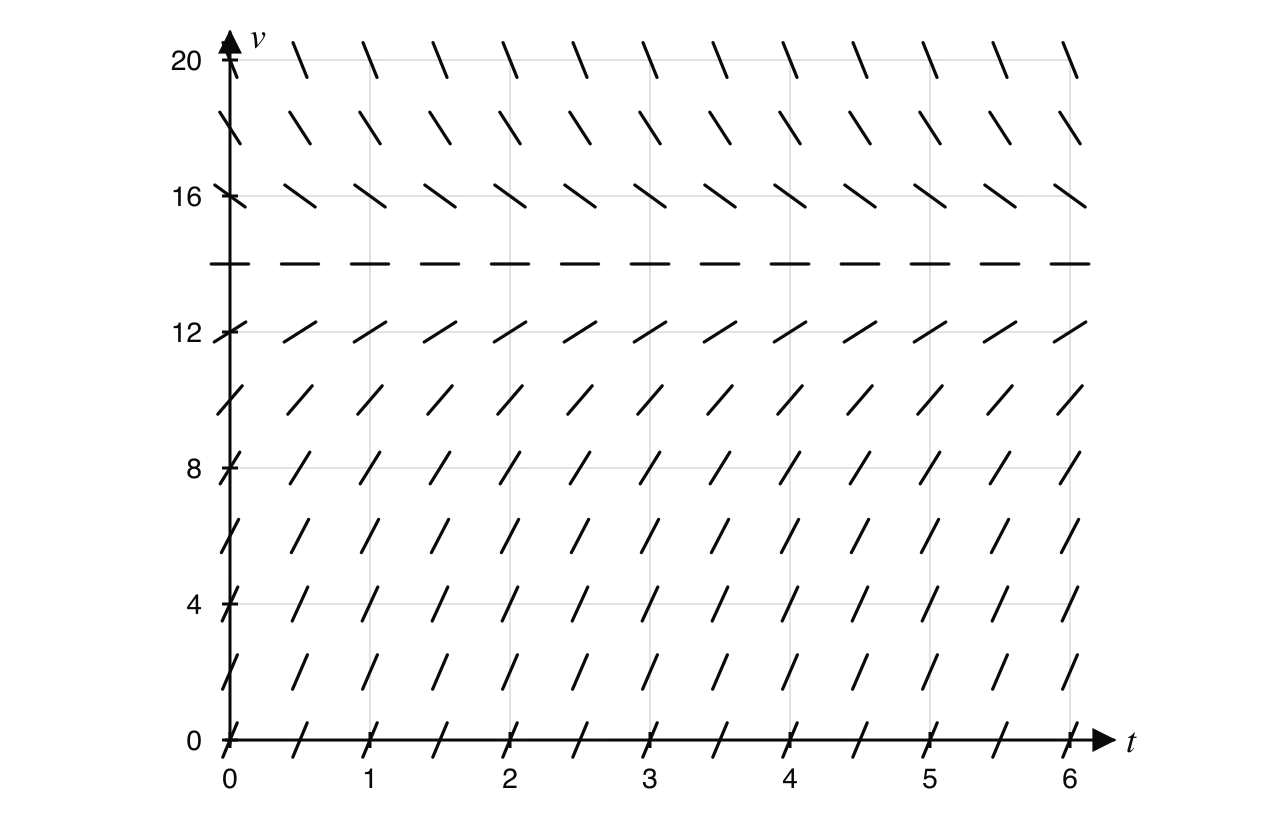
A skydiver jumps from a helicopter. Her velocity, m s⁻¹, seconds after she jumps, is modelled by the differential equation
The slope field for this differential equation is shown in the following diagram.
- (a)
Find her terminal velocity according to this model.
2 marks
- (b)
On the diagram, sketch the solution curve for the skydiver.
2 marks
- (c)
Use Euler's method with a step length of 0.5 to estimate her velocity after 2 seconds.
4 marks
- (d)
The exact solution of the differential equation is . Find the percentage error in your answer to part (c).
2 marks
- (e)
With reference to the slope field, explain why Euler's method overestimates her velocity.
2 marks
- (f)
Let metres be the distance she has fallen. Using , show that .
5 marks
- (g)
Find her velocity after she has fallen 50 m.
2 marks
Practice all 18 in Augment
Free with an account. Every question has its markscheme, and Augment keeps the ones you got wrong so you can come back to them.
More questions in Calculus
- 5.1Limits and the derivative
- 5.2Increasing and decreasing functions
- 5.3Differentiating polynomials
- 5.4Tangents and normals
- 5.5Introduction to integration
- 5.6Stationary points
- 5.7Optimisation
- 5.8The trapezoidal rule
- 5.9Further differentiation
- 5.10The second derivative
- 5.11Further integration
- 5.12Areas and volumes
- 5.13Kinematics
- 5.14Setting up differential equations
- 5.15Slope fieldsThis page
- 5.16Euler’s method
- 5.17Phase portraits
- 5.18Second-order differential equations
Check your answers in Augment
A free account opens all 18 questions on Slope fields with their markschemes, and keeps a record of what you have marked.