5.16 Euler’s method questions for IB Maths AI
50 questions on Euler’s method, written by Augment in the style of IB exam papers. Six of them are below in full, to answer on paper.
- IB Mathematics: Applications and Interpretation
- Part of 5 Calculus
- HL only
Questions by paper and level
| Paper | Questions |
|---|---|
| Paper 1 | 19 |
| Paper 2 | 27 |
| Paper 3 | 4 |
| Every paper | 50 |
Counted on
Questions to try
Written by Augment in the style of IB exams, not past papers. Answer them on paper, then check each one against its markscheme with a free account.
The following diagram shows the slope field for the differential equation
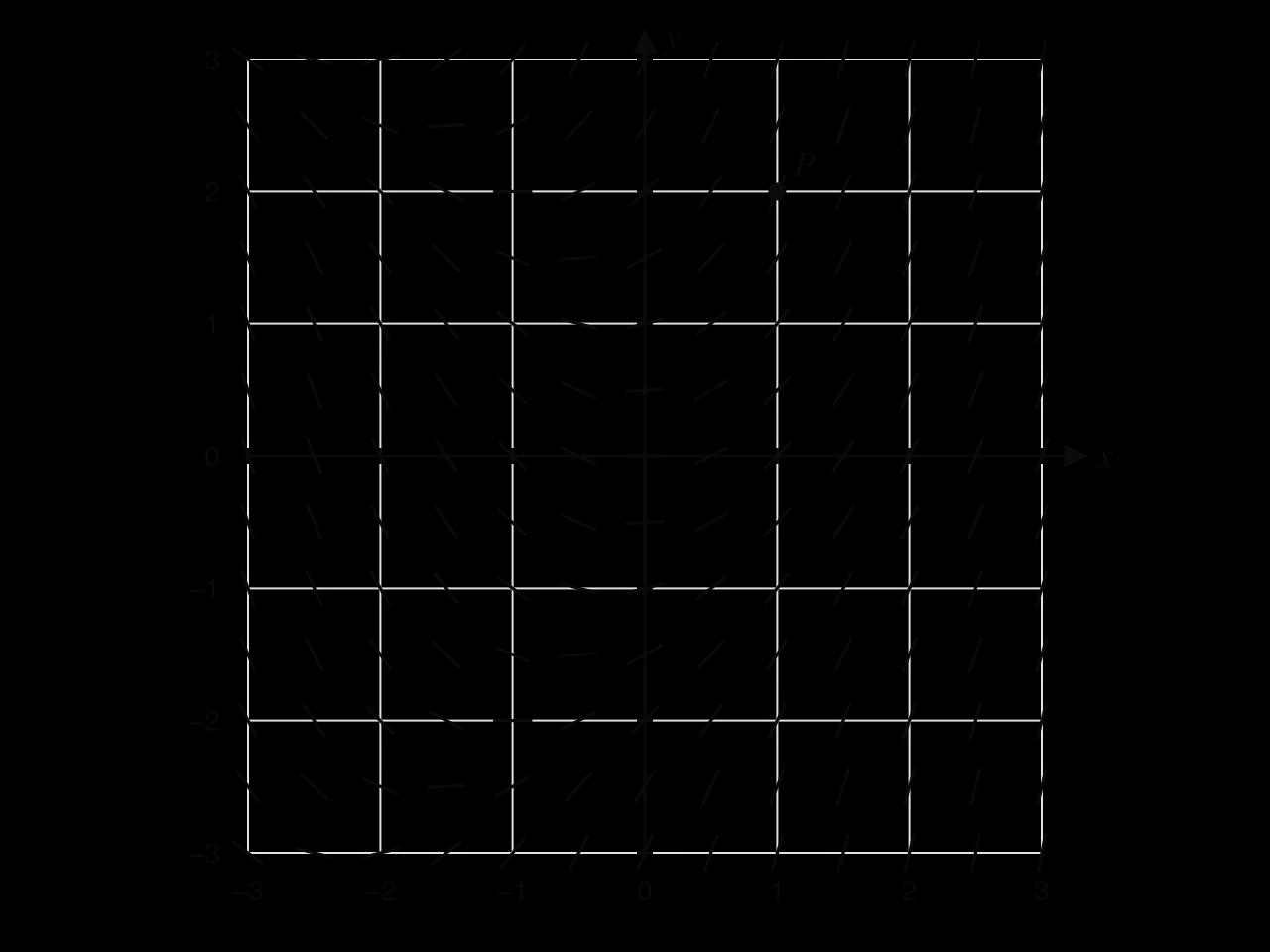
The point lies on a solution curve.
- (a)
Find the equation of the tangent to the solution curve at .
2 marks
- (b)
Use your tangent to estimate the value of on this solution curve when .
1 mark
- (c)
By considering at , state whether your estimate in part (b) is an underestimate or an overestimate. Justify your answer.
2 marks
- (d)
On the diagram, sketch the solution curve through .
2 marks
Rabbits are introduced onto a small island. The number of rabbits, , years after they are introduced, is modelled by the logistic differential equation
where when .
- (a)
Find the values of for which .
2 marks
- (b)
Interpret, in context, the non-zero value of found in part (a).
1 mark
- (c)
Find the number of rabbits when the population is increasing most rapidly, and the rate of increase at that moment.
3 marks
- (d)
Use Euler's method with a step length of 0.5 to estimate the number of rabbits after 3 years.
4 marks
- (e)
The solution of the differential equation is . Find the percentage error in the estimate in part (d).
2 marks
- (f)
Explain why Euler's method underestimates the number of rabbits for .
2 marks
- (g)
Find the time at which the population is increasing most rapidly.
2 marks
This question investigates a model for the interaction between a crop pest and its natural predator in a greenhouse.
Selin grows tomatoes in a large greenhouse. She controls aphids, which damage the plants, by releasing ladybirds, which eat the aphids. Let be the number of aphids, in thousands, and the number of ladybirds, in hundreds, weeks after she starts monitoring the greenhouse.
Selin models the two populations by the coupled differential equations
where and .
- (a)
At one moment there are 6000 aphids and 100 ladybirds in the greenhouse.
Find the value of and the value of at this moment, and interpret your answers in context.
3 marks
- (b)(i)
Consider the case in which there are no ladybirds in the greenhouse.
Write down the differential equation satisfied by .
1 mark
- (b)(ii)
Hence find the long-term number of aphids when there are no ladybirds, justifying your answer.
2 marks
- (c)(i)
Show that is an equilibrium point of the system.
2 marks
- (c)(ii)
Write down the coordinates of the other two equilibrium points.
2 marks
- (d)(i)
To investigate the behaviour close to , let and , where and are small. You may assume that terms in , and can be ignored.
Show that .
3 marks
- (d)(ii)
Find a similar approximation for .
2 marks
- (d)(iii)
The approximations can be written as .
Find the eigenvalues of .
2 marks
- (d)(iv)
Hence describe the behaviour of the aphid and ladybird populations when they start close to .
2 marks
- (e)
At the start of one season there are 2000 aphids and 100 ladybirds in the greenhouse.
Use Euler's method with a step length of 0.25 weeks to estimate the number of aphids and the number of ladybirds after 1 week.
4 marks
- (f)
Sketch, on a set of axes with on the horizontal axis and on the vertical axis, the trajectory that starts at . Show the direction of motion along the trajectory.
2 marks
- (g)(i)
Selin considers spraying a pesticide that kills aphids and ladybirds at the same rate. She modifies her model to
Find the equilibrium point of the modified model at which both species are present.
3 marks
- (g)(ii)
Comment on whether spraying the pesticide is a sensible way to reduce the aphid population in the long term.
1 mark
Consider the differential equation , where when .
- (a)
Use Euler's method with a step length of 0.1 to find an approximate value of when . Show all your working.
4 marks
- (b)
By considering , explain why your answer to part (a) is likely to be an underestimate.
2 marks
Consider the differential equation
- (a)
Explain why Euler's method cannot be used to approximate the solution that passes through the point .
1 mark
- (b)
Use Euler's method with a step length of 0.25 to find an approximate value of when , given that when .
4 marks
- (c)
Solve the differential equation to find the exact solution through , giving in terms of .
5 marks
- (d)
Find the percentage error in the approximation found in part (b).
3 marks
- (e)
State how the approximation in part (b) could be improved.
1 mark
- (f)
Show that the solution curve through never meets the -axis.
2 marks
This question uses a second-order differential equation to explore how the damping setting of an automatic door closer affects the way a door shuts.
A heavy fire door in a hospital corridor is fitted with a hydraulic closer. The door is pushed open and then released from rest. Let be the angle, in radians, between the door and its closed position seconds after it is released. The motion of the door is modelled by
where is a positive constant called the damping setting of the closer. When , and .
- (a)
By letting , write the differential equation as a system of first-order equations in the form , where is a matrix in terms of .
2 marks
- (b)(i)
The closer is first set with .
Show that the eigenvalues of are and .
2 marks
- (b)(ii)
Find an eigenvector for each eigenvalue.
2 marks
- (c)
Hence show that .
4 marks
- (d)
The door is considered shut once .
Find the time taken for the door to be shut.
2 marks
- (e)
Show that, with this setting, the door never swings past its closed position.
2 marks
- (f)
Sketch the phase portrait for this system, with on the horizontal axis and on the vertical axis. Your sketch should show the eigenvector lines and the trajectory that starts at .
3 marks
- (g)(i)
After some years the closer wears and the damping setting falls to .
Find the eigenvalues of for this setting.
2 marks
- (g)(ii)
Hence describe the motion of the door with this setting.
2 marks
- (h)
Use Euler's method with a step length of 0.1 seconds to estimate the value of when for the worn closer.
4 marks
- (i)
A computer solution of the differential equation gives when .
Calculate the percentage error in your answer to part (h).
2 marks
- (j)
Find the set of values of for which has two distinct real eigenvalues.
2 marks
- (k)
Explain why the manufacturer would not choose a very large value of .
1 mark
Practice all 50 in Augment
Free with an account. Every question has its markscheme, and Augment keeps the ones you got wrong so you can come back to them.
More questions in Calculus
- 5.1Limits and the derivative
- 5.2Increasing and decreasing functions
- 5.3Differentiating polynomials
- 5.4Tangents and normals
- 5.5Introduction to integration
- 5.6Stationary points
- 5.7Optimisation
- 5.8The trapezoidal rule
- 5.9Further differentiation
- 5.10The second derivative
- 5.11Further integration
- 5.12Areas and volumes
- 5.13Kinematics
- 5.14Setting up differential equations
- 5.15Slope fields
- 5.16Euler’s methodThis page
- 5.17Phase portraits
- 5.18Second-order differential equations
Check your answers in Augment
A free account opens all 50 questions on Euler’s method with their markschemes, and keeps a record of what you have marked.