3 Geometry and trigonometry
An overview of geometry and trigonometry: how triangles, solids, circles and Voronoi diagrams solve problems of distance, area and position, and how HL adds radians, vectors, matrix transformations and graph theory.
- IB Mathematics: Applications and Interpretation
- SL and HL
16 subtopics in Geometry and trigonometry
Each one has its own page once something is published for it.
- 3.1Volume and surface area in three dimensions104 questions · notes
- 3.2Trigonometry in triangles85 questions · notes
- 3.3Applications of trigonometry53 questions · notes
- 3.4Arcs and sectors31 questions · notes
- 3.5Perpendicular bisectors47 questions · notes
- 3.6Voronoi diagrams36 questions · notes
- 3.7Radian measureHL only29 questions · notes
- 3.8The unit circle and trigonometric equationsHL only39 questions · notes
- 3.9Matrix transformationsHL only34 questions · notes
- 3.10VectorsHL only48 questions · notes
- 3.11Vector equations of linesHL only30 questions · notes
- 3.12Vectors in kinematicsHL only33 questions · notes
- 3.13Scalar and vector productsHL only47 questions · notes
- 3.14Graph theoryHL only48 questions · notes
- 3.15Adjacency matricesHL only36 questions · notes
- 3.16Tree and cycle algorithmsHL only36 questions · notes
An overview of 3 Geometry and trigonometry
Introduction
Geometry and trigonometry measure the physical world: the height of a building that cannot be climbed, the volume of a storage tank, the bearing a ship must steer, the region of a city closest to each hospital. At SL the topic works with triangles, three-dimensional solids, circles and the boundaries between nearest points, with every angle in degrees. Almost every problem starts by turning a written description into a labelled diagram, then choosing the right relationship between lengths and angles.
At HL the topic gains more new material than any other and reaches well beyond triangles. Radians give a second way to measure angles, vectors describe position and movement in two and three dimensions, matrices transform shapes, and graph theory models networks such as roads, cables and web links, where the question is often the shortest or cheapest route.
 YouTube
How the subtopics fit together
The subtopics form five strands. The map of the topic shows each strand as a row, with the SL subtopics shaded and the HL-only subtopics dashed; an arrow means the first subtopic is used in the second.
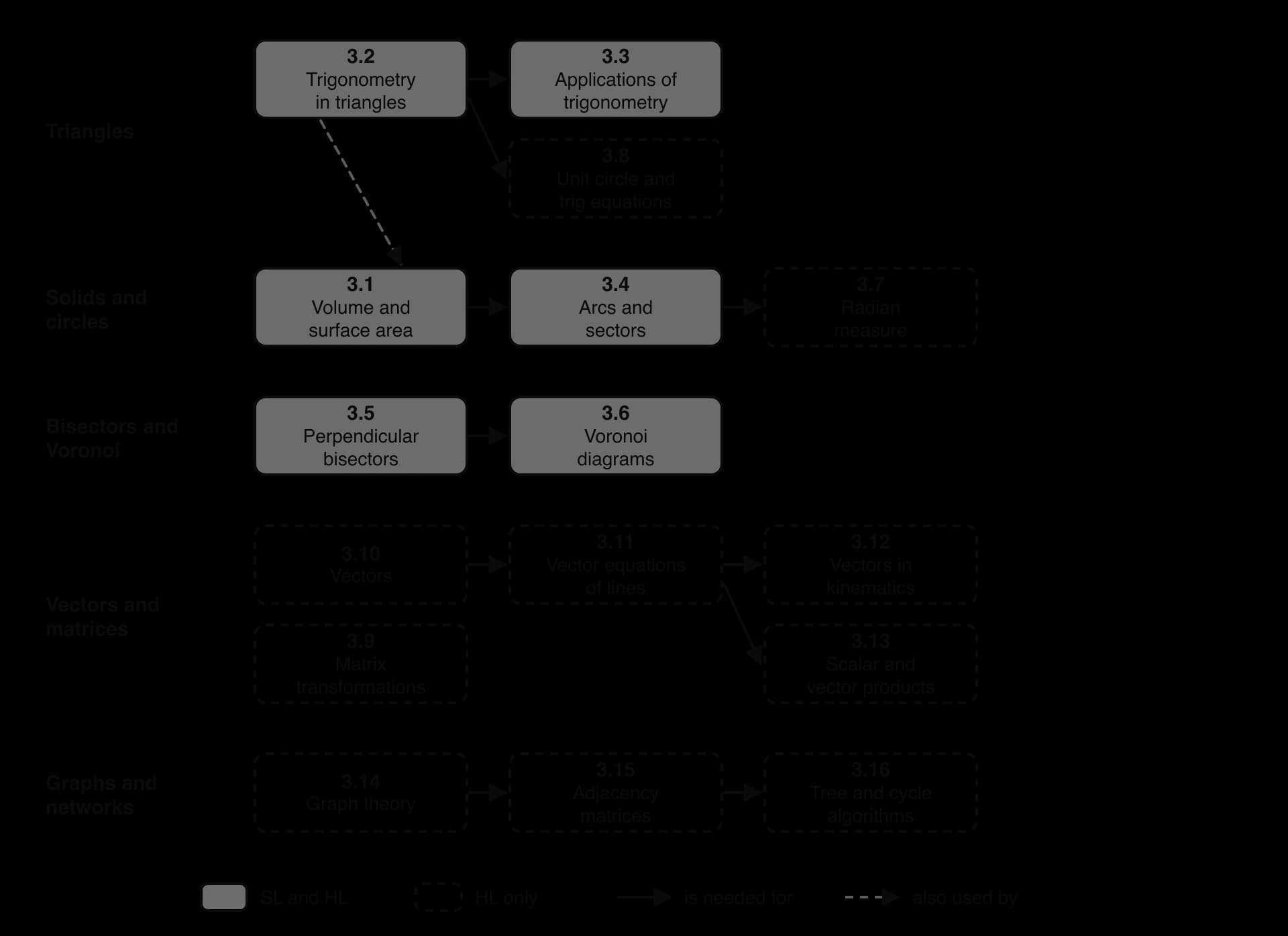
The triangles strand is the core of SL. Right-angled trigonometry, the sine rule and the cosine rule find any side or angle, and their applications cover angles of elevation and depression and three-figure bearings. Right-angled triangles drawn inside the solids of subtopic 3.1 give their hidden lengths and angles, and the area formula gives the area of a segment of a circle in subtopic 3.4.
The bisectors and Voronoi strand applies coordinate geometry to questions of location, such as which hospital or mobile phone mast is nearest. The perpendicular bisector of the segment joining two points is the line of points equally far from both, so it forms the boundaries of a Voronoi diagram, which splits a plane into the regions nearest to each of a set of sites. At HL, the two remaining strands use vectors and matrices to describe lines, motion and transformations, and graphs of vertices and edges to find efficient routes.
The subtopics
Subtopic | Level | What it covers |
|---|---|---|
3.1 Volume and surface area in three dimensions | SL | Distance and midpoint in 3D, volume and surface area of pyramids, cones, spheres and compound solids, and angles between lines and planes inside solids |
3.2 Trigonometry in triangles | SL | Sine, cosine and tangent in right-angled triangles, the sine and cosine rules, and the area of a triangle as |
3.3 Applications of trigonometry | SL | Pythagoras' theorem, angles of elevation and depression and bearings in context, and drawing labelled diagrams from written descriptions |
3.4 Arcs and sectors | SL | Arc length, sector area and perimeter in degrees, segments, annular sectors and the net of a cone |
3.5 Perpendicular bisectors | SL | The equation of the perpendicular bisector of a segment, from two points or from a segment's equation and midpoint |
3.6 Voronoi diagrams | SL | Sites, cells, edges and vertices, adding a site, cell areas, nearest neighbour interpolation and the toxic waste dump problem |
3.7 Radian measure | HL | The radian, converting between degrees and radians, arc length and sector area in radians, and angular speed |
3.8 The unit circle and trigonometric equations | HL | Sine and cosine of any angle, the Pythagorean identity, the ambiguous case of the sine rule, and solving trigonometric equations graphically |
3.9 Matrix transformations | HL | Reflections, stretches, enlargements, rotations and translations with matrices, combined transformations, area scale factors and fractals |
3.10 Vectors | HL | Vectors in 2D and 3D, components, magnitude, position and displacement vectors, and unit vectors to rescale a direction |
3.11 Vector equations of lines | HL | Vector and parametric equations of lines, and whether two lines are parallel, intersecting or skew |
3.12 Vectors in kinematics | HL | Position and velocity vectors, collisions and closest approach, variable velocity, projectiles and circular motion |
3.13 Scalar and vector products | HL | The scalar and vector products, angles between vectors and lines, areas, and components of a vector along another |
3.14 Graph theory | HL | Vertices, edges and degree; simple, complete, weighted and directed graphs; connectivity, subgraphs and trees |
3.15 Adjacency matrices | HL | Adjacency matrices, counting walks with matrix powers, weighted adjacency tables and transition matrices for random walks |
3.16 Tree and cycle algorithms | HL | Eulerian and Hamiltonian routes, Kruskal's and Prim's algorithms, the Chinese postman problem and bounds for the travelling salesman problem |
Links to other topics
Perpendicular bisectors rely on the gradients and perpendicular lines of subtopic 2.1. The sinusoidal models of subtopics 2.5 and 2.9 are built on the sine and cosine functions, which subtopic 3.8 extends to angles of any size through the unit circle. Volumes of solids return in subtopic 5.12, where integration finds the volume of a solid formed by rotating a curve.
The HL strands lean on topic 1: transformation matrices use the matrix algebra of subtopic 1.14, and the transition matrix of a graph in subtopic 3.15 becomes a Markov chain in subtopic 4.19. Motion described by vectors in subtopic 3.12 is the two- and three-dimensional version of the calculus kinematics in subtopic 5.13.
From the formula booklet
The entries of the mathematics: applications and interpretation formula booklet that 3 uses. Each opens in the explained booklet.
- Area of a parallelogramPrior learning › SL and HL › Area of a parallelogram
- Area of a trianglePrior learning › SL and HL › Area of a triangle
- Area of a trapezoidPrior learning › SL and HL › Area of a trapezoid
- Area of a circlePrior learning › SL and HL › Area of a circle
- Circumference of a circlePrior learning › SL and HL › Circumference of a circle
- Volume of a cuboidPrior learning › SL and HL › Volume of a cuboid
- Volume of a cylinderPrior learning › SL and HL › Volume of a cylinder
- Volume of prismPrior learning › SL and HL › Volume of prism
- Area of the curved surface of a cylinderPrior learning › SL and HL › Area of the curved surface of a cylinder
- Distance between two points and Prior learning › SL and HL › Distance between two points and
And 33 more in the formula booklet.
Carry on with 3 in Augment
With a free account, Augment remembers where you stopped and what you have practiced.