 YouTube
Turn written descriptions into labelled diagrams and solve real problems with Pythagoras' theorem, right-angled and non-right-angled trigonometry, angles of elevation and depression, and three-figure bearings.
Each is in the Maths AI glossary, with every other term in the subject.
A pair of equal angles formed on opposite sides of a line that crosses two parallel lines, each lying between the parallels.
The angle measured downwards from the horizontal to the line of sight of an object below the observer.
The angle measured upwards from the horizontal to the line of sight of an object above the observer.
A unit of angle equal to of a degree, written ″; a milliarcsecond is one thousandth of an arcsecond.
The bearing of the starting point from the destination, which differs from the original bearing by 180°.
Construct a labelled diagram from a written description of a real situation, stating the modelling assumptions.
Use Pythagoras' theorem and its converse to solve problems in context.
Draw and label angles of elevation and depression, showing the horizontal, and explain why the angle of elevation from A to B equals the angle of depression from B to A.
Calculate heights, distances and angles using angles of elevation and depression, including problems with two observation points.
Write directions as three-figure bearings and find back bearings.
Determine the angles inside a triangle from bearings, using north lines, and solve navigation problems with the sine and cosine rules.
Calculate distances, speeds and bearings in multi-step problems, interpreting the answers in context.
Calculate the distance to a star from its parallax angle.
Trigonometry was developed to answer practical questions: how tall a building is, how far away a ship is, which direction to steer, how high an aircraft should be on its approach to a runway. The methods of subtopic 3.2, Trigonometry in triangles, solve any triangle once it has been drawn. In a real problem the harder step usually comes before any calculation, in reading a description in words, deciding what the triangle is, and drawing it with the right angles in the right places.
Two conventions make this possible. Angles of elevation and depression describe directions up and down, always measured from the horizontal. Bearings describe directions across the ground, always measured clockwise from north. With these, a sentence such as "a ship sails 48 km on a bearing of 070°" becomes a side and an angle of a triangle.
53 exam-style questions on this subtopic, written in the style of the IB papers. The first has its markscheme open. Counted on
A kayaker sets off at 13:00 and paddles at constant velocity. Her position vector relative to a port, P, hours after 13:00 is
The entries of the mathematics: applications and interpretation formula booklet that 3.3 uses. Each opens in the explained booklet.
With a free account, Augment remembers where you stopped and what you have practiced.
The direction of one point from another, given as the angle measured clockwise from north, written with three digits from 000° to 360°.
An instrument for measuring an angle of elevation or depression, by sighting an object along it and reading the angle from the horizontal.
Two angles between a pair of parallel lines on the same side of a line crossing them; they add up to 180°.
A level line through the observer's position, from which angles of elevation and depression are measured.
The straight line from an observer's eye to the object being observed.
The apparent change in the direction of an object when it is viewed from two different positions; for a star, the parallax angle is half the shift seen from opposite sides of Earth's orbit.
A figure on the surface of a sphere bounded by three arcs of great circles; its angles add up to more than 180°.
Scope: The course covers applications of right-angled and non-right-angled trigonometry, including Pythagoras' theorem; angles of elevation and depression; three-figure bearings; and constructing labelled diagrams from written statements. The rules themselves (the ratios, the sine rule, the cosine rule and the area formula) are taught in subtopic 3.2, and right-angled triangles in three dimensions in subtopic 3.1. Questions are set in degrees and in two dimensions, with a GDC.
YouTubeA real situation is never exactly a triangle. A lighthouse has width, the sea has waves, a person's eye is not at ground level, and Earth's surface is curved. To use trigonometry, the situation is replaced by a simplified geometric model. People, ships, aircraft and the tops of buildings become points; the ground or the sea becomes a horizontal line; towers, walls and cliffs become vertical lines at right angles to the ground; paths of travel become straight line segments.
These assumptions are usually reasonable over short distances, and they make the right angles in a diagram visible. They also limit the accuracy of the answer. A height found from an angle measured at eye level is the height above the eye, not above the ground, until the eye height is added. A distance of several hundred kilometres over the sea is longer along Earth's curved surface than the straight line in a flat diagram.
When a situation contains a right angle and two of the three sides are known, Pythagoras' theorem gives the third side without any angle. Right angles appear wherever a vertical object stands on horizontal ground, wherever two roads or walls meet square, and wherever movements are due north and then due east.
Screen sizes give an everyday case. A television described as "55-inch" has a diagonal of 55 inches; with the usual width-to-height ratio of 16 : 9, the width and height are and for some , and gives . The screen is therefore about 47.9 inches (121.8 cm) wide and 27.0 inches (68.5 cm) high.
The converse of Pythagoras' theorem says that if the sides of a triangle satisfy , then the angle opposite is a right angle. Builders use it to set out square corners: a triangle with sides in the ratio 3 : 4 : 5 has a right angle, since . If , the angle is not 90°, and the cosine rule from subtopic 3.2 says whether it is larger () or smaller.
Directions up and down are measured from the horizontal, the level line through the observer's eye. Any angle that describes how far up or down an object is seen is measured from this line, never from the vertical.
The direction in which the object is seen is a second line.
An object above the observer is seen by looking up from the horizontal; an object below by looking down.
The angle at the top of a cliff, looking down at a boat, is measured in the same way but downwards.
The diagram of an observer at the top of a cliff and a boat on the sea shows both angles together. The horizontal at the top of the cliff and the sea surface are parallel lines, and the line of sight crosses both.
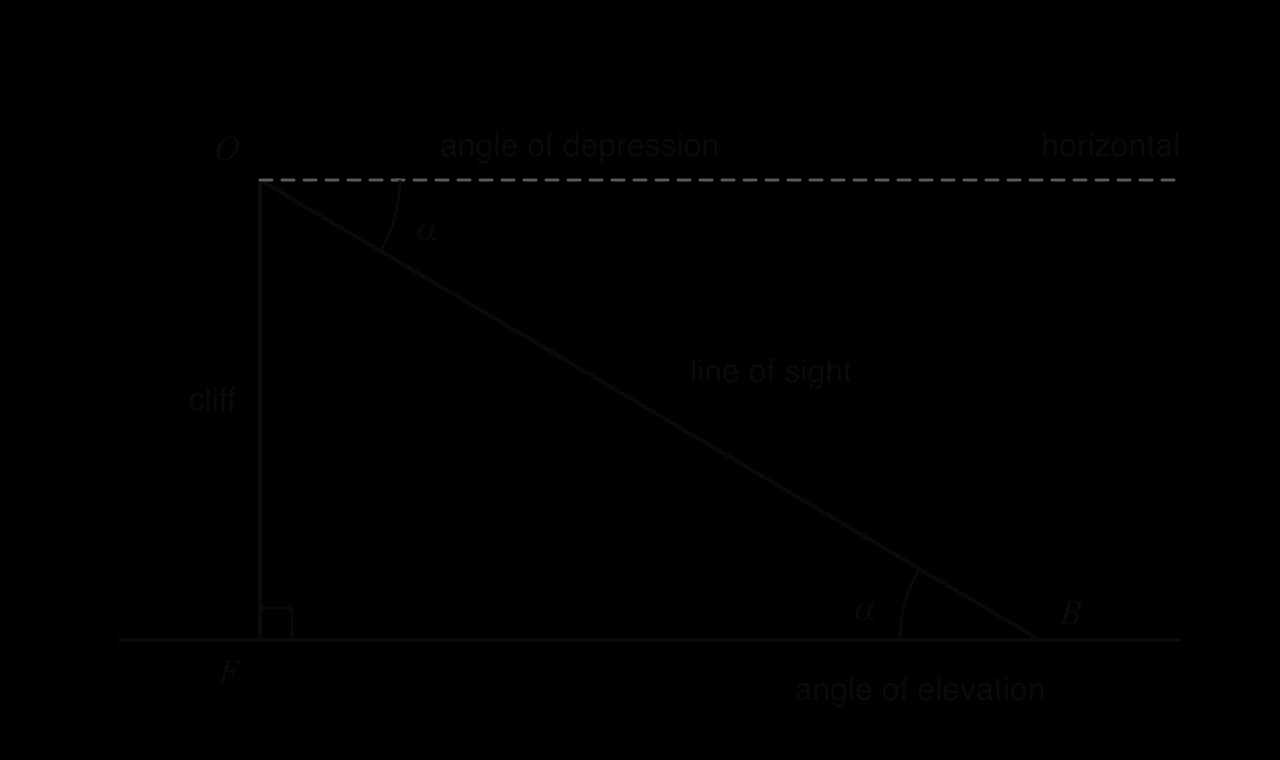
When a straight line crosses two parallel lines, the angles on opposite sides of it, between the parallels, are equal. They form a Z shape.
The angle of depression from the top of the cliff to the boat and the angle of elevation from the boat to the top of the cliff are alternate angles between the two horizontals, so they are equal. This is why the angle of depression, measured at the top, can be placed at the bottom of the diagram inside the right-angled triangle , where it is the angle at opposite the height of the cliff.
A diagram of an angle of elevation or depression must show the horizontal line through the observer, the line of sight, and the angle between them. An angle of depression always sits at the top, between a horizontal line drawn out from the observer and the line of sight going down. If no horizontal line has been drawn at the top, it has to be added before the angle can be marked.
Most elevation and depression problems contain a right-angled triangle made of the height, the horizontal distance and the line of sight. The angle of elevation is at the lower end, so the height is opposite it and the horizontal distance adjacent to it: the tangent ratio links them directly.
Aircraft land by following an angle of depression. An instrument landing system sends out a radio beam called the glideslope, normally at 3° above the horizontal, that leads to the touchdown point on the runway. An aircraft on the glideslope 10 km (horizontally) from the touchdown point is m above it, and when it is 300 m above the runway it is m, about 5.7 km, from touchdown. Airports with tall buildings nearby use steeper approaches: at London City Airport the glideslope is 5.5°, so at 10 km the aircraft is about 963 m up.
Source: Wikipedia, "Instrument landing system", 2026.
A height that cannot be reached is found by measuring a horizontal distance and an angle of elevation. The angle is measured with a simple instrument.
The clinometer is held at eye level, so the angle gives the height of the object above the observer's eye. The eye height must be added to give the height above the ground. A field study usually repeats the measurement from several distances and averages the results, because a small error in the angle produces a large error in the height when the angle is steep.
When the horizontal distance to an object cannot be measured, for example because the base of a tower is on private land or across a river, two angles of elevation from two points a known distance apart are enough. There are two methods. The first works with the non-right-angled triangle formed by the two observation points and the top, using the sine rule. The second writes the horizontal distances in terms of the height using , and solves for the height.
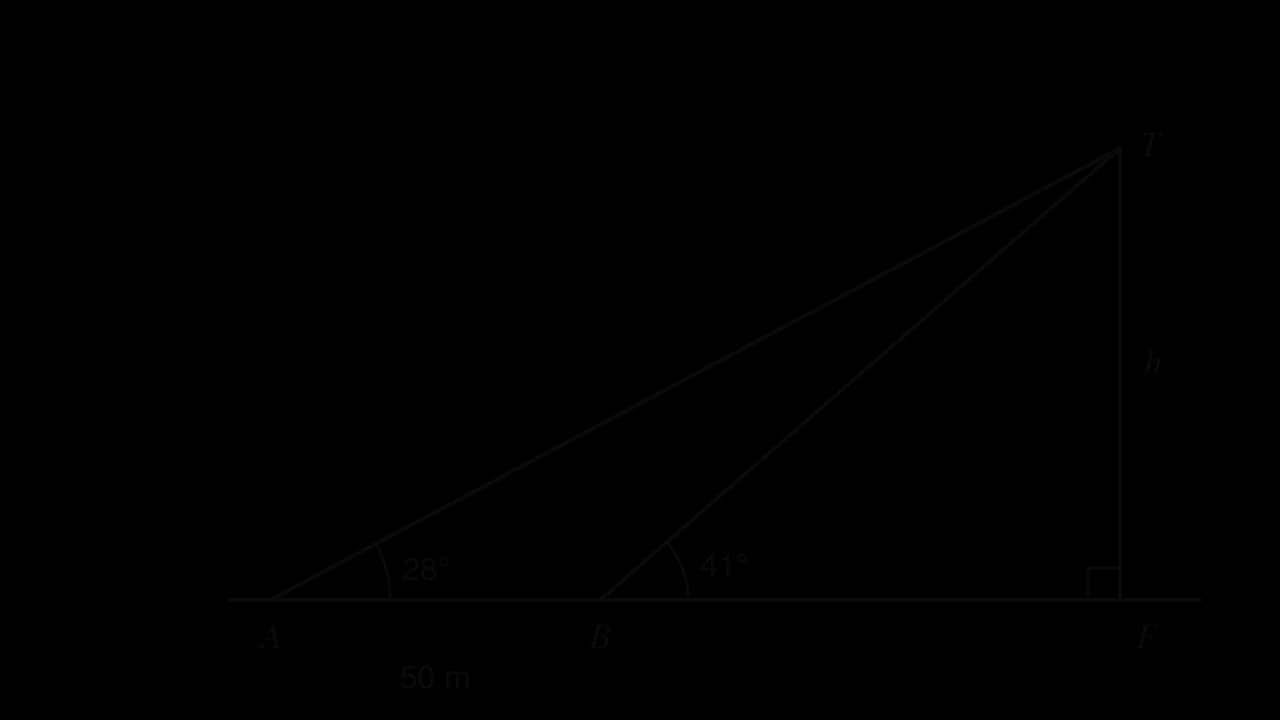
The same two-angle method gives a speed when the observer stays still and the object moves. The two horizontal distances are found from the two angles, and their difference is the distance travelled in the time between the observations.
The bell tower of Pisa Cathedral began to lean during its construction in the twelfth century because the soft ground under one side settled. Its tilt is described by the angle between the tower's axis and the vertical. By 1990 the tilt had reached 5.5°, and the tower was closed to the public. Stabilisation work between 1993 and 2001, which included lead counterweights and the removal of soil from beneath the raised side, reduced the tilt to 3.97°. The tower is 55.86 m high on the low side and 56.67 m on the high side.
Year | Tilt from vertical | Horizontal displacement of the top (height 55.86 m) |
|---|---|---|
1990 | 5.5° | m |
2001 onwards | 3.97° | m |
Source: Wikipedia, "Leaning Tower of Pisa", 2026. Displacements computed.
The model is a right-angled triangle whose vertical side is the height and whose angle at the top, between the vertical and the tower, is the tilt. The horizontal displacement of the top is opposite the tilt angle, so it equals the height multiplied by the tangent of the tilt. On these figures the top of the tower moved back by m, yet the reported correction at the top was only about 45 cm. A gap this large shows the limits of the model and of the quoted angles. The tower is a hollow cylinder whose base walls are 2.44 m thick, and its upper floors were built with one side taller than the other to compensate for the lean, so the tower is slightly curved and no single tilt angle describes it exactly. A displacement computed from a quoted tilt is therefore an estimate, to be checked against direct measurement where it exists.
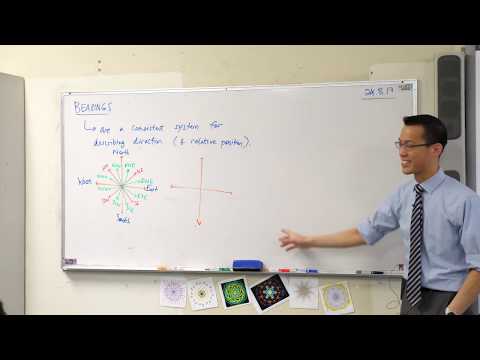
Directions across the ground are given as bearings. A bearing is measured from north because a compass needle points north, and clockwise because that is the direction a compass is read.
Writing three digits, such as 055° rather than 55°, avoids ambiguity when bearings are spoken or written quickly. Due north is 000°, due east 090°, due south 180° and due west 270°.
Direction | N | NE | E | SE | S | SW | W | NW |
|---|---|---|---|---|---|---|---|---|
Bearing | 000° | 045° | 090° | 135° | 180° | 225° | 270° | 315° |
The phrase "the bearing of from " means the direction in which a person at looks to see , so the angle is measured at , from the north line at . The word after "from" names the point where the north line is drawn.
 YouTube
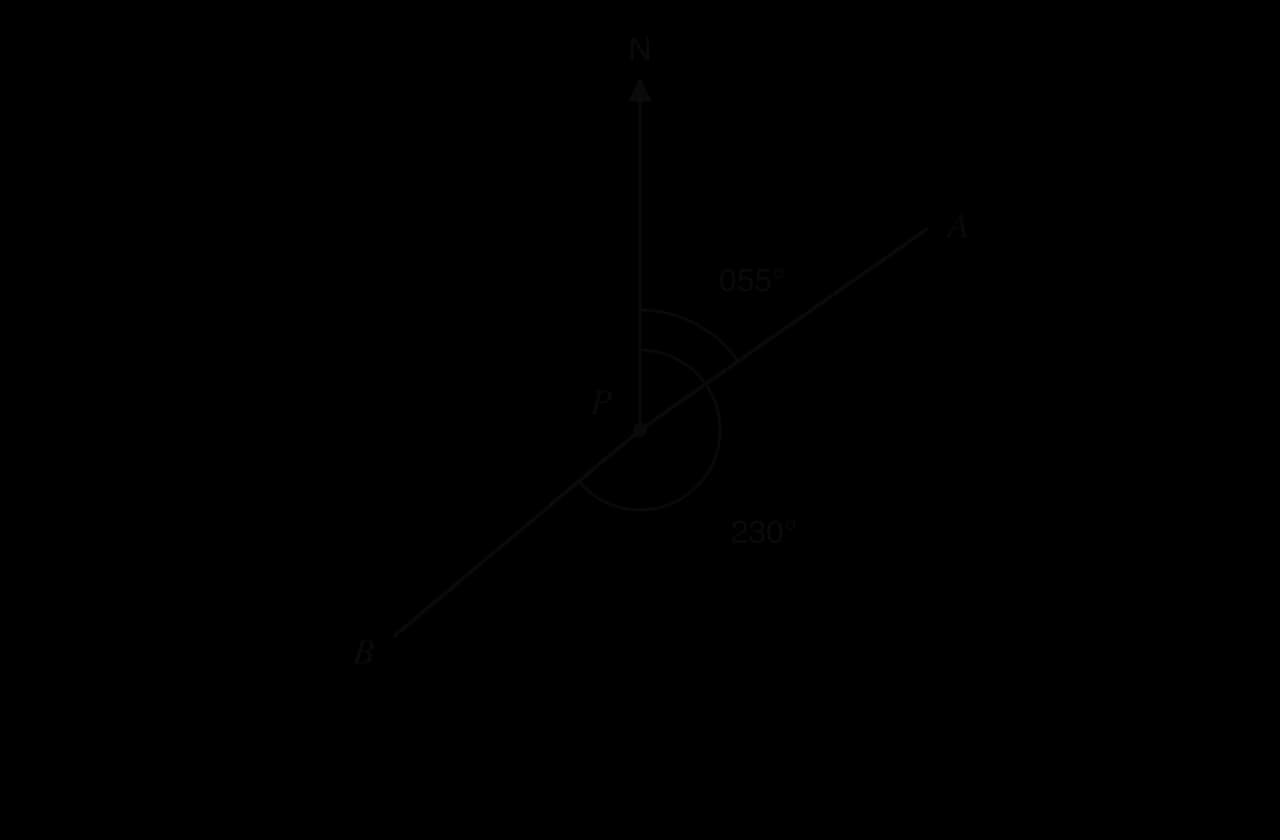
If is on a bearing of 055° from , then is in exactly the opposite direction from . Turning to face the opposite direction is a turn of 180°.
The bearing of from in the example is , and if is on a bearing of 300° from , then is on a bearing of from . The rule follows from the north lines at the two points being parallel.
The north lines at and are parallel, and the line crosses them. The bearing of from , 055°, and the angle between the north line at and the line measured on the same side are co-interior, so that angle is . The bearing of from is measured clockwise from north all the way round to , which is , the same as .
A journey made of two straight legs, or two observers sighting the same object, forms a triangle whose angles have to be worked out from bearings before the sine or cosine rule can be used. The method is the same in every problem.
Draw a north line at every point where a bearing is measured.
Mark each bearing as a clockwise angle from its north line.
Find each interior angle of the triangle from the bearings, using angles on a straight line (180°), angles around a point (360°), co-interior angles (180°) and back bearings.
Check that the three interior angles add up to 180°, and that the diagram looks roughly like the angles found.
Fixing the position of an object from two bearings taken at different places is a form of triangulation, the method of subtopic 3.2. Ships and coastguards used it long before satellite positioning.
A question in words has to become a diagram before it can be solved, and most of the reasoning happens on the diagram. A good diagram need not be drawn to scale, but it should be roughly the right shape, so that obtuse angles look obtuse and longer sides look longer. Every given length and angle goes on it, the unknown is marked, and right angles are shown with a square.
Read the whole statement once, then pick out each object and represent it as a point (with the letter used in the question).
Draw the horizontal ground or sea, and any vertical heights, as straight lines at right angles.
Draw north lines at each point where a bearing is given, and mark the bearings clockwise.
Add the given lengths and angles, and mark the unknown with a letter or "?".
Identify the triangle (or triangles) to be solved, and the right angles, before choosing a rule.
The diagram is a representation of the situation: the same information as the words, in a form in which the triangle and its known parts can be seen. Questions often build in stages, so a diagram drawn at the start is extended as new information arrives.
The two observers on opposite sides make the angle at the top a single triangle's angle, so one application of the sine rule is enough. When the two observers are on the same side, as with the tower, the interior angle at the nearer point is 180° minus its angle of elevation, and the angle at the top is the difference between the two angles of elevation.
The same triangle that finds the height of a tower can find the distance to a star. As Earth moves around the Sun, a nearby star appears to shift slightly against much more distant stars. Viewing it from two ends of a baseline and measuring the change in direction gives a long, thin triangle.
The parallax angles of stars are tiny, so astronomers measure them in very small units.
The diagram of Earth's orbit shows the right-angled triangle formed by the Sun, Earth and the star. The side from the Sun to Earth is 1 astronomical unit (AU), the mean distance between them, and the parallax angle is at the star.
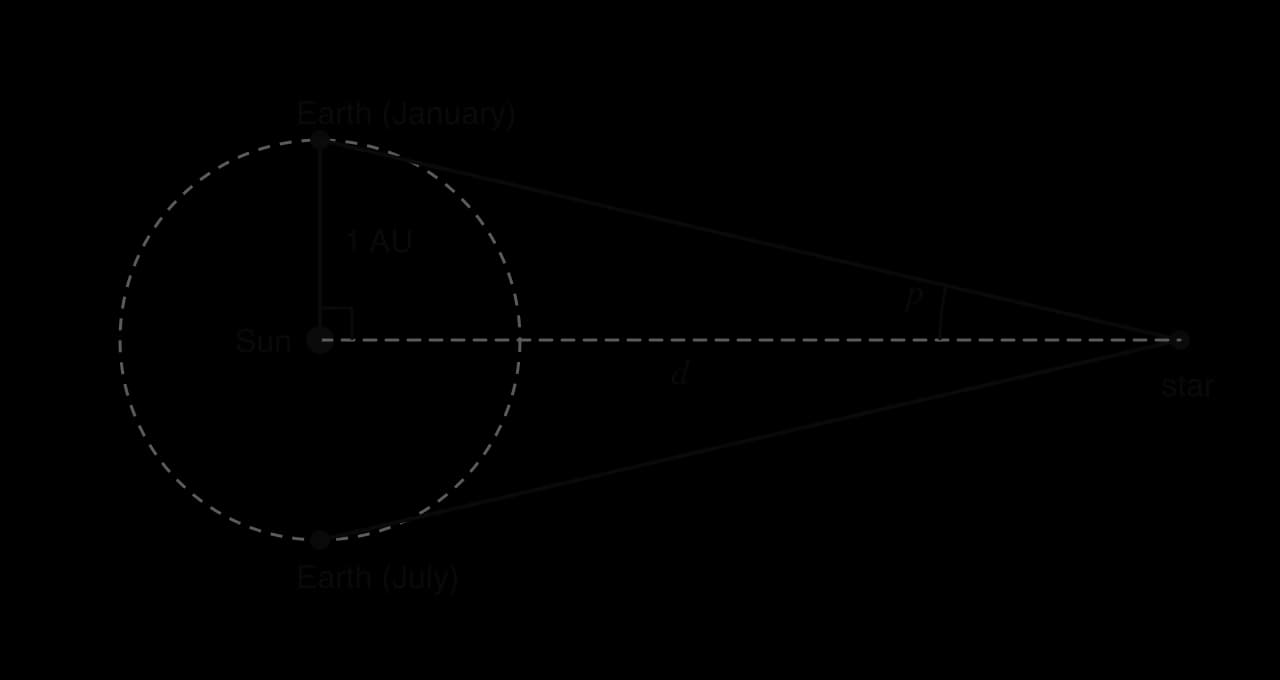
In the right-angled triangle, 1 AU is opposite the angle and the distance to the star is adjacent to it.
Proxima Centauri is the nearest star to the Sun. Its parallax measured by the European Space Agency's Gaia satellite (Gaia Data Release 3) is 768.0665 milliarcseconds, that is 0.7680665″. Converting to degrees and using the parallax formula gives its distance.
One light-year is about 63,241 AU, so
Source: Wikipedia, "Proxima Centauri" (Gaia Data Release 3), 2026.
The calculated distance, about AU or 4.25 light-years, matches the published value of 4.2465 light-years. The triangle is so thin that the angle at the star is less than a thousandth of a degree; a GDC must keep the full value of , because rounding it to changes the distance by about 0.2%. The parallax angle shrinks as the distance grows, so the method gives reliable distances only for stars within the Milky Way, and astronomers use other methods for more distant objects.
Over the distances in most applications, a few kilometres, the difference between a spherical and a flat triangle is far smaller than the errors in measuring the angles, which is why the flat model of subtopic 3.2 is used.
Applications of trigonometry appear on most papers, often as the opening parts of a longer question in Paper 2 or as a complete 5–8 mark question in Paper 1. Typical shapes are: an angle of depression from a cliff, a tower, a helicopter or a camera, followed by a distance and then a speed; two angles of elevation from two points; a ship's journey on two bearings, with the cosine rule for the distance and the sine rule for a bearing; and one-mark parts that ask you to draw or write down an angle. Other command terms are find, calculate, show that and justify.
For drawing parts, the horizontal line through the observer must be shown and the angle labelled; an angle marked from the vertical earns nothing. For calculations, write the ratio or rule with the numbers substituted before using the GDC, and keep every intermediate value unrounded. Speeds need the units the question asks for, so convert minutes to hours and metres to kilometres explicitly.
Many questions combine bearings with a speed or time: one part finds a distance with the cosine rule, the next uses distance = speed × time. When two objects arrive at the same time, write an equation that equates their times before substituting.
A ladder 4.2 m long leans against a vertical wall with its foot 1.1 m from the wall on level ground. Find how high up the wall the ladder reaches. [2]
A triangle has sides 9 cm, 12 cm and 15.2 cm. Determine whether it is right-angled, giving a reason. [2]
Find the angle of elevation of the top of a 38 m building from a point on level ground 52 m from its base. [2]
From the top of an 85 m cliff, the angle of depression of a buoy is 23°. Find the horizontal distance from the foot of the cliff to the buoy. [2]
Write down the back bearing of (a) 048° [1] (b) 305°. [1]
A hiker walks 35 km on a bearing of 040° and then 22 km on a bearing of 130°. (a) Show that the angle between the two legs of the walk, at the turning point, is 90°. [2] (b) Find the distance from the hiker's starting point. [2] (c) Find the bearing of the hiker's final position from the starting point. [3]
Two points on level ground are 80 m apart and in line with the foot of a mast, on the same side of it. The angles of elevation of the top of the mast from the two points are 22° and 35°. Find the height of the mast. [4]
A ship sails due east from point . A lighthouse is on a bearing of 040° from . After sailing 15 km to point , the bearing of from the ship is 315°. (a) Find the three angles of triangle . [3] (b) Find the distance . [3] (c) Find the shortest distance from the lighthouse to the ship's course. [2]
A star has a parallax angle of 0.25″. Calculate its distance in astronomical units and in light-years (1 light-year ≈ 63,241 AU). [3]
Explain why the angle of elevation of from equals the angle of depression of from . [2]
m
but ; these are not equal, so it is not right-angled (the largest angle is slightly obtuse).
m (200.247…)
(a) 228° (b) 125°
(a) Back bearing of the first leg is 220°; . (b)
(a) ,
,
The horizontal lines through and are parallel and the line of sight crosses both; the two angles are alternate angles between the parallels, so they are equal.
Model real objects as points, the ground as a horizontal line and heights as vertical lines; state the assumptions.
Pythagoras' theorem finds a side of a right-angled triangle from two sides; its converse checks for a right angle.
Angles of elevation and depression are measured from the horizontal through the observer, never from the vertical.
The angle of elevation from to equals the angle of depression from to (alternate angles).
With two angles of elevation from two points, use the sine rule in the oblique triangle, or two tangent equations, to find a height.
A bearing is measured clockwise from north and written with three figures; the back bearing differs by 180°.
Find interior angles from bearings using north lines, angles on a straight line, co-interior angles and back bearings, then use the sine or cosine rule.
For stellar parallax, AU, with in degrees (1″ = °).
I can turn a written description into a labelled diagram, with points, horizontal and vertical lines, and the unknown marked.
I can state the modelling assumptions in a trigonometry problem and say how they affect the answer.
I can use Pythagoras' theorem in context, and its converse to test for a right angle.
I can draw and label an angle of elevation or depression, showing the horizontal line.
I can explain why an angle of depression and the matching angle of elevation are equal.
I can find a height or a horizontal distance from one angle of elevation or depression.
I can add an observer's eye height when a clinometer is used.
I can find a height from two angles of elevation, by the sine rule and by two tangent equations.
I can find a speed from two angles of depression and a time, converting the units.
I can write a bearing with three figures and find a back bearing.
I can find the interior angles of a triangle from bearings, drawing north lines at every point.
I can find a distance and a bearing for a two-leg journey with the cosine and sine rules.
I can find the shortest distance from a point to a straight course.
I can calculate the distance to a star from its parallax angle.
where distances are in kilometres, the first component is the distance east of P and the second is the distance north of P.
Find the kayaker's speed.
2 marks
(M1)
A1
[2 marks]
Find the time, to the nearest minute, at which the bearing of the kayaker from P is 045°.
4 marks
recognizing that the east and north components are equal (M1)
(A1)
A yacht leaves a marina at the point and sails at a constant speed of 7.5 km h on a bearing of 120°. Distances are in kilometres, with a unit vector due east and a unit vector due north.
Find the velocity vector of the yacht, giving your answer in the form .
3 marks
Find the distance of the yacht from the origin after 2.4 hours.
2 marks
Kai stands on level ground at a point 24.5 m from the base of a vertical cedar tree. The angle of elevation of the top of the tree from where Kai stands is 32°. Ignore Kai's height.
Find the height of the tree.
2 marks
Kai walks 8 m directly towards the tree. Find the new angle of elevation of the top of the tree.
2 marks
In the right-angled triangle , is opposite the 41° angle and is the hypotenuse.
Method 2: two tangent equations. With , the two right-angled triangles give and . So and . Subtracting:
The tower is about 68.5 m tall. Both methods agree, which is a useful check.
(b) Two sides and the included angle are known, so the cosine rule gives .
The ship is about 58.8 km from the harbour.
(c) Angle is opposite the side 30 km, which is shorter than , so it is acute and the sine rule can be used.
Angle is measured clockwise beyond the direction 070°, so the bearing of from is , about 101°.
(d) The return direction is the back bearing: , about 281°.
Horizontal line drawn through and the angle between it and labelled A1
The horizontal line must be shown for the second A1.
(b) 34° A1
(c) angle (A1)
(M1)
m A1
(d) (M1)
m A1
(e) is opposite the 34° angle and is opposite the larger 52° angle, so R1
The observer at is closer A1
Do not award R0A1. Accept "B has the larger angle of elevation for the same height, so is closer".
Total [10]
15:34 A1
Note: Award the final mark for 15:34 or "34 minutes past 3 pm" only.
[4 marks]