3.5 Perpendicular bisectors · IB Maths AI | Augment Education
3.5 Perpendicular bisectors
Find the equation of the perpendicular bisector of a line segment from two points or from a segment's equation and midpoint, explain why it is the set of equidistant points, and use bisectors to locate fair boundaries and centres.
IB Mathematics: Applications and Interpretation
Part of 3 Geometry and trigonometry
SL and HL
Key terms introduced here
Each is in the Maths AI glossary, with every other term in the subject.
The circle that passes through all three vertices of a triangle; its centre is the circumcentre and its radius is the distance from the circumcentre to any vertex.
A boundary on which every point is the same distance from the nearest points of two coastlines or regions; between two single points it is their perpendicular bisector.
The line that passes through the midpoint of a line segment and is perpendicular to it; it is the set of all points that are the same distance from the two endpoints of the segment.
A drawing made using only an unmarked straight edge and a pair of compasses, in which every length and point comes from circles and lines rather than from measurement.
Notes on 3.5 Perpendicular bisectors
27 min readLast reviewed
Learning objectives
State the meaning of a perpendicular bisector and of an equidistant point.
Explain why every point on the perpendicular bisector of [AB] is the same distance from A and from B.
Find the equation of the perpendicular bisector of a line segment given its two endpoints, in the forms y=mx+c
Questions on 3.5
47 exam-style questions on this subtopic, written in the style of the IB papers. The first has its markscheme open. Counted on
Question 1 · AI-001096 marks
A farming cooperative in the Rift Valley has two water wells at A(1,7) and B(9,3), where distances are in kilometres. The cooperative wants to know which points are the same distance from both wells.
(a)
Find the coordinates of the midpoint of [AB].
[2]2 marks
Markscheme (a)
(21+9,27+3)
From the formula booklet
The entries of the mathematics: applications and interpretation formula booklet that 3.5 uses. Each opens in the explained booklet.
Find the equation of a perpendicular bisector given the equation of a line segment and its midpoint.
Write down the perpendicular bisector of a horizontal or vertical segment.
Determine the point on a given line that is equidistant from two given points.
Find an endpoint of a segment from the other endpoint and the perpendicular bisector.
Find the point equidistant from three given points by intersecting two perpendicular bisectors, using technology where appropriate.
Introduction
A new bus stop should be the same distance from two schools; a border at sea should be fair to two countries; a phone should connect to whichever of two masts is closer. Each of these problems asks for the points that are the same distance from two fixed points, and those points always form one straight line, the perpendicular bisector of the segment joining them.
The perpendicular bisector is the building block of the Voronoi diagrams in subtopic 3.6, where every boundary between two regions is part of one. It is also the quickest route to the centre of a circle through three known points, which surveyors and archaeologists use to recover the centre of a circular feature from a few points on its edge.
The tools from straight lines
Finding a perpendicular bisector combines four short results from earlier work, and every bisector calculation uses all four.
Tool
Result
Where it is taught
Midpoint of [AB]
(2x1+x2,2y1+y2)
prior learning; subtopic 3.1
Gradient of [AB]
m=x2−x1y2−y1
Perpendicular gradient
m1×m2=−1, so m2=−m11
Line through a point with a gradient
y−y1=m(x−x1)
subtopic 2.1
The midpoint of a line segment is the point halfway between its ends, found by averaging the coordinates. The gradient measures the steepness of the segment, and two lines are perpendicular when the product of their gradients is −1, so the gradient of a perpendicular line is the negative reciprocal of the original. A line is fixed by one point and its gradient, which point-gradient form turns straight into an equation.
What a perpendicular bisector is
To bisect something is to cut it into two equal parts. The word is used for angles as well as segments.
A segment has infinitely many bisectors: every line through its midpoint cuts it in half. Exactly one of them crosses it at a right angle.
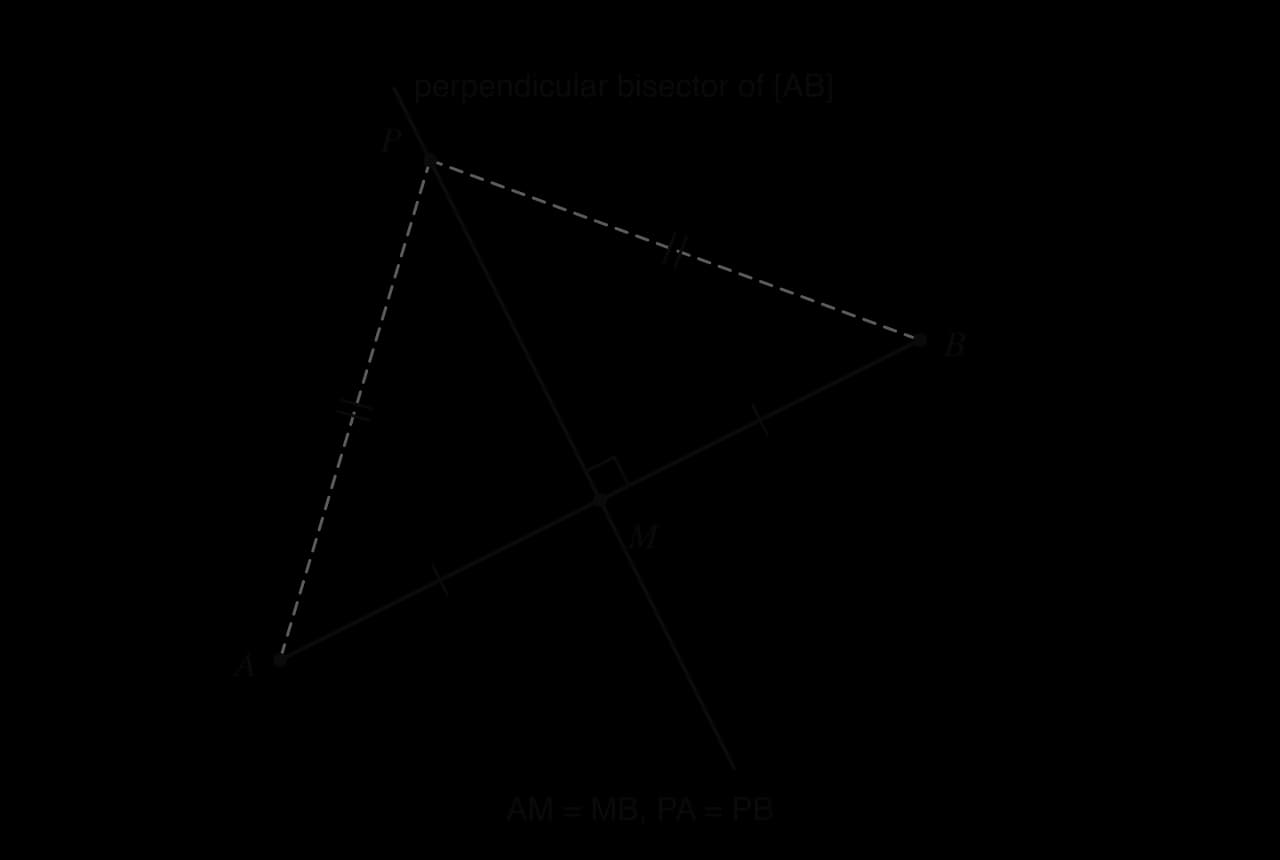
The diagram of a perpendicular bisector shows both properties at once: the bisector meets [AB] at its midpoint M at a right angle, and a point P anywhere on it is the same distance from A as from B.
The perpendicular bisector cuts [AB] in half at a right angle, and every point on it, such as P, is equidistant from A and B.
Equidistance
Equidistant points
The second half of the definition, equal distance from the two endpoints, is the property that applications use.
The collection of all points that satisfy a condition is described with its own word.
Why every point on the bisector is equidistant
Let M be the midpoint of [AB] and P any point on the perpendicular bisector. The triangles PMA and PMB each have a right angle at M, share the side PM, and have equal sides AM=MB. Pythagoras' theorem in each triangle gives
PA2=PM2+AM2=PM2+MB2=PB2,
so PA=PB. The two triangles are mirror images in the bisector, which is the same fact seen as a symmetry: reflecting A in the perpendicular bisector gives B.
Why every equidistant point is on the bisector
The converse also holds: no point off the bisector is equidistant from A and B. The distance formula proves both directions together. A point (x,y) is equidistant from A(x1,y1) and B(x2,y2) exactly when the squared distances are equal.
The x2 and y2 terms cancel, so the equidistant points satisfy a linear equation: they form a straight line. Its gradient is −y2−y1x2−x1, the negative reciprocal of the gradient of [AB], so it is perpendicular to [AB]; and substituting the midpoint makes both sides equal x22−x12+y22−y12, so it passes through the midpoint. The line of equidistant points is therefore exactly the perpendicular bisector.
The equation of a perpendicular bisector from two points
The method
Given A(x1,y1) and B(x2,y2), four steps give the equation.
Find the midpoint M of [AB]. The bisector passes through it.
Find the gradient m of [AB].
Find the perpendicular gradient −m1. This is the bisector's gradient.
Substitute M and −m1 into y−y1=m(x−x1)
Steps 1 and 4 make the line pass through the midpoint, and steps 2 and 3 make it perpendicular, so together they meet both halves of the definition.
The check at the end uses the equidistant property, and it catches the usual errors: a line through an endpoint, a line with the wrong gradient and most arithmetic slips all give a point that is not equidistant.
Integer coefficients
An equation is often wanted in the form ax+by+d=0 where a,b,d∈Z. Multiplying through by the lowest common denominator of the fractions clears them, and moving every term to one side gives the general form.
The distance-formula method
The equidistance argument gives a second method that needs no gradients at all. Setting the squared distances from (x,y) to the two points equal and expanding gives the bisector directly in general form.
The gradient method shows each property of the bisector as a separate, visible step (midpoint, gradient, negative reciprocal, substitution), which makes errors easy to locate. The distance-formula method is a useful independent check and works well when the answer is wanted in general form.
Horizontal and vertical segments
When the two points have the same y-coordinate, the segment is horizontal, its gradient is 0, and the negative reciprocal −01 does not exist. The bisector is vertical, so its equation is x=k, where k is the x-coordinate of the midpoint. In the same way, a vertical segment (same x-coordinate) has a horizontal bisector y=k.
Checking with the GDC
A GDC gives a visual check. Plot the two points (as a short list in the statistics editor, or by eye) and graph the bisector; it should cross the segment halfway and at a right angle. Right angles look like right angles only when both axes have the same scale, so use a window with equal scales, such as the zoom menu's square option (TI-84 Plus CE: ZOOM → ZSquare). On paper, the check is the equidistance of one point on the line, as in the first worked example.
From a segment's equation and its midpoint
Sometimes the endpoints are not known. Instead, the information available is the equation of the line containing the segment and the coordinates of its midpoint. The method is the same, except that the gradient is read from the equation rather than calculated from two points.
A useful shortcut for a line in general form: ax+by+d=0 has gradient −ba, and any line perpendicular to it can be written bx−ay+k=0 (swap the coefficients and change one sign). For 2x−3y+6=0, perpendicular lines are 3x+2y+k=0, and M(3,4) gives k=−17.
Where a bisector meets another line
Many problems need a point that is equidistant from two places and lies on a given road, river or pipeline. Such a point lies on two lines at once, the bisector and the given line, so it is their intersection. Finding it means solving two linear equations together, a system of linear equations: by substitution when both are in the form y=mx+c, or with the GDC's simultaneous equation solver (TI-84 Plus CE: APPS → PlySmlt2 → SIMULTANEOUS EQN SOLVER; Casio fx-CG50: MENU → Equation → SIMUL) or the intersect tool on a graph.
The graph of the villages and the road shows the construction: the bisector crosses the segment [AB] at its midpoint at a right angle, and meets the road at the only point on the road that is fair to both villages.
bisector y = 0.75x + 2
road y = 0.5x + 4
[AB]
The health centre is where the perpendicular bisector of [AB] meets the road: the one point on the road that is √50 km from both villages.
The reverse problem: finding an endpoint
If one endpoint B and the perpendicular bisector are known, the other endpoint A can be recovered. A is the mirror image of B in the bisector, so three steps find it.
The segment [AB] is perpendicular to the bisector, so find the line through B with the negative reciprocal of the bisector's gradient.
Intersect that line with the bisector. The intersection is the midpoint M.
M is halfway from B to A, so A=(2xM−xB,2yM−yB).
Points equidistant from three points
The circumcentre
A point equidistant from A, B and C must lie on the perpendicular bisector of [AB] (equidistant from A and B) and on the perpendicular bisector of [BC] (equidistant from B and C). Two non-parallel lines meet at exactly one point, so if the three points do not lie on one straight line there is exactly one such point.
The third bisector needs no calculation. A point with OA=OB and OB=OC also has OA=OC, so it lies on the bisector of [AC] too: all three bisectors pass through the same point. Because the circumcentre is the same distance from all three vertices, a circle centred there passes through all three.
Where the circumcentre lies depends on the shape of the triangle. For an acute triangle it is inside; for a right-angled triangle it is the midpoint of the hypotenuse, so the hypotenuse is a diameter; for an obtuse triangle it is outside. If the three points lie on a straight line, the bisectors are parallel and no point is equidistant from all three.
Finding the centre of a circle from three points
Three points on the edge of any circle, such as the stones of a buried circular wall found by archaeologists, determine the circle. Its centre is the circumcentre of the triangle they form.
The graph of the post holes shows the two bisectors meeting at the centre and the circle of radius 5 m through all three holes.
bisector of [PQ]
bisector of [QR]
circumcircle
y = 6 - sqrt(25 - (x - 6)^2)
Two perpendicular bisectors meet at the circumcentre (6, 6), which is 5 m from all three post holes, so the circle of radius 5 m passes through P, Q and R.
Equidistance lines and fair boundaries
When two countries face each other across a narrow sea, their territorial seas (which extend up to 12 nautical miles from the coast) can overlap. International law then sets the default boundary as the median line, every point of which is equidistant from the nearest points on the two countries' baselines (lines that mostly follow the low-water coastline), unless the countries agree otherwise or historic title or special circumstances call for a different line.
Source: United Nations Convention on the Law of the Sea, Article 15 (UN text, accessed 2026); Wikipedia, "Territorial waters", accessed 2026.
For two points the equidistance line is a single perpendicular bisector. A real coastline has many points, so the median line is built from pieces of bisectors: along each stretch it follows the bisector of the two coastal points that are currently nearest, and it turns where the nearest pair changes. The result has the same shape as the edges of a Voronoi diagram, with the coastal points as sites.
The same reasoning applies to two identical phone masts. If signal strength depends only on distance, a phone on the perpendicular bisector of the two masts receives equal signals, and on either side it connects to the nearer mast. Adding a third mast and more bisectors divides a whole region into the cells of a Voronoi diagram.
Ruler-and-compass construction
Long before coordinates, the perpendicular bisector was drawn with a straight edge and a pair of compasses. The construction is not needed when coordinates are given, but it shows the equidistant property directly.
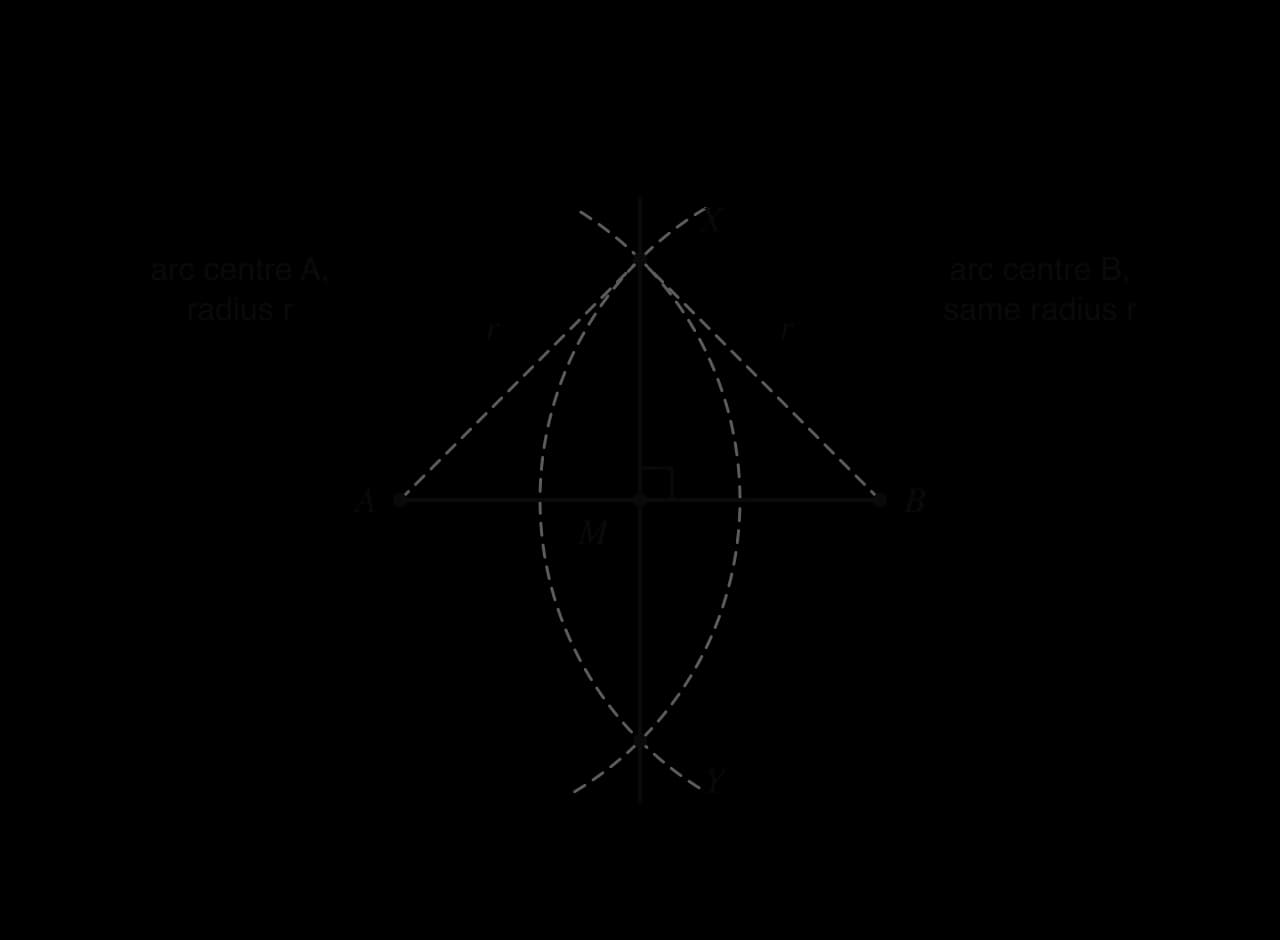
To bisect [AB]:
Open the compasses to a radius r more than half the length of [AB].
With the point on A, draw arcs above and below the segment.
With the same radius and the point on B, draw arcs that cross the first two at X and Y.
Draw the straight line through X and Y. It is the perpendicular bisector, and it crosses [AB] at its midpoint M.
The diagram of the construction shows why it works: X is a distance r from both A and B, so it is equidistant from them, and so is Y. Both points lie on the perpendicular bisector, and two points fix a line.
X and Y are each a distance r from both A and B, so the line through them is the locus of equidistant points: the perpendicular bisector.
If the radius is less than half of AB, the arcs do not meet, which is why step 1 needs a radius greater than half the segment. The four points A, X, B, Y form a rhombus with all sides r, and the diagonals of a rhombus bisect each other at right angles, which is a second explanation of the result.
YouTube
Revision Village, “Perpendicular Bisectors [IB Math AI SL/HL]”: watch the midpoint, negative reciprocal and point-gradient steps applied to sites on a grid, the same four-step method used throughout.
Exam focus
Perpendicular bisectors appear on Paper 1 as questions of 4–7 marks and inside longer Voronoi diagram questions on Paper 2 (and, at HL, Paper 3). The command terms are find (show the midpoint, the gradient, the perpendicular gradient and the substitution), write down (a bisector such as x=14 for a horizontal segment, needing no working), determine (a point equidistant from two places on a given line) and "give your answer in the form …" (y=mx+c, or ax+by+d=0 with a,b,d∈Z). A typical markscheme for a 4–5 mark bisector awards (A1) for the gradient of the segment, (A1) for the midpoint, (M1) for using the negative reciprocal, (M1) for substituting the midpoint into a line equation, and A1 for the final equation in the requested form. Midpoints must be written as coordinate pairs, in brackets.
In part (d) the segment [AC] is horizontal, so no gradient is needed: the bisector is the vertical line through the midpoint (5,4). Part (e) uses "hence", so the expected method intersects the bisectors already found rather than starting again.
Practice questions
Find the midpoint and the gradient of the segment joining (−2,1) and (6,5). [3]
Find the equation of the perpendicular bisector of the segment joining (−2,1) and (6,5), in the form y=mx+c. [3]
Write down the equation of the perpendicular bisector of the segment joining (5,−3) and (5,11). [1]
Find the perpendicular bisector of S(−1,4) and T(5,−6) in the form ax+by+d=0
A segment lies on the line y=4x−7 and has midpoint (2,1). Find the equation of its perpendicular bisector. [3]
Two wells are at W1(0,6) and W2(8,2) (in km). A pipeline follows y=−x+11
The perpendicular bisector of [CD] is y=−x+4, and D is (5,3). Find the coordinates of
Find the coordinates of the point equidistant from E(0,0), F(8,0) and G(0,6), and explain why it is the midpoint of [FG]
Show that the point (1,7) lies on the perpendicular bisector of A(−2,3) and B(5,4). [3]
Explain why three points on a straight line have no point that is equidistant from all three. [2]
Answers
Midpoint (2,3); gradient 84=21.
Perpendicular gradient −2: y−3=−2(x−2), so y=−2x+7
Vertical segment with midpoint (5,4): y=4.
Midpoint (2,−1); gradient 6−10=−35
Perpendicular gradient −41: y−1=−41(x−2)
Midpoint (4,4); gradient −21; bisector y=2x−4
Line through D with gradient 1: y=x−2; with y=−x+4: M=(3,1)
Bisector of [EF]: x=4; of [EG]: y=3; point (4,3)
Distance to A: 32+42=5
The bisectors of the two segments are both perpendicular to the same line, so they are parallel and never meet; no point lies on both.
Summary
A bisector cuts a segment or angle into two equal parts; the perpendicular bisector of [AB] passes through its midpoint at right angles.
Every point on the perpendicular bisector is equidistant from A and B, and every equidistant point is on it: it is the locus of points equidistant from A and B.
Method: midpoint, gradient of [AB], negative reciprocal, then y−y1=m(x−x1) through the midpoint.
Horizontal segments have vertical bisectors x=k; vertical segments have horizontal bisectors y=k.
Setting PA2=PB2 for a general point gives the bisector directly in general form.
Given a segment's equation and midpoint, take the gradient from the equation and proceed as before.
The point on a given line equidistant from two points is the intersection of that line with their bisector.
Two bisectors of a triangle's sides meet at the circumcentre, the centre of the circle through all three vertices.
Self-check
To do:
I can state the definition of a perpendicular bisector and of a locus.
To do:
I can explain, with Pythagoras' theorem or the distance formula, why points on the bisector are equidistant from the endpoints.
To do:
I can find the midpoint of a segment and write it as coordinates in brackets.
To do:
I can find the perpendicular gradient and check it by multiplying to get −1.
To do:
I can find the equation of a perpendicular bisector in the form y=mx+c.
To do:
I can rearrange it into ax+by+d=0 with integer coefficients.
To do:
I can write down the bisector of a horizontal or vertical segment.
To do:
I can find a bisector from a segment's equation and midpoint.
To do:
I can find where a bisector meets another line, by substitution or with my GDC.
To do:
I can find a missing endpoint from the other endpoint and the bisector.
To do:
I can find the circumcentre of three points and the radius of the circle through them.
To do:
I can check an answer by showing that a point on my line is equidistant from both points.
To do:
I can explain why the edges of a Voronoi diagram are parts of perpendicular bisectors.
(M1)
(5,5)A1
[2 marks]
(b)
Find the gradient of [AB].
[1]1 mark
Markscheme (b)
9−13−7=−21A1
[1 mark]
(c)
Find the equation of the perpendicular bisector of [AB]. Give your answer in the form y=mx+c.
[2]2 marks
Markscheme (c)
gradient of perpendicular =2(M1)
y−5=2(x−5)
y=2x−5A1
Note: Award the method mark for the negative reciprocal of their gradient from part (b). Follow through from parts (a) and (b).
[2 marks]
(d)
A straight road runs along the line y=7. Write down the coordinates of the point on the road that is equidistant from both wells.
[1]1 mark
Markscheme (d)
(6,7)A1
Note: Follow through from their equation in part (c).
[1 mark]
Question 2 · AI-002137 marks
Two villages, Arroyo and Bellavista, are shown on a map with a coordinate grid where one unit represents one kilometre. Arroyo is at A(2, 3) and Bellavista is at B(10, 7).
The council wants to build a water tower that is the same distance from both villages.
(a)
Find the coordinates of the midpoint of [AB].
[2]2 marks
(b)
Find the gradient of [AB].
[2]2 marks
(c)
Find the equation of the perpendicular bisector of [AB]. Give your answer in the form y=mx+c.
Two mobile phone masts are located at P(−4, 1) and Q(2, −3) on a coordinate grid. Every point on the boundary line between their coverage areas is equidistant from P and Q.
(a)
Find the equation of the perpendicular bisector of [PQ]. Give your answer in the form ax+by+d=0, where a,b,d∈Z.
[5]5 marks
(b)
Write down the coordinates of the point where the boundary line crosses the y-axis.
The perpendicular bisector is 5x+3y−28=0. Any non-zero integer multiple, such as 10x+6y−56=0, is also correct.
Dividing by 2 gives 5x+3y−28=0, the same line as the gradient method.
, and the bisector is the vertical line through it:
x=4
.
(b) [EF] is vertical (both x-coordinates are 4). Its midpoint is (4,2−1+9)=(4,4), and the bisector is the horizontal line through it: y=4.
The perpendicular gradient is −23. Through M(3,4):
y−42y−83x+2y−17=−23(x−3)=−3x+9=0
The perpendicular bisector is 3x+2y−17=0.
. Gradient of
[AB]
:
7−11−9=−34
. Perpendicular gradient:
43
.
y−5=43(x−4)⟹y=0.75x+2
(b) The centre lies on both lines:
0.75x+2=0.5x+4⟹0.25x=2⟹x=8,y=8
The health centre is at (8,8).
(c) (8−1)2+(8−9)2=50 and (8−7)2+(8−1)2=50, so each village is 50=7.07 km (3 s.f.) away. The equal distances confirm the answer.
Intersect with the bisector to find the midpoint:
2x−1=−0.5x+6.5⟹2.5x=7.5⟹x=3,y=5
So M=(3,5). Since M is the midpoint of [AB],
2xA+9=3,2yA+2=5⟹A=(−3,8).
Check: the gradient of [AB] is 9−(−3)2−8=−21, perpendicular to 2 ✓, and the midpoint is (3,5), which lies on y=2x−1 ✓.
. Gradient of
[PQ]
:
9−22−3=−71
, so the perpendicular gradient is 7.
y−2.5=7(x−5.5)⟹y=7x−36
(b) Substitute y=7x−36 into x+7y−48=0:
x+7(7x−36)−48=0⟹50x=300⟹x=6,y=6
With the GDC's simultaneous equation solver, enter 7x−y=36 and x+7y=48. The centre is (6,6).
(c) Radius =(6−2)2+(6−3)2=25=5 m. Check: 32+42=5 to Q and 42+32=5 to R ✓.
; perpendicular gradient
−34
.
y−6=−34(x−8)⟹4x+3y−50=0
For the ship, compare distances: to K, 102+42=116; to L, 62+82=100. The ship is closer to L, so it is in L's waters. As a check, 4(10)+3(4)−50=2>0, the same sign as for L (64+36−50=50>0), while K gives −50<0: the ship is on L's side of the line.
. [4]
(6,6)
A1
Note: award A0 if the brackets are omitted.
(b) gradient of [AB]=10−28−4=21(A1)
gradient of bisector =−2(M1)
y−6=−2(x−6)(M1)
2x+y−18=0A1
(c) −2x+18=x−3 (or a GDC intersection of the two lines) (M1)
(7,4)A1
(d) x=5A1
(e) substituting x=5 into 2x+y−18=0(M1)
(5,8)A1
distance =(5−2)2+(8−4)2(M1)
=5 kmA1
Total [13]
, where
a,b,d∈Z
. [4]
.
Find
the point on the pipeline equidistant from the two wells, and its distance from each. [6]
C
. [5]
. [5]
.
; perpendicular
53
:
y+1=53(x−2)
, so
3x−5y−11=0
.
, so
y=−0.25x+1.5
(or
x+4y−6=0
).
. With
y=−x+11
:
3x=15
, so
(5,6)
. Distances
52+02=5
km and
32+42=5
km.
;
C=(2×3−5,2×1−3)=(1,−1)
.
, 5 units from each. Angle
FE^G=90°
, so
[FG]
is a diameter of the circumcircle and its midpoint
(4,3)
is the centre.
; to
B
:
(−4)2+32=5
. Equal distances, so the point is on the bisector (the locus of equidistant points).
 YouTube