Notes on 3.11 Vector equations of lines
Learning objectives
Write down the vector equation of a line from a point on it and a direction vector, in two and three dimensions.
Find the vector equation of the line through two given points.
Convert between the vector equation of a line and its parametric equations.
Determine whether a given point lies on a line, and find an unknown coordinate of a point on a line.
Convert a two-dimensional line between the forms and .
Determine whether two lines are parallel, and show that two equations describe the same line.
Determine whether two lines in three dimensions intersect, are parallel or are skew, and find the point of intersection where it exists.
Interpret the parameter of a line in context, including rays and line segments.
Introduction
A straight line in a plane has a familiar equation, , built from a gradient and an intercept. That form does not work in three dimensions: a single gradient cannot describe a direction in space, and a single linear equation in , and describes a flat plane. The vector equation of a line solves both problems at once. It describes a line by one point on it and one direction along it, and it works in exactly the same way in two dimensions and in three.
Straight paths in space appear wherever things travel or are built in straight lines: the flight path of an aircraft between turns, a submarine on a fixed course, a laser beam, a tunnel bored through rock, the ray from a viewer's eye that a computer follows to decide what colour a pixel should be. Questions such as "does this path pass through that point?", "do these two paths meet?" and "where?" become equations in one or two unknown numbers.
 YouTube
The vector equation of a line
A point and a direction
A line is fixed by one point on it and its direction. Let be a known point on the line, with position vector from subtopic 3.10, and let be a non-zero vector pointing along the line. Starting at , every other point on the line can be reached by moving some multiple of
As runs through all real numbers, runs through the position vectors of every point on the line, and of no other point. A point not on the line cannot be reached from by moving along , because
The vector has a name of its own, because its role is different from that of . The position vector says where the line is; the direction vector says which way it goes.
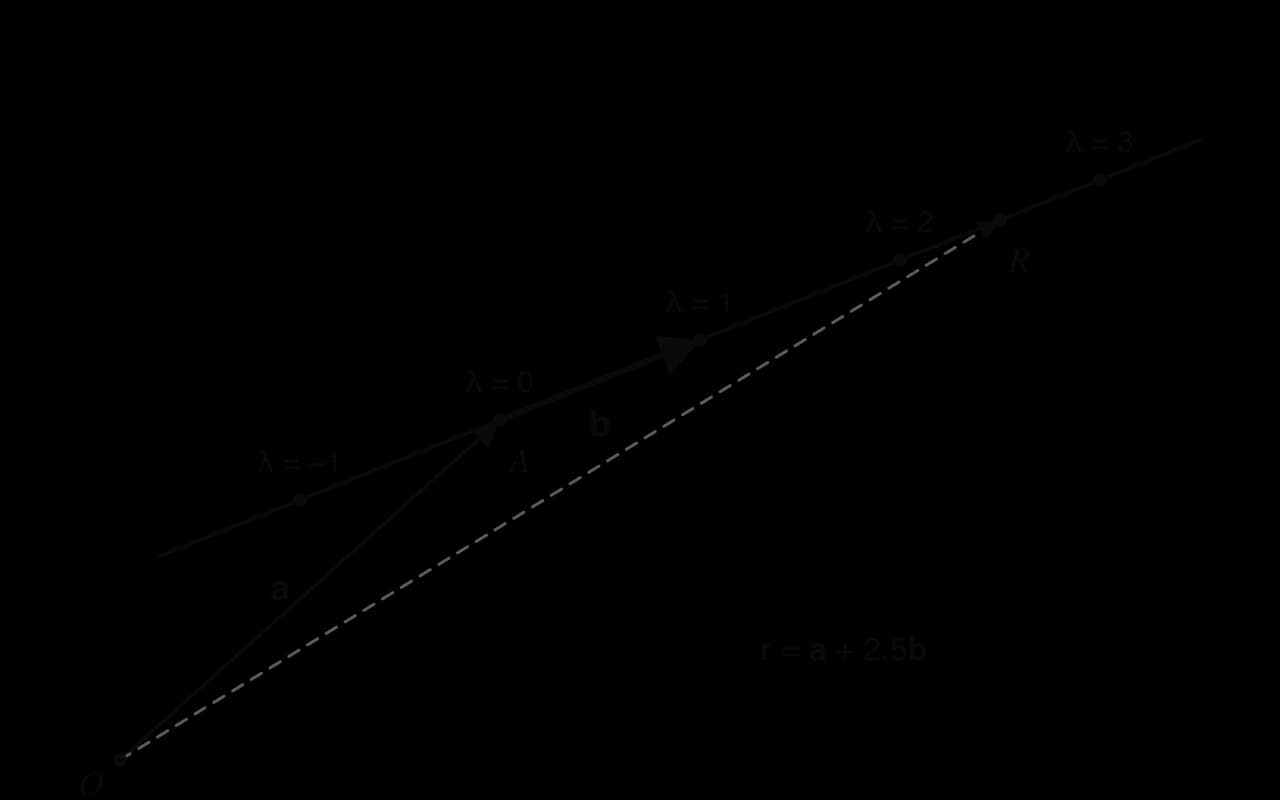
The diagram shows a line through with direction vector . Each value of gives one point, equally spaced along the line; the point with has position vector
The parameter λ
The number (the Greek letter lambda) is the line's parameter: a variable that labels the points of the line. It counts how many steps of length separate from , with a sign showing which way. Other common letters are (mu),
The size of has a simple meaning. The distance from to the point with parameter is . If
Rays and line segments
Restricting the parameter gives part of a line. Taking only gives the points from onwards in the direction of , a half-line that starts at and never ends.
Computer graphics uses rays in this way. To decide what a viewer sees through one pixel of a screen, a ray tracing program sends a ray from the eye through the pixel, with , and finds the object it hits first, the one with the smallest positive
The line through two points
When a line is given by two points and , the direction vector is the displacement between them,
A direction vector can be replaced by any non-zero multiple of itself, so common factors can be removed. The direction
The example shows that a line has infinitely many vector equations: any point on it can serve as , and any non-zero multiple of a direction vector can serve as . Two equations that describe the same set of points are said to give the same line.
Parametric equations of a line
The vector equation holds one equation for each coordinate. Writing
The parametric form is the working form for almost every calculation. Testing a point, finding where a line reaches a given height, or finding where two lines meet all come down to one component equation at a time. In two dimensions there are just two equations, for and .
Points on a line
Testing whether a point lies on a line
A point lies on a line exactly when one value of the parameter produces all of its coordinates. The method uses one parametric equation to find the only possible value of , and then checks that value in the remaining equations.
Write the parametric equations.
Use the simplest equation to find .
Substitute that into the other equations.
If every coordinate matches, the point is on the line; if any one fails, it is not.
Using the line
Collinear points
Three points lie on one straight line when the third is on the line through the first two. In vector terms, and
The two tests are the same calculation: is on the line exactly when
Unknown coordinates
When a point on a line has missing coordinates, the known coordinate gives , and gives the rest.
Lines in two dimensions
From y = mx + c to vector form
The vector equation works in a plane with two-component vectors. A line from subtopic 2.1, Equations of straight lines, passes through its -intercept , and its gradient means a rise of
Conversely, a direction vector with gives a gradient of
To go from vector form back to , the parameter is removed: solve one parametric equation for and substitute into the other.
The graph of marks the points given by and 2. Equal steps in give equal steps of 3 across and 2 down, which is the direction vector, and the gradient of the line is
Parallel lines
Two lines are parallel when their direction vectors are parallel, that is, when one direction vector is a scalar multiple of the other. This extends the 2D rule that parallel lines have equal gradients to three dimensions, where gradients are not available. The test for parallel vectors from subtopic 3.10 applies directly.
Parallel lines either never meet or are the same line. To tell which, test whether a point of one lies on the other: if it does, the lines are coincident; if not, they are parallel and distinct.
Intersecting lines
The method
Two lines meet if some point lies on both. That point has a parameter on the first line and a parameter on the second, and in general these are different numbers, because the point is a different number of steps from each line's starting point.
Setting the two position vectors equal gives one equation for each component, with two unknowns and . In two dimensions there are two equations, which have a single solution unless the lines are parallel. In three dimensions there are three equations in two unknowns, more equations than unknowns, so a solution of two of them may not satisfy the third. The method is:
Write the lines with different parameters, and .
Equate the -, - and -components.
Solve two of the equations simultaneously, by hand or with the GDC's simultaneous equation solver (on a TI-84 Plus CE:
APPS→PlySmlt2→ SIMULTANEOUS EQN SOLVER; on a Casio fx-CG50:MENU→Equation→SIMUL).Substitute
The equations in step 3 form a system of linear equations in and , which subtopic 1.8 solves with technology. Each equation has to be rearranged into the form before it is entered.
Skew lines
In a plane, two lines that are not parallel always meet. In space, two lines can point in different directions and still miss each other, one passing over the other. A road bridge crossing a railway at an angle is an everyday example, and so is a diagonal across a room's floor and a different diagonal across its ceiling.
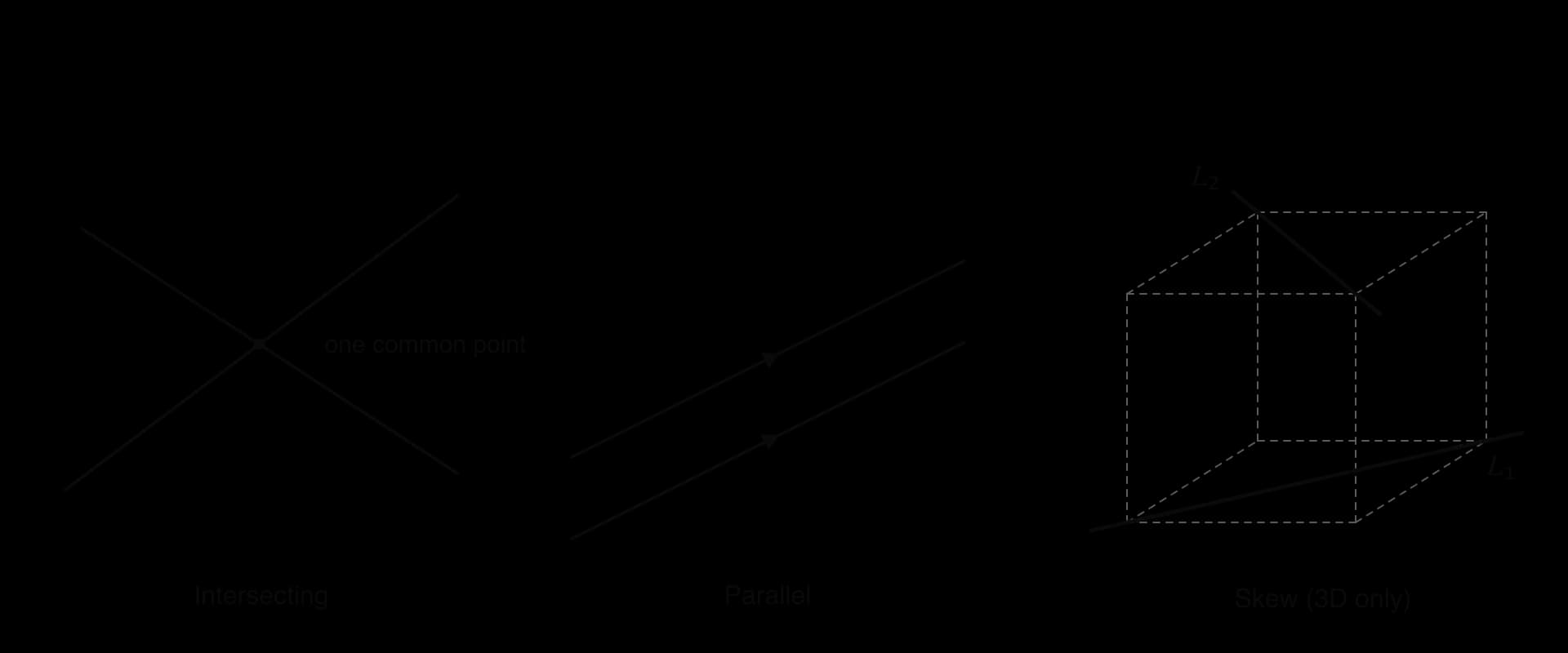
The three-panel diagram compares the cases. Intersecting lines share one point, parallel lines have the same direction and never meet, and skew lines, such as the floor diagonal and the ceiling diagonal of a box, have different directions but never meet either.
Deciding which case applies
Every pair of lines falls into exactly one of four cases, decided by two questions: are the directions parallel, and is there a common point? The table summarises the method.
Directions parallel? | Common point? | Relationship | How it shows in the equations |
|---|---|---|---|
yes | yes | coincident | a point of one line satisfies the other |
yes | no | parallel, distinct | a point of one line fails the other |
no | yes | intersecting | two equations give ; the third holds |
no | no | skew (3D only) | two equations give ; the third fails |
A GDC can sometimes carry out the whole test at once. Solvers that allow more equations than unknowns accept three equations in two unknowns and report that there is no solution when the lines are skew; others need a square system, in which case two equations are solved and the third is checked by hand. Either way, the working to write down is the three component equations, the values of and , and the check of the third equation with its conclusion.
Two flight paths on a radar screen
A radar display shows aircraft from above, so it shows only the - and -coordinates. Two flight paths that cross on the screen may still be at different heights where they cross. In three dimensions such paths are skew, and the vertical separation where they appear to cross is what matters for safety.
Case study: The Channel Tunnel breakthrough
The Channel Tunnel links Folkestone in England with Coquelles in France through a 50.46 km railway tunnel, opened in 1994. It was bored from both ends at once, so each team followed a planned straight-line course and the two courses had to meet under the sea. The service tunnel broke through on 30 October 1990, and the ceremonial breakthrough, when workers from each side met, followed on 1 December 1990. The two bores were found to be misaligned by only 30 cm horizontally and 8 cm vertically.
Source: Wikipedia, "Channel Tunnel" (accessed 2026).
A simplified model shows what such a misalignment means mathematically. Place the origin at the English starting point, with along the tunnel, horizontal across it and vertical, in metres, and suppose (hypothetically) that each team bores 19 km on a straight, gently descending course. The planned meeting point is .
The planned lines intersect at , where . Now suppose the French bore actually heads for a point 30 cm to the side of and 8 cm above it,
The -equation forces , and then the -equation gives . The -equation becomes
The model shows a general fact about lines in space. Two lines chosen with slightly uncertain directions are skew almost every time, because intersection needs the third equation to hold exactly. For this reason engineers ask how close two bores come rather than whether they meet exactly. A tunnel several metres wide can join two bores 30 cm apart, so the breakthrough was a success. A gap of 30 cm after about 38 km of combined tunnelling in the model measures the precision of the surveying, which was very high.
Exam focus
Vector equations of lines appear on HL Paper 1 and Paper 2, often in context: a ship or submarine on a straight course, an aircraft approaching an airport, a laser, a tunnel or a pipe. Common parts are write down an equation from a point and a direction (1–2 marks), find the equation through two points, find where a line reaches a given height or crosses a given line, show that a point lies on a line, and determine whether two lines intersect, with the check of the third equation earning a reasoning mark. Lines are often combined with the scalar product (perpendicular lines, the angle between lines; subtopic 3.13) and with motion (subtopic 3.12), where the parameter is time.
Write the parametric equations explicitly before solving, name the method ("equating components", "solving and simultaneously"), and show the third-equation check with a conclusion. When the GDC solves the system, write down the equations entered and the values of and it gives. A point asked for as coordinates should be given as coordinates.
The values of and in part (c) do not depend on , because appears only in the -component. Spotting which equations are free of the unknown, and solving those first, is the key step in questions with a parameter in a line.
Practice questions
Write down a vector equation of the line through with direction vector . [2]
Find a vector equation of the line through
Answers
Summary
The vector equation of a line is : is the position vector of a point on the line, a direction vector, a real parameter. Always write "
Self-check
- To do:
I can write down from a point and a direction, with "" included.
- To do:
I can find the equation of a line through two points and simplify its direction vector.
- To do:
I can explain what a value of