3.8 The unit circle and trigonometric equations · IB Maths AI | Augment Education
3.8 The unit circle and trigonometric equations
Define sine and cosine for any angle on the unit circle, use tan θ = sin θ/cos θ and cos²θ + sin²θ = 1, handle the ambiguous case of the sine rule, and solve trigonometric equations graphically.
IB Mathematics: Applications and Interpretation
Part of 3 Geometry and trigonometry
HL only
Key terms introduced here
Each is in the Maths AI glossary, with every other term in the subject.
The situation in which two sides of a triangle and an angle that is not between them are given, and the data fit two different triangles, one with an acute angle and one with the obtuse supplement of that angle.
One of the four regions into which the x- and y-axes divide the coordinate plane, numbered 1 to 4 anticlockwise starting from the region where both coordinates are positive.
An angle drawn with its vertex at the origin, its first arm along the positive x-axis, and measured anticlockwise to its second arm; a negative angle is measured clockwise.
The circle of radius 1 with its centre at the origin of a coordinate grid.
Notes on 3.8 The unit circle and trigonometric equations
35 min readLast reviewed
Learning objectives
State the definitions of cosθ and sinθ as the coordinates of a point on the unit circle, for any angle θ.
Explain how the graphs of y=sinx and y=cosx are built from the unit circle, and write down their key features.
Determine the sign of sinθ, cosθ and tanθ in each quadrant, and use the symmetries of the unit circle to relate angles.
Use the definition tanθ=cosθsinθ.
Use the Pythagorean identity cos2θ+sin2θ=1 to find one trigonometric value from another.
Determine whether two sides and a non-included angle give no triangle, one triangle or two triangles, and find every possible triangle with the sine rule or the cosine rule.
Solve trigonometric equations graphically in a finite interval using technology, finding every solution in the interval.
Interpret the solutions of a trigonometric equation in the context of a rotating or repeating situation.
Introduction
In a right-angled triangle, sine, cosine and tangent are ratios of sides, so they only make sense for angles between 0° and 90°. Rotating objects, waves, tides and alternating currents turn through angles of any size, many times over, and their mathematics needs a sine and cosine for every angle. The unit circle provides them by taking cosθ and sinθ to be the coordinates of a point on a circle of radius 1, whatever the angle.
This one definition explains why the sine rule can give two different triangles from the same data, why the graphs of sine and cosine repeat every 2π, and why a trigonometric equation such as sinx=0.4 has many solutions. Equations of this kind arise whenever the time at which a rotating or oscillating quantity reaches a particular value is needed.
The unit circle
The definitions start with a circle of radius 1, because then the hypotenuse of every right-angled triangle drawn from its centre is 1, and the ratios become plain lengths.
Every angle is measured from the same starting line and in the same direction, so that each angle corresponds to exactly one point on the circle.
Cosine and sine as coordinates
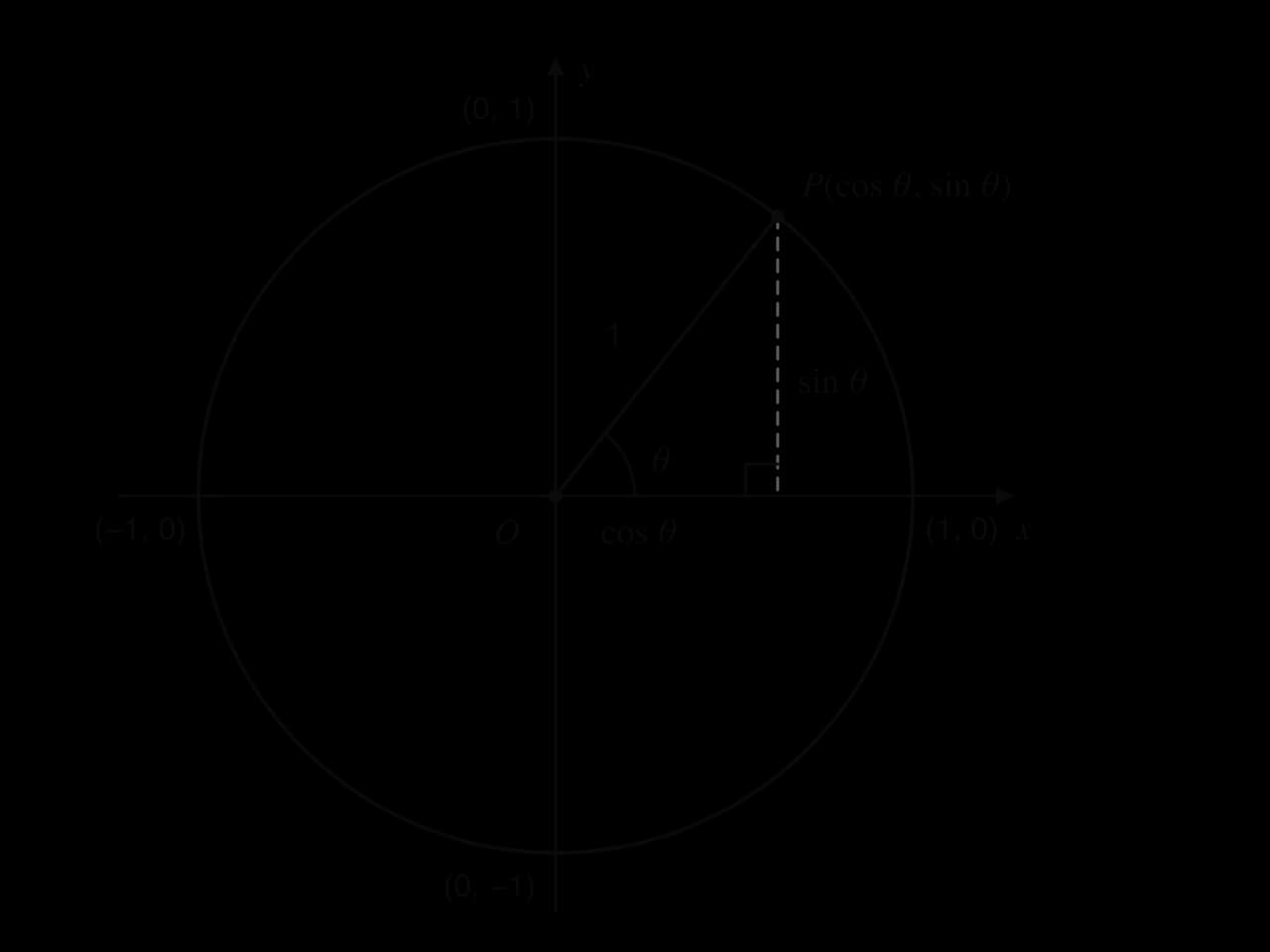
Draw an angle θ in standard position and let its second arm meet the unit circle at the point P. For an acute angle, dropping a perpendicular from P to the x-axis makes a right-angled triangle with hypotenuse 1. By the cosine ratio the horizontal side is 1×cosθ=cosθ, and by the sine ratio the vertical side is 1×sinθ=sinθ
For an acute angle, the right-angled triangle inside the unit circle has hypotenuse 1, so its horizontal and vertical sides are cos θ and sin θ: the coordinates of P.
The unit circle figure shows this triangle. For acute angles the coordinates and the triangle ratios agree. For every other angle there is no triangle to start from, so the coordinates themselves become the definition.
Extending a definition in this way is an example of generalization: the new definition agrees with the old one wherever the old one made sense (acute angles), and also gives a value wherever the old one did not (0, obtuse angles, reflex angles, negative angles and angles of more than a full turn). The four points where the circle meets the axes give the values at quarter-turns directly.
θ
0
2π (90°)
π (180°)
23π
Because every point on the unit circle has both coordinates between −1 and 1, sine and cosine always take values in the interval −1≤y≤1. An equation such as sinθ=1.2 therefore has no solution.
Quadrants, signs and symmetry
The four quadrants
The axes divide the plane into four regions, numbered anticlockwise from the top right. The sign of each coordinate, and so of each trigonometric value, depends only on which region the arm of the angle lies in.
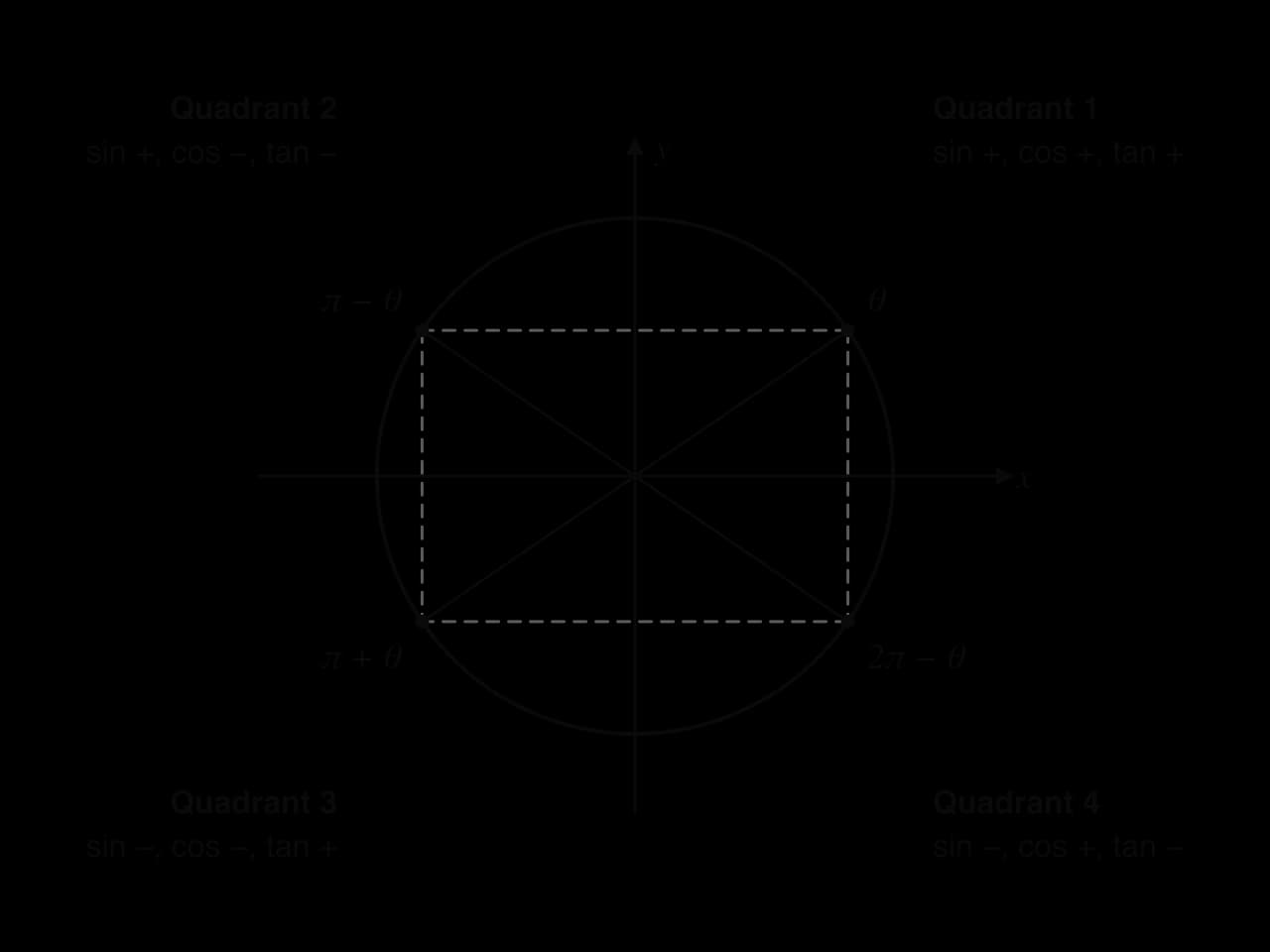
The four points at θ, π − θ, π + θ and 2π − θ are reflections of one another, so their sines and cosines have the same size and differ only in sign.
The quadrant diagram shows the signs in each region. In quadrant 1 all three functions are positive; in quadrant 2 only the sine; in quadrant 3 only the tangent; in quadrant 4 only the cosine. Some books remember this as "CAST", reading the positive function in each quadrant anticlockwise from quadrant 4: Cosine, All, Sine, Tangent.
Quadrant
Angles (radians)
Angles (degrees)
sinθ
cosθ
tanθ
1
0<θ<2π
Symmetries of the unit circle
The quadrant diagram also shows that the four points at θ, π−θ, π+θ and 2π−θ are mirror images of one another in the axes. Reflecting the point
The angle −θ is measured clockwise, so it ends at the same point as 2π−θ. The first line matters most in practice, because it is the reason the sine rule can give two different triangles from the same data.
In degrees, sin(180∘−θ)=sinθ says that an acute angle and the obtuse angle that makes it up to 180° share the same sine. The inverse sine on a GDC only ever returns the acute one.
Angles beyond a full turn
An angle of 2π+θ is a full turn followed by θ, so it ends at exactly the same point as θ. Any whole number of extra turns, in either direction, makes no difference to the point, and so no difference to the sine or the cosine.
sin(θ+2kπ)=sinθ,cos(θ+2kπ)=cosθ(k∈Z)
The smallest such p is the period of the function, the length of one complete cycle. Periodicity is the reason trigonometric functions model repeating situations: the height of a point on a turning wheel, the depth of water in a tidal harbour, the voltage of an alternating current.
The graphs of sine and cosine
As the angle θ increases from 0 to 2π, the point P travels once round the unit circle anticlockwise. Plotting its y-coordinate against the angle gives the graph of y=sinθ; plotting its x-coordinate gives y=cosθ
From 0 to 2π, P climbs from (1,0) to (0,1): the sine rises from 0 to 1 and the cosine falls from 1 to 0.
From 2π
After 2π the point retraces the same path, so the graphs repeat.
The graph of sine and cosine shows two curves of exactly the same shape. The cosine curve is the sine curve shifted 2π to the left, because the x-coordinate of a point at angle θ equals the y-coordinate of a point a quarter-turn further round: cosθ=sin(θ+2π)
Feature
y=sinx
y=cosx
Value at x=0
0
1
Maximum value
1, at x=2π
These two curves are the building blocks of every sinusoidal model in subtopic 2.5: stretching them vertically changes the amplitude, stretching them horizontally changes the period, and moving them up or down changes the principal axis.
YouTube
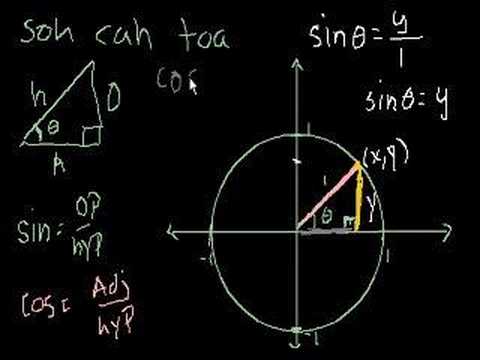
Khan Academy, “Unit circle definition of trig functions”: watch how the coordinates of a point on the unit circle give the sine and cosine of any angle, including obtuse and negative ones.
The Khan Academy video works through the same definition as the unit circle figure, showing the coordinates of the point changing sign as the angle passes into the second, third and fourth quadrants.
The tangent function
In a right-angled triangle, tanθ=adjacentopposite. In the unit-circle triangle the opposite side is sinθ and the adjacent side is cosθ
The tangent has a geometric meaning on the unit circle. The radius OP runs from (0,0) to (cosθ,sinθ), so its gradient is cosθ−0sinθ−0=tanθ
The sign of tanθ follows from the signs of sine and cosine: positive when they agree (quadrants 1 and 3) and negative when they differ (quadrants 2 and 4). The arms at θ and θ+π point in opposite directions along the same line, so they have the same gradient, and the tangent has period π, half the period of sine and cosine.
The tangent graph shows vertical asymptotes where the cosine is zero, because division by zero is undefined there. Between the asymptotes the curve rises through every real value, so an equation such as tanx=50 has solutions, while sinx=50 has none.
The Pythagorean identity
The point (cosθ,sinθ) lies on the unit circle, whose equation is x2+y2=1. Substituting the coordinates gives a result true for every angle. Equivalently, for an acute angle, Pythagoras' theorem in the unit-circle triangle with legs cosθ
cos2θ+sin2θ=1
Here sin2θ means (sinθ)2, the square of the sine. An equation that holds for every value of its variable has a special name.
An equation such as sinθ=0.4 is true only for particular angles, so it is solved; an identity is true for all angles, so it is used to rewrite one expression as another. The identity used most often comes straight from the equation of the unit circle.
Finding one value from another
The identity gives cosθ from sinθ (or the reverse), but only up to its sign, because squaring loses the sign. The quadrant of the angle decides which sign is correct.
Exact values (for understanding only)
Two triangles give exact values for the angles 6π, 4π and 3π
Table of exact values
θ
6π (30°)
4π
The ambiguous case of the sine rule
The sine rule of subtopic 3.2 finds an angle from the sine of that angle. Because sinθ=sin(180∘−θ), every sine between 0 and 1 belongs to two angles in a triangle's range of 0° to 180°: an acute one and its obtuse supplement. The GDC's sin−1 gives only the acute angle. When the obtuse angle also fits in a triangle with the given data, there are two different triangles, and both must be found.
Why two triangles can exist
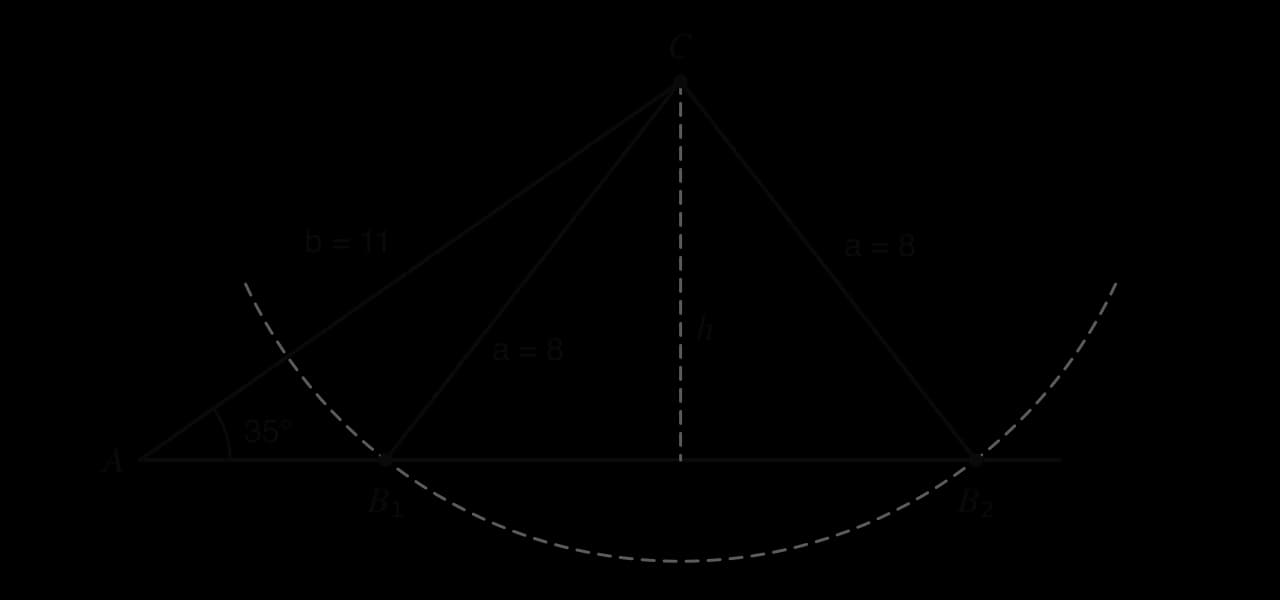
Suppose angle A and the side b=AC next to it are fixed, and the side a=BC opposite A has a given length. The vertex C is fixed, and B must lie on the base line from A at a distance a from C. The possible positions of B are the points where a circle of radius
The side a = 8 can swing to meet the base line at B₁ or B₂, because it is longer than the height h = 11 sin 35° ≈ 6.31 but shorter than b = 11. The angle at B₁ is the supplement of the angle at B₂.
The ambiguous-case figure shows the arc of radius 8 crossing the base line at two points. Triangle CB₁B₂ is isosceles (both sides from C are 8), so its base angles are equal, and the angle AB^1C is the supplement of that base angle. That is the geometric reason the two angles at B are θ and 180∘−θ
When there are no, one or two triangles
The number of triangles depends on how the length a compares with the perpendicular height from C to the base line, h=bsinA, and with b.
Given angle A
Condition on a
Number of triangles
Why
acute
a<bsinA
0
the side is too short to reach the base line
acute
a=bsinA
In practice, a calculation with the sine rule shows which case applies without the table:
Find sinB=absinA. If this is greater than 1, there is no triangle (the GDC gives an error for sin−1
The cosine-rule method
The cosine rule gives both triangles at once, as the two roots of a quadratic. Taking the unknown side as x and writing the cosine rule for the given angle gives an equation of the form x2−(2bcosA)x+(b2−a2)=0
Ambiguous triangles in radians
The same reasoning works in radians, with π−θ as the second angle: the GDC must then be in radian mode, and the angle sum of a triangle is π.
Solving trigonometric equations graphically
An equation in which the unknown is an angle inside a trigonometric function is solved for the angles that make it true.
Why there is more than one solution
The equation sinx=0.4 asks for the angles whose unit-circle point is at height 0.4. The horizontal line y=0.4 crosses the unit circle twice, at x=sin−1(0.4)
The graph of y=sinx and y=0.4 shows both solutions in 0≤x≤2π and their symmetry about the peak at 2π
The graphical method with technology
Most trigonometric equations in applications cannot be rearranged neatly, so they are solved by graphing. The method has the same steps every time.
Check the angle unit and set the GDC to radian or degree mode.
Enter the left side as Y1 and the right side as Y2 (or rearrange to f(x)=0
This is the graphical solution method of subtopic 2.4, applied to periodic functions. The number of solutions is visible on the screen, so the method finds solutions that the inverse function on its own would miss.
Many equations mix trigonometric and other functions, cannot be solved by algebra at all, and are solved by graphing.
Equations in context
When a trigonometric function models a rotating or repeating quantity, solving an equation answers the question "when does the quantity reach this value?". The interval comes from the time period in the question, and every solution in it is a moment when the value is reached.
The graph of the bucket's height shows each answer: the four crossings of h=4, the two 10-second stretches above that line, and the short dips below the water level at the start and end of each revolution. Reading the graph before calculating helps to avoid missing a solution or giving one outside the interval.
YouTube
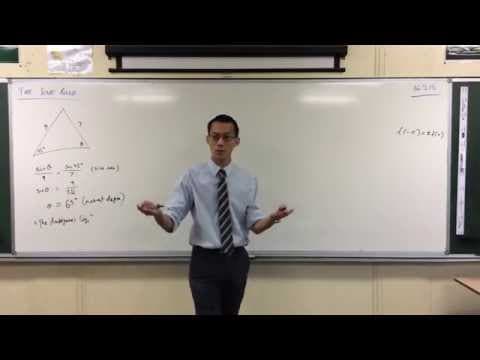
Eddie Woo, “Sine Rule: The Ambiguous Case”: watch how a side of fixed length swings to meet the base line at two points, and why the two angles found are supplementary.
The Eddie Woo video works through the ambiguous case with the same swinging-side construction as the ambiguous-case figure, and is a useful review of the conditions for two triangles before attempting mixed questions.
Exam focus
The unit circle and trigonometric equations are examined on HL Papers 1 and 2, usually inside larger questions. The ambiguous case appears as a triangle or enclosure problem: show that two triangles exist, find both possible angles or sides (by the sine rule with 180∘−θ, or by solving the cosine-rule quadratic), and then find or compare their areas, often choosing the triangle that fits a condition. Graphical equation solving appears inside sinusoidal-model questions from subtopics 2.5 and 2.9: find the times when a height or depth reaches a given value, or the total time it stays above a level. Identities are used to findcosθ or tanθ
The most common lost marks are a missing obtuse angle, a GDC in degree mode for an angle given in radians, and solutions outside the interval. In (b), giving only 1.01 loses an A1 and every later mark that needs the second triangle.
When a question asks you to choose between two triangles (the larger area, the shorter side, an obtuse angle), find both first and then state which one is chosen and why. Calculus is not needed to "maximise" the area, because there are only two candidates to compare.
Practice questions
An angle of 5 radians is drawn in standard position. Find the coordinates of the point where its arm meets the unit circle, and state the quadrant. [3]
Find all values of x, 0≤x≤2π, for which cosx=−0.3. [3]
Given that sinθ=−0.35
Answers
(cos5,sin5)=(0.284,−0.959); quadrant 4, since 23π≈4.71<5<2π
Summary
On the unit circle (radius 1, centre the origin), the point at angle θ in standard position is (cosθ,sinθ); this defines sine and cosine for every angle, and both take values from −1 to 1.
Signs by quadrant: all positive in quadrant 1; only sine in 2; only tangent in 3; only cosine in 4.
Symmetries: sin(π−θ)=sinθ
Self-check
To do:
I can state the coordinates of the point on the unit circle at any angle θ.
To do:
I can find sinθ and cosθ at 0, 2π
Questions on 3.8
39 exam-style questions on this subtopic, written in the style of the IB papers. The first has its markscheme open. Counted on
Question 1 · AI-0015314 marks
The Riverside Wheel is a large observation wheel with radius 40 m. Its centre is 45 m above the ground. The wheel turns anticlockwise at a constant speed and completes one rotation every 15 minutes. There are 24 passenger capsules, equally spaced around the rim.
(a)
Write down, in radians, the angle at the centre of the wheel between two adjacent capsules. Give your answer as an exact multiple of π.
[1]1 mark
Markscheme (a)
12πA1
[1 mark]
(b)(i)
Find the distance between two adjacent capsules, measured along the rim.
[2]2 marks
Markscheme (b)(i)
40×12π(M1)
10.5 m(310π,10.4719…)
(b)(ii)
Find the straight-line distance between two adjacent capsules.
[2]2 marks
Markscheme (b)(ii)
EITHER
402+402−2(40)(40)cos12π
(c)
Write down the angular speed of the wheel in radians per minute.
[1]1 mark
Markscheme (c)
152π(0.419)A1
[1 mark]
(d)
Find the distance travelled by a capsule in 4 minutes.
[2]2 marks
Markscheme (d)
40×4×152π(M1)
67.0 m
(e)
Valentina boards a capsule at the lowest point of the wheel at time t=0. Her height above the ground, h metres, t minutes later is modelled by
h(t)=45−40cos(152πt).
(f)
Find the length of time, during one rotation, for which Valentina is more than 70 m above the ground. Give your answer in minutes.
[4]4 marks
Markscheme (f)
45−40cos(152πt)=70
Question 2 · AI-0015617 marks
A pendulum consists of a small bob on a light rod of length 1.2 m. The angle, θ radians, between the rod and the vertical t seconds after the bob is released is modelled by
θ(t)=0.3cos(2.5t),t≥0.
Question 3 · AI-0042220 marks
A car is tested on an elliptical track. Its position vector, in metres, relative to the centre of the track, t seconds after the test begins is
r=(400cos(0.05t)250sin(0.05t)).
From the formula booklet
The entries of the mathematics: applications and interpretation formula booklet that 3.8 uses. Each opens in the explained booklet.
, the ambiguous case of the sine rule, and the graphical solution of trigonometric equations in a finite interval with technology. Exact values of the trigonometric functions are not assessed, and no algebraic solution of equations using further identities is required. Sinusoidal models (amplitude, period, principal axis) are taught in subtopic 2.5, Modelling with functions, and subtopic 2.9, Further modelling.
. The coordinates of P are therefore
(cosθ,sinθ)
.
.
, because a quarter-turn ends at the point
(0,1)
.
(270°)
2π (360°)
Point on the circle
(1,0)
(0,1)
(−1,0)
(0,−1)
(1,0)
cosθ
1
0
−1
0
1
sinθ
0
1
0
−1
0
.
(b) 2.3 lies between 2π≈1.571 and π≈3.142, so the arm is in the second quadrant, the top-left quarter of the plane. Points there are to the left of the y-axis (negative x) and above the x-axis (positive y), so the cosine is negative and the sine is positive.
Check: (−0.66627)2+0.745702=0.4439+0.5561=1.0000, so the point is on the unit circle.
in standard position lies in the third quadrant.
0° to 90°
+
+
+
2
2π<θ<π
90° to 180°
+
−
−
3
π<θ<23π
180° to 270°
−
−
+
4
23π<θ<2π
270° to 360°
−
+
−
(cosθ,sinθ)
in the
y
-axis changes the sign of its
x
-coordinate and keeps its
y
-coordinate, and so on. Each reflection gives a pair of results.
.
Show the solution
Sine is the y-coordinate. The points with the same y-coordinate as the point at 0.7 are that point itself and its reflection in the y-axis, at π−0.7.
θ=0.7orθ=π−0.7=2.44(2.4415…)
Cosine is the x-coordinate. The points with the same x-coordinate are the point itself and its reflection in the x-axis, at 2π−0.7.
θ=0.7orθ=2π−0.7=5.58(5.5831…)
Check on the GDC: sin2.4415…=0.644 and cos5.5831…=0.765, matching sin0.7=0.644 and cos0.7=0.765
radians (360°).
. Following the point quarter-turn by quarter-turn builds the shapes:
to
π
, P moves to
(−1,0)
: the sine falls back to 0 and the cosine falls to −1.
From π to 23π, P moves to (0,−1): the sine falls to −1 and the cosine rises to 0.
From 23π to 2π, P returns to (1,0): the sine rises to 0 and the cosine rises to 1.
y = sin x
y = cos x
One cycle of each curve: the sine starts at 0 and rises, the cosine starts at 1 and falls. Each curve has range −1 ≤ y ≤ 1 and repeats every 2π.
.
1, at x=0 and 2π
Minimum value
−1, at x=23π
−1, at x=π
Zeros in 0≤x≤2π
0,π,2π
2π,23π
Range
−1≤y≤1
−1≤y≤1
Period
2π
2π
, so the
tangent ratio
becomes
cosθsinθ
. This quotient makes sense for any angle with
cosθ=0
, and it is taken as the definition.
.
tan43π=−1, because at 43π the sine and cosine have equal size and opposite signs.
. The tangent of an angle is the gradient of its arm. A steep arm has a large tangent; a horizontal arm (at 0 or
π
) has tangent 0; a vertical arm (at
2π
or
23π
) has no gradient, and
tanθ
is undefined there.
y = tan x
y = tan(x)
y = tan(x)
The tangent graph has vertical asymptotes where cos x = 0, at x = π/2 and 3π/2, and repeats every π; unlike sine and cosine its range is all real numbers.
The answer agrees with the GDC's tan2.3 in radian mode. The angle is in the second quadrant, where the sine is positive and the cosine negative, so the quotient is negative. Geometrically, the arm at 2.3 rad slopes down from left to right through the origin, so its gradient is negative.
and
sinθ
and hypotenuse 1 gives the same equation.
with
cosθ=0
.
, then
cos2θ=1−0.36=0.64
, so
cosθ=±0.8
.
, with the sine rule, cosine rule and
21absinC
from subtopic 3.2. The unit-circle definitions, the signs in each quadrant and the symmetries such as
sin(π−θ)=sinθ
are not listed and need to be understood.
.
(a) Find the value of sinθ. [3]
(b) Hence find the value of tanθ. [2]
Show the solution
(a) Use the Pythagorean identity.
sin2θ=1−cos2θ=1−0.282=1−0.0784=0.9216
So sinθ=±0.9216=±0.96. The angle is in the fourth quadrant, below the x-axis, where the sine is negative. Therefore sinθ=−0.96
(b) tanθ=cosθsinθ=0.28−0.96=−724=−3.43
Check: θ=2π−cos−1(0.28)=2π−1.2870=4.9962, and sin4.9962=−0.960
must be entered as
(sin(1.2))2
, which is 0.869; entering
sin(1.22)
gives
sin1.44=0.991
, a different number. The square applies to the value of the sine, not to the angle.
: half of an equilateral triangle with side 2 (angles 30°, 60°, 90°; sides 1,
3
, 2) and an isosceles right-angled triangle with legs 1 (angles 45°, 45°, 90°; hypotenuse
2
). They are useful for checking the shape of a graph or a GDC answer, and each satisfies the Pythagorean identity.
(45°)
3π (60°)
sinθ
21
22
23
cosθ
23
22
21
tanθ
33
1
3
For 6π: (23)2+(21)2=43+41=1.
say that two different expressions have the same value for every angle. Replacing one form by the other changes the appearance of a calculation without changing its value, which is how one trigonometric value is found from another.
can be 52.1° or 127.9°.
a
centred at C meets the base line, and a circle can cross a line twice.
.
1 (right-angled at B)
the arc just touches the base line
acute
bsinA<a<b
2
the arc crosses the base line twice on the same side of A
acute
a≥b
1
the second crossing is behind A, so it gives no triangle
right or obtuse
a>b
1
only the acute value of B fits
right or obtuse
a≤b
0
two angles of 90° or more cannot be in one triangle
).
Find B1=sin−1(sinB), the acute value, and B2=180∘−B1, the obtuse value.
Check each value: it gives a triangle only if A+B<180∘. Both may pass, or only B1.
For each valid B, find C=180∘−A−B and then the third side with the sine rule.
.
(a) Show that two triangles fit this information. [2]
(b) Find the two possible values of AB. [5]
(c) Find the difference between the areas of the two triangles. [3]
Show the solution
(a) The height from C to the line AB is 11sin35∘=6.309… cm. Since 6.309<8<11, the side BC is longer than the height but shorter than AC, so two triangles exist.
(b) Use the sine rule for angle B.
11sinB=8sin35∘⇒sinB=811sin35∘=0.78866…
B1=sin−1(0.78866…)=52.061∘ and B2=180∘−52.061∘=127.939∘
Using the GDC's polynomial root finder (with the unrounded coefficient 20cos32∘): x=13.05… or x=3.906….
Both roots are positive, so there are two possible positions. The ship is 3.91 km or 13.1 km from port: its course crosses the circle of radius 7 km around the lighthouse twice, once on entering it and once on leaving it.
.
Find
the two possible sizes of angle
Q^
, and the corresponding lengths of PQ.
Show the solution
The side opposite P^ is QR = 4.5, and the side next to P^ is PR = 6. The height is 6sin0.6=3.39, and 3.39<4.5<6, so two triangles exist.
sinQ^=4.56sin0.6=0.75286…
Q^1=sin−1(0.75286…)=0.852 and Q^2=π−0.852…=2.29
Third angles: R^1=π−0.6−0.85239…=1.6892… and R^2=π−0.6−2.2892…=0.25239…
PQ=sin0.64.5sinR^:PQ1=7.91 cm,PQ2=1.99 cm
So Q^=0.852 with PQ = 7.91 cm, or Q^=2.29 with PQ = 1.99 cm.
in the first quadrant and at
π−sin−1(0.4)
in the second. Every extra full turn gives two more. On the graph, the line
y=0.4
crosses the sine curve twice in every cycle.
to
2π
, and for
cos−1
an angle from 0 to
π
.
sin−1(0.4)=0.412 is the principal value; π−0.412=2.73 is another solution of sinx=0.4.
y = sin x
y = 0.4
In 0 ≤ x ≤ 2π the line y = 0.4 meets the sine curve twice, at points symmetric about x = π/2: x = 0.412 and x = π − 0.412 = 2.73.
. Without the interval, the solutions would also include
0.412+2π
,
2.73+2π
,
0.412−2π
and so on, which is why every trigonometric equation is solved in a stated finite interval.
and enter one function).
Set the window: x from the start to the end of the interval exactly, and y wide enough to show both graphs.
Use the intersection feature for each crossing (or the zero feature for f(x)=0), working from left to right. On a TI-84 Plus CE this is 2ndTRACE (CALC) → intersect; on a Casio fx-CG50 it is SHIFTF5 (G-SOLVE) → INTSECT in the graph screen; on a TI-Nspire, Menu → Analyze Graph → Intersection.
Count the crossings in the window, and give every one that lies in the interval, correct to 3 significant figures.
and
Y2=2.5
with window
0≤x≤2π
(about 6.28) and
−3≤y≤5
.
The function cos(2x) completes a cycle every π, so it has two cycles in the interval, and the line crosses the curve twice in each: four intersections.
Using the intersection feature on each: x=0.524,2.62,3.67,5.76.
Sketch: the curve oscillates between −2 and 4 with two full cycles; the horizontal line y=2.5 cuts it near the top of each peak, at the four values listed.
Check by algebra for this equation: cos(2x)=0.5, so 2x=3π,35π,37π,311π, which gives x=6π,65π,67π,611π: the same four values.
and
Y2=x−1
with
0≤x≤2π
and
−3≤y≤6
(radian mode).
The line starts below the sine curve at x=0 (−1 compared with 0) and rises steadily; the sine curve rises to 2 and then falls. They cross once, while the sine curve is falling. After that crossing the line keeps rising while the curve falls, and beyond x=3 the line is above 2, the largest value of 2sinx, so there is no second crossing in the interval.
Intersection: x=2.38 (2.3800…).
The equation has exactly one solution, x=2.38.
(a) Find the times in the first minute, 0≤t≤60, when the bucket is 4 m above the water. [3]
(b) Find the total length of time in the first minute for which the bucket is more than 4 m above the water. [2]
(c) Find how long the bucket spends under water during each revolution. [3]
Show the solution
(a) With the GDC in radian mode, graph Y1=2.5−3cos(15πx) and Y2=4 for 0≤x≤60, −1≤y≤6. The period is π/152π=30 s, so there are two revolutions and four intersections.
Intersections: t=10,20,40,50 seconds.
(b) From the sketch, the curve is above y=4 between t=10 and t=20, and between t=40 and t=50
(c) The bucket is under water when h(t)<0. Solve 2.5−3cos(15πt)=0
The bucket is under water for 0≤t<2.796 and 27.20<t≤30, a total of 2×2.796…=5.59
h(t) = 2.5 − 3cos(πt/15)
h = 4
Over two revolutions the bucket's height reaches 4 m four times; it is above 4 m for 10 s in each 30 s turn and below the water near t = 0, 30 and 60.
. Beside it, add the ambiguous-case table (0, 1 or 2 triangles) with one sketch of each case, and a five-step checklist for solving a trigonometric equation on the GDC, starting with "check the mode".
from
sinθ
with the sign decided by the quadrant. Exact values are not assessed, and algebraic solutions using further identities are not required.
unchanged, for which two triangles exist. [2]
Show the markscheme
(a) height from Q to line PR =15sin0.6=8.47 (8.4696…) M1
8.47<10<15, so QR can meet line PR at two points R1AG
(b) 15sinR=10sin0.6(M1)
sinR=0.84696…, R=1.01 (1.0102…) A1
or R=π−1.0102…=2.13 (2.1313…) A1
(c) EITHER PR=sin0.610sin(π−0.6−R)(M1)
OR 102=x2+152−2(15)xcos0.6, solved for x
PR=17.7 m (17.696…) A1, PR=7.06 m (7.0635…) A1
(d) 21×15×17.696…×sin0.6(M1)
=74.9 m2 (74.941…) A1
(e) 15sin0.6<QR<15(M1)
8.47<QR<15A1
Total [12]
, intersections at
t=10,20,40,50
". A sketch with the intersections marked earns the method mark even when an answer is wrong. Give every solution in the interval, and none outside it: an extra or a missing value usually costs the final A1.
"). A correct value with the wrong sign earns no accuracy mark.
and
π<θ<23π
,
find
cosθ
and
tanθ
. [4]
Explain why the equation 2cosx=3 has no solution. [1]
In triangle ABC, A=30∘, b=12 cm and a=8 cm. Find the two possible sizes of angle B and the two possible lengths of c. [6]
In triangle ABC, A=50∘ and b=10 cm. Find the range of values of a for which two triangles exist. [3]
In triangle ABC, A=65∘, b=6 cm and a=8 cm. Explain why only one triangle exists, and find angle B. [3]
The depth of water in a harbour, d metres, t hours after midnight, is modelled by d(t)=6+2.5cos(0.5t). Find all the times in 0≤t≤24 when the depth is 7.5 m. [4]
Solvesinx=0.3x for 0<x≤2π. [2]
A point moves anticlockwise round a circle of radius 4 cm centred at the origin, starting at (4,0). After turning through θ radians its coordinates are (4cosθ,4sinθ). Find the values of θ, 0≤θ≤2π, for which its y-coordinate is −2.6. [3]
.
Principal value cos−1(−0.3)=1.88 (1.8754…); the other is 2π−1.8754…=4.41. (Or graph y=cosx and y=−0.3.)
cos2θ=1−0.1225=0.8775; third quadrant, so cosθ=−0.937 (−0.93674…); tanθ=−0.93674…−0.35=0.374.
cosx=1.5, but −1≤cosx≤1 for every x (the x-coordinate of a point on the unit circle).
sinB=812sin30∘=0.75; B=48.6∘ or 131.4∘. Then C=101.4∘ or 18.6∘, and c=sin30∘8sinC=15.7 cm or 5.10 cm.
10sin50∘<a<10, so 7.66<a<10 (cm).
a>b, so the side opposite A is the longer one: the obtuse value would make A+B>180∘. sinB=86sin65∘=0.6797…, B=42.8∘; the alternative 137.2∘ gives 65∘+137.2∘>180∘.
Graph y=6+2.5cos(0.5x) and y=7.5 for 0≤x≤24 (radian mode): t=1.85,10.7,14.4,23.3 hours.
Graph y=sinx and y=0.3x: one intersection with x>0, at x=2.36 (the crossing at x=0 is excluded).
4sinθ=−2.6, sinθ=−0.65. Graph or symmetry: θ=π+0.7075…=3.85 and θ=2π−0.7075…=5.58.
,
cos(π−θ)=−cosθ
,
sin(−θ)=−sinθ
,
cos(−θ)=cosθ
; sine and cosine are periodic with period
2π
.
The graphs of y=sinx and y=cosx trace the y- and x-coordinates of a point going round the unit circle.
tanθ=cosθsinθ, the gradient of the arm; undefined where cosθ=0, period π.
cos2θ+sin2θ=1 finds one value from another up to sign; the quadrant decides the sign.
Ambiguous case: given two sides and a non-included angle, sinB gives B and 180∘−B (or π−B); two triangles exist when bsinA<a<b.
Trigonometric equations are solved graphically on a finite interval: correct angle mode, window equal to the interval, every intersection found and checked against the interval.
,
π
,
23π
and
2π
from the unit circle.
To do:
I can state the sign of sine, cosine and tangent in each quadrant.
To do:
I can use sin(π−θ)=sinθ and the other symmetries to find a second angle with the same sine or cosine.
To do:
I can sketch y=sinx and y=cosx for 0≤x≤2π and label their maxima, minima and zeros.
To do:
I can calculate tanθ from sinθ and cosθ and explain where it is undefined.
To do:
I can use cos2θ+sin2θ=1 to find a missing value, choosing the sign from the quadrant.
To do:
I can decide whether given data give no, one or two triangles.
To do:
I can find both triangles in the ambiguous case with the sine rule, and with the cosine-rule quadratic.
To do:
I can choose between two triangles using a condition in the question.
To do:
I can solve a trigonometric equation on the GDC with the correct mode and window, finding every solution in the interval.
To do:
I can count the solutions of an equation from the number of cycles in the interval.
To do:
I can interpret the solutions of an equation in a model of a rotating or repeating quantity, including lengths of time above or below a level.
A1
[2 marks]
(M1)
OR
2×40sin24π(M1)
THEN
10.4 m(10.4420…)A1
[2 marks]
(67.0206…)
A1
[2 marks]
Find Valentina's height after 4 minutes.
[2]2 marks
Markscheme (e)
45−40cos(158π)(M1)
49.2 m(49.1811…)A1
Note: Award the method mark only for 5.10, from a calculator in degree mode.
[2 marks]
OR sketch of
h
with the line
h=70
(M1)
t=5.36175…, t=9.63824…(A1)(A1)
9.63824…−5.36175…=4.28 minutes(4.27648…)A1
[4 marks]
(a)
Write down the greatest angle between the rod and the vertical, in radians. Hence find this angle in degrees.
[2]2 marks
(b)
Find the length of the arc travelled by the bob as it swings from one extreme position to the other.
[2]2 marks
(c)
Find the period of the model.
[2]2 marks
(d)
Find all the times in the first 3 seconds at which θ=0.15.
[3]3 marks
(e)
The horizontal displacement of the bob from its lowest position is x=1.2sinθ metres. Find the greatest value of x.
[2]2 marks
(f)
Find θ′(t).
[2]2 marks
(g)
The speed of the bob is 1.2∣θ′(t)∣m s−1. Find the greatest speed of the bob and the first time at which it occurs.
[3]3 marks
(h)
Suggest one reason why this model may not be suitable for large values of t.
 YouTube
 YouTube