Represent vectors as arrows, columns and i, j, k components in 2D and 3D; add, subtract and scale them; find magnitudes, displacement vectors and unit vectors; and rescale a direction to a given speed or force.
IB Mathematics: Applications and Interpretation
Part of 3 Geometry and trigonometry
HL only
Key terms introduced here
Each is in the Maths AI glossary, with every other term in the subject.
A vector written as a vertical list of its components in brackets, with the x-component at the top, then the y-component and, in three dimensions, the z-component.
The signed amount by which a vector moves in the direction of one of the coordinate axes; a vector in two dimensions has an x-component and a y-component, and one in three dimensions also has a z-component.
A line segment with a direction from its starting point to its end point, drawn as an arrow, used to represent a vector; the segment from A to B is written AB.
The vector AB from a point A to a point B, which describes the change in position from A to B; it equals b−a, the position vector of the end point minus that of the starting point.
Multiplying a vector by a positive scalar so that it has a required magnitude while keeping its direction; the vector of magnitude L in the direction of v is ∣v∣Lv.
The rule that to add two vectors, the second is drawn starting from the end of the first, and the sum is the vector from the start of the first to the end of the second.
The vector 0, all of whose components are 0; it has magnitude 0 and no direction.
Notes on 3.10 Vectors
40 min readLast reviewed
Learning objectives
Distinguish between scalar and vector quantities and represent a vector by a directed line segment.
Write a vector in column form and in terms of the base vectors i, j and k, and convert between the two forms.
Calculate the magnitude of a vector from its components in two and three dimensions.
Find sums, differences and resultants of vectors, both algebraically and geometrically.
Determine whether two vectors are parallel, and use the zero vector and the negative of a vector.
Find position vectors of points and the displacement vector AB=b−a between two points.
Find a unit vector in the direction of a given vector by normalizing it.
Find a vector of a given magnitude in a given direction, such as a velocity with a given speed, by rescaling.
Introduction
Some quantities are described completely by a single number: a mass of 4 kg, a temperature of 21 °C, a time of 3 hours. Others need a direction as well. A walker who moves 5 km has not been described fully until it is known whether the 5 km went north or south-west, and a force of 200 N pushes a door open or shut depending on which way it acts. Vectors are the mathematical objects that carry both a size and a direction, and they let positions, movements, velocities and forces be added, compared and measured with simple arithmetic on their components.
Pilots combine the velocity of an aircraft through the air with the velocity of the wind; engineers add the forces acting on a joint in a bridge and check that they cancel; GPS receivers locate a phone by working with positions in three dimensions. Each of these is a calculation with vectors, and every later vector subtopic (lines, kinematics, and the scalar and vector products) is built on the ideas developed here.
YouTube
Revision Village, “Vectors Basics [IB Math AI HL]”: watch how a vector is written as a column and in i, j, k form, and how magnitudes and displacement vectors are calculated from components.
Scalars and vectors
A quantity that has size only is a scalar. Its value is a single number, usually with a unit, and two scalars of the same kind are combined with ordinary arithmetic: 3 kg of flour and 2 kg of sugar make 5 kg of ingredients, whatever direction the bags are carried in.
A quantity that has both a size and a direction is a vector. Combining two vectors needs the directions as well as the sizes. Walking 3 km east and then 2 km east leaves a walker 5 km from the start, but walking 3 km east and then 2 km west leaves the walker only 1 km away, and walking 3 km east and then 2 km north gives a distance of 13≈3.61 km, by Pythagoras' theorem. The two walks have the same distances but different directions, so they end in different places.
Several everyday quantities come in pairs, one scalar and one vector, that are easily confused. The table sets the most common pairs side by side.
Scalar (size only)
Vector (size and direction)
distance: 5 km
displacement: 5 km on a bearing of 060°
speed: 12 m s⁻¹
velocity: 12 m s⁻¹ due south
mass: 70 kg
weight: 686 N vertically downwards
time, temperature, area, volume, energy
force, acceleration, momentum
Speed is the size of a velocity, and distance is the size of a displacement. Subtopic 3.12, Vectors in kinematics, uses this link constantly: an object's speed is the magnitude of its velocity vector.
Representing vectors
Directed line segments
The simplest picture of a vector is an arrow. The length of the arrow shows the size of the vector and the arrowhead shows its direction. An arrow from a point A to a point B is a directed line segment, written AB; the order of the letters matters, because BA
An arrow can be drawn anywhere, because only its length and direction matter. Two arrows with the same length and the same direction represent the same vector, even if they are in different places. This is the idea of a translation from prior learning: every point of a shape moves by the same vector, so the same arrow can be drawn from every point.
The grid diagram shows four arrows. The two marked a are equal vectors, each going 3 units across and 2 units up from wherever it starts. The arrow −a has the same length but points the opposite way, and 2a points the same way as a but is twice as long.
Equal vectors have the same length and direction wherever they are drawn; −a reverses the direction and 2a doubles the length.
Notation
Printed books write a vector in bold type: a, v, F. Bold is impossible in handwriting, so a handwritten vector is underlined (a) or given a small arrow (a
The notation for points and lengths is just as precise. The table collects the standard symbols for vectors, points and lengths.
Symbol
Meaning
AB
the vector from A to B
a
Components and column vectors
Breaking a vector into components
Arrows are good for pictures but awkward for calculation. The arrow from A to B in the grid diagram can be described instead by how far it goes in each axis direction: 3 units in the x-direction and 2 units in the y-direction. These two numbers fix the vector completely, because they fix both its length and its direction.
The components are written as a column, from top to bottom in the order x, y, z. The vector of the grid diagram is (32), and the vector −a
A column vector looks like a pair or triple of coordinates, but it means something different. The coordinates (3,2) name one fixed point; the column vector (32) names a movement of 3 across and 2 up that can start anywhere. Keeping the two notations separate, points in round brackets on one line and vectors in columns, avoids confusion when both appear in one problem.
The base vectors i, j and k
A second way to write components uses three special vectors, one along each axis, each of length 1. In three dimensions, i points one unit along the positive x-axis, j one unit along the positive y-axis and k one unit along the positive z
i=100,j=010,k=001
Any vector is a combination of these three moves. The vector that goes 3 units in the x-direction, 4 in the y-direction and 2 in the z-direction is three lots of i, four of j and two of k
The 3D diagram shows the base vectors as short thick arrows along the axes and builds v from the origin O to the point P(3,4,2) by moving 3i, then 4j
The components of v are the edges of the box from O to P: 3 units along x, 4 along y and 2 up, so v = 3i + 4j + 2k.
A missing base vector means a zero component: 5i−2k=50−2
The magnitude of a vector
From Pythagoras' theorem to the magnitude formula
The size of a vector is the length of its arrow. In two dimensions the components are the two shorter sides of a right-angled triangle, with the arrow as the hypotenuse. The vector (32) therefore has length 32+22=13≈3.61
In three dimensions Pythagoras' theorem is used twice. The vector v=v1v2v3
This is the same calculation as the distance between two points in three dimensions from subtopic 3.1, and the same as the length of a space diagonal of a cuboid. For the vector of the 3D diagram, ∣3i+4j+2k∣=9+16+4=29≈5.39
Squaring removes the signs, so a negative component makes a positive contribution: ∣−6j∣=6, and (4−3) has the same magnitude, 5, as (43)
Magnitude on the GDC
The magnitude is a short calculation by hand, but a GDC removes arithmetic slips with awkward components. The simplest method works on every model: type the square root of the sum of the squared components directly, with brackets round each negative component. Some GDCs also have a vector menu with a built-in magnitude, usually called the norm; on a TI-Nspire it is norm( in the Matrix & Vector menu. Either way, the expression (…)2+(…)2+(…)2
Adding and subtracting vectors
The triangle law
A walker who goes 3 km east and then 4 km north ends up at the same place as one who walks straight there. The single straight move is the sum of the two moves. Drawing the second arrow so that it starts where the first one ends, tip to tail, puts the sum along the third side of a triangle.
The sum of several vectors is found the same way: arrows are drawn tip to tail in a chain, and the sum runs from the start of the chain to its end. The single vector that has the same effect as all of them together has its own name.
Adding by components
The triangle law has a simple algebraic form. If a moves a1 across and b then moves b1
Because adding numbers can be done in either order, a+b=b+a. The parallelogram shows the same thing geometrically: going along a then b, or along b
The negative of a vector and subtraction
Reversing a vector keeps its length and turns it round. The reverse of AB is BA
Subtracting a vector means adding its negative: a−b=a+(−b). In components, corresponding components are subtracted. Geometrically, when a and b are drawn from the same point,
The sum runs from the start of the chain to its end; the difference a − b runs from the tip of b to the tip of a when both start at the same point.
A vector added to its own negative gives a vector with no length and no direction. This is the vector equivalent of the number 0.
The zero vector appears whenever a set of vectors cancels out. A walk that returns to its starting point has a resultant displacement of 0, and an object that stays still under several forces has a resultant force of 0, and the forces are then said to be in equilibrium.
The final part of the example illustrates a general fact. The magnitude of a sum is at most the sum of the magnitudes, ∣a+b∣≤∣a∣+∣b∣, because the straight side of a triangle is never longer than the other two sides together. Equality holds only when the two vectors point the same way.
Resultant velocities: a boat crossing a river
A boat on a river is carried along by the current while its engine drives it through the water. Relative to the riverbank, its velocity is the resultant of its velocity through the water and the velocity of the water itself. The same addition describes a swimmer in a current or a drone in wind.
Scalar multiples and parallel vectors
Multiplying a vector by a scalar
Adding a to itself gives a+a=2a, a vector in the same direction and twice as long. In general, multiplying a vector by a number k multiplies every component by k.
The magnitude result shows what multiplication by k does. The length is multiplied by ∣k∣, the size of k ignoring its sign. If k>0 the direction is unchanged; if k<0
Parallel vectors
Two vectors that point along the same line, in the same direction or in opposite directions, are parallel. A scalar multiple of v always lies along the same line as v, and every vector along that line is a scalar multiple of v, so the algebraic test for parallel vectors is a scalar multiple.
To test two vectors, divide each component of one by the corresponding component of the other. If every ratio gives the same value k, the vectors are parallel; if any ratio differs, they are not. For 4−26
Parallel vectors also decide whether three points lie on one straight line. If AB and AC
Position vectors and displacement vectors
Position vectors
Vectors can describe where points are, not only how things move. Choosing a fixed origin O, each point A is reached from O by exactly one vector, OA
A position vector is tied to the origin in a way that other vectors are not. The arrow for a can still be drawn anywhere, but only when it starts at O does it end at A. Convention links the letters: the point A has position vector a, B
The vector between two points
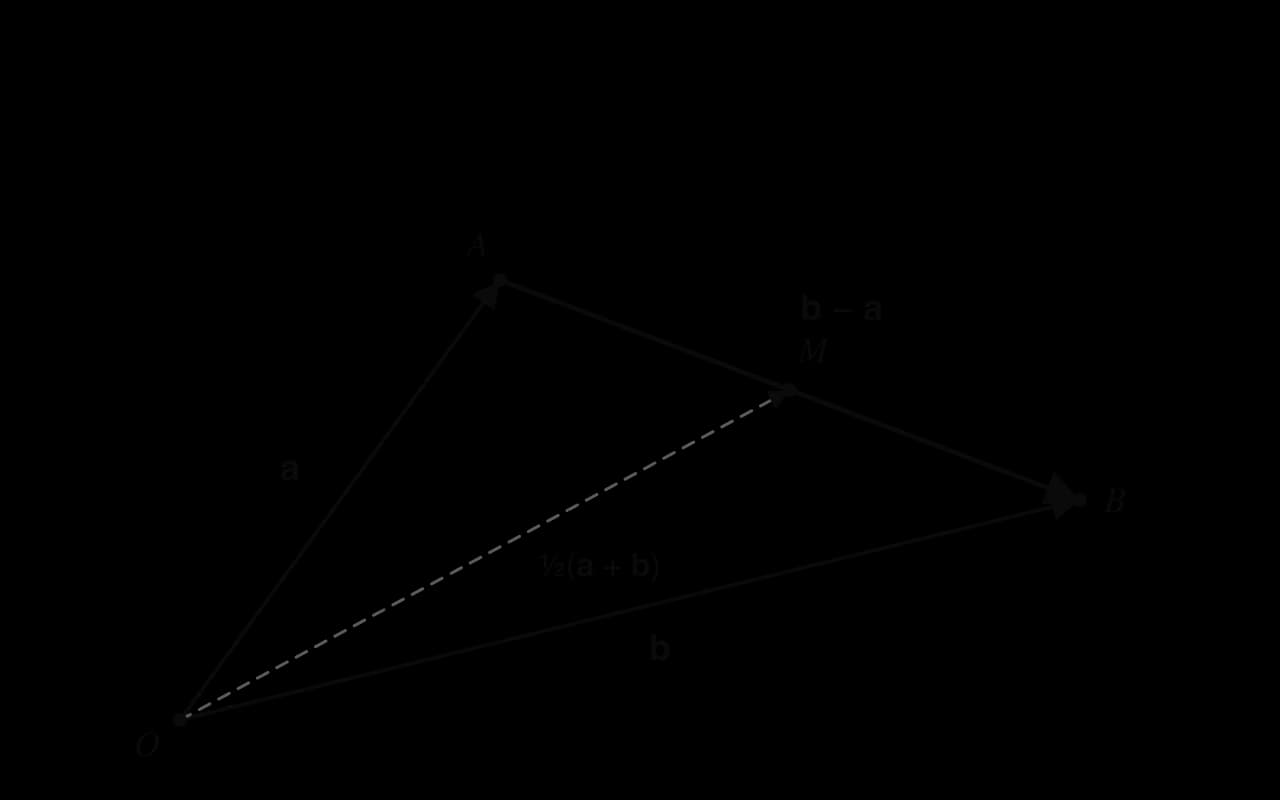
To go from A to B, one route is to go back from A to the origin and then out from O to B. The first step is AO=−a
AB=AO+OB=−a+b=b−a
The rule is "end minus start", the same as the change in any quantity. Its magnitude is the distance between the two points, which gives the 3D distance formula of subtopic 3.1 in vector form.
AB=∣AB∣=∣b−a∣=(b1−a1)2+(b2−a2)2+(b3−a3)2
The position-vector diagram shows a and b from O, the displacement b−a from A to B
The displacement from A to B is end minus start, b − a, and the midpoint M of [AB] has position vector ½(a + b).
The midpoint is halfway along AB, so its position vector is a+21(b−a)=21(a+b)
Shapes described by vectors
Equal vectors describe parallel, equal sides. In a parallelogram ABCD, the side AD is parallel to and the same length as BC
Unit vectors, normalizing and rescaling
Unit vectors
Many problems separate a vector's direction from its size: a velocity is "at 7 m s⁻¹ in the direction of 3i+4j", a force is "of 50 N towards the point P". The tool for this is a vector of length exactly 1, which carries direction and nothing else.
Normalizing a vector
Any non-zero vector v can be shrunk or stretched to length 1 without changing its direction. Multiplying by the positive scalar ∣v∣1 multiplies the length ∣v∣ by ∣v∣1
v^=∣v∣v,∣v^∣=∣v∣1∣v∣=1
The unit vector in the direction of 2−12
Rescaling a vector to a given magnitude
Once the unit vector is known, a vector of any chosen length L in the same direction is L times it. This is how a speed and a direction are combined into a velocity vector, or a force's size and direction into a force vector.
vector of magnitude L in the direction of v=L×∣v∣v
The direction vector itself usually has the wrong length. A particle moving "with speed 7 m s⁻¹ in the direction 3i+4j" does not have velocity 7(3i+4j)=21i+28j
The vector velocity found in this way is a velocity vector; subtopic 3.12 uses it to give an object's position at any time.
Unit vectors with an unknown component
A unit vector has magnitude 1, so the squares of its components add to 1. This gives an equation for a missing component. Because the equation involves a square, it has two solutions, and the context or a condition such as "p>0" decides which is needed.
Case study: Flying with and against the jet stream
Jet streams are fast, narrow bands of wind high in the atmosphere. The polar jet streams blow from west to east at around 9 km altitude, the height at which many airliners cruise, typically at about 180 km/h and sometimes much faster; speeds of 400 km/h have been measured. Airlines plan routes to use the jet stream when flying east and to avoid it when flying west.
Source: Wikipedia, "Jet stream" (accessed 2026).
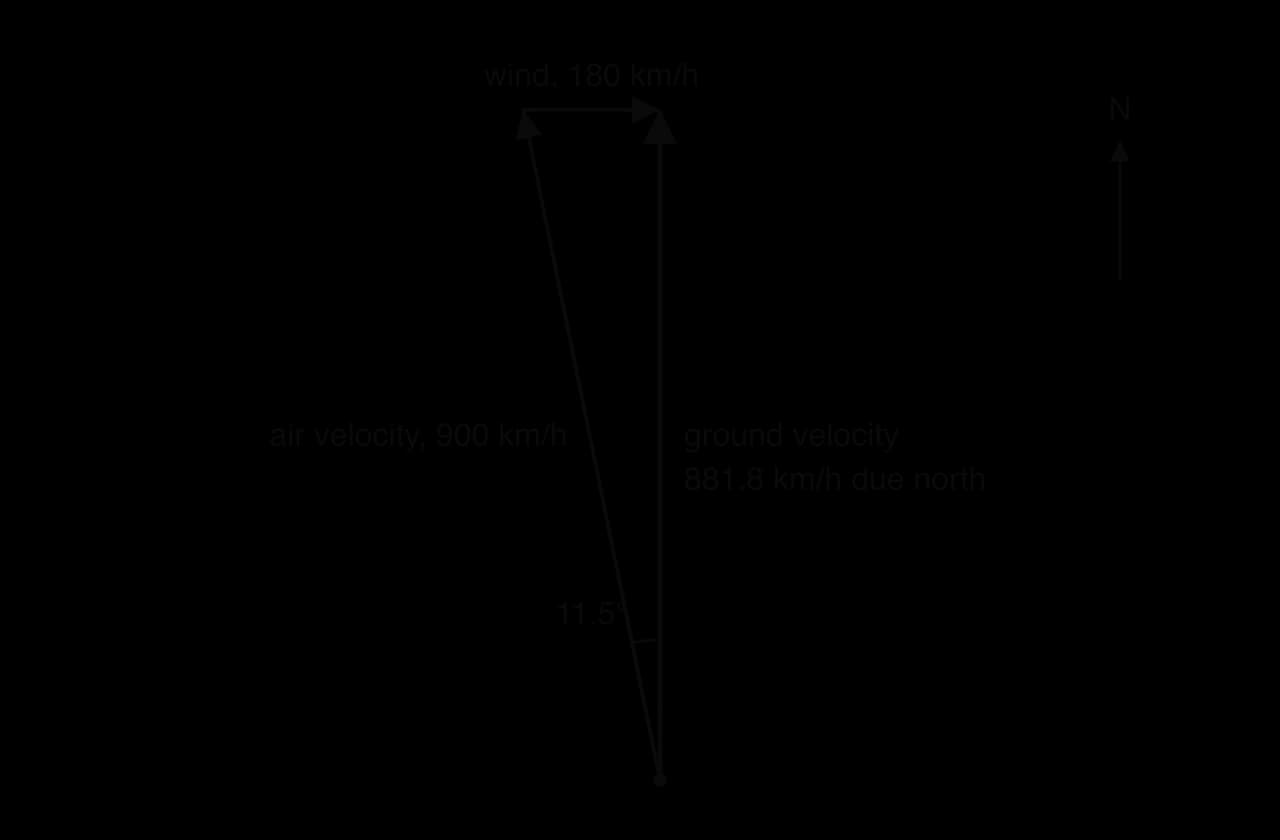
An aircraft's motion through the air is its air velocity, set by its engines and the direction in which it points (its heading). The wind carries the whole body of air, aircraft included. Relative to the ground, the aircraft's velocity is the resultant of the two.
ground velocity=air velocity+wind velocity
Take a hypothetical airliner with an airspeed of 900 km/h, a wind of 180 km/h blowing due east, i as 1 km/h east and j as 1 km/h north. The wind velocity is 180i.
Along the wind
Flying due east, the air velocity is 900i and the ground velocity is 900i+180i=1080i, a ground speed of 1080 km/h. Flying due west, it is −900i+180i=−720i
Across the wind
A crosswind needs the full vector method. If the aircraft points due north, its air velocity is 900j and its ground velocity is
v=180i+900j,∣v∣=1802+9002=917.8 km/h
The aircraft is pushed east of north by an angle tan−1(900180)=11.3°, so its track over the ground is a bearing of about 011° even though the aircraft points due north. To fly a track of due north, the pilot must point the aircraft partly into the wind, so that the air velocity's eastward component is −180
(−180y),(−180)2+y2=9002⇒y=777600=881.8
The ground velocity is then 881.8j: due north at 881.8 km/h. The heading is sin−1(900180)=11.5°
To track due north in a 180 km/h westerly wind, the aircraft points 11.5° into the wind and loses about 18 km/h of ground speed. Speeds hypothetical; jet stream speed from Wikipedia, “Jet stream”.
The crosswind costs far less time than a headwind of the same strength: 900 to 881.8 km/h rather than 900 to 720 km/h. Only the component of the wind along the track changes the ground speed directly; the component across the track has to be cancelled by turning, which costs a little speed through the reduced northward component of the air velocity. The model has limits: real winds change with height, position and time, and a route crosses many different wind fields, so flight planners combine many such vector calculations along a route, using forecast winds.
Exam focus
Vectors at this level appear on HL Paper 1 and Paper 2, usually as the opening parts of longer questions on lines (subtopic 3.11), motion (subtopic 3.12) or the scalar and vector products (subtopic 3.13). Typical first parts are worth 1–3 marks each and use write down (a vector read from coordinates or a diagram), find (a displacement vector, a magnitude, a unit vector or a missing component) and show that (a magnitude or a parallel relationship). Contexts include ropes, cables and sunshades fixed at 3D points, drones and aircraft, ships with a velocity vector, and forces.
The working that earns method marks is short but must be visible: the subtraction b−a or its result, the square root of the sum of squares with the numbers substituted, and the division by the magnitude when a unit vector or a given speed is involved. Only the magnitude formula is given in the formula booklet; AB=b−a
Part (d) combines three skills (a displacement vector, normalizing and adding to a position vector), so it has the most places to go wrong. A typical wrong answer adds 10CR, or 10010
Questions that give a unit vector with a missing component (for example pi+21j−21k
Practice questions
State which of the following are vectors: (i) a mass of 4 kg; (ii) a weight of 39 N acting downwards; (iii) a speed of 30 km/h; (iv) a velocity of 30 km/h towards the north-east; (v) a temperature of −5 °C; (vi) a displacement of 5 m east. [2]
Given p=3i−j+2k and q=−i+4j−2k
Answers
(ii), (iv) and (vi) are vectors; (i), (iii) and (v) are scalars.
2p−3q=(6+3)i+(−2−12)j+(4+6)k=9i−14j+10k
Summary
A scalar has size only; a vector has size and direction and is drawn as a directed line segment AB, printed in bold and underlined in handwriting.
Components: v=v1v2v3=v1i+v2j+v3k
Self-check
To do:
I can sort quantities into scalars and vectors and give the vector partner of distance and speed.
To do:
I can read AB, ∣AB∣
Questions on 3.10
48 exam-style questions on this subtopic, written in the style of the IB papers. The first has its markscheme open. Counted on
Question 1 · AI-000436 marks
A ferry leaves a pier at 09:00. Its position vector, relative to a lighthouse, t hours after 09:00 is given by
r=(25)+t(6−8)
where distances are measured in kilometres. The unit vector (10) points east and (01)
(a)
Find the speed of the ferry.
[2]2 marks
Markscheme (a)
62+(−8)2
Question 2 · AI-000446 marks
A survey drone flies in a straight line at constant velocity. Relative to its launch pad, it is at the point A(4,−2,0.5) at time t=0 and at the point B(36,22,10.1) when t=8
Question 3 · AI-000466 marks
Two light aircraft take off from the same airfield, O, and fly at the same constant altitude. Aircraft A leaves at 08:00 with velocity (240320) km h−1. Aircraft B leaves at 08:30 with velocity (−300400)
From the formula booklet
The entries of the mathematics: applications and interpretation formula booklet that 3.10 uses. Each opens in the explained booklet.
Both magnitudes are exact whole numbers. Writing (−6)2 with the bracket is a good habit: typing −62 into a calculator gives −36.
with the numbers substituted is the working to write down.
, which the calculator reads as
4−36+9
and reports as an error or a wrong value. Each component must be squared inside its own brackets:
(−6)2=36
.
across, the total move across is
a1+b1
; the same is true in the other directions. So vectors are added by adding their corresponding components.
then
a
, reaches the same opposite corner.
, and in components every sign changes.
.
a−b
is the arrow from the tip of
b
to the tip of
a
, because
b+(a−b)=a
. The two panels of the addition diagram show both constructions.
.
N. The ring does not move, so the resultant of the three forces is the zero vector.
(a) Find the third force F3.
(b) Find the magnitude of F3.
(c) Show that the magnitude of F1+F2 is not equal to ∣F1∣+∣F2∣.
Show the solution
(a) Equilibrium means F1+F2+F3=0, so F3=−(F1+F2).
F1+F2=(12−205+9)=(−814)⇒F3=(8−14) N
(b) ∣F3∣=82+(−14)2=260=16.1
(c) ∣F1∣=144+25=13
.
(b) The resultant is the sum of the two velocities.
v=1.2i+3j,∣v∣=1.22+32=10.44=3.23 m s−1(3 s.f.)
(c) Only the northward component carries the boat across. It covers 60 m at 3 m s⁻¹, which takes 60÷3=20 s. In those 20 s the eastward component carries it 1.2×20=24 m downstream. The boat lands 24 m east of the point opposite its start after 20 s.
(d) To land directly opposite, the resultant must have no eastward component. The boat's own velocity must therefore have an x-component of −1.2 to cancel the current, and its magnitude must still be 3.
The angle θ west of north satisfies sinθ=31.2=0.4, so θ=23.6°. The bearing is 360°−23.6°=336.4°, about 336°. The boat now crosses at 2.7495… m s⁻¹, so the crossing takes 60÷2.7495…=21.8 s. Aiming upstream costs about 1.8 s compared with drifting.
the direction is reversed, which is why
−v=(−1)v
. Multiplying by
k=0
gives the zero vector. The number
k
is called a scalar because it scales the vector.
and opposite directions when
k<0
.
and
−63−9
the ratios are
−1.5
,
−1.5
and
−1.5
, so the second vector is
−1.5
times the first. The two vectors are parallel and point in opposite directions, and the second is 1.5 times as long. A zero in one vector must be matched by a zero in the same place in the other.
and
b=−69q
are parallel.
(a) Find the values of p and q.
(b) State whether a and b point in the same direction, and write down the ratio ∣b∣:∣a∣.
Show the solution
(a) Parallel means b=ka. The x-components are both known, so they give k.
−6=2k⇒k=−3
Then the other components must match: 9=−3p, so p=−3, and q=−3×(−3)=9
(b) Since k=−3<0, the vectors point in opposite directions. The magnitude is multiplied by ∣k∣=3, so ∣b∣:∣a∣=3:1
are parallel, the two arrows both start at
A
and point along the same line, so
A
,
B
and
C
are
collinear
. Subtopic 3.11, Vector equations of lines, develops this into equations for whole lines.
. The components of this vector are the coordinates of
A
.
; its components are the coordinates of
A
.
The point A(2,−1,5) has position vector a=2i−j+5k.
has
b
, and so on.
and the second is
OB=b
, so by the triangle law
to
B
; it equals
b−a
, the position vector of the end point minus that of the starting point.
, and the
midpoint
M
of
[AB]
.
: the average of the two position vectors, matching the midpoint formula for coordinates. The same reasoning finds any point a given fraction of the way along a segment. The point one-third of the way from
A
to
B
has position vector
a+31(b−a)
.
, the vector in the opposite direction, with every sign wrong. The magnitude is the same, so a distance comes out correctly, but any later direction, unit vector or new position will be wrong. "End minus start" fixes the order: for
AB
, the end is
B
.
(a) Write downTG as a column vector and in terms of i, j and k.
(b) Find the length of the rope.
(c) A ring is fixed on the rope one-quarter of the way from T to G. Find the coordinates of the ring.
Show the solution
(a) End minus start: g−t.
TG=10−26−00−7=86−7=8i+6j−7k
The negative z-component shows the rope going down from the top of the pole to the ground.
(b) The length is the magnitude of TG.
TG=82+62+(−7)2=149=12.2 m (3 s.f.)
(c) Start at T and go one-quarter of the way along TG.
t+41TG=207+21.5−1.75=41.55.25
The ring is at the point (4, 1.5, 5.25), 5.25 m above the ground. The question asks for coordinates, so the answer is written as a point.
, so
AD=BC
. This gives a quick way to find a missing vertex, and the magnitudes of the side vectors show whether the shape is special, such as a rhombus.
.
(a) Find the coordinates of D.
(b) Show thatABCD is a rhombus.
(c) Verify that the diagonals [AC] and [BD] have the same midpoint.
Show the solution
(a) In parallelogram ABCD, AD=BC.
BC=c−b=3−14,d=a+BC=120+3−14=414
So D is (4, 1, 4).
(b) A rhombus is a parallelogram with two adjacent sides of equal length. Compare AB and AD.
The adjacent sides are both 26≈5.10 units long, so the parallelogram is a rhombus.
(c) The midpoint of [AC] is 21(a+c)=21(8,7,3)=(4,3.5,1.5)
; when it asks for "the coordinates of
R
", write a point such as
(4,1.5,5.25)
. Markschemes often accept either form, but some remove the final mark for a column vector given where coordinates were asked for, so match the form to the question.
.
, which gives 1, and a positive scalar keeps the direction.
is found by dividing by its magnitude,
4+1+4=3
, which gives
2/3−1/32/3
. Its magnitude is
94+91+94=1
, as required. The zero vector cannot be normalized: it has no direction, and dividing by
∣0∣=0
is impossible.
.
, because that vector has magnitude
7×5=35
. The direction must first be reduced to a unit vector.
, where
k
is vertically upwards.
Find
the drone's velocity vector and the rate at which it is climbing.
Show the solution
(a) The magnitude of the direction is 32+42=5, so the unit vector is 51(3i+4j). Rescale to length 7.
v=7×53i+4j=4.2i+5.6j m s−1
Check: 4.22+5.62=49=7
(b) The magnitude of the direction is 4+1+4=3.
v=15×312−12=10−510 m s−1
The vertical component is 10, so the drone climbs at 10 m s⁻¹. Check: 100+25+100=15.
.
(b) The point B has coordinates (1,−2,4), and BC=25u. Find the coordinates of C and write down the distance BC.
Show the solution
(a) A unit vector has magnitude 1, so
p2+0.482+0.62=1⇒p2=1−0.2304−0.36=0.4096⇒p=±0.64
Since p>0, p=0.64.
(b) 25u=161215
C is (17, 10, 19). Because u has length 1, 25u has length 25, so BC=25 without further calculation.
, which has speed 45 m s⁻¹. Dividing by the magnitude 3 first gives
10i−5j+10k
. A final check that the answer's magnitude equals the given speed catches the error.
. Subtopics 1.12 and 1.13 use this picture throughout.
, a ground speed of 720 km/h. On a 5,000 km route the eastbound flight takes
5000÷1080=4.63
hours (about 4 h 38 min) and the westbound flight
5000÷720=6.94
hours (about 6 h 57 min), a difference of about 2 h 19 min for the same aircraft over the same distance. In one dimension the vectors add like signed numbers, which is why the effect is so easy to see.
and cancels the wind. The air velocity still has magnitude 900, so
west of north, a bearing of about 348°. The wind triangle shows the three vectors.
; midpoint
21(a+b)
; parallel test
w=kv
; unit vector
∣v∣v
; vector of length
L
as
L∣v∣v
. Beside each, add a small sketch and one numerical example of your own.
, the unit vector and the rescaling rule must be known.
and another at
R(100,60,30)
. The camera is at
C(40,25,12)
. All distances are in metres.
(a) Write down the position vector of C. [1]
(b) FindCP. [2]
(c) Find the length of the cable from C to P. [2]
(d) The camera moves 10 m in a straight line from C directly towards R. Find the coordinates of its new position. [4]
(e) During this movement the camera travels at 2.5 m s⁻¹. Find its velocity vector. [2]
Show the markscheme
(a) OC=402512 (or 40i+25j+12k) A1
(b) CP=p−c(M1)
=−40−2518
(c) (−40)2+(−25)2+182=2549
=50.5 m (50.4876…) A1
(d) CR=603518
∣CR∣=5149=71.7565…
new position =c+71.7565…10603518
=(48.4,29.9,14.5)A1
(e) 71.7565…2.5603518
=2.091.220.627
Total [11]
of it, to
c
; the 10 m must be measured along a unit vector.
with
p>0
) reward setting the magnitude equal to 1 with an
M1
, then the correct sign of the root with an
A1
. Bearings found from a vector's components, such as the direction of travel of a ship or helicopter, are measured in degrees clockwise from north; the warning that HL papers assume radians applies to trigonometric functions of angles, not to bearings, which are always in degrees.
,
find
2p−3q
and its magnitude. [3]
The points A(−2,5,1) and B(4,1,3) are given. Find (a) AB; (b) the distance AB; (c) the coordinates of the midpoint of [AB]. [5]
Find the unit vector in the direction of 6i−2j+3k. [2]
A drone flies at 26 km/h in the direction of 5i+12j. Find its velocity vector. [2]
The vectors a4−6 and 3b9 are parallel. Finda and b. [3]
Three forces F1=4i−j+3k, F2=−2i+5j and F3, in newtons, act on a particle that stays at rest. FindF3 and its magnitude. [3]
The vector u=0.36i+qj+0.8k is a unit vector with q<0. The point C is (3,0,−5) and CD=50u. Findq and the coordinates of D. [5]
OABC is a parallelogram, where O is the origin, a=231 and c=4−12. (a) FindOB and AC. (b) Find the lengths of the two diagonals. (c) Show that the diagonals have the same midpoint. [7]
A ferry can travel at 5 m s⁻¹ through still water. It crosses a river whose current flows due east at 1.5 m s⁻¹, and it must travel due north relative to the banks. (a) Find the bearing on which the ferry must steer. (b) Find its speed relative to the banks. (c) Explain why this speed is less than 5 m s⁻¹. [6]
The first vector is k times the second. From the z-components, −6=9k, so k=−32. Then a=3k=−2 and 4=bk, so b=−6.
F3=−(F1+F2)=−(2i+4j+3k)=−2i−4j−3k N; magnitude 29=5.39 N.
q2=1−0.1296−0.64=0.2304, so q=−0.48. 50u=(18,−24,40), so D=(21,−24,35).
(a) OB=a+c=623, AC=c−a=2−41. (b) OB=49=7, AC=21=4.58. (c) Midpoint of [OB]: (3,1,1.5); midpoint of [AC]: 21(2+4,3−1,1+2)=(3,1,1.5), the same point.
(a) The ferry's own velocity is (−1.5y) with magnitude 5; sinθ=51.5=0.3, θ=17.5° west of north, a bearing of about 342.5°. (b) y=25−2.25=22.75=4.77 m s⁻¹. (c) Part of the ferry's velocity through the water (its −1.5 east component) is used to cancel the current, so only the remaining northward component moves it across.
, where
i
,
j
,
k
are unit vectors along the axes.
Magnitude: ∣v∣=v12+v22+v32, from Pythagoras' theorem used twice.
Vectors add and subtract component by component; geometrically by the triangle law (tip to tail). The resultant is the sum, and a resultant of 0 means equilibrium. Magnitudes do not simply add.
kv multiplies the length by ∣k∣ and reverses the direction if k<0; vectors are parallel when one is a scalar multiple of the other.
Position vector a=OA; displacement AB=b−a (end minus start); distance AB=∣b−a∣; midpoint 21(a+b).
Unit vector in the direction of v: ∣v∣v (normalizing). Vector of magnitude L in that direction: L∣v∣v (rescaling), for example a velocity from a speed and a direction.
Ground velocity = air (or water) velocity + wind (or current) velocity; cancelling a crosswind or current needs a heading into it.
,
AB
,
[AB]
and
(AB)
correctly.
To do:
I can convert between column vectors and i,j,k form, including zero components.
To do:
I can find the magnitude of a 2D or 3D vector, squaring negative components correctly.
To do:
I can add and subtract vectors by components and by drawing.
To do:
I can find a missing force so that a set of forces is in equilibrium.
To do:
I can find a resultant velocity for a boat in a current or an aircraft in wind, and the heading needed to cancel a crosswind.
To do:
I can multiply a vector by a scalar and describe the effect on its length and direction.
To do:
I can test whether two vectors are parallel and find unknown components that make them parallel.
To do:
I can find AB=b−a and the distance AB from two points.
To do:
I can find the midpoint of a segment, or a point a given fraction of the way along it, with position vectors.
To do:
I can find a missing vertex of a parallelogram using equal vectors.
To do:
I can normalize a vector and find a missing component of a unit vector.
To do:
I can find a velocity vector from a speed and a direction, and check its magnitude.
points north.
(M1)
10 km h−1A1
[2 marks]
(b)
Find the position vector of the ferry at 10:30.
[2]2 marks
Markscheme (b)
t=1.5(M1)
r=(25)+1.5(6−8)=(11−7)A1
[2 marks]
(c)
Find the bearing on which the ferry is travelling.
[2]2 marks
Markscheme (c)
tan−1(86)=36.869…° (angle east of south) (M1)
180°−36.869…°=143°(143.130…°)A1
Note: Accept any correct right-angled triangle method, for example 90°+tan−1(68).
[2 marks]
, where
t
is measured in seconds and distances in metres. The
z
-axis is vertical.
(a)
Find the velocity vector of the drone.
[2]2 marks
(b)
Find the speed of the drone.
[2]2 marks
(c)
The drone continues on the same path. Find the time at which it reaches a height of 25 metres.
 YouTube