Notes on 3.12 Vectors in kinematics
Learning objectives
Write down the initial position and the velocity of an object from an equation , and find its speed and direction of travel.
Find the position of an object at a given time, and the time at which it reaches a given point or height.
Use a time shift for an object that starts moving later.
Find the relative position and relative velocity of two moving objects.
Determine whether two objects collide, distinguishing a collision from paths that only cross.
Find the time and distance of closest approach, using technology or the scalar product.
Find velocity and acceleration vectors from a position vector, and position from a velocity vector, in two dimensions.
Find the Cartesian equation of a path by eliminating the time.
Solve problems on projectile motion and circular motion as special cases of motion in two dimensions.
Interpret results in context and comment on the assumptions of a model.
Introduction
Ships, aircraft, drones, footballs and satellites all move through space, and the questions people ask about them are the same: where will it be, how fast is it going, will it hit something, and how close will it come. Vectors answer these questions in one line each. A position vector gives where an object is, a velocity vector gives how it moves, and the arithmetic of vectors from subtopic 3.10, Vectors, turns "where will it be in two hours" into a single addition.
A ship's radar is one real example. A marine radar fitted with an automatic radar plotting aid tracks other vessels and calculates each one's course, speed and closest point of approach, which is the distance at which the two ships will pass if neither changes course. The calculation behind that display is a closest-approach calculation with position and velocity vectors.
Position, velocity and speed as vectors
Describing motion with vectors
The study of motion without asking what causes it is called kinematics. In one dimension, a single number (a displacement along a line) is enough to say where an object is. In a plane or in space, a position needs two or three numbers, so it is a position vector measured from a fixed origin . When the object moves, changes with time and is written .
Every kinematics problem in two or three dimensions starts by fixing three things: an origin, a direction for each axis, and units. A typical problem states, for example, "the direction is due east, the direction is due north and the direction is vertically upwards; distances are in kilometres and time in hours". Without that information a vector such as
The velocity vector
In subtopic 5.13 the velocity of an object moving along a line is a signed number: its rate of change of displacement. In two or three dimensions the rate of change of position has a direction as well as a size, so velocity becomes a vector. Each component of the velocity vector is the rate of change of the matching component of position.
The speed is the size of the velocity, without its direction, so it is the magnitude of the velocity vector. A boat with velocity travels 5 km every hour along its slanted course, because
Velocity is a vector and speed is a scalar. A velocity is therefore written as a column vector with units, and a speed as one positive number with units. Two objects with velocities and
Direction of travel as a bearing
In two dimensions with east and north, the direction of a velocity can be given as a bearing, measured clockwise from north. A quick sketch of the velocity vector on a pair of compass axes shows which quadrant it is in, and right-angled trigonometry gives the angle. For a velocity (east and north both positive), the angle from north towards east is
Motion with constant velocity
Deriving r = r₀ + tv
An object with constant velocity moves the same displacement, , in every unit of time. After 1 unit it has moved , after 2 units , and after units
The equation has the same form as the vector equation of a line from subtopic 3.11, Vector equations of lines. The initial position plays the part of the known point , the velocity plays the part of the direction vector , and the time
Written out in components, the equation becomes a set of parametric equations, one for each coordinate. For a 3D motion with
Each coordinate is a linear function of time with gradient equal to the matching velocity component. Questions about "when" and "where" become linear equations in .
Units and the meaning of t
The units of follow from the units of distance and time. If positions are in kilometres and is in hours, then is in km h⁻¹. Time is often measured from a clock time such as " hours after 09:00", and the final answer may need converting back: means 2 hours and 24 minutes, so 11:24, not 11:40.
To find | What to do |
|---|---|
Position at a given time | Substitute the value of into . |
Time at which one coordinate takes a value (a height, a north line) | Set that component equal to the value and solve the linear equation for . |
The check in part (b) is the same test used in subtopic 3.11 for whether a point lies on a line, with one extra meaning: the common value of is the moment the aircraft is there. If the two equations had given different values of , the aircraft would not pass over the airport at all.
Starting at a later time: the time shift
Sometimes one object starts moving after the clock has started. A ferry that leaves its port 1 hour after has been moving for only hours at time . Its position is the starting point plus lots of its velocity.
At the bracket is zero, so the object is at , as it should be. Before the object has not set off, so the equation does not apply; it would give a position "behind" the start. The same idea appears with functions in subtopic 2.8, Transformations of graphs: replacing
Relative position and relative velocity
The position of one object relative to another
When two objects move, the question that usually matters is where one is compared with the other. The vector from A to B is the displacement vector from subtopic 3.10. When A and B are moving, both position vectors depend on time, and so does the vector between them.
The order matters. The position of B relative to A is , the vector that points from A to B, and the position of A relative to B is its negative. Both give the same distance, but the direction is reversed, and a bearing worked out from the wrong one is 180° out.
Relative velocity
If both objects move with constant velocity, the relative position is
The relative position has exactly the form . It starts at the initial relative position and changes by
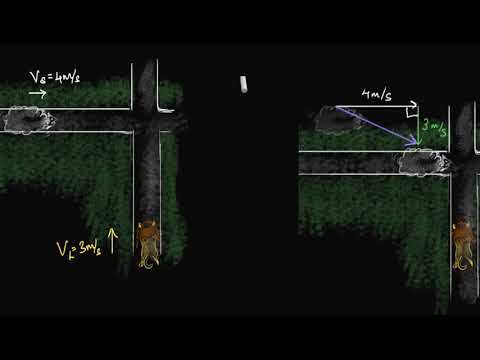
An everyday case is a passenger in a train. A train moving at passes a car moving at
 YouTube
The Khan Academy video works through relative velocity with arrows before using components, which is a useful check on the algebra: the relative velocity arrow closes the triangle from the tip of
Collisions and crossing paths
Same place, same time
Two moving objects collide only if they are at the same point at the same moment. This is a stronger condition than their paths crossing. Two ships' routes can cross on a chart, but if one passes the crossing point an hour before the other arrives, nothing happens.
The test is to set using the same on both sides. Each component gives one equation in
To find where the paths cross, the method is different. The two paths are lines, so the times are allowed to differ: write with two different time letters, exactly as two lines with parameters and
Question | Equation | Unknowns |
|---|---|---|
Do the objects collide? | one time |
Testing for a collision in three dimensions
In three dimensions there is one more equation than in two, and the extra check is what usually rules a collision out. The usual method is to solve for from the simplest component, then substitute that into the other two. A GDC's equation solver can solve each component equation for in turn; a simultaneous equation solver is not suited to the task, because the system has more equations than unknowns.
Interception
A collision that is planned is called an interception. A rescue boat that must reach a drifting life raft chooses its own velocity so that the two positions agree at a chosen time. If the raft's position is known and the rescue boat leaves the origin at , then the boat's velocity must satisfy
Closest approach
The idea
Most moving objects never collide, and the useful question is how close they come. The distance between two objects at time is the magnitude of their relative position,
Three methods find it. All three give the same answer; the choice depends on the problem and on what is easiest to write down.
Method 1: minimise the distance with technology
Write as a function, graph it on the GDC and use the minimum feature. This is the most general method: it works for constant and variable velocities alike.
For the two ships that leave harbour at noon (A from the origin with , B from
The graph of falls, reaches a minimum and rises again. The GDC's minimum feature gives and .
On the GDC, enter the distance as a function of (the calculator's variable for ), choose a window that includes the minimum (here and
Method 2: minimise the square of the distance
The square root makes awkward to differentiate, but and are smallest at the same , because squaring keeps the order of positive numbers. For constant velocities,
The vertex of is at
Method 3: the perpendicular condition
At the moment of closest approach, the relative position is perpendicular to the relative velocity. The ship–lighthouse diagram shows why for a fixed point: of all the line segments from the lighthouse to the ship's straight path, the shortest is the one that meets the path at a right angle. Any other segment is the hypotenuse of a right-angled triangle that has the perpendicular as one of its sides, so it is longer.
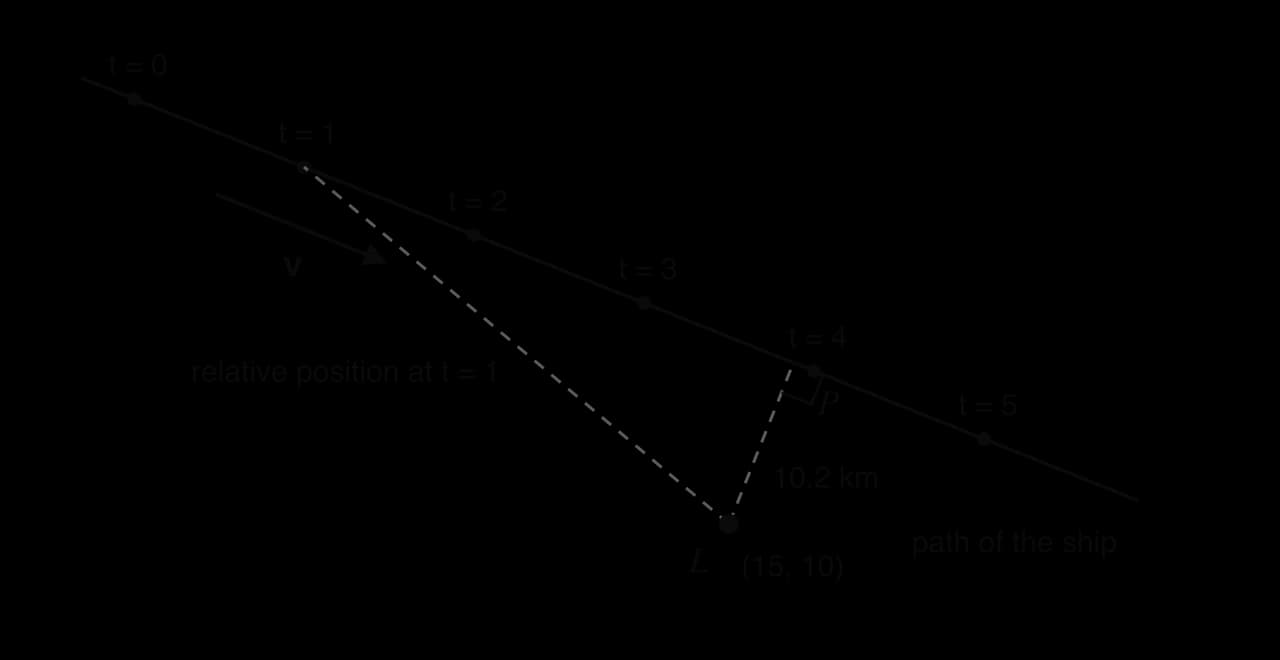
Two vectors are perpendicular when their scalar product is zero, which is taught in subtopic 3.13. For two moving objects with relative position and relative velocity , the condition is
For the ships, and
Variable velocity in two dimensions
Differentiating a position vector
When the velocity changes, the path is no longer a straight line and no longer applies. The position is then some other vector function of time,
The velocity is the derivative of the position, taken one component at a time, and the acceleration is the derivative of the velocity.
The derivatives and
Quantity | How to find it from |
|---|---|
Velocity | Differentiate each component of |
Acceleration |
Integrating a velocity vector
When the velocity is given and the position is wanted, the process runs backwards: each component of is integrated to give the matching component of . Each indefinite integral has its own constant of integration, so the result has a constant vector , found from the position at one known time (usually the initial position).
The Cartesian equation of a path
A position vector gives and separately in terms of . The shape of the path itself, the curve traced out, is a relation between and with removed.
The usual method is to rearrange the simpler component to make the subject and substitute into the other. For the particle with velocity ,
The path is a parabola, as the graph shows. The marked points are the particle's positions at : equal steps of 7 m in every second, but unequal steps in .
The Cartesian equation loses information. It shows where the object goes but not when it is there, or in which direction it travels along the curve. Times and speeds can only be found from the parametric form.
Projectile motion
A special case of variable velocity
A ball thrown, kicked or hit moves in a vertical plane. If air resistance is ignored, the only acceleration is gravity, , acting vertically downwards. Horizontally there is no acceleration, so the horizontal velocity stays constant; vertically the velocity decreases at a steady rate.
If an object is launched from the origin with initial velocity , its acceleration is
Many models round to 10, which makes the vertical component . A launch from a point other than the origin adds its position vector, as in
Launch speed and angle
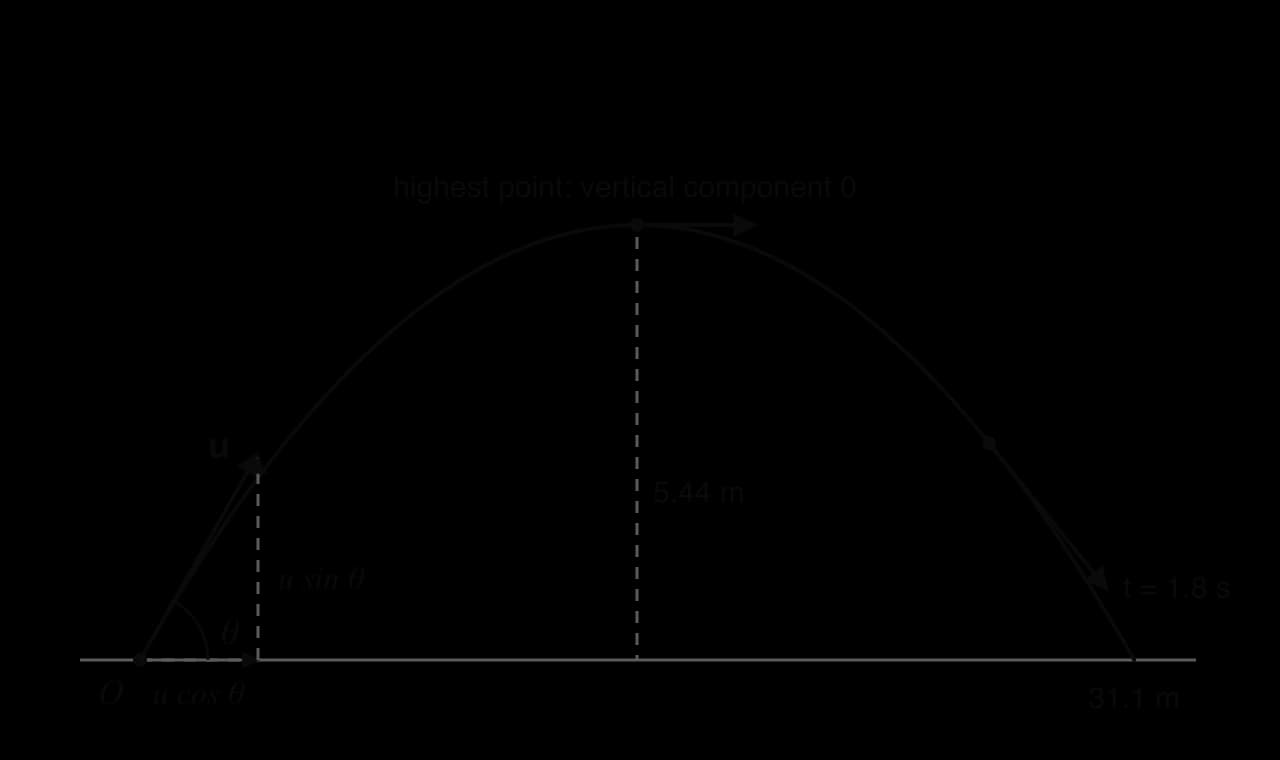
A launch is often described by a speed and an angle of elevation instead of components. Resolving the velocity into horizontal and vertical components with right-angled trigonometry gives
and in reverse
Key results from the components
Feature | Condition | Result (launch from ground level) |
|---|---|---|
Highest point | vertical velocity |
The path is a downward-opening parabola, a quadratic model in , whose gradient at the origin is
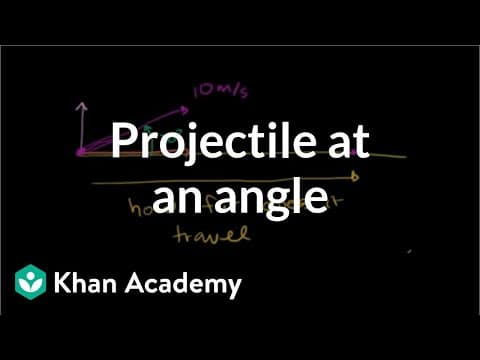 YouTube
The model ignores air resistance, spin and the size of the ball. A real football slows down horizontally and, with spin, can curve sideways, so the 31.1 m range is an upper estimate. For a heavy, compact object such as a shot put the model is close; for a table-tennis ball it is poor.
Circular motion
Position on a circle
An object moving round a circle of radius centred at the origin, turning through an angle radians every unit of time, has position
The constant is the angular speed from subtopic 3.7, Radian measure, in radians per unit time. The object completes one turn when , so the time for one revolution, the period, is
To show that a position vector describes a circle centred at , show that its magnitude is constant. Using (subtopic 3.8, The unit circle and trigonometric equations):
Velocity and acceleration in circular motion
Differentiating with the chain rule gives the velocity and the acceleration.
Three properties follow from these vectors.
The speed is constant:
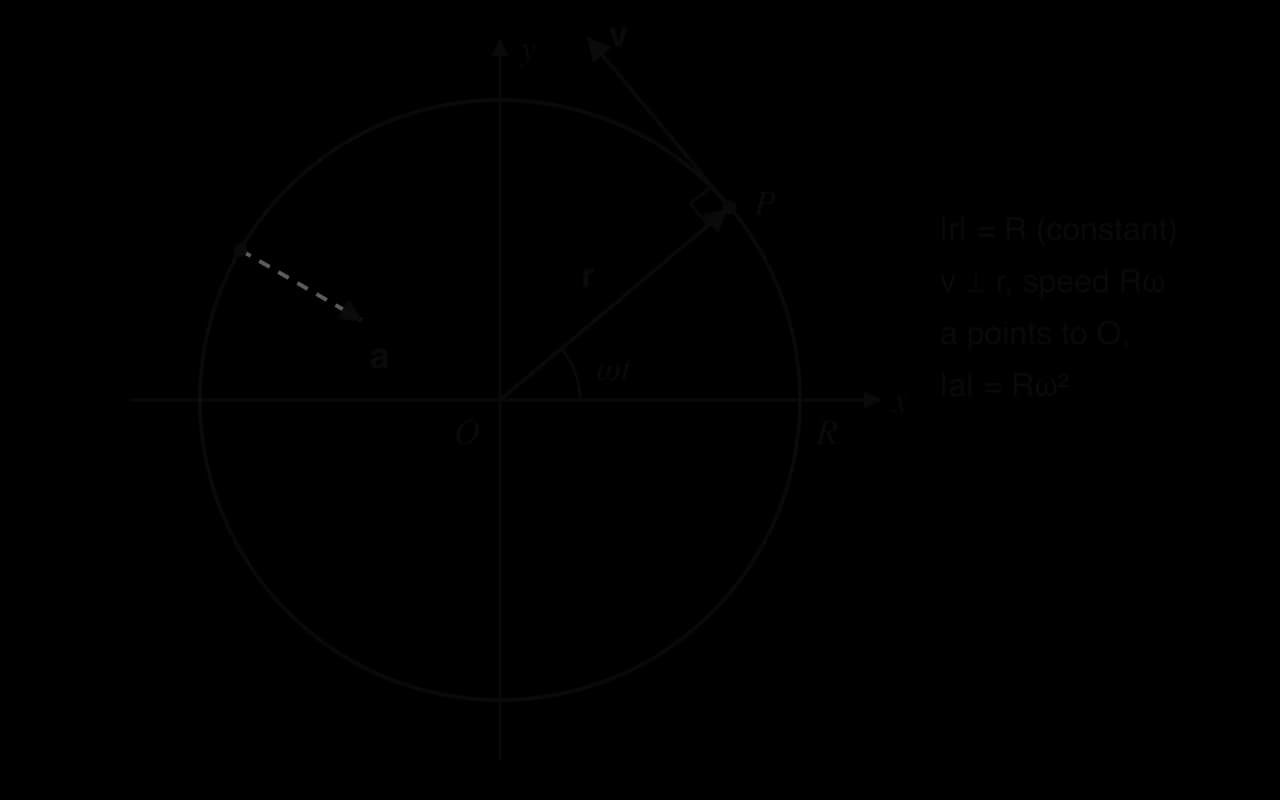
The acceleration is not zero even though the speed is constant, because the direction of the velocity is changing all the time. This is the main difference between speed (a scalar) and velocity (a vector) in two dimensions.
Case study: the orbit of the International Space Station
The International Space Station (ISS) orbits at about 400 km above the Earth's surface, at about 7.67 km s⁻¹, going round roughly every 93 minutes, which is about 15.5 orbits a day. Modelling its orbit as uniform circular motion about the Earth's centre tests whether these figures are consistent with one another.
Quantity | Value |
|---|---|
Height above the surface | about 400 km |
Orbital speed | 7.67 km s⁻¹ |
Time for one orbit | about 93 minutes |
Orbits per day | 15.5 |
Earth's mean radius | 6371 km |
Source: Wikipedia, "International Space Station" and "Earth radius", accessed 2026.
The radius of the orbit is measured from the Earth's centre, so km. With s, the angular speed is
The model's speed is the circumference of the orbit divided by the period.
This is within 0.6% of the quoted 7.67 km s⁻¹. The difference comes from the rounded inputs: "about 400 km" and "roughly 93 minutes" are both approximate, and a period of 92.5 minutes would give 7.67 km s⁻¹ exactly. The orbits per day check is , which agrees.
The model also gives the station's acceleration towards the Earth's centre.
This is only a little less than the 9.8 m s⁻² at the surface, so gravity at the height of the station is still strong; the station stays in orbit because it moves sideways fast enough to keep falling around the Earth rather than into it. The limitations of the model are that the real orbit is slightly elliptical, its height drifts down between engine boosts, and the orbit is tilted to the equator, so a full 3D model would need a third component.
Exam focus
Vectors in kinematics appear on HL Papers 1 and 2. Paper 1 questions of 5–9 marks typically give and ask for a speed, a distance, a bearing of travel, or the time when the object reaches a height. Paper 2 questions of up to about 20 marks build a full context: two moving objects, a collision check, the time and distance of closest approach and a judgement against a safety distance; or a projectile with a launch speed and angle, a maximum height, a landing point, the Cartesian path and an intersection with another object's path; or a position vector with trigonometric or exponential components to differentiate. The command terms are write down (initial position, velocity), find (speed, position, time, distance), show that (a given distance, that a path is circular, that two vectors are perpendicular) and determine (whether objects collide, whether an alarm is raised). Kinematics combines with the scalar product (subtopic 3.13), differentiation with the chain and product rules (subtopic 5.9) and quadratic models (subtopic 2.5).
The formula booklet gives the magnitude of a vector, the vector equation of a line and the scalar product, plus the calculus kinematics of subtopic 5.13. It does not give , the time shift, the collision and closest-approach conditions, or the projectile and circular motion results: these have to be built from the components each time.
The same question shape appears with an object and a fixed point instead of two moving objects. In that case the relative position is from the fixed point to the object, and the perpendicular condition uses the object's own velocity.
In projectile questions, read whether the model uses or and keep to it. When a time has to be converted to a clock time, convert the decimal part of an hour by multiplying by 60, and round only at the end.
Practice questions
A particle has position
Boat A leaves the origin at with velocity km h⁻¹. Boat B leaves the point at
Particles P and Q have positions
A ship moves with position
A particle has velocity m s⁻¹ and is at when
A ball is thrown so that its position after seconds is ,
A point moves with position
Two aircraft fly at constant velocity. Their positions, in kilometres, hours after 14:00 are
Answers
Initial position
Summary
An object with constant velocity and initial position has position
Self-check
- To do:
I can read the initial position and velocity from and find the speed.
- To do:
I can give the direction of a 2D velocity as a three-figure bearing, using a sketch.
- To do:
I can find the time at which an object reaches a given height or line, and check whether it passes through a point.
- To do:
I can write the equation of an object that starts later, using