Notes on 3.13 Scalar and vector products
Learning objectives
Calculate the scalar product of two vectors from their components, and use .
Find the angle between two vectors, using vectors that both start at the vertex of the angle.
Determine whether two vectors are perpendicular, and find an unknown that makes them perpendicular or makes the angle between them obtuse.
Find the acute angle between two lines from their direction vectors, and justify replacing an obtuse result by its supplement.
Calculate the vector product of two vectors and describe its direction using the right-hand screw rule.
Use to find the area of a parallelogram and of a triangle.
Find the component of a vector in the direction of another vector and the component perpendicular to it.
Find the perpendicular distance from a point to a line.
Interpret scalar and vector products in context, including work done, torque and the angle at which light or force acts on a surface.
Introduction
Two vectors can be added and subtracted component by component, as in subtopic 3.10, Vectors. Multiplying them is less obvious, and there are two useful products with different results. The scalar product is a number, and it measures how far two vectors point in the same direction. The vector product is a vector at right angles to both, and its size measures how far they point in different directions.
Between them, the two products give angles, right angles, areas and distances in three dimensions without drawing anything. Physics uses both: the work done by a force is a scalar product, and the turning effect of a force on a spanner is a vector product. In computer graphics, the brightness of each point of a 3D surface is worked out from a scalar product between the surface's normal and the direction of the light.
The scalar product
Definition by components
The scalar product multiplies matching components and adds the results. It takes two vectors and gives a single number, which is why it is called the scalar product; the dot between the vectors gives it its other name, the dot product.
In two dimensions there is no third term:
A vector dotted with itself gives the square of its magnitude, since
The geometric form
The same number can be found from the lengths of the two vectors and the angle between them.
The reason comes from the cosine rule of subtopic 3.2, Trigonometry in triangles. Placing and tail to tail forms a triangle whose third side is . The cosine rule gives the length of that side from the angle; the components give it another way, and comparing the two results gives the formula.
Show why v · w = |v||w| cos θ
In the triangle with sides , and , with angle
The geometric form shows what the scalar product measures. If and are fixed, is largest when the vectors point the same way (
Sign of | Angle between the vectors | |
|---|---|---|
positive | acute, |
The angle between two vectors
The angle between two vectors is measured when they are placed tail to tail, both starting from the same point. It is always between 0° and 180° (0 and radians).
Rearranging the geometric form gives the angle:
The method has three steps: find the scalar product, find the two magnitudes, then apply the inverse cosine. The inverse cosine on a GDC gives an angle between 0° and 180°, exactly the range of angles between vectors, so no adjustment is needed.
On a GDC, vectors can be entered and combined directly: many calculators have dot product and cross product functions in a vector or matrix menu (on a TI-Nspire, dotP( and crossP( in the Matrix & Vector menu), and a norm or magnitude function. The working to write down is still the scalar product value, the two magnitudes and the cosine expression.
Angles in a triangle from coordinates
To find an angle of a triangle, such as , use the two vectors that start at the vertex :
 YouTube
Perpendicular vectors
The most used fact about the scalar product is the test for a right angle. Since , two non-zero vectors are at right angles exactly when their scalar product is zero.
The test works both ways. A zero scalar product proves a right angle, and a known right angle gives an equation, which is how unknown components are found. The perpendicular condition also appears in closest-approach problems in subtopic 3.12, Vectors in kinematics, where the relative position at closest approach is perpendicular to the relative velocity.
The sign of the scalar product turns questions about obtuse or acute angles into inequalities. The angle between and is obtuse when , because the magnitudes in
Work done by a force
In physics, a force that moves an object does work, which is energy transferred. Only the part of the force acting along the direction of motion does work: pulling a sledge with a rope at an angle to the ground wastes the upward part of the pull, which lifts slightly but moves nothing forward.
A child pulls a sledge 20 m along flat ground with a force of 50 N in a rope at 30° to the ground. The work done is J, compared with 1000 J if the rope were horizontal. In component form, a force
The angle between two lines
Using direction vectors
Two lines in two or three dimensions have direction vectors, from their vector equations (subtopic 3.11). The angle between the lines is found from the angle between their direction vectors, which does not depend on the positions . Lines in 3D need not meet: for skew lines the angle is the angle between their directions, as if one were moved to cross the other.
A line has no single direction: and describe the same line. When two lines cross they form two pairs of angles, and . The angle between two lines is, by convention, the acute one.
The diagram of two crossing lines shows the two possible answers. The direction vectors and as drawn make an obtuse angle of 108.3°, but reversing
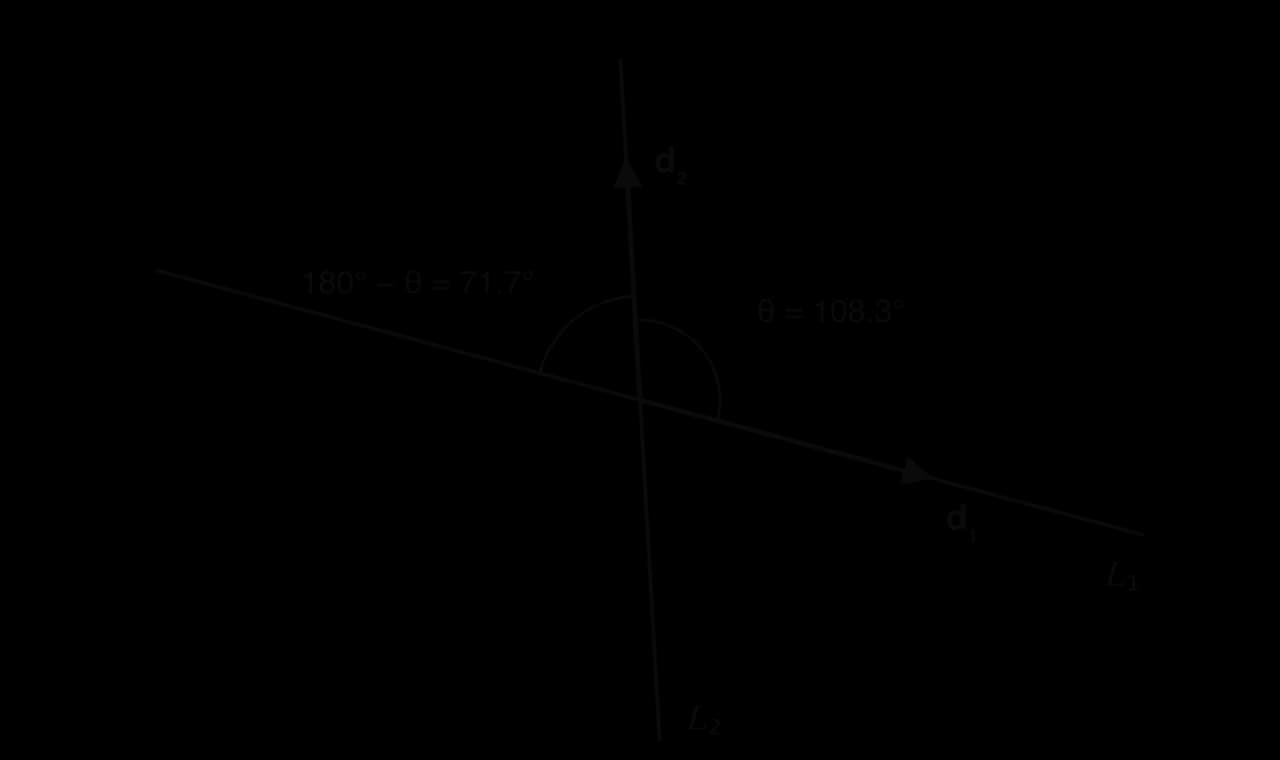
An equivalent method takes the absolute value of the scalar product, which always gives the acute angle directly:
The vector product
Definition by components
The vector product of two 3D vectors is a third vector that is perpendicular to both. Its components come from a fixed pattern of products.
A short routine makes the pattern easier to apply. For the first component, ignore the first row and cross-multiply the rest (
The vector product is defined for vectors in three dimensions. Two-dimensional vectors can be treated as 3D vectors with a zero third component, so becomes
Direction: the normal vector and the right-hand screw rule
The vector product is perpendicular to the plane containing and . A vector perpendicular to a plane is called a normal to that plane.
Every plane has two opposite normal directions, and the vector product picks one of them by a rule of the right hand.
With this rule the full geometric description of the vector product is
where is the unit normal given by the right-hand screw rule. The base vectors follow it: , because curling from the -axis to the -axis makes the right thumb point up the
Three consequences follow straight from the description, and each can be checked with components.
Order matters: . Curling the other way reverses the thumb.
Parallel vectors give zero: if and
 YouTube
Areas from the vector product
The parallelogram and the triangle
The magnitude has a direct geometric meaning. In the parallelogram with sides and , the base is
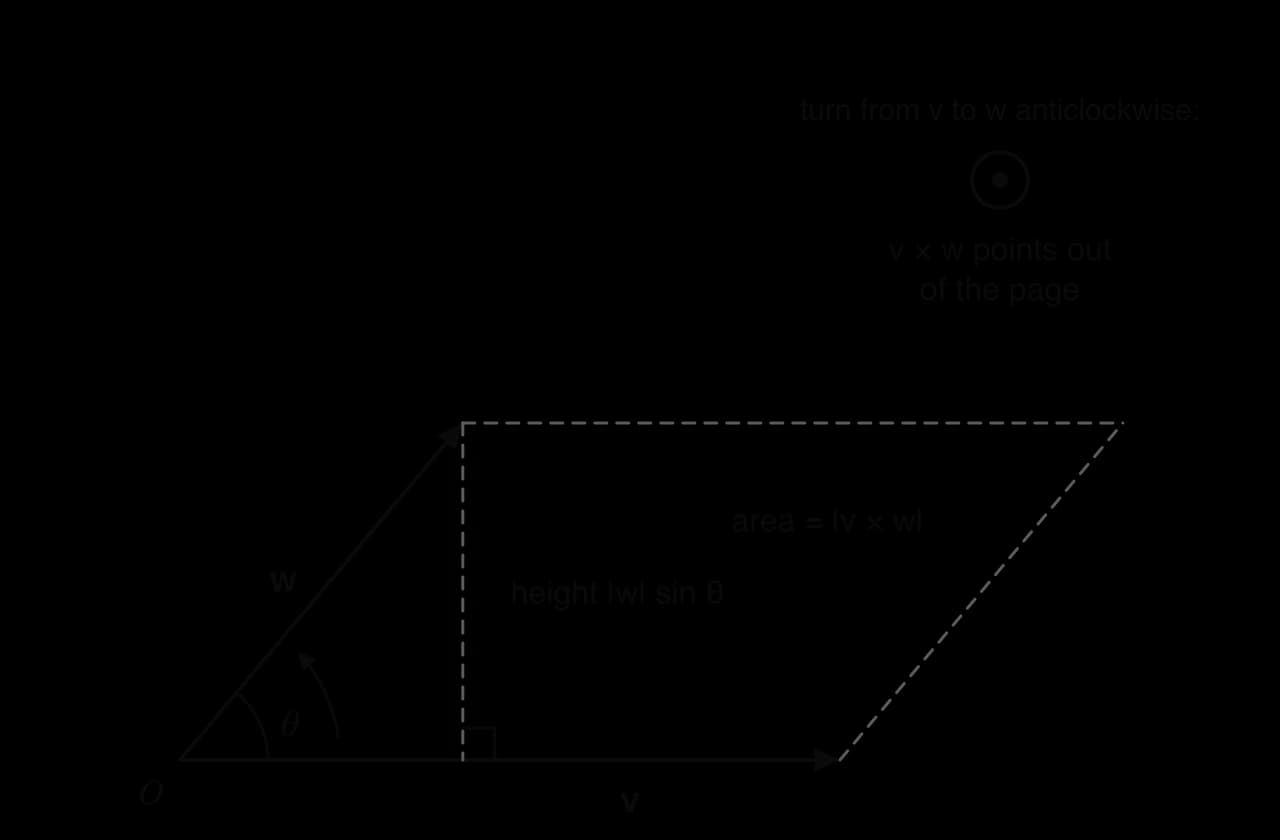
A triangle with two sides and from the same vertex is half of that parallelogram.
This is the vector version of the area of a triangle using sine, , from subtopic 3.2. The advantage of the vector form is that it works directly from 3D coordinates without first finding side lengths and an angle.
A normal to a plane and the angle between a line and a plane
Three points that do not lie on one line fix a plane. The vector product of two vectors in the plane gives a normal to it, which describes the plane's tilt. Two uses of the normal follow.
The angle between two planes (an extension; for example, a roof panel and the horizontal ground) equals the acute angle between their normals. The normal of horizontal ground is
Torque: the turning effect of a force
A force applied to a spanner turns a nut. The turning effect, called torque, depends on the size of the force, the distance from the nut, and the angle at which the force is applied: only the part of the force at right angles to the spanner turns it.
A force of 40 N at the end of a 0.25 m spanner gives a torque of N m when it acts at right angles to the spanner, but only N m when it acts at 60° to the spanner. Pushing along the spanner (
Components of a vector along and across another
The component in the direction of another vector
A vector can be split into two parts: one along a chosen direction , and one at right angles to it. The components of subtopic 3.10 are the special case where the directions are the axes. The length of the part along is , the adjacent side of a right-angled triangle with hypotenuse , as the components diagram shows.

Dividing the scalar product by removes the length of and leaves exactly this length.
Another way to read the formula is , the scalar product of with the unit vector in the direction of . Only the direction of matters, so
The component perpendicular to another vector
The part of at right angles to , in the plane of the two vectors, is the opposite side of the same triangle, . The vector product gives it in the same way that the scalar product gives the other.
By Pythagoras' theorem the two components satisfy
The scalar component also describes how sunlight falls on a surface. Lambert's cosine law says that the power per unit area received by a surface is proportional to the cosine of the angle between the direction of the light source and the surface's normal. With unit vectors, that cosine is the scalar product , which is why the scalar product appears in solar-panel design and in the lighting calculations of 3D computer graphics.
Perpendicular distance from a point to a line
The shortest distance from a point to a line is measured along the perpendicular from the point to the line. If is any point on the line, is the line's direction and is the point, the perpendicular distance is the component of
There are three equivalent routes, and the choice depends on what has already been found.
Vector product:
The same idea, with the scalar product condition from subtopic 3.12, finds the foot of the perpendicular: the point on the line for which .
Exam focus
Scalar and vector products appear on HL Papers 1 and 2, usually as parts of a 3D geometry or kinematics question rather than on their own. Typical shapes are: find two vectors from coordinates, then an angle of a triangle (4–5 marks); find a cross product and hence an area (3–4 marks); find an unknown that makes two vectors or lines perpendicular (a linear or quadratic equation); find the acute angle between two lines; show that two vectors are perpendicular or never parallel; and a context such as a sun shade, a rope on a platform, a roof or a force in a magnetic field. The command terms are find, calculate, show that, hence and determine. Write down the vectors used, the value of the scalar product and the magnitudes (or the components of the cross product), then the formula with numbers substituted, since method marks are awarded for each. Markschemes do not award the method mark for a cross product with fewer than two correct components.
The formula booklet gives both forms of the scalar product, the angle formula, the component form of the vector product, and the area of a parallelogram. The perpendicular test, the
Questions on perpendicular lines with a parameter usually lead to a quadratic in the parameter, and both roots must be given unless the context rules one out. When a later part says "for the negative value of ", the earlier part was expected to find both.
To "show that" two vectors are perpendicular, write the scalar product in full, show that it equals zero, and end with the statement "so the vectors are perpendicular". To show that two vectors are never parallel, show that their vector product is never the zero vector, or that never equals .
Practice questions
Given
Find the value of for which
Find the acute angle between the lines
Calculate
The points , and lie on the three axes. Find the area of triangle
A force N acts on a trolley that moves through the displacement
Find the shortest distance from the point to the line
Find the values of for which the angle between
A charged particle moves with velocity
(a) Find . [2]
(b) The force on the particle is , with . Given that
Answers
;
Summary
Scalar product:
Self-check
- To do:
I can calculate a scalar product from components in 2D and 3D.
- To do:
I can explain why using the cosine rule.
- To do:
I can find the angle between two vectors in degrees or radians, with the GDC in the right mode.
- To do:
I can choose the two vectors that start at the vertex of an angle in a triangle.
- To do: