3.4 Arcs and sectors · IB Maths AI | Augment Education
3.4 Arcs and sectors
Calculate arc lengths, sector areas and perimeters in degrees, work backwards to an angle or a radius, and extend the methods to segments, annular sectors and the net of a cone.
IB Mathematics: Applications and Interpretation
Part of 3 Geometry and trigonometry
SL and HL
Key terms introduced here
Each is in the Maths AI glossary, with every other term in the subject.
The part of an annulus between two radii; for central angle θ degrees, outer radius R and inner radius r its area is 360θ×π(R2−r2)
Notes on 3.4 Arcs and sectors
36 min readLast reviewed
Learning objectives
Identify the parts of a circle: arcs, chords, sectors, segments and the angle at the centre.
Calculate the length of an arc from the radius and the central angle in degrees.
Calculate the area of a sector and the perimeter of a sector.
Find the central angle or the radius from a given arc length, sector area or perimeter.
Calculate the area and perimeter of a segment, using the area of a triangle from subtopic 3.2.
Calculate the area of an annular sector, such as the region swept by a windscreen wiper.
Determine the dimensions of a cone made from a sector, and the sector needed to make a given cone.
Interpret arc and sector calculations in real contexts, including clocks, running tracks and measurements with bounds.
Introduction
Many real objects are made from pieces of a circle: a slice of pizza, the area cleared by a windscreen wiper, the bend of a running track, the paper of a party hat. Each piece is a fraction of a whole circle, and every formula for arcs and sectors follows from that fraction. If an angle at the centre is 41
Questions on 3.4
31 exam-style questions on this subtopic, written in the style of the IB papers. The first has its markscheme open. Counted on
Question 1 · AI-0022816 marks
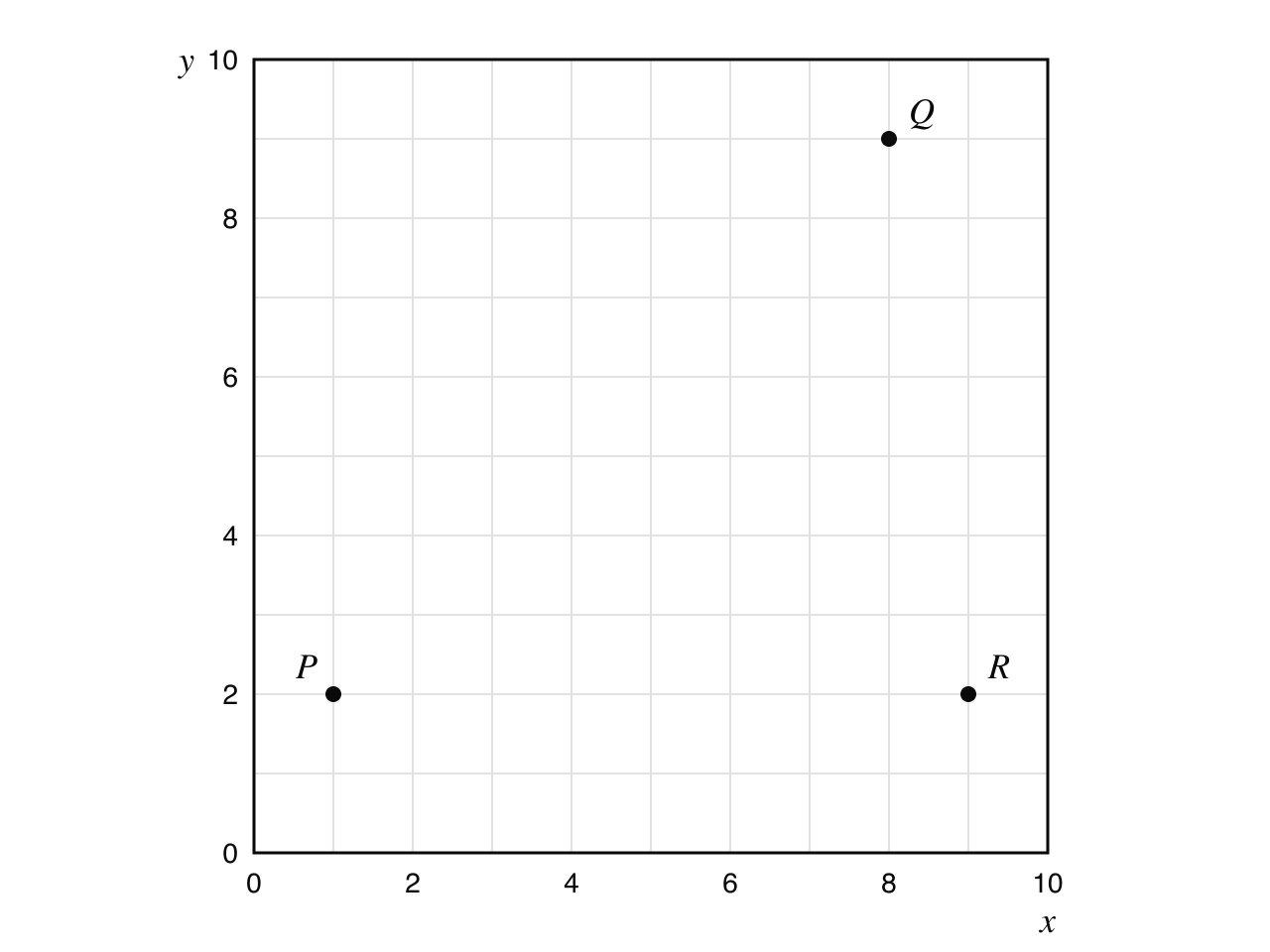
Archaeologists excavating a site find three post holes P(1, 2), Q(8, 9) and R(9, 2) from a circular hut. Distances are in metres. They believe all three post holes lie on the circular wall of the hut.
(a)
Write down the equation of the perpendicular bisector of [PR].
[1]1 mark
Markscheme (a)
x=5A1
[1 mark]
(b)
Find the equation of the perpendicular bisector of [PQ].
[4]4 marks
Markscheme (b)
From the formula booklet
The entries of the mathematics: applications and interpretation formula booklet that 3.4 uses. Each opens in the explained booklet.
The flat shape that folds to make the curved surface of a cone, a sector whose radius is the cone's slant height and whose arc length equals the circumference of the cone's base.
A line segment or arc subtends an angle at a point when lines drawn from its two ends to the point form that angle.
of a full turn, the curved edge is
41
of the circumference and the slice is
41
of the area.
The same proportional reasoning lets the methods run backwards. Around 240 BC, Eratosthenes used an angle of 7.2° and a distance of 5000 stadia between two Egyptian cities to estimate the distance around the whole Earth, by treating the distance as an arc of a circle.
The parts of a circle
A circle is the set of all points in a plane at a fixed distance, the radius r, from a fixed point, the centre O. A diameter is a chord through the centre, so its length is 2r. The distance around the circle has its own name.
The number π≈3.14159 is defined as the ratio of any circle's circumference to its diameter. Because every circle is an enlargement of every other circle, this ratio is the same for all of them, which is why C=πd=2πr works for a coin and for the equator alike. The area of a circle is πr2; both results are prior learning.
Arcs and chords
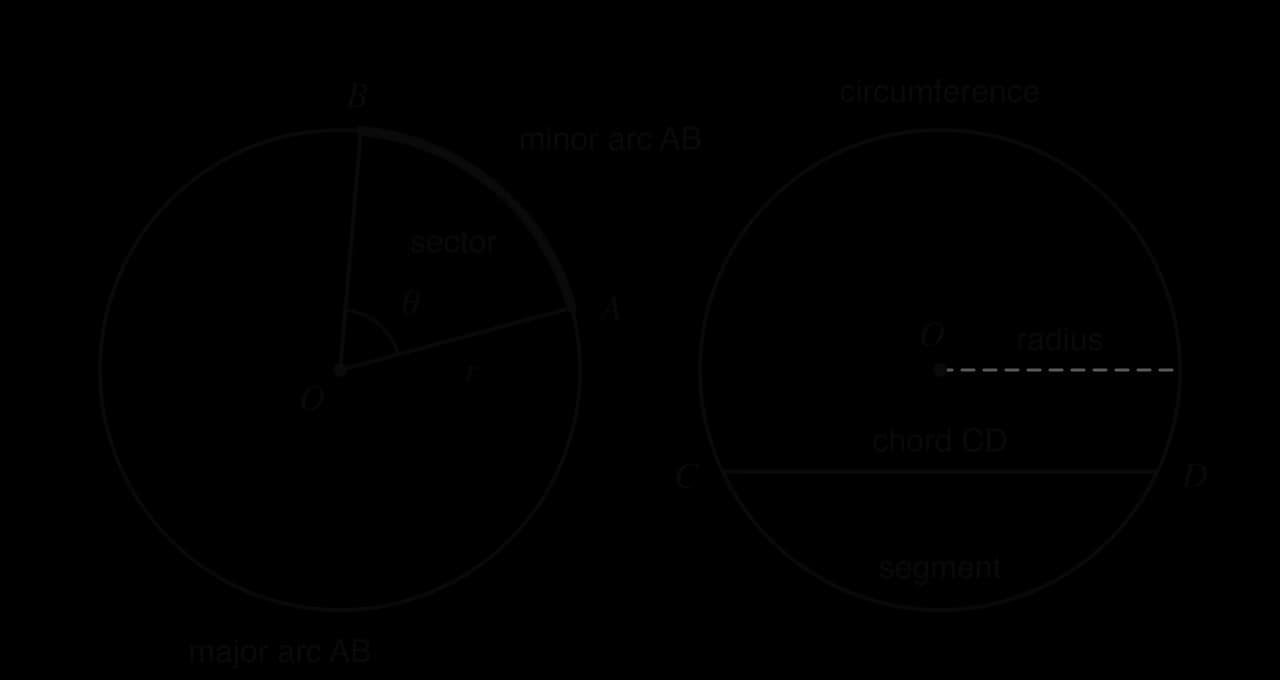
Two points A and B on a circle split the circumference into two pieces. Each piece is an arc.
Unless the two points are the ends of a diameter, one arc is shorter than the other. The two arcs are named by their size.
By convention, "arc AB" on its own means the minor arc. The other arc goes the long way round.
The straight line between the two points cuts across the circle rather than following it.
The angle at the centre
The two radii OA and OB meet at the centre and form an angle. The size of this angle determines what fraction of the circle the arc, and the slice, contain.
The word "subtend" describes the relationship between an arc and that angle: the arc AB is "opposite" the angle AO^B, and the angle "stands on" the arc.
Sectors and segments
A circle can be cut into two kinds of piece. Cutting along two radii gives a slice shaped like a piece of pie; cutting along a chord gives a piece shaped like a slice of a melon.
The diagram of the parts of a circle shows both kinds of region side by side, with each part labelled.
A sector is cut off by two radii and is a fraction of the whole circle; a segment is cut off by a chord and is not.
A sector and a segment are easy to mix up because both are bounded by an arc. The difference is the straight edge: a sector has two radii meeting at the centre, a segment has one chord that does not pass through the centre (unless it is a diameter, which gives two semicircles).
Arc length
The formula from a fraction of a turn
A full turn is 360°. A central angle of θ degrees is the fraction 360θ of a full turn, and because the circle looks the same all the way round, the arc it cuts off is the same fraction of the circumference.
l=360θ×2πr
A semicircle has θ=180°, so its arc is 360180×2πr=πr, half the circumference. A quarter circle has θ=90° and arc 2πr. The formula is the general rule behind these special cases.
The formula shows two proportional relationships. For a fixed radius, doubling the angle doubles the arc; for a fixed angle, doubling the radius doubles the arc. The graph of arc length against central angle is therefore a straight line through the origin, steeper for a larger circle.
r = 5 cm
r = 10 cm
Arc length is proportional to the central angle, and doubling the radius doubles every arc length: the r = 10 line is twice as steep.
Calculating arc lengths
The method is a substitution, but two decisions come first: which radius belongs to the arc, and which angle stands on it. A diagram with the radius and angle marked settles both.
The exact answer keeps π as a symbol. It is found by simplifying the fraction 360θ and multiplying by 2r, leaving π untouched; a decimal answer comes from evaluating it with the GDC's π key, never with 3.14, which already differs from π in the third significant figure.
Clock hands
A clock is a natural source of arcs. The minute hand turns through 360° in 60 minutes, which is 6° per minute. The hour hand turns through 360° in 12 hours, which is 30° per hour or 0.5° per minute. The tip of each hand moves along an arc whose radius is the hand's length.
When both hands matter, the angle between them is found from each hand's position measured from 12 o'clock. At 3:40, the minute hand has turned 40×6°=240° from 12, and the hour hand has turned 3×30°+40×0.5°=110°. The angle between them is 240°−110°=130°. If the hands are 9 cm and 6 cm long, the straight-line distance between the tips is the third side of a triangle with an included angle of 130°, found with the cosine rule from subtopic 3.2.
d=92+62−2×9×6×cos130°=13.7 cm (3 s.f.)
Finding the angle or the radius
The arc length formula links three quantities, l, r and θ. Given any two, the third follows by rearranging.
θ=2πr360lr=2πθ360l
Rearranging is quick by hand, but a GDC's equation solver avoids errors with the order of operations: enter the formula with the known values and solve for the unknown (TI-84 Plus CE: MATH → Numeric Solver; Casio fx-CG50: MENU → Equation → SOLVER). Either way, write down the equation that was solved.
Reading the arc length formula backwards is also how Eratosthenes estimated the size of the Earth. At noon on the summer solstice the Sun was directly overhead at Syene, while at Alexandria, roughly due north, the Sun's rays made an angle of about 7.2° with the vertical. Because the Sun's rays arrive almost parallel, that angle equals the central angle between the two cities at the Earth's centre, and the distance between them, about 5000 stadia, is the arc it subtends.
3607.2×C=5000⟹C=5000×7.2360=250000 stadia
Source: Wikipedia, "Eratosthenes" (account of Cleomedes), accessed 2026.
Since 7.2° is 501 of a full turn, the whole circumference is 50 times the arc. The length of a stadion is uncertain, so the accuracy of the result in kilometres is still debated, but the method is the arc length formula exactly.
Area of a sector
The formula from a fraction of the circle
The same fraction of a turn gives the area. A sector with central angle θ is 360θ of the whole circle, so its area is that fraction of πr2.
A=360θ×πr2
Area is not proportional to the radius: doubling the radius multiplies a sector's area by 4, because area depends on r2. It is still proportional to the angle. Comparing the two formulas also shows a neat link between them.
lA=360θ×2πr360θ×πr2=2r⟹A=21rl
A sector therefore has the same area as a triangle with base l (the arc, straightened) and height r. The result gives a quick check, or a short cut when the arc length is already known.
For an exact answer, the fraction 360θ is simplified first and π is left as a symbol, exactly as for arc lengths.
Finding the angle or the radius from an area
Working backwards from an area is the same as from an arc, except that finding the radius needs a square root at the end.
θ=πr2360Ar=πθ360A
When the radius is the unknown, the equation contains r2, so the last step is a square root. Only the positive root is kept, because a radius is a length.
YouTube
Corbettmaths, “Area of a Sector”: watch how each sector is treated as a fraction of a full circle, the same reasoning as the formula A = θ/360 × πr².
Perimeter of a sector
The boundary of a sector has three parts: the arc and two radii. Its perimeter adds them.
The radii are easy to forget because the arc is the only curved, and most noticeable, part of the boundary. Fencing a sector-shaped flower bed, edging a slice of cake with icing or framing a fan-shaped window all need the whole perimeter.
Problems with two unknowns
Sometimes a question gives two facts about a sector and neither the radius nor the angle. Two facts give two equations, which can be solved as a system with the GDC or by substitution.
Area of a segment
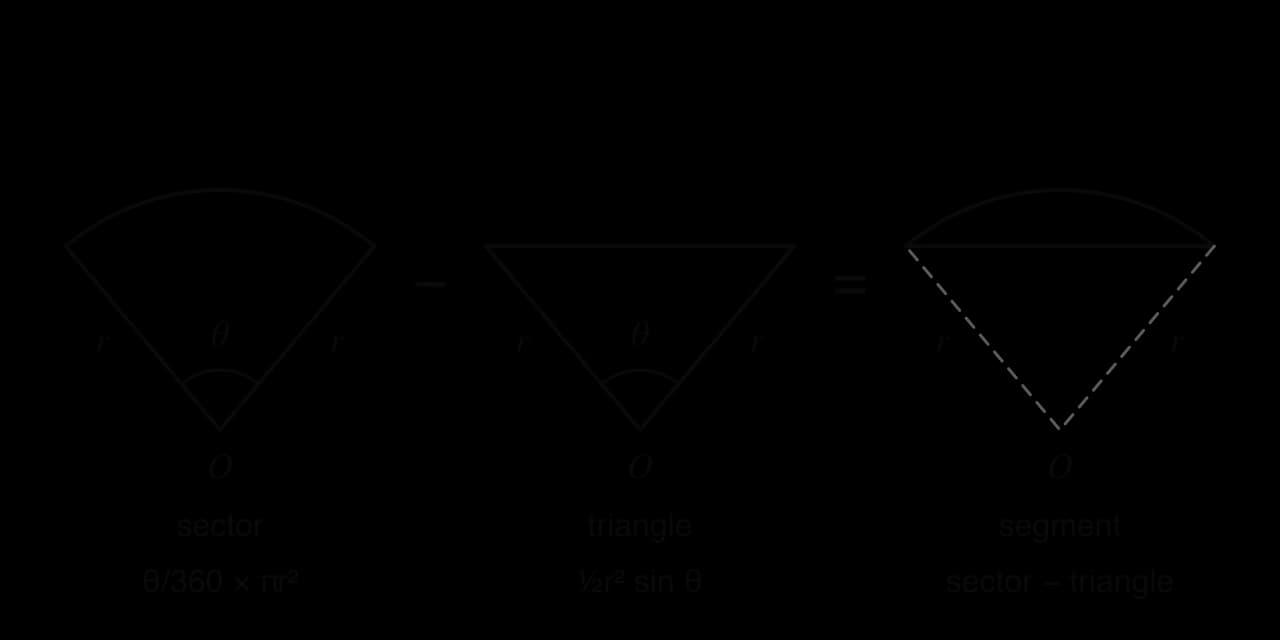
A segment is what remains of a sector when the triangle formed by the two radii and the chord is removed. The diagram of the subtraction shows the three shapes.
The segment is the sector with the triangle removed; both shapes share the two radii and the angle θ.
The triangle has two sides of length r with the angle θ between them, so its area comes from the area of a triangle using sine, 21absinC, with a=b=r and C=θ.
area of segment=360θ×πr2−21r2sinθ
The GDC must be in degree mode for sinθ (see angle mode in subtopic 3.2). In radian mode, sin80 is calculated for 80 radians and gives −0.994 instead of 0.985, a negative triangle area and a segment larger than the sector.
The chord and the perimeter of a segment
The boundary of a segment is the arc and the chord. The chord is the third side of the isosceles triangle, so the cosine rule gives it.
chord2=r2+r2−2r2cosθ=2r2(1−cosθ)
Splitting the isosceles triangle down its line of symmetry gives two right-angled triangles with hypotenuse r and angle 2θ at the centre, so the chord is also 2rsin2θ. Both forms give the same value; the cosine rule is the one most often written.
When the angle is not given
Real problems usually give lengths, not the central angle. The angle comes first, from right-angled trigonometry on half of the isosceles triangle, then the segment formula applies.
The major segment is the rest of the circle. Its area is the circle's area minus the minor segment, or equivalently the major sector plus the triangle.
Annuli and annular sectors
The annulus
The region between two circles with the same centre is a ring.
A slice of an annulus, cut by two radii, is a sector with a smaller sector removed from its point.
The formula comes from subtracting two sectors with the same angle.
360θ×πR2−360θ×πr2=360θ×π(R2−r2)
The boundary of an annular sector has four parts: an outer arc, an inner arc and two straight edges of length R−r.
P=360θ×2πR+360θ×2πr+2(R−r)
Windscreen wipers
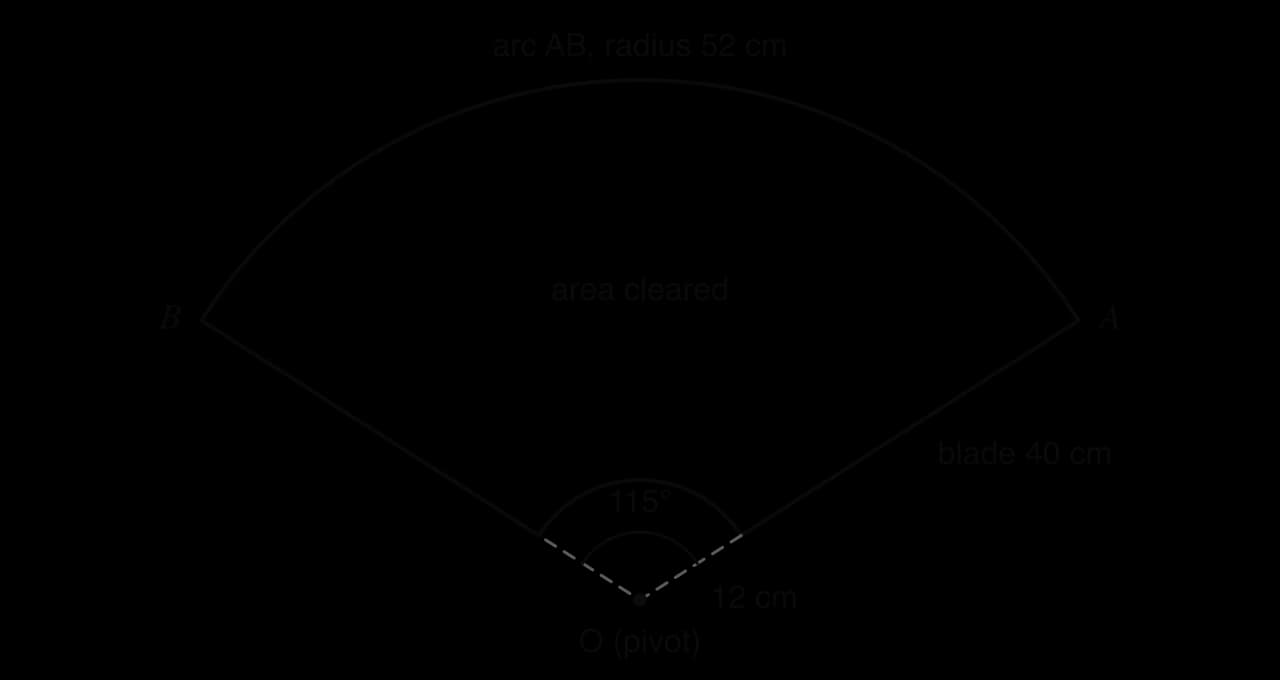
A windscreen wiper is the standard example. The metal arm turns about a pivot, but the rubber blade is fixed only to the outer part of the arm, so the glass it clears is an annular sector, with an uncleared strip between the pivot and the start of the blade. The diagram of the wiper shows a hypothetical arm of 52 cm whose blade covers the outer 40 cm, turning through 115°.
The cleared glass is the 52 cm sector with the 12 cm sector removed: its inner radius is the arm length minus the blade length.
A second wrong radius appears in the same problem: the blade length itself. The arc traced by the end of the blade has radius 52 cm (its distance from the pivot), not 40 cm (its length). Every radius in a sector problem is measured from the centre of rotation.
Cone nets
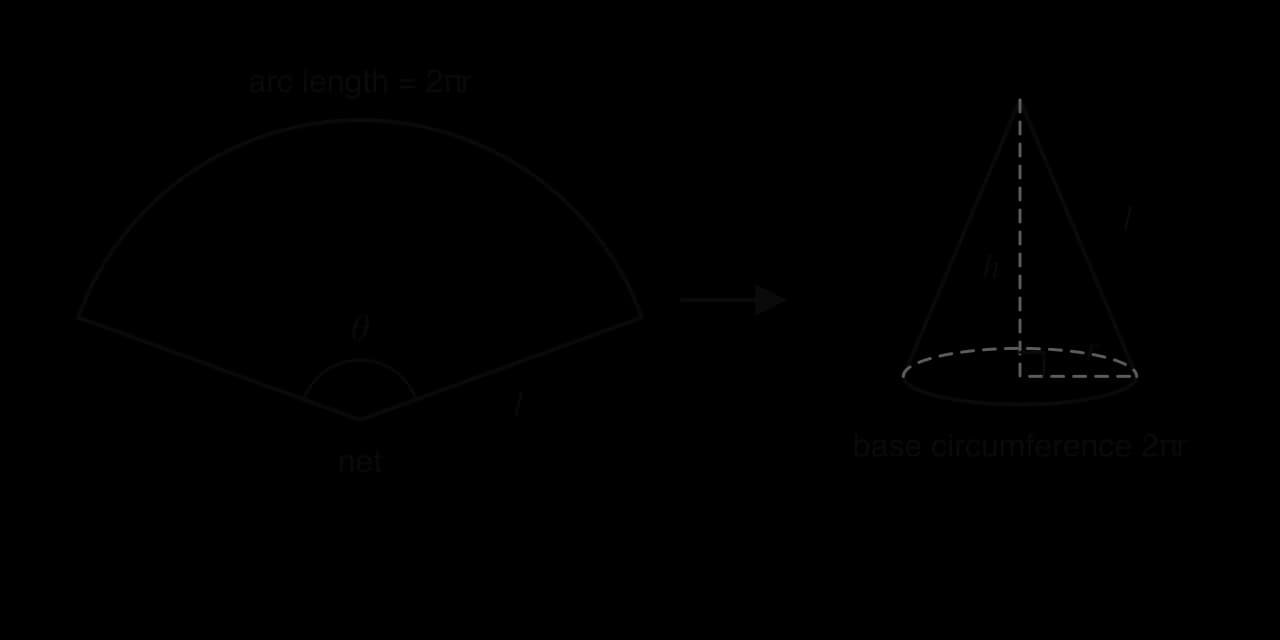
A cone's curved surface can be cut along a straight line from the apex to the base and flattened. The flat shape is a sector, which is why paper cones, party hats and lampshades are cut from sectors.
The diagram of a cone net shows how each length of the sector becomes a length of the cone.
Rolling the sector up turns its radius into the slant height and its arc into the circumference of the base.
Two facts come from the folding:
Each radius of the sector runs from the apex to the base, so the sector's radius equals the slant height l of the right cone.
The arc of the sector goes exactly once around the base, so the arc length equals the base circumference.
360θ×2πl=2πr⟹θ=360×lr
The fraction of a full circle used by the net is lr, the ratio of the base radius to the slant height. Since r<l in every cone, the net is always less than a full circle. The vertical height h, the base radius and the slant height form a right-angled triangle, so Pythagoras' theorem gives l2=r2+h2.
The sector's area is the cone's curved surface area. Substituting θ=360×lr into the sector area formula shows why the formula for the curved surface of a cone (subtopic 3.1) is πrl.
360θ×πl2=lr×πl2=πrl
The relations also run in reverse. Given the cone, Pythagoras' theorem gives the slant height, which is the radius of the sector, and θ=360×lr gives its angle.
Measured sectors and bounds
Real sectors are measured, so the radius and the angle are rounded values. The greatest and least possible areas come from the upper bounds and lower bounds of both measurements, as in subtopic 1.6. Area increases with both r and θ, so the upper bound of the area uses the upper bounds of both, and the lower bound uses both lower bounds.
The largest possible percentage error in the recorded area treats each bound in turn as the exact value and keeps the larger result. Against the upper bound, 16.71916.286−16.719×100%≈2.59%; against the lower bound, 15.86116.286−15.861×100%≈2.68%. The largest possible percentage error is about 2.68%, even though the upper bound is slightly further away in absolute terms, because the lower bound is the smaller denominator.
Case study: staggered starts on a running track
A standard 400 m track has two straights joined by two semicircular bends. Its distances are measured along a running line 0.30 m outside the inner edge of lane 1 and 0.20 m outside the inner edge of every other lane, with lanes 1.22 m wide. The inner edge of the track is a semicircle of radius 36.5 m, so the running line of lane 1 has radius 36.80 m.
Lane
Radius of running line (m)
Length of one bend (m)
Extra distance in a 400 m race (m)
1
36.80
115.611
0.000
2
37.92
119.129
7.037
3
39.14
122.962
14.703
4
40.36
126.795
22.368
5
41.58
130.627
30.034
6
42.80
134.460
37.699
7
44.02
138.293
45.365
8
45.24
142.126
53.030
Source: Wikipedia, "Running track" (lane measurement table, based on World Athletics track specifications), accessed 2026.
Each bend is a semicircle, an arc with central angle 180°, so its length is 360180×2πr=πr. For lane 1, π×36.80=115.61 m. The two bends together make 231.22 m, which leaves 400−231.22=168.78 m for the two straights, or 84.39 m each.
The straights are the same length in every lane, but the bends are not. A runner who stays in lane 8 for a full lap runs two bends of radius 45.24 m.
2×π×45.24−2×π×36.80=2π(45.24−36.80)=53.03 m
So in a 400 m race, the lane 8 runner must start 53.03 m further round the track than the lane 1 runner, and this head start is called the stagger. In a 200 m race (one bend) the stagger is half of this, 26.5 m.
The calculation shows that the stagger depends only on the difference in radii, 2π×Δr for a full lap, and not on the size of the track. From lane 2 outwards each lane adds 1.22 m to the radius, so each extra lane adds 2π×1.22=7.665 m to a 400 m stagger. Lane 2 adds only 7.037 m, because its running line is measured 0.20 m from its inner edge rather than 0.30 m, so its radius is only 1.12 m more than lane 1's (2π×1.12=7.037).
stagger = 7.037 + 7.665(n − 2)
From lane 2 outwards the stagger rises by the same 7.665 m per lane, because each lane adds the same 1.22 m to the bend radius. Source: Wikipedia, Running track, 2026.
The model has limitations. Runners do not run exactly on the measured line, and a runner who drifts 0.1 m outwards on both bends adds 2π×0.1≈0.63 m to the race, which is several hundredths of a second at elite speed. The stagger also makes the lane 8 runner start out of sight of the others, which affects pacing but not distance. As a model of distance, the arc length formula is exact for the line on which the track is measured.
YouTube
Revision Village, “Length of an Arc, Area of a Sector (Circles) [IB Math AI SL/HL]”: watch how the degree formulas are applied, including working backwards to an angle or a radius.
Exam focus
Arcs and sectors appear on Paper 1 as short questions of 4–7 marks and as early parts of longer Paper 2 questions, often combined with the cosine rule and 21absinC from subtopic 3.2, with cone nets from subtopic 3.1, or with bounds and percentage error from subtopic 1.6. Typical command terms are calculate and find (substitute into the formula, showing the substitution), write down (an angle at the centre from a clock or a symmetry), determine and "give your answer in terms of π" (exact answers). Recurring shapes are a windscreen wiper or sprinkler (an annular sector), a clock (angles from times, arc lengths, the distance between hand tips), a segment of a lawn or a field reached by a tethered animal, a party hat or paper cup (a cone net), and a sector whose measurements are given to a stated accuracy. The method mark is for a correct substitution into the arc or sector formula, so write the substitution with numbers before the answer.
The fan question shows three habits that keep marks: the radius in every formula is a distance from the centre O; the annular area subtracts two sector areas, not two radii; and the segment uses the full-accuracy sector and triangle areas stored in the GDC.
Practice questions
A sector has radius 15 cm and central angle 36°. Calculate (a) its arc length and (b) its area. [4]
A sector of radius 9 cm has area 60 cm². Find its central angle. [2]
An arc of length 22 cm subtends an angle of 105° at the centre of a circle. Find the radius of the circle. [2]
Find the perimeter of a major sector of radius 7 m and central angle 230°. [3]
A chord of a circle of radius 12 cm subtends an angle of 100° at the centre. Find (a) the length of the chord and (b) the area of the minor segment. [6]
A sector of radius 20 cm and angle 216° is rolled into a cone with no overlap. Find the base radius, the vertical height and the volume of the cone. [6]
A sprinkler on a pivot waters the region between 3 m and 11 m from the pivot as it turns through 75°. Calculate the area watered. [3]
At 4:20, find the angle between the hour hand and the minute hand of a clock. The minute hand is 10 cm long. Find the distance its tip travels between 4:20 and 4:40. [4]
The radius of a sector is 12 cm, correct to the nearest centimetre, and its angle is 40°, correct to the nearest 5°. Find the upper and lower bounds of its area. [4]
A sector has perimeter 28 cm and area 48 cm². Find the two possible pairs of radius and central angle. [6]
An arc is part of the circumference; a sector is bounded by two radii and an arc; a segment is bounded by a chord and an arc.
A central angle of θ degrees is the fraction 360θ of a full turn, and every arc and sector formula applies this fraction to the whole circle.
Arc length l=360θ×2πr; sector area A=360θ×πr2; and A=21rl.
Perimeter of a sector = arc length + 2r.
Area of a segment = sector − triangle = 360θπr2−21r2sinθ
Annular sector area = 360θπ(R2−r2): subtract the areas, never the radii.
A cone net is a sector whose radius is the slant height and whose arc is the base circumference, so θ=360×lr.
Rearranging the formulas, or a GDC solver, gives the angle or the radius from a known arc, area or perimeter; keep full accuracy until the final answer.
Self-check
To do:
I can name and sketch an arc, a chord, a sector, a segment and a central angle.
To do:
I can tell a minor arc from a major arc, and a sector from a segment.
To do:
I can calculate an arc length and a sector area in degrees, exactly and to 3 significant figures.
To do:
I can explain why both formulas use the fraction 360θ.
To do:
I can find the angle or the radius from a given arc length or sector area.
To do:
I can calculate the perimeter of a sector, including a major sector.
To do:
I can solve a sector problem with two unknowns, such as a given perimeter and area.
To do:
I can find the area of a segment by subtracting 21r2sinθ from the sector, with my GDC in degree mode.
To do:
I can find a chord length with the cosine rule.
To do:
I can find the area of an annular sector, choosing radii measured from the centre.
To do:
I can find angles between clock hands and distances travelled by their tips.
To do:
I can find the base radius, height or sector angle in a cone-net problem.
To do:
I can find upper and lower bounds of a sector's area from rounded measurements.
To do:
I can interpret a staggered start on a running track using arc lengths.
midpoint (4.5,5.5)(A1)
gradient of PQ =8−19−2=1(A1)
perpendicular gradient =−1(M1)
y=−x+10A1
[4 marks]
(c)
Hence find the coordinates of C, the centre of the hut.
[2]2 marks
Markscheme (c)
y=−5+10(M1)
(5,5)A1
[2 marks]
(d)
Find the radius of the hut.
[2]2 marks
Markscheme (d)
(5−1)2+(5−2)2(M1)
5 m A1
[2 marks]
(e)
Find the floor area of the hut.
[2]2 marks
Markscheme (e)
π×52(M1)
78.5 m2(25π,78.5398…)A1
[2 marks]
(f)
Find the size of angle PCR.
[3]3 marks
Markscheme (f)
PR =8, CP = CR =5(A1)
cosPC^R=2×5×525+25−64(M1)
106°(106.260…°)A1
Note: Accept 2arctan(34) or equivalent right-angled trigonometry.
[3 marks]
(g)
The wall between P and R that does not pass through Q has been destroyed. Find the length of this section of wall.
[2]2 marks
Markscheme (g)
360106.260…×2π×5(M1)
9.27 m (9.27295…)A1
Note: Follow through from parts (d) and (f).
[2 marks]
Question 2 · AI-0035014 marks
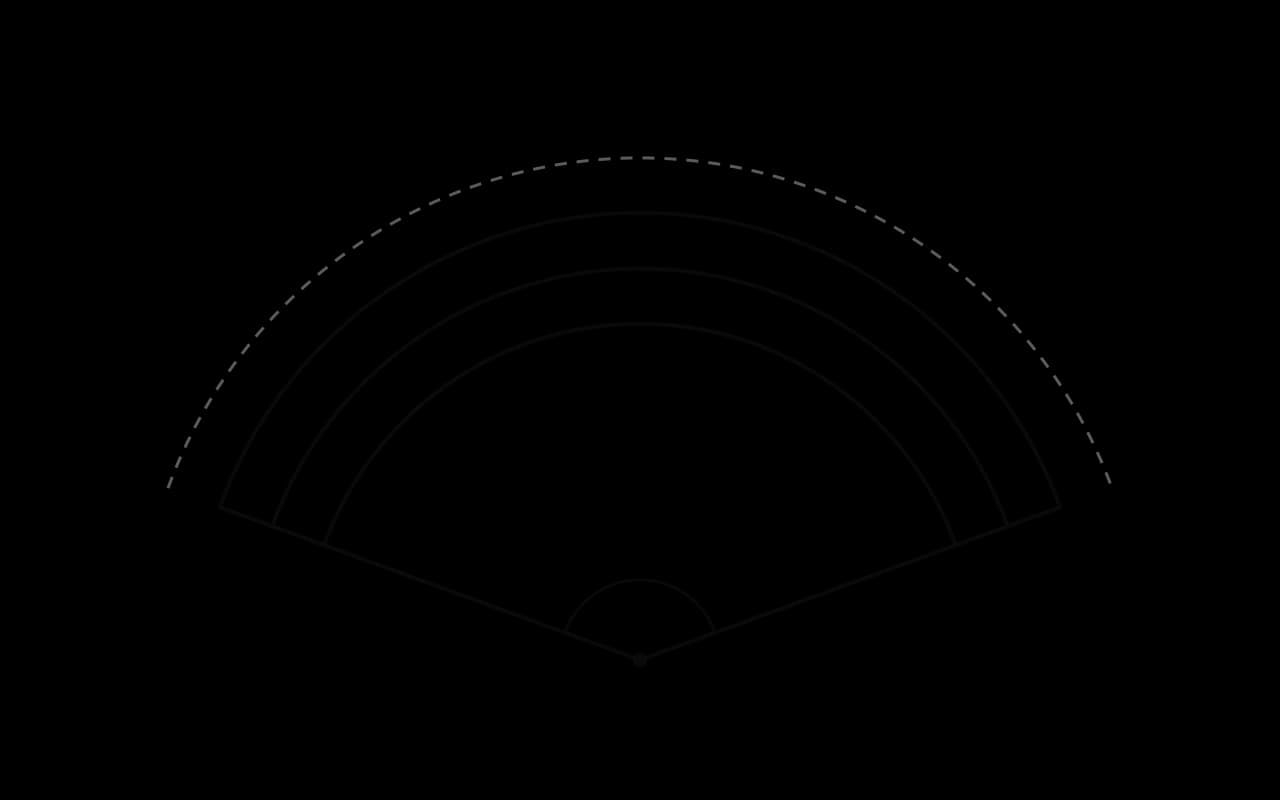
An outdoor theatre is built as an amphitheatre. Seen from above, the stage is at O and the rows of benches (tiers) are arcs of circles centred at O, each subtending an angle of 140° at O.
The first tier has radius 12 m, and the radius of each tier is 0.9 m greater than that of the tier in front of it.
Diagram not to scale.
(a)
Show that the length of the arc of the first tier is 29.3 m, correct to three significant figures.
[2]2 marks
(b)
The arc lengths of the tiers form an arithmetic sequence. Find the common difference.
[2]2 marks
(c)
Find the length of the arc of the 20th tier.
[2]2 marks
(d)
Each spectator needs 0.55 m of bench. Find the maximum number of spectators who can sit on the 20th tier.
[2]2 marks
(e)
Find the total length of the arcs of the first 20 tiers. Give your answer to the nearest metre.
[2]2 marks
(f)
The architect, Chiara, wants the amphitheatre to seat at least 3000 spectators. She assumes that the whole length of every tier can be used.
Find the least number of tiers needed.
[3]3 marks
(g)
Explain why, in practice, more tiers than your answer to part (f) may be needed.
A robot arm is pivoted at the origin of an Argand diagram, where 1 unit represents 1 cm. The tip of the arm is at the point T, which represents 30+40i.
The arm then rotates 50° anticlockwise about the origin.
(a)
Write 30+40i in the form reiθ.
[2]2 marks
(b)
By multiplying by a suitable complex number, find the new position of the tip of the arm. Give your answer in the form a+bi