3.1 Volume and surface area in three dimensions · IB Maths AI | Augment Education
3.1 Volume and surface area in three dimensions
Find distances and midpoints in 3D, calculate the volume and surface area of pyramids, cones, spheres, hemispheres and compound solids, and find lengths and angles inside solids using right-angled triangles.
IB Mathematics: Applications and Interpretation
Part of 3 Geometry and trigonometry
SL and HL
Key terms introduced here
Each is in the Maths AI glossary, with every other term in the subject.
The part of a straight line between two endpoints, written [AB]
Notes on 3.1 Volume and surface area in three dimensions
53 min readLast reviewed
Learning objectives
Calculate the distance between two points in three-dimensional space, and find the midpoint of the line segment joining them.
Calculate the volume and surface area of prisms, cylinders, right pyramids, right cones, spheres and hemispheres.
Determine which surfaces count when finding an external, curved, total or painted surface area.
Calculate the volume and surface area of compound solids, including a frustum as the difference of two solids.
Find an unknown dimension of a solid from its volume or surface area, using technology where appropriate.
Use the scale factors for length, area and volume of similar solids.
Identify right-angled triangles inside three-dimensional objects and use them to find unknown lengths and angles.
Calculate the angle between two intersecting lines, and the angle between a line and a plane.
Introduction
Almost every object that is designed, built or packaged has three dimensions. An engineer needs the length of a cable between two towers at different heights, a manufacturer needs the amount of metal in a can and the volume it holds, and an architect needs the angle a roof makes with the horizontal. Three-dimensional geometry answers these questions with a small set of tools: coordinates that locate points in space, formulas for the volume and surface area of standard solids, and right-angled triangles found inside solids.
Alongside volume and surface area, three-dimensional geometry includes the distance between two points in space, the midpoint of the line segment joining them, and the angle between two lines or between a line and a plane. All three rest on Pythagoras' theorem, which extends from a flat page into space when it is applied twice.
Questions on 3.1
104 exam-style questions on this subtopic, written in the style of the IB papers. The first has its markscheme open. Counted on
Question 1 · AI-001377 marks
The planet Mars can be modelled as a sphere with radius 3389.5 km.
(a)
Calculate the volume of Mars, in km³. Give your answer in the form a×10k, where 1≤a<10
From the formula booklet
The entries of the mathematics: applications and interpretation formula booklet that 3.1 uses. Each opens in the explained booklet.
The point on a line segment that is the same distance from both endpoints; for endpoints (x1,y1,z1) and (x2,y2,z2) it is (2x1+x2,2y1+y2,2z1+z2).
A solid with two identical, parallel polygonal ends joined by rectangular faces, so that every cross-section parallel to the ends is the same shape and size.
Solids with the same shape, in which every length of one is k times the corresponding length of the other, so that corresponding areas are in the ratio k2 and volumes in the ratio k3.
The distance from the apex of a cone or pyramid to the edge of its base, measured along the sloping surface; for a pyramid it is the height of a triangular face, measured from the midpoint of a base edge.
A line segment joining two vertices of a solid that do not lie on the same face, passing through the inside of the solid; in a cuboid it joins opposite corners.
The solid made of all the points within a fixed distance r (the radius) of a fixed point (the centre); its surface is the set of points exactly r from the centre.
An ordered triple (x,y,z) that gives the position of a point in space as its distances along three mutually perpendicular axes that meet at the origin O(0,0,0).
The amount of three-dimensional space occupied by a solid, measured in cubic units such as cm3 or m3.
Points and distances in three dimensions
Three-dimensional coordinates
A point on a flat page needs two numbers to fix its position. A point in a room needs three: how far along, how far across and how high. Three-dimensional coordinates add a third axis, the z-axis, perpendicular to both the x-axis and the y-axis. In most applied problems the x- and y-axes lie on horizontal ground and the z-coordinate measures height.
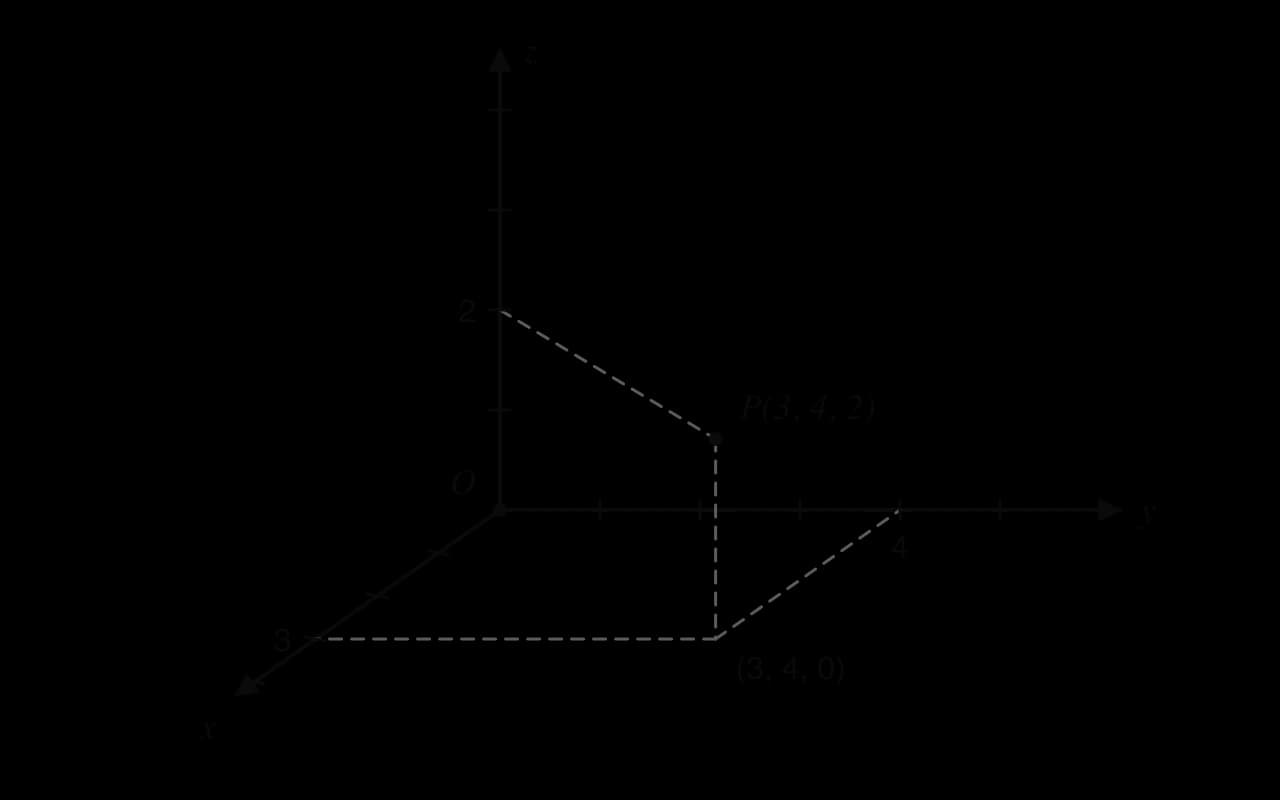
The point P(3,4,2) is reached from the origin by moving 3 units in the x-direction, 4 units in the y-direction and 2 units up. Directly beneath P on the horizontal plane is the point (3,4,0), its "shadow" at ground level. Drawing a 3D point as the corner of a box, with dashed lines back to the axes, makes its position clear on a flat page.
The point P(3, 4, 2) sits 2 units directly above (3, 4, 0). The dashed lines show the three coordinates as the edges of a box.
The x-axis is drawn sloping towards the viewer because a page has only two dimensions. Lengths along it look shorter than they are, and angles that are right angles in space do not look like right angles on paper. Reading lengths or angles off such a drawing is the main source of error in three-dimensional problems. A diagram is only a representation, so every length and angle has to come from calculation.
Pythagoras' theorem
Every length and angle calculation in three-dimensional geometry is built from right-angled triangles, so Pythagoras' theorem is the starting point.
The converse also holds: if the three sides of a triangle satisfy c2=a2+b2, the angle opposite c is a right angle. In three dimensions the theorem is used over and over, because the right angles in a solid lie in many different planes: between a vertical edge and the floor, between two edges of a base, between a height and a radius.
The distance between two points
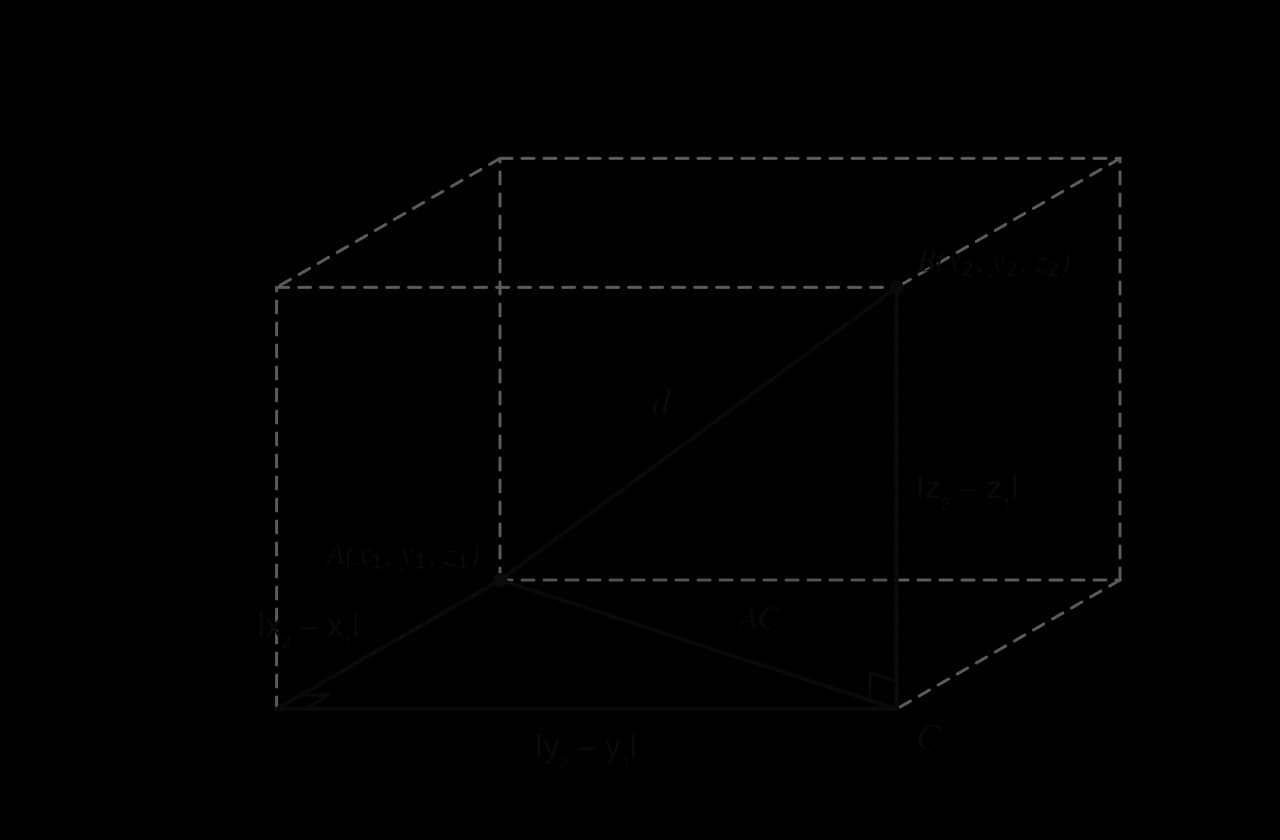
In two dimensions, the distance between (x1,y1) and (x2,y2) is the hypotenuse of a right-angled triangle whose other sides are the horizontal and vertical differences. In three dimensions the same idea is used twice. The two points A(x1,y1,z1) and B(x2,y2,z2) are opposite corners of a box whose edges are parallel to the axes and have lengths ∣x2−x1∣, ∣y2−y1∣ and ∣z2−z1∣.
Two right-angled triangles give the distance: first AC across the base, then AB = d up through the box.
The first right-angled triangle lies flat on the base of the box. Its hypotenuse AC runs from A to the point C directly below B, so AC2=(x2−x1)2+(y2−y1)2. The second triangle ACB stands vertically: CB is vertical and AC is horizontal, so the angle at C is a right angle and Pythagoras' theorem applies again.
d2=AC2+CB2=(x2−x1)2+(y2−y1)2+(z2−z1)2
Taking the square root gives the distance formula. Squaring removes any negative signs, so the order of subtraction does not matter: (x1−x2)2=(x2−x1)2.
d=(x1−x2)2+(y1−y2)2+(z1−z2)2
The midpoint of a line segment
The midpoint of a segment is found by averaging the endpoints' coordinates, one coordinate at a time. Halfway from A to B means halfway in the x-direction, halfway in the y-direction and halfway in height, and each of these is the mean of the two values.
M=(2x1+x2,2y1+y2,2z1+z2)
The formula works in reverse. If one endpoint A and the midpoint M are known, the other endpoint is as far beyond M as A is before it, so each coordinate of B is 2×(coordinate of M)−(coordinate of A).
When a distance is given and a coordinate is unknown, the distance formula becomes an equation. Squaring both sides removes the square root, and the equation often has two solutions, because two points on a line can be the same distance from a third point.
Volume, capacity and surface area
Measuring space and surface
Volume measures the amount of space a solid occupies, counted in cubes: a cube of side 1 cm has volume 1 cm3. Surface area measures the total area of the faces of a solid, counted in squares. The two quantities answer different practical questions: volume says how much a container holds or how much material a solid block contains, while surface area says how much material is needed to make or cover the outside.
For a container, the volume it can hold is called its capacity. Capacity is usually given in litres or millilitres, which are volume units: 1 ml=1 cm3 and 1 litre=1000 cm3.
Converting between units of volume needs care, because a length conversion is cubed. A cube of side 1 m is also a cube of side 100 cm, so 1 m3=1003 cm3=1000000 cm3. In the same way an area conversion is squared: 1 m2=1002 cm2=10000 cm2.
Quantity
Conversion
Reason
Length
1 m = 100 cm; 1 cm = 10 mm
given
Area
1 m2=10000 cm2
1002
Volume
1 m3=1000000 cm3
1003
Capacity
1 litre=1000 cm3; 1 m3=1000 litres
1 litre is a cube of side 10 cm
The surface area of a solid made of flat faces is the sum of the areas of its faces. Some solids also have a curved surface, which is measured separately. Many applied problems ask only for part of the surface: the outside of a tank that is painted, the inside of an open container that is coated, or the curved surface of a hat.
The curved part of a cylinder, cone or sphere has no flat faces to add, so its area has its own formula. A question that asks for "the curved surface area" excludes any flat ends.
Nets
A net shows a solid's surface unfolded into one flat shape. Folding the net back up rebuilds the solid, so the area of the net equals the surface area of the solid. Nets explain where surface area formulas come from: a cylinder's curved surface unrolls into a rectangle, and a cone's curved surface unrolls into a sector of a circle.
Prisms and cylinders
Prisms
A prism has the same cross-section all the way along its length, like a loaf of sliced bread or a length of guttering. Its volume is therefore the area of one cross-section multiplied by the length: each centimetre of length adds one more slice of volume A. A cuboid is a prism with a rectangular cross-section, so its volume V=lwh is a special case.
V=Ah
Here A is the area of the cross-section and h is the length of the prism (its height when it stands on one end). The surface area of a prism is the area of the two ends plus the area of the rectangular faces. Each rectangle has one side equal to h and the other equal to a side of the cross-section, so the rectangles together have area (perimeter of the cross-section) ×h.
Cylinders
A cylinder is a prism with a circular cross-section, so its volume is the area of the circle multiplied by the height. Its curved surface unrolls into a rectangle whose width is the height h and whose length is the circumference 2πr of the circular end.
The total surface area adds two circles of area πr2, one at each end. An open container such as a cup, a water tank without a lid or a pipe needs only one end or none, and the context decides which.
Right pyramids
Volume of a pyramid
A pyramid has a polygon as its base and triangular faces that rise to a single point, the apex. In a right pyramid the apex is directly above the centre of the base, so the solid is symmetric and every slanting face of a regular base is the same isosceles triangle.
The volume of any pyramid is one third of the volume of the prism with the same base and height.
V=31Ah
Here A is the area of the base and h is the perpendicular (vertical) height from the base to the apex. A cube shows where the 31 comes from. A cube of side a can be cut into three identical pyramids, each with a square face of the cube as its base and the same corner of the cube as its apex. Each pyramid has base area a2 and height a, and three of them fill the cube, so each has volume 31a3=31×a2×a. The same factor holds for every pyramid and cone, which makes V=31Ah a generalization that holds for any base shape.
Slant height and the right-angled triangles in a pyramid
The vertical height h runs inside the pyramid from the apex to the centre of the base, and cannot be measured directly on a solid object. The height of each triangular face, measured up the face from the middle of a base edge to the apex, is different and always longer.
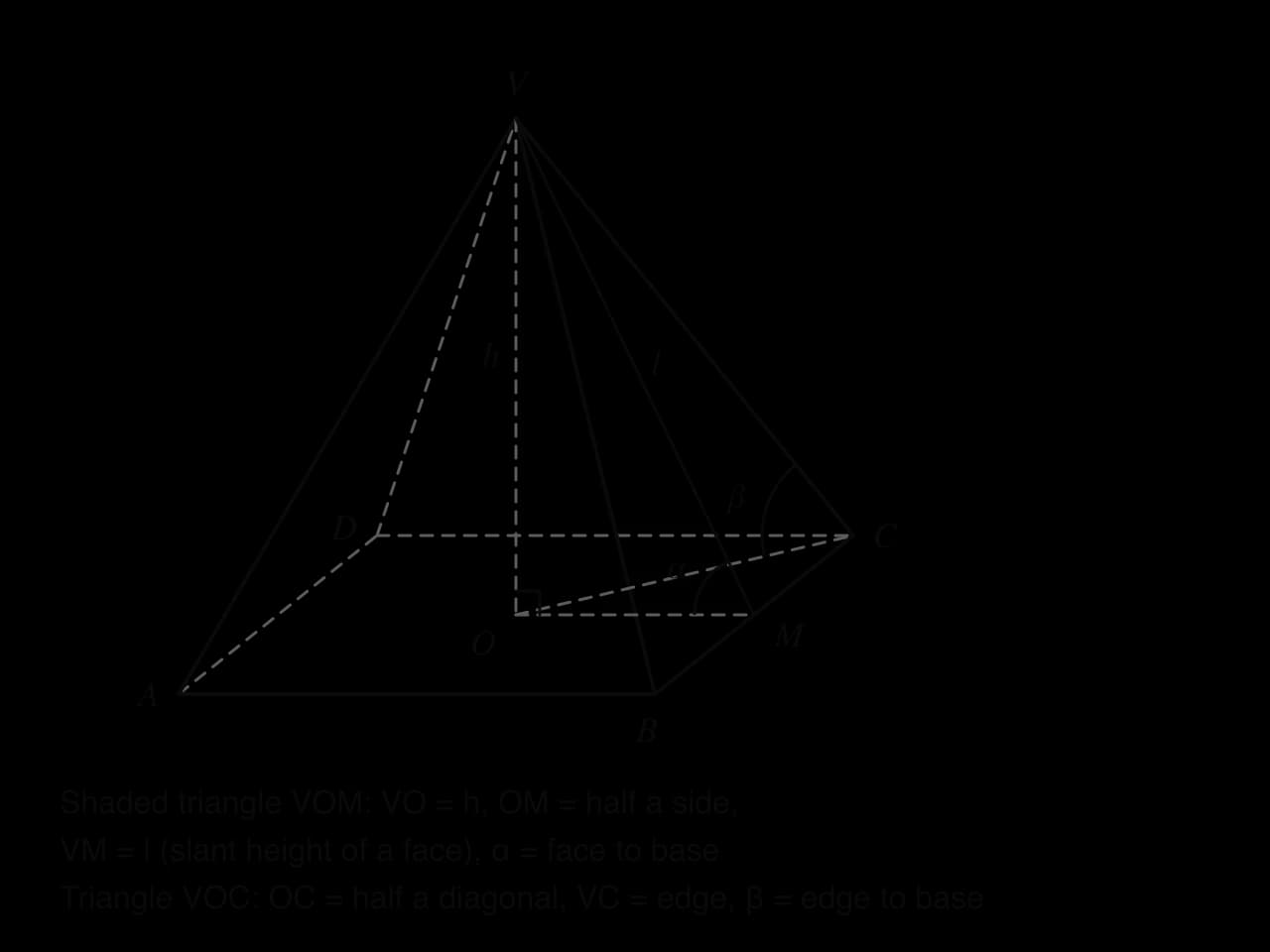
The vertical height, the slant height and the base are linked by right-angled triangles inside the pyramid. In a square-based right pyramid VABCD with base centre O, the line VO is vertical, so it is perpendicular to every horizontal line through O. Two of these triangles are used again and again.
Both triangles have their right angle at O, the centre of the base: VOM links h with the slant height of a face, and VOC links h with a sloping edge.
Triangle VOM, where M is the midpoint of a base edge: VO=h, OM is half the side of the base, and the hypotenuse VM is the slant height l of a face.
Triangle VOC, where C is a corner of the base: OC is half the diagonal of the base, and the hypotenuse VC is a sloping edge.
The surface area of a right pyramid is the area of the base plus the areas of the triangular faces. Each face is a triangle with base equal to a side of the base polygon and height equal to its slant height.
When the base is a rectangle rather than a square, the faces come in two pairs with different slant heights, because the centre of the base is a different distance from the long and the short edges.
Right cones
Volume of a cone
A cone is the limit of a pyramid whose base has more and more sides, and a pyramid on a regular polygon with 100 sides is already almost impossible to tell apart from a cone. The volume formula for pyramids therefore carries over, with the base area A=πr2.
V=31πr2h
The radius r, the vertical height h and the slant height l form a right-angled triangle, with the right angle at the centre of the base. The slant height is the hypotenuse, so l=r2+h2, and l is always longer than both r and h.
Curved surface area of a cone
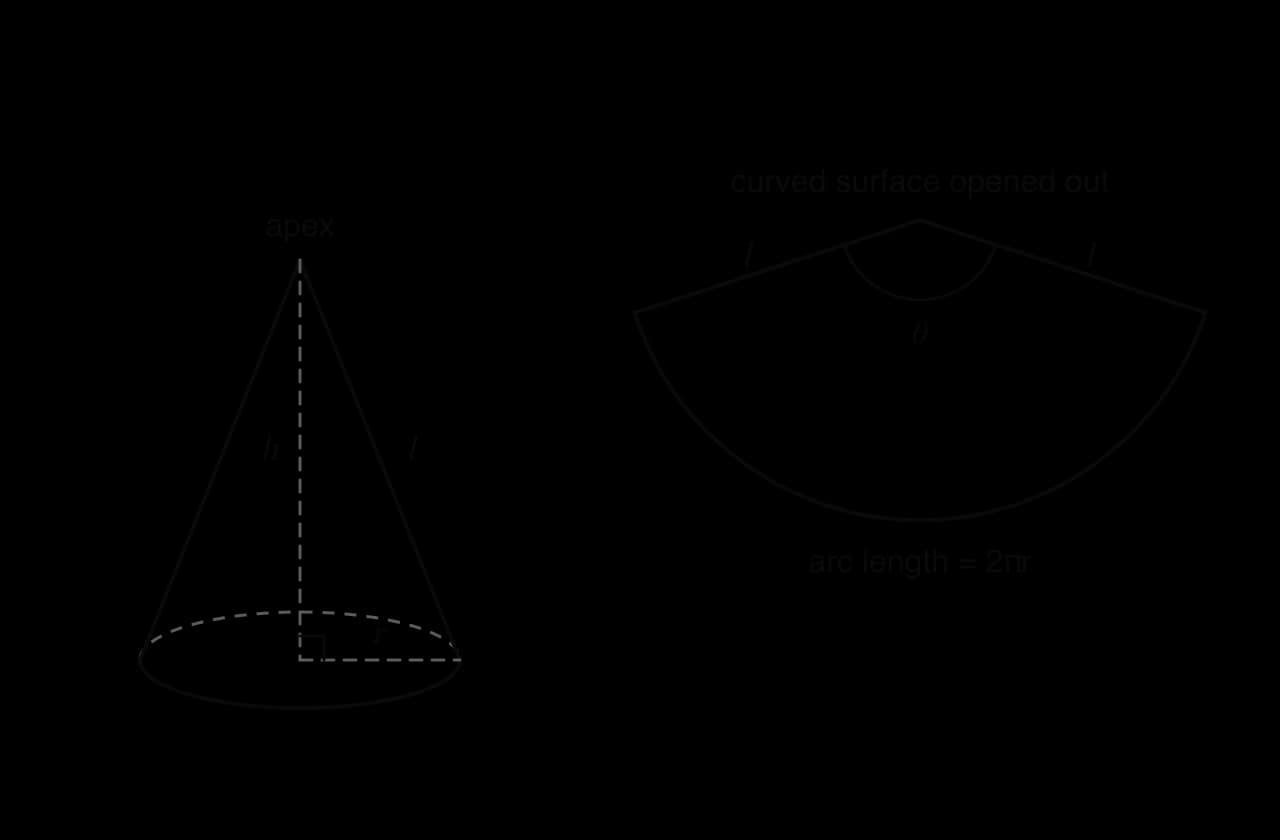
Cutting the curved surface of a cone along a slant line and flattening it gives a sector of a circle. The radius of the sector is the slant height l, and the arc of the sector is the edge that wrapped around the base, so its length is the base circumference 2πr.
The curved surface of a cone opens into a sector of radius l whose arc, 2πr, is the circumference of the base.
A full circle of radius l has circumference 2πl and area πl2. The sector has arc 2πr, which is the fraction 2πl2πr=lr of the full circumference, so its area is the same fraction of the full circle's area.
curved surface areatotal surface area of a solid cone=lr×πl2=πrl=πrl+πr2
The same fraction gives the angle of the sector: θ=lr×360°. Subtopic 3.4, Arcs and sectors, works with sector angles in full.
YouTube
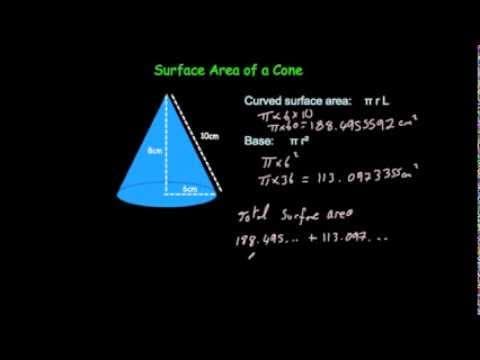
Corbettmaths, “Surface Area of a Cone”: worked examples using πrl for the curved surface, including finding the slant height first with Pythagoras' theorem.
The video uses the same two steps for every cone: find the slant height from r and h if it is not given, then substitute into πrl and add the base only when the cone is solid.
A cone can also be made from a flat sector of card, which turns the relationship between the sector and the cone into a calculation.
Spheres and hemispheres
Volume and surface area of a sphere
A sphere is perfectly round in every direction: every point on its surface is the same distance from its centre. Balls, bubbles, droplets and planets are modelled as spheres.
VA=34πr3=4πr2
Archimedes found both formulas by comparing a sphere with the cylinder that fits exactly around it, which has radius r and height 2r. The cylinder has volume πr2×2r=2πr3, and the sphere fills exactly two thirds of it: 32×2πr3=34πr3. The surface area of the sphere equals the curved surface area of the same cylinder: 2πr×2r=4πr2. The volume grows with the cube of the radius and the area with its square, so doubling the radius of a ball multiplies its volume by 8 and its surface area by 4.
Hemispheres
Cutting a sphere through its centre gives two hemispheres. A hemisphere has half the volume and half the curved surface of the sphere. A solid hemisphere also has a flat circular face of area πr2, which must be added when the whole surface is needed.
Vcurved surface areatotal surface area of a solid hemisphere=32πr3=2πr2=2πr2+πr2=3πr2
Finding a dimension from a volume or area
Often the volume or area is known and a length is needed: the radius of a ball that holds a given amount of air, or the height of a cone with a given capacity. The method is to write the formula with the known value, then rearrange. For a sphere, 34πr3=V rearranges to r=34π3V.
The GDC gives the same answer graphically, which is useful when rearranging is awkward. Graph the formula as a function of the unknown and a horizontal line at the known value, and find the intersection.
V = (4/3)πr³
V = 500
The volume of a sphere grows with the cube of the radius; the curve meets V = 500 at r ≈ 4.92 cm.
The graph also shows why small changes in radius cause large changes in volume: the curve steepens as r grows, because the volume depends on r3.
Earth as a sphere
Earth is not a perfect sphere: rotation flattens it slightly, so its equatorial radius (about 6378 km) is larger than its polar radius (about 6357 km). Modelling Earth as a sphere of mean radius 6371 km gives a surface area and a volume in standard form.
The sphere is a good mathematical model here. The flattened shape (an ellipsoid with two equatorial radii of 6378.137 km and a polar radius of 6356.752 km) has volume 34π×6378.1372×6356.752=1.0832×10¹² km3, which differs from the sphere's volume by less than 0.0001%. The percentage error from treating Earth as a sphere is far smaller than the error from rounding the radius to the nearest 100 km.
Compound solids
Building solids from simpler ones
Real objects are rarely a single standard solid. A grain silo is a cylinder with a cone or hemisphere on top, a pencil is a prism with a cone at one end, and a capsule-shaped gas tank is a cylinder with a hemisphere at each end.
Volume of a compound solid is found by adding the volumes of the parts that are joined, and subtracting the volumes of parts that are removed. Parts that are joined do not overlap, so their volumes add without adjustment.
Surface area needs more thought. Where two solids are joined, the faces that touch are inside the compound solid and are no longer part of its surface. Each piece of the surface must be listed and checked:
Sketch the solid and list every face and curved surface of each part.
Cross out the faces that are joined together (hidden inside).
Cross out any surface the question excludes: a base resting on the ground, an open top, the inside of a container.
Add the areas of what remains.
Frustums
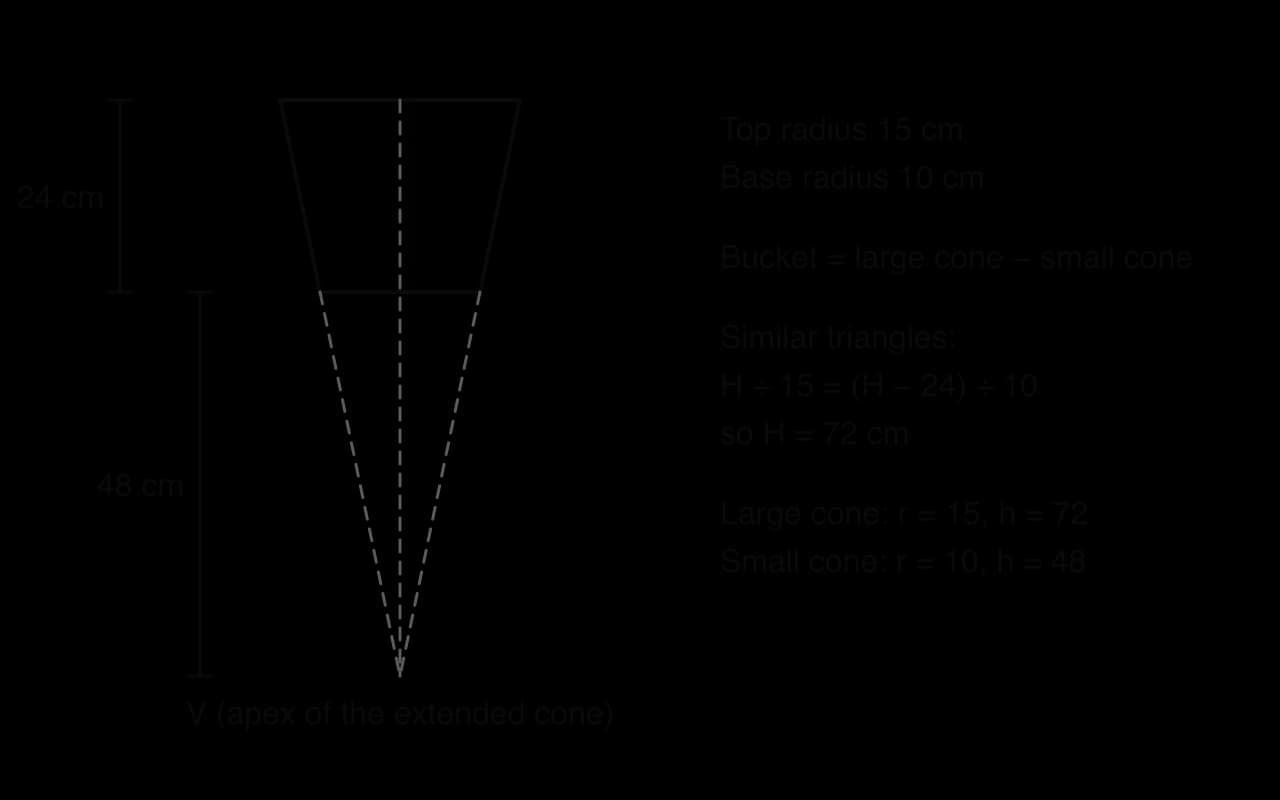
Cutting the top off a cone or a pyramid with a cut parallel to the base leaves a frustum. Buckets, lampshades, flowerpots and some reservoirs have this shape. A frustum's volume is found as the difference of two similar solids: the whole cone (or pyramid) minus the small one that was cut off.
The height of the missing small cone is usually unknown. Extending the sloping sides to the apex makes two similar right-angled triangles, and their sides are in proportion.
Extending the sides of the bucket to the apex V completes a cone of height 72 cm; the bucket is that cone minus a similar cone of height 48 cm.
Similar solids
Two solids are similar when one is an enlargement of the other: every length in one is the same multiple k of the matching length in the other. Areas and volumes then scale by different factors. A cube of side 1 enlarged by scale factor 2 becomes a cube of side 2, with face area 4 times as large and volume 8 times as large.
length ratio=k,area ratio=k2,volume ratio=k3
Areas are products of two lengths, so each picks up the factor k twice; volumes are products of three lengths, so they pick up k three times. A cone filled to half its height holds a liquid cone similar to the whole cone with k=21, so it contains only (21)3=81 of the full volume.
Packing and capacity
A common modelling question asks how many small objects fit in a box. Dividing the volume of the box by the volume of one object gives an upper bound for the count, because the objects cannot fill the gaps between them. A sphere in the smallest cube that holds it fills only (2r)334πr3=6π≈52% of the cube. Even the densest possible arrangement of equal spheres, the stacking used for oranges on a market stall, fills only 32π≈74% of space. Johannes Kepler conjectured this in 1611, and Thomas Hales announced a computer-assisted proof in 1998.
Lengths and angles inside solids
Right-angled triangles in three dimensions
Lengths and angles inside a solid are found by locating a right-angled triangle that contains the unknown and two known measurements, then using Pythagoras' theorem or a trigonometric ratio. Finding the triangle is the hard part, because right angles in three dimensions often do not look like right angles in a drawing. A vertical line meets every horizontal line through its foot at 90°, and an edge of a cuboid is perpendicular to every line in the face it meets at right angles.
A reliable method for any three-dimensional length or angle:
Mark the unknown length or angle on the diagram.
Find a triangle that contains it and has a right angle. Check the right angle by reasoning (a vertical line meets the horizontal; an edge is perpendicular to a face), not by appearance.
Redraw that triangle flat, as a separate 2D sketch, with its right angle marked and every known length labelled.
If a needed side is missing, find it first from another right-angled triangle, often one lying in the base.
Use Pythagoras' theorem or the appropriate ratio, keeping unrounded values.
Space diagonals
The longest straight rod that fits in a box runs from one corner to the opposite corner, through the inside of the box.
For a cuboid with edges a, b and c, the diagonal of the base is a2+b2, and the space diagonal is the hypotenuse of a vertical right-angled triangle with that base diagonal and the height c. This is the distance formula with differences a, b and c.
d=a2+b2+c2
Projection and the angle between a line and a plane
A line that meets a plane makes many different angles with the lines in the plane, so "the angle with the plane" needs a precise meaning. The definition uses the line's shadow on the plane when a light shines straight down onto the plane.
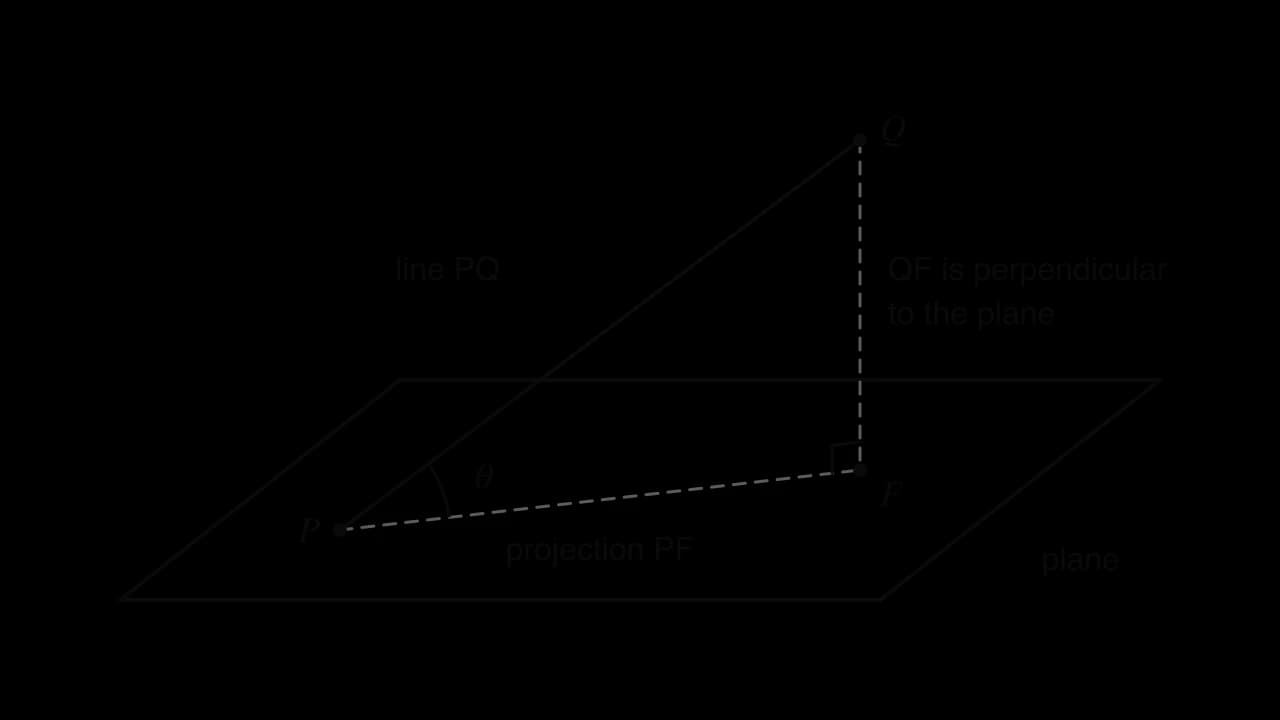
The angle between a line and a plane is then measured between the line and its own projection. This is the smallest angle the line makes with any line in the plane.
In practice the angle sits in a right-angled triangle. If the line meets the plane at P, and Q is another point on the line, drop the perpendicular from Q to the plane, meeting it at F. Triangle PFQ has its right angle at F, and the required angle θ is at P.
The angle between line PQ and the plane is the angle θ between PQ and its projection PF; triangle PFQ has its right angle at F.
When the plane is horizontal, the perpendicular QF is vertical, so tanθ=PFheight of Q above the plane. This is how the angle of a rope, a cable, a ramp or a sloping edge with the ground is found.
The angle between two intersecting lines
Two lines that meet at a point lie in one plane, so the angle between them is an angle of an ordinary triangle. In a three-dimensional problem the task is to find a triangle containing both lines, often by joining their other endpoints. If that triangle has a right angle, right-angled trigonometry gives the angle; otherwise the cosine rule from subtopic 3.2 is needed.
Angles in a pyramid
Two angles in a right pyramid appear often: the angle between a sloping edge and the base, and the angle between a triangular face and the base. Both have their right angle at the centre O of the base. The face angle is measured along the line of steepest slope of the face, from the midpoint M of a base edge to the apex, so it is the angle VMO in triangle VOM.
YouTube
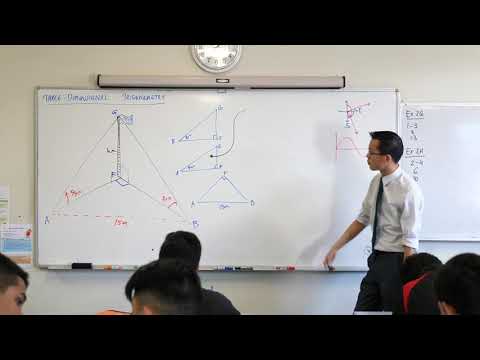
Eddie Woo, “3D Trigonometry Example (1 of 2: Setting up the triangles)”: watch how each right-angled triangle is pulled out of the 3D diagram and redrawn flat before any calculation.
The video demonstrates step 3 of the method: every triangle used is drawn separately, the right angle is justified from the geometry, and only then are the ratios applied.
Angles from coordinates
When the endpoints of a line are given as coordinates with the z-axis vertical, the angle the line makes with the horizontal comes from two numbers: the change in height and the horizontal distance, which is the 2D distance using the x- and y-coordinates only.
Case study: The Great Pyramid of Giza
The Great Pyramid of Giza, built for the pharaoh Khufu, is close to a right pyramid on a square base. When it was finished it stood about 146.6 m tall, and each side of its base measures about 230.3 m. Most of its smooth outer casing has since been removed, lowering the height to about 138.5 m today. The ancient builders specified the slope of each face as a seked, a horizontal run for each unit of rise, which corresponds to a face angle of 51°50′40″, about 51.84°.
Measurement
Value
Original height
146.6 m
Side of the square base
230.3 m
Recorded slope of each face
51°50′40″ (51.84°)
Present height
138.5 m
Source: Wikipedia, "Great Pyramid of Giza", 2026.
Volume. Modelling the pyramid as a right square pyramid with its original dimensions:
V=31×230.32×146.6=2591794…≈2.59×10⁶ m3
This is about 2.6 million cubic metres, close to published estimates of the pyramid's volume. The figure includes a natural rock hill at the core of the pyramid, so the volume of stone placed by the builders was smaller.
Slant height and the face angle. The triangle from the apex to the centre of the base and out to the midpoint of a base edge has vertical side 146.6 m and horizontal side 2230.3=115.15 m.
The computed face angle, 51.85°, agrees with the recorded 51.84° to within 0.01°. The agreement is partly built in, because the original height of the apex no longer exists and is reconstructed from the base and the slope of the surviving casing stones. The calculation therefore confirms that the three published measurements are consistent with a right square pyramid.
The angle of an edge. The projection of a sloping edge onto the base is half the diagonal, 115.152=162.8… m.
tanβ=162.8…146.6⇒β=42.0°
The edges rise at about 42°, roughly 10° less steeply than the faces, because the corner of the base is 2 times as far from the centre as the midpoint of a side.
Surface area. The four sloping faces, each a triangle of base 230.3 m and height 186.4 m, have a total area of
4×21×230.3×186.4…=85863…≈85900 m2
This is the area the original white limestone casing covered, more than 8.5 hectares.
Quantity (right square pyramid model)
Computed value
Volume
2.59×10⁶ m3
Slant height of a face
186.4 m
Angle of a face with the base
51.85° (recorded: 51.84°)
Angle of an edge with the base
42.0°
Area of the four sloping faces
85900 m2
Limitations. The model ignores the missing casing and the internal hill, assumes a perfectly square base and a single apex, and uses lengths that are themselves estimates from a damaged monument. Each computed value is therefore an estimate for the pyramid as originally designed.
Exam focus
Three-dimensional geometry appears on both papers. Paper 1 questions (4–7 marks) ask for a 3D distance and midpoint from coordinates, the angle a rope or cable makes with the ground, or the volume or surface area of a single solid or a simple compound solid. Paper 2 questions use solids as the opening parts of a longer question (12–17 marks), often continuing into cost, percentage error, simultaneous equations or optimisation with derivatives (subtopic 5.7). Command terms include write down, calculate, find, show that and, in longer questions, justify and comment.
What markschemes reward:
(M1) for a correct substitution into the relevant formula, often one (M1) for each part of a compound solid and another (M1) for adding or subtracting them.
The π key, not 3.14 or 722: answers from approximations of π lose the accuracy mark.
Units on final answers when the question asks for them.
In "show that" questions with a rounded given answer, both the unrounded value (for example 412.37…) and the rounded value (412) must be seen.
Choosing the surfaces, as in part (c), is the most frequent source of lost marks with solids. A silo standing on the ground is not painted underneath, and the top of the cylinder is covered by the roof, so neither circle is included.
Coordinates questions are short, but because the diagram looks two-dimensional many candidates drop the x- or y-coordinate. Writing all three differences in the distance formula, and naming the right-angled triangle used for an angle, secures the method marks.
Practice questions
Find the distance between P(3,−2,7) and Q(−1,4,1), and the coordinates of the midpoint of [PQ]. [4]
A solid cone has base radius 7 cm and vertical height 24 cm. Calculate its volume and its total surface area, giving each in terms of π. [5]
A sphere has surface area 1000 cm2. Find its radius and its volume. [4]
A trophy is a solid cylinder of radius 2.5 cm and height 6 cm with a solid hemisphere of radius 2.5 cm on top. Calculate its volume. [3]
A right pyramid has a square base of side 6 cm. The slant height of each triangular face is 5 cm. (a) Find the vertical height of the pyramid. [2] (b) Calculate its volume and total surface area. [3] (c) Find the angle between a triangular face and the base. [2]
A cuboid measures 9 cm by 4 cm by 6 cm (height). Find the length of its space diagonal and the angle the space diagonal makes with the base. [4]
The points A(2,k,1) and B(5,1,−3) are 34
Two cones are similar, with heights 9 cm and 12 cm. The smaller cone has volume 270 cm3. Calculate the volume of the larger cone. [2]
A plant pot is a frustum of a cone with top radius 12 cm, base radius 8 cm and depth 15 cm. Calculate its capacity in litres. [5]
A tent pole is vertical, with its foot at O(0,0,0) and its top at T(0,0,2.4). A guy rope runs from T to a peg at G(1.5,−2,0)
Answers
PQ=42+62+62=88=9.38; midpoint (1,1,4).
V=31π×49×24=392π(1230 cm3)
4πr2=1000⇒r=8.92 cm; V=34π(8.9206…)3=2970 cm3
π×2.52×6+32π×2.53=150.5…
(a) h=52−32=4
Base diagonal 97=9.849…; space diagonal 133=11.5
9+(1−k)2+16=34⇒(1−k)2=9⇒k=−2
k=912=34; 270×(34)3=640 cm3
12H=8H−15⇒H=45
Rope =1.52+22+2.42=12.01=3.47
Summary
Distance between (x1,y1,z1) and (x2,y2,z2): d=(x1−x2)2+(y1−y2)2+(z1−z2)2, from Pythagoras' theorem used twice; the midpoint averages each coordinate.
Prism V=Ah; cylinder V=πr2h, curved surface 2πrh.
Right pyramid V=31Ah; surface area = base + triangular faces, each with height equal to its slant height.
Right cone V=31πr2h, curved surface πrl with l=r2+h2
Sphere V=34πr3, A=4πr2
Compound solids: add or subtract volumes; for surface area, list the visible surfaces and leave out joined, open or excluded faces. A frustum is a large cone or pyramid minus a similar small one.
Similar solids with length ratio k have area ratio k2 and volume ratio k3.
Lengths and angles inside solids come from right-angled triangles, redrawn flat, with the right angle justified from the geometry.
The angle between a line and a plane is the angle between the line and its projection onto the plane.
Keep unrounded values, use the π key, convert units by squaring or cubing the length factor, and round only the final answer.
Self-check
To do:
I can plot a point in three dimensions and read its coordinates from a diagram.
To do:
I can find the distance between two points in three dimensions and explain why the formula works.
To do:
I can find a midpoint, and an endpoint from a midpoint.
To do:
I can find an unknown coordinate from a given distance, including both solutions.
To do:
I can convert between cm3, m3 and litres.
To do:
I can calculate the volume and surface area of a prism and a cylinder, open or closed.
To do:
I can find the slant height of a pyramid or cone and use it for surface area.
To do:
I can calculate the volume and surface area of a sphere and of a solid or hollow hemisphere.
To do:
I can find a radius or height from a given volume or surface area, by rearranging or with the GDC.
To do:
I can decide which surfaces count for a painted, coated or total surface area of a compound solid.
To do:
I can find the volume of a frustum using similar triangles.
To do:
I can use the scale factors k, k2 and k3 for similar solids.
To do:
I can find a space diagonal and the angle it makes with a face.
To do:
I can find the angle between a line and a plane using its projection.
To do:
I can find the angles a sloping edge and a face of a pyramid make with its base.
and
k∈Z
.
[3]3 marks
Markscheme (a)
V=34π(3389.5)3(M1)
=163115609799…(A1)
1.63×10¹¹ (km³) A1
[3 marks]
(b)
Write down the volume of Mars in m³.
[2]2 marks
Markscheme (b)
1 km3=109 m3(M1)
1.63×10²⁰ (m³) A1
Note: Follow through from part (a). Award the method mark only for 1.63×10¹⁴ (multiplying by 103).
[2 marks]
(c)
The mass of Mars is 6.42×10²³ kg.
Calculate the mean density of Mars, in kg m⁻³.
[2]2 marks
Markscheme (c)
1.631156…×10206.42×1023(M1)
3940 (kg m⁻³) (3935.85…)A1
Note: Accept 3.94×10³. Accept 3939 from use of the 3 s.f. value. Follow through from part (b).
[2 marks]
Question 2 · AI-0014016 marks
The town of Brennick stores its drinking water in a tank in the shape of a cylinder. The radius of the tank is 42 m and its depth is 18 m.
(a)
Calculate the volume of the tank, in m³.
[2]2 marks
(b)
Given that 1 m³ = 1000 litres, write down the volume of the tank in litres. Give your answer in the form a×10k, where 1≤a<10 and k∈Z.
[2]2 marks
(c)
The town uses 1.35×10⁷ litres of water each day. No water enters the tank.
Find the number of complete days that a full tank can supply the town.
[2]2 marks
(d)
The radius and the depth of the tank were each measured correct to the nearest metre.
Find the upper bound of the volume of the tank.
[3]3 marks
(e)
The lower bound of the volume of the tank is 94 685.6 m³, correct to one decimal place.
Find the largest possible percentage error in using your answer to part (a) as the volume of the tank.
[3]3 marks
(f)
During one storm, 12 mm of rain fell on the area that drains into the tank. This area is 3.6 km².
(i) Find the volume of rain, in m³, that fell on this area. Give your answer in the form a×10k, where 1≤a<10 and k∈Z
to 3 significant figures. Brackets around negative coordinates prevent sign errors:
2−(−4)=6
, not
−2
.
.
So B is (5,−4,−9). Check: moving from A to M changes the coordinates by (+2,−4,−7), and the same change again takes M to (5,−4,−9).
and
y=13
and find both intersections, or use the polynomial solver on
x2−6x−135=0
. Write down the equation that was solved.
The cable is about 1830 m long (assuming it is straight; a real cable sags, so it is a little longer).
(b) Average each pair of coordinates.
M=(20+820,20+1460,21250+1980)=(410,730,1615)
(c) 1615−1250=365 m, which is half the 730 m rise between the stations, as expected at the midpoint.
unrounded (store them in the GDC) until the final answer.
cm.
, which confirms the result.
2nd
TRACE
→
intersect
), or use the equation solver. Write down the equation
34πr3=500
.
.
sweets.
Triangle ACG is right-angled at C, because CG is vertical and AC lies on the floor.
AG=132+42=185=13.60…≈13.6 m
(b) The projection of AG onto the floor is AC (since C is directly below G). In triangle ACG:
tanθ=134⇒θ=17.1°
(c) Join B to G. The edge AB is perpendicular to the whole face BCGF, so it is perpendicular to BG, and triangle ABG is right-angled at B. The hypotenuse is AG and the side adjacent to the angle at A is AB.
cosα=18512⇒α=28.1°
(b) The projection of the rope onto the ground is OA, and triangle OAF is right-angled at O because the pole is vertical.
OA=2.42+5.12=5.636… m
tanθ=5.636…6.5⇒θ=49.1°
Using sinθ=8.603…6.5 gives the same angle.
=25=5
(m)
A1
AG
(b) π×42×15+31π×42×3(M1)(M1)
(award (M1) for the cylinder and (M1) for adding a correctly substituted cone)
=256π=804 m3 (804.247…) A1
(c) 2π×4×15+π×4×5(M1)(M1)
(award (M1) for the curved surface of the cylinder and (M1) for adding the curved surface of the cone; no base, no top of the cylinder)
=140π=439.82… m2(A1)
9439.82…=48.9…, so 49 litresA1
(the final A1 is for rounding up to a whole litre)
(d) tanθ=43 (or cosθ=54) (M1)
θ=36.9° (36.8698…°) A1
(e) 242+182+182(M1)
=1224=35.0 m (34.9857…) A1
(f) horizontal distance OA=242+182=30(A1)
tanθ=3018, θ=31.0° (30.9637…°) A1
Total [15]
units apart.
Find
the possible values of
k
. [3]
, in metres.
Calculate
the length of the rope and the angle it makes with the ground. [5]
;
l=49+576=25
;
A=π×7×25+49π=224π(704 cm2)
.
(2973.5…).
, about
151 cm3
.
cm. (b)
V=31×36×4=48 cm3
;
A=36+4×21×6×5=96 cm2
. (c)
tan−1(34)=53.1°
.
cm; angle
tan−1(9.849…6)=31.4°
.
or
k=4
.
.
;
V=31π(122×45−82×30)=1520π=4775… cm3
, about 4.78 litres.
m; horizontal distance
1.52+22=2.5
m; angle
tan−1(2.52.4)=43.8°
.
; total surface
πrl+πr2
.
; hemisphere
V=32πr3
, curved surface
2πr2
, solid total
3πr2
.
.
(ii) Find this volume as a percentage of the volume of the tank found in part (a).
 YouTube
 YouTube