Notes on 3.7 Radian measure
Learning objectives
State the definition of a radian and explain why a full turn is radians.
Convert angles from degrees to radians and from radians to degrees, giving answers as exact multiples of or as decimals.
Calculate the length of an arc using , with in radians.
Calculate the area of a sector using , with in radians.
Find the perimeter of a sector and the area of a segment, and find an unknown radius or angle from given lengths and areas.
Calculate angular displacement and angular speed, and convert revolutions per minute to radians per second.
Use to relate the angular diameter of a distant object to its size and distance.
Introduction
Angles have been measured in degrees for more than two thousand years, but the number 360 is a historical choice with no connection to the geometry of a circle. The radian measures an angle by the length of arc it cuts off, compared with the radius. With that choice, the formulas for arc length and sector area lose their awkward factor of , the speed of a point on a rotating wheel is simply its distance from the centre multiplied by its rate of turning, and, later in the course, the derivatives of and take their simplest form.
Engineers describe the rotation of motors, turbines and hard drives in radians per second, and astronomers describe the size of the Moon in the sky as an angle that, in radians, is almost exactly its diameter divided by its distance. All of these uses depend on the definition of the radian and on converting between radians and degrees.
Measuring angles in degrees
An angle measures an amount of turning. The oldest unit still in everyday use for it is the degree, and its precise definition is the starting point for every conversion.
The number 360 is convenient because it has many factors: 2, 3, 4, 5, 6, 8, 9, 10, 12, 15, 18, 20, 24, 30, 36, 40, 45, 60, 72, 90, 120 and 180 all divide it exactly. A half, third, quarter, fifth, sixth, eighth, ninth, tenth or twelfth of a turn is therefore a whole number of degrees, which made the unit easy to use for early astronomers and surveyors working without decimals.
The degree is usually traced back to Babylonian astronomy, which counted in base 60. Two explanations are commonly given for 360 in particular: that it is close to the number of days in a year, so the Sun appears to move about one degree a day against the stars, and that the Babylonians divided the angle of an equilateral triangle into 60 parts. Neither can be confirmed, but the base-60 subdivisions survive in the minutes and seconds of both time and angle.
Unit | Fraction of a full turn | Example |
|---|---|---|
1 full turn | 1 | a wheel turning once |
1 degree (1°) | the Sun's apparent daily movement against the stars, roughly | |
1 minute of arc (1′) |
The radian
Degrees divide a full turn into an arbitrary number of equal parts. A unit that comes from the circle itself uses the only length every circle already has, its radius. If an arc is laid along the circumference with exactly the same length as the radius, the angle it subtends at the centre is the same size in every circle, large or small, and this angle is called the radian.
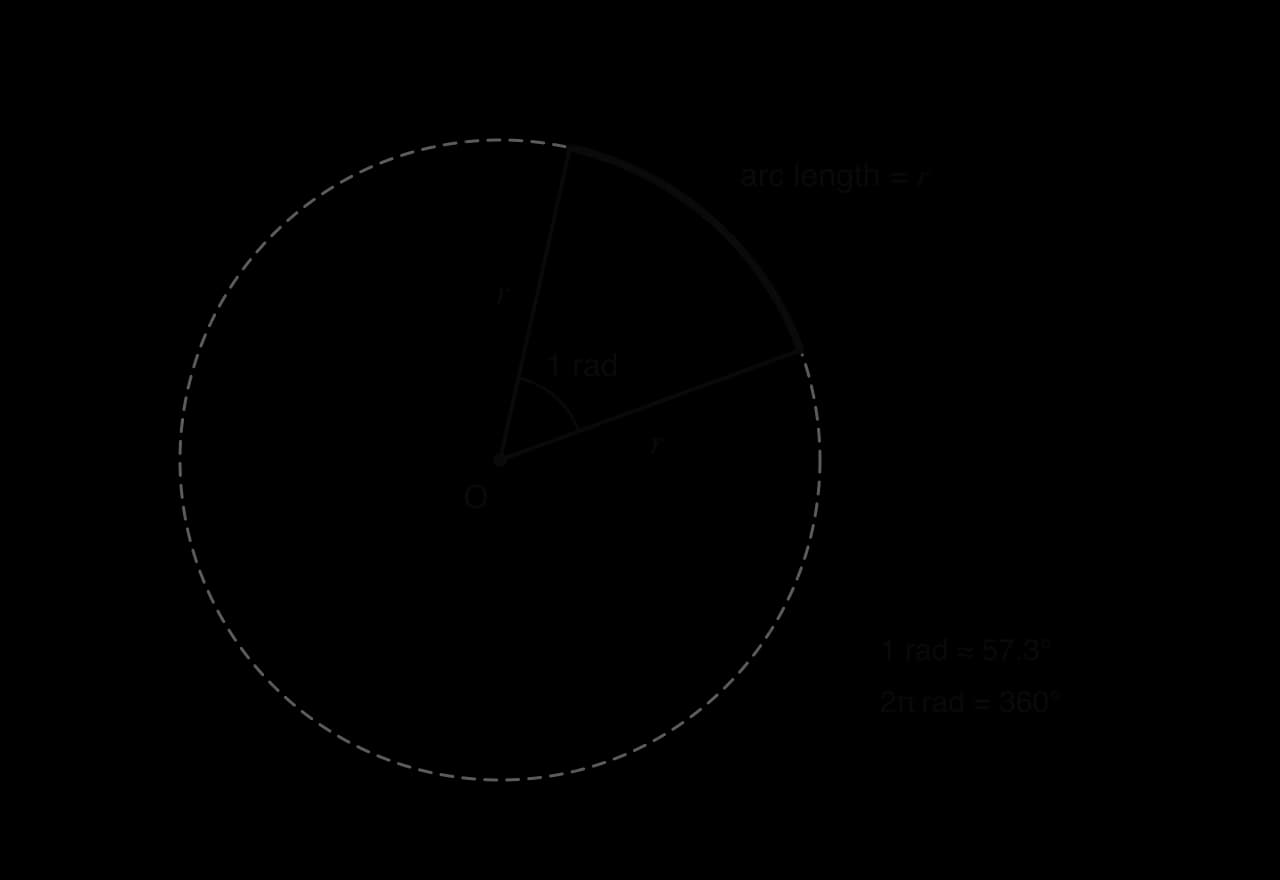
The diagram of one radian shows a sector that is slightly less than a sixth of the circle. The angle is the same in a circle of any size: doubling the radius doubles the arc, so the ratio of arc to radius, and therefore the angle, does not change. The radian therefore depends only on the amount of turning, and the size of the circle used to draw it makes no difference.
Why a full turn is 2π radians
The angle in radians is the number of radius lengths that fit along the arc. The whole circumference has length , so a full turn contains
Since a full turn is also 360°, the two units are linked by one equation, the basis of every conversion.
Dividing both sides by gives
Writing radians
The radian is so widely used that the unit is usually left out: an angle written as with no symbol is 1.2 radians, while an angle in degrees always carries the ° sign. The abbreviation "rad" is used where the unit needs emphasis, as in angular speeds measured in rad s⁻¹. A radian is the ratio of two lengths (arc ÷ radius), so in the SI system it is formally a dimensionless unit.
 YouTube
The Khan Academy video shows the same construction as the one-radian figure, wrapping radius-length arcs around a circle until they complete the turn. Watching the arcs build up makes the value easy to remember.
Converting between degrees and radians
Every conversion uses . Dividing both sides by 180 gives the size of one degree in radians, and dividing by gives the size of one radian in degrees.
From these, the two conversion rules follow by multiplication.
A quick way to choose the right factor is to think about the size of the numbers. Degree values are large (a right angle is 90) and radian values are small (a right angle is about 1.57), so converting from degrees to radians must make the number smaller: multiply by , which is about 0.0175. Converting from radians to degrees must make the number larger: multiply by
Exact multiples of π
Many common angles are simple fractions of 180°, so in radians they are the same fractions of . Writing them this way keeps the value exact, with no rounding.
Degrees | 30° | 45° | 60° | 90° | 120° | 135° | 150° | 180° | 270° | 360° |
|---|---|---|---|---|---|---|---|---|---|---|
Fraction of 180° |
The pattern is worth learning for the multiples of 30° and 45°, because they appear constantly. Every other angle is converted with the rule. Radian measures may be given either as exact values such as or as decimals such as 1.31; the exact form keeps full precision, and the decimal (usually to 3 significant figures) is easier to compare and to use in later calculations.
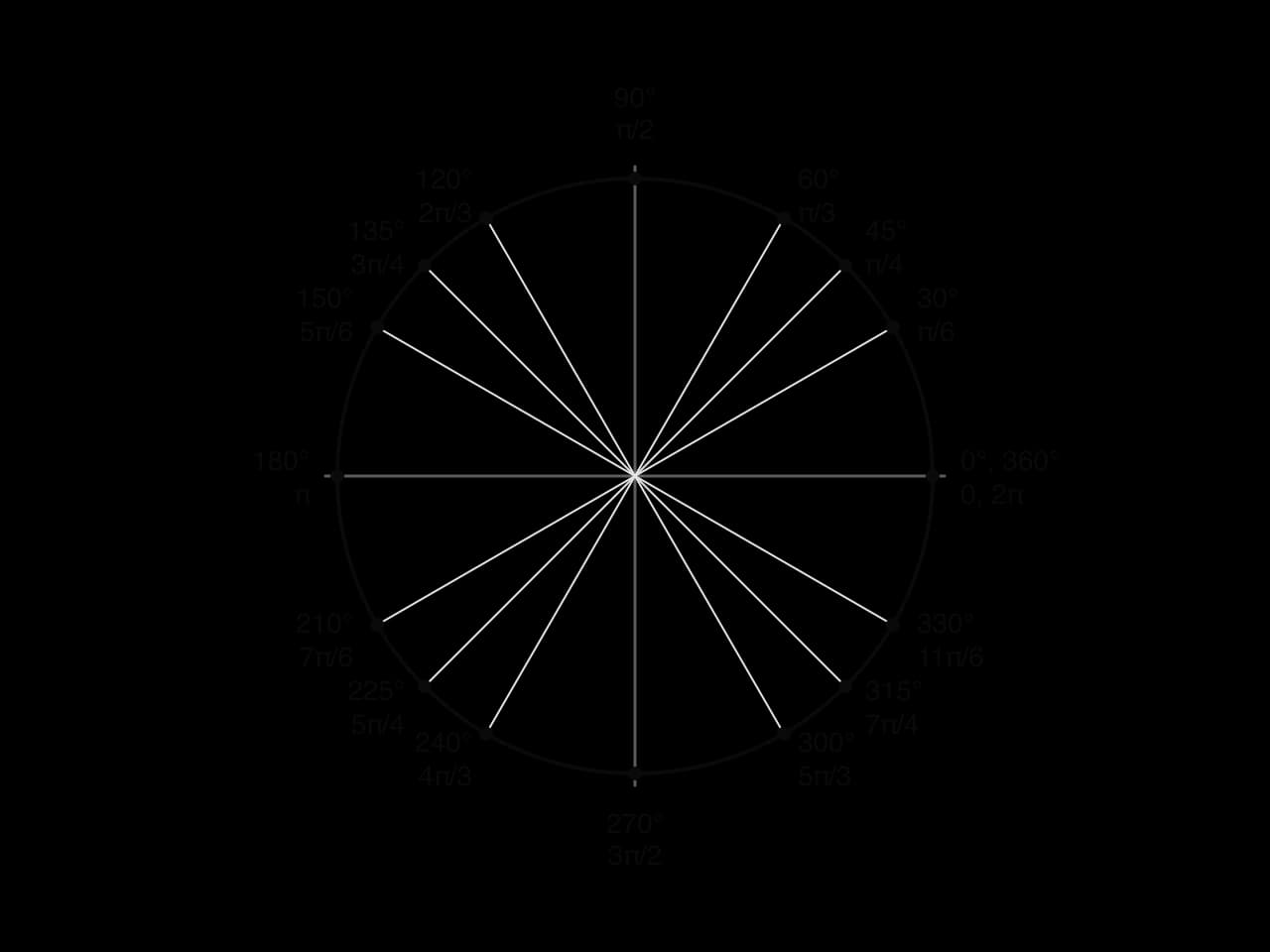
The conversion wheel shows every multiple of 30° and 45° around a circle with both names. Reading it anticlockwise from the positive horizontal axis, the denominators 6, 4 and 3 belong to the multiples of 30°, 45° and 60°, and the numerators count how many of those steps have been taken: is seven steps of 30°, which is 210°.
The GDC and angle mode
A GDC calculates , and in whichever angle mode is set: degree mode treats an input as degrees, and radian mode treats it as radians. The same keystrokes give very different results. In radian mode , the sine of 1 radian (about 57.3°); in degree mode
On a TI-84 Plus CE: press
MODEand selectRADIANorDEGREE.On a Casio fx-CG50: press
SHIFTMENU(SET UP) and changeAngletoRadorDeg.On a TI-Nspire: the angle setting is under
Settingsin the document or system settings.
Most GDCs can also convert a single value without changing the mode. The angle menu (on a TI-84 Plus CE, 2nd APPS for ANGLE) contains a degree symbol ° and a radian symbol ʳ. In radian mode, entering 75° returns 1.308996939, the value in radians; in degree mode, entering 2.4ʳ returns 137.5098708, the value in degrees. On a Casio fx-CG50 the same symbols are in the OPTN → ANGLE menu.
Arc length in radians
Subtopic 3.4, Arcs and sectors, finds the arc length of a sector with central angle in degrees as the fraction of the whole circumference. The same idea in radians uses the fraction
The factors of cancel and leave the simplest possible formula. It also follows directly from the definition: an angle of 1 radian cuts off one radius of arc, so an angle of radians cuts off radii, a length of .
The formula also rearranges to , which is the definition of radian measure written as an equation: the angle in radians is the arc length divided by the radius. That gives a way to find an angle from two lengths without any trigonometry.
Sector area in radians
The area of a sector is the same fraction of the area of the whole circle.
There is a second way to see the result. A sector with a very small angle is almost a thin triangle with height and base equal to its arc , so its area is close to
which is the area of a triangle with base and height , as the thin-triangle picture suggests.
Perimeter of a sector
The boundary of a sector is one arc and two radii, so in radians its perimeter has a compact form.
This form is useful when the perimeter is fixed (by a length of fencing, edging or wire) and the radius and angle can vary. Rearranging gives , which expresses the angle in terms of the radius and turns a two-variable problem into a one-variable one.
Finding an unknown radius or angle
When a length or an area is given, the formulas become equations. With only one unknown, they rearrange directly; with two unknowns, two facts are needed, and the second formula supplies the second equation.
Sometimes the second fact is a relationship rather than a number, such as an area equal to a perimeter. Writing both quantities in terms of the same unknown turns the relationship into an equation in one variable, which may have a solution that has to be rejected because it makes no geometric sense.
Area of a segment
A segment is the region between a chord and its arc. Its area is the sector minus the triangle formed by the two radii and the chord. The triangle has two sides of length with the angle between them, so by the area formula its area is
Both terms need the angle in radians in this form: the on its own because the sector formula requires it, and the because the GDC has to be in radian mode to evaluate the sine of a radian angle.
Optimising a sector with a fixed perimeter
Writing the perimeter as allows the area of a sector to be written in terms of one variable, so that the largest possible area can be found. The same approach is developed for any function in subtopic 5.7, Optimisation.
The graph of area against radius shows the trade-off. A small radius gives a wide angle but a small circle, and a large radius uses most of the edging on the two straight sides, leaving almost no arc. The maximum lies between, where the arc takes half the edging and each radius a quarter.
Angular displacement and angular speed
When an object rotates about a fixed point, each point on it moves along an arc. The angle through which the object turns is its angular displacement, and the rate at which that angle changes is its angular speed. Measuring both in radians links them directly to distances and speeds along the arc.
Angular displacement says how far an object has turned but not how quickly. A wheel that turns through radians in 2 seconds and one that takes a minute have the same angular displacement but very different rates of turning.
For a constant angular speed, the angle turned in time is . A point at distance from the centre then travels an arc of length
All points on a rigid rotating object share the same angular speed, but their linear speeds are proportional to their distances from the centre. The tip of a fan blade moves much faster than a point near the hub, even though both go round once in the same time. The formula only works with in radians per unit time, for the same reason that only works in radians.
Rotation rates of motors, drives and wheels are usually quoted in revolutions per minute.
The conversion has two parts, one for the angle and one for the time.
The same relationship works in reverse for a wheel rolling along a road. If the tyre does not slip, the distance the car moves in one revolution is one circumference, so the linear speed of the car equals the speed of the rim relative to the axle, and .
Case study: the rotation of the Earth
The Earth turns once on its axis, relative to the distant stars, in one sidereal day of about 86,164.09 seconds (23 hours 56 minutes 4 seconds). The ordinary 24-hour solar day is about four minutes longer, because the Earth also moves along its orbit and has to turn a little further for the Sun to return to the same position in the sky. For the rate of rotation, the sidereal day is the right period.
The angular speed of the Earth is therefore
In one hour the Earth turns through rad, which is 15.04°, so the stars appear to move across the sky by about 15° every hour. Measured against the Sun, over the 24-hour solar day, the rate is exactly
Every point on the Earth's surface shares this angular speed, but the linear speed depends on the distance from the axis. A point on the equator is 6378 km from the axis (the equatorial radius), so
about 1670 km h⁻¹. At latitude 51.5° N (London), the circle of latitude has radius km, and the speed drops to
Place | Distance from the axis (km) | Speed due to rotation (m s⁻¹) |
|---|---|---|
Equator (0°) | 6378 | 465 |
Latitude 30° | 5524 | 403 |
London (51.5° N) | 3970 | 290 |
Latitude 70° | 2181 | 159 |
Poles (90°) | 0 | 0 |
Source: sidereal day 86,164.0905 s and equatorial radius 6378.137 km from the IERS and WGS 84 values, via Wikipedia ("Sidereal time", "Earth radius"), 2026. Speeds computed with a spherical Earth.
The model treats the Earth as a sphere of radius 6378 km. The real Earth is slightly flattened (the polar radius is about 6357 km), so the true distances from the axis differ from the table's by less than 0.3%, which changes the speeds by less than 1 m s⁻¹. These speeds are one reason rockets are launched eastwards from sites near the equator, where the ground already carries them at up to 465 m s⁻¹ in the direction they need to go.
Small angles and angular diameter
For a very small angle, the arc of a circle and the straight chord across it are almost the same length. An object of width seen from a large distance therefore cuts off an angle that satisfies , whether the object is curved or straight. Astronomers and surveyors use this to find sizes from distances, or distances from sizes.
The Moon has a diameter of 3474 km and a mean distance from the Earth of about 384,400 km. Its angular diameter is therefore
just over half a degree, which agrees with the observed size of the full Moon, about half a degree (30 minutes of arc). The Sun, about 400 times wider but also about 400 times further away, has almost the same angular diameter, which is why the Moon can just cover it in a total solar eclipse.
Source: Moon diameter 3474 km and mean Earth–Moon distance 384,400 km from Wikipedia ("Moon", "Lunar distance"), 2026.
The approximation is good because for small angles in radians: , within 0.2% of 0.1, and agrees with 0.00904 to four significant figures. It fails for large angles;
Exam focus
Radian measure is examined on HL Papers 1 and 2, usually as short parts inside geometry questions: a conversion of an angle (1 mark), an arc length, sector area or perimeter with the angle in radians (2–3 marks), a segment or a shape made of sectors and triangles, and the volume of a prism whose cross-section is a sector or has a sector removed. Command terms are write down (exact angles such as ), find, calculate and show that (an expression for the perimeter or area in terms of and ). Harder questions set the radius or the angle as an unknown, build an expression in one variable, and then optimise it with the GDC or by differentiation (links to subtopic 5.7). Radians are also assumed in every HL question with a trigonometric function, so a question about a sinusoidal model can fail entirely if the GDC is in degree mode.
The most frequent loss of marks in these questions is using a degree formula with a radian angle, or a radian formula with a degree angle. Write the angle in the unit the formula needs before substituting, and say which unit you are using.
In "show that" parts, such as showing that a perimeter or an area has a given form, every line must move forward from the formulas and
Practice questions
Write down 225° in radians as an exact multiple of . [1]
Convert 1.2 radians to degrees, correct to 1 decimal place. [1]
A sector has radius 15 cm and angle 0.8 radians. Find its arc length, its area and its perimeter. [4]
A sector of angle 1.25 radians has an area of 40 cm². Find its radius. [2]
A chord cuts off a minor segment from a circle of radius 10 cm. The chord subtends an angle of 1.4 radians at the centre. Calculate the area of the segment. [3]
A turntable rotates at 45 rpm. Find its angular speed in rad s⁻¹ and the speed of a point 8.5 cm from the centre, in m s⁻¹. [4]
A sector has perimeter 30 cm and area 50 cm². Find all possible pairs of values of its radius and angle. [5]
A student calculates
Answers
Summary
One radian is the angle subtended at the centre of a circle by an arc equal in length to the radius; a full turn is rad.
: multiply by
Self-check
- To do:
I can state the definition of a radian and explain why a full turn is radians.
- To do:
I can convert degrees to radians, giving an exact multiple of or a decimal.
- To do:
I can convert radians to degrees and check the answer by its size.
- To do:
I can write down the radian values of 30°, 45°, 60°, 90°, 180°, 270° and 360°.
- To do:
I can switch my GDC between degree and radian mode and check which mode it is in.
- To do:
I can find an arc length and a sector area with