 YouTube
Use sine, cosine and tangent to find sides and angles in right-angled triangles, then the sine rule, the cosine rule and ½ab sin C to solve and find the area of any triangle.
Each is in the Maths AI glossary, with every other term in the subject.
An angle greater than 0° and less than 90°.
In a right-angled triangle, the side next to a given acute angle that is not the hypotenuse.
The GDC setting that fixes whether angles are entered and given in degrees or in radians.
The area of any triangle equals , half the product of two sides multiplied by the sine of the angle between them.
Identify the hypotenuse, the opposite side and the adjacent side of a right-angled triangle relative to a given angle.
Calculate an unknown side of a right-angled triangle using the sine, cosine or tangent ratio.
Calculate an unknown angle of a right-angled triangle using an inverse trigonometric function, with the GDC in degree mode.
Use the sine rule to find a side or an angle of any triangle when a side and its opposite angle are known.
Use the cosine rule to find a side from two sides and the included angle, and to find an angle from three sides.
Calculate the area of any triangle using
85 exam-style questions on this subtopic, written in the style of the IB papers. The first has its markscheme open. Counted on
Amara is designing a wheelchair ramp for the entrance of a community library. The ramp rises a vertical height of m over a horizontal distance of m.
Find the gradient of the ramp.
2 marks
The entries of the mathematics: applications and interpretation formula booklet that 3.2 uses. Each opens in the explained booklet.
With a free account, Augment remembers where you stopped and what you have practiced.
For an acute angle in a right-angled triangle, .
In any triangle , , which links the three sides with one angle; rearranged, .
The side of a right-angled triangle opposite the right angle; it is always the longest side.
The angle between two given sides of a triangle, at the vertex where they meet.
A function, , or , that takes the value of a trigonometric ratio and gives the angle with that ratio.
A triangle in which none of the three angles is 90°.
An angle greater than 90° and less than 180°.
In a right-angled triangle, the side across from a given acute angle, which does not form either arm of that angle.
For an acute angle in a right-angled triangle, .
In any triangle , , where each side is divided by the sine of the angle opposite it.
A memory aid for the right-angled ratios: Sine = Opposite ÷ Hypotenuse, Cosine = Adjacent ÷ Hypotenuse, Tangent = Opposite ÷ Adjacent.
Finding all the unknown sides and angles of a triangle from the ones that are given.
For an acute angle in a right-angled triangle, .
A method of finding the positions of distant points by measuring the angles to them from the ends of a baseline of known length, and solving the resulting triangles.
Determine which rule to use from the information given, sketch a well-labelled diagram and solve a triangle fully without rounding early.
Solve problems with several triangles, such as fields split along a diagonal and measurements given to a stated accuracy.
A triangle is the simplest rigid shape: once its three sides are fixed, its angles are fixed too. Trigonometry is the study of the link between the sides and the angles of a triangle, and it turns a few measured lengths and angles into every other length, angle and area. Surveyors, architects, navigators, engineers and astronomers use it to measure distances that cannot be reached with a tape measure, such as the width of a river, the height of a mountain or the distance across a bay.
Right-angled triangles come first, because their side ratios depend only on one angle. The sine rule, the cosine rule and the area formula then extend the same ideas to triangles with no right angle. The Great Trigonometrical Survey of India, for example, mapped the subcontinent in the nineteenth century from a few carefully measured baselines, thousands of measured angles and these rules, and used them to find the height of the mountain now called Everest.
YouTubeIn a right-angled triangle, one side has a fixed name and the other two are named by their position relative to the angle being studied. The longest side, across from the right angle, never changes its name.
The other two sides form the right angle. Which of them is "opposite" and which is "adjacent" depends on the angle in question, usually called (theta).
The third side touches the angle and is not the hypotenuse.
The same triangle drawn twice, with at a different vertex, shows that "opposite" and "adjacent" swap when the angle moves, while the hypotenuse stays the same.
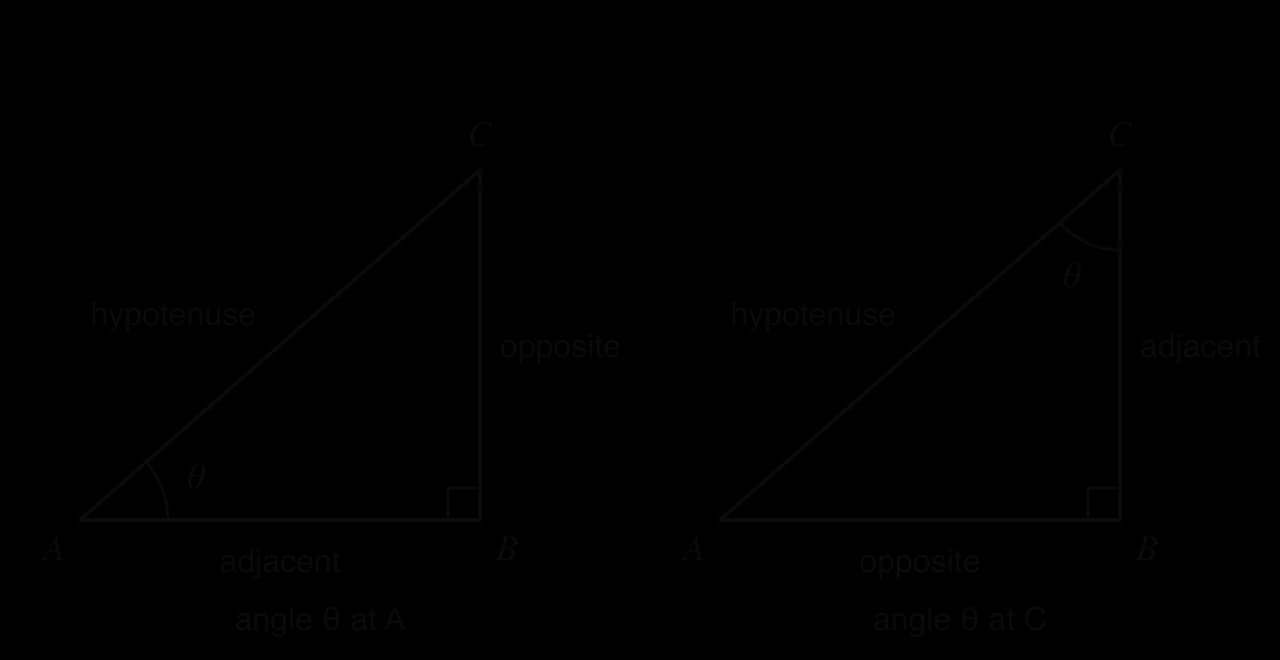
A reliable routine is to find the hypotenuse first (across from the right-angle square), then the side across from (opposite), and the remaining side is adjacent. Labelling the three sides on a sketch before writing any equation removes most errors in right-angled trigonometry.
Two right-angled triangles that share an acute angle have the same three angles: the right angle, and . Triangles with equal angles are similar, so one is an enlargement of the other and every side is multiplied by the same scale factor. Dividing one side by another cancels the scale factor, so the ratio is the same in every right-angled triangle with angle , however large or small it is drawn.
A right-angled triangle with and hypotenuse 2 cm has opposite side 1 cm; one with hypotenuse 10 cm has opposite side 5 cm.
Each angle therefore has its own fixed value of each ratio, and these values have names.
There are three ways to divide one of the three sides by another (ignoring the upside-down versions), and each has a name.
The tangent ratio compares the two shorter sides and does not involve the hypotenuse at all. It is the same quantity as the gradient of a line that makes angle with the horizontal: rise ÷ run (see subtopic 2.1 and its angle of inclination).
A memory aid joins the first letters of each ratio into one word.
A GDC gives the value of each ratio for any angle. The table shows how the ratios change as the angle grows from 10° to 80°.
10° | 30° | 45° | 60° | 80° | |
|---|---|---|---|---|---|
0.174 | 0.5 | 0.707 | 0.866 | 0.985 | |
0.985 | 0.866 | 0.707 | 0.5 | 0.174 | |
0.176 | 0.577 | 1 | 1.73 | 5.67 |
Three patterns follow from the definitions. In a right-angled triangle the hypotenuse is the longest side, so and are always between 0 and 1. As grows, the opposite side grows relative to the hypotenuse, so increases while decreases. The tangent has no upper limit: as approaches 90°, the adjacent side shrinks towards zero and grows without bound. The sine of an angle also equals the cosine of the other acute angle, because the side opposite one acute angle is adjacent to the other: .
When an angle and one side are known, the ratio that links the known side and the wanted side gives an equation with one unknown. The method has four steps.
Sketch the triangle and label the hypotenuse, opposite and adjacent sides relative to the known angle.
Identify which side is known and which is wanted.
Choose the ratio that contains exactly those two sides: opp and hyp → sine; adj and hyp → cosine; opp and adj → tangent.
Write the equation, rearrange for the unknown and evaluate on the GDC in degree mode.
If the unknown is on the top of the fraction, multiply; if it is on the bottom, the rearrangement swaps it with the ratio, so the unknown is the known side divided by the ratio.
When the unknown side is the denominator, the equation still starts in the same way.
To find an angle from two known sides, the process runs the other way: the ratio is calculated first, and then the angle with that ratio is needed. The GDC's , and keys do this. Each undoes the matching ratio, so it is an inverse function (subtopic 2.2).
The notation means "the angle whose sine is ". The marks an inverse function, as in , rather than a power, so is different from .
A GDC measures angles in one of two units, degrees or radians, and uses whichever unit is set. In SL geometry and trigonometry every angle is in degrees, so the calculator must be in degree mode before any trigonometric calculation.
To check or change the setting on a TI-84 Plus CE, press MODE and select DEGREE; on a Casio fx-CG50, press SHIFT MENU (SET UP) and set Angle to Deg. A quick test is to calculate : degree mode gives 0.5, while radian mode gives .
When two sides of a right-angled triangle are known and the third side is wanted, no angle is needed: Pythagoras' theorem gives it directly, . When an angle is involved, either as data or as the answer, a trigonometric ratio is needed. Many problems use both, and the two methods give a useful check on each other.
The isosceles triangle in the roof example shows a common strategy: a triangle that is not right-angled can often be cut into right-angled triangles by a perpendicular. The sine rule, the cosine rule and the area formula are all built on this idea.
Most triangles in surveying, navigation and design have no right angle, so the ratios cannot be applied to them directly.
Its angles can be of two kinds, and the difference matters when a rule is used to find an angle.
A triangle can contain at most one angle of 90° or more, because the three angles add up to 180°.
The standard labelling convention names the vertices with capital letters , , , uses the same letters for the angles at those vertices, and names each side with the lower-case letter of the angle opposite it. Side is opposite angle , so it is the side ; side is ; side is . The sine rule, the cosine rule and the area formula are written with these letters, so labelling a diagram this way lets the formulas be copied straight onto it.
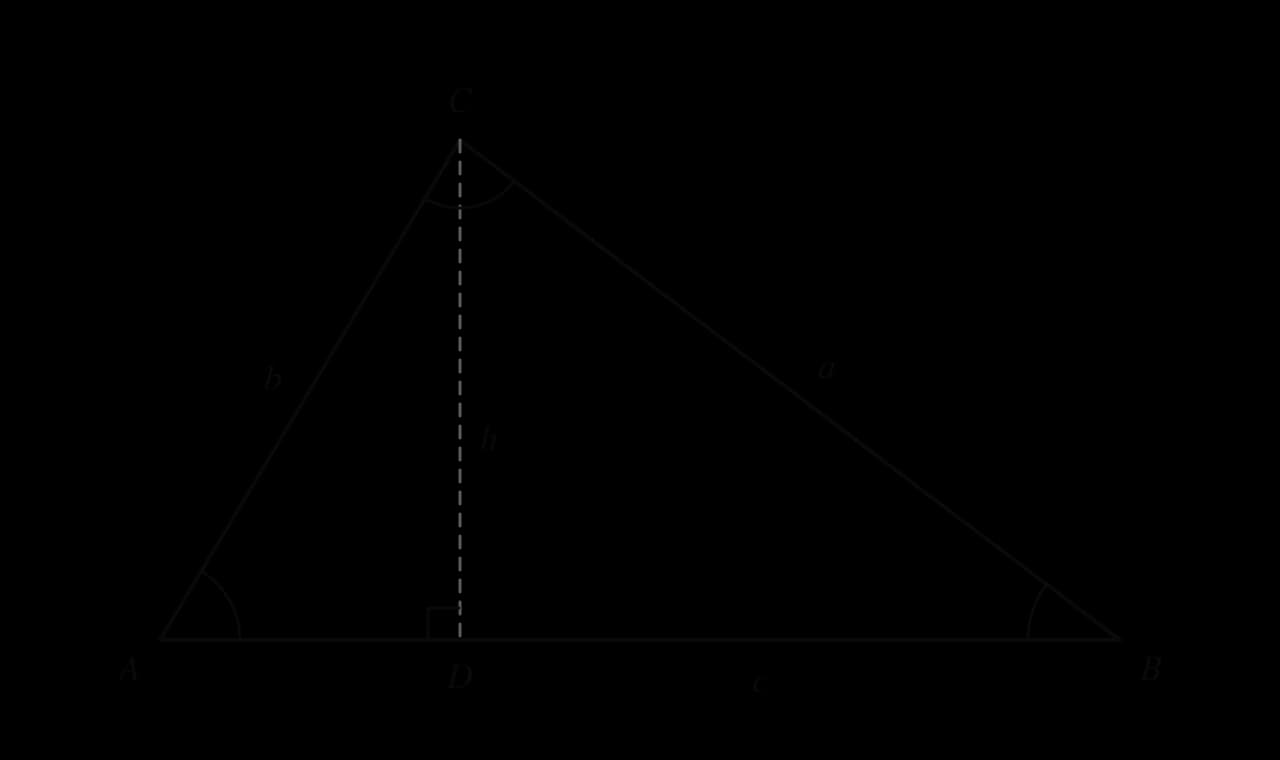
Three pieces of information, at least one of them a side, are enough to fix a triangle. Three angles alone are not enough: they fix the shape but not the size. Which rule to use depends on which three pieces are known.
In the triangle with height from to on , the two right-angled triangles and share the side . In triangle , is opposite angle and the hypotenuse is ; in triangle , is opposite angle and the hypotenuse is . Writing both ways and equating the two expressions gives the rule.
Dropping a perpendicular from instead links , , and in the same way, so all three fractions are equal.
In every triangle the ratio side ÷ sine of the opposite angle is the same for all three pairs, and the longest side is opposite the largest angle, the shortest side opposite the smallest angle. The derivation uses a triangle whose height falls inside it. When angle is obtuse the height falls outside, and the same argument works because , a fact that follows from the symmetry of the graph of .
The sine rule links two sides and the two angles opposite them. It can be used when a side and its opposite angle are both known (a "pair"), plus one more side or angle. With two angles known, the third comes from the angle sum, , so two angles and any side are always enough.
To find a side, use the form with sides on top: , so .
To find an angle, use the reciprocal form with sines on top, which puts the unknown in the numerator:
Only two of the three fractions are used at a time. The two forms are equivalent, since each is the other turned upside down.
Measuring two angles from the ends of a known line, as the coastguards did, fixes the position of a distant point without anyone travelling to it. Repeated over a whole region, this is the method of surveying called triangulation.
The GDC's always gives an angle between and . In a triangle, an angle with sine 0.6 could be or : both have the same sine. The graphs of and for show why.
The sine curve is symmetric about , so every value of between 0 and 1 is reached twice between 0° and 180°: once by an acute angle and once by an obtuse one. The cosine curve is different. It is positive for acute angles, zero at 90° and negative for obtuse angles, so each value of belongs to exactly one angle between 0° and 180°. An angle found with the sine rule may therefore be the acute partner of the true obtuse angle, whereas an angle found with the cosine rule is always the correct one.
The sine rule needs a known side–angle pair. When two sides and the angle between them are known, or all three sides, there is no such pair, and a different rule is needed. Placing the triangle on coordinate axes gives it. Put at the origin with side along the positive -axis, so is at . The point is a distance from the origin at angle to the -axis, so by right-angled trigonometry its coordinates are .
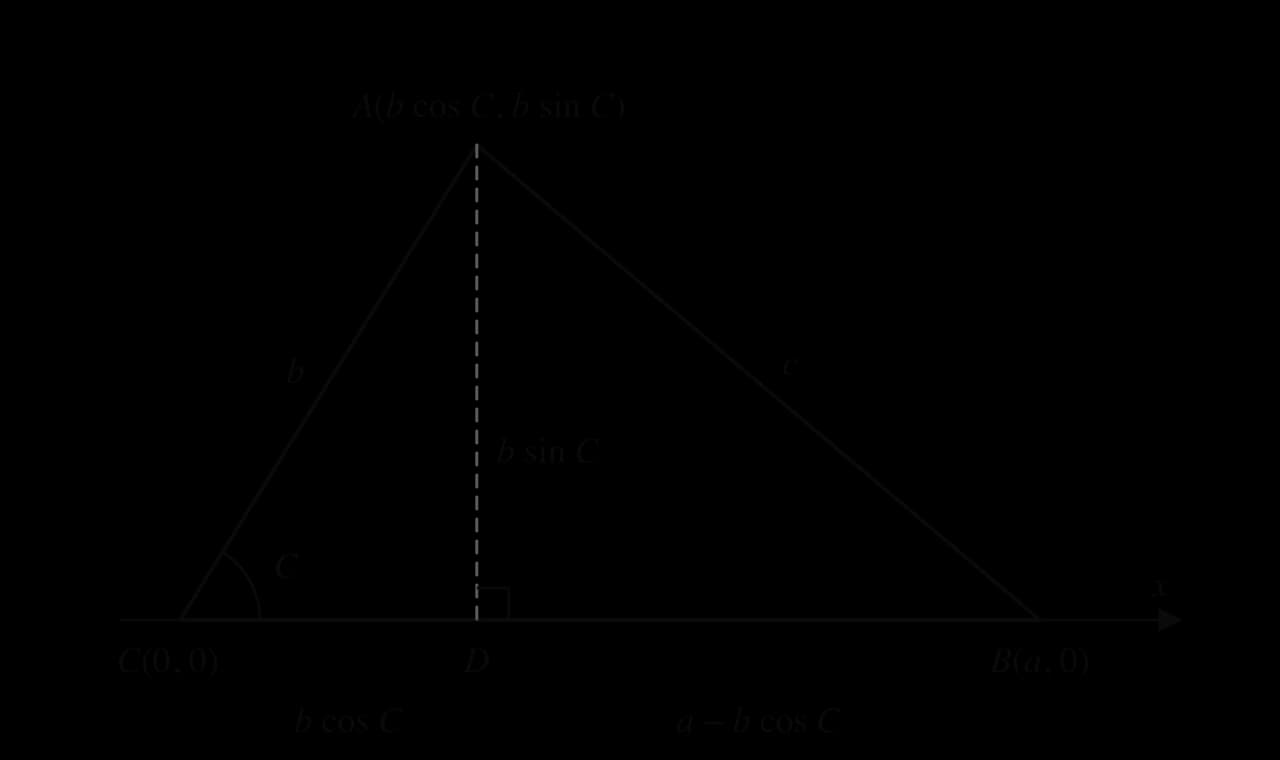
In the right-angled triangle , the horizontal side is , the vertical side is and the hypotenuse is . Pythagoras' theorem gives , and the identity , which holds because the point lies at distance 1 from the origin, simplifies it.
The rule works with any vertex as : the side on the left is always the one opposite the angle in the cosine, and the two sides on the right are the two sides that meet at that angle.
When , and the cosine rule becomes , Pythagoras' theorem. The term is a correction for an angle that is not a right angle. For an acute angle , , so is less than : the side opposite an acute angle is shorter than it would be in a right-angled triangle. For an obtuse angle, , the correction is added, and .
When two sides and the angle between them are known, the first form gives the third side directly. The step that needs care is the pairing: the unknown side must be the one opposite the known angle.
When all three sides are known, the rearranged form gives any angle. The side opposite the wanted angle is the one that is subtracted on the top.
Sometimes two sides and a non-included angle are known, and the wanted side is the third side. Substituting into the cosine rule then gives a quadratic equation in the unknown side, which the GDC can solve. Alternatively, the sine rule can be used twice. When the side opposite the known angle is the longer of the two known sides, only one triangle fits and the quadratic has exactly one positive root.
In this example angle could not be obtuse, because means is smaller than the 40° angle . That is why the sine-rule route gives one answer here. When the known side opposite the given angle is the shorter one, two different triangles may fit the data, and extra information, such as a diagram showing whether the angle is acute or obtuse, is needed to decide which triangle is meant.
 YouTube
The area of any triangle is . For a non-right-angled triangle the height is usually unknown, but trigonometry gives it from a side and an angle. In the coordinate diagram used for the cosine rule, the base is and the height of above it is .
The angle must be the included angle between the two sides used. The same formula can be written with any pair: or . When , and the formula becomes , the familiar half base times height for a right-angled triangle. Because , the formula also holds when is obtuse.
Data: city coordinates from Wikipedia ("Miami", "Hamilton, Bermuda", "San Juan, Puerto Rico"), 2026; distances computed with a mean Earth radius of 6371 km.
The area formula contains four quantities: the area, two sides and an angle. Any one of them can be found from the other three by rearranging. Finding an angle from an area gives a value of , and, as with the sine rule, two angles between 0° and 180° share that sine. The context or the diagram has to show whether the angle is acute or obtuse.
A field with straight edges can be split into triangles along its diagonals, and its area is the sum of the triangles' areas. Surveyors measure the sides and one or two angles, find each diagonal with the cosine rule, and then find the areas with . Older rules of thumb, such as one recorded in ancient Egypt that multiplies the averages of the two pairs of opposite sides, , are exact for rectangles but overestimate the area of other quadrilaterals.
The calculation of percentage error is taught in subtopic 1.6 (percentage error). Measured lengths and angles are also rounded values, which leads to a range of possible areas.
When sides and angles are measured to the nearest unit, each lies between a lower and an upper bound (subtopic 1.6, upper bound). The largest possible area uses the largest possible sides, but the angle needs more care: is largest at 90° and decreases on either side, so the largest area comes from the angle closest to 90° within its bounds.
Every triangle problem starts with the same question about the information given. The decision depends on whether there is a right angle, and if not, whether a side and its opposite angle are both known.
Information given | What is wanted | Method |
|---|---|---|
Right angle, two sides | Third side | Pythagoras' theorem |
Right angle, a side and an acute angle, or two sides | A side or an angle | SOH CAH TOA |
A side and its opposite angle, plus another side or angle | A side or an angle | Sine rule |
Two angles and any side | A side | Angle sum, then sine rule |
Two sides and the included angle | Third side | Cosine rule |
Three sides | An angle | Cosine rule |
Two sides and the included angle | Area |
The table works as a decision sequence. A right angle means the ratios are the quickest tool. Otherwise, a known side–angle pair points to the sine rule; no pair, but two sides with the angle between them or three sides, points to the cosine rule. An angle that could be obtuse is safest found with the cosine rule.
Real problems often need two or three rules in sequence, with the answer to one step feeding the next. Every intermediate value should be kept unrounded in the GDC: a value rounded to three significant figures and then used again can change the third significant figure of the final answer. This is called premature rounding. Final answers are given to three significant figures, and angles usually to one decimal place, unless a different accuracy is stated.
The Great Trigonometrical Survey of India began on 10 April 1802 with the measurement of a baseline about 7.5 miles (12 km) long near Madras (now Chennai), and was completed in 1871. Measuring long distances across hills, rivers and forests with chains was impossible, so the surveyors measured the baseline with great care and then measured only angles. From each end of a known side, they sighted a new hilltop or tower with a theodolite and measured the angles at both ends. With one side and two angles known, the sine rule gave the other two sides of the triangle, and each new side became the known side of the next triangle.
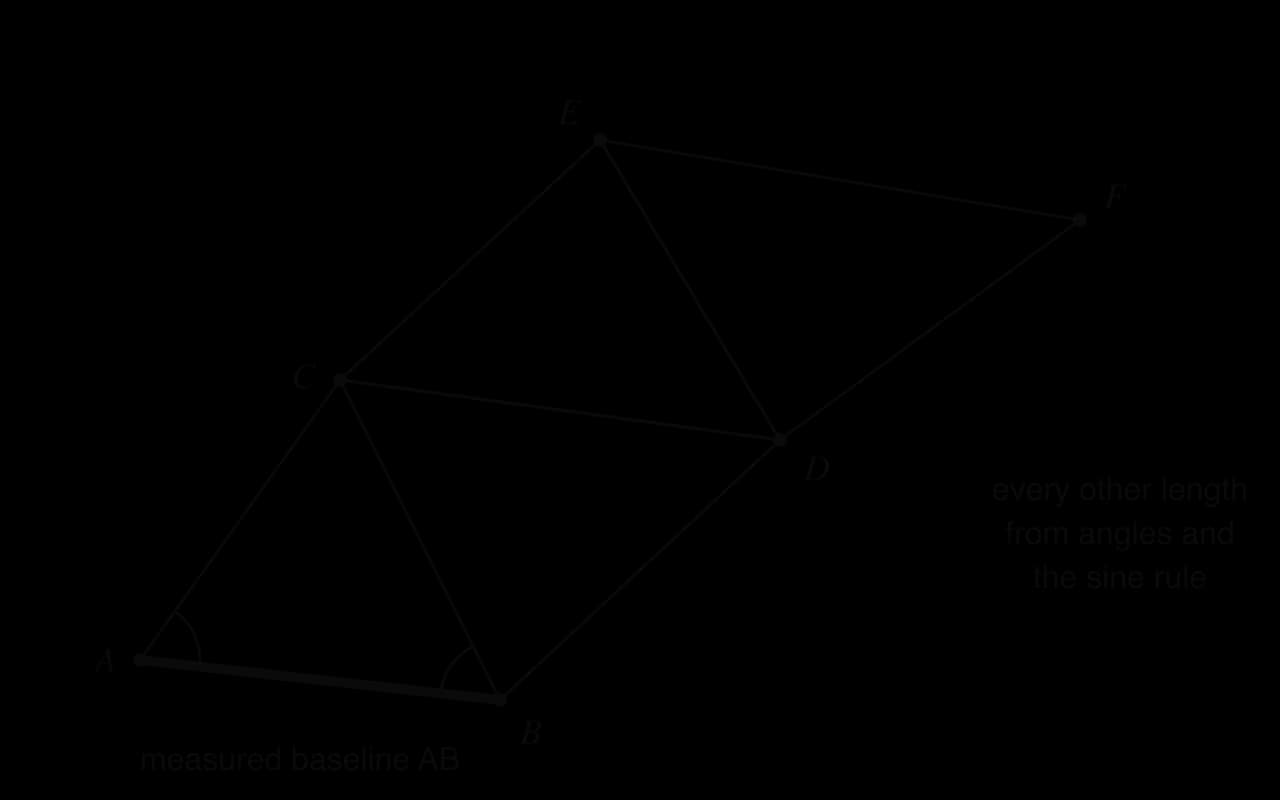
The surveyors covered the subcontinent with chains of such triangles running north to south and east to west. Heights were found in a similar way, from the angle up to a summit and the horizontal distance to it. In 1852 Radhanath Sikdar, a mathematician working for the survey, used theodolite observations made from stations at least 174 km from the peak to identify Peak XV as the highest mountain then known. In 1856 the Surveyor General, Andrew Waugh, announced its height as 29,002 ft (8840 m). A joint survey by China and Nepal in 2020 measured the height as 8848.86 m.
The nineteenth-century value differs from the modern one by about 0.1%, an error of under 9 m in a height found from sightings more than 170 km away. Such accuracy depended on the care taken with the baseline and the angles, because every later length is calculated from the baseline, so a percentage error in the baseline carries into every side of the chain.
Sources: Wikipedia, "Great Trigonometrical Survey", "Mount Everest" and "Radhanath Sikdar", 2026.
International cooperation and rivalry also drove the development of triangulation. In the 1730s the French Academy of Sciences sent one expedition to Lapland, led by Pierre Louis Maupertuis with the Swedish physicist Anders Celsius, and another, which left France in May 1735, to the equator in what is now Ecuador. Both measured the length of a degree of latitude by triangulation, to test whether Earth is flattened at the poles, as Newton's theory of gravity predicted. The Lapland results showed that it is.
Trigonometry in triangles appears on most papers. In Paper 1 it usually forms a short question of 4–7 marks: find an angle with the cosine rule, then an area with , or a right-angled calculation followed by the sine rule. In Paper 2 it opens or runs through a longer question about a field, a park, a building or a route, often split into triangles and combined with percentage error (1.6), sectors and segments (3.4) or Voronoi cells (3.6). The command terms are find, calculate, write down, show that and justify.
Markschemes award (M1) for substituting into the correct rule, (A1) for correct substitution and A1 for the answer, so the substituted formula should always be written down before the GDC is used. Treating a non-right-angled triangle as right-angled earns no marks for that part, and using radian mode loses the accuracy marks. In a "show that" question, both the unrounded and the rounded value must be seen, and the given value must not be used to reach itself.
The final parts of triangle questions often depend on earlier answers. Follow-through marks are available for using an earlier wrong value correctly, but only if the working is shown, so every step should be written even when the GDC does the arithmetic.
In a right-angled triangle, the hypotenuse is 13 cm and one angle is 35°. Find the side opposite the 35° angle. [2]
A right-angled triangle has shorter sides 8.2 m and 5.9 m. Find the angle opposite the 8.2 m side. [2]
In triangle , , and cm. Find . [3]
Two sides of a triangle are 7 cm and 10 cm, and the angle between them is 64°. Find the third side. [3]
A triangle has sides 6 cm, 9 cm and 13 cm. Find its largest angle. [3]
Calculate the area of a triangle with sides 12 m and 15 m enclosing an angle of 40°. [2]
A triangle has sides 9 cm and 11 cm with an obtuse angle between them, and its area is 42 cm². Find . [3]
A triangular car park has m, m and angle
Two sides of a triangle are measured as 12 cm and 20 cm, to the nearest centimetre, and the angle between them as 70°, to the nearest degree. Find the largest possible area of the triangle. [3]
Explain why the cosine rule, rather than the sine rule, should be used to find the largest angle of a triangle when all three sides are known. [2]
cm
cm
m²
;
(a)
Upper bounds 12.5 cm and 20.5 cm; the angle closest to 90° is 70.5°: cm² (120.78…)
The largest angle may be obtuse. only gives angles up to 90°, and an obtuse angle has the same sine as its acute supplement, so the sine rule cannot tell them apart; the cosine of an obtuse angle is negative, so the cosine rule gives the correct angle directly.
In a right-angled triangle, label the hypotenuse (opposite the right angle), then the opposite and adjacent sides relative to the angle .
, , (SOH CAH TOA); the ratios depend only on the angle because right-angled triangles with the same angle are similar.
, and give an angle from a ratio; the GDC must be in degree mode.
Sine rule:
Cosine rule: for a side from two sides and the included angle;
An acute angle and its obtuse supplement have the same sine; the cosine rule distinguishes them, so use it for an angle that may be obtuse.
Area of any triangle: , with the angle between and
Compound shapes are split into triangles; keep every intermediate value unrounded and give final answers to 3 significant figures.
I can label the hypotenuse, opposite and adjacent sides for either acute angle of a right-angled triangle.
I can find a side of a right-angled triangle when it is on the top or the bottom of the ratio.
I can find an angle with , or , and I know is not .
I can check and set degree mode on my GDC, and test it with .
I can label a triangle with sides , , opposite angles , , .
I can derive the sine rule from the perpendicular height of a triangle.
I can use the sine rule to find a side, and its reciprocal form to find an angle.
I can explain why the sine rule may give the acute partner of an obtuse angle.
I can use the cosine rule to find a side from two sides and the included angle.
I can use the cosine rule to find any angle from three sides, including an obtuse angle.
I can set up the cosine rule as a quadratic and solve it on the GDC, rejecting a negative root.
I can find the area of a triangle with , and find an angle or side from a given area.
I can find the area of a field by splitting it into triangles.
I can find the largest possible area of a triangle from measurements given to a stated accuracy.
I can choose the right method from the information given and avoid premature rounding.
A1
[2 marks]
Local building regulations state that the gradient of a wheelchair ramp must not be greater than .
Show that Amara's ramp satisfies the regulations.
2 marks
A1
, so the gradient is less than the maximum allowed R1
the ramp satisfies the regulations AG
Note: Accept a comparison of fractions, e.g.
[2 marks]
Find the angle that the ramp makes with the horizontal.
2 marks
(M1)
A1
[2 marks]
A second entrance to the library is m above the ground. Find the minimum horizontal distance needed for a ramp to this entrance that satisfies the regulations.
2 marks
OR (M1)
(m) A1
[2 marks]
A road sign at the foot of the Col de la Croix in the Alps warns drivers that the road has a gradient of . Assume that the road rises at this constant gradient.
Find the vertical height gained when a car travels a horizontal distance of m along this road.
2 marks
Find the angle that the road makes with the horizontal.
2 marks
Find the distance the car travels along the road.
2 marks
Oksana owns a field in the shape of a triangle, PQR, where PQ 1240 m, QR 1580 m and PR 1910 m.
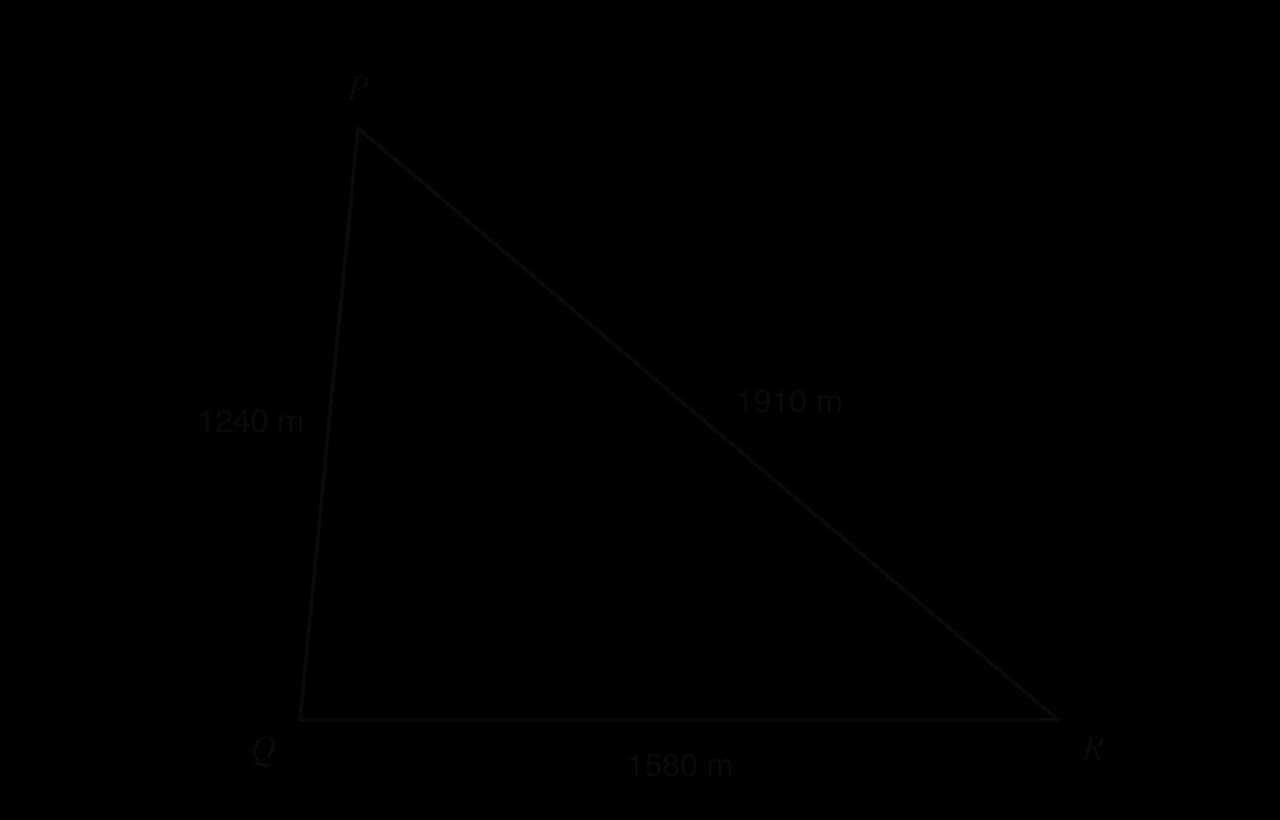
Find the size of angle PQR.
3 marks
Calculate the area of the field, in m². Give your answer in the form , where and .
3 marks
Given that 1 hectare m², write down the area of the field in hectares.
1 mark
Oksana plants wheat in the whole field. She expects a yield of kg of wheat per hectare.
Find the expected total yield of wheat, in kg.
2 marks
The mean mass of one grain of wheat is kg.
Estimate the number of grains of wheat in the expected yield. Give your answer in the form , where
Oksana sells all the wheat for 0.24 US dollars (USD) per kg.
Find the total income from the wheat. Give your answer correct to the nearest dollar.
2 marks
The boat is about 9.84 km from .
(b) The shortest distance to the coastline is the perpendicular from to . In the right-angled triangle formed with , the distance is the hypotenuse and the perpendicular is opposite the 67° angle.
The boat is about 9.06 km from the coast. Using the rounded value 9.84 would give 9.0577…, which still rounds to 9.06, but in a longer chain of calculations the rounding errors build up.
Since is obtuse, the other two angles must both be acute, so is the only possibility. Then , and the sine rule again gives the side.
So , and cm. As a check, the longest side (14 cm) is opposite the largest angle (105°) and the shortest side (8.11 cm) is opposite the smallest angle (34.0°).
So cm. Because is negative, the last term is added, and is longer than cm, the length it would have with a right angle at .
This is a quadratic in with coefficients , and . The GDC's polynomial root finder (on a TI-84 Plus CE: APPS → PlySmlt2 → POLYNOMIAL ROOT FINDER, degree 2; on a Casio fx-CG50: MENU → Equation → POLY, degree 2) gives
A length cannot be negative, so cm.
The sine rule gives the same answer in three steps: , so ; then ; then cm.
(b) In triangle all three sides are now known. Angle is opposite .
(c) Add the areas of the two triangles, each found from two sides and the included angle.
The field has an area of about 3320 m².
(d) The estimate is m², and the percentage error compares it with the accurate value.
The ancient estimate is about 3.97% too large.
Award (M1) for substituting into the cosine rule, (A1) for correct substitution.
m A1
(b) M1A1
A1
AG
The unrounded value must be seen for the final A1. Accept the cosine rule, .
(c) (M1)(A1)
A1
(d) (M1)
OR
m A1
(e) (A1)
(M1)
m A1
Total [14]
2 marks