5 Calculus
An overview of Topic 5, Calculus: how differentiation and integration describe change and accumulation, how the subtopics build on each other, and how SL and HL differ.
- IB Mathematics: Analysis and Approaches
- SL and HL
19 subtopics in Calculus
Each one has its own page once something is published for it.
- 5.1Limits and the derivative24 questions · notes · 29 quick fire
- 5.2Increasing and decreasing functions36 questions · notes · 27 quick fire
- 5.3Differentiating polynomials70 questions · notes · 33 quick fire
- 5.4Tangents and normals74 questions · notes · 30 quick fire
- 5.5Introduction to integration37 questions · notes · 29 quick fire
- 5.6Chain, product and quotient rules131 questions · notes · 38 quick fire
- 5.7The second derivative57 questions · notes · 30 quick fire
- 5.8Stationary points, optimisation and inflexion166 questions · notes · 34 quick fire
- 5.9Kinematics41 questions · notes · 31 quick fire
- 5.10Indefinite integrals and substitution by inspection65 questions · notes · 41 quick fire
- 5.11Definite integrals and areas163 questions · notes · 39 quick fire
- 5.12Continuity, differentiability and first principlesHL only21 questions · notes · 39 quick fire
- 5.13Limits and L’Hôpital’s ruleHL only41 questions · notes · 38 quick fire
- 5.14Implicit differentiation and related ratesHL only26 questions · notes · 37 quick fire
- 5.15Derivatives of further functionsHL only51 questions · notes · 40 quick fire
- 5.16Integration by substitution and by partsHL only36 questions · notes · 39 quick fire
- 5.17Areas and volumes of revolutionHL only27 questions · notes · 38 quick fire
- 5.18First-order differential equationsHL only27 questions · notes · 40 quick fire
- 5.19Maclaurin seriesHL only28 questions · notes · 39 quick fire
An overview of 5 Calculus
Calculus is the mathematics of change and accumulation. Differential calculus measures how fast a quantity changes: the gradient of a curve at a point, the velocity of a moving object, the rate at which a population grows. Integral calculus does the reverse, adding up small changes to find a total: the area under a curve, the distance travelled from a velocity, the volume of a solid. The two are linked by the fundamental theorem of calculus, which shows that integration undoes differentiation.
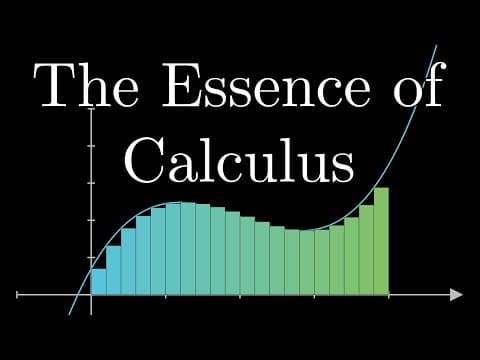
Both halves rest on the idea of a limit. The gradient of a curve at a point is the limit of the gradients of chords, and an area under a curve is the limit of the sum of the areas of thinner and thinner rectangles. Calculus brings together almost every earlier topic: functions and their graphs (Topic 2), sequences and series (Topic 1), circular functions (Topic 3) and, at HL, continuous random variables (Topic 4).
 YouTube
How the subtopics build on each other
The topic starts with differentiation of simple functions and its uses, then introduces integration, and then extends both to a wider range of functions. Subtopics 5.12 to 5.19 are HL only.
Subtopic | Level | What it covers |
|---|---|---|
5.1 Limits and the derivative | SL | Limits from tables and graphs; the derivative as a gradient and as a rate of change |
5.2 Increasing and decreasing functions | SL | The sign of ; sketching from and the reverse |
5.3 Differentiating polynomials | SL | The power rule for integer powers; gradients at points |
5.4 Tangents and normals | SL | Equations of tangents and normals; tangents through an external point |
5.5 Introduction to integration | SL | Anti-differentiation, the constant of integration, areas with a GDC |
5.6 Chain, product and quotient rules | SL | Derivatives of , , , , and their combinations |
5.7 The second derivative | SL | , concavity and the graphs of , and |
5.8 Stationary points, optimisation and inflexion | SL | Maximum and minimum points, optimisation problems, points of inflexion |
5.9 Kinematics | SL | Displacement, velocity, acceleration and distance travelled |
5.10 Indefinite integrals and substitution by inspection | SL | Standard integrals, linear composites and the reverse chain rule |
5.11 Definite integrals and areas | SL | Exact definite integrals, areas above and below the axis, areas between curves |
5.12 Continuity, differentiability and first principles | HL | Continuity, differentiability, the derivative from first principles, higher derivatives |
5.13 Limits and L'Hôpital's rule | HL | Indeterminate forms and L'Hôpital's rule |
5.14 Implicit differentiation and related rates | HL | Implicit differentiation, related rates of change, harder optimisation |
5.15 Derivatives of further functions | HL | , , , , inverse trigonometric functions and their integrals |
5.16 Integration by substitution and by parts | HL | Substitution with changes of limits; integration by parts, including repeated use |
5.17 Areas and volumes of revolution | HL | Areas with respect to ; volumes of revolution about either axis |
5.18 First-order differential equations | HL | Slope fields, Euler's method, separable and homogeneous equations, integrating factors |
5.19 Maclaurin series | HL | Power series for standard functions, and their use in approximations and limits |
Subtopics 5.1 to 5.4 form the foundation: the meaning of a derivative, what its sign shows, how to find it for polynomials and how to use it for tangents. Subtopics 5.5, 5.10 and 5.11 build integration in three stages, while 5.6 to 5.9 extend differentiation to more functions and to applications. The HL subtopics then make the ideas rigorous (5.12, 5.13) and extend the methods to harder functions, differential equations and series.
Key concepts in calculus
Change. A derivative is a rate of change, and calculus describes any quantity that changes continuously: speed, growth, cooling.
Approximation. A tangent approximates a curve near a point, a sum of rectangles approximates an area, and a Maclaurin series approximates a function by a polynomial.
Modelling. Rates of change in context lead to optimisation problems, kinematics and, at HL, differential equations that model growth and decay.
Relationships and representation. The graphs of , and are three representations of one function, and features of one appear as features of the others.
Equivalence. Differentiation and integration are inverse processes, linked by the fundamental theorem of calculus.
Calculus at SL and at HL
SL students study subtopics 5.1 to 5.11, which cover differentiation of the standard functions with the chain, product and quotient rules, applications to graphs, optimisation and kinematics, and integration of standard functions, including areas. HL students study all of these and also 5.12 to 5.19. The HL material adds rigour (continuity, differentiability and first principles), a wider range of functions and integration techniques, volumes of revolution, differential equations and Maclaurin series.
From the formula booklet
The entries of the mathematics: analysis and approaches formula booklet that 5 uses. Each opens in the explained booklet.
- Derivative of Topic 5: Calculus › SL and HL › SL 5.3 Derivative of
- Integral of Topic 5: Calculus › SL and HL › SL 5.5 Integral of
- Area between a curve and the -axis, where Topic 5: Calculus › SL and HL › SL 5.5 Area between a curve and the -axis, where
- Derivative of Topic 5: Calculus › SL and HL › SL 5.6 Derivative of
- Derivative of Topic 5: Calculus › SL and HL › SL 5.6 Derivative of
- Derivative of Topic 5: Calculus › SL and HL › SL 5.6 Derivative of
- Derivative of Topic 5: Calculus › SL and HL › SL 5.6 Derivative of
- Chain ruleTopic 5: Calculus › SL and HL › SL 5.6 Chain rule
- Product ruleTopic 5: Calculus › SL and HL › SL 5.6 Product rule
- Quotient ruleTopic 5: Calculus › SL and HL › SL 5.6 Quotient rule
And 33 more in the formula booklet.
Carry on with 5 in Augment
With a free account, Augment remembers where you stopped and what you have practiced.