5.8 Stationary points, optimisation and inflexion · IB Maths AA | Augment Education
5.8 Stationary points, optimisation and inflexion
Find and classify stationary points with the first and second derivative tests, locate points of inflexion, and use derivatives to solve optimisation problems in context.
IB Mathematics: Analysis and Approaches
Part of 5 Calculus
SL and HL
Key terms introduced here
Each is in the Maths AA glossary, with every other term in the subject.
A condition linking the variables in an optimisation problem, such as a fixed volume or a fixed length of material. It is used to write the quantity to be optimised in terms of a single variable.
A way to classify a stationary point at x=a from the sign of f′(x) just before and just after a: positive then negative gives a maximum, negative then positive a minimum, no change of sign a stationary point of inflexion.
Notes on 5.8 Stationary points, optimisation and inflexion
37 min readLast reviewed
Questions on 5.8
166 exam-style questions on this subtopic, written in the style of the IB papers. The first has its markscheme open. Counted on
Question 1 · AA-000019 marks
Let f(x)=x3−6x2+9x+1
Try a quick-fire question
One of 34 short multiple-choice questions on 5.8. Pick an answer to see why it's right or wrong.
The graph of y=f′(x) is shown. How many stationary points does f have?
Carry on with 5.8 in Augment
With a free account, Augment remembers where you stopped and what you have practiced.
Finding the greatest or least value of a quantity, such as an area, a cost or a time, by writing it as a function of one variable and locating its maximum or minimum on the allowed domain.
A point on a curve where the concavity changes, from concave up to concave down or the reverse, so f′′(x) changes sign there. The gradient at the point may be zero or non-zero.
A point on the graph of y=f(x) where the gradient is zero, f′(x)=0, so the tangent is horizontal. It is a local maximum, a local minimum or a stationary point of inflexion.
A point of inflexion where the gradient is also zero. The sign of f′(x) is the same on both sides, so the point is stationary but neither a maximum nor a minimum, as at the origin on y=x3.
does not by itself decide the nature of a stationary point or show a point of inflexion.
Find points of inflexion, with zero and non-zero gradient, from a change of sign of f′′(x).
Determine the greatest and least values of a function on an interval, including values at endpoints.
Solve optimisation problems by writing a quantity as a function of one variable, using a constraint and a suitable domain.
Justify that a value found in an optimisation problem is a maximum or a minimum, and interpret it in context.
The derivative f′(x) gives the gradient of a curve at every point. Where the gradient is zero the curve is momentarily flat: it may be at the top of a hill, at the bottom of a valley, or levelling off before it continues in the same direction. Finding and classifying these points is the main use of differentiation in sketching graphs, and it answers practical questions of the form "what is the greatest volume?", "what is the least cost?" or "when is the temperature highest?".
The second derivative adds a second layer of information: how the gradient itself is changing. Where the curve switches from bending one way to bending the other there is a point of inflexion, which is often the place where a quantity is growing or falling fastest.
Stationary points
What a stationary point is
On a smooth curve, the tangent at each point has a gradient equal to the value of the derivative there. At most points the tangent slopes up or down. At a few points it is horizontal, and these are the points where the function stops increasing or decreasing, at least for an instant.
The word "stationary" comes from motion: if f(x) gives the position of an object, then f′(x) is its velocity, and at a stationary point the object is not moving for that instant.
The three types of stationary point
A stationary point is always one of three types. The type depends on what the gradient does on either side of the point.
A local maximum: the curve rises to the point and falls after it, so the gradient changes from positive to negative. The point is higher than every nearby point.
A local minimum: the curve falls to the point and rises after it, so the gradient changes from negative to positive. The point is lower than every nearby point.
A stationary point of inflexion: the curve flattens out and then continues in the same direction, so the gradient has the same sign on both sides. The point is neither a maximum nor a minimum.
A local maximum or local minimum is also called a turning point, because the curve turns from going up to going down or the reverse. A stationary point of inflexion is a stationary point but not a turning point.
y = 3x⁵ − 5x³
The curve has a horizontal tangent at all three marked points. It turns at (−1, 2) and (1, −2), but at the origin it only levels off and keeps falling.
The curve y=3x5−5x3 has all three types. Its derivative is dxdy=15x4−15x2=15x2(x2−1), which is zero at x=−1, x=0 and x=1. The table summarises how the sign of the gradient identifies each type.
Type
Sign of f′(x) just before
At the point
Sign of f′(x) just after
Shape
Local maximum
+
0
−
rises, then falls
Local minimum
−
0
+
falls, then rises
Stationary point of inflexion
+
0
+
rises, levels off, rises again
Stationary point of inflexion
−
0
−
falls, levels off, falls again
Finding stationary points
Stationary points are found by solving an equation, then using the original function to find the y-coordinates.
Differentiate to find f′(x).
Solve f′(x)=0. Each solution is the x-coordinate of a stationary point.
Substitute each solution into f(x), not f′(x), to find the y-coordinate.
A second error is to solve f(x)=0 instead of f′(x)=0. The solutions of f(x)=0 are where the curve crosses the x-axis; the solutions of f′(x)=0 are where it is flat. These are different points except by coincidence.
Classifying stationary points
Solving f′(x)=0 finds the stationary points but does not say what type they are. Determining the type, also called the nature of the point, needs a test.
The first derivative test
The first derivative test looks at the sign of f′(x) at values of x a little to the left and a little to the right of the stationary point. The sign shows whether the function is increasing or decreasing there, which is exactly what separates the three types.
The test values must lie between neighbouring stationary points. If a test value jumps past another stationary point, the sign it gives may belong to a different part of the curve. A sign table with one column for each interval keeps this organised.
The first derivative test always works for a function whose derivative is defined near the point, which makes it the safest choice when a stationary point might be a point of inflexion.
The second derivative test
The second derivative f′′(x) measures how the gradient is changing. At a local maximum the gradient goes from positive, through zero, to negative, so it is decreasing; this usually means f′′(a)<0 and the curve is concave down. At a local minimum the gradient is increasing, so usually f′′(a)>0 and the curve is concave up.
A helpful picture is a cup. A curve that is concave up holds water, like the bottom of a valley, so a flat point there is a minimum. A curve that is concave down spills water, like the top of a hill, so a flat point there is a maximum.
The second derivative test is often quicker than a sign table, especially for functions that are awkward to evaluate at test points. It also works well with functions other than polynomials.
This example shows why the word "local" matters. The local maximum value −4 is smaller than the local minimum value 4. A local maximum is only higher than the points close to it, not necessarily higher than every point on the curve.
The same method applies to exponential and trigonometric functions, using the rules of 5.6.
When the second derivative test fails
If f′′(a)=0, the second derivative test gives no information. The three functions y=x4, y=−x4 and y=x3 show why. All three have f′(0)=0 and f′′(0)=0, yet the origin is a minimum on the first, a maximum on the second and a stationary point of inflexion on the third.
y = x⁴ (minimum)
y = −x⁴ (maximum)
y = x³ (inflexion)
Each curve has f′(0) = 0 and f″(0) = 0, but the origin is a different type of stationary point on each. A zero second derivative does not decide the type.
Choosing a test
Both tests are valid, and each has its strengths.
First derivative test
Second derivative test
What is checked
Sign of f′(x) either side of a
Sign of f′′(a)
Work needed
Two evaluations of f′ (or reading signs from factors)
One more differentiation and one evaluation
Always decides the type?
Yes
No: inconclusive when f′′(a)=0
Identifies stationary points of inflexion?
Yes
No
Best when
f′(x) factorises neatly, or f′′(a) might be 0
f′′(x)
Stationary points and unknown constants
Some questions give information about a stationary point and ask for constants in the function. Each piece of information gives an equation. A stationary point at (p,q) gives two equations: f′(p)=0 because the point is stationary, and f(p)=q because the point lies on the curve.
The number of stationary points of a cubic depends on the quadratic f′(x). Its discriminant decides whether f′(x)=0 has two, one or no real solutions, which gives a cubic with two turning points, one stationary point of inflexion, or no stationary points at all.
Greatest and least values on an interval
A local maximum is the highest point in its own neighbourhood. In many problems the question is different: what is the greatest value the function takes anywhere on a given interval? This is the global maximum on that interval, and the least value is the global minimum.
Endpoints matter
On a closed interval a≤x≤b, the greatest or least value of a continuous function occurs either at a stationary point inside the interval or at one of the endpoints x=a and x=b. At an endpoint the gradient need not be zero, so solving f′(x)=0 alone can miss the answer.
To find the global maximum and minimum on a≤x≤b:
Find the stationary points that lie inside the interval.
Evaluate f at each of these stationary points and at both endpoints.
The largest of these values is the global maximum; the smallest is the global minimum.
Points of inflexion
Concavity and where it changes
A curve is concave up on an interval where f′′(x)>0, so the gradient increases, and concave down where f′′(x)<0, so the gradient decreases (see 5.7). A point where the curve changes from one to the other is a point of inflexion.
At a point of inflexion the gradient reaches a local maximum or local minimum value: it stops increasing and starts decreasing, or the reverse. That is why points of inflexion often mark the moment of fastest growth or fastest decline in a model, for example the point at which a spreading infection is gaining new cases most quickly.
Zero and non-zero gradient
The gradient at a point of inflexion can be zero or non-zero.
If f′(a)=0 as well, the point is a stationary point of inflexion, as at the origin on y=x3. The tangent is horizontal.
If f′(a)=0, the point is a non-stationary point of inflexion. The tangent slopes, and it crosses the curve at the point.
y = x³ − 3x
tangent y = −3x
At the non-stationary point of inflexion (0, 0) the gradient is −3. The tangent crosses the curve there, passing from one side of the curve to the other.
For y=x3−3x, the second derivative is dx2d2y=6x, which is negative for x<0 and positive for x>0. The curve changes from concave down to concave up at the origin, where the gradient is 3(0)2−3=−3. This point is not stationary, so the methods for stationary points do not find it: solving f′(x)=0 gives only x=±1.
Finding points of inflexion
Find f′′(x).
Solve f′′(x)=0 to find the candidates.
Check that f′′(x) changes sign at each candidate, using test values on either side or the factors of f′′(x).
Find the y-coordinate from f(x). If a question asks, find the gradient f′(a) to decide whether the point is stationary.
Why f′′(x)=0 is not enough
A zero second derivative only identifies candidates. On y=x4, f′′(x)=12x2 is zero at x=0, but 12x2≥0 on both sides, so the curve is concave up throughout and the origin is a minimum, not a point of inflexion.
The function f(x)=x4−4x3, whose stationary points are (0,0) and (3,−27), shows both kinds of point of inflexion on one curve.
Reading points of inflexion from the graph of f′
Since f′′ is the derivative of f′, the points of inflexion of f are where f′ has a local maximum or local minimum. The stationary points of f are where the graph of f′ meets the x-axis. When only the graph of f′ is given, both kinds of point can still be found from it.
The graph of y=f′(x) for f′(x)=x3−3x+2=(x+2)(x−1)2 crosses the x-axis at x=−2, touches it at x=1, and has a local maximum at x=−1.
y = f′(x)
The graph of the derivative f′, not of f. It crosses the x-axis at x = −2 and touches it at x = 1.
Optimisation
The method
Optimisation means finding the best value of a quantity: the largest volume, the least cost, the shortest time. Calculus solves these problems once the quantity is written as a function of a single variable, because the best value is then a maximum or minimum of that function.
Most problems involve two or more variables linked by a fixed condition, such as a given volume or a given length of material. This condition is the constraint. It is used to eliminate all but one variable.
Draw a diagram if the situation is geometric, and name the variables.
Write an expression for the quantity to be optimised.
Use the constraint to write that quantity in terms of one variable.
State the domain: the values of the variable that make sense in context.
Differentiate, and solve derivative =0.
Verify that the value gives a maximum or minimum (second derivative test or first derivative test), and check the endpoints of the domain.
Answer the question in context, with units.
Maximising the volume of an open box
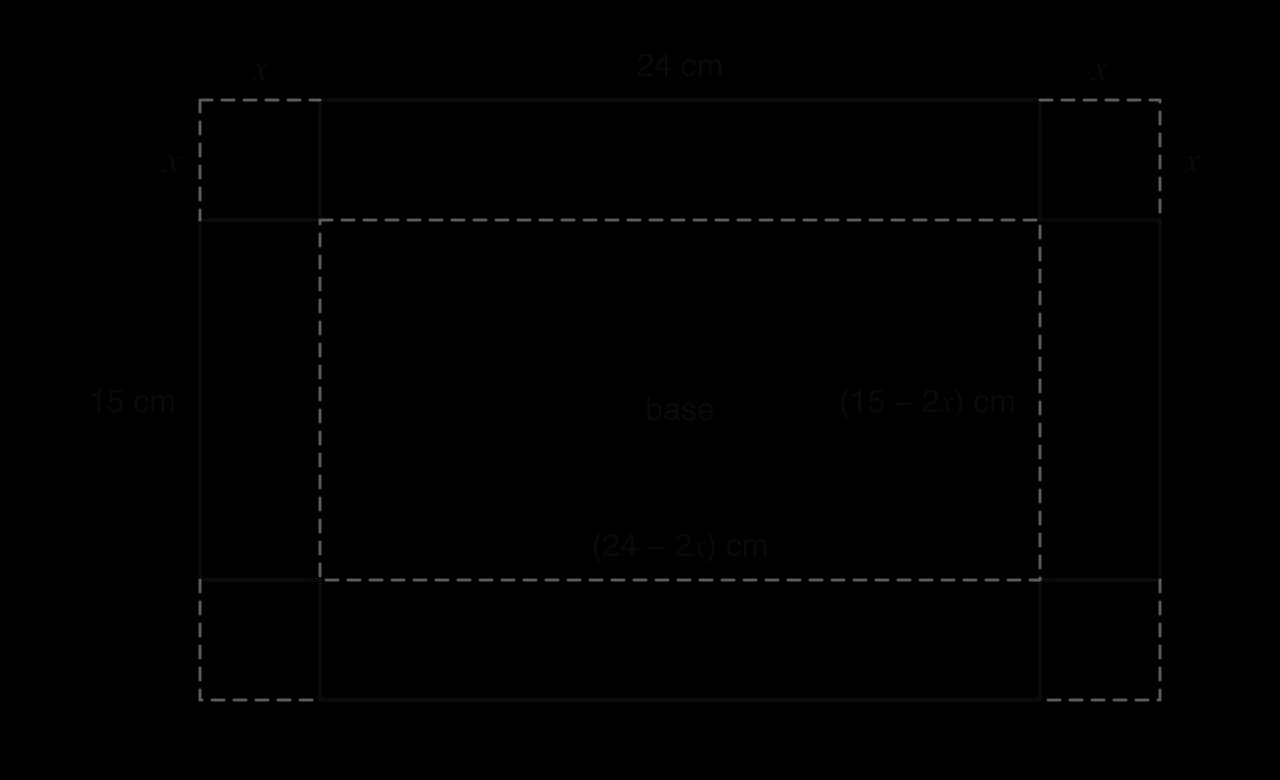
An open box is made from a rectangular sheet of card 24 cm by 15 cm by cutting a square of side x cm from each corner and folding up the sides.
Cutting a square of side x from each corner shortens both sides of the base by 2x. The flaps fold up to height x.
A small cut gives a wide, shallow box; a large cut gives a deep box with a tiny base. Both have small volumes, so somewhere in between the volume is greatest.
Because V is close to 0 at both ends of the domain and has only one stationary point inside it, the local maximum at x=3 is also the global maximum. It is good practice to say this when a question asks for "the maximum".
Minimising the surface area of a can
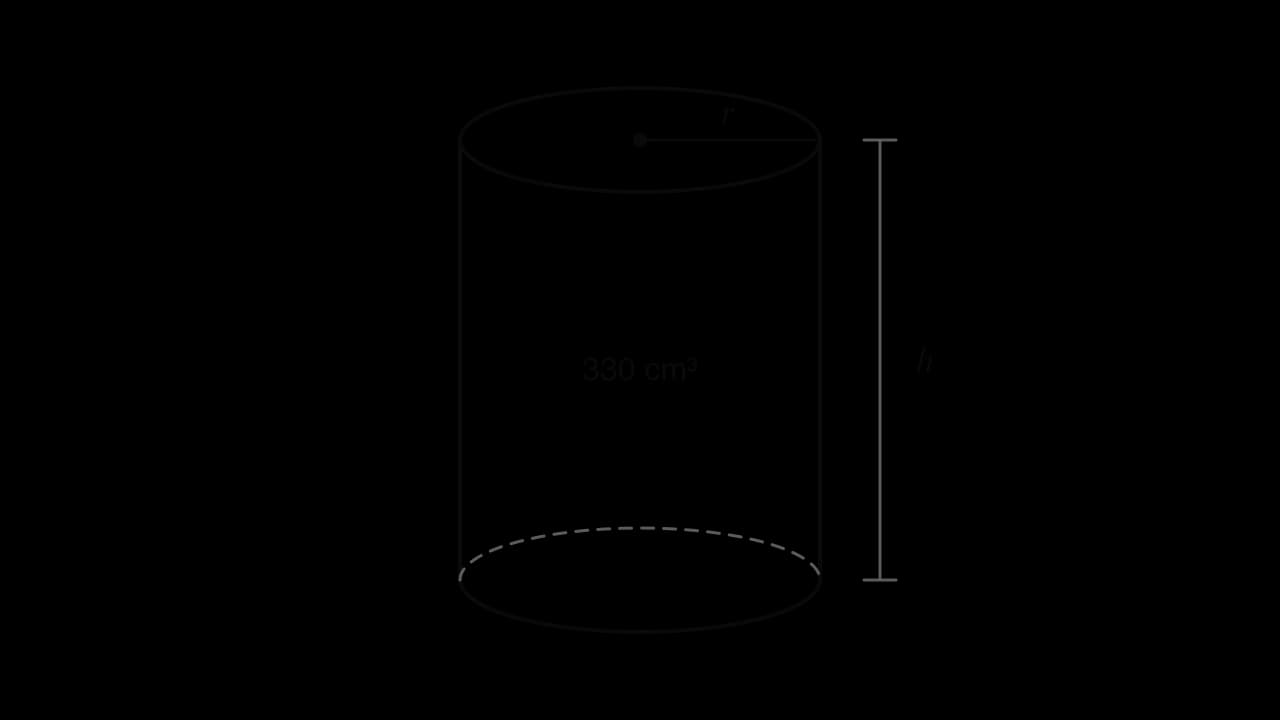
A drinks can is a closed cylinder. A manufacturer wants to hold 330cm3 while using as little metal as possible, so the surface area should be a minimum for the fixed volume.
Two dimensions, r and h, but only one free choice: once r is chosen, the fixed volume decides h.
The answer has a neat form. From r3=π165, πr3=165, so
h=πr2330=πr22×165=πr22πr3=2r
The can with the least surface area has its height equal to its diameter, for any fixed volume. Real drinks cans are taller and narrower than this. A model that counts only area leaves out other factors: the top and base are made of thicker metal than the side, and a narrow can is easier to hold. Optimisation gives the best answer to the question the model asks, so the model must include whatever matters in reality.
Shortest distance to a curve
The distance between two points involves a square root, which makes differentiation messy. Since distance is never negative, the distance D is least exactly when D2 is least, so it is simpler to minimise D2.
When the optimum is at an endpoint
Not every optimisation problem has its answer at a stationary point. If the function has no maximum inside the domain, or the stationary point is a minimum when a maximum is wanted, the answer lies at an endpoint.
Every optimisation problem rests on a mathematical model. The function is a simplified description of reality, the domain records what is physically possible, and the derivative locates the best choice within those limits. A box made from real card loses some volume to the thickness of the material, and the can model ignored the cost of thicker lids, so an optimum found from a model should be checked against the situation it describes.
Exam-style questions on stationary points and optimisation
The first question is typical of a non-calculator paper. It combines a geometric "show that" with trigonometric differentiation and a justification.
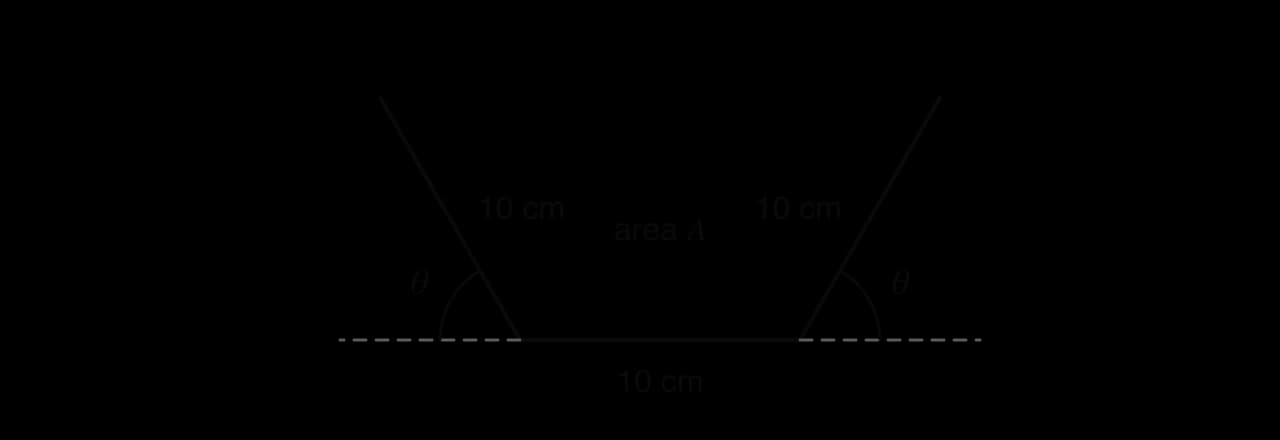
The gutter is made by bending a 30 cm wide strip of metal 10 cm from each edge. Changing θ changes the shape of the cross-section.
The second question allows a GDC. It mixes stationary points, a point of inflexion and the global behaviour of a model on a closed interval.
Self-check
To do:
I can find the coordinates of the stationary points of a function by solving f′(x)=0 and substituting into f(x).
To do:
I can classify a stationary point as a local maximum, local minimum or stationary point of inflexion with the first derivative test.
To do:
I can use the second derivative test, and I know it is inconclusive when f′′(a)=0.
To do:
I can find constants in a function from information about its stationary points.
To do:
I can find the greatest and least values of a function on a closed interval, including values at the endpoints.
To do:
I can find points of inflexion by solving f′′(x)=0 and checking that f′′(x) changes sign, and decide whether each is stationary.
To do:
I can read stationary points and points of inflexion of f from the graph of f′.
To do:
I can set up an optimisation problem using a constraint and a domain, solve it, and justify that my answer is a maximum or minimum.
To do:
I can interpret the result of an optimisation in context, with units, and comment on the limitations of the model.
, for
x∈R
.
(a)
Find f′(x).
[2]2 marks
Markscheme (a)
f′(x)=3x2−12x+9A1A1
Award A1 for each two correct terms.
(b)
Find the coordinates of the two stationary points of the graph of f.
[4]4 marks
Markscheme (b)
Setting f′(x)=0: 3(x−1)(x−3)=0
(c)
Find the equation of the tangent to the graph of f at the point where x=4.
[3]3 marks
Markscheme (c)
f′(4)=48−48+9=9
Markscheme notes
YouTube
Why the derivative is the slope of a tangent: Essence of calculus, chapter 1, by 3Blue1Brown.
Question 2 · AA-0006815 marks
A storage tank is made from a right circular cylinder with a closed flat base and a hemispherical roof. The cylinder has radius r metres and height h metres, and the hemisphere has the same radius r metres. The volume of the tank is 45π m3.
A drinking cup is made from paper in the shape of the curved surface of a right cone, with no lid. The cone has base radius r cm and height h cm. The cup holds 250 cm3 when full.
(a)
Express h in terms of r.
[2]2 marks
(b)
Let A cm2 be the area of paper used to make the cup. Show that A=π2r4+r2562500
(c)
Find the value of r that minimises A, and the minimum value of A.
[3]3 marks
(d)
For the cup with minimum area, find the angle between the slanting side of the cup and its vertical axis.
[3]3 marks
(e)
Each cup is cut from a sector of a circle of paper and the two straight edges are joined without overlap. For the cup with minimum area, find the angle of the sector, in degrees.
If f′(x1)<0 and f′(x2)>0, the point is a local minimum.
If f′(x1) and f′(x2) have the same sign, the point is a stationary point of inflexion.
(left of
−1
),
x=0
(between
−1
and
2
) and
x=3
(right of
2
).
x
−2
−1
0
2
3
f′(x)
6(−4)(−1)=24
0
6(−2)(1)=−12
0
6(1)(4)=24
Sign
+
0
−
0
+
Shape
rising
flat
falling
flat
rising
The gradient changes from positive to negative at x=−1, so (−1,12) is a local maximum. It changes from negative to positive at x=2, so (2,−15) is a local minimum.
-coordinates are
f(0)=0
and
f(3)=81−108=−27
.
4(1)(−4)=−16
0
4(1)(−2)=−8
0
4(16)(1)=64
Sign
−
0
−
0
+
Solve f′(x)=0.
1−x24=0⇒x2=4⇒x=2 or x=−2
The y-coordinates are f(2)=2+2=4 and f(−2)=−2−2=−4.
The second derivative is
f′′(x)=8x−3=x38
f′′(2)=1>0, so (2,4) is a local minimum. f′′(−2)=−1<0, so (−2,−4) is a local maximum.
y = x + 4/x
The local maximum (−2, −4) is lower than the local minimum (2, 4). Each is only the highest or lowest point on its own branch.
Since e−x>0 for every x, f′(x)=0 only when x=1, and f(1)=e−1. The stationary point is (1,e1).
Differentiate again, using the product rule on e−x(1−x).
g′′(3π)=3>0, so (3π,3π−3) is a local minimum.
g′′(35π)=−3<0, so (35π,35π+3) is a local maximum.
is easy to find, as with most polynomials
.
The point is stationary, so the derivative is zero at x=1.
3+2a+b=0(1)
The point lies on the curve, so y=−4 when x=1.
1+a+b=−4⇒a+b=−5(2)
Equation (1) gives 2a+b=−3. Subtracting (2) from this gives a=2, and then b=−7.
(b) Now dxdy=3x2+4x−7=(3x+7)(x−1), so the other stationary point is at x=−37.
The second derivative is dx2d2y=6x+4.
At x=1: dx2d2y=10>0, so (1,−4) is a local minimum.
At x=−37: dx2d2y=−14+4=−10<0, so this point is a local maximum. Its y-coordinate is (−37)3+2(−37)2−7(−37)=27392.
has no real solutions, that is, when the discriminant is negative.
Δ=(−6)2−4(3)(k)=36−12k<0⇒k>3
(b) When k=3, f′(x)=3x2−6x+3=3(x−1)2. This is zero only at x=1, so there is exactly one stationary point, at (1,f(1))=(1,1).
Since 3(x−1)2>0 for every x=1, the gradient is positive on both sides of x=1. The point (1,1) is a stationary point of inflexion.
The second derivative test would not help here: f′′(x)=6x−6 gives f′′(1)=0.
, so the stationary points are at
x=−1
and
x=3
. Both lie in the interval.
Evaluate f at the stationary points and the endpoints.
x
−2 (endpoint)
−1 (stationary)
3 (stationary)
6 (endpoint)
f(x)
−8−12+18+2=0
−1−3+9+2=7
27−27−27+2=−25
216−108−54+2=56
The greatest value is 56, at the endpoint x=6. The least value is −25, at the local minimum x=3. The range is −25≤f(x)≤56.
y = x³ − 3x² − 9x + 2, −2 ≤ x ≤ 6
The local maximum (−1, 7) is far below the value at the endpoint x = 6, which is the greatest value on the interval.
and
x=1
. Check the signs.
dx2d2y
36
0
−12
0
36
Concavity
up
down
up
and
(1,−3)
.
at
(1,−3)
. Neither is zero, so both are non-stationary points of inflexion.
y = x⁴ − 6x² + 2
The curve is concave up beyond x = ±1 and concave down between them. The points of inflexion sit on the sloping parts between the maximum and the two minima.
. So
f′′(1)=12(0)2=0
.
(b) The only solution of f′′(x)=0 is x=1. For every x=1, (x−1)2>0, so f′′(x)>0 on both sides of x=1. The second derivative does not change sign, so the curve is concave up on both sides and x=1 is not a point of inflexion. Since there are no other candidates, the graph has no point of inflexion.
The point (1,1) is not stationary either, because f′(1)=1=0.
,
f′′(1)=−12<0
,
f′′(3)=36>0
. The sign changes at both values, so both give points of inflexion.
is a stationary point of inflexion, as the first derivative test also shows.
, so
(2,−16)
is a non-stationary point of inflexion.
.
At x=−2, the graph of f′ crosses from negative to positive, so f has a local minimum.
At x=1, the graph of f′ touches the axis and stays positive on both sides, so f has a stationary point of inflexion.
(b) Points of inflexion of f are where f′ has turning points, that is, where f′′(x)=0 and changes sign.
f′′(x)=3x2−3=3(x−1)(x+1)
This is zero at x=−1 (the local maximum of f′) and x=1 (the local minimum of f′), and changes sign at both. The points of inflexion of f are at x=−1 and x=1. The one at x=1 is the stationary point of inflexion found in (a).
(b) The cut must have positive length, and the shorter side of the base, 15−2x, must be positive. So 0<x<7.5.
(c) Differentiate and solve dxdV=0.
dxdV=12x2−156x+360=12(x2−13x+30)=12(x−3)(x−10)
So x=3 or x=10. The value x=10 is outside the domain 0<x<7.5 (it would need a cut wider than half of the 15 cm side), so it is rejected.
Check the nature with the second derivative.
dx2d2V=24x−156,at x=3:72−156=−84<0
So x=3 gives a maximum.
(d) V=3(24−6)(15−6)=3×18×9=486. The maximum volume is 486cm3, when 3 cm squares are cut from the corners.
V = x(24 − 2x)(15 − 2x)
The volume is zero at both ends of the domain and has a single maximum inside it, at x = 3. The other solution of dV/dx = 0, x = 10, lies outside the domain.
, so
h=πr2330
. Substitute to remove
h
.
A=2πr2+2πr⋅πr2330=2πr2+r660
(b) The domain is r>0. Write A=2πr2+660r−1 and differentiate.
drdA=4πr−r2660
Set this equal to zero.
4πr=r2660⇒r3=4π660=π165⇒r=3π165=3.7449…
The second derivative is
dr2d2A=4π+r31320
which is positive for every r>0. So r=3.74 cm (3 s.f.) gives a minimum.
(c) h=π(3.7449…)2330=7.4898…, so h=7.49 cm. The minimum area is
A=2π(3.7449…)2+3.7449…660=264.356…
The least surface area is 264cm2 (3 s.f.), for a can of radius 3.74 cm and height 7.49 cm.
is
, which is zero when
x=2.5
.
,
S=9
, which is larger than the value at
x=2.5
.
units.
. The circle has circumference
20−x=2πr
, so
r=2π20−x
and its area is
πr2=π⋅4π2(20−x)2=4π(20−x)2
Adding the two areas gives A(x). The domain includes 0 and 20, where all the wire goes into one shape.
(b) Differentiate, using the chain rule on (20−x)2.
A′(x)=162x+4π2(20−x)(−1)=8x−2π20−x
Set A′(x)=0 and multiply by 8π.
πx−4(20−x)=0⇒x(π+4)=80⇒x=π+480=11.20…
A′′(x)=81+2π1>0, so this is a minimum. The minimum area is
A(π+480)=14.0024…≈14.0cm2
when 11.2 cm is used for the square.
(c) The only stationary point is a minimum, so the maximum must be at an endpoint.
A(0)=4π400=π100≈31.8,A(20)=16400=25
The maximum total area is π100≈31.8cm2, when the wire is not cut and all of it forms a circle.
A(x)
The only stationary point is a minimum. The greatest area is at the endpoint x = 0, where the gradient is not zero.
(b) Expand first: A=100sinθ+100sinθcosθ. Use the product rule on sinθcosθ.
dθdA=100cosθ+100(cos2θ−sin2θ)
Since cos2θ−sin2θ=cos2θ,
dθdA=100(cosθ+cos2θ)
(c) Set the derivative equal to zero and use cos2θ=2cos2θ−1.
cosθ+2cos2θ−1=0⇒(2cosθ−1)(cosθ+1)=0
So cosθ=21 or cosθ=−1. In the domain 0<θ≤2π, cosθ=−1 has no solution, so θ=3π.
Justify with the first derivative test, using exact values on each side.
At θ=4π: dθdA=100(22+cos2π)=502>0.
At θ=2π: dθdA=100(0+cosπ)=−100<0.
The gradient changes from positive to negative, so θ=3π gives a maximum.
(d)
A=100sin3π(1+cos3π)=100⋅23⋅23=753
The maximum cross-sectional area is 753cm2 (about 130cm2).
(with the GDC or by factorising).
−0.003(x2−60x+800)=−0.003(x−20)(x−40)=0⇒x=20 or x=40
h(20)=−8+36−48+30=10 and h(40)=−64+144−96+30=14.
h′′(x)=−0.006x+0.18. Then h′′(20)=0.06>0, so (20,10) is a local minimum, and h′′(40)=−0.06<0, so (40,14) is a local maximum.
(c) h′′(x)=0 when x=30. The second derivative is linear with a negative coefficient, so it changes sign from positive to negative at x=30, and this is a point of inflexion. h(30)=−27+81−72+30=12, so the point is (30,12).
h′(30)=−2.7+5.4−2.4=0.3. Between the dip at x=20 and the crest at x=40, the track climbs most steeply at (30,12), where it rises 0.3 cm for each centimetre travelled horizontally.
(d) Compare the stationary values with the endpoints: h(0)=30, h(20)=10, h(40)=14, h(50)=−125+225−120+30=10.
The greatest height is 30 cm, at the start (x=0). The least height is 10 cm, reached both at x=20 and at the end, x=50.
(e) The gradient h′(x) is a quadratic with a negative leading coefficient, so on 0≤x≤50 its least value is at an endpoint. h′(0)=−2.4 and h′(50)=−7.5+9−2.4=−0.9. The steepest downhill gradient is −2.4, at the very start of the section.
h(x)
The highest point and the steepest descent are both at the start of the section, x = 0, not at a stationary point. The point of inflexion is where the climb is steepest.
M1
x=1 or x=3A1
(1,5) and (3,1)A1A1
A1
f(4)=64−96+36+1=5A1
y−5=9(x−4), so y=9x−31A1
.
[2]2 marks
(b)
The external surface of the tank, including the base, is S m2. Show that S=35πr2+r90π.
[3]3 marks
(c)
Find drdS.
[2]2 marks
(d)
Find the value of r for which S has a minimum value.
[3]3 marks
(e)
Use the second derivative to justify that this value of r gives a minimum value of S.
[2]2 marks
(f)
Find the minimum value of S, and the corresponding height of the cylinder.