5.5 Introduction to integration · IB Maths AA | Augment Education
5.5 Introduction to integration
Reverse differentiation to integrate polynomials and negative integer powers, find the constant of integration from a known point, and use a GDC to evaluate definite integrals and the area under a curve.
IB Mathematics: Analysis and Approaches
Part of 5 Calculus
SL and HL
Key terms introduced here
Each is in the Maths AA glossary, with every other term in the subject.
A function F whose derivative is a given function f, so that F′(x)=f(x). Every continuous function has infinitely many antiderivatives, which differ only by a constant.
A known value of a function, such as a point on its graph, used to find the constant of integration and so pick out one antiderivative from the family F(x)+C.
The arbitrary constant C added to an antiderivative to give every function with the same derivative. Its value can be found from a boundary condition, a known point on the curve.
A sum of areas of thin rectangles, ∑f(xi)δx, that approximates the area under a curve. As the rectangles become narrower, the sum tends to the definite integral.
, where
n∈Z
and
n=−1
, rewriting products, quotients and roots of
x
as powers first.
Determine the constant of integration from a boundary condition, including in contexts such as cost and growth.
Describe the area under a curve as the limit of a sum of rectangles, and estimate it with lower and upper sums.
Calculate definite integrals with a graphic display calculator (GDC).
Find the area of a region enclosed by a curve y=f(x) and the x-axis, where f(x)>0, using a GDC.
Differentiation starts with a function and finds its rate of change. Many problems run the other way: the rate of change is known, and the original quantity is wanted. A speedometer records how fast a car moves, and the distance travelled has to be worked out from it; a meter records how fast water flows into a tank, and the volume collected is the question. The process that reverses differentiation is called integration.
Integration has a second, geometric meaning. The area of a region under a curve can be approximated by thin rectangles, and as the rectangles become narrower their total area approaches a single number, the definite integral. That the same operation both reverses differentiation and measures area is one of the central results of calculus, and it turns integration into a tool for finding totals of every kind: distance from velocity, volume from flow rate, total cost from the cost of each extra item.
Integration as the reverse of differentiation
Undoing a derivative
The power rule (see 5.3) gives dxd(x2)=2x. Reading this result backwards answers a new question: which function has derivative 2x? One answer is x2. But x2+3, x2−7 and x2+π also have derivative 2x, because the derivative of any constant is 0.
So a derivative does not determine the original function uniquely. Every function of the form x2+C, where C is a constant, has derivative 2x, and no other function does. Each of these functions is an antiderivative of 2x.
The process of finding an antiderivative is called anti-differentiation, or integration. It reverses differentiation in the same way that taking a square root reverses squaring, and like the square root it needs care: differentiation loses the information about the constant term, and integration cannot recover it without extra information.
A family of curves
Graphically, the antiderivatives of a function form a family of curves. The graphs of y=x2+C are all translations of y=x2 parallel to the y-axis. At any chosen value of x, every curve in the family has the same gradient, 2x, so their tangents at that value of x are parallel.
y = x² + 3
y = x² + 1
y = x²
y = x² − 2
Four members of the family y = x² + C. At x = 1 every curve has gradient 2, so the curves are vertical translations of each other with parallel tangents.
To pick out one curve from the family, one point on it must be known. For example, the only member of the family that passes through (1,4) is y=x2+3, since 4=12+C gives C=3. The extra piece of information that selects one curve in this way is called a boundary condition.
Notation: the indefinite integral
The family of all antiderivatives of f(x) is written with an integral sign.
Each part of the notation has a meaning. The sign ∫ is an elongated S, for "sum", for reasons that become clear when integrals are linked to areas. The integrand f(x) sits between ∫ and dx, and dx states that the variable of integration is x. The constant of integration C stands for any real number, so the answer to an indefinite integral is a whole family of functions, not one function.
For example, ∫2xdx=x2+C and ∫3t2dt=t3+C. The letter used for the variable does not matter, but it must match the letter in dx or dt.
Because integration reverses differentiation, any answer can be checked by differentiating it: the derivative of the answer must equal the integrand. This check takes seconds and catches most errors in coefficients and powers.
Integrating powers of x
The rule for x to the power n
To integrate xn, reverse each step of the power rule. Differentiation multiplies by the power and then reduces the power by 1. Reversing this means increasing the power by 1 and then dividing by the new power. Differentiating the result confirms it:
dxd(n+1xn+1)=n+1(n+1)xn=xn.
This gives the rule, which is in the formula booklet.
∫xndx=n+1xn+1+C,n=−1
For example, ∫x4dx=5x5+C, and ∫x−3dx=−2x−2+C=−2x21+C. For a negative power, adding 1 makes the power less negative: −3+1=−2.
Constants, multiples and sums
Two properties of differentiation carry straight over to integration. A constant multiple can be taken outside the integral, and a sum can be integrated term by term:
∫kf(x)dx=k∫f(x)dx,∫(f(x)+g(x))dx=∫f(x)dx+∫g(x)dx.
Only one constant C is written at the end, since the sum of several arbitrary constants is itself one arbitrary constant.
A constant integrand is a multiple of x0, so ∫kdx=kx+C. For example, ∫5dx=5x+C, since the derivative of 5x is 5. In general, for a term axn,
∫axndx=n+1axn+1+C,n=−1.
Negative powers
Terms such as x23 must be written as powers of x before the rule can be used. Move the power of x to the numerator by making its exponent negative, keeping any number in front where it is:
x23=3x−2,4x31=41x−3,2x5 is 25x−1 (the excluded case).
After integrating, it is usual to write the answer with positive powers again.
Rewriting products and quotients first
There is no simple rule for integrating a product or a quotient of two functions. The integral of a product is not the product of the integrals: ∫x⋅xdx=3x3+C, whereas (∫xdx)(∫xdx) would give 4x4. When the integrand is a product of polynomials, expand the brackets first. When it is a fraction with a single term in the denominator, divide each term of the numerator by the denominator.
Finding the constant of integration
Boundary conditions
The constant C cannot be found from the derivative alone. If one point on the curve is also known, or one value of the function, then substituting it into y=F(x)+C gives an equation for C. This extra piece of information is called a boundary condition.
The method has three steps:
Integrate to find y=F(x)+C.
Substitute the known values of x and y and solve for C.
Write the function with the value of C in place.
The same method works with function notation. If f′(x) is given together with a value such as f(3)=7, then the boundary condition is the point (3,7) on the graph of y=f(x).
Questions with an unknown coefficient
Sometimes the gradient function contains an unknown constant as well as the constant of integration. Each unknown needs its own piece of information: a value of the gradient fixes the coefficient in dxdy, and a point on the curve fixes C.
Boundary conditions in context
In applications, the boundary condition is often a starting value: the value of a quantity when the input is zero. The constant of integration then has a real meaning, such as an initial height or a fixed cost.
In economics, the marginal cost C′(x) is the rate at which the total cost C(x) of making x items increases, roughly the cost of making one more item. Integrating the marginal cost gives the total cost up to a constant, and that constant is the fixed cost: the amount that must be paid even when nothing is produced.
The constant of integration has the same units as the quantity found, here US dollars. A model's constant should always be interpreted in this way, because it gives a quick check: a negative fixed cost or a negative starting height would show an error.
The area under a curve
Approximating an area with rectangles
The area of a region with straight sides can be found with formulas for rectangles, triangles and trapeziums. The region under a curve has one curved side, so a different method is needed. The idea is to approximate the region with many thin rectangles, whose areas are easy to find, and then let the rectangles become narrower and narrower.
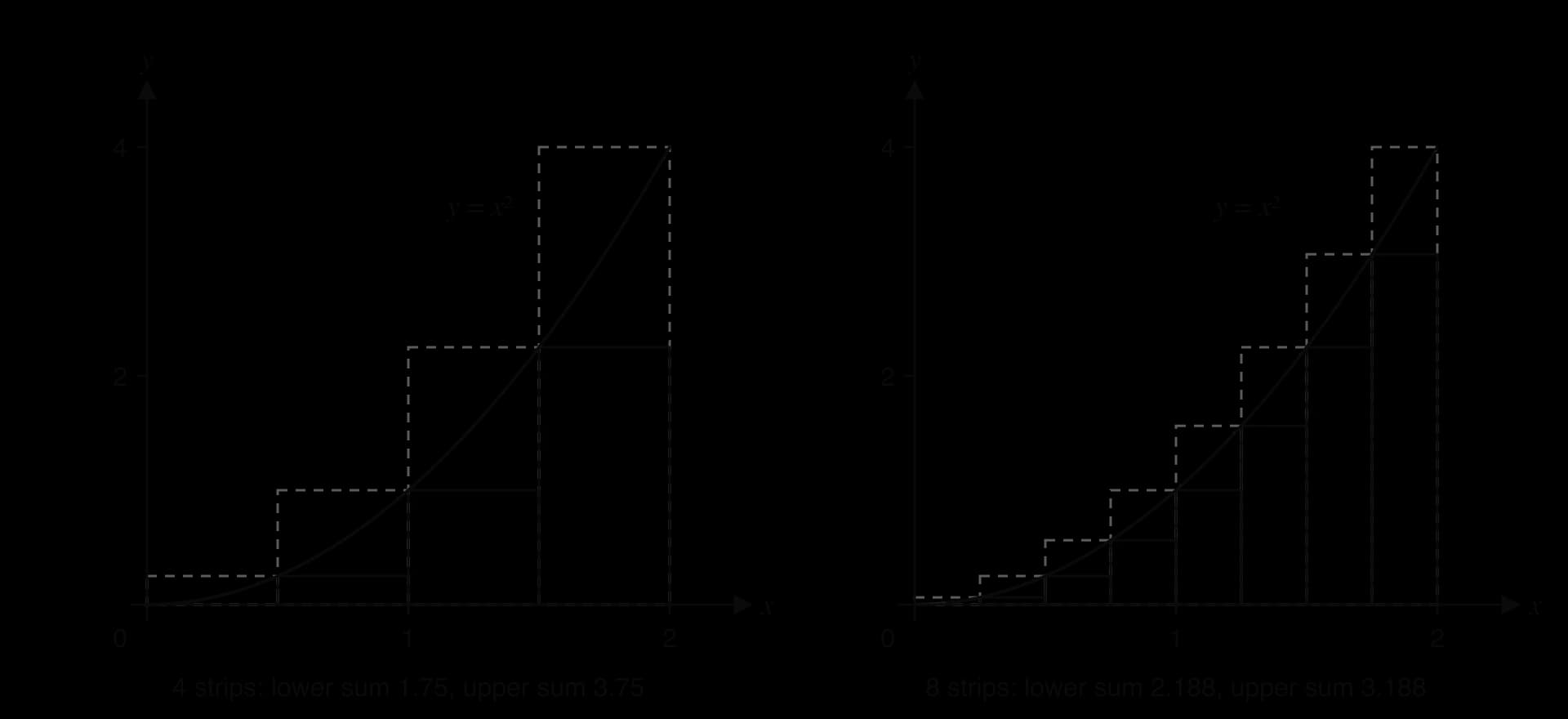
Consider the region between the curve y=x2, the x-axis and the line x=2. Divide the interval from x=0 to x=2 into 4 strips, each of width 0.5. In each strip, a rectangle whose height is the value of x2 at the left end of the strip lies entirely under the curve. The total area of these four rectangles is a lower sum:
0.5(02+0.52+12+1.52)=0.5(0+0.25+1+2.25)=1.75.
Using the height at the right end of each strip instead gives rectangles that cover the region, and an upper sum:
0.5(0.52+12+1.52+22)=0.5(0.25+1+2.25+4)=3.75.
The true area A therefore satisfies 1.75<A<3.75.
Lower rectangles (shaded) fit under the curve and upper rectangles (dashed) cover it. With twice as many strips, the gap between the two sums halves.
Doubling the number of strips to 8 narrows the gap: the lower sum becomes 2.1875 and the upper sum 3.1875. The table shows what happens as the number of strips n increases.
Number of strips n
Width δx
Lower sum
Upper sum
4
0.5
1.75
3.75
8
0.25
2.1875
3.1875
16
0.125
2.421875
2.921875
100
0.02
2.6268
2.7068
1000
0.002
2.662668
2.670668
Both sums approach the same number, about 2.667. In this case the difference between the upper and lower sums is exactly n8 (the height of the last upper rectangle, 4, times the width n2), so the gap can be made as small as desired by taking enough strips. The limit is the exact area, 38, a value that 5.11 confirms with an antiderivative. This is an example of approximation leading to an exact value: each sum is only an estimate, but the limit of the estimates is exact.
Riemann sums and the definite integral
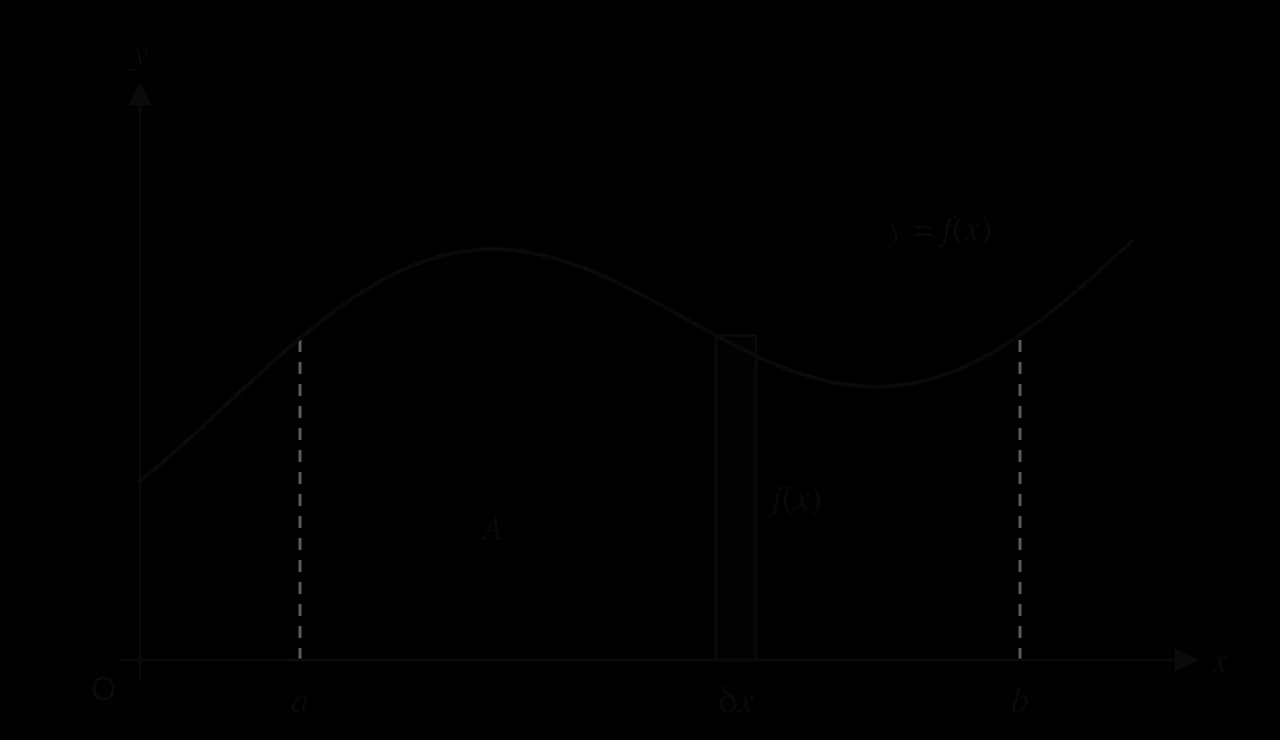
The same construction works for any curve y=f(x) that lies above the x-axis between x=a and x=b. Split the interval into strips of width δx (read "delta x", a small change in x). A strip at position x is approximately a rectangle of height f(x) and width δx, so its area is approximately f(x)δx. Adding the strips gives a Riemann sum:
A≈∑f(x)δx.
A thin strip at position x has area close to f(x) δx. Adding all the strips from a to b and letting δx tend to 0 gives the exact area A.
As δx→0, the number of strips grows without limit, the error in each strip shrinks faster than the strips multiply, and the sum tends to the exact area. This limit is written with an integral sign, the elongated S replacing the ∑, and dx replacing δx:
δx→0limx=a∑bf(x)δx=∫abf(x)dx.
A definite integral is a number, not a family of functions, so it has no +C. Its value depends only on the integrand and the two limits. For a function that is positive on the interval, the definite integral gives the area under the curve, and this result is in the formula booklet:
A=∫abydx,where y=f(x)>0 for a≤x≤b.
The connection with anti-differentiation, which explains why the same sign ∫ is used for both ideas, is the fundamental theorem of calculus in 5.11. It shows how to evaluate ∫abf(x)dx exactly from an antiderivative of f.
YouTube
Watch how the distance travelled by a car is approximated by thin rectangles under its velocity graph, and how the approximation becomes exact as the rectangles get thinner.
Definite integrals with technology
Evaluating a definite integral on a GDC
A graphic display calculator (GDC) evaluates definite integrals numerically, using a refined version of the strip method. The GDC needs the integrand, the variable and the two limits. The result is a decimal approximation, normally accurate to many more figures than the 3 significant figures used for final answers.
A GDC can also evaluate definite integrals of functions with no simple antiderivative. The integral ∫01e−x2dx, which is important in probability, cannot be written exactly using the functions met in this course, but its value is easy to find with technology.
When the GDC shows a value such as 13.99999999 or 6.000000001, the exact answer is almost certainly an integer, but that can only be confirmed by an analytic method (see 5.11). Report the value as the GDC gives it, rounded to 3 significant figures, unless an exact answer can be justified.
The area between a curve and the x-axis
A region enclosed by a curve and the x-axis is bounded on the left and right by the points where the curve meets the axis. To find its area:
Find the x-intercepts of the curve, by factorising or with the GDC. These are the limits a and b.
Check, from a sketch or the GDC graph, that f(x)>0 between them.
Write down the integral ∫abf(x)dx and evaluate it with the GDC.
A region may also be bounded by vertical lines x=a and x=b instead of x-intercepts. The integral is set up in the same way, with the lines giving the limits. For example, the region bounded by y=x28, the x-axis and the lines x=1 and x=4 has area ∫14x28dx=6 square units.
Integrals as totals in context
The strip argument applies whenever a quantity is built up from a rate. If water flows into a tank at r(t) litres per minute, then over a short time δt about r(t)δt litres flow in. Adding these amounts and letting δt→0 gives the total volume:
total volume=∫t1t2r(t)dt.
The area under a rate graph is therefore a total amount, and its units are the units of the rate multiplied by the units of time: litres per minute times minutes gives litres. The same idea gives distance from velocity (5.9) and total cost from marginal cost. Integration in this sense is a model of accumulation.
Exam-style questions on integration
Longer questions on integration combine anti-differentiation and a boundary condition with tangents and gradients from 5.3 and 5.4, or combine definite integrals and areas with the equation-solving features of the GDC.
Self-check
To do:
I can explain why an indefinite integral has a constant of integration and what the family F(x)+C looks like graphically.
To do:
I can integrate axn for any integer n=−1, including negative powers.
To do:
I can rewrite products and quotients as sums of powers of x before integrating.
To do:
I can check an integral by differentiating my answer.
To do:
I can use a boundary condition to find the constant of integration, including in contexts such as cost.
To do:
I can estimate the area under a curve with lower and upper sums and explain why the sums approach the definite integral.
To do:
I can evaluate a definite integral with a GDC.
To do:
I can find the area enclosed by a curve and the x-axis by finding the limits and integrating with a GDC.
. The curve passes through the point
(43π,23)
.
Find y in terms of x.
[6]6 marks
Markscheme
attempt to integrate M1
y=−3cos(2x−3π)+cA1A1
Note: Award A1 for −3, A1 for cos(2x−3π). Condone the absence of +c here.
substitutes x=43π and y=23
23=−3cos(67π)+c=−3(−23)+c
y=−3cos(2x−3π)+23
Question 2 · AA-0040715 marks
At a ski resort, a café records the number of visitors to the resort, y, and the number of hot drinks it sells, x, on eight days. The results are shown in the following table.
Visitors (y)
1200
1850
2400
2900
3300
3900
4400
5100
Hot drinks sold (x)
410
560
720
800
950
1060
1210
1330
The café owner wants to estimate the number of hot drinks she will sell from a forecast of the number of visitors.
(a)
Find the equation of an appropriate regression line.
[3]3 marks
(b)
Explain why the regression line of y on x is not appropriate for this purpose.
[1]1 mark
(c)
The resort's season lasts 120 days. The number of visitors on day t of the season is modelled by
The extra cost is 1700−1250=450, that is, USD 450.
(exactly; the GDC shows
14
).
(b) ∫01e−x2dx=0.746824…≈0.747
(c) ∫14x28dx=6 (exactly).
Each answer is a single number with no constant of integration.
, so
(x−3)(x+2)=0
. The curve meets the
x
-axis at
x=−2
and
x=3
.
(b) The parabola opens downwards, so y>0 between its roots. The area is
∫−23(6+x−x2)dx.
(c) Using the GDC, the area is 20.8333…≈20.8 square units. (The exact value is 6125.)
y = 6 + x − x²
The region R lies between the arch of the parabola and the x-axis, from x = −2 to x = 3, where the curve is above the axis.
(c) 1500+666.67=2166.67, so about 2170 litres (3 s.f.).
The units check: the rate is in litres per minute and t is in minutes, so the area is in litres.
r = 4t(10 − t)
The flow rate peaks at 100 litres per minute after 5 minutes. The area under the curve from t = 0 to t = 10, about 667, is the volume collected in litres.
Substitute P(1,−2) (M1):
−2=2−1−4+C⟹C=1
So f(x)=2x3−x2−4x+1 (A1).
(b) At x=2: f(2)=16−4−8+1=5 and f′(2)=24−4−4=16.
The tangent passes through (2,5) with gradient 16:
y−5=16(x−2)⟹y=16x−27
(c) A horizontal tangent has gradient 0. Solve 6x2−2x−4=0:
3x2−x−2=0⟹(3x+2)(x−1)=0⟹x=−32 or x=1
(The tangent at P itself is horizontal, with equation y=−2.)
(b) x=0 and x=4. (At x=4 the graph touches the axis, because of the squared factor.)
(c) For 0<x<4, both 0.5x and (x−4)2 are positive, so f(x)>0. The area is
∫04(0.5x3−4x2+8x)dx=10.666…≈10.7 square units.
(d) Each part has area 21(10.666…)=5.333…, so k satisfies
∫0k(0.5x3−4x2+8x)dx=5.333…
Solve with the GDC (for example, graph y=∫0xf(t)dt and find where it equals 5.333, or use the solver): k=1.5429…≈1.54.
y = 0.5x³ − 4x² + 8x
The line x = 1.54 splits R into two regions of area 5.33 each. It lies just right of the peak at x = 4/3, because the curve rises steeply on the left and falls slowly on the right.
into their expression containing
c
M1
A1
A1
Find the number of visitors on day 30, according to this model.
[2]2 marks
(d)
Hence estimate the number of hot drinks the café sells on day 30.
[2]2 marks
(e)
Let D(t) be the estimated number of hot drinks sold on day t, found by substituting V(t) into the regression line from part (a).
Write down an expression for D(t).
[1]1 mark
(f)
Find the rate at which the estimated number of hot drinks sold per day is changing on day 30.
[3]3 marks
(g)
By integrating D(t), estimate the total number of hot drinks sold by the café during the 120-day season.
[3]3 marks
for which the volume of water in the reservoir is increasing.
[3]3 marks
(c)
Find the volume of water in the reservoir when t=20.
[3]3 marks
(d)
Find the greatest volume of water in the reservoir for 0≤t≤20. Justify your answer.
[4]4 marks
(e)
Find the greatest rate at which the volume of water is decreasing for 0≤t≤20.
 YouTube