5.6 Chain, product and quotient rules · IB Maths AA | Augment Education
5.6 Chain, product and quotient rules
Differentiate rational powers, sin x, cos x, eˣ and ln x, then use the chain, product and quotient rules, alone and together, to find gradients and rates of change of real quantities.
IB Mathematics: Analysis and Approaches
Part of 5 Calculus
SL and HL
Key terms introduced here
Each is in the Maths AA glossary, with every other term in the subject.
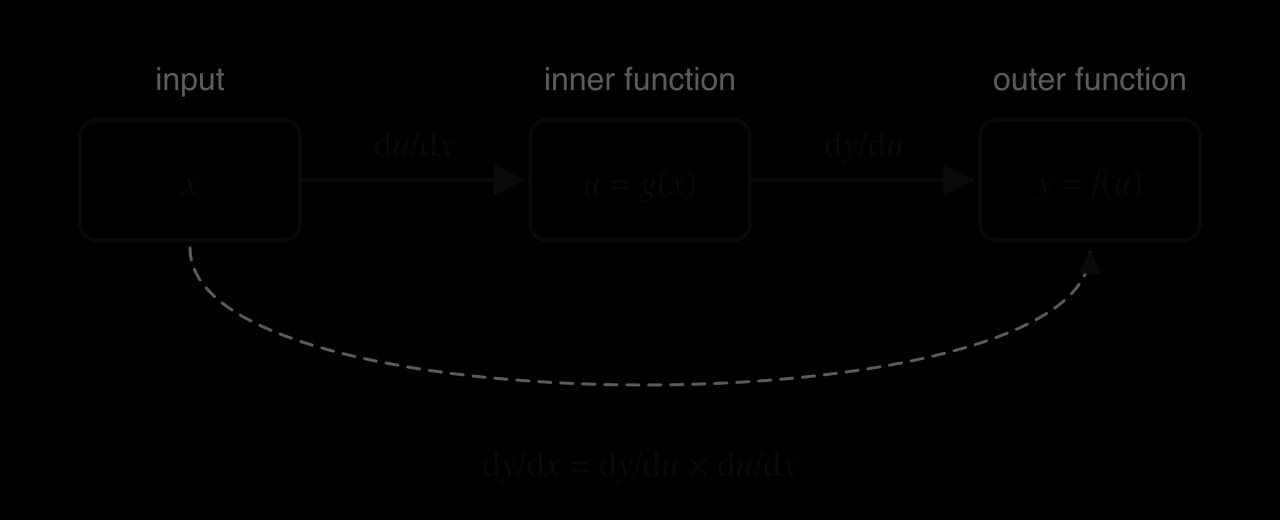
The rule for differentiating a composite function: if y=g(u) and u=f(x), then dxdy=dudy×dxdu
Notes on 5.6 Chain, product and quotient rules
35 min readLast reviewed
Questions on 5.6
131 exam-style questions on this subtopic, written in the style of the IB papers. The first has its markscheme open. Counted on
Question 1 · AA-0012515 marks
A garden bed is in the shape of a sector of a circle with radius r metres and angle θ radians, where 0<θ<2π. The whole perimeter of the bed is edged with 24 metres of timber.
Try a quick-fire question
One of 38 short multiple-choice questions on 5.6. Pick an answer to see why it's right or wrong.
The radius of a circle increases at 2cm s−1. How fast is its area increasing when the radius is 5 cm?
From the formula booklet
The entries of the mathematics: analysis and approaches formula booklet that 5.6 uses. Each opens in the explained booklet.
The rule for differentiating one function of x divided by another: if y=vu, then dxdy=v2vdxdu−udxdv.
,
ex
and
lnx
, together with sums and multiples of these.
Use the chain rule to differentiate composite functions such as (3x2−5)4, e−2x and ln(x2+1).
Use the product rule to differentiate a product of two functions, and the quotient rule to differentiate a quotient.
Decide which rule, or combination of rules, a function needs, and simplify the result by factorising.
Find gradients, tangents and the points where a derivative is zero for functions built with these rules.
Interpret derivatives as rates of change of real quantities, with units.
Polynomials are only a small part of the functions used to model the world. Oscillations are described by sine and cosine, growth and decay by ex, and many scientific scales by lnx. Real models also build new functions out of old ones: a vibration that dies away is a product such as e−tsint, the height of a capsule on a rotating wheel is a cosine of a multiple of time, and an average is a quotient.
Differentiation of these functions rests on a short list of standard derivatives and three rules for combining them. The chain rule handles a function of a function, the product rule a product, and the quotient rule a quotient. Together they allow the derivative of almost any function met in the course to be found, so that its gradient, tangents and rates of change can be studied.
Derivatives of standard functions
Rational powers of x
The power rule dxd(xn)=nxn−1 was met in 5.3 for integer powers. It holds for every real power n, so in particular for every rational power, such as 21, 23 or −31. This means that roots can be differentiated once they are written as powers:
x=x21,3x2=x32,x1=x−21.
The result of differentiating xn is in the formula booklet:
f(x)=xn⇒f′(x)=nxn−1.
The derivatives of sin x and cos x
The gradient of the graph of y=sinx can be read from the curve. At x=0 the curve rises at its steepest, at x=2π it has a maximum and gradient 0, at x=π it falls at its steepest, and at x=23π it has a minimum. Plotting these gradients against x gives a curve that starts at 1, falls to 0, reaches −1 and returns: the graph of y=cosx.
y = sin x
y = cos x (the gradient of sin x)
Wherever sin x has a maximum or minimum, cos x is 0, and where sin x crosses the axis at its steepest, cos x is ±1. The cosine curve records the gradient of the sine curve.
The same reasoning applied to y=cosx produces a curve that starts at 0, falls to −1 at 2π and rises again: the graph of y=−sinx. Both results are in the formula booklet:
f(x)=sinx⇒f′(x)=cosx,f(x)=cosx⇒f′(x)=−sinx.
The graphs show only that these results are reasonable. They can be proved from first principles, using the limit hsinh→1 as h→0, which is true only when angles are measured in radians.
The derivative of e to the x
The exponential function ex (see 2.9) has a remarkable property: its derivative is itself.
f(x)=ex⇒f′(x)=ex
So the gradient of the graph of y=ex at any point equals the y-coordinate of that point. At (0,1) the gradient is 1, at (1,e) it is e, and at (2,e2) it is e2≈7.39. This property is what defines the number e: among all exponential functions ax, only a=e gives a graph whose gradient at (0,1) is exactly 1. For other bases, the gradient is proportional to the value, with a constant different from 1, which 5.15 shows is lna.
The derivative of ln x
The natural logarithm lnx is the inverse of ex, so its graph is the reflection of y=ex in the line y=x. Reflection in y=x swaps the rise and the run of every tangent, so it replaces each gradient by its reciprocal. The point (lna,a) on y=ex, where the gradient is a, becomes the point (a,lna) on y=lnx, where the gradient must be a1. This gives the result in the formula booklet:
f(x)=lnx⇒f′(x)=x1,x>0.
y = eˣ
y = ln x
tangent to eˣ, gradient 2
tangent to ln x, gradient ½
Reflecting y = eˣ in y = x gives y = ln x. The tangent with gradient 2 at (ln 2, 2) reflects to the tangent with gradient ½ at (2, ln 2), so the gradient of ln x at x = 2 is 1/2.
The graph of y=lnx always increases, since x1>0 for x>0, but it becomes less and less steep as x grows. This matches the slow growth of a logarithmic scale.
Standard derivatives
Function f(x)
Derivative f′(x)
Condition
xn
nxn−1
n∈Q
sinx
cosx
x in radians
cosx
−sinx
x in radians
ex
ex
lnx
x1
x>0
All five results are in the formula booklet. As with polynomials, the derivative of a sum is the sum of the derivatives, and a constant multiple stays as a multiple: dxd(af(x)+bg(x))=af′(x)+bg′(x).
The laws of logarithms and exponents (see 1.7) can turn a function that looks complicated into a sum of standard ones. For example, ln(5x)=ln5+lnx, so dxdln(5x)=x1: the constant ln5 differentiates to 0. Likewise ln(x3)=3lnx has derivative x3, and ex+2=e2×ex has derivative e2ex=ex+2.
The chain rule
Composite functions
A composite function applies one function to the output of another (see 2.5). In y=(3x2−5)4, the input x is first turned into 3x2−5, and then this result is raised to the power 4. The first step is the inner function, u=3x2−5, and the second is the outer function, y=u4.
Expanding (3x2−5)4 and differentiating term by term would work, but would take a long time, and for sin(x2) or e−2x there is nothing to expand. The chain rule differentiates a composite function directly.
Why rates multiply
Suppose u changes 3 times as fast as x, and y changes 2 times as fast as u. Then a small change in x produces a change 3 times as large in u, which in turn produces a change 2 times as large again in y. So y changes 2×3=6 times as fast as x. Rates of change along a chain of functions multiply.
Each link in the chain has its own rate of change. The rate of change of the output with respect to the input is the product of the two rates.
In terms of small changes δx, δu and δy, the fractions cancel:
δxδy=δuδy×δxδu.
As δx→0, δu→0 too, and each ratio tends to the corresponding derivative. This gives the chain rule, in the form printed in the formula booklet.
The formula looks as if the du terms cancel. They do not cancel literally, since dudy is not a fraction, but the notation was designed so that the rule is easy to remember and use correctly.
Using the chain rule with a substitution
When first learning the rule, it helps to name the inner function u and to write out each derivative.
With practice, the substitution can be done mentally: "differentiate the bracket as if it were x, then multiply by the derivative of what is inside the bracket". The same pattern gives general results for each standard outer function.
Function
Derivative
Example
[g(x)]n
n[g(x)]n−1g′(x)
dxd(x2+1)3=6x(x2+1)2
sing(x)
g′(x)cosg(x)
dxdsin(5x)=5cos(5x)
cosg(x)
−g′(x)sing(x)
dxdcos(x2)=−2xsin(x2)
eg(x)
g′(x)eg(x)
dxdex3=3x2ex3
lng(x)
g(x)g′(x)
When the inner function is linear, g(x)=ax+b, its derivative is the constant a. The derivative is then just the derivative of the outer function multiplied by a: dxde3x=3e3x, dxdcos(2x−1)=−2sin(2x−1) and dxd(4−5x)6=−30(4−5x)5.
Powers of trigonometric functions and longer chains
The notation sin2x means (sinx)2: the inner function is sinx and the outer function is squaring. This is different from sin(x2), where the inner function is x2 and the outer function is sine. The two are differentiated differently, and confusing them is a common source of error.
A chain can also have more than two links. For y=esin(2x), the input is doubled, then the sine is taken, then the exponential. The chain rule applies once for each link, working from the outside in: differentiate the outermost function, then multiply by the derivative of the next function in, and so on.
Tangents and gradients with the chain rule
Once a derivative is found, it is used exactly as in 5.4: substitute a value of x to find the gradient, then use the point–gradient form of a line.
Finding unknown constants
When a function contains unknown constants, each given value of the function or of its gradient provides one equation. Two unknowns need two pieces of information.
The product rule
A product is not differentiated factor by factor
The derivative of a sum is the sum of the derivatives, but the derivative of a product is not the product of the derivatives. A single example shows this: x⋅x=x2 has derivative 2x, but the product of the derivatives of x and x is 1×1=1.
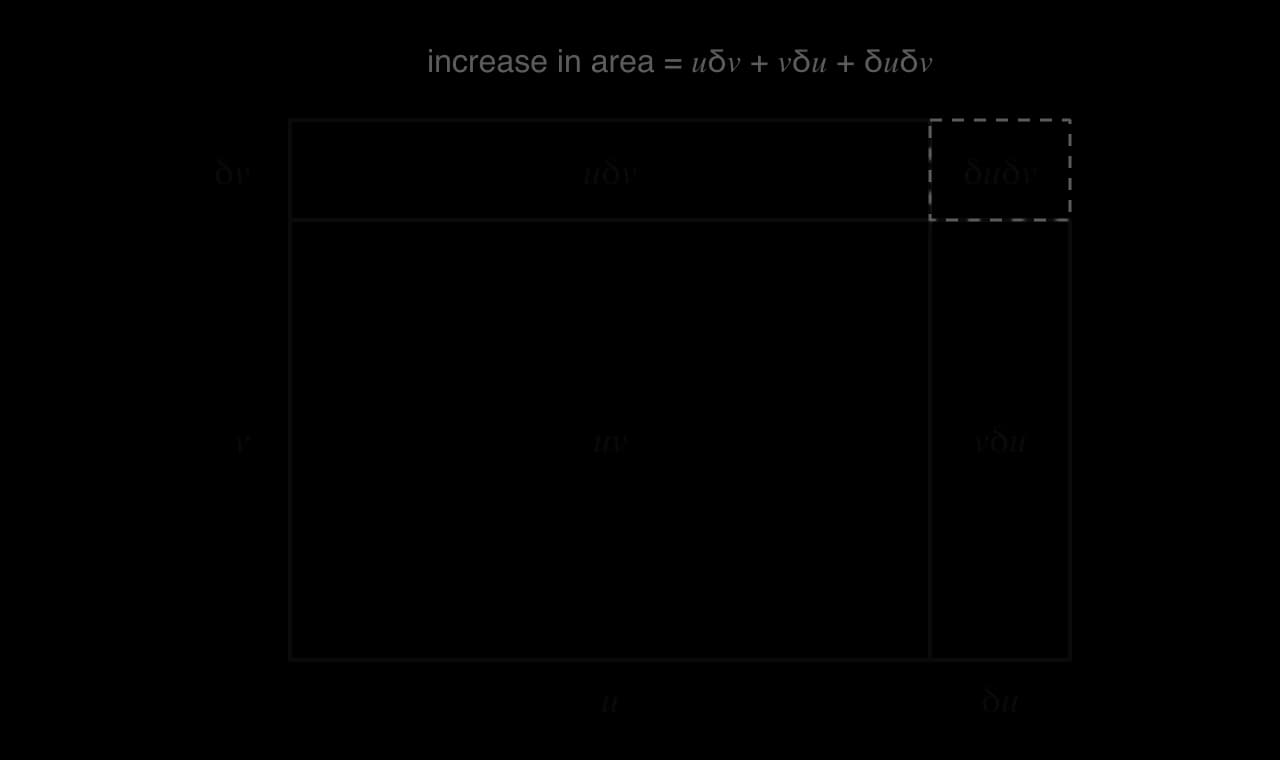
To see the correct rule, think of y=uv as the area of a rectangle with sides u and v, where both sides depend on x. When x increases by δx, the sides increase by δu and δv.
When both sides grow, the area gains two strips and a tiny corner. As the changes shrink, the corner becomes negligible compared with the strips.
The increase in area is
δy=uδv+vδu+δuδv.
Dividing by δx:
δxδy=uδxδv+vδxδu+δuδxδv.
As δx→0, the last term tends to 0×dxdv=0, and the other ratios tend to derivatives. The result is the product rule.
This form is printed in the formula booklet. The order of the two terms does not matter, since they are added.
Using the product rule
Set out a product rule calculation by writing down u, v and their derivatives before substituting. This makes the work easy to check and avoids losing a term.
Factorising the result
A derivative is usually wanted for a purpose: to find where the gradient is zero, or to decide where a function increases. Both need the derivative in factorised form. Products involving ekx are especially convenient, because ekx appears in both terms and is never zero.
The product rule often combines with the chain rule, because one or both factors may be composite.
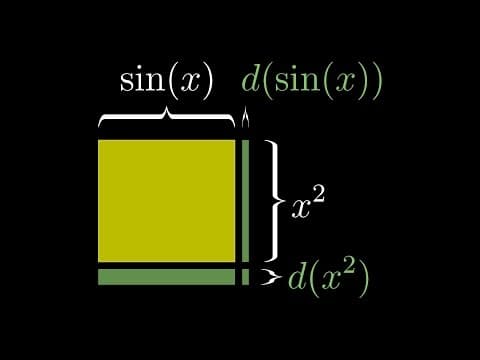
YouTube
Watch the product rule appear as two thin strips added to a rectangle, and the chain rule as a nudge passed along a chain of functions, each link scaling it.
The quotient rule
The rule and where it comes from
A quotient vu is the product u×v−1, so it could always be differentiated with the product and chain rules. Doing this once, in general, gives a formula that saves time. With y=uv−1, the chain rule gives dxd(v−1)=−v−2dxdv, so
dxdy=u×(−v21dxdv)+v1dxdu=v2vdxdu−udxdv.
The quotient rule is in the formula booklet in this form. Unlike the product rule, the order of the terms in the numerator matters, because they are subtracted: the term with dxdu, the derivative of the numerator, comes first.
Using the quotient rule
The factorised answers say more than the unsimplified ones. In (a), the derivative −(x−3)27 is negative for every x=3, so the graph of y=x−32x+1 decreases on each side of its vertical asymptote. In (c), every factor of the derivative is positive or zero, so y=x2+1ex never decreases; its gradient is zero only at x=1.
The derivative of tan x
The quotient rule gives the derivative of tanx=cosxsinx, a standard result that HL students use as a formula in 5.15.
Quotient rule or not?
The quotient rule always works for a quotient, but it is not always the quickest method.
Form of the function
Best method
Example
Denominator is a constant
Treat as a constant multiple
5x3−4x=51(x3−4x)
Denominator is a single power of x
Divide each term, then use the power rule
xx2+3=x23+3x−21
Numerator is a constant
Write as a negative power, then the chain rule
(x2+1)24=4(x2+1)−2
Both numerator and denominator vary
Quotient rule
x+1x2
For example, the quotient rule applied to (x2+1)24 gives the correct answer, −(x2+1)316x, but only after a longer calculation in which the term (x2+1)2×0 has to be handled. The chain rule reaches it in one line.
Combining the rules
Choosing the rule from the structure
Any function built from the standard functions can be differentiated by identifying its overall structure, applying the matching rule, and then dealing with each piece in the same way. The overall structure is the last operation that would be carried out when evaluating the function.
Last operation
Rule to apply first
Example
Addition or subtraction
Differentiate term by term
x3+lnx
A function applied to an expression
Chain rule
ln(x2+1), esinx
Multiplication of two expressions in x
Product rule
x2cosx
Division of two expressions in x
Quotient rule
xlnx
Inside each rule, any piece that is itself composite or a product needs its own rule. A product of composites, such as e2xsin(3x), needs the product rule on the outside and the chain rule for each factor.
Using technology with combined rules
Some equations f′(x)=0 cannot be rearranged neatly, and a GDC finds their solutions from the graph of y=f′(x). A graphic display calculator (GDC) can also evaluate the gradient at a point numerically, which gives a quick check on a derivative found by hand: the two values should agree.
Simplifying with logarithm laws first
When a logarithm contains a product, a quotient or a power, the laws of logarithms can split it into simpler terms before differentiating. This is an example of equivalence: the two forms are the same function, but one is much easier to differentiate.
Rates of change in context
Interpreting a derivative as a rate
If a quantity Q depends on a variable t, then dtdQ is the rate at which Q changes as t increases. Its units are the units of Q divided by the units of t, and its sign shows whether Q is increasing or decreasing (see 5.1). The standard derivatives and the chain, product and quotient rules make it possible to find such rates for the exponential, trigonometric and rational models used in science and economics.
Air pressure decreases with height above sea level. A simple model, close to standard values in the lower atmosphere, is
p(h)=101.3e−0.12h,
where p is the pressure in kilopascals (kPa) and h is the height in kilometres. By the chain rule,
p′(h)=101.3×(−0.12)e−0.12h=−12.156e−0.12h kPa per km.
At sea level the pressure falls by about 12.2 kPa for each kilometre climbed; at a height of 5 km, p′(5)=−12.156e−0.6≈−6.67 kPa per km. The rate of decrease is proportional to the pressure itself, which is the property of exponential models: p′(h)=−0.12p(h).
Linking rates with the chain rule
The chain rule also connects rates of change of different quantities. If A depends on r, and r depends on time t, then
dtdA=drdA×dtdr.
So the rate of change of A can be found from the rate of change of r, even without writing A directly in terms of t. HL students develop this idea further as related rates of change in 5.14.
Product and quotient models
Many models multiply a growing factor by a decaying one. Sales of a new product, for example, often rise quickly after its launch and then fall away as the market becomes saturated.
Quotient models often describe a quantity that approaches a limit. A simple model of learning, for example, gives the number of words N of a new vocabulary list that a student can recall after t minutes of study as
N(t)=t+540t.
The quotient rule, with u=40t and v=t+5, gives
N′(t)=(t+5)2(t+5)(40)−40t(1)=(t+5)2200 words per minute.
At the start, N′(0)=8 words per minute; after 5 minutes, N′(5)=2; after 15 minutes, N′(15)=0.5. The rate is always positive but falls steadily, and N approaches 40, the length of the list. This pattern of diminishing returns is typical of quotient models with a horizontal asymptote (see 2.8).
Exam-style questions on the chain, product and quotient rules
Typical longer questions ask for a derivative, then use it: to find a gradient, a tangent or normal, or the points where the gradient is zero. A context question adds units and interpretation.
Self-check
To do:
I can differentiate rational powers of x, including roots and reciprocals of roots.
To do:
I can state and use the derivatives of sinx, cosx, ex and lnx, and I know why radians are needed.
To do:
I can identify the inner and outer functions of a composite function and apply the chain rule, including chains of three functions.
To do:
I can tell sin2x from sin(x2) and differentiate each.
To do:
I can use the product rule and factorise the result to find where the derivative is zero.
To do:
I can use the quotient rule with the numerator terms in the right order, and decide when a simpler method is better.
To do:
I can combine the rules, simplifying with the laws of logarithms where possible.
To do:
I can find and interpret rates of change of real quantities, with units.
(a)
Show that r=2+θ24.
[2]2 marks
Markscheme (a)
perimeter =2r+rθM1
r(2+θ)=24A1
r=2+θ24AG
(b)
Show that the area, A square metres, of the garden bed is given by A=(2+θ)2288θ.
[2]2 marks
Markscheme (b)
A=21r2θ=21(2+θ24)2θ
(c)
Find the two values of θ for which the area of the garden bed is 32 m2.
[4]4 marks
Markscheme (c)
(2+θ)2288θ=32⇒9θ=(2+θ)2M1
θ2−5θ+4=0A1
(θ−1)(θ−4)=0(M1)
θ=1 or θ=4A1
Note: Both values satisfy 0<θ<2π, so both are valid.
(d)
Show that dθdA=(2+θ)3288(2−θ).
[3]3 marks
Markscheme (d)
attempt to use the quotient rule M1
dθdA=(2+θ)4288(2+θ)2−288θ×2(2+θ)
(e)
Hence, find the maximum possible area of the garden bed, justifying that it is a maximum.
[4]4 marks
Markscheme (e)
dθdA=0⇒θ=2 M1A1
dθdA>0 for 0<θ<2 and dθdA<0 for θ>2, so this is a maximum R1
maximum area =42288×2=36 (m2
Note: The R1 may be awarded for a sign diagram of dθdA.
Question 2 · AA-0014616 marks
A seat on an observation wheel starts at its lowest point. The height of the seat above the ground, h metres, t minutes later is modelled by
h(t)=20−18cos(12πt),0≤t≤24.
(a)
Find the exact height of the seat when t=9.
[2]2 marks
(b)
Write down the maximum height of the seat and the value of t at which it occurs.
(b) Graph y=f′(x) on 0≤x≤π and find its zero: x=2.0344…≈2.03. Then f(2.0344…)=2.4735…≈2.47.
(c) Since e2x>0, f′(x)=0 when cosx+21sinx=0, that is, tanx=−2. In 0≤x≤π this gives x=π−arctan2=2.0344…, which agrees with the GDC.
y = f(x)
y = f′(x)
The graph of f′ crosses the x-axis at x = 2.03, exactly where the graph of f has its highest point on the interval.
Now differentiate, using the chain rule on the first term:
dxdy=3×2x+12−2x1=2x+16−2x1
Combine over the common denominator 2x(2x+1):
dxdy=2x(2x+1)12x−(2x+1)=2x(2x+1)10x−1
Differentiating the original form directly would need the chain rule and the quotient rule together, with much more algebra.
The units are metres per minute.
(b) h′(5)=4πsin3π=4π×23=23π≈10.9 metres per minute.
(c) The greatest value of sin15πt is 1, so the greatest rate of rising is 4π≈12.6 metres per minute. This first happens when 15πt=2π, that is, at t=7.5 minutes. Then h=60−60cos2π=60 m, so the capsule is level with the centre of the wheel, moving straight upwards.
As a check, the capsule travels the circumference 120π m in 30 minutes, a speed of 4π m per minute. At the level of the centre all of this motion is vertical, which agrees with the answer.
. At
t=4
,
dtdr=21
metre per minute.
(b) The area is A=πr2, so drdA=2πr. By the chain rule,
dtdA=drdA×dtdr=2πr×t1=2π(2t)×t1=4π.
The area increases at a constant rate of 4π≈12.6 square metres per minute. The radius grows more and more slowly, but each small increase in radius adds a ring around a longer circumference, and the two effects balance exactly.
(b) S′(2)=50e−0.5(2)=100e−0.5≈60.7 thousand downloads per week, per week. Weekly sales are rising.
S′(6)=50e−1.5(−2)=−100e−1.5≈−22.3 thousand downloads per week, per week. Weekly sales are falling.
(c) S′(t)=0 when 4−t=0, since e−0.25t>0. So weekly sales stop increasing at t=4, four weeks after launch, when they reach S(4)=800e−1≈294 thousand downloads.
S = 200te^(−0.25t)
Weekly sales rise while the factor 200t dominates and fall once the decay factor e^(−0.25t) takes over. The gradient is zero at t = 4.
and
dxdv=1
(M1 for the quotient rule with the terms in the right order):
f′(x)=x2x⋅x1−lnx⋅1=x21−lnx
which is the given result. Show the line x⋅x1−lnx before simplifying; in a "show that" question, a skipped step loses marks.
(b) f(1)=1ln1=0 and f′(1)=11−0=1. The tangent passes through (1,0) with gradient 1:
y−0=1(x−1)⟹y=x−1
(c) f′(x)=0⟺1−lnx=0⟺lnx=1⟺x=e. Then f(e)=elne=e1. The point is (e,e1).
(d) The tangent at this point is horizontal, so the normal is vertical: x=e.
y = ln x / x
tangent y = x − 1
The tangent at (1, 0) has gradient 1. At (e, 1/e) the gradient is 0, so the normal there is the vertical line x = e.
(b) At t=0, dtdv=9.79 m s⁻². This is very close to the acceleration due to gravity, 9.8 m s⁻², which is reasonable: at the moment she jumps her speed is zero, so there is no air resistance and gravity alone acts on her.
(c) dtdv=9.79e−1.78=1.6509…≈1.65 m s⁻². Her velocity is still increasing, but much more slowly.
 YouTube