5.17 Areas and volumes of revolution · IB Maths AA | Augment Education
5.17 Areas and volumes of revolution
Find the area between a curve and the y-axis by integrating with respect to y, and find volumes of solids formed by rotating regions about the x-axis or the y-axis, including regions between two curves.
IB Mathematics: Analysis and Approaches
Part of 5 Calculus
HL only
Key terms introduced here
Each is in the Maths AA glossary, with every other term in the subject.
The fixed line about which a region is turned to form a solid of revolution. Every cross-section of the solid perpendicular to it is a circle or a ring.
Finding a volume of revolution by slicing the solid perpendicular to the axis of rotation into thin discs of volume πr2δx and adding them with an integral.
Finding the volume of a solid with a hole by slicing it into rings (washers) of outer radius R and inner radius r: V=π∫ab(R2−r2)dx.
Notes on 5.17 Areas and volumes of revolution
29 min readLast reviewed
Integration was first used to find the area between a curve and the x-axis (5.11). The same idea, cutting a shape into thin strips and adding them up, also finds areas measured against the y-axis, and volumes of solids. When a flat region is rotated one full turn about a line, it sweeps out a solid whose cross-sections are all circles. Many manufactured objects are made this way: a potter's wheel or a lathe turns material about a fixed axis, so vases, bowls, wine glasses, bottles and machine parts are solids of revolution.
The volume of such a solid depends only on the curve that forms its profile. Slicing the solid into thin discs and adding their volumes with an integral gives the volume exactly, which allows a designer to calculate how much a container holds, how deep a given amount of liquid will be, or how much material a part needs.
Area between a curve and the y-axis
Integrating with respect to y
The area between a curve and the x-axis is found by cutting the region into thin vertical strips. Each strip has height y and width δx, so its area is approximately yδx, and adding the strips and letting δx→0
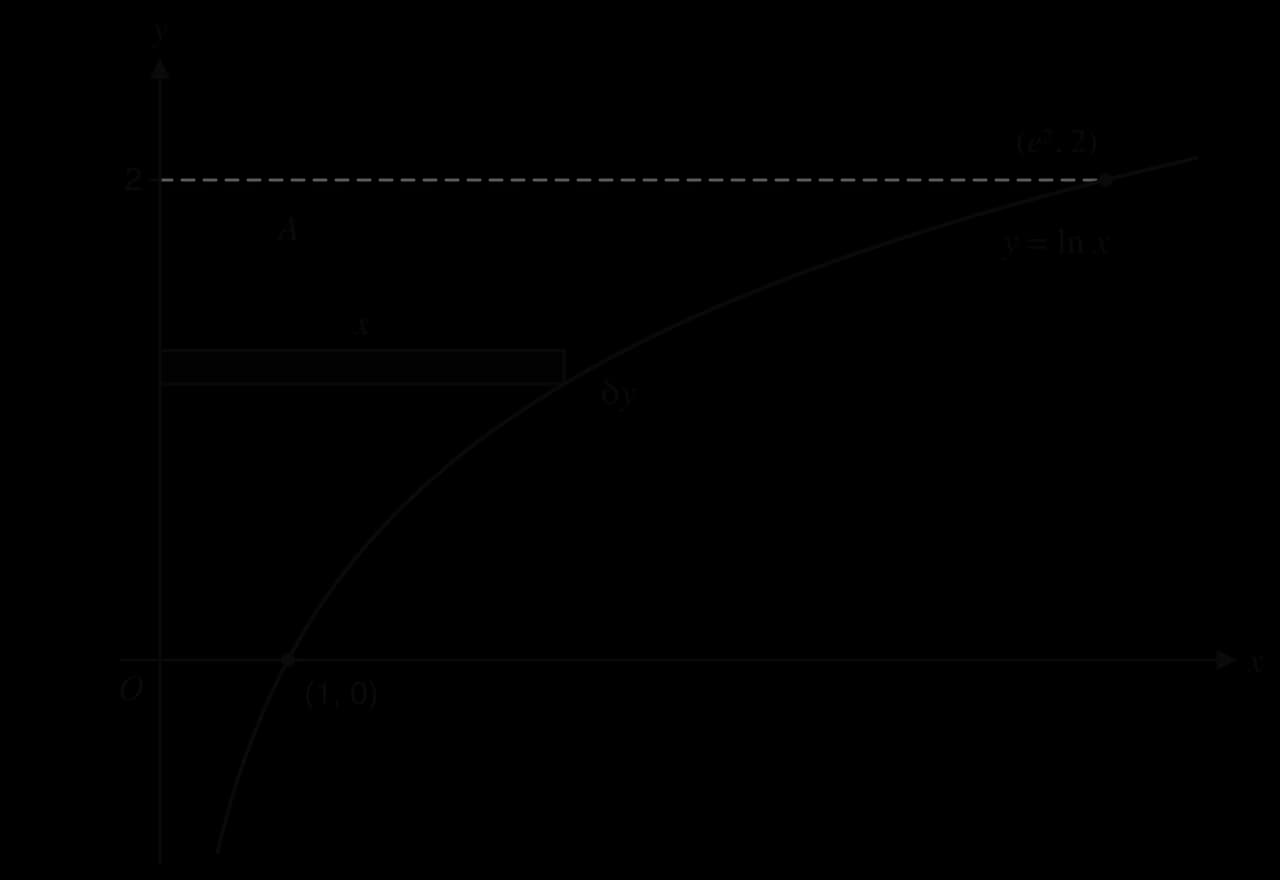
A region bounded by a curve and the y-axis is cut into thin horizontal strips instead. Each strip has length x, the distance from the y-axis to the curve, and thickness δy, so its area is approximately xδy. Adding the strips from y=c
A=∫cdxdy
The roles of x and y are simply exchanged. The curve must be written as x=g(y), with x as a function of y, and the limits c
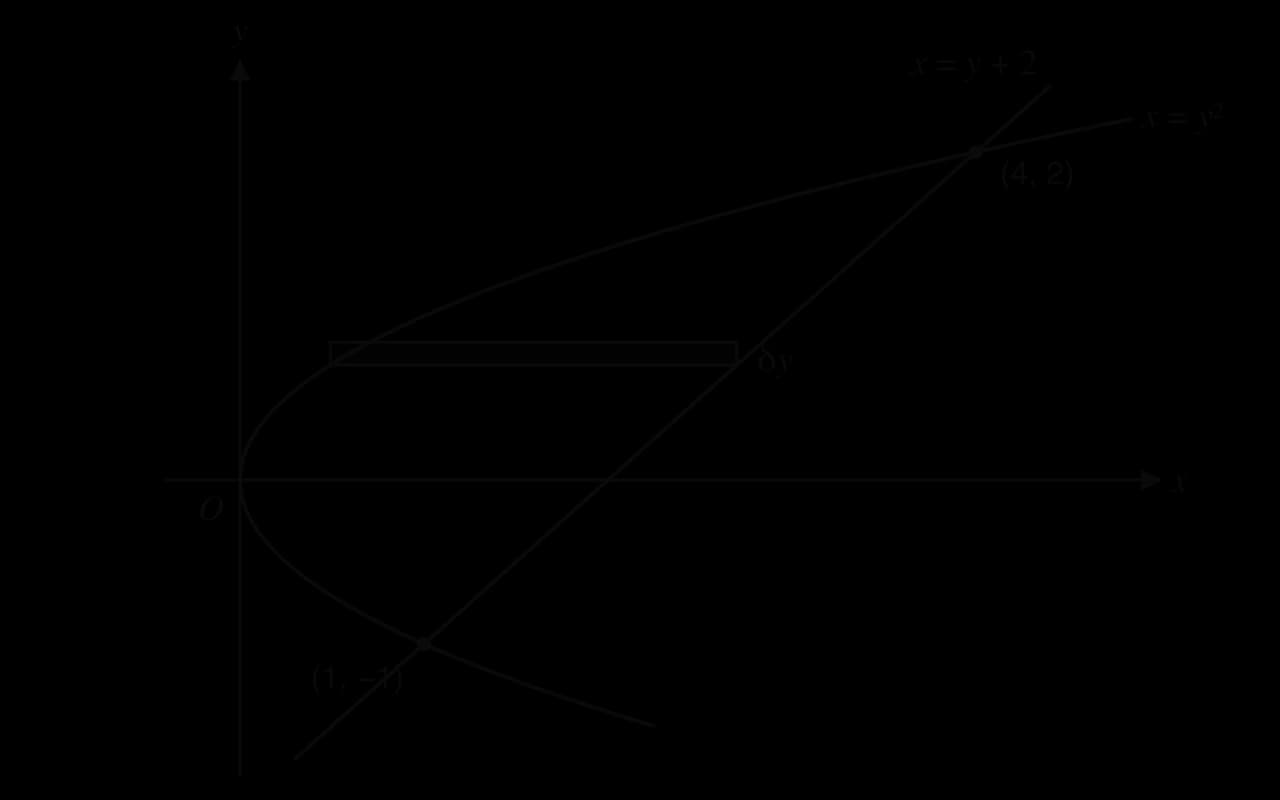
Each horizontal strip has length x (from the y-axis to the curve) and thickness δy. Adding the strips from y = 0 to y = 2 gives the area A.
To rearrange y=f(x) into x=g(y), make x the subject, as when finding an inverse function (2.2). For example, y=x3
The check shows that integrating with respect to y is not a new kind of area. It is the same area found by slicing in a different direction, and the choice of direction is made to keep the calculation simple.
Curves on both sides of the y-axis
For a region to the left of the y-axis, x is negative, so ∫cdxdy is negative. This matches the behaviour of ∫abydx
Choosing between dx and dy
Integrating with respect to y is often the better choice for a region bounded on the left and right by two curves. Each horizontal strip then runs from the left curve to the right curve, and its length is xright−xleft, so
A=∫cd(xright−xleft)dy
where c and d are the y-coordinates of the points where the curves meet. With vertical strips, the same region might have a different top or bottom boundary in different places, so the area would have to be split into several integrals.
Volumes of revolution
Solids of revolution
When a region in the plane turns through one full revolution (2π radians) about a fixed line, it sweeps out a solid. Every point of the region moves in a circle centred on the line, so every cross-section of the solid perpendicular to the line is a circle (or a ring, if the region does not touch the line).
Familiar solids arise in this way. Rotating a rectangle about one of its sides gives a cylinder; rotating a right-angled triangle about one of its shorter sides gives a cone; rotating a semicircle about its diameter gives a sphere. The formulas for their volumes (3.1) can all be derived by integration, and the same method finds volumes of solids that have no simple formula.
Rotating about the x-axis: the disc method
Consider the region under the curve y=f(x), above the x-axis, between x=a and x=b. Rotating it about the x
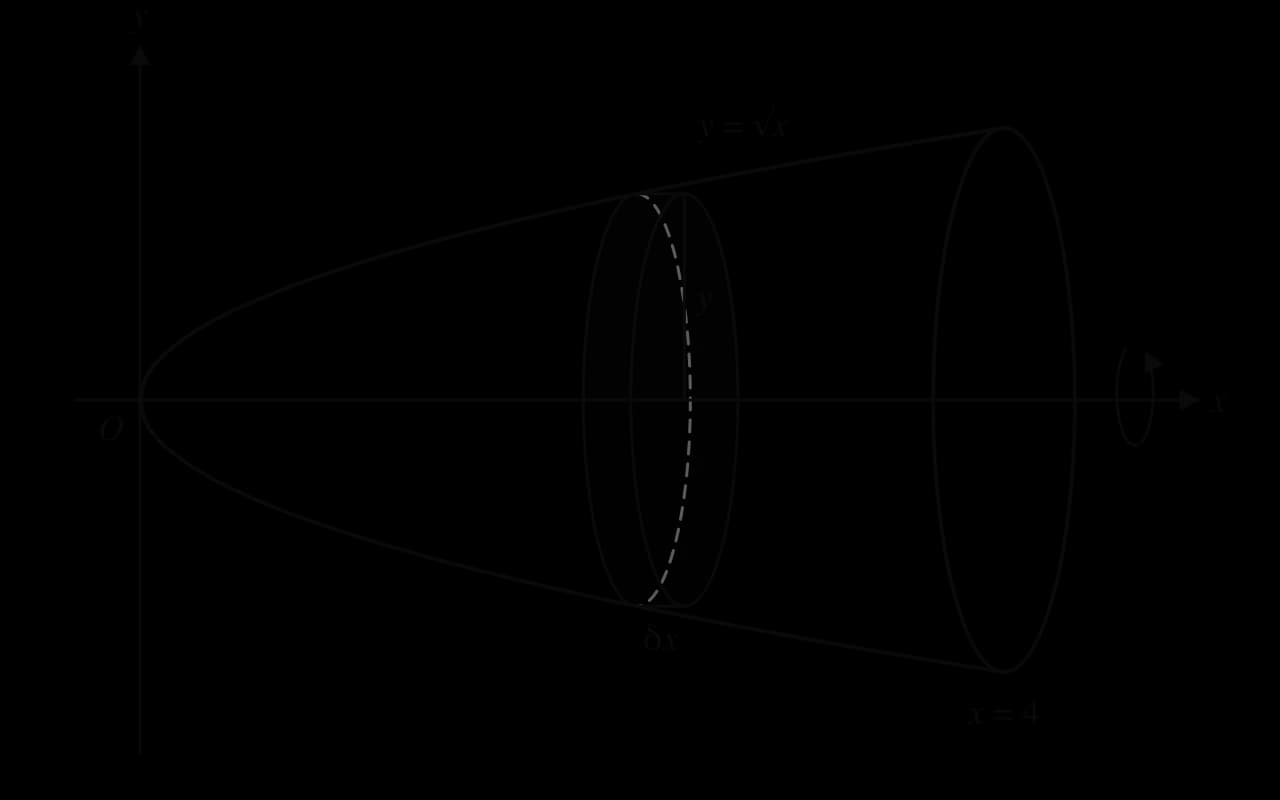
δV≈πy2δx
Adding the volumes of all the discs from x=a to x=b approximates the volume of the solid. As δx→0 the approximation becomes exact, and the sum becomes an integral, in the same way as the area under a curve in 5.5 and 5.11.
Each slice perpendicular to the x-axis is a disc of radius y and thickness δx, with volume about πy² δx. The integral adds the discs from one end of the solid to the other.
Squaring y before integrating is the key step. The integrand is πy2, the area of a circular cross-section, so a volume integral adds up cross-sectional areas, in the same way that an area integral adds up lengths.
Cones and spheres
Two of the volume formulas in 3.1 can now be proved. A cone is formed by rotating a straight line through the origin, and a sphere by rotating a semicircle.
The radius of the cone grows in proportion to x, so the area of each circular slice grows in proportion to x2. Integrating x2 produces the factor 31
Volumes involving other functions
Any function that can be squared and integrated can be rotated. Trigonometric functions often need an identity before integrating, and products such as (lnx)2 may need integration by parts (5.16).
When a region lies below the x-axis, y is negative but y2 is positive, so ∫abπy2dx
Rotating about the y-axis
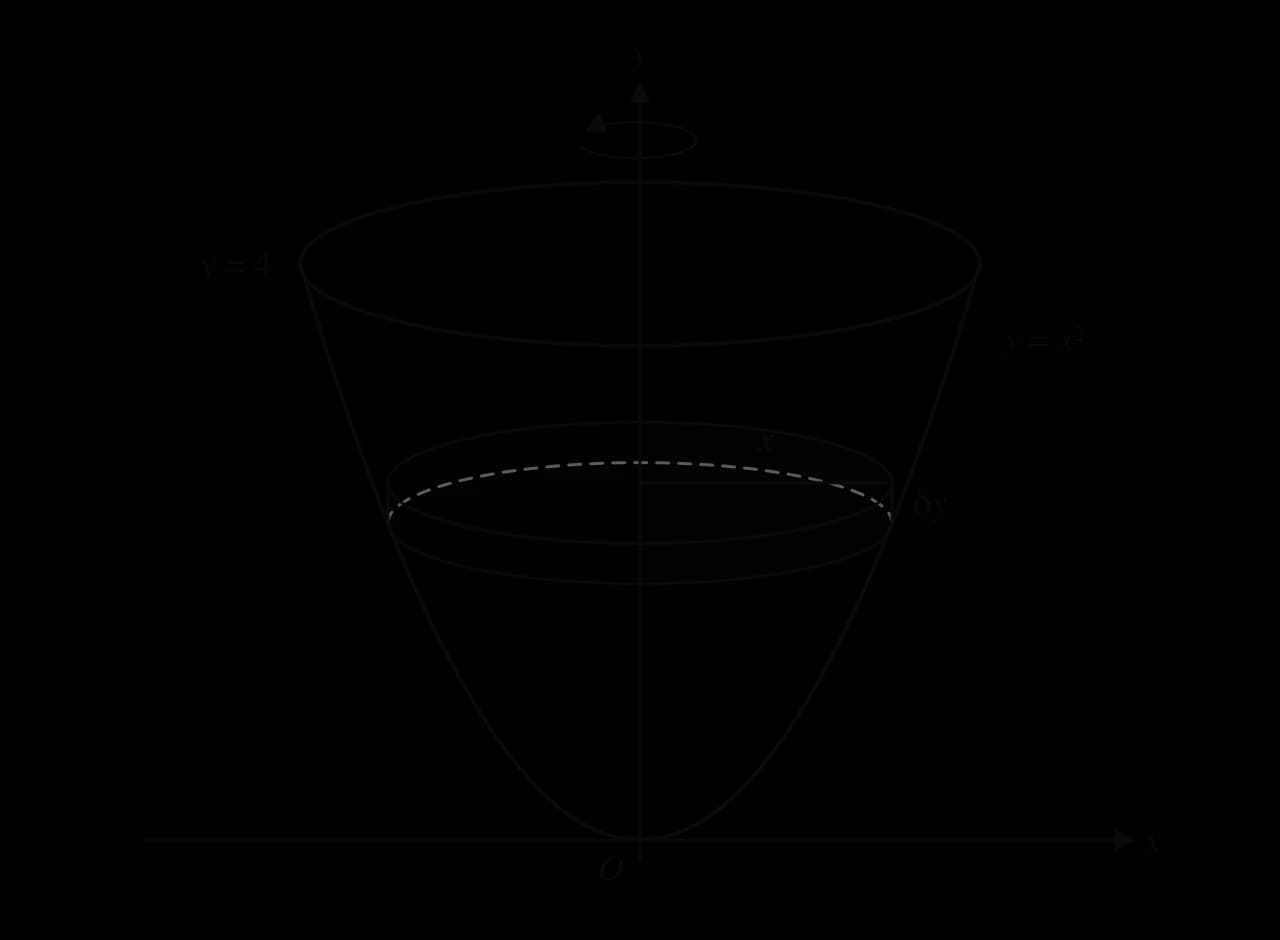
Rotating a region about the y-axis works in the same way with x and y exchanged. The slices are now horizontal discs of thickness δy, and the radius of each disc is the horizontal distance x from the y
About the y-axis the discs are horizontal: radius x, thickness δy. The curve must be written as x in terms of y before squaring.
The bowl formed by rotating y=x2 about the y-axis has the same volume as the solid formed by rotating y=x
Regions between two curves
The washer method
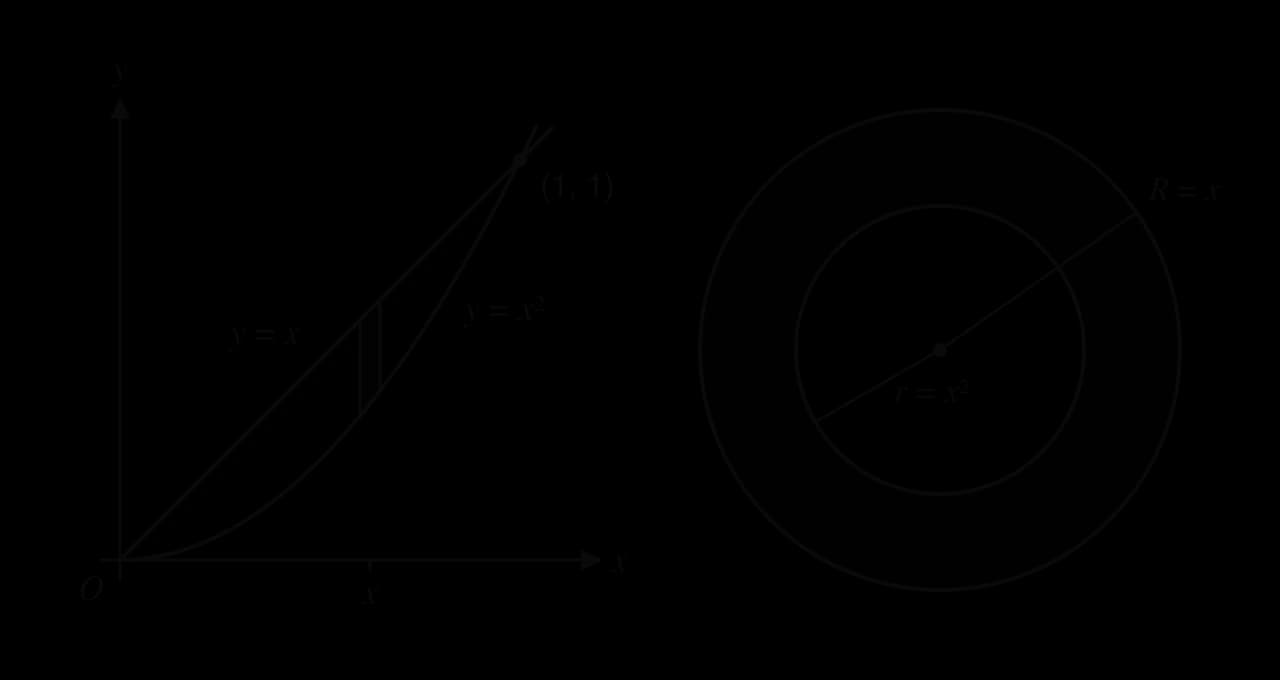
When the region being rotated does not touch the axis of rotation along its whole length, the solid has a hole through it. A thin slice of such a solid is a flat ring, called a washer, with an outer radius R and an inner radius r. Its volume is the volume of the outer disc minus the volume of the hole:
δV≈πR2δx−πr2δx=π(R2−r2)δx
For a region between two curves y=f(x) (the outer one) and y=g(x) (the inner one), with f(x)≥g(x)≥0
The top of the strip is on y = x and its bottom on y = x², so rotating it gives a ring with outer radius R = x and inner radius r = x².
Washers about the y-axis
About the y-axis the washers are horizontal, the radii are horizontal distances, and both curves must be written as x in terms of y:
V=π∫cd(xouter2−xinner2)dy
Regions that need splitting
Sometimes the inner or outer boundary changes part of the way along the axis. The solid is then split where the boundary changes, and the volumes of the parts are added. This happens often when a region under a curve y=f(x), with x between two positive values, is rotated about the y-axis.
Modelling real objects
A container with circular horizontal cross-sections can be modelled by rotating a curve about a vertical axis. Placing the axis of the container along the y-axis, with y the height above the base and x the inner radius at that height, the volume of liquid up to a depth h is
V(h)=∫0hπx2dy
The capacity is V at the full height. The depth for a given volume is the solution of V(h)= the volume, which usually needs a GDC.
Exam-style questions on areas and volumes of revolution
Self-check
To do:
I can rearrange y=f(x) into x=g(y) and find the area between a curve and the y-axis using ∫cd∣x∣dy
Questions on 5.17
27 exam-style questions on this subtopic, written in the style of the IB papers. The first has its markscheme open. Counted on
Question 1 · AA-0037717 marks
Consider the function g(x)=arctan(x+1)−arctan(x−1), where x∈R.
(a)
Show that g is an even function.
[2]2 marks
Markscheme (a)
g(−x)=arctan(1−x)−arctan(−x−1)
Question 2 · AA-0038014 marks
The region R is enclosed by the graph of y=arcsinx, the graph of y=arccosx and the x-axis.
Question 3 · AA-0066413 marks
Let h(x)=x2+4x+132x+7
Try a quick-fire question
One of 38 short multiple-choice questions on 5.17. Pick an answer to see why it's right or wrong.
The diagram shows the curve x=y2 and the line x=6−y. Which single integral gives the shaded area?
From the formula booklet
The entries of the mathematics: analysis and approaches formula booklet that 5.17 uses. Each opens in the explained booklet.
, are in 5.11; the integration methods used here are in 5.10, 5.15 and 5.16.
gives
∫abydx
.
to
y=d
and letting
δy→0
gives
and
d
are values of
y
.
(with
c<d
) is
A=∫cd∣x∣dy
The curve must be rearranged into the form x=g(y), and the limits are y-values. This formula is in the formula booklet.
gives
x=y31
,
y=lnx
gives
x=ey
, and
y=x2
with
x≥0
gives
x=y
.
gives
x=y31
. The region runs from
y=0
(where the curve meets the
y
-axis, at the origin) to
y=8
, and
x≥0
throughout.
A=∫08y31dy=[43y34]08=43×834=43×16=12
Check by integrating with respect to x. The line y=8 meets the curve at x=2. The region is the rectangle 0≤x≤2, 0≤y≤8 (area 16) minus the area under the curve, ∫02x3dx=4. So A=16−4=12, which agrees.
-axis and the curve, from
y=0
to
y=2
. Rearrange:
y=lnx
gives
x=ey
, which is positive for every
y
.
A=∫02eydy=[ey]02=e2−e0=e2−1
The area is e2−1≈6.39.
Integrating with respect to x instead would need the rectangle 0≤x≤e2, 0≤y≤2 minus ∫1e2lnxdx, which needs integration by parts (5.16). Integrating with respect to y is much quicker here.
for a region below the
x
-axis (5.11). Area is always positive, which is why the formula uses
∣x∣
. When a curve crosses the
y
-axis between
y=c
and
y=d
, find where it crosses, integrate each part separately, and add the sizes of the results.
. Find the total area of these regions.
Show the solution
Find where the curve meets the y-axis: y2−2y=0 gives y(y−2)=0, so y=0 or y=2.
For 0<y<2, x=y(y−2)<0 (the curve is to the left of the y
∫02(y2−2y)dy=[3y3−y2]02=38−4=−34
∫23(y2−2y)dy=[3y3−y2]23=(9−9)−(38−4)=34
The negative sign shows that the first region is to the left of the axis. The total area is
A=34+34=38
With a GDC, ∫03y2−2ydy=2.67
. For the region between
y=lnx
and the
y
-axis from
y=0
to
y=2
, the limits are 0 and 2, not 1 and
e2
(the
x
-coordinates of the ends of the curve).
gives
y2−y−2=0
, so
(y−2)(y+1)=0
and
y=−1
or
y=2
. The points are
(1,−1)
and
(4,2)
.
Every horizontal strip runs from the parabola on the left to the line on the right, so one integral with respect to y gives the whole area.
For −1<y<2, the line is to the right of the parabola (at y=0, the line gives x=2 and the parabola x=0). So
A=∫−12((y+2)−y2)dy=[2y2+2y−3y3]−12
=(2+4−38)−(21−2+31)=310−(−67)=627=29
With vertical strips, the region would need splitting at x=1: for 0≤x≤1 it lies between the two halves of the parabola, and for 1≤x≤4 between the line and the upper half of the parabola.
-axis forms a solid. Cut the solid into thin slices perpendicular to the
x
-axis, each of thickness
δx
. A slice at position
x
is very nearly a thin cylinder, a disc, with radius
y=f(x)
(the height of the curve there) and thickness
δx
. Its volume is approximately
is rotated through
2π
about the
x
-axis is
V=∫abπy2dx
This formula is in the formula booklet.
is rotated through
2π
radians about the
x
-axis. Find the exact volume of the solid formed.
Show the solution
Here y2=(x)2=x, and the region runs from x=0 to x=4.
V=∫04πxdx=π[2x2]04=π×8=8π
The volume is 8π≈25.1 cubic units. This is the solid in the figure: a bowl-shaped solid lying on its side, called a paraboloid.
-axis. Find the volume of the solid formed.
Show the solution
Here y2=(x2)2=x4.
V=∫02πx4dx=π[5x5]02=532π
The volume is 532π≈20.1 cubic units.
and not
π∫abydx
. For
y=x2
from 0 to 2,
π∫02x2dx=38π
, which is wrong; the correct integrand is
πx4
.
-axis and the line
x=h
about the
x
-axis. Show that the volume of the cone is
31πr2h
.
Show the solution
The line passes through the origin (the vertex of the cone) and the point (h,r) (the edge of the base). Square y:
-axis. The radius of a disc is always the distance from the axis of rotation to the curve. About the
y
-axis that distance is
x
, and the slices are stacked along the
y
-axis, so the integral is
π∫x2dy
: square
x
, integrate with respect to
y
.
, the outer radius is
R=f(x)
and the inner radius is
r=g(x)
. The washer method is the same as working out the volume generated by the outer curve and subtracting the volume generated by the inner curve, so the volume is a difference of two volumes.
-axis. Find the exact volume of the solid formed.
Show the solution
Find where the curves meet: x2=x gives x(x−1)=0, so x=0 or x=1.
For 0<x<1, x>x2, so the line is the outer boundary and the curve the inner one: R=x and r=x2
V=π∫01(x2−x4)dx=π[3x3−5x5]01=π(31−51)=152π
Equivalently, the line generates a cone of volume π∫01x2dx=3π
, not
π∫ab(R−r)2dx
. For the region between
y=x
and
y=x2
, the wrong integrand gives
π∫01(x−x2)2dx=30π
, a quarter of the correct
152π
. Squaring
R−r
treats the region as if it had been moved down to touch the axis.
-axis. Find the exact volume of the solid formed.
Show the solution
Find where they meet: x2=2x gives x=0 or x=2, at the points (0,0) and (2,4). So 0≤y≤4.
Write both as x in terms of y: the curve is x=y and the line is x=2y
V=π∫04(y−4y2)dy=π[2y2−12y3]04=π(8−316)=38π
is rotated through
2π
about the
y
-axis. Find the exact volume of the solid formed.
Show the solution
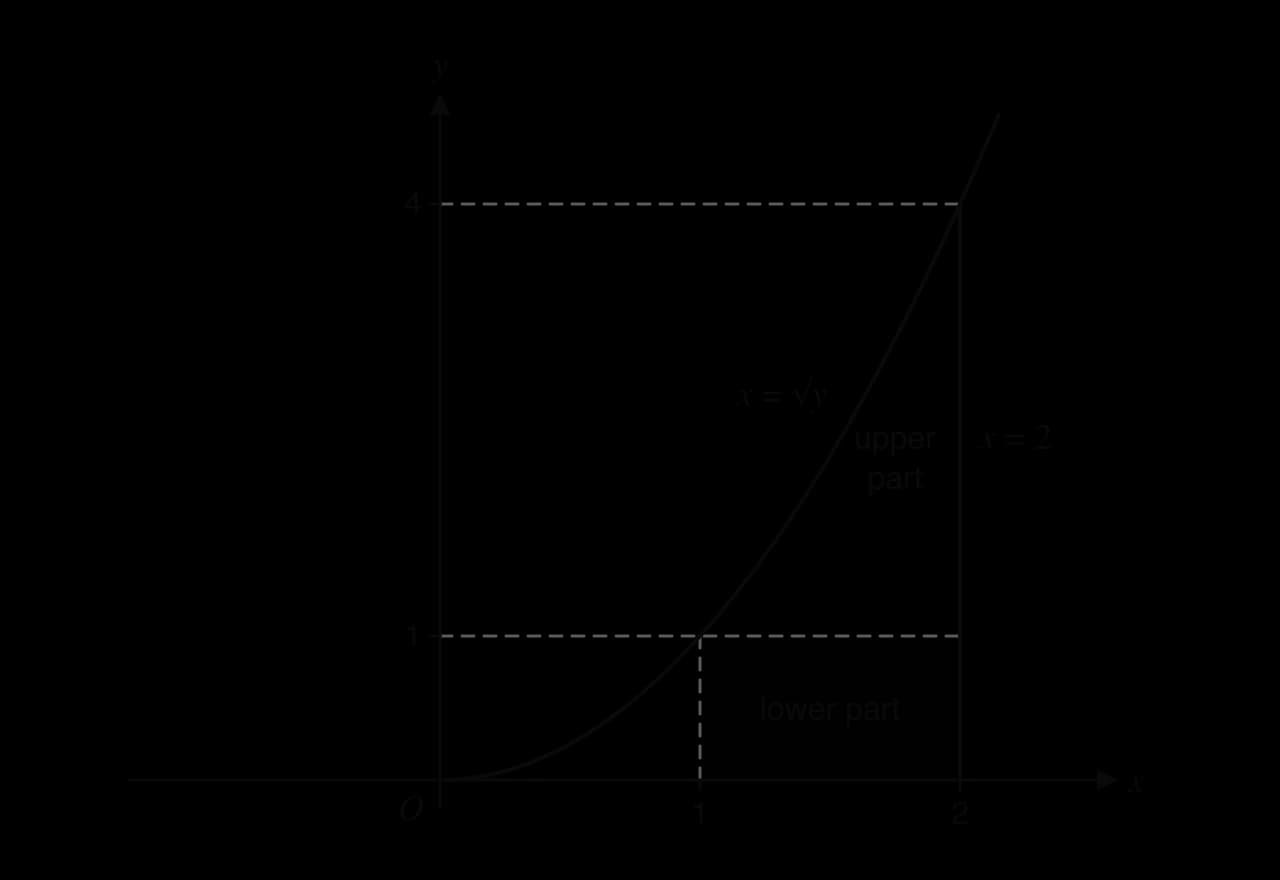
The region does not touch the y-axis, so the solid has a hole: every slice is a washer. The outer radius is always x=2. The inner radius changes at y=1, where the curve meets the line x=1.
Below y = 1 every horizontal strip runs from x = 1 to x = 2; above it, from the curve x = √y to x = 2. The two parts are rotated separately.
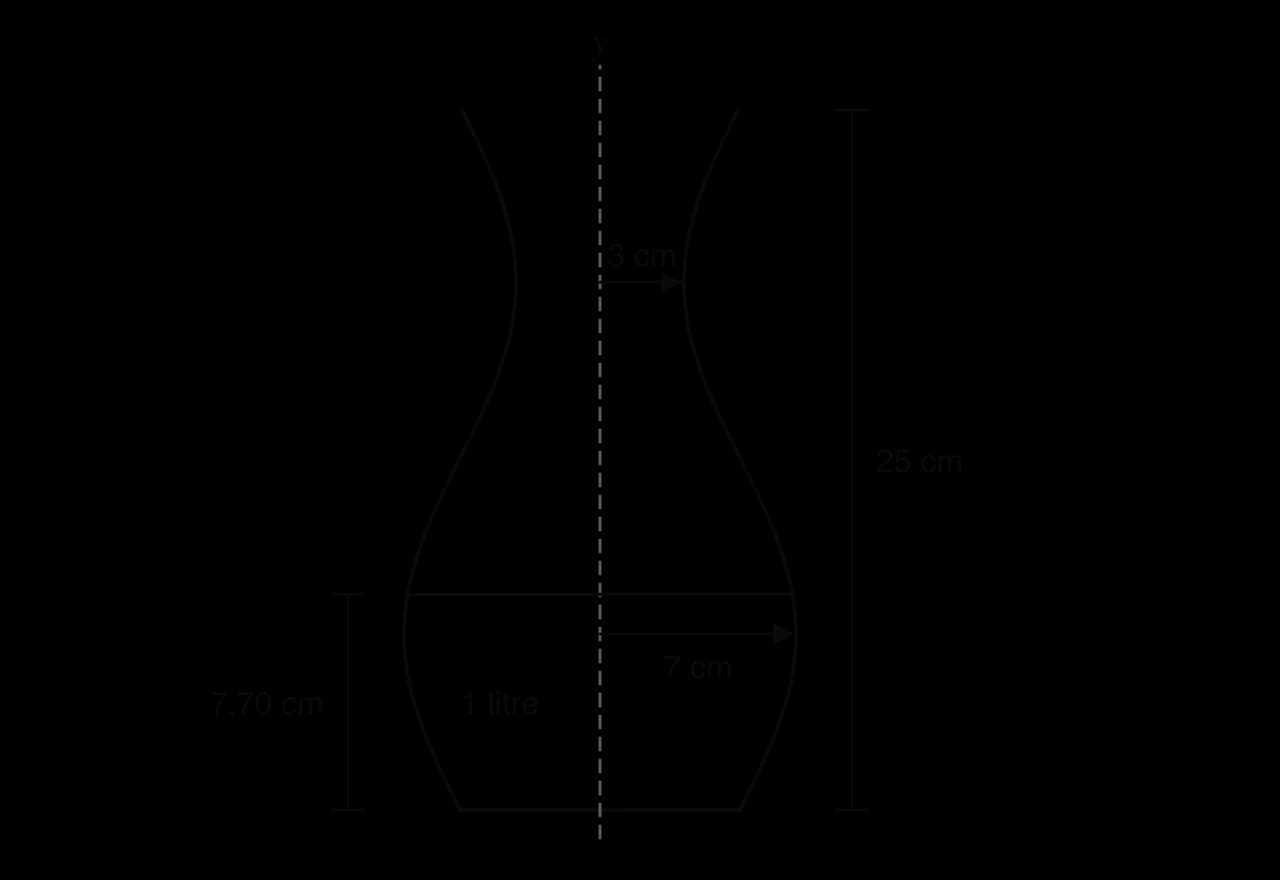
about the y-axis, where x is the inner radius and y is the height above the base, both in centimetres. A GDC is allowed.
(a) Find the capacity of the vase, in litres.
(b) Water is poured into the empty vase until it holds 1 litre. Find the depth of the water.
Show the solution
(a) The capacity is the volume of revolution from y=0 to y=25:
V=∫025π(5+2sin4y)2dy=2121.5… cm3
from the GDC. Since 1 litre=1000 cm3, the capacity is about 2.12 litres.
(b) The depth h satisfies
∫0hπ(5+2sin4y)2dy=1000
Solve with the GDC, for example by graphing the integral as a function of h and finding where it equals 1000. This gives h=7.70 cm (3 s.f.).
The wide lower part of the vase holds almost half its capacity: 1 litre fills less than a third of the height.
The answer is sensible: the radius near the base is between 5 cm and 7 cm, and a cylinder of radius 6.4 cm and height 7.7 cm holds about π×6.42×7.7≈990 cm3.
, and
2121.5
lies between them.
or
V=∫abπx2dy
are in the formula booklet, so the marks are for setting up the integral correctly: the right variable, the right limits and the
π
and the square in place. Write the integral in full before evaluating it, even on Paper 2: a GDC value with no integral shown can lose the method mark if it is wrong.
-axis, with
x≥0
. A calculator is not allowed.
(a) Show that the area of R is 316, by integrating with respect to y.
(b) Find the exact volume of the solid formed when R is rotated through 2π about the x-axis.
(c) Find the exact volume of the solid formed when R is rotated through 2π about the y-axis.
Show the solution
(a) The curve meets the y-axis at (0,4) and the x-axis at (2,0). Rearrange: x2=4−y, so x=4−y (taking x≥0). The region runs from y=0 to y=4.
A=∫04(4−y)21dy
By the reverse chain rule (5.10), ∫(4−y)21dy=−32(4−y)23
A=[−32(4−y)23]04=0−(−32×423)=32×8=316
which is the given result. (Integrating with respect to x gives the same: ∫02(4−x2)dx=8−38=316
The two solids have different volumes (15256π≈53.6 and 8π≈25.1) even though they come from the same region, because the region is at different distances from the two axes.
instead of
π∫(R2−r2)
.
-axis. Lengths are in centimetres. A GDC is allowed.
(a) Show that the volume of wine in the glass when it is filled to a depth of h cm is V=1.25πh2.
(b) Find the capacity of the glass.
(c) Find the depth of the wine when the glass is half full by volume.
(d) Wine is poured into the glass at a constant rate of 20 cm3 s−1. Find the rate at which the depth is increasing when the depth is 5 cm.
Show the solution
(a) Rearrange: y=0.4x2 gives x2=0.4y=2.5y. Rotate about the y-axis from y=0 to y=h:
V=∫0hπ(2.5y)dy=2.5π[2y2]0h=2.5π×2h2=1.25πh2
(b) At h=10, V=1.25π×100=125π=393 cm3 (3 s.f.).
(c) Half the capacity is 62.5π. Solve 1.25πh2=62.5π: h2=50, so h=50=7.07
(d) This is a related rates question (5.14). From (a), dhdV=2.5πh. By the chain rule,
dtdh=dtdV÷dhdV=2.5πh20
At h=5, dtdh=12.5π20=0.509 cm s−1
-axis. A GDC is allowed.
(a) Find the x-coordinates of the points where the curve meets the line.
(b) Find the volume of the solid formed.
(c) Explain why the volume is not equal to π∫−22(3−(x2+1))2dx.
Show the solution
(a) x2+1=3 gives x2=2, so x=−2 or x=2.
(b) The region lies between y=x2+1 and y=3, and does not touch the x-axis (x2+1≥1
V=π∫−22(9−(x2+1)2)dx=52.1 (3 s.f.)
from the GDC. The exact value is 151762π.
(c) The integral in (c) squares the height of the region, R−r, which is the volume of the solid obtained if the region were moved down to touch the x-axis. The real region is between 1 and 3 units from the axis, so it sweeps out washers of area π(R2−r2)
.
To do:
I can handle a curve that crosses the y-axis, and choose between integrating with respect to x and to y.
To do:
I can explain how slicing a solid into discs leads to V=∫abπy2dx.
To do:
I can find volumes of revolution about the x-axis and about the y-axis, with the correct variable and limits.
To do:
I can prove the volume formulas for a cone and a sphere by integration.
To do:
I can use the washer method π∫(R2−r2) for a region between two curves, and split a region whose boundary changes.
To do:
I can model a container as a solid of revolution and find its capacity, or the depth for a given volume, with a GDC.
M1
=−arctan(x−1)+arctan(x+1) (since arctan is an odd function) R1
=g(x), so g is even AG
(b)
By considering limits, show that the graph of y=g(x) has a horizontal asymptote and state its equation.
[2]2 marks
Markscheme (b)
as x→±∞, arctan(x+1) and arctan(x−1) both tend to 2π (or both to −2π) M1
so g(x)→0; the horizontal asymptote is y=0A1
(c)
Find the coordinates of the maximum point on the graph of y=g(x).
[2]2 marks
Markscheme (c)
attempt to find the maximum (graph, or g′(x)=0) (M1)
(0,2π)((0,1.57079…))A1
Note: Accept (0,1.57).
(d)
Hence write down the range of g.
[1]1 mark
Markscheme (d)
0<g(x)≤2πA1
Note: Accept ]0,2π] or 0<y≤1.57. Award A0 if 0 is included.
(e)
Solve the equation g(x)=1.
[2]2 marks
Markscheme (e)
attempt to find the intersection of y=g(x) and y=1(M1)
x=±1.13(±1.13321…)A1
(f)
Find the area of the region enclosed by the graph of y=g(x), the x-axis and the lines x=−2 and x=2.
[2]2 marks
Markscheme (f)
area =∫−22g(x)dx(M1)
=4.31(4.31404…)
(g)
The region described in part (f) is rotated 2π about the x-axis. Find the volume of the solid formed.
[3]3 marks
Markscheme (g)
V=π∫−22(arctan(x+1)−arctan(x−1))2dx(M1)(A1)
Note: Award (M1) for an attempt to use π∫y2dx and (A1) for correct limits and integrand.
=16.3(16.3437…)A1
(h)
Find the coordinates of the points of inflexion on the graph of y=g(x).
[3]3 marks
Markscheme (h)
attempt to find where g′′(x)=0, or where g′(x) has a maximum or minimum (M1)
x=±1.07(±1.07456…)A1
y=1.05(1.04719…)A1
Note: Accept (−1.07,1.05) and (1.07,1.05). Award (M1)A1A0 if only one point is given.
y = arcsin x
y = arccos x
(a)
Find the exact coordinates of the point where the two graphs intersect.
[3]3 marks
(b)
Find the area of R.
[3]3 marks
(c)
The region R is rotated 2π about the x-axis. Find the volume of the solid formed.