Use differentiation and integration to move between displacement, velocity and acceleration, decide when a particle is at rest, changes direction or speeds up, and find displacement and total distance travelled.
IB Mathematics: Analysis and Approaches
Part of 5 Calculus
SL and HL
Key terms introduced here
Each is in the Maths AA glossary, with every other term in the subject.
The position of a particle relative to a fixed origin, measured along a line with a sign for direction, usually written s. A change in displacement is final position minus initial position.
The rate of change of displacement with respect to time, v=dtds. Its sign shows the direction of motion; its size is the speed.
Notes on 5.9 Kinematics
25 min readLast reviewed
Kinematics is the mathematical description of motion: where an object is, how fast it is moving and in which direction, and how its motion is changing. Calculus is the natural language for it. Velocity is the rate of change of position, and acceleration is the rate of change of velocity, so differentiation and integration connect the three quantities.
The same ideas describe a sprinter leaving the blocks, a car between traffic lights, a stone falling from a cliff or a piston moving in an engine. In each case the motion is along a straight line, and a single number with a sign records the position of the object at each moment.
Describing motion in a straight line
Questions on 5.9
41 exam-style questions on this subtopic, written in the style of the IB papers. The first has its markscheme open. Counted on
Question 1 · AA-00179HL only · 7 marks
A particle P travels along a straight line. At time t seconds, the displacement of P from a fixed point O is s metres, where
s(t)=4sin(t+3π)−2cos(t−6π),for 0≤t≤5.
Try a quick-fire question
One of 31 short multiple-choice questions on 5.9. Pick an answer to see why it's right or wrong.
For a particle moving in a straight line, which of these quantities can be negative?
From the formula booklet
The entries of the mathematics: analysis and approaches formula booklet that 5.9 uses. Each opens in the explained booklet.
. It is at least as large as the size of the displacement.
Particles, origin and direction
An object is modelled as a particle: a single point with no size, so its position is one number. The particle moves along a straight line on which a fixed point O, the origin, and a positive direction are chosen. Time t is usually measured in seconds from the start of the motion, so t≥0.
Displacement is a signed quantity. A particle with s=−3 is 3 m from O on the negative side. The displacement over a time interval is the change in position, final displacement minus initial displacement, which can be positive, negative or zero even when the particle has moved a long way.
Velocity and speed
The sign of the velocity gives the direction of motion. If v>0 the displacement is increasing, so the particle moves in the positive direction; if v<0 it moves in the negative direction. Speed ignores direction: velocities of 5m s−1 and −5m s−1 both mean a speed of 5m s−1.
In everyday language "speed" and "velocity" are used loosely. In kinematics they are different quantities: velocity has a sign, speed never does.
Acceleration
Acceleration is the second derivative of displacement. A positive acceleration means the velocity is increasing; a negative acceleration means the velocity is decreasing. Whether the particle is getting faster or slower depends on the sign of the velocity as well.
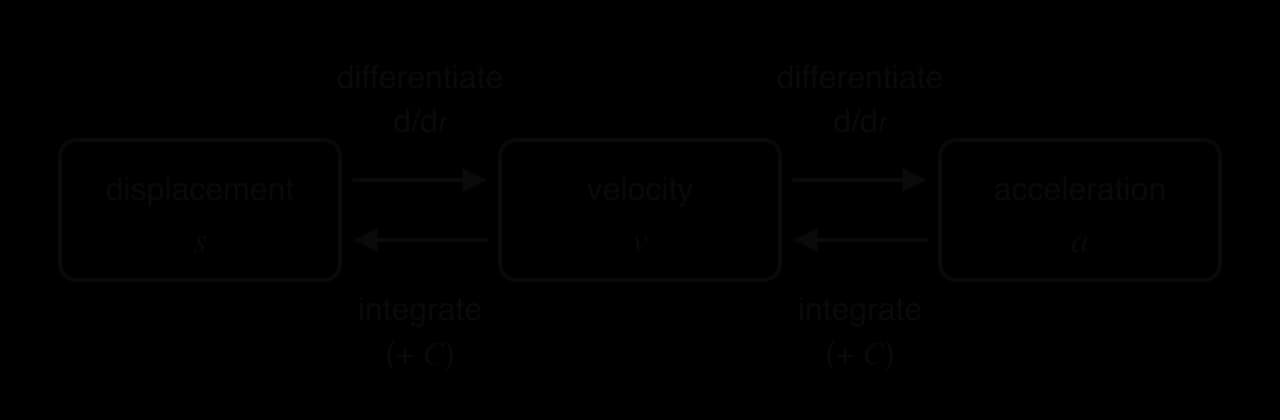
Differentiation moves from displacement to velocity to acceleration. Integration reverses each step, with a constant of integration that is found from known values, such as the position or velocity at the start.
Differentiate with respect to t to move right; integrate to move left, and each integration brings a constant that needs an initial condition.
From displacement to velocity and acceleration
When the displacement is given as a function of time, differentiating once gives the velocity and twice gives the acceleration. Substituting a value of t gives the value at that instant.
The language of questions about motion is precise. "Initially" means at t=0. "At rest" means v=0. "Returns to its starting point" means s takes its initial value again. "At the origin" means s=0.
The same differentiation works for any function of time. A smooth start, as in a sprint, is often modelled with an exponential function.
The model is a simplification. It has the sprinter accelerating hardest at the moment of starting and never slowing down, whereas real sprinters reach their top speed partway through the race and slow slightly towards the end.
The signs of velocity and acceleration
At rest and changing direction
A particle is at rest at an instant when its velocity is zero. It changes direction when its velocity changes sign, from positive to negative or the reverse. Any change of direction happens at an instant of rest, but the converse is false: the velocity can be zero for an instant without changing sign.
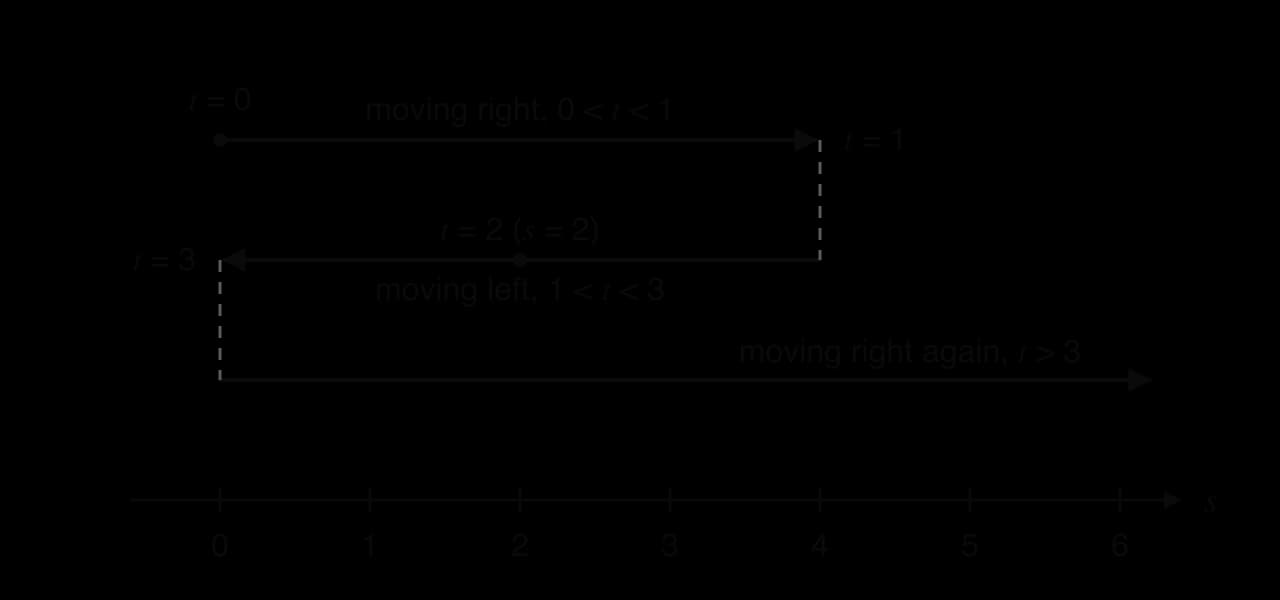
For the particle with s=t3−6t2+9t, the velocity v=3(t−1)(t−3) is positive for 0≤t<1, negative for 1<t<3 and positive for t>3. The particle moves away from O to s=4, turns round at t=1, comes back to O at t=3, then turns again and moves off in the positive direction.
The particle actually moves along the s-axis. The three arrows are drawn at different heights only to separate the stages of its motion; it turns at t = 1 and t = 3, where v = 0.
Speeding up and slowing down
Acceleration does not on its own say whether a particle is getting faster. A negative acceleration makes the velocity decrease, but if the velocity is already negative, decreasing it makes it more negative, and the speed ∣v∣ increases. What matters is whether v and a have the same sign.
v
a
Velocity is…
Speed is…
+
+
increasing, positive
increasing: speeding up
+
−
decreasing, positive
decreasing: slowing down
−
−
decreasing, negative (moving away from 0)
increasing: speeding up
−
+
increasing, negative (moving towards 0)
decreasing: slowing down
A particle is speeding up when v and a have the same sign, that is, when v×a>0. It is slowing down when they have opposite signs, v×a<0.
Motion graphs
Displacement–time graphs
On a graph of s against t, the gradient at any point is the velocity. Where the graph rises the particle moves in the positive direction; where it falls it moves in the negative direction. A turning point of the graph is an instant of rest at which the particle changes direction, and a point of inflexion is where the velocity is greatest or least.
s = t³ − 6t² + 9t
The gradient of the displacement–time graph is the velocity. It is zero at the turning points t = 1 and t = 3, and most negative at the point of inflexion t = 2, where v = −3.
Velocity–time graphs
On a graph of v against t:
the gradient at any point is the acceleration;
the graph is above the t-axis while the particle moves in the positive direction, and below while it moves in the negative direction;
a change of direction is where the graph crosses the t-axis;
the signed area between the graph and the t-axis is the displacement, and the total area is the distance travelled.
The last point follows because displacement is an antiderivative of velocity, and a definite integral of v measures signed area. The link between integrals and areas is developed in 5.11.
A car journey between two sets of traffic lights is a standard example. Its velocity–time graph is made of straight-line pieces, so the gradients and areas can be found from geometry.
0 ≤ t ≤ 10
10 ≤ t ≤ 40
40 ≤ t ≤ 55
The car speeds up at a constant rate, travels at 20 m s⁻¹, then brakes at a constant rate. The area under the graph, a trapezium, is the distance travelled.
When the graph of v is curved, the same features are read from it with calculus. In the following example the graph and the formula are used together.
From acceleration and velocity back to displacement
Integrating with initial conditions
If the acceleration is known, integrating gives the velocity, and integrating again gives the displacement:
v=∫adt,s=∫vdt
Each integration introduces a constant, which is found from an initial condition such as the velocity or displacement at t=0.
Motion under gravity
Near the Earth's surface, ignoring air resistance, every falling object has the same constant acceleration of about 9.8m s−2 downwards. Integrating this constant gives the familiar formulas for vertical motion, so the quadratic models used for projectiles in 2.6 are a consequence of calculus rather than something to memorise.
Displacement as a definite integral
The change in displacement between two times is found from the velocity by a definite integral, without needing the constant of integration:
s(t2)−s(t1)=∫t1t2vdt
This is the displacement of the particle from t=t1 to t=t2. Motion in the negative direction makes a negative contribution to the integral, so forwards and backwards motion cancel. To find the actual position at t2, add this change to the position at t1.
Total distance travelled
The total distance travelled counts every metre covered, in either direction, as positive. It is found by integrating the speed ∣v∣ rather than the velocity.
The two are equal only when the particle does not change direction during the interval. In general the distance travelled is at least as large as the size of the displacement.
Each shaded region has area 4/3. The displacement adds them with signs (4/3 − 4/3 + 4/3 = 4/3); the distance travelled adds them all as positive (4).
Without a GDC, the distance is found by splitting the interval at each time the velocity changes sign, integrating v on each piece, and adding the absolute values of the results.
When the particle's displacement function is known, the distance can also be found from its positions at the turning times. For s=t3−6t2+9t from t=0 to t=4, the particle goes from s=0 to s=4 (at t=1), back to s=0 (at t=3), then to s=4 (at t=4), so it travels 4+4+4=12 m, with a displacement of only 4 m.
With a GDC, both integrals are evaluated directly. Enter ∣v∣ using the absolute value function for the distance.
Exam-style questions on kinematics
The first question is typical of a calculator-free paper: every step is algebraic, and the answers are exact.
The second question needs a GDC throughout, as is typical of a calculator paper with a non-polynomial velocity.
Self-check
To do:
I can find velocity and acceleration by differentiating a displacement function, and give each with the correct units.
To do:
I can find velocity and displacement from acceleration by integrating, using initial conditions to find each constant.
To do:
I can find when a particle is at rest and decide whether it changes direction there.
To do:
I can explain the difference between velocity and speed.
To do:
I can decide whether a particle is speeding up or slowing down from the signs of v and a.
To do:
I can read velocity from the gradient of a displacement–time graph, and acceleration and displacement from a velocity–time graph.
To do:
I can find the displacement ∫t1t2vdt and the total distance travelled ∫t1t2∣v∣dt, with and without a GDC.
To do:
I can solve multi-step motion problems in context, such as vertical motion under gravity.
(a)
Show that s(t)=sint+3cost.
[3]3 marks
Markscheme (a)
4sin(t+3π)=4(21sint+23cost)=2sint+23cost
(b)
Find the value of t when P is first at rest.
[2]2 marks
Markscheme (b)
v(t)=cost−3sint=0⇒tant=31
(c)
Find the total distance travelled by P.
[2]2 marks
Markscheme (c)
∫05cost−3sintdt
Question 2 · AA-0036314 marks
A particle P travels in a straight line. At time t seconds, the velocity of P is v m s−1, where
v(t)=4cos(1.5t)+0.5t−1,0≤t≤6.
(a)
Write down the initial velocity of P.
[1]1 mark
(b)
Find the values of t at which P is at rest.
[3]3 marks
(c)
Find the acceleration of P when it changes direction for the second time.
[3]3 marks
(d)
Find the total distance travelled by P.
[3]3 marks
(e)
Find the displacement of P from its initial position when t=6.
A cyclist rides along a straight road. Her distance, s metres, from the start after t seconds was recorded by a sensor. Some of the results are shown in the following table.
t (s)
1.9
1.99
2
2.01
2.1
s (m)
13.87
14.8852
15
15.1152
16.17
(a)
Find the average velocity of the cyclist between t=2 and t=2.1.
[2]2 marks
(b)(i)
Find the average velocity of the cyclist between t=1.99 and t=2
s(1)=1−6+9=4 m and s(3)=27−54+27=0 m. The particle is momentarily still at 4 m from O when t=1, and back at O when t=3.
(d) a=6(2)−12=0m s−2. At t=2 the velocity is not changing at that instant: it is at its least value, v(2)=12−24+9=−3m s−1.
At t=0: a=9.6m s−2. At t=2: a=9.6e−1.6=1.94m s−2 (3 s.f.).
(b) e−0.8t>0 for every t, so 1−e−0.8t<1 and v<12. As t increases, e−0.8t→0, so the velocity approaches 12m s−1 but never reaches it. The line v=12 is a horizontal asymptote of the graph of v.
The gradient of the velocity graph is the acceleration. It is steepest at the start and flattens out as the velocity approaches 12 m s⁻¹.
. So
v=0
only when
t=2
.
(b) For every t=2, (t−2)2>0, so v>0 on both sides of t=2. The velocity does not change sign, so the particle does not change direction. It slows to rest for an instant at t=2 and then continues in the positive direction.
and
t=3
; the acceleration changes sign at
t=2
. Make a sign table on the intervals these values create.
Interval
0≤t<1
1<t<2
2<t<3
t>3
Sign of v
+
−
−
+
Sign of a
−
−
+
+
Signs of v and a
different
same
different
same
Motion
slowing down
speeding up
slowing down
speeding up
The particle is speeding up for 1<t<2 and for t>3.
(b) The velocity is never negative, so the distance equals the area under the graph. Split it into a triangle, a rectangle and a triangle.
21(10)(20)+(30)(20)+21(15)(20)=100+600+150=850m
(c) Average speed is the total distance divided by the total time.
55850=15.5m s−1(3 s.f.)
. The graph crosses the
t
-axis at both (it is a parabola with two distinct roots), so
v
changes sign and the particle changes direction at
t=2
s and
t=4
s.
(b) a=dtdv=2t−6, which is zero at t=3. Then v(3)=9−18+8=−1m s−1: this is the minimum point of the velocity graph, where the particle moves fastest in the negative direction.
(c) Compare the signs of v and a.
Interval
0≤t<2
2<t<3
3<t<4
4<t≤5
v
+
−
−
+
a
−
−
+
+
The signs are different, so the particle is slowing down, for 0≤t<2 and 3<t<4.
v = t² − 6t + 8
Below the t-axis, between t = 2 and t = 4, the particle moves in the negative direction. Its speed is greatest there at the lowest point (3, −1), where a = 0.
When t=0, v=2, so C=2 and v=3t2−4t+2.
(b) The particle is at rest when 3t2−4t+2=0. The discriminant is (−4)2−4(3)(2)=16−24=−8<0, so there are no real solutions. Since v(0)=2>0 and v is never zero, v>0 for all t: the particle always moves in the positive direction and is never at rest.
(c) Integrate the velocity.
s=∫(3t2−4t+2)dt=t3−2t2+2t+D
When t=0, s=−1, so D=−1 and s=t3−2t2+2t−1.
When t=2: s=8−8+4−1=3 m.
s=19.6t−4.9t2+D,s(0)=0⇒s=19.6t−4.9t2
(b) At the highest point the stone is momentarily at rest: 19.6−9.8t=0, so t=2. Then s=39.2−19.6=19.6. The greatest height is 19.6 m above the cliff top.
(c) The sea is 24.5 m below the origin, so solve s=−24.5.
19.6t−4.9t2=−24.5⇒4.9t2−19.6t−24.5=0⇒t2−4t−5=0
(t−5)(t+1)=0, and t≥0, so t=5 s. Then v=19.6−49=−29.4m s−1. The negative sign means the stone is moving downwards; its speed is 29.4m s−1.
(d) The stone rises 19.6 m, then falls 19.6 m back to the cliff top and a further 24.5 m to the sea.
19.6+19.6+24.5=63.7m
Its displacement, by contrast, is −24.5 m: it ends 24.5 m below its starting point.
.
The particle moves 4 m in the positive direction, so its position at t=3π is s=−1+4=3 m.
(b) The displacement from t=0 to t=T is
∫0T6sin(3t)dt=2−2cos(3T)
The particle is back at its start when this is zero: cos(3T)=1, so 3T=2π (the first positive solution) and T=32π s.
Between t=3π and t=32π the velocity is negative, and the particle retraces the 4 m back to s=−1.
(b) v=(t−1)(t−3) changes sign at t=1 and t=3. Integrate on each piece, using F(t)=3t3−2t2+3t, where F(0)=0, F(1)=34, F(3)=0 and F(4)=34.
∫01vdt=34,∫13vdt=0−34=−34,∫34vdt=34−0=34
The distance is the sum of the absolute values.
34+34+34=4m
The particle moves 34 m forwards, 34 m back, and 34 m forwards again, ending 34 m from where it started after travelling 4 m.
This can be checked by hand: an antiderivative is 12(t+1.25e−0.8t), which gives 12(2+1.25e−1.6−1.25)=12.028…
(b) The distance run in the first T seconds is
∫0T12(1−e−0.8t)dt=12(T+1.25e−0.8T−1.25)
Solve 12(T+1.25e−0.8T−1.25)=100 with the GDC (for example, by graphing both sides and finding the intersection): T=9.58 s (3 s.f.).
,
a=−18m s−2
.
(b) 6t2−18t+12=6(t2−3t+2)=6(t−1)(t−2)=0, so t=1 and t=2.
(c) Integrate, then use s=2 when t=0.
s=∫(6t2−18t+12)dt=2t3−9t2+12t+C,C=2
s=2t3−9t2+12t+2
(d) P changes direction at t=1 and t=2 (both roots of v are single roots, so v changes sign). Find its position at each turning time and at the ends.
t
0
1
2
3
s
2
2−9+12+2=7
16−36+24+2=6
54−81+36+2=11
distance=∣7−2∣+∣6−7∣+∣11−6∣=5+1+5=11m
(e) Speed is ∣v∣. The extreme values of v on 0≤t≤3 occur at the endpoints or where a=0, that is, at t=1.5.
v(0)=12,v(1.5)=13.5−27+12=−1.5,v(3)=54−54+12=12
The greatest speed is 12m s−1, at t=0 and t=3.
, so
v=0
when
sin(2πt)=0
, that is,
2πt=π
, giving
t=2
.
(b) Using the GDC's derivative at a point, or the product rule,
a=2t1sin(2πt)+2πtcos(2πt)
At t=1: a=21(1)+2π(0)=0.5m s−2.
(c) v(3)=3sin(23π)=−3=−1.73m s−1 and a(3)=−0.289m s−2 (GDC). Both are negative, so the particle is speeding up.
(d) ∫04vdt=−0.962 m (3 s.f.).
(e) ∫04∣v∣dt=3.44 m (3 s.f.).
(f) Graph v on the GDC. The maximum of v is 1.04 at t=1.17, and the minimum is −1.74 at t=3.07. The greatest speed is 1.74m s−1 (3 s.f.).
v = √t sin(πt/2)
The area below the t-axis (2 < t < 4) is larger than the area above it, so the displacement over 0 ≤ t ≤ 4 is negative. The greatest speed is at the lowest point.
M1A1
2cos(t−6π)=2(23cost+21sint)=3cost+sintA1
s(t)=2sint+23cost−3cost−sint=sint+3costAG
(M1)
t=6π(=0.524,0.523598…)A1
(M1)
=5.80 (m) (5.80034…)A1
Note: Award (M1)A0 for −2.20 (the displacement s(5)−s(0)).
Find the total length of time for which the velocity of P is negative.
[2]2 marks
.
[1]1 mark
(b)(ii)
Find the average velocity of the cyclist between t=2 and t=2.01.
[1]1 mark
(c)
Hence estimate the velocity of the cyclist at t=2.