5.4 Tangents and normals · IB Maths AA | Augment Education
5.4 Tangents and normals
Find the equations of the tangent and the normal to a curve at a point, find where a tangent has a given gradient, find tangents through a point off the curve, and use a GDC for gradients.
IB Mathematics: Analysis and Approaches
Part of 5 Calculus
SL and HL
Key terms introduced here
Each is in the Maths AA glossary, with every other term in the subject.
The straight line through a point on a curve that is perpendicular to the tangent at that point. If the tangent has gradient m=0, the normal has gradient −m1.
Find the points where the tangent has a given gradient, or is parallel or perpendicular to a given line.
Determine where a tangent or normal meets the curve again, or meets the coordinate axes.
Find the equations of the tangents to a curve that pass through a given point not on the curve.
Use a GDC to find gradients numerically and hence the equations of tangents and normals.
Use a tangent as a linear approximation to a curve close to the point of tangency.
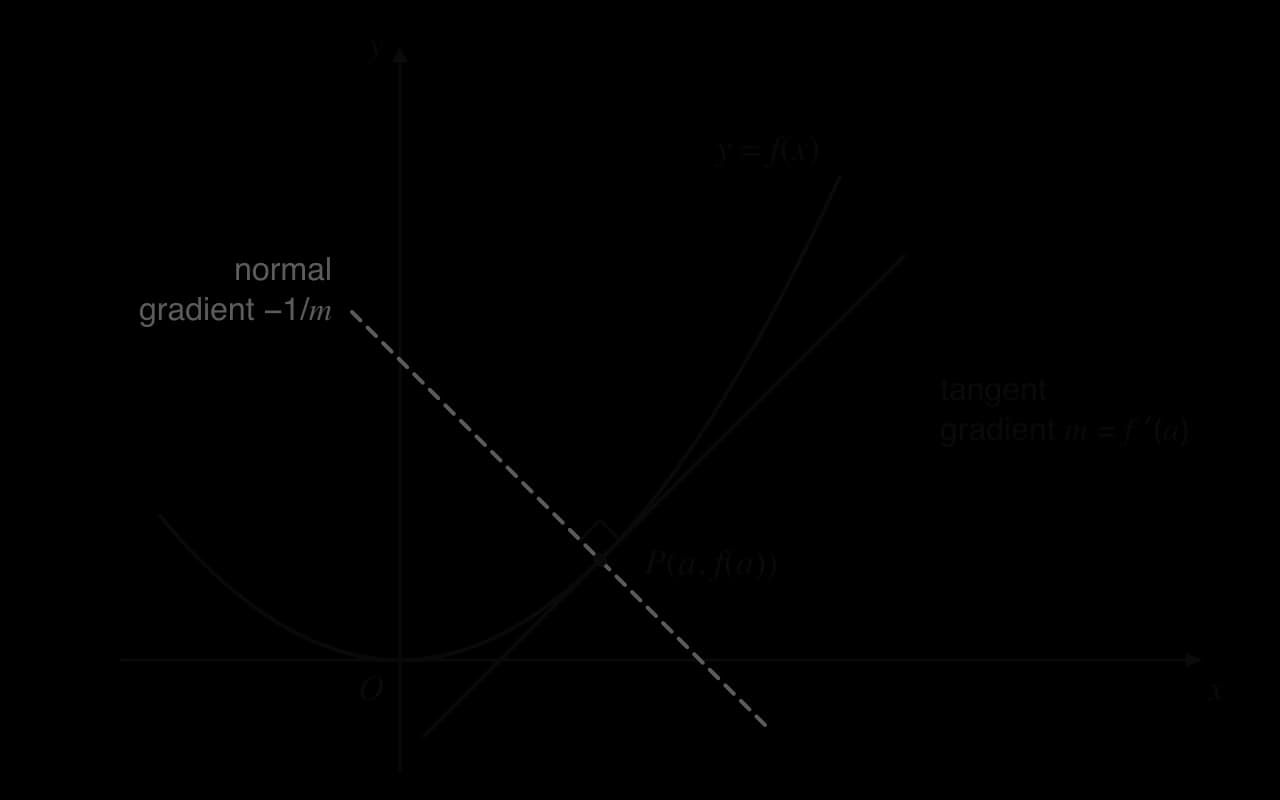
A tangent is the straight line that best matches a curve at a point: it passes through the point and has the same gradient as the curve there. The normal is the line through the same point at right angles to the tangent. Both are straight lines, so their equations come from 2.1, and their gradients come from the derivative.
Tangents and normals appear in many applications. A stone released from a sling moves off along the tangent to its circular path. When light reflects from a curved mirror, the angles of the incoming and outgoing rays are measured from the normal to the mirror at the point where the light hits it. Close to the point of tangency, the tangent is also a simple approximation to the curve, which is the basis of many numerical methods.
The equation of a tangent
The point of tangency and the gradient
The tangent to the curve y=f(x) at the point where x=a touches the curve at the point of tangency (a,f(a)) and has the same gradient as the curve at that point (5.1). Two pieces of information fix a straight line: one point on it and its gradient.
The equation of the tangent then follows from the point–gradient form of a straight line (2.1), y−y1=m(x−x1).
The method
Find the y-coordinate of the point, f(a), if it is not given.
Differentiate to find f′(x).
Substitute x=a to find the gradient m=f′(a).
Substitute the point and the gradient into y−y1=m(x−x1), then rearrange into the form asked for.
y = x² − 3x + 1
tangent y = 5x − 15
The tangent touches the parabola at (4, 5) and lies below it on both sides of the point, because this parabola bends upwards.
Tangents to curves with negative powers
The answer to the last part does not depend on the point chosen: every tangent to y=xk forms a triangle of area 2k with the axes, here 2×2=4. Checking such a pattern for one or two more points is a good test of a calculation.
The equation of a normal
Definition and gradient
The gradient of the normal follows from the rule for perpendicular lines in 2.1: two lines with gradients m1 and m2 are perpendicular when m1×m2=−1. The normal gradient is the negative reciprocal of the tangent gradient. For example, if the tangent has gradient 32, the normal has gradient −23; if the tangent has gradient −4, the normal has gradient 41.
The tangent and the normal both pass through the point of tangency P, at right angles to each other. Their gradients multiply to −1.
y = x³ − 2x
normal at (1, −1): y = −x
tangent at (1, −1): y = x − 2
With equal scales, the right angle between the tangent and the normal at (1, −1) is visible. The normal crosses the curve again at the origin and at (−1, 1).
Normals at points with a horizontal tangent
Normals and reflection
When a ray of light hits a mirror, the angle of incidence and the angle of reflection are both measured from the normal to the mirror at the point where the ray hits it, and they are equal. For a curved mirror, the normal at each point is the normal to the curve that forms its cross-section. This is how a satellite dish or a car headlight works: a parabolic shape sends every ray that arrives parallel to its axis through a single point, the focus.
Tangents with a given gradient
Parallel and perpendicular conditions
Sometimes the gradient of the tangent is given and the point of tangency is unknown. Set f′(x) equal to the gradient, solve for x (5.3), and then find the equation of the tangent at each point found. A tangent "parallel to y=9x" has gradient 9; a tangent "perpendicular to x+4y=3" has gradient 4, since that line has gradient −41.
A perpendicular condition works in the same way, once the gradient of the given line has been found by rearranging it into the form y=mx+c. The tangent gradient is then the negative reciprocal of that gradient.
Tangents and normals with the axes and the curve
Triangles formed with the axes
A common problem combines a tangent and a normal with the coordinate axes, to find lengths or areas. Sketching the curve and both lines first makes it clear which points are needed.
Where a tangent meets the curve again
A tangent can cross the curve at another point. To find it, solve the equation of the curve and the equation of the tangent simultaneously. The x-coordinate of the point of tangency is always a repeated root of the resulting equation, because the line and the curve touch there, so a factor (x−a)2 appears.
Deciding whether a line is a tangent
For a quadratic curve and a straight line, the repeated-root idea gives a test without any calculus: the line is a tangent exactly when the quadratic equation formed by the two has a discriminant of zero (2.7). Calculus gives a second method, by matching gradients.
Tangents through a point not on the curve
The method with an unknown point of tangency
A harder problem gives a point that is not on the curve and asks for the tangents to the curve that pass through it. The point of tangency is unknown, so call it (a,f(a)), write the equation of the tangent there in terms of a, and then use the fact that the given point lies on this tangent to form an equation in a.
Let the point of tangency be (a,f(a)), and find f′(a) in terms of a.
Write the tangent: y−f(a)=f′(a)(x−a).
Substitute the coordinates of the external point for x and y.
Solve the resulting equation for a. Each solution gives one tangent.
y = x²
tangent y = 6x − 9
tangent y = −2x − 1
From a point below the parabola, two tangents can be drawn, one touching each side. From a point inside the parabola (above the curve) no tangent can be drawn at all.
The number of tangents depends on where the external point is. For a parabola that opens upwards, a point below the curve gives two tangents and a point above the curve gives none, which shows up in the algebra as a quadratic in a with two roots or with no real roots.
Using a GDC for tangents and normals
Numerical gradients
For a function that cannot yet be differentiated by hand, the gradient at a point can be found with a graphic display calculator (GDC), using its numerical derivative (5.1). The equations of the tangent and normal then follow in the usual way. Many GDCs can also draw the tangent at a point and display its equation, which is a useful check.
When the GDC gives a gradient as a long decimal, keep the full value in the calculator for the equation of the line and round only the final coefficients, normally to 3 significant figures.
The tangent as a linear approximation
Close to the point of tangency, the curve and its tangent are very close together. The tangent can therefore be used to estimate values of the function near the point, an example of approximation with a simpler model. For f(x)=x3, the tangent at (2,8) is y=12x−16. At x=2.1 it gives 12(2.1)−16=9.2, while the true value is 2.13=9.261. The estimate gets worse further from the point, because the curve bends away from the tangent.
Exam-style questions on tangents and normals
The second question uses a GDC for the gradient.
Self-check
To do:
I can find the equation of the tangent to a curve at a given point using y−f(a)=f′(a)(x−a).
To do:
I can find the gradient of the normal as −m1 and write the equation of the normal, including when the tangent is horizontal.
To do:
I can find the points where a tangent has a given gradient, or is parallel or perpendicular to a given line, and write the tangents' equations.
To do:
I can find where a tangent or normal meets the axes or the curve again, and use repeated roots to help factorise.
To do:
I can decide whether a line is a tangent to a curve, by matching gradients or with the discriminant.
To do:
I can find the tangents to a curve through a point not on the curve, using an unknown point of tangency.
To do:
I can use a GDC to find a gradient numerically and hence the equations of a tangent and a normal.
To do:
I can use a tangent to estimate values of a function close to the point of tangency.
, for
x∈R
.
(a)
Find f′(x).
[2]2 marks
Markscheme (a)
f′(x)=3x2−12x+9A1A1
Award A1 for each two correct terms.
(b)
Find the coordinates of the two stationary points of the graph of f.
[4]4 marks
Markscheme (b)
Setting f′(x)=0: 3(x−1)(x−3)=0
(c)
Find the equation of the tangent to the graph of f at the point where x=4.
[3]3 marks
Markscheme (c)
f′(4)=48−48+9=9
Markscheme notes
YouTube
Why the derivative is the slope of a tangent: Essence of calculus, chapter 1, by 3Blue1Brown.
Question 2 · AA-001116 marks
The profile of a straight road up a hill is modelled by
h(x)=0.003x2−0.00001x3,0≤x≤200,
where h metres is the height of the road above its starting point and x metres is the horizontal distance from the starting point.
The angle of inclination of the road at a point is the angle between the tangent to the graph of h at that point and the horizontal.
(a)
Find the angle of inclination of the road at the point where x=50, giving your answer in degrees.
[3]3 marks
(b)
Find the values of x at which the angle of inclination of the road is 10∘.
The gradient: dxdy=2x−3, so at x=4 the gradient is m=8−3=5.
The tangent:
y−5=5(x−4)⟹y=5x−15
Check: at x=4 the tangent gives y=20−15=5, which is the point of tangency.
-axis,
y=0
:
−2x+4=0
, so
x=2
, giving
(2,0)
.
.
.
,
m=1
.
, they are
(0,0)
and
(−1,1)
.
.
is its axis of symmetry.
is
1
and the normal gradient is
−1
. The normal is
y−1=−(x−2)
, that is,
y=−x+3
.
(b) The normal has gradient −1, so it makes an angle of 45∘ with the horizontal, and therefore 45∘ with the vertical incoming ray.
(c) The incoming ray is vertical and makes 45∘ with the normal. Reflecting it in the normal turns it through 2×45∘=90∘, so the reflected ray is horizontal. A horizontal line through P(2,1) is y=1, which passes through F(0,1). The point F is the focus of the parabola.
, that is,
y=9x−27
.
, that is,
y=9x+5
.
.
.
.
Tangent: y−1=2(x−1), so y=2x−1. On the x-axis, 2x−1=0, giving A(21,0).
Normal: y−1=−21(x−1), so y=−21x+23. On the x-axis, x=3, giving B(3,0).
The triangle has base AB=3−21=25 along the x-axis and height 1 (the y-coordinate of P):
area=21×25×1=45
y = x²
tangent y = 2x − 1
normal y = −x/2 + 3/2
Triangle PAB has a right angle at P, between the tangent and the normal. Its base AB lies on the x-axis and its height is the y-coordinate of P.
. Since
x=1
is a repeated root,
(x−1)2=x2−2x+1
is a factor:
.
.
. Then
y=9−12+7=4
, so the point of tangency is
(3,4)
. The line passes through it:
4=2(3)+k
, so
k=−2
.
Method 2 (discriminant). Solve x2−4x+7=2x+k, that is, x2−6x+(7−k)=0. For a tangent there is exactly one (repeated) root:
(−6)2−4(1)(7−k)=0⟹36−28+4k=0⟹k=−2
Both methods give k=−2.
.
. The only real solution is
a=1
, so there is exactly one tangent.
, touching the curve at
(1,3)
.
gives
dxdy=−5
.
Tangent: y−5=−5(x−1), so y=−5x+10.
Normal: the gradient is −−51=51, so y−5=51(x−1), that is, y=0.2x+4.8.
The tangent-drawing feature of the GDC shows y=−5x+10, which confirms the result.
. [3]
(M1 for substituting
x=2
into
f′
, A1 for
−4
). The tangent through
(2,−3)
is
y−(−3)=−4(x−2)⟹y+3=−4x+8⟹y=−4x+5
(M1 for using point–gradient form with these values.)
(c) The normal gradient is −−41=41.
y+3=41(x−2)⟹4y+12=x−2⟹x−4y−14=0
(d) Solve x3−4x2+5=−4x+5:
x3−4x2+4x=0⟹x(x2−4x+4)=0⟹x(x−2)2=0
x=2 (a repeated root) is the point P, so Q has x=0. Then y=−4(0)+5=5, so Q is (0,5).
.
(b) y−1.2=−0.36(x−2), so y=−0.36x+1.92.
(c) On the x-axis, −0.36x+1.92=0, so x=5.333…, giving A(5.333…,0), that is, A(316,0).
The normal gradient is −−0.361=2.777…. The normal is y−1.2=2.777…(x−2); on the y-axis, x=0, so y=1.2−5.555…=−4.355…, giving B(0,−4.355…).
Using the distance formula (3.1):
AB=(5.333…)2+(4.355…)2=6.8858…≈6.89
M1
x=1 or x=3A1
(1,5) and (3,1)A1A1
A1
f(4)=64−96+36+1=5A1
y−5=9(x−4), so y=9x−31A1
y = h(x)
y = f(x)
L
Find the acute angle between the tangent to the graph of
f
at O and the
x
-axis.
[3]3 marks
(e)
The line y=xtanθ, where θ is acute, divides the region enclosed by the graph of f and the x-axis into two parts of equal area.
 YouTube