5.10 Indefinite integrals and substitution by inspection · IB Maths AA | Augment Education
5.10 Indefinite integrals and substitution by inspection
Integrate powers of x with rational exponents, sin x, cos x, 1/x and e^x, their composites with ax + b, and products of the form k g′(x) f(g(x)) by inspection or substitution.
IB Mathematics: Analysis and Approaches
Part of 5 Calculus
SL and HL
Key terms introduced here
Each is in the Maths AA glossary, with every other term in the subject.
), then checking the guess by differentiating and adjusting the constant factor.
,
x1
and
ex
.
Rewrite roots, reciprocals and fractions as sums of powers so that they can be integrated term by term.
Integrate the composite of any standard function with a linear function ax+b, such as cos(3x+1) or 2x−51.
Recognise integrands of the form kg′(x)f(g(x)) and integrate them by inspection (the reverse chain rule) or by substitution.
Determine the constant of integration from a boundary condition, including in contexts.
Verify any indefinite integral by differentiating the answer.
Integration reverses differentiation. Once the derivatives of sinx, cosx, ex and lnx and the chain rule are known, each of them can be read backwards to give a new integral. The result is a short list of standard integrals, two rules that extend it to many more functions, and a habit of checking every answer by differentiating.
These integrals are the working tools of the rest of calculus. They give exact areas under curves of exponential and trigonometric functions, displacements from velocities, and total quantities, such as the volume of water that has flowed out of a tank, from a rate of change.
Integration as the reverse of differentiation
An antiderivative of a function f is any function F with F′(x)=f(x). Adding a constant to F does not change its derivative, so every function that has one antiderivative has infinitely many, and they differ only by a constant. The indefinite integral collects all of them in one expression:
∫f(x)dx=F(x)+C
The function being integrated, f(x), is the integrand, and C is the constant of integration. The dx shows that the variable of integration is x.
Because integration undoes differentiation, every derivative result gives an integral. For example, dxd(sinx)=cosx means that ∫cosxdx=sinx+C. This also gives a reliable check: differentiating the answer to an integral must give back the integrand exactly.
Standard integrals
Powers of x with rational exponents
The power rule for derivatives, dxd(xn+1)=(n+1)xn, holds for every rational power. Dividing by n+1 gives the rule for integrating a power.
The rule applies to roots and reciprocals once they are written as powers: x=x21, 3x2=x32, x31=x−3 and x1=x−21. Constant multiples and sums are integrated term by term, just as they are differentiated term by term:
∫(af(x)+bg(x))dx=a∫f(x)dx+b∫g(x)dx
Dividing by a fractional power is the step that causes most errors. Dividing by 23 is the same as multiplying by 32, so ∫x21dx=32x23+C.
There is no product rule or quotient rule for integration. A product or quotient must first be rewritten as a sum of powers, by expanding brackets or by dividing each term of the numerator by the denominator.
The integral of 1/x
The power rule leaves out exactly one power, x−1. Its integral comes from the derivative of the natural logarithm: dxd(lnx)=x1 for x>0. But x1 is also defined for negative x, where lnx is not. For x<0, the function ln(−x) is defined, and by the chain rule
dxdln(−x)=−x1×(−1)=x1
Both cases are covered by the absolute value ∣x∣, which equals x when x>0 and −x when x<0.
y = 1/x
y = ln|x|
y = ln|x| has a branch on each side of the y-axis. Its gradient at x = 2 is 1/2 and at x = −2 is −1/2, matching y = 1/x on both branches.
The graph of y=ln∣x∣ is the graph of y=lnx together with its reflection in the y-axis. On the left branch the curve falls as x increases, so its gradient is negative, exactly as x1 is negative there. The vertical asymptote at x=0 splits the domain in two: an integral of x1 never crosses x=0.
Exponential and trigonometric functions
The exponential function is its own derivative, so it is also its own integral. The derivatives dxd(sinx)=cosx and dxd(cosx)=−sinx give the two trigonometric integrals. The second one carries a minus sign: since dxd(−cosx)=sinx, the integral of sinx is −cosx.
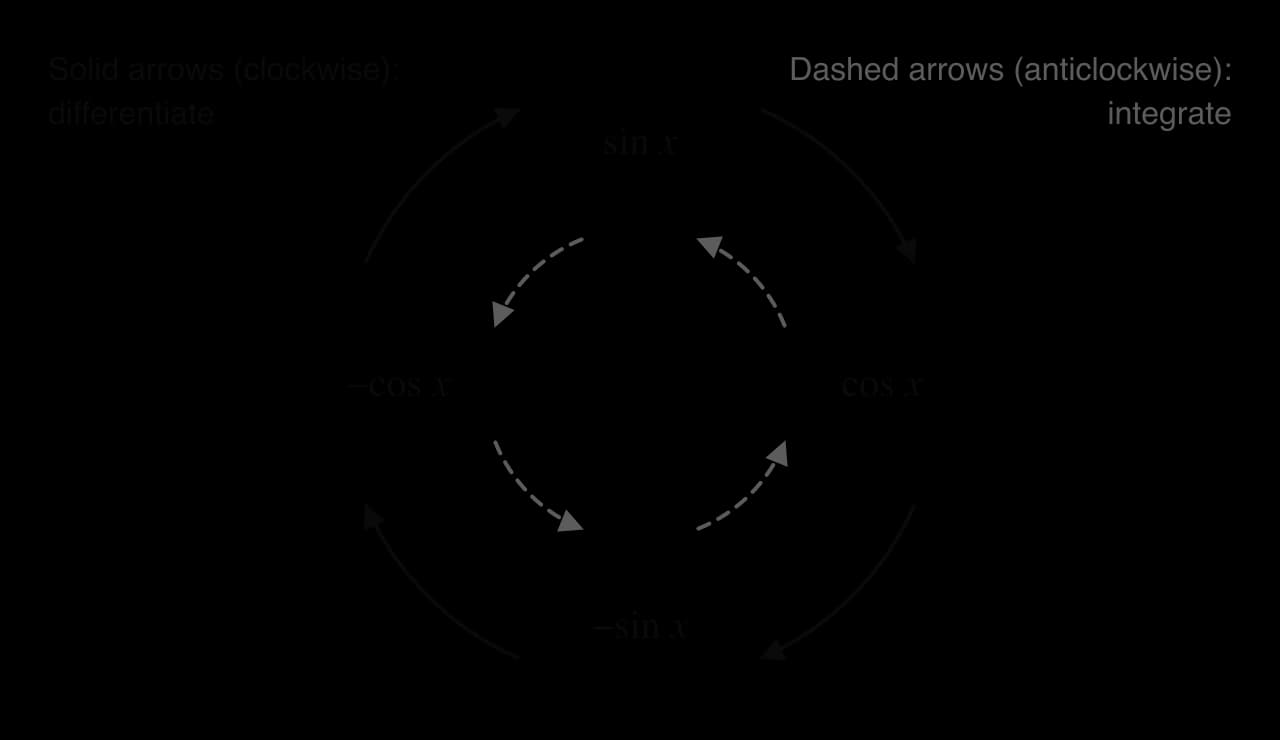
The four functions sinx, cosx, −sinx and −cosx form a cycle. Differentiating moves one step clockwise round the cycle and integrating moves one step anticlockwise, so four integrations (or four differentiations) bring a function back to itself.
Differentiating moves clockwise and integrating moves anticlockwise round the cycle, so the integral of sin x is −cos x and the integral of cos x is sin x.
These results hold only when x is measured in radians, because the derivatives of sinx and cosx are only this simple in radians. All the standard integrals are collected in the table.
Integrand f(x)
Indefinite integral ∫f(x)dx
Comes from
xn, n∈Q, n=−1
n+1xn+1+C
dxdxn+1=(n+1)xn
x1
ln∣x∣+C
dxdlnx=x1
ex
ex+C
dxdex=ex
sinx
−cosx+C
dxdcosx=−sinx
cosx
sinx+C
dxdsinx=cosx
Finding a function from its derivative
An indefinite integral is a family of functions. Their graphs are vertical translations of one another, because changing C moves the whole graph up or down without changing its gradient at any x. One extra piece of information, a boundary condition such as a point on the curve or the value of the function at a given x, picks out a single member of the family. This is set out for polynomials in 5.5; the method is the same for every integral.
C = −1
C = 0
C = 1
C = 2
Every curve y = ½sin 2x + C has gradient cos 2x at each x. Only the curve with C = 2 passes through the point (π/4, 5/2).
The curves all have the gradient function dxdy=cos2x, because the chain rule gives dxd(21sin2x)=21×2cos2x=cos2x. Substituting the point (4π,25) into y=21sin2x+C gives 21+C=25, so C=2.
Composites with a linear function
Why the integral is divided by a
Many integrands are a standard function of a linear expression ax+b, such as cos(3x+1), e4−2x or 2x−51. Each is a composite function whose inner function is ax+b. Differentiating a composite of this kind with the chain rule multiplies by the derivative of the inner function, which is the constant a:
dxdF(ax+b)=aF′(ax+b)
To reverse this, integrate the outer function as usual and then divide by a. If F is an antiderivative of f, then
∫f(ax+b)dx=a1F(ax+b)+C,a=0
For example, dxdsin(3x+1)=3cos(3x+1), which is three times too large, so ∫cos(3x+1)dx=31sin(3x+1)+C.
Integrand
Indefinite integral
(ax+b)n, n=−1
a1⋅n+1(ax+b)n+1+C
ax+b1
a1ln∣ax+b∣+C
eax+b
a1eax+b+C
sin(ax+b)
−a1cos(ax+b)+C
cos(ax+b)
a1sin(ax+b)+C
Expanding (3x+2)5 and integrating term by term gives the same family of functions, but it takes far longer and produces a different-looking constant term. Two correct answers to an indefinite integral may look different and still both be right, as long as they differ only by a constant.
Negative and fractional powers of a linear expression
Roots and reciprocals of a linear expression are written as powers in the same way as roots and reciprocals of x. The only exception is the power −1, which gives a logarithm.
Equivalent forms of a logarithmic answer
Integrals of reciprocals can be written in more than one correct form. Dividing first gives ∫3x1dx=31∫x1dx=31ln∣x∣+C, while the linear rule with a=3 gives 31ln∣3x∣+C. Both are right, because
31ln∣3x∣=31ln3+31ln∣x∣
and 31ln3 is a constant that is absorbed into C. When an answer has to be given in a particular form, such as ln(k(2x+1)3), the constant is often written as lnk so that the laws of logarithms can combine the terms.
The linear rule only works for linear inner functions
Dividing by the derivative of the inner function is valid only when that derivative is a constant. For ∫(x2+1)3dx, the inner function x2+1 has derivative 2x, which is not constant, and 4×2x(x2+1)4 is wrong: differentiating it with the quotient rule does not give back (x2+1)3. Such an integrand must be expanded first, or, if a factor of 2x is present, integrated by inspection (the reverse chain rule).
Rewriting with trigonometric identities
Some trigonometric integrands are not on the list but can be rewritten as one that is. The most common are sin2x and cos2x. The double angle identity cos2x=1−2sin2x=2cos2x−1 (3.6) rearranges to
sin2x=21(1−cos2x),cos2x=21(1+cos2x)
Each right-hand side is a constant plus a cosine of the linear function 2x, which can be integrated. Similarly, sinxcosx=21sin2x.
Integration by inspection: the reverse chain rule
Recognising a chain rule derivative
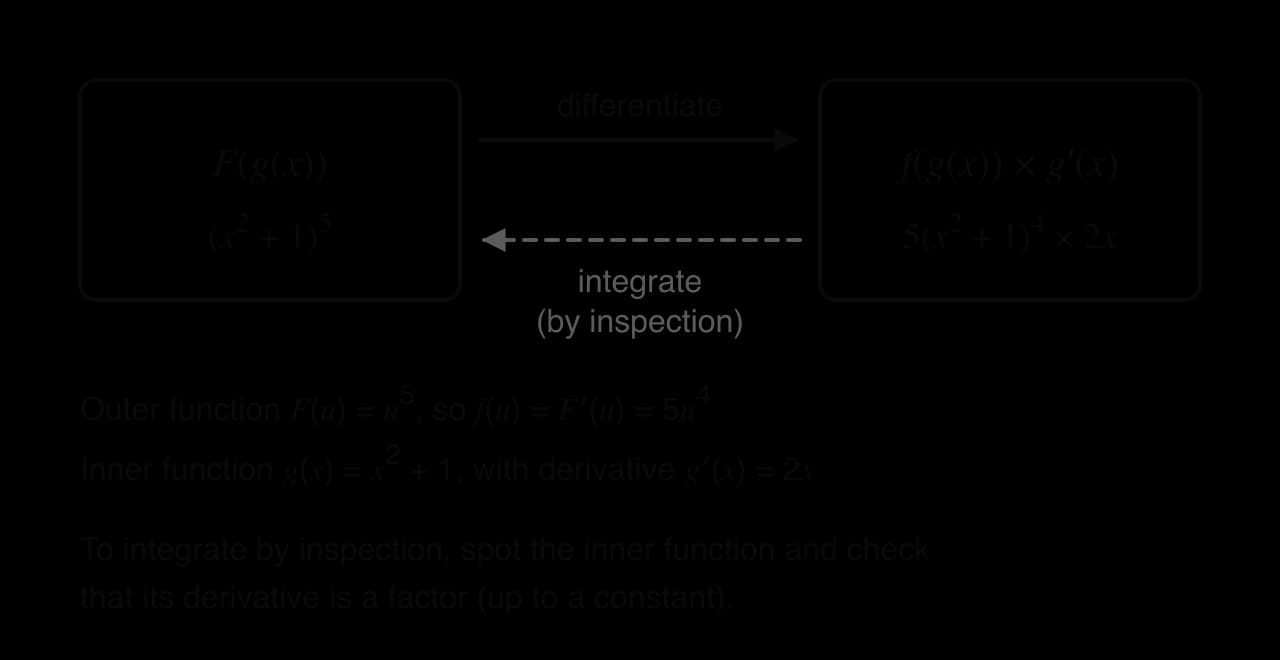
The chain rule differentiates a composite function F(g(x)) as
dxdF(g(x))=F′(g(x))×g′(x)=f(g(x))g′(x)
where f=F′. Reading this backwards gives an integral:
∫f(g(x))g′(x)dx=F(g(x))+C
An integrand of this shape is the product of a composite function f(g(x)) and the derivative g′(x) of its inner function. For example, in ∫2x(x2+1)4dx the inner function is g(x)=x2+1 and the factor 2x is exactly g′(x).
The chain rule produces a factor g′(x). An integrand that already contains the derivative of its inner function can be integrated by running the chain rule backwards.
The word "inspection" means that the answer is found by looking at the integrand and recognising its structure, not by a fixed algorithm. The method works in four steps.
Identify the inner function g(x), usually the expression inside a bracket, a root, an exponent or the denominator.
Check that the rest of the integrand is a constant multiple of g′(x). If it is not, inspection does not work.
Integrate the outer function as if g(x) were a single variable, and write the guess in terms of g(x).
Differentiate the guess and compare it with the integrand. Multiply the guess by whatever constant makes them agree.
Adjusting the constant factor
The factor in front of the composite does not have to match g′(x) exactly. It is enough that it is a constant multiple of g′(x), because a constant can be moved outside the integral and corrected for afterwards.
The patterns to look for
Most integrals that can be found by inspection fit one of a few patterns. Each comes from a standard derivative combined with the chain rule.
Integrand
Integral
Example
g′(x)[g(x)]n, n=−1
n+1[g(x)]n+1+C
∫cosxsin3xdx=4sin4x+C
g(x)g′(x)
ln∣g(x)∣+C
g′(x)eg(x)
eg(x)+C
g′(x)cos(g(x))
sin(g(x))+C
∫3x2cos(x3)dx=sin(x3)+C
g′(x)sin(g(x))
−cos(g(x))+C
∫exsin(ex)dx=−cos(ex)+C
The second pattern deserves particular attention. Whenever the numerator of a fraction is a constant multiple of the derivative of the denominator, the integral is a logarithm of the denominator. In ∫x2+32xdx the modulus is not needed, because x2+3 is always positive.
More integrals by inspection
The same idea applies whenever a function sits inside another function and the derivative of the inside is also a factor. Recognising the inner function is the skill to practise. Typical places for it are an exponent (ex2), a trigonometric argument (cos(x3)), the base of a power (sin3x=(sinx)3, (lnx)2) and the inside of a root (x2+9).
Finding an unknown constant
Some questions give the answer to an integral in terms of an unknown constant and ask for its value. Differentiating the given answer and comparing it with the integrand is the quickest approach.
Integration by substitution
Inspection can also be written out formally as a substitution. The inner function is given a new name, u=g(x), and the derivative dxdu=g′(x) is used to replace g′(x)dx by du. The integral then becomes a standard integral in u. Both methods give the same answer; substitution takes longer to write but makes each step visible, which helps when the constant factor is awkward. Substitution in general, including integrands where the inner function is not obvious, is HL content in 5.16.
Integrals in context
When a rate of change is known, integrating it gives the quantity itself, up to a constant. A known starting value, such as the amount at time t=0, fixes the constant. The rate of change of a cost with respect to the number of items made is called the marginal cost; integrating it gives the total cost, and the constant of integration is the fixed cost of making zero items.
The rate of leaking in the model falls over time, from 20 litres per hour at t=0 to about 1.6 litres per hour when the tank empties. This is realistic for a leak near the bottom of a tank, where the flow slows as the water level, and so the pressure, drops.
Exam-style questions on indefinite integrals
Questions on indefinite integrals usually appear on the non-calculator paper, often as the first part of a longer question that later uses the result for an area (5.11) or a kinematics problem (5.9). The two examples show typical structures.
Self-check
To do:
I can integrate xn for any rational n=−1, after rewriting roots and reciprocals as powers.
To do:
I can state the integrals of x1, ex, sinx and cosx, including the modulus in ln∣x∣ and the sign of ∫sinxdx.
To do:
I can integrate f(ax+b) for each standard function by dividing by a.
To do:
I can rewrite sin2x and cos2x with a double angle identity and integrate them.
To do:
I can recognise kg′(x)f(g(x)) and integrate it by inspection, adjusting a constant factor.
To do:
I can integrate a fraction whose numerator is a multiple of the derivative of its denominator.
To do:
I can carry out the same integral by substitution, giving the answer in terms of x.
To do:
I can use a boundary condition to find the constant of integration, including in a context.
To do:
I can check any indefinite integral by differentiating my answer.
. The curve passes through the point
(43π,23)
.
Find y in terms of x.
[6]6 marks
Markscheme
attempt to integrate M1
y=−3cos(2x−3π)+cA1A1
Note: Award A1 for −3, A1 for cos(2x−3π). Condone the absence of +c here.
The letter K is used for the constant because C already stands for the cost. When x=0, C=2000:
2000=0+3009+K=900+K,K=1100
So C(x)=50x+3002x+9+1100, and
C(100)=5000+300209+1100=10437.05…
The total cost of making 100 chairs is about USD 10 400 (3 s.f.).
and integrate by inspection, with the outer function
u−2
integrating to
−1u−1
:
f(x)=∫6x(x2+1)−2dx=3×−1(x2+1)−1+C=−x2+13+C
Substitute the point (0,5): 5=−3+C, so C=8.
f(x)=8−x2+13
The marks are for: recognising the reverse chain rule (or making a substitution), the correct integral, substituting the point, and the final answer.
(b) As x→±∞, x2+13→0, so the horizontal asymptote is y=8.
(c) f′(x)=0 only at x=0, where f′ changes from negative to positive, so f(0)=5 is the minimum value. The graph approaches y=8 but never reaches it, since x2+13>0. The range is 5≤f(x)<8.
. Find
g(x)
. [3 marks]
, which is the given result. A "show that" needs this line written out, even when it is short.
(b) "Hence" means use part (a). Integrate the right-hand side, dividing by 2 for the cos2x term:
∫sin2xdx=∫(21−21cos2x)dx=2x−41sin2x+C
(c) From (b), g(x)=2x−41sin2x+C. At x=2π, sin2x=sinπ=0, so