5.19 Maclaurin series · IB Maths AA | Augment Education
5.19 Maclaurin series
Find Maclaurin series from derivatives at zero, build new series by substitution, multiplication, differentiation and integration or from a differential equation, and use them for approximations and limits.
IB Mathematics: Analysis and Approaches
Part of 5 Calculus
HL only
Key terms introduced here
Each is in the Maths AA glossary, with every other term in the subject.
The set of values of x for which a power series converges. A Maclaurin series can be used to evaluate or approximate its function only for x in this interval, for example −1<x≤1 for ln(1+x)
Carry on with 5.19 in Augment
With a free account, Augment remembers where you stopped and what you have practiced.
The polynomial formed by the terms of a Maclaurin series up to a chosen power of x. It has the same value and the same first few derivatives as the function at x=0, so it approximates the function near 0.
The infinite series f(0)+xf′(0)+2!x2f′′(0)+3!x3f′′′(0)+…, which writes a function as a power series in x built from its derivatives at x=0.
Notes on 5.19 Maclaurin series
27 min readLast reviewed
Polynomials are the easiest functions to work with: their values need only addition and multiplication, and they can be differentiated and integrated term by term. A Maclaurin series writes a function such as ex or sinx as a polynomial with infinitely many terms. Taking only the first few terms gives a polynomial that is very close to the function for values of x near 0.
Calculators and computer software evaluate functions such as sinx and ex with polynomial approximations of this kind (or with closely related methods), after first reducing x to a small interval near 0 where few terms are needed. The same series also give quick estimates of values such as e
Approximating a function by a polynomial
Matching the derivatives at zero
Near x=0, the simplest approximation to a function is its tangent line, f(x)≈f(0)+f′(0)x. The tangent has the same value and the same gradient as f
Adding a term in x2 allows the approximation to bend in the same way as the curve. The quadratic 1+x+2x2
The pattern continues. Suppose a polynomial
p(x)=a0+a1x+a2x2+a3x3+⋯+anxn
is to have the same value and the same first n derivatives as f at x=0. Substituting x=0 into p and its derivatives gives:
and in general p(k)(0)=k!ak, because differentiating xk
ak=k!f(k)(0)
where f(k) is the kth derivative and 0!=1.
The Maclaurin series
Letting the number of terms grow without limit gives an infinite series.
A Maclaurin polynomial approximates the function near 0, and for the functions in this course the approximation improves as more terms are taken, as long as x is in the series' interval of convergence. The series is an example of a power series, a series in increasing whole-number powers of x.
The standard Maclaurin series
The series for e^x
Every derivative of ex is ex, so f(k)(0)=e0=1
ex=1+x+2!x2+3!x3+4!x4+⋯=k=0∑∞k!xk
The factorials grow so quickly that the series converges for every real x. Substituting x=1 gives a series for e itself, e=1+1+21+61+241+⋯
The series for sin x and cos x
The derivatives of sinx repeat in a cycle of four: sinx, cosx, −sinx, −cosx, then sinx
sinx=x−3!x3+5!x5−7!x7+⋯
For cosx, the values at 0 are 1,0,−1,0,1,…, so only the even powers survive:
cosx=1−2!x2+4!x4−6!x6+⋯
Both series converge for every real x. They reflect the symmetry of the functions: sinx is odd and its series has only odd powers, while cosx is even and its series has only even powers.
The series for ln(1 + x)
The function lnx has no Maclaurin series, because ln0 is undefined. Shifting it to ln(1+x) fixes this. Its derivatives are
and in general f(k)(0)=(−1)k−1(k−1)!. The coefficient of xk
ln(1+x)=x−2x2+3x3−4x4+⋯,−1<x≤1
The denominators are 1,2,3,4,…, not factorials: the factorials cancelled.
Unlike the series for ex, sinx and cosx, this series is valid only for −1<x≤1. At x=1
The series for (1 + x)^p
For f(x)=(1+x)p, the derivatives are p(1+x)p−1
(1+x)p=1+px+2!p(p−1)x2+3!p(p−1)(p−2)x3+⋯
This is exactly the extended binomial theorem of 1.10. When p∈N the series stops after p+1 terms and is valid for all x; otherwise, for p∈Q, it is an infinite series valid for ∣x∣<1
Summary of the standard series
Function
Maclaurin series
Valid for
ex
1+x+2!x2+3!x3+⋯
Finding a series by repeated differentiation
The general formula works for any function whose derivatives at 0 can be found. The method is to differentiate several times, substitute x=0 into each derivative, and then substitute the values into the formula. It is reliable but can involve heavy differentiation, so it suits the first three or four terms.
For a composite function, the chain rule and the product rule produce longer expressions at each stage. Simplifying each derivative before differentiating again keeps the working manageable, and a question often gives one derivative to show, which then serves as a check.
Building new series from known ones
Repeated differentiation quickly becomes long. Most series are found faster by adapting the standard series, in four ways: substitution, multiplication, differentiation and integration. These are valid because a power series behaves like a polynomial inside its interval of convergence.
Substitution
Replacing x by an expression such as x2, −x or 3x throughout a known series gives the series of the new function. The interval of convergence changes with it.
Substitution also combines with the laws of logarithms. Since ln(1−x1+x)=ln(1+x)−ln(1−x)
for −1<x<1. The even powers cancel. Choosing x=31 makes 1−x1+x=2
ln2≈2(31+811+12151)=1215842=0.69300
which is within 0.00015 of ln2=0.693147… after only three terms. The series for ln(1+x) with x=1 would need thousands of terms for the same accuracy, which shows the benefit of choosing a small value of
Multiplication
The series of a product is the product of the two series, expanded and collected up to the power needed. Only the products of terms whose powers add to at most the highest power needed to be found.
Composition
A series can be substituted into another series. To expand esinx, write u=sinx=x−6x3+⋯
esinx=1+(x−6x3)+2x2+6x3+⋯=1+x+2x2+0x3+⋯
Here u2=x2+… and u3=x3+…
Differentiation and integration
Inside its interval of convergence, a power series can be differentiated or integrated term by term, like a polynomial. Differentiating the series for sinx gives
Integration gives the series for arctanx, whose derivatives are awkward to find directly. Since dxd(arctanx)=1+x21
1+x21=1−x2+x4−x6+⋯,∣x∣<1
Integrate term by term:
arctanx=∫1+x21dx=C+x−3x3+5x5−7x7+⋯
Substituting x=0 gives arctan0=0=C, so
arctanx=x−3x3+5x5−7x7+⋯
The series is valid for −1≤x≤1. At x=1 it gives 4π=1−31+51−71+⋯
Integrating a series also gives approximate values of definite integrals that cannot be found exactly. The function e−x2, which underlies the normal distribution (4.9), has no antiderivative made of standard functions, but its series can be integrated term by term.
Maclaurin series from differential equations
Many differential equations (5.18) have no solution in terms of standard functions. If the value y(0) is known, the differential equation itself gives y′(0), and differentiating the equation gives y′′(0), y′′′(0)
The method:
Substitute x=0 and y(0) into the differential equation to find y′(0).
Differentiate the differential equation with respect to x, treating
When the differential equation contains products such as xy, each differentiation produces a pattern that can be used to find higher derivatives quickly.
Using Maclaurin series
Approximations
A Maclaurin polynomial gives good approximations for values of x close to 0, and the closer x is to 0, the fewer terms are needed. For the alternating series of sinx, cosx, ln(1+x)
To approximate a value, choose the function and the value of x so that x is small and inside the interval of convergence. To estimate ln1.1, use ln(1+x) with x=0.1
Evaluating limits
Limits of the indeterminate form 00 as x→0 can be found by replacing each function by its series. After simplifying, the lowest power of x cancels and the limit can be read off. This gives the same results as L'Hôpital's rule (5.13), and is often quicker when the rule would have to be applied several times.
The standard limit limx→0xsinx=1 follows in the same way: xsinx=1−6x2+⋯→1
Validity and the interval of convergence
A Maclaurin series is an infinite sum, and an infinite sum has a value only if it converges (1.8). For some functions this happens for every x; for others only on an interval.
The series for ln(1+x) shows what goes wrong outside the interval. At x=2 the partial sums are 2,0,2.667,−1.333,5.067,−5.6,12.7,…
The interval of convergence of a new series follows from the series it was built from:
Substituting kx for x in a series valid for ∣x∣<1 gives a series valid for ∣kx∣<1, that is ∣x∣<∣k∣1
YouTube
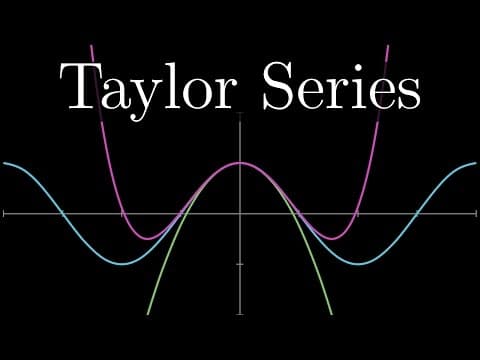
A visual explanation of how each new term of a Taylor polynomial matches one more derivative at a point. Watch for the cosine approximation and the discussion of the radius of convergence of ln x near the end.
Exam-style questions on Maclaurin series
Maclaurin series questions usually lead from finding a series, either by differentiation or from the standard series, to using it for an approximation, a limit or an integral. The first question below is for a paper without a GDC; the second allows one.
Self-check
To do:
I can explain why the coefficient of xn in a Maclaurin series is n!f(n)(0)
Questions on 5.19
28 exam-style questions on this subtopic, written in the style of the IB papers. The first has its markscheme open. Counted on
Question 1 · AA-0000710 marks
This question explores how a Maclaurin series can be used to find a limit.
(a)
Show that the Maclaurin series for cosx up to and including the term in x4 is 1−2x2+24x4.
[3]3 marks
Markscheme (a)
Finding derivatives of cosx at x=0: 1,0,−1,0,1M1
Substituting into ∑n!f(n)(0)xn
(b)
Hence find x→0limx21−cosx.
(c)
Verify your answer to part (b) using L’Hôpital’s rule.
[3]3 marks
Markscheme (c)
lim2xsinxM1
=lim2cosx
Question 2 · AA-0079228 marks
This question asks you to use the arguments of products of complex numbers to find formulae for π in terms of inverse tangents.
Throughout this question, arctanx takes values in ]−2π,2π[
Question 3 · AA-0100019 marks
Let f(x)=exsinx, for x∈R. The n
Try a quick-fire question
One of 39 short multiple-choice questions on 5.19. Pick an answer to see why it's right or wrong.
For which values of x is the Maclaurin series of ln(1+x) valid?
From the formula booklet
The entries of the mathematics: analysis and approaches formula booklet that 5.19 uses. Each opens in the explained booklet.
, approximate integrals that cannot be found exactly, and an alternative to L'Hôpital's rule for limits.
at
0
. For
ex
, with
f(0)=1
and
f′(0)=1
, it gives
ex≈1+x
, which is accurate only very close to
0
because the line cannot bend.
also has the same
second derivative
as
ex
at
0
, and stays close to
ex
over a wider interval.
y = eˣ
y = 1 + x
y = 1 + x + x²/2
Both approximations agree with eˣ at x = 0. The quadratic matches its curvature as well as its gradient, so it stays close to eˣ over a wider interval than the tangent line.
a total of
k
times gives the constant
k!
, while every other term either becomes
0
or still contains a power of
x
. Matching
p(k)(0)=f(k)(0)
requires
The polynomial formed by its terms up to xn is a Maclaurin polynomial of degree n.
is in the formula booklet, together with the series for
ex
,
ln(1+x)
,
sinx
,
cosx
and
arctanx
. The series for
(1+x)p
appears there as the extended binomial theorem. Knowing how each one is derived still matters, because questions often ask you to show the first few terms from the derivatives.
A calculator gives e=1.64872 (5 d.p.). The error is about 0.00028, roughly the size of the next term, 1200.55=0.00026
again. At
x=0
they take the values
0,1,0,−1,0,1,…
Only the odd powers survive, with alternating signs:
y = sin x
degree 1
degree 3
degree 5
degree 7
Each extra term of the series keeps the polynomial close to sin x over a wider interval. Far from 0 every polynomial eventually moves away from the curve, but with enough terms any fixed value of x is reached.
only in radians (3.4, 5.6).
A calculator gives cos0.2=0.9800666 (7 d.p.). The approximation is correct to 6 decimal places: three terms are enough because 0.2 is close to 0 and the factorials make later terms tiny (the next term is 7200.26≈9×10⁻⁸).
is
k!(−1)k−1(k−1)!=k(−1)k−1
, so
it gives
ln2=1−21+31−41+⋯
, which converges, but very slowly. For
x>1
the terms
kxk
grow without limit, so the series has no sum.
, not
3!x3
. It is also a series for
ln(1+x)
, not
lnx
; to use it for
ln1.2
, substitute
x=0.2
, not
x=1.2
.
,
p(p−1)(1+x)p−2
, and so on, so
f(k)(0)=p(p−1)⋯(p−k+1)
. The Maclaurin series is
. The case
p=−1
gives the geometric series
1+x1=1−x+x2−x3+⋯
of 1.8, a useful starting point for many other series.
As x→0, every term after the first tends to 0, so the limit is 61.
(b) Use ex2=1+x2+2x4+⋯
ex2−cosx=23x2+(21−241)x4+⋯
Divide by x2.
x2ex2−cosx=23+2411x2+⋯→23 as x→0
. It also explains the small-angle approximations
sinx≈x
and
cosx≈1−2x2
for small
x
in radians, which are the first terms of the series.
and give a wrong answer of
0
.
, which swing further and further from
ln3≈1.099
. Adding more terms makes the approximation worse, not better.
y = ln(1 + x)
degree 3
degree 8
Between x = −1 and x = 1 the degree 8 polynomial is closer to ln(1 + x) than the degree 3 one. Beyond x = 1 the higher-degree polynomial moves away faster: more terms make the approximation worse.
; substituting
x2
gives
∣x2∣<1
, that is
∣x∣<1
.
A product or sum of two series is valid where both are valid. The series for exln(1+x) is valid for −1<x≤1, because the series for ex is valid for every x.
Differentiating or integrating a series does not change the interval, except possibly at its end points (the series for 1+x21 needs ∣x∣<1, but the series for arctanx also converges at x=±1).
inside that interval when approximating. The series for
ex
,
sinx
and
cosx
, and those made from them by substitution and multiplication, are valid for all real
x
.
.
(a) Show that f′′(x)=−1+sinx1.
(b) Hence find the Maclaurin series for f(x) up to and including the term in x3.
(c) Verify your answer to part (b) by substituting the series for sinx into the series for ln(1+u).
(d) Hence find limx→0x2ln(1+sinx)−x.
Show the solution
(a) By the chain rule, f′(x)=1+sinxcosx. By the quotient rule,
(e) x=2 lies outside the interval of convergence −1<x≤1. The series for ln(1+x) does not converge there, so adding more terms of the series would not approach f(2)
.
To do:
I can derive the Maclaurin series of ex, sinx, cosx, ln(1+x) and (1+x)p, and state where each is valid.
To do:
I can find the first few terms of a Maclaurin series by repeated differentiation.
To do:
I can find new series by substitution, multiplication, composition, differentiation and integration, including the series for arctanx.
To do:
I can find the Maclaurin series of the solution of a differential equation from its initial condition.
To do:
I can use a series to approximate a value or a definite integral, and judge how accurate the approximation is.
To do:
I can evaluate limits of the form 00 using Maclaurin series.
To do:
I can explain why a series cannot be used outside its interval of convergence.
A1
1−2x2+24x4AG
[4]
4 marks
Markscheme (b)
x21−cosx=x22x2−24x4+⋯M1
=21−24x2+⋯
So the limit is 21M1A1
M1
=21A1
, and the argument of a non-zero complex number takes values in
]−π,π]
.
(a)
For a>0, explain why arg(a+i)=arctan(a1).
[1]1 mark
(b)(i)
Find (2+i)(3+i).
[1]1 mark
(b)(ii)
Hence show that arctan(21)+arctan(31)=4π
(c)(i)
Let a,b∈R, where a>1 and b>1.
Show that (a+i)(b+i)=(ab−1)+(a+b)i
(c)(ii)
Show that arctan(a1)+arctan(b1)=4π
(c)(iii)
Hence find all the pairs of integers a and b, with 1<a≤b, such that arctan(a1)+arctan(b1)=4π
(d)(i)
Find (3+i)(7+i).
[1]1 mark
(d)(ii)
Hence show that arctan(31)+arctan(71)=arctan(21)
(d)(iii)
Hence show that 4π=2arctan(31)+arctan(71)
(e)(i)
Show that (5+i)4=476+480i.
[2]2 marks
(e)(ii)
Hence show that (5+i)4(239−i)=114244(1+i).
[2]2 marks
(e)(iii)
Hence show that 4π=4arctan(51)−arctan(2391)
(f)
For small values of x, arctanx≈x−3x3.
Use this approximation and the result from part (e)(iii) to find an approximate value for
(g)
Using the same approximation with 4π=arctan1 gives π≈2.67. Suggest why the result from part (e)(iii) gives a much better approximation.
 YouTube