5.15 Derivatives of further functions · IB Maths AA | Augment Education
5.15 Derivatives of further functions
Differentiate tan, sec, cosec, cot, aˣ, logₐx, arcsin, arccos and arctan, and use these results backwards to integrate, including composites with linear functions and integrands rearranged by partial fractions.
IB Mathematics: Analysis and Approaches
Part of 5 Calculus
HL only
Key terms introduced here
Each is in the Maths AA glossary, with every other term in the subject.
Taking the natural logarithm of both sides of y=f(x) and then differentiating implicitly. It is used for functions such as xx, where the variable is in both the base and the exponent, and to simplify long products and quotients.
The derivatives of sinx, cosx, ex and lnx, together with the chain, product and quotient rules, are enough to differentiate a large family of functions. The remaining standard functions, the other trigonometric functions, exponentials and logarithms with any base, and the inverse trigonometric functions, complete the list of standard derivatives.
Their real importance shows when the results are read backwards. The derivative of arctanx is 1+x21, a simple rational function with no trigonometry in it, so integrating 1+x21
Derivatives of the trigonometric functions
The derivative of tan x
Writing tanx=cosxsinx and using the quotient rule gives
These results hold only with x in radians, as do those for sinx and cosx. On many calculators and in some books cosecx is written cscx.
Using the results with the chain, product and quotient rules
Second derivatives and stationary points
The new derivatives combine with everything in 5.7 and 5.8. A second derivative often simplifies with a Pythagorean identity, and stationary points are found as before by solving f′(x)=0.
Exponential functions with any base
The derivative of a to the power x
The function ex is its own derivative. Any other exponential function ax, with a>0, can be rewritten with base e using a=elna
ax=(elna)x=exlna
Here lna is a constant, so the chain rule gives
dxd(ax)=exlna×lna=axlna
The derivative of ax is proportional to ax itself, with constant of proportionality lna. This is the defining property of exponential change: the rate of growth is proportional to the current size. When a=e
A population model shows the meaning of the derivative. A town of 1500 people growing by 4% a year has population P=1500×1.04t after t years, so
dtdP=1500×1.04t×ln1.04
After 10 years the population is 1500×1.0410≈2220 and it is growing at about 2220×0.0392≈87 people per year. The growth rate is ln1.04≈3.92%
Logarithms with any base
The derivative of log base a of x
The change of base formula from 1.7 writes any logarithm in terms of natural logarithms:
logax=lnalnx
Since lna1 is a constant,
dxd(logax)=lna1×x1=xlna1
For example, dxd(logx)=xln101
Logarithmic differentiation
A function such as xx has the variable in both the base and the exponent, so neither the power rule nor the rule for ax applies. Logarithmic differentiation takes the natural logarithm of both sides, which turns the exponent into a factor, and then uses implicit differentiation from 5.14.
The derivative of xx is zero when 1+lnx=0, that is at x=e−1
Derivatives of the inverse trigonometric functions
The derivative of arcsin x
The inverse trigonometric functions are defined in 3.9 on restricted domains: y=arcsinx means siny=x with −2π≤y≤2π
cosydxdy=1⇒dxdy=cosy1
To write this in terms of x, use cos2y=1−sin2y=1−x2
dxd(arcsinx)=1−x21,−1<x<1
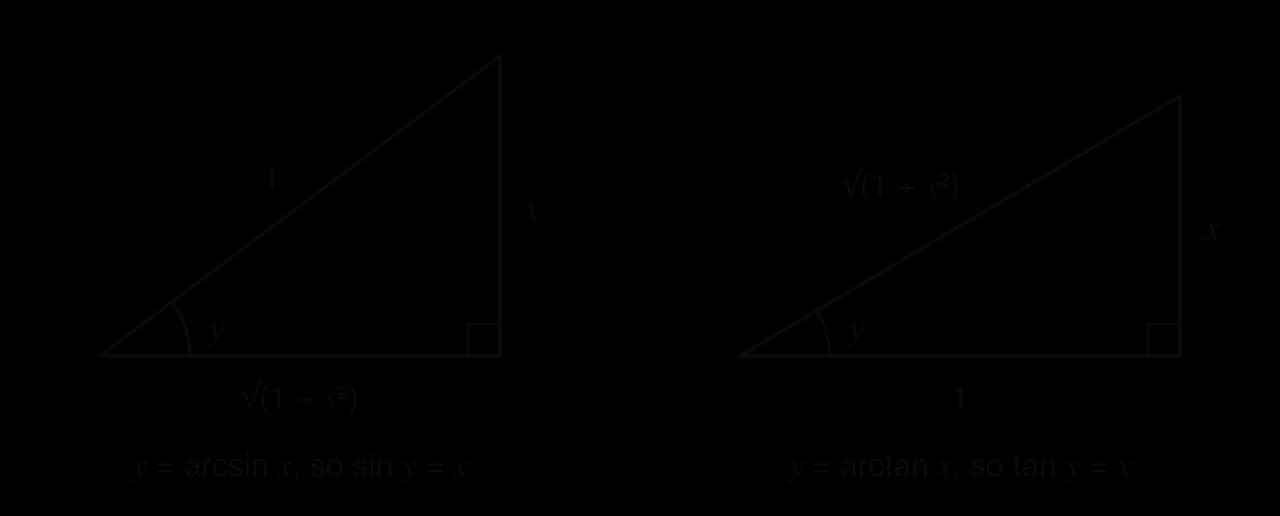
A right-angled triangle gives the same result: if siny=x, label the hypotenuse 1 and the opposite side x; then the adjacent side is 1−x2
Labelling a triangle from sin y = x or tan y = x gives cos y = √(1 − x²) and sec² y = 1 + x², the expressions that turn each derivative into a function of x.
The derivative is undefined at x=±1, where the denominator is 0. The graph of y=arcsinx has vertical tangents at its end points (±1,±2π)
The derivatives of arccos x and arctan x
For y=arccosx, cosy=x with 0≤y≤π. Differentiating implicitly, −sinydxdy=1
dxd(arccosx)=−1−x21,−1<x<1
The two derivatives differ only in sign. This is expected, since arcsinx+arccosx=2π for every x in [−1,1]
For y=arctanx, tany=x with −2π<y<2π
dxd(arctanx)=1+x21,x∈R
f(x)
f′(x)
Valid for
arcsinx
1−x21
Differentiating composites of inverse trigonometric functions
The result in (b) is a pattern worth recognising: dxdarctan(ax)=a2+x2a
A rotating camera gives a practical use of the derivative of arctan. A camera 20 m from a straight road turns to follow a car travelling at 25 m s−1. If x is the car's distance along the road from the point nearest the camera, the camera's angle is θ=arctan20x
dtdθ=dxdθ×dtdx=400+x220×25=400+x2500 rad s−1
The camera turns fastest, at 1.25 rad s−1, as the car passes (x=0), and only 0.625 rad s−1 when the car is 20
Integrals from the new derivatives
Standard integrals
Every one of these derivatives gives a standard integral when read backwards.
Each result in the table can be checked by differentiating the right-hand side.
Derivative
Integral
dxd(tanx)=sec2x
∫sec2xdx=tanx+C
The formula booklet gives the last two in a more general form, with a constant a>0:
These can be verified by differentiation. For the first, the chain rule gives a1×1+a2x21×a1=a2+x21
There is no separate integral for −1−x21
Composites with a linear function
If ∫f(x)dx=F(x)+C, then for constants a=0 and b
∫f(ax+b)dx=a1F(ax+b)+C
because differentiating a1F(ax+b) with the chain rule gives back f(ax+b). This is integration by inspection (5.10) applied to the new standard integrals.
When the coefficient of x2 is not 1, take it out as a factor first so that the integrand matches the booklet form exactly.
Definite integrals
Definite integrals of these functions often give exact answers in terms of π, because the inverse trigonometric functions take values such as 4π and 6π
Part (a) means that the area under y=1+x21 from x=0 to x=1
Rearranging the integrand
Many integrands do not match a standard form until they are rearranged. Three rearrangements are common: completing the square, splitting the numerator, and partial fractions. Trigonometric identities give a fourth.
Completing the square
A quadratic denominator with no real roots can be written as (x+p)2+q with q>0 by completing the square. The integrand is then a composite of a2+u21
Splitting the numerator
When the numerator contains x, split the fraction so that one part has the derivative of the denominator on top (giving a logarithm) and the other part has a constant on top (giving an arctan).
Using trigonometric identities
The Pythagorean identities from 3.9, 1+tan2x=sec2x and 1+cot2x=cosec2x
∫tan2xdx=∫(sec2x−1)dx=tanx−x+C
∫cot2xdx=∫(cosec2x−1)dx=−cotx−x+C
Partial fractions
A rational function whose denominator factorises into two distinct linear factors can be split into partial fractions, as in 1.11. Each fraction integrates to a natural logarithm.
The two denominators x2−1 and x2+1 look alike but lead to completely different integrals. The first factorises into real linear factors and gives logarithms; the second does not factorise and gives an arctan.
Integrand
Method
Result
a2+x21, or a quadratic with no real roots
Standard integral (after completing the square)
arctan
Exam-style questions on further derivatives and integrals
Self-check
To do:
I can derive the derivatives of tanx, secx, cosecx and cotx from those of sinx and cosx
Questions on 5.15
51 exam-style questions on this subtopic, written in the style of the IB papers. The first has its markscheme open. Counted on
Question 1 · AA-0019618 marks
Let g(x)=1+cos2xsinx, where 0≤x≤π.
(a)
Show that g(π−x)=g(x).
[2]2 marks
Markscheme (a)
sin(π−x)=sinx
Question 2 · AA-0037516 marks
A painting hangs on a vertical wall. The bottom edge of the painting is 1.2 m above the eye level of a visitor and the top edge is 3.0 m above the eye level of the visitor. The visitor stands on level ground at a horizontal distance of x metres from the wall, where x>0.
The angle subtended at the visitor's eye by the painting is θ radians.
(a)
Show that θ=arctan(x3)−arctan(x1.2)
Question 3 · AA-0038230 marks
This question asks you to investigate what happens when a trigonometric function is followed by its inverse function.
Consider the functions f(x)=arcsin(sinx) and g(x)=arccos(cosx), for x∈R
Try a quick-fire question
One of 40 short multiple-choice questions on 5.15. Pick an answer to see why it's right or wrong.
What is the derivative of arctan(x2)?
From the formula booklet
The entries of the mathematics: analysis and approaches formula booklet that 5.15 uses. Each opens in the explained booklet.
produces an inverse trigonometric function. Results like this are why inverse trigonometric functions appear in areas, probability and the solutions of differential equations, even when the problem has nothing to do with angles.
,
logax
,
arcsinx
,
arccosx
and
arctanx
, and the integrals that reverse them, including composites with a linear function and integrands rearranged by partial fractions. The functions themselves are defined in 3.9 and 1.5, partial fractions in 1.11, and integration by substitution and by parts in 5.16.
for every
x
in the domain, the gradient of
y=tanx
is always at least
1
: the function is increasing on each branch, and it is steepest far from the origin, near its
vertical asymptotes
.
y = tan x
y = sec² x (the gradient)
The gradient of tan x is sec² x, which is never less than 1. At the origin tan x has gradient exactly 1, and the gradient grows without bound near the asymptotes.
cosx
−sinx
tanx
sec2x
secx
secxtanx
cosecx
−cosecxcotx
cotx
−cosec2x
and
cosec
go with
cosec2
and
coseccot
.
(c)
y=x2secx
(d)
y=ln(secx)
(e)
y=cosec4x
Show the solution
(a) Chain rule with inner function 3x2:
dxdy=sec2(3x2)×6x=6xsec2(3x2)
(b) Here y=(tan2x)3, a power of a function of a function. Apply the chain rule twice:
dxdy=3tan2(2x)×sec2(2x)×2=6tan2(2x)sec2(2x)
(c) Product rule:
dxdy=x2×secxtanx+2x×secx=xsecx(xtanx+2)
(d) Chain rule with inner function secx:
dxdy=secx1×secxtanx=tanx
This result is useful backwards: ∫tanxdx=ln∣secx∣+C.
(e) Chain rule with inner function 4x:
dxdy=−cosec4xcot4x×4=−4cosec4xcot4x
, so the correct derivative is
3sec23x
. In (b), also note that
tan3(2x)
means
(tan2x)3
, which needs the chain rule twice: once for the cube and once for the
2x
.
. (b) The function
f(x)=x−2arctanx
is defined for all real
x
. Find the coordinates of the stationary points of the graph of
f
and determine their nature.
Show the solution
(a) dxdy=secxtanx. By the product rule,
dx2d2y=secxtanx×tanx+secx×sec2x=secxtan2x+sec3x
Using tan2x=sec2x−1:
dx2d2y=secx(sec2x−1)+sec3x=2sec3x−secx
(b) f′(x)=1−1+x22
f(1)=1−2×4π=1−2π
The second derivative is f′′(x)=(1+x2)24x
:
,
lne=1
and the result reduces to
dxd(ex)=ex
.
y = 2ˣ
y = 3ˣ
tangent, gradient ln 2 ≈ 0.693
tangent, gradient ln 3 ≈ 1.099
Both curves pass through (0, 1). There the gradient of aˣ is ln a: less than 1 for a = 2 and more than 1 for a = 3. The base with gradient exactly 1 at (0, 1) is e ≈ 2.718.
Show the solution
(a) dxdy=5xln5.
(b) Chain rule with inner function x2:
dxdy=3x2ln3×2x=2xln3×3x2
(c) Product rule, with dxd(2−x)=2−xln2×(−1)=−2−xln2
dxdy=2−xcosx−2−xln2sinx=2−x(cosx−ln2sinx)
of the current population, slightly less than
4%
, because the
4%
is added once a year rather than continuously.
. The power rule applies only when the variable is in the base and the exponent is constant, as in
x2
. In
2x
the variable is in the exponent, so the result is
2xln2
.
, where
logx
means
log10x
.
Show the solution
(a) Rewrite as y=ln2ln(x2+1), then use the chain rule:
dxdy=ln21×x2+12x=(x2+1)ln22x
(b) Product rule:
dxdy=x×xln31+log3x=ln31+log3x
and
xlna1
. Questions that say "show that" or "prove" the result expect the rewriting step:
ax=exlna
, or the change of base
logax=lnalnx
.
.
(b)
y=xsinx
,
x>0
Show the solution
(a) Take natural logarithms: lny=xlnx. Differentiate both sides with respect to x, using the chain rule on the left and the product rule on the right:
or the other reversed trigonometric results: read them backwards from the derivatives. Check that your integrand matches the booklet form exactly, with coefficient
1
in front of
x2
, before using it.
. [2 marks] (b) Hence find
∫arctanxdx
. [3 marks] (c) Find the exact value of
∫01arctanxdx
. [2 marks]
Show the solution
(a) By the product rule (M1),
dxd(xarctanx)=x×1+x21+1×arctanx=arctanx+1+x2x(A1, given answer)
The first integral is [ln(x2−6x+10)]34=ln2−ln1=ln2
∫34x2−6x+102x−3dx=ln2+43π(A1)
. (a) Find
dxdy
. [2 marks] (b) Find the equation of the tangent to
C
at the point where
x=1
, giving your answer in the form
y=mx+c
with
m
and
c
exact. [3 marks] (c) Find the area of the region bounded by
y=4−x21
, the
x
-axis and the lines
x=0
and
x=1.5
. [2 marks]
Show the solution
(a) Chain rule (M1):
dxdy=1−4x21×21=4−x21(A1)
(b) At x=1: y=arcsin21=6π
y=31x+6π−31(A1)
(c) By part (a), the area is ∫01.54−x21dx=arcsin(0.75)−arcsin0
.
To do:
I can differentiate ax and logax and explain the results by rewriting with base e.
To do:
I can use logarithmic differentiation for functions such as xx and xsinx.
To do:
I can derive the derivatives of arcsinx, arccosx and arctanx by implicit differentiation, justifying the sign of the square root.
To do:
I can differentiate composites, products and quotients involving all these functions.
To do:
I can write down the standard integrals that reverse these derivatives, and integrate composites with a linear function such as ∫4+9x21dx.
To do:
I can complete the square or split the numerator to reach an arctan or arcsin integral.
To do:
I can use partial fractions to integrate a rational function with two distinct linear factors, and tell when a denominator leads to logarithms instead of an arctan.
and
cos(π−x)=−cosx
M1
g(π−x)=1+(−cosx)2sinx=1+cos2xsinxA1
=g(x)AG
(b)
Let I=∫0πxg(x)dx. By using the substitution u=π−x, show that
I=π∫0πg(x)dx−I.
[4]4 marks
Markscheme (b)
du=−dx; when x=0, u=π and when x=π
(c)
By using the substitution v=cosx, show that ∫0πg(x)dx=∫−111+v21dv.
[3]3 marks
Markscheme (c)
dv=−sinxdxA1
limits: x=0⇒v=1, x=π⇒v=−1
(d)
Hence find the exact value of ∫0πg(x)dx.
[2]2 marks
Markscheme (d)
[arctanv]−11=arctan1−arctan(−1)M1
=4π+4π=2π
(e)
Hence find the exact value of ∫0π1+cos2xxsinxdx.
[2]2 marks
Markscheme (e)
2I=π×2πM1
I=4π2
(f)
By using a similar method, or otherwise, find the exact value of ∫0πxsin3xdx.
[5]5 marks
Markscheme (f)
sin3(π−x)=sin3x, so with J=∫0πxsin3xdx, J=π∫0πsin3xdx−JM1
Note: Candidates may instead integrate by parts directly. Award M1 for a correct first application of parts, A1 for a correct expression, M1A1 for integrating the remaining terms correctly and A1 for 32π.
.
[2]2 marks
(b)
Find the maximum value of θ and the value of x at which it occurs.
[3]3 marks
(c)(i)
Find dxdθ.
[2]2 marks
(c)(ii)
Hence show that the maximum value of θ occurs when x=3.6.
[3]3 marks
(d)
The visitor walks directly towards the wall at a constant speed of 0.5 m s−1.
Find the rate of change of θ when the visitor is 4 m from the wall.