5.11 Definite integrals and areas · IB Maths AA | Augment Education
5.11 Definite integrals and areas
Evaluate definite integrals exactly and with a GDC, use their properties, and find areas between a curve and the x-axis and between two curves, using the fundamental theorem of calculus.
IB Mathematics: Analysis and Approaches
Part of 5 Calculus
SL and HL
Key terms introduced here
Each is in the Maths AA glossary, with every other term in the subject.
The result linking differentiation and integration: if F′(x)=f(x), then ∫abf(x)dx=F(b)−F(a). Equivalently, the rate of change of the area under y=f(t) from a to x is f(x).
The value of a definite integral read as an area: regions above the x-axis count as positive and regions below count as negative, so ∫abf(x)dx is the area above minus the area below.
, and with a GDC.
Use the properties of definite integrals: reversing the limits, splitting the interval, and constant multiples and sums.
Find the area between a curve and the x-axis when the curve lies above it, below it, or on both sides of it.
Find the area enclosed between two curves, finding the limits from their points of intersection.
Explain informally why the fundamental theorem of calculus links areas and antiderivatives.
Interpret a definite integral of a rate of change as a total change in context.
A definite integral turns a function into a single number. Geometrically, that number measures the area between a curve and the x-axis, counted positive above the axis and negative below it. Physically, it adds up the effect of a rate over an interval: the distance travelled from a velocity, the energy produced from a power output, the volume of water from a rate of flow.
The definite integral was first met as an area found with technology and approximated by rectangles (5.5). The fundamental theorem of calculus explains why the same number can also be found exactly, from an antiderivative, and this makes exact areas of many regions possible without a calculator.
Evaluating definite integrals
Notation and the method
A definite integral has a lower limit a and an upper limit b, written at the bottom and top of the integral sign. To evaluate it, find any antiderivative F of f, write it in square brackets with the limits, and subtract its value at the lower limit from its value at the upper limit:
∫abf(x)dx=[F(x)]ab=F(b)−F(a)
This works for any antiderivative. If F(x)+C is used instead of F(x), the constant appears in both terms and cancels: (F(b)+C)−(F(a)+C)=F(b)−F(a). The constant of integration is therefore left out of definite integrals, and the answer is a number, not a function.
The reason the difference F(b)−F(a) gives the area under the curve is a result called the fundamental theorem of calculus. The method can be used before the reason is understood.
Every standard integral from 5.10 can be used in the same way. Exact answers often contain π, e or logarithms, and the values sin0=0, cos0=1, e0=1 and ln1=0 come up constantly at the lower limit.
Definite integrals by inspection
When an antiderivative is found by inspection (5.10), the limits are still values of x, so substitute them into the answer written in terms of x.
Definite integrals with a GDC
A graphic display calculator (GDC) evaluates a definite integral numerically, even when no antiderivative can be written down, as for ∫01e−x2dx=0.747 (3 s.f.). Enter the integrand, the variable and the two limits, and write down the integral that was entered as well as its value. A GDC answer is a decimal, so where an exact value is asked for, the integral has to be evaluated by hand.
Properties of definite integrals
Each property follows directly from writing the integral as F(b)−F(a).
Property
Statement
Reason
Equal limits
∫aaf(x)dx=0
F(a)−F(a)=0
Reversing the limits
∫baf(x)dx=−∫abf(x)dx
Splitting the interval
∫abf(x)dx+∫bcf(x)dx=∫acf(x)dx
Constant multiple
∫abkf(x)dx=k∫abf(x)dx
Sum and difference
∫ab(f(x)±g(x))dx=∫abf(x)dx±∫abg(x)dx
Splitting the interval, also called additivity, holds for any order of a, b and c. It is the property used whenever an area has to be split at a point where a curve crosses the x-axis.
Unknown limits and constants
When the value of a definite integral is given and a limit or a coefficient is unknown, evaluating the integral produces an equation for the unknown. The equation is often a quadratic or involves a logarithm, and any solution that does not satisfy a stated condition is rejected.
The fundamental theorem of calculus
The area function
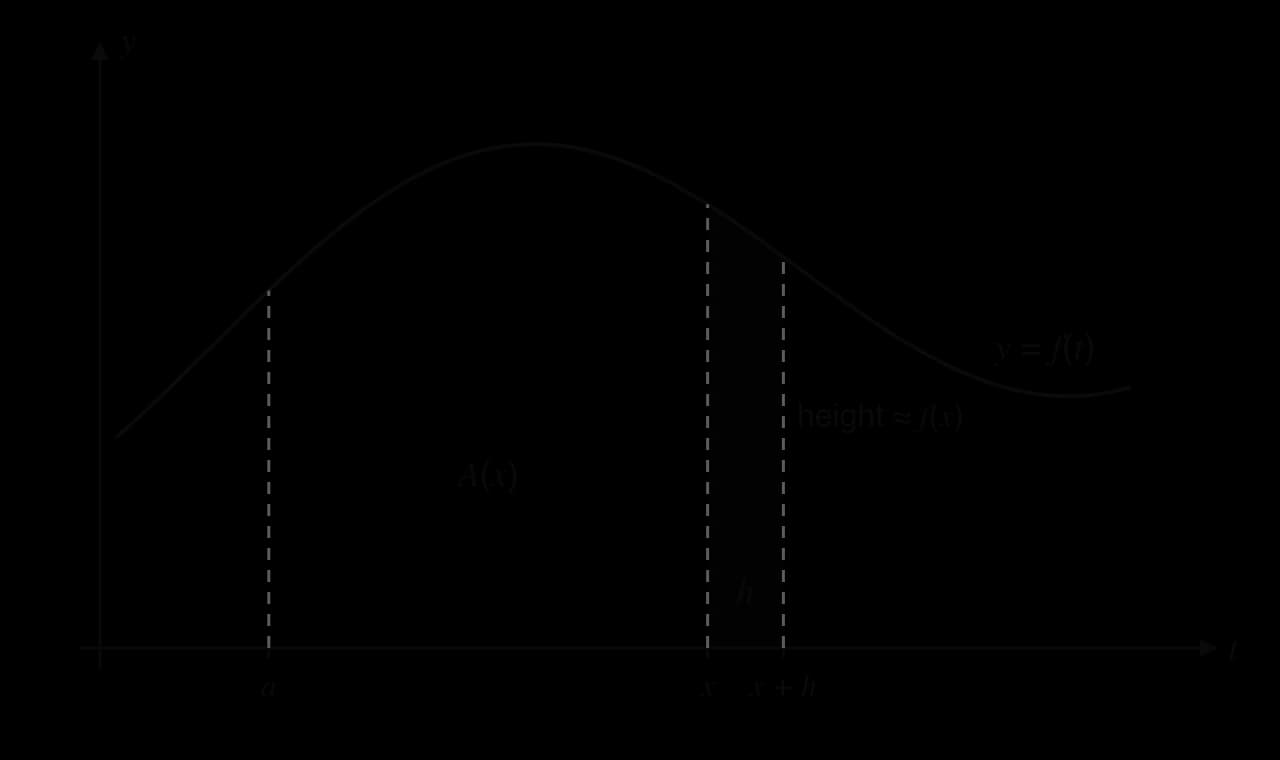
An antiderivative comes from differentiation, so its link with area needs explaining. Choose a fixed starting point a and let A(x) be the area under the curve y=f(t) between t=a and t=x, for a function with f(t)>0. The variable t is used for the horizontal axis so that x is free to be the moving right-hand edge of the region. As x increases, the region grows, so A is a function of x with A(a)=0.
Moving the right-hand edge from x to x + h adds a thin strip of width h and height close to f(x), so the area grows at the rate f(x).
Increasing x by a small amount h adds a thin strip to the region. The strip is almost a rectangle of width h and height f(x), so
A(x+h)−A(x)≈f(x)×h⇒hA(x+h)−A(x)≈f(x)
The left-hand side is the gradient of a chord of the graph of A. As h→0 the strip becomes a better and better rectangle, the approximation becomes exact, and the gradient of the chord becomes the derivative. So A′(x)=f(x): the area function is an antiderivative of f.
Any other antiderivative F differs from A by a constant, A(x)=F(x)+C. Since A(a)=0, the constant is C=−F(a), so A(x)=F(x)−F(a). Putting x=b gives the area from a to b:
area=A(b)=F(b)−F(a)=∫abf(x)dx
The theorem joins the two halves of calculus. Differentiation finds a rate of change from a quantity; integration finds the total of a quantity from its rate of change. As a result, finding tangents and finding areas are inverse problems.
Integrating a rate of change
Applied to a derivative, the theorem says that integrating a rate of change gives the total change:
∫abf′(x)dx=f(b)−f(a)
If v(t) is a velocity, ∫t1t2v(t)dt is the change in position (5.9). If P(t) is the power output of a solar panel in kilowatts, ∫t1t2P(t)dt is the energy produced in kilowatt-hours. The units of a definite integral are the units of the integrand multiplied by the units of x, which matches the "height times width" picture of a thin strip.
Given a starting value and an integral of the rate, the final value follows: f(b)=f(a)+∫abf′(x)dx. For example, if f(0)=5 and ∫03f′(x)dx=7, then f(3)=5+7=12, without ever finding f.
Area between a curve and the x-axis
Curves above the axis
When f(x)≥0 for a≤x≤b, the area of the region bounded by y=f(x), the x-axis and the lines x=a and x=b is the definite integral:
A=∫abydx
This is the formula in the formula booklet. The limits are often the points where the curve meets the x-axis, found by solving f(x)=0.
Curves below the axis and signed area
When the curve lies below the x-axis, every value of f(x) is negative, and so is the definite integral. Each thin strip contributes "height × width" with a negative height. The definite integral therefore measures signed area.
For a region entirely below the axis, the area is the size of the integral: A=−∫abf(x)dx=∫abf(x)dx. For example, ∫04(x2−4x)dx=−332, and the region between y=x2−4x and the x-axis has area 332, the reflection of the previous example.
Curves that cross the axis
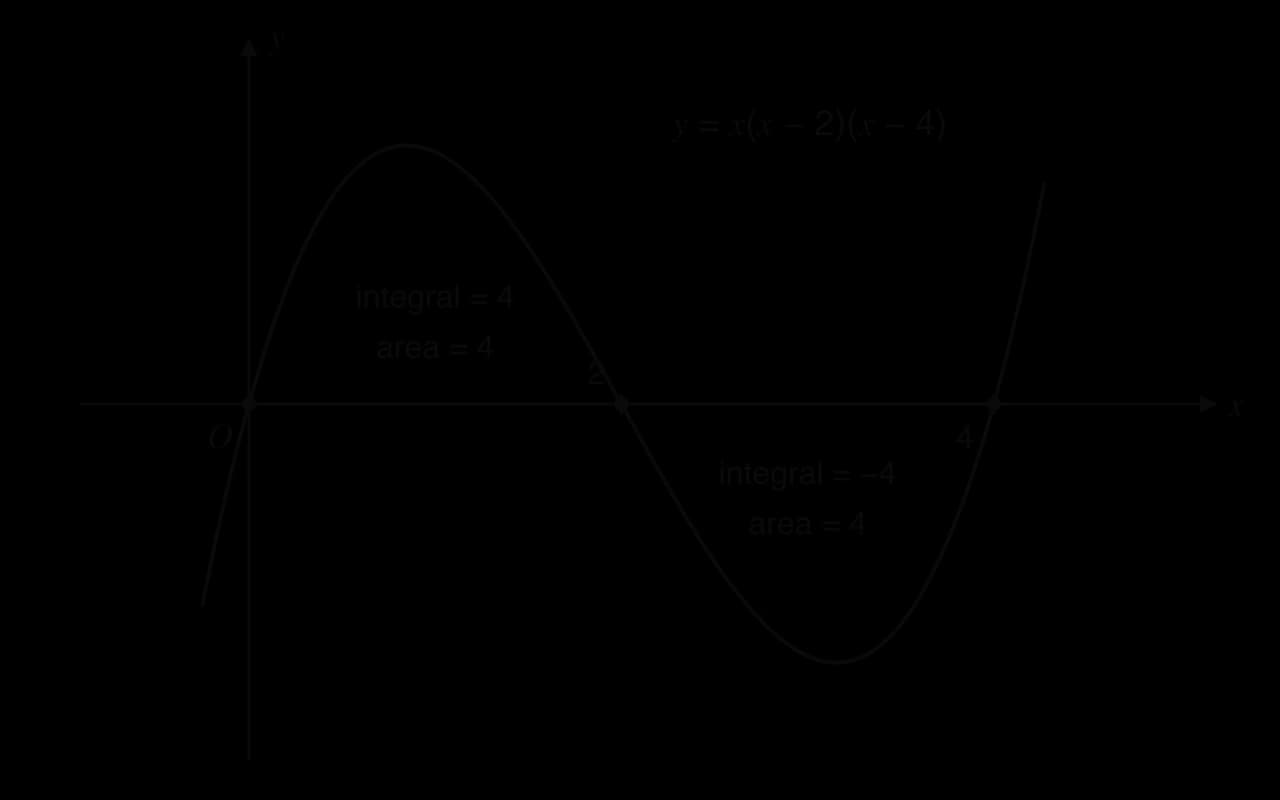
When a curve crosses the x-axis between the limits, the positive and negative parts of the integral cancel. A single integral then gives the signed area, not the total area.
The two regions have equal areas, so the single integral from 0 to 4 is 4 + (−4) = 0, while the total shaded area is 4 + 4 = 8.
For y=x(x−2)(x−4)=x3−6x2+8x, an antiderivative is F(x)=4x4−2x3+4x2, with F(0)=0, F(2)=4 and F(4)=0. So ∫04ydx=0, although the shaded regions plainly have a total area of 8. The correct method splits the interval at each root and adds the sizes of the separate integrals.
Areas with a GDC
On a calculator paper, the quickest way to find the area between a curve and the x-axis is to enter ∫ab∣f(x)∣dx directly. The modulus makes every part of the curve below the axis count positively, so no splitting is needed.
Finding a limit from an area
A known area gives an equation for an unknown limit, in the same way as a known integral does. When the region is above the axis, the area and the integral are equal.
Area between two curves
Top curve minus bottom curve
Suppose f(x)≥g(x) for a≤x≤b. The region between the two curves is the region under y=f(x) with the region under y=g(x) removed. Its area is therefore ∫abf(x)dx−∫abg(x)dx, which combines into a single integral of the difference. Each thin vertical strip of the region has height f(x)−g(x), "top minus bottom".
The formula still works when part of the region lies below the x-axis. Adding the same constant to both functions moves the whole region up without changing its shape, and it does not change f(x)−g(x), so the area only depends on the vertical distance between the curves.
Finding the limits from intersections
When the region is enclosed by the two curves alone, its left and right edges are the points where the curves meet. Solve f(x)=g(x) to find the limits, then decide which curve is on top, for example by testing one value of x between the limits.
Curves that cross between the limits
If the curves cross inside the interval, the curve on top changes, and the integral of f(x)−g(x) over the whole interval would let the parts cancel. As with the x-axis, split the interval at each crossing point and add the separate areas, or integrate ∣f(x)−g(x)∣ on a GDC.
Intersections with a GDC
Many pairs of curves meet at points that cannot be found algebraically, such as ex=x+2. A GDC finds the intersections; store them to full accuracy and use the stored values as limits, because rounded limits give a slightly wrong area.
Regions bounded by more than two curves
A region can be bounded by a curve, a line and an axis together. The boundary at the bottom (or top) then changes partway across, and the area must be split at the x-value where it changes. A sketch is essential to see the pieces.
Area between curves in context: measuring inequality
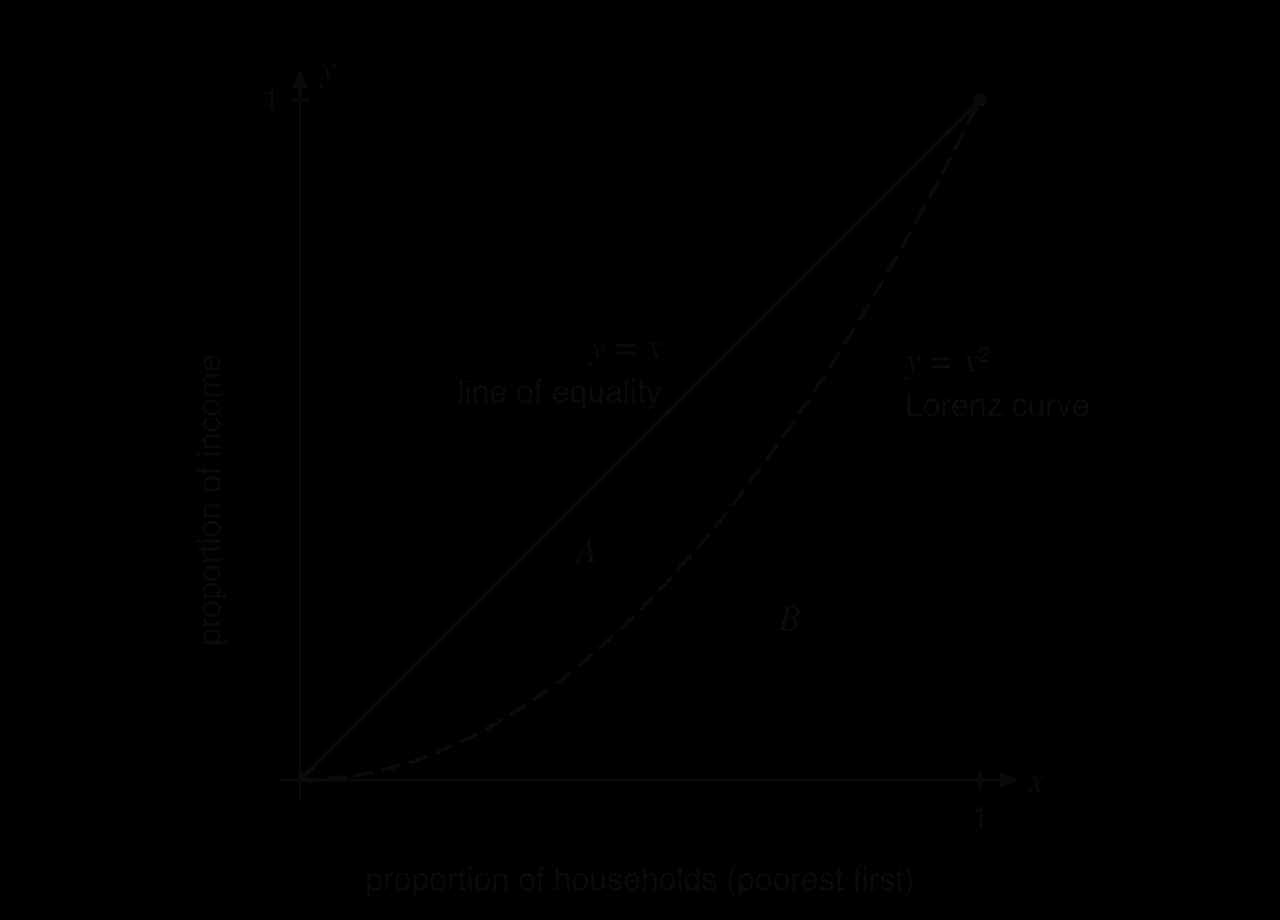
Economists describe how evenly income is shared with a Lorenz curve. Households are ordered from poorest to richest, and the point (x,L(x)) on the curve means that the poorest fraction x of households receive a fraction L(x) of the total income. If income were shared equally, the curve would be the line of equality y=x. The further the curve sags below that line, the more unequal the distribution.
The Gini coefficient is the area A between the line of equality and the Lorenz curve as a fraction of the whole triangle A + B, which has area 1/2.
The Gini coefficient G compares the area A between the two curves with the area of the triangle under the line of equality, A+B=21:
G=21A=2∫01(x−L(x))dx
G=0 means perfect equality and values closer to 1 mean greater inequality.
Exam-style questions on definite integrals and areas
Area questions appear on both papers. On the non-calculator paper, every step of the integration must be shown and answers are exact; on the calculator paper, the integral is set up by hand and evaluated with the GDC.
Self-check
To do:
I can evaluate a definite integral exactly using F(b)−F(a), including trigonometric, exponential and logarithmic integrands.
To do:
I can explain why the constant of integration is left out of a definite integral.
To do:
I can use the properties of definite integrals to reverse limits, split intervals and deal with constants.
To do:
I can find an unknown limit or constant from the value of a definite integral.
To do:
I can explain informally why the area function has derivative f(x), and state the fundamental theorem of calculus.
To do:
I can find the area between a curve and the x-axis, splitting at roots when the curve crosses the axis.
To do:
I can find the area between two curves, using their intersections as limits and "top minus bottom" as the integrand.
To do:
I can set up an area as ∫ab∣f(x)−g(x)∣dx and evaluate it with a GDC, using stored limits.
To do:
I can interpret a definite integral of a rate of change, with its units, in a context.
.
The line L passes through the origin O and makes an angle of 50° with the positive x-axis. The line L meets the graph of f at O and at the point P.
y = f(x)
L
(a)
Write down the equation of L.
[1]1 mark
Markscheme (a)
y=xtan50°(y=1.19175…x)A1
(b)
Find the x-coordinate of P.
[3]3 marks
Markscheme (b)
x(4−x)=xtan50°(M1)
4−x=tan50°
(c)
Find the area of the region enclosed by L and the graph of f.
[3]3 marks
Markscheme (c)
attempt to find the integral of the difference between f and L(M1)
∫02.80824…(4x−x2−xtan50°)dx
(d)
Find the acute angle between the tangent to the graph of f at O and the x-axis.
[3]3 marks
Markscheme (d)
f′(x)=4−2x
(e)
The line y=xtanθ, where θ is acute, divides the region enclosed by the graph of f and the x-axis into two parts of equal area.
The curves cross at x = π/4, so cos x is on top to the left of the crossing and sin x is on top to the right of it.
, so
x2−5x+4=0
and
x=1
or
x=4
. Check in the original equation: at
x=1
,
1=1
but
1−2=−1
, so
x=1
is rejected; at
x=4
, both sides equal
2
. The line meets the
x
-axis at
(2,0)
.
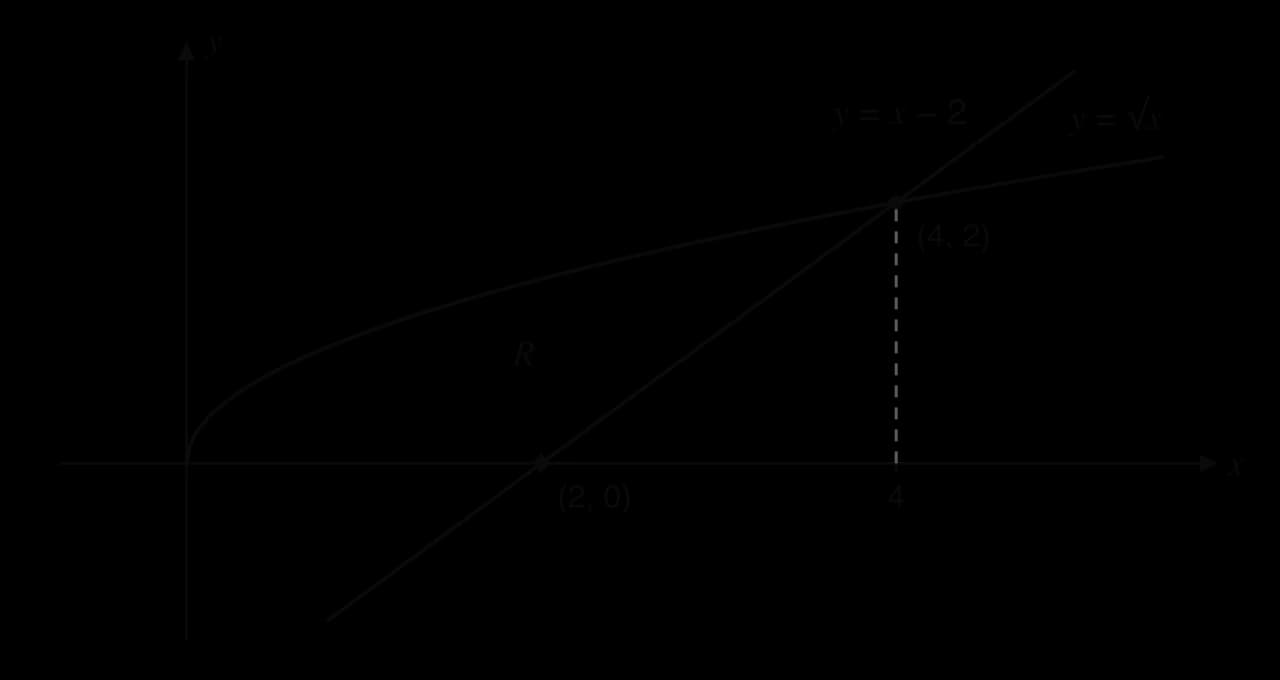
The lower boundary of R changes at x = 2, from the x-axis to the line, so R is the area under the curve minus the triangle under the line.
The area under the curve from 0 to 4 includes R and the triangle under the line from x=2 to x=4. Subtract the triangle:
∫04x21dx=[32x23]04=32×8=316
The triangle has base 2 and height 2, so its area is 2. The area of R is 316−2=310.
For the second country,
G2=2∫01(x−x3)dx=2[2x2−4x4]01=2(21−41)=21
Since G2>G1, the second country has the more unequal distribution. This matches the curves: x3≤x2 on [0,1], so the poorest households in the second country receive a smaller share of income.
. At
x=4
,
y=8
, so
P
is
(4,8)
.
(b) At x=1, the curve gives 5 and the line gives 2, so the curve is on top.
area of R=∫04((6x−x2)−2x)dx=∫04(4x−x2)dx=[2x2−3x3]04=32−364=332
The marks are for the correct integral with limits, a correct antiderivative, substituting the limits, and the answer.
(c) Find the area to the left of x=2:
∫02(4x−x2)dx=[2x2−3x3]02=8−38=316
This is exactly half of 332, so the area to the right of x=2 is also 332−316=316, and the two regions have equal area. A "show that" ends with a sentence that states the conclusion.
(3 s.f.). Store the unrounded values,
p=−1.90090…
and
q=1.40687…
(b) At x=0, f(0)=4>g(0)=1, so f is on top.
∫pq(4−x2−e0.5x)dx=6.75 (3 s.f.)
(c) The graph of f crosses the x-axis at x=2, inside the interval, so use the modulus:
∫03∣4−x2∣dx=7.67 (3 s.f.)
The exact value is 323: the part above the axis has area 316 and the part below has area 37.
(d) ∫03f(x)dx=316−37=3, because the region between x=2 and x=3 lies below the x-axis and its integral is negative, so it is subtracted instead of added.
y = f(x)
y = g(x)
The enclosed region lies between x = −1.90 and x = 1.41 with f on top. For (c), the graph of f is below the x-axis between x = 2 and x = 3.
(A1)
x=2.81(2.80824…)A1
(A1)
3.69(3.69108…)A1
(M1)
f′(0)=4, so tanθ=4(A1)
θ=76.0°(75.9637…°)A1
Note: Accept 1.33 radians.
.
[5]5 marks
Markscheme (e)
area enclosed by the graph of f and the x-axis =∫04(4x−x2)dx=332(A1)
let m=tanθ; the line meets the graph where x=4−m(M1)
∫04−m(4x−x2−mx)dx=316
Note: Award M1 for equating an area expression in m or θ to half of their total area.
m=0.825197…(A1)
θ=39.5°(39.5293…°)A1
Note: The integral evaluates to 6(4−m)3, so (4−m)3=32
, giving your answer in the form
bπ−a
, where
a,b∈Z+
.
[4]4 marks
.
[5]5 marks
(c)
Show that the local maximum value of f is 1+2.
[3]3 marks
(d)
By writing f(x)=2cosx(cosx+sinx), find the x-intercepts of the graph of f.
[3]3 marks
(e)
The region R is enclosed by the graph of f, the x-axis and the y-axis. Find the exact area of R.