5.3 Differentiating polynomials · IB Maths AA | Augment Education
5.3 Differentiating polynomials
Differentiate powers of x, polynomials and terms with negative integer powers using the power rule, then find the gradient of a curve at a point and the points where the gradient takes a given value.
IB Mathematics: Analysis and Approaches
Part of 5 Calculus
SL and HL
Key terms introduced here
Each is in the Maths AA glossary, with every other term in the subject.
The derivative of a sum or difference of functions is the sum or difference of their derivatives: if f(x)=g(x)±h(x), then f′(x)=g′(x)±h′(x).
,
(2x−1)2
and
xx3−4
as sums of powers of
x
before differentiating.
Find the gradient of a curve at a given point.
Find the points on a curve where the gradient takes a given value.
Find unknown coefficients from information about gradients.
Interpret derivatives of polynomial models as rates of change.
Finding a gradient with tables of chords, as in 5.1, works for any function but is slow and only gives an estimate. For the most common functions there is a far quicker way. The gradient functions of x2, x3 and x4 follow a simple pattern, and that pattern extends to every whole-number power of x, including negative powers. Together with two rules for sums and multiples, it allows any polynomial to be differentiated exactly in a single line.
These rules are the starting point for all of differential calculus. Tangents and normals (5.4), increasing and decreasing functions (5.2), maximum and minimum points (5.8) and motion (5.9) all depend on being able to differentiate quickly and accurately.
The derivative of xn
A pattern in the gradient functions
The chord method of 5.1, applied to the first few powers of x, gives these gradient functions.
Function f(x)
x
x2
x3
x4
x5
Gradient function f′(x)
1
2x
3x2
In each case the old power becomes a multiplier and the new power is one less than the old one. For example, the gradient of y=x3 at x=2 is 3×22=12, and a table of chords gives values approaching 12: the chord from x=2 to x=2.001 has gradient 0.0012.0013−8=12.006001.
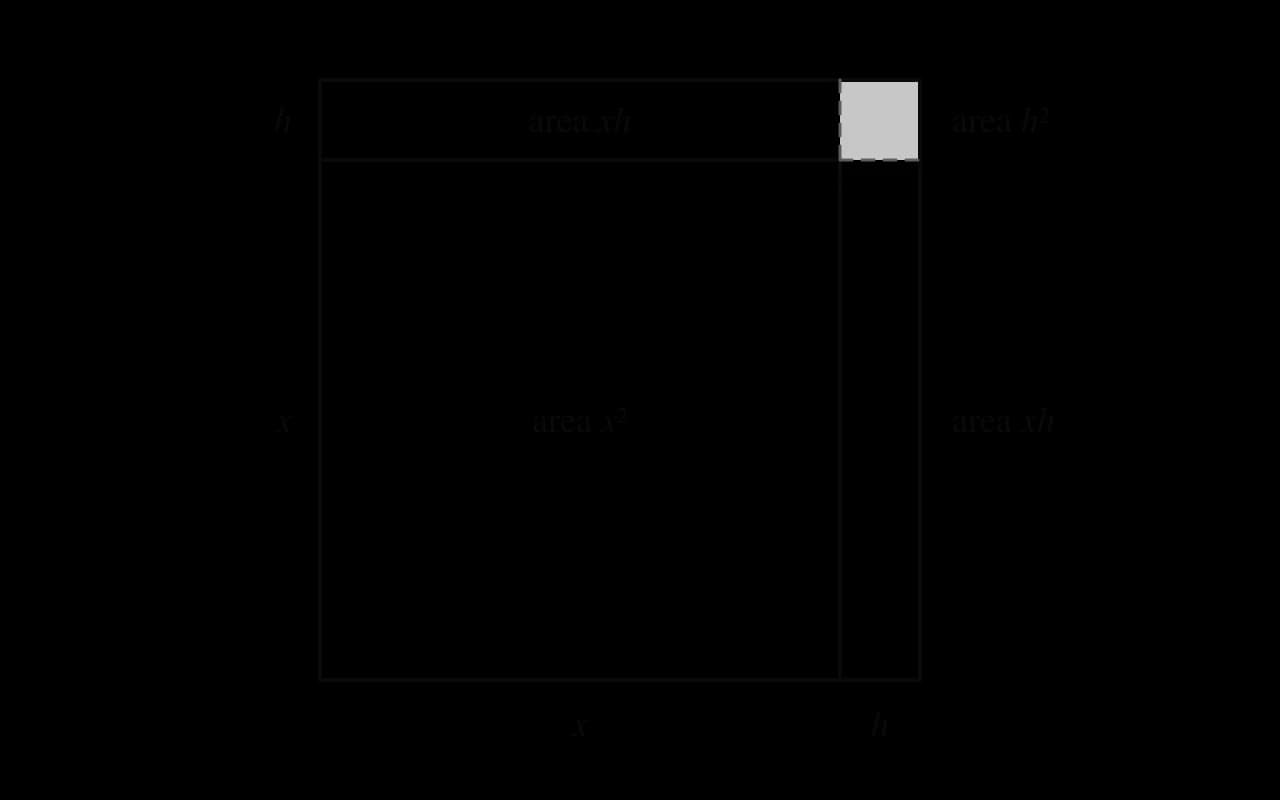
The pattern for x2 can be explained with a picture. Think of x2 as the area of a square of side x. If the side grows by a small amount h, the area grows by two strips of area xh and a tiny corner of area h2.
When the side of the square grows by h, the area grows by 2xh + h². For small h the corner h² is tiny compared with the two strips, so the area grows at a rate of about 2x per unit of side.
The rate of change of the area is the change in area divided by the change in side:
h(x+h)2−x2=h2xh+h2=2x+h
As h→0, this tends to 2x, so the derivative of x2 is 2x. The same idea with a cube of side x gives three thin slabs of volume x2h (plus much smaller pieces), so the derivative of x3 is 3x2.
YouTube
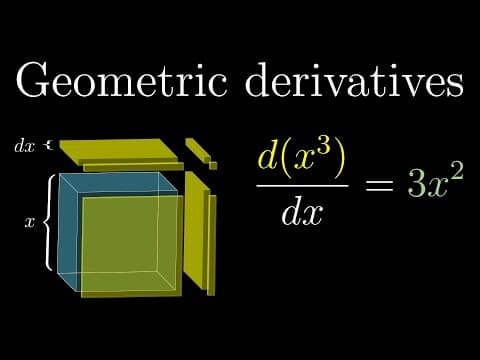
Watch the growing square and the growing cube, and how the tiny corner pieces become negligible, giving the derivatives of x² and x³ without any algebra.
The power rule
The pattern holds for every power of x where the power is an integer. Combined with a constant multiplier a, this gives the power rule.
Finding a derivative is called differentiation. To differentiate y=f(x) "with respect to x" means to find dxdy, or f′(x).
The rule f(x)=xn⇒f′(x)=nxn−1 is in the formula booklet, where it holds for any real power n; 5.6 extends it to fractional powers.
Linear functions and constants
Two special cases of the power rule match what is already known about straight lines.
A linear term.ax=ax1, so its derivative is a×1×x0=a. The line y=ax has gradient a everywhere.
A constant. The graph of y=c is a horizontal line, which has gradient 0. This agrees with the power rule, since c=cx0 gives c×0×x−1=0
Why a constant multiplier stays
Multiplying a function by a constant a stretches its graph vertically by a factor of a (2.11). Every rise is multiplied by a while every run stays the same, so every gradient is multiplied by a. This is the constant multiple rule: the derivative of af(x) is af′(x).
y = x²
y = 3x²
tangent to y = x² at x = 1, gradient 2
tangent to y = 3x² at x = 1, gradient 6
Stretching y = x² vertically by a factor of 3 triples every gradient: at x = 1 the gradient changes from 2 to 6.
Differentiating polynomials
The sum rule
A polynomial is a sum of terms of the form axn. The gradient of a sum of two functions is the sum of their gradients, because the rise of the sum over any run is the sum of the two rises. This is the sum rule, and it means a polynomial is differentiated one term at a time.
The sum rule and the constant multiple rule together say that differentiation is "linear": it can be done term by term, and constants can be taken outside. Products and quotients do not behave like this.
Expanding brackets first
The power rule applies only to single terms axn. A product of brackets must first be expanded into a sum of such terms.
Dividing first
A fraction whose denominator is a single power of x can be split into separate terms, each of which is a power of x.
Negative integer powers
Rewriting fractions as powers
The power rule also holds for negative integer powers, using the exponent law xn1=x−n (1.5). To differentiate a term with x in the denominator, first rewrite it as a power of x, then apply the rule. For example,
y=x1=x−1⟹dxdy=−1×x−2=−x21
The result agrees with the graph of the reciprocal function: both branches slope downwards everywhere, and −x21 is negative for every x=0. Near the vertical asymptote the branches are very steep, and −x21 is large and negative; far from the origin they flatten out, and −x21 tends to 0.
y = 1/x
tangent at (2, 0.5), gradient −1/4
The gradient of y = 1/x is −1/x², which is negative everywhere. At x = 2 the gradient is −1/4: the curve is falling, but gently.
Original form
Power form
Derivative
Fraction form
x1
x−1
−x−2
−x21
x23
3x−2
−6x−3
4x31
41x−3
−x52
−2x−5
10x−6
The gradient at a point
Substituting into the derivative
The derivative f′(x) is the gradient function, so the gradient of the curve at a particular point is found by substituting the x-coordinate of the point into f′(x). Only the x-coordinate is used.
Points where the gradient has a given value
Solving f′(x)=m
To find where a curve has a particular gradient m, set the derivative equal to m and solve for x. Then substitute each x-value into the original function to find the y-coordinates of the points. There may be no solutions, one, or several.
y = x³ − 6x + 2
tangent at (2, −2)
tangent at (−2, 6)
The curve has gradient 6 at two points, and the tangents there are parallel. Between them the gradient is less than 6.
The two tangents in the graph are parallel, because they have the same gradient. "Find the points where the tangent is parallel to the line y=6x+1" is the same question as "find where the gradient is 6". Finding the equations of these tangents is the subject of 5.4.
Negative powers and given gradients
Finding unknown coefficients
When a curve contains unknown constants, information about its gradient gives equations for them. A point on the curve gives an equation from y=f(x), and a gradient gives an equation from f′(x).
Rates of change with polynomial models
Exact rates of change
In a context, the derivative of a model gives the exact instantaneous rate of change, replacing the numerical estimates of 5.1. Two geometric examples show a pattern: the rate of change of the area of a circle with respect to its radius is its circumference, and the rate of change of the volume of a sphere with respect to its radius is its surface area.
A=πr2⟹drdA=2πrV=34πr3⟹drdV=4πr2
Other variables and letters that stand for constants
The variable that a function is differentiated with respect to is the one in the denominator of the notation: dtds is found by treating s as a function of t. Any other letters in the formula, such as a, k, g or π, are constants, and they are treated exactly like numbers.
Marginal cost
In economics, the derivative of a cost function C(x) with respect to the number of items x is called the marginal cost. It approximates the cost of producing one more item.
The variables in a model are often not x and y, so the derivative is written with the letters of the context: drdA, dxdC, dtdh. The rules are exactly the same; only the names change.
Exam-style questions on differentiating polynomials
The second question uses a GDC to solve an equation in a context.
Self-check
To do:
I can state and use the power rule: if f(x)=axn, then f′(x)=anxn−1 for n∈Z.
To do:
I can explain why the derivative of a constant is 0 and the derivative of ax is a.
To do:
I can differentiate a polynomial term by term, expanding brackets or dividing first when needed.
To do:
I can rewrite terms such as x23 and 4x31
To do:
I can find the gradient of a curve at a given point by substituting into the derivative.
To do:
I can find the points on a curve where the gradient takes a given value, including zero.
To do:
I can use information about a point and a gradient to find unknown coefficients.
To do:
I can interpret the derivative of a polynomial model as a rate of change with units.
, for
x∈R
.
(a)
Find f′(x).
[2]2 marks
Markscheme (a)
f′(x)=3x2−12x+9A1A1
Award A1 for each two correct terms.
(b)
Find the coordinates of the two stationary points of the graph of f.
[4]4 marks
Markscheme (b)
Setting f′(x)=0: 3(x−1)(x−3)=0
(c)
Find the equation of the tangent to the graph of f at the point where x=4.
[3]3 marks
Markscheme (c)
f′(4)=48−48+9=9
Markscheme notes
YouTube
Why the derivative is the slope of a tangent: Essence of calculus, chapter 1, by 3Blue1Brown.
Question 2 · AA-0006815 marks
A storage tank is made from a right circular cylinder with a closed flat base and a hemispherical roof. The cylinder has radius r metres and height h metres, and the hemisphere has the same radius r metres. The volume of the tank is 45π m3.
(d) The variable is r, and 34π is a constant multiplier.
drdV=34π×3r2=4πr2
This is the surface area of a sphere of radius r, as estimated numerically in 5.1.
.
−2
differentiates to
0
.
(b) Write 8x4=81x4 and 32x3=32x3:
dxdy=81×4x3−32×3x2+0=21x3−2x2
(c) dxdy=0−1−5x4=−1−5x4.
, so
dxdy=4x+5
.
(b) Expand: f(x)=x4+2x2+1, so f′(x)=4x3+4x.
(c) Expand: (x−2)2=x2−4x+4, so g(x)=x3−4x2+4x and g′(x)=3x2−8x+4.
So dxdy=2x−4.
−x36
−43x−4
−4x43
x610
.
(b) y=52x−3, so dxdy=52×(−3)x−4=−56x−4=−5x46.
(c) y=2x2−3x−1+x−4, so
dxdy=4x+3x−2−4x−5=4x+x23−x54
The middle term: −3×(−1)x−2=3x−2.
(d) Split the fraction: g(x)=x2x2−x23=1−3x−2. Then
g′(x)=0−3×(−2)x−3=6x−3=x36
.
f′(−2)=2−48=0, so the tangent at x=−2 is horizontal: the graph is momentarily flat there. (The point (−2,−8) is a stationary point; see 5.8.)
f′(1)=2−8=−6, so at x=1 the graph is decreasing steeply, falling about 6 units for each unit to the right.
.
.
Solve:
1−x21=43⟹x21=41⟹x2=4⟹x=±2
At x=2, y=2+21=25; at x=−2, y=−2−21=−25.
The points are (2,25) and (−2,−25).
The gradient is dxdy=2ax+b, and at x=1 it equals 8:
2a+b=8
Subtracting the first equation from the second gives a=3, and then b=2.
Check: y=3x2+2x gives y=5 at x=1 and dxdy=6x+2=8 at x=1.
is a constant.
gives
t=9.814=1.428…≈1.43
seconds. At this instant the height is not changing: the ball is at the top of its flight.
(b) k is a constant, so kx3 differentiates to 3kx2, −k2x to −k2, and 5k to 0:
dxdy=3kx2−k2
(c) Write P=3q2−4q−1. Then
dqdP=6q+4q−2=6q+q24
. When
10
items are being produced, the total cost is increasing at a rate of USD 6 per item, so one more item costs about USD 6.
(c) C(10)=10−60+150+200=300 and C(11)=13.31−72.6+165+200=305.71. The 11th item costs 305.71−300=USD 5.71, close to the estimate of USD 6 from the derivative.
(d) Solve 0.03x2−1.2x+15=6:
0.03x2−1.2x+9=0⟹x2−40x+300=0⟹(x−10)(x−30)=0
The marginal cost is also USD 6 when x=30.
(M1):
6(1)2+2a(1)−12=0⟹2a−6=0⟹a=3
which is the given value (A1 for the working that leads to it).
(c) With a=3, f′(x)=6x2+6x−12=6(x2+x−2)=6(x+2)(x−1).
f′(x)=0 gives x=1 (given) or x=−2.
f(−2)=2(−8)+3(4)−12(−2)+1=−16+12+24+1=21. The point is (−2,21).
(d) Solve 6x2+6x−12=−12:
6x2+6x=0⟹6x(x+1)=0⟹x=0 or x=−1
f(0)=1 and f(−1)=−2+3+12+1=14. The points are (0,1) and (−1,14).
metres per month. The value is positive, so two months after the start of the year the depth is increasing, slowly, at
0.06
m per month.
(c) Solve d′(t)=0.5, that is, −0.06t2+0.6t−0.9=0.5. With the GDC (graphing y=d′(t) and y=0.5 and finding the intersections, or with the polynomial solver for −0.06t2+0.6t−1.4=0):
t=3.70900… or t=6.29099…
so t=3.71 or t=6.29 months (3 s.f.). Both are in the domain 0≤t≤12.
as powers of
x
and differentiate them correctly.
M1
x=1 or x=3A1
(1,5) and (3,1)A1A1
A1
f(4)=64−96+36+1=5A1
y−5=9(x−4), so y=9x−31A1
.
[2]2 marks
(b)
The external surface of the tank, including the base, is S m2. Show that S=35πr2+r90π.
[3]3 marks
(c)
Find drdS.
[2]2 marks
(d)
Find the value of r for which S has a minimum value.
[3]3 marks
(e)
Use the second derivative to justify that this value of r gives a minimum value of S.
[2]2 marks
(f)
Find the minimum value of S, and the corresponding height of the cylinder.
 YouTube
 YouTube